
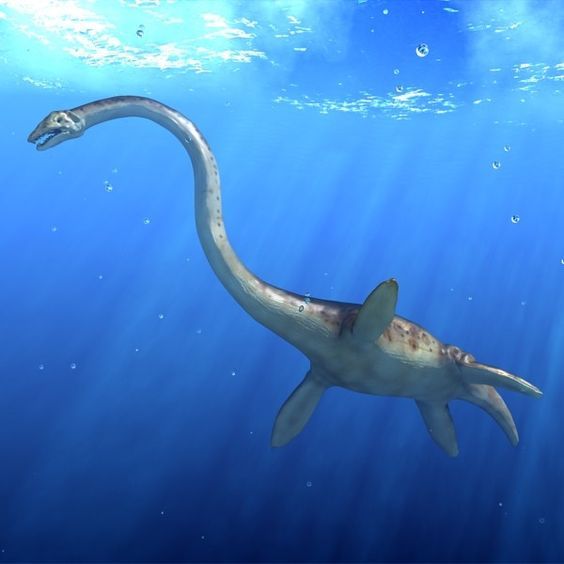
Plesiosaurs were the long-necked, four-flippered marine reptiles that shared the Mesozoic oceans with ichthyosaurs, ammonites, and later with mosasaurs.
For roughly 135 million years - from the Late Triassic to the end of the Cretaceous - plesiosaurs swam through every ocean on Earth, evolving body sizes from 2 metres to well over 10 metres, and splitting into two dramatically different body plans: the small-headed long-necks (the plesiosauroids) and the gigantic short-necked pliosaurs. When the asteroid struck 66 million years ago, every plesiosaur on Earth died.
This guide covers every aspect of plesiosaur biology and history: the two body plans, the unique four-flipper underwater flight stroke, diet and hunting, live birth confirmed by a 2011 fossil embryo, the story of Mary Anning and the 1823 Lyme Regis skeleton, the Loch Ness Monster myth, and why plesiosaurs are not dinosaurs. It is a reference entry, not a summary - so expect specifics: metres, dates, vertebrae counts, and the actual fossil evidence behind each claim.
Etymology and Classification
The name Plesiosaurus means 'near lizard', from the Greek plesios ('near') and sauros ('lizard'). The English geologists William Daniel Conybeare and Henry De la Beche coined the name in 1821, before any complete skeleton had been found, based on fragmentary material from the English Jurassic.
The word was meant to distinguish the new animal from the already-known Ichthyosaurus ('fish lizard'), implying that Plesiosaurus looked closer to a typical lizard than its fish-shaped marine contemporary. The species name P. dolichodeirus means 'long-necked' in Greek and was applied after Mary Anning's complete skeleton confirmed just how long that neck really was.
Plesiosaurs belong to the reptile superorder Sauropterygia, an entirely marine lineage that returned to the sea in the Triassic period. Sauropterygia also contains the earlier placodonts and nothosaurs, which were evolutionary precursors to the fully aquatic plesiosaurs. The order Plesiosauria itself contains two major subgroups:
- Plesiosauroidea - the long-necked, small-headed plesiosaurs, including the type genus Plesiosaurus, the enormously long-necked Elasmosaurus, and Cryptoclidus.
- Pliosauroidea - the short-necked, big-headed pliosaurs, including Liopleurodon, Kronosaurus, and Pliosaurus.
Both groups share the same four-flipper body plan and the same basic skeleton, but they diverged ecologically into different predator niches. Plesiosaurs are not dinosaurs, and they are not closely related to mosasaurs, ichthyosaurs, or crocodiles. Their nearest living relatives are almost meaningless to point to - the entire Sauropterygia superorder went extinct at the K-Pg boundary, leaving no descendants.
Two Body Plans
The single most important thing to understand about Plesiosauria is that it contains two very different body plans, both using the same four-flipper propulsion system.
Long-necked plesiosaurs (Plesiosauroidea)
- Small head, often less than 10 per cent of total body length
- Extremely long neck - 40 to 70+ vertebrae
- Compact barrel-shaped body
- Four large flippers of roughly equal size
- Short tail
The type species Plesiosaurus dolichodeirus is a typical member of this group. It was about 3 to 3.5 metres long, with a small head, a long flexible neck, and paddle-shaped limbs. The elasmosaurids took the long-neck body plan to an extreme - Elasmosaurus platyurus was around 10 to 14 metres long, with more than half of that length in the neck. Elasmosaurs hold the record for the most cervical vertebrae of any vertebrate ever - over 70 in some species.
Long-necked plesiosaurs were probably slow to moderate swimmers that relied on their long necks to reach out and seize small prey without alerting it. The small head could dart forward through shoals of fish or squid while the body stayed stationary.
Short-necked pliosaurs (Pliosauroidea)
- Very large head - sometimes 2 metres or more long
- Short, muscular neck with fewer and stouter vertebrae
- Stout, powerful body
- Four large flippers
- Short tail
Pliosaurs sacrificed the long neck for a huge head and massive bite. Liopleurodon ferox from the Late Jurassic reached 6 to 7 metres. Later pliosaurs such as Kronosaurus queenslandicus from Australia and Pliosaurus funkei ('Predator X') from Svalbard reached 10 to 12 metres, weighed over 10 tonnes, and had skulls more than 2 metres long.
Pliosaur bite forces have been estimated at up to four times that of a modern saltwater crocodile - among the highest bite forces of any animal that has ever lived.
These were the ocean's apex predators through much of the Jurassic, ambushing other marine reptiles, large fish, and even other plesiosaurs.
Size and Physical Description
Plesiosaur size varies dramatically by species, but the basic body plan is consistent: barrel-shaped trunk, four flippers, short tail, neck and head proportioned according to the animal's predator niche.
Size range across Plesiosauria:
| Group | Example | Length | Head size | Habit |
|---|---|---|---|---|
| Plesiosauroidea | Plesiosaurus dolichodeirus | 3-3.5 m | Small (~25 cm) | Coastal, fish and squid |
| Plesiosauroidea | Cryptoclidus eurymerus | 4 m | Small | Offshore, soft-bodied prey |
| Plesiosauroidea | Elasmosaurus platyurus | 10-14 m | Small | Open-ocean fish hunter |
| Pliosauroidea | Liopleurodon ferox | 6-7 m | Large (~1.3 m) | Apex predator |
| Pliosauroidea | Kronosaurus queenslandicus | 9-11 m | Very large (~2.3 m) | Apex predator |
| Pliosauroidea | Pliosaurus funkei | 10-12 m | Huge (~2-2.5 m) | Apex predator, Arctic |
Across all plesiosaurs, several skeletal features recur:
- Four flippers of roughly equal size - the forelimbs and hindlimbs differ in detail but not in function.
- Fused, strengthened pectoral and pelvic girdles - large flat plates of bone that anchored powerful flipper muscles.
- Short tail - plesiosaurs did not use the tail for thrust. Some may have had a small vertical tail fin for steering.
- Ribs fused into a barrel-like body - streamlining the torso around the lungs and gut.
The skin of plesiosaurs is poorly known because few fossils preserve skin impressions. The rare examples that do show small, smooth, non-overlapping scales - less obvious than the keeled scales of mosasaurs. Some specimens suggest dark dorsal pigmentation consistent with countershading camouflage.
The Four-Flipper Flight Stroke
The most distinctive feature of Plesiosauria is the four-flipper underwater flight stroke. No living vertebrate uses this system. Modern sea turtles fly with the front flippers and use the hind flippers only for steering. Penguins and sea lions use front flippers only. No modern fish, mammal, or bird uses all four limbs equally as propulsive wings.
Plesiosaurs did.
Biomechanical models, computer simulations, and comparisons of flipper skeletons suggest the following picture:
- All four flippers were modified limbs, powered by large muscles anchored to the massive pectoral and pelvic girdles.
- The flippers moved in a lift-based flight stroke rather than a paddle-like drag stroke, generating thrust on both the down-beat and the up-beat.
- The front and rear pairs beat out of phase with each other, producing continuous thrust and good stability.
- The system is most efficient at cruising speed and for maneuvering rather than for short bursts - plesiosaurs were unlikely to be chase predators, but were probably excellent long-distance swimmers.
Some researchers have suggested that the rear flippers mainly aided steering rather than contributing equal thrust, but the majority of biomechanical studies through the 2010s and 2020s support the out-of-phase four-flipper flight model.
Hunting and Diet
Plesiosaurs were carnivores, but exactly what and how they ate varied with body plan.
Long-necked plesiosaurs
Long-necked plesiosaurs were ambush and stalk hunters of small, soft-bodied prey. The small head could dart forward at the end of the long neck, seizing single fish or squid without the body approaching closely enough to spook the prey. Stomach contents from multiple specimens confirm this diet.
Documented prey of long-necked plesiosaurs (from fossil gut contents and bite marks):
- Small bony fish
- Squid-like cephalopods
- Belemnites (extinct squid-like animals, identified by their cigar-shaped internal shells)
- Ammonites (soft body tissue, not the shells)
- Occasional benthic invertebrates
Many long-necked plesiosaurs also swallowed gastroliths - stones carried in the stomach. One Cimoliasaurus specimen contained more than 250 such stones. Theories for their use include grinding ammonite shell fragments in the gut, serving as ballast to help keep the neutrally buoyant body at the right depth, or both.
Short-necked pliosaurs
Pliosaurs were the ambush apex predators of their seas. The huge head and powerful jaws, combined with stout conical teeth up to 20 centimetres long, allowed pliosaurs to seize large prey and tear it apart.
Documented and inferred prey of pliosaurs:
- Large bony fish including Leedsichthys
- Sharks
- Other marine reptiles, including long-necked plesiosaurs and ichthyosaurs
- Occasional mosasaurs (in the Cretaceous, where the groups overlapped)
- Ammonites
Bite marks on plesiosaur fossils, on ichthyosaur fossils, and on ammonite shells match pliosaur tooth spacing and curvature. Some long-necked plesiosaur skeletons bear healed bite injuries consistent with surviving pliosaur attacks - evidence of active predation rather than mere scavenging.
Live Birth: The Polycotylus Discovery
For almost two centuries after plesiosaurs were first described, palaeontologists argued about how they reproduced. Some imagined sea-turtle-like egg-laying on beaches. Others inferred live birth based on analogy with modern sea snakes and ichthyosaurs, which are already known to give live birth at sea.
The question was settled in 2011. Researchers led by F. Robin O'Keefe and Luis Chiappe published a detailed description of a Polycotylus latipinnis specimen held at the Natural History Museum of Los Angeles County. The specimen, collected in 1987 in Kansas, preserved a single large embryo inside the body cavity of the adult. The embryo bones were clearly those of a juvenile Polycotylus, positioned in life inside the mother's torso.
Key conclusions from the Polycotylus embryo:
- Plesiosaurs were viviparous - they gave birth to live young at sea.
- Embryos were large relative to the mother, indicating heavy parental investment in few offspring rather than many tiny young.
- Plesiosaurs were fully aquatic - they never needed to come ashore to lay eggs.
- Reproductive strategy resembled modern dolphins more than modern reptiles, suggesting possibly some level of parental care, though this is inferred rather than proven.
This fit a pattern increasingly visible in Mesozoic marine reptiles: most independently evolved live birth as an adaptation to full aquatic life.
Global Distribution and Temporal Range
Plesiosaurs lived in every ocean on Earth across more than 135 million years, from the Late Triassic to the end of the Cretaceous. Fossils have been recovered from every continent including Antarctica.
Temporal range of major plesiosaur groups:
| Group | First appearance | Last appearance | Approximate duration |
|---|---|---|---|
| Basal plesiosaurs | Late Triassic (~201 Ma) | Early Jurassic (~180 Ma) | ~20 million years |
| Pliosauridae | Early Jurassic (~190 Ma) | Late Cretaceous (~89 Ma) | ~100 million years |
| Plesiosauridae | Early Jurassic | Middle Jurassic | ~30 million years |
| Cryptoclididae | Middle Jurassic | Late Jurassic | ~30 million years |
| Elasmosauridae | Late Jurassic | End-Cretaceous (66 Ma) | ~80 million years |
| Polycotylidae | mid-Cretaceous | End-Cretaceous (66 Ma) | ~35 million years |
The Mesozoic world was warmer, had higher sea levels, and contained vast shallow epicontinental seas flooding large portions of modern continents. The Western Interior Seaway split North America in two; the Tethys Sea spanned modern southern Europe, North Africa, and the Middle East; similar shelf seas covered much of Europe, central Asia, and Australia.
These warm, plankton-rich shelves supported enormous populations of fish, squid-like cephalopods, ammonites, and the plesiosaurs that hunted them.
Notable fossil localities:
- Lyme Regis, England - the Jurassic Coast, Mary Anning's hunting ground.
- Holzmaden, Germany - Jurassic black shales preserving exceptional plesiosaur skeletons.
- Western Interior Seaway, USA - Kansas chalk and shale yielding elasmosaurs and polycotylids.
- Svalbard, Norway - Arctic Jurassic seas preserving large pliosaurs including Pliosaurus funkei.
- Queensland, Australia - Cretaceous seas yielding Kronosaurus.
- Seymour Island, Antarctica - late Cretaceous elasmosaurs at high latitudes.
Discovery: Mary Anning and the Jurassic Coast
Plesiosaurs entered science through the work of Mary Anning (1799-1847), a working-class fossil hunter from Lyme Regis on the Dorset coast of England. Anning had already made her name with the first complete ichthyosaur skeleton (extracted when she was a teenager) when she turned to the strange, long-necked remains that kept appearing in the same Jurassic cliffs.
The timeline of the discovery is key to understanding how revolutionary the find was:
| Date | Event |
|---|---|
| 1821 | Conybeare and De la Beche coin Plesiosaurus from fragmentary material |
| 1823 | Mary Anning begins excavating an articulated skeleton from the Lyme Regis cliffs |
| 1824 | The near-complete specimen is extracted and acquired by the Duke of Buckingham |
| 1824 | Conybeare presents the skeleton to the Geological Society of London |
| 1824 | Some French anatomists initially suspect a hoax because the neck seems impossibly long |
| 1840s | Multiple additional specimens confirm the body plan is real |
Anning's plesiosaur was almost complete - she had to extract it plank by plank from the crumbling cliffs, often working in winter storms with falling rocks. The combination of small head, unbelievably long neck, stout body, short tail, and four roughly equal paddles genuinely seemed implausible to some European scientists, prompting the suggestion of a hoax.
Conybeare's careful description settled the question, and plesiosaurs joined ichthyosaurs as the archetypal 'antediluvian monsters' of the new science of palaeontology.
Mary Anning continued to find important specimens through the 1830s, including the first British pterosaur. She was never elected to the Geological Society (which did not admit women until 1919), but her contributions to vertebrate palaeontology are now recognised as foundational.
The Loch Ness Monster: Why Not a Plesiosaur
The popular image of the Loch Ness Monster as a surviving plesiosaur took hold in the 1930s, with the famous (and now confirmed fake) 'surgeon's photograph' of 1934 showing what looks like a small head on a long neck. The idea has persisted in popular culture ever since: Nessie is usually drawn as a plesiosaur-shaped creature.
Science rules this out on several independent grounds.
Geological:
- Plesiosaurs went extinct at the K-Pg boundary 66 million years ago. No fossil plesiosaur remains have ever been found in Cenozoic deposits.
- Loch Ness was covered by ice sheets until roughly 10,000 years ago. Any population of marine reptiles would have had to recolonise the lake after the last glaciation - from nowhere, because plesiosaurs exist nowhere else either.
- The lake is freshwater. Known plesiosaurs were marine; only a few specialised species tolerated fresh water, and those were much smaller than typical Nessie reports.
Ecological:
- Loch Ness is about 56 km^2 in surface area and holds an estimated fish biomass of a few hundred tonnes. A breeding population of large predators requires dozens of individuals at minimum and far more prey than the lake supports.
- Plesiosaurs were air-breathing. A population would need to surface many times per day, producing regular public sightings rather than rare anomalous ones.
Historical:
- No physical evidence - no bones, no carcasses, no dropped teeth - has ever been recovered despite more than 90 years of active searching, including sonar surveys and environmental DNA studies.
- Environmental DNA samples from Loch Ness in 2019 found no reptile DNA. The dominant large-animal DNA was from eel (Anguilla anguilla), which is almost certainly the source of most long-bodied 'Nessie' sightings.
The plesiosaur-Nessie image is an excellent example of how popular culture rearranges real palaeontology into mythology, not a serious biological proposition.
Extinction
Plesiosaurs disappeared in the Cretaceous-Paleogene (K-Pg) mass extinction approximately 66 million years ago. The extinction was triggered by the impact of a 10-12 kilometre asteroid at what is now Chicxulub in the Yucatan Peninsula of Mexico. The impact released energy equivalent to roughly a billion Hiroshima-scale atomic bombs and caused a cascade of global catastrophes.
Mechanisms of the K-Pg extinction:
- Global wildfires ignited by superheated debris re-entering the atmosphere
- Months to years of 'impact winter' as dust and soot blocked sunlight
- Collapse of marine phytoplankton productivity
- Acidification of surface ocean waters
- Secondary volcanism from the Deccan Traps in India
- Global food web failure starting at the base
Plesiosaurs sat at or near the top of oceanic food webs that depended entirely on photosynthetic plankton. When sunlight was cut off and plankton populations crashed, every link in the chain failed in sequence. The extinction was geologically instantaneous - within hundreds to a few thousand years, every plesiosaur on Earth was dead, together with every mosasaur, every ammonite, and every non-avian dinosaur.
Sharks, bony fish, sea turtles, and crocodilians survived the same event. The oceans took 5 to 10 million years to rebuild complex food webs, and whales - descendants of small land mammals - eventually evolved to fill some of the apex marine predator niches plesiosaurs had held for 135 million years. No modern animal swims exactly the way plesiosaurs did.
Plesiosaurs and Other Ocean Giants of the Mesozoic
Plesiosaurs shared the Mesozoic seas with several other large marine reptile groups. Understanding who competed and ate whom matters for understanding plesiosaur ecology.
| Animal | Group | Approximate size | Era | Relationship to plesiosaurs |
|---|---|---|---|---|
| Ichthyosaurus communis | Ichthyosaur | 2-3 m | Early Jurassic | Contemporary, ate similar small prey |
| Temnodontosaurus platyodon | Ichthyosaur | 9-12 m | Early Jurassic | Large contemporary, possible prey of pliosaurs |
| Liopleurodon ferox | Pliosaur | 6-7 m | Late Jurassic | Top predator alongside other plesiosaurs |
| Pliosaurus funkei | Pliosaur | 10-12 m | Late Jurassic, Arctic | Apex predator of Svalbard seas |
| Kronosaurus queenslandicus | Pliosaur | 9-11 m | Early Cretaceous | Apex predator of Australian seas |
| Elasmosaurus platyurus | Long-necked plesiosaur | 10-14 m | Late Cretaceous | Extreme long-neck form |
| Mosasaurus hoffmannii | Mosasaur | 11-17 m | Late Cretaceous | Ate plesiosaurs; outcompeted them in some seas |
| Tylosaurus proriger | Mosasaur | 12-14 m | Late Cretaceous | Preyed on late plesiosaurs |
Through most of the Jurassic, pliosaurs were the unambiguous apex predators of the sea. In the Cretaceous, mosasaurs rose to dominance, and the largest pliosaur lineages declined, though elasmosaurs and polycotylids persisted right up to the K-Pg extinction.
Related Reading
- Mosasaurus: Last Ruler of the Cretaceous Oceans
- Megalodon: Giant Shark of the Prehistoric Oceans
- Basilosaurus: The Ancient Whale That Ruled After the Reptiles
- Prehistoric Marine Life: Monsters of the Ancient Seas
References
Relevant peer-reviewed and museum sources consulted for this entry include published research in Science, Proceedings of the National Academy of Sciences, Journal of Vertebrate Paleontology, Palaeontology, and Cretaceous Research; the 2011 Polycotylus viviparity description (O'Keefe and Chiappe, Science 333); biomechanical modelling of plesiosaur flipper locomotion published through the 2010s and 2020s; museum records from the Natural History Museum (London), the Lyme Regis Museum, the Natural History Museum of Los Angeles County, and the Natural History Museum of Oslo (for Pliosaurus funkei); and the 2019 Loch Ness environmental DNA study.
Specific size estimates reflect current consensus ranges and continue to be refined as new specimens are described.
Frequently Asked Questions
What is a plesiosaur?
A plesiosaur is a member of Plesiosauria, an order of marine reptiles that lived from the Late Triassic to the end of the Cretaceous, roughly 201 to 66 million years ago.
Plesiosaurs had barrel-shaped bodies, four large flippers, short tails, and either very long necks with small heads (the long-necked plesiosauroids, such as Plesiosaurus and Elasmosaurus) or very short necks with massive heads (the short-necked pliosauroids, such as Liopleurodon and Pliosaurus). They were fully aquatic, giving birth to live young at sea, and propelled themselves with a unique four-flipper underwater flight stroke.
Plesiosaurs are not dinosaurs; they belong to the separate marine reptile superorder Sauropterygia.
How big were plesiosaurs?
Size varied enormously across the group. The type species Plesiosaurus dolichodeirus reached about 3 to 3.5 metres. Smaller plesiosaurs were around 2 metres, useful for hunting small fish in coastal shallows. Elasmosaur plesiosaurs reached 10 to 14 metres, most of that length in the extraordinarily long neck.
The largest short-necked pliosaurs - Pliosaurus funkei, Kronosaurus, Liopleurodon - reached 10 to 12 metres and weighed over 10 tonnes, with skulls more than 2 metres long. For comparison, a modern killer whale reaches 8 to 9 metres. A large pliosaur had a bigger head and a more powerful bite than any predator alive today.
Were plesiosaurs dinosaurs?
No. Plesiosaurs are often called ‘dinosaurs of the sea’ in popular writing, but this is incorrect. Dinosaurs (Dinosauria) are a specific group of land-dwelling archosaur reptiles. Plesiosaurs belong to Sauropterygia, a completely separate reptile lineage that returned to the sea in the Triassic period. The two groups share a common reptile ancestor hundreds of millions of years ago but diverged well before dinosaurs evolved.
Plesiosaurs lived alongside dinosaurs through the Jurassic and Cretaceous, but they are as different from dinosaurs as bats are from birds.
How did plesiosaurs swim?
Plesiosaurs swam using a four-flipper underwater flight stroke unlike anything in modern animals. All four limbs were modified into roughly equal-sized, wing-like paddles. Biomechanical modelling and comparison with modern sea turtles (which use only their front flippers) suggest plesiosaurs moved the front and rear flippers in a coordinated out-of-phase beat, generating thrust on both downstrokes and upstrokes.
This produced efficient long-distance cruising and good manoeuvrability, though probably not high top speed. Modern sea turtles, penguins, and sea lions each use some version of flipper-based underwater flight, but none use all four limbs the way plesiosaurs did. The system is genuinely unique in vertebrate evolution.
Who discovered plesiosaurs?
The first articulated plesiosaur skeleton was discovered by Mary Anning on the Jurassic coast of Lyme Regis in southern England between 1823 and 1824. Anning was a self-taught fossil hunter from a poor Dorset family who made many of the most important early vertebrate palaeontology discoveries in Britain, including the first complete ichthyosaurs and the first British pterosaur.
The Lyme Regis plesiosaur skeleton was so complete and so strange - with its long neck, small head, and four paddles - that the geologist William Conybeare described it to the Geological Society of London, where some members initially suspected a hoax. The genus name Plesiosaurus (‘near lizard’) had been coined a few years earlier by Conybeare and Henry De la Beche in 1821 from earlier fragmentary finds.
Is the Loch Ness Monster a plesiosaur?
No. The popular idea that ‘Nessie’ is a surviving plesiosaur is ruled out by science for several independent reasons. First, plesiosaurs went extinct at the K-Pg boundary 66 million years ago, and there is no fossil evidence of any plesiosaur surviving into the Cenozoic era.
Second, Loch Ness itself was covered by glacial ice until about 10,000 years ago, so any breeding population of large marine reptiles would have had to colonise the lake after the ice retreated - impossible, since there are no plesiosaurs anywhere else in the world. Third, the lake is too small and has too little fish biomass to support a breeding population of large predators.
Fourth, plesiosaurs needed to breathe air but also to surface often, so any population would be easy to document. The plesiosaur-Nessie image is a cultural association, not a biological possibility.
Did plesiosaurs lay eggs or give birth to live young?
Plesiosaurs gave birth to live young at sea. The decisive evidence came in 2011 with the publication of a Polycotylus latipinnis fossil from Kansas that preserved a single large embryo inside the mother’s body cavity. Polycotylus is a short-necked polycotylid plesiosaur, and the find confirmed viviparity for the group.
The embryo is large relative to the mother, suggesting plesiosaurs invested heavily in a small number of offspring rather than producing many tiny young - a reproductive pattern more similar to modern dolphins than to most reptiles. Live birth at sea also means plesiosaurs never came ashore and could be fully aquatic, unlike sea turtles which still must lay eggs on beaches.
Why did plesiosaurs go extinct?
Plesiosaurs were wiped out by the Cretaceous-Paleogene (K-Pg) mass extinction approximately 66 million years ago, the same event that ended non-avian dinosaurs, mosasaurs, ammonites, and most other large marine vertebrates. A 10 to 12 kilometre asteroid struck what is now Chicxulub in Mexico, triggering global wildfires, an impact winter, collapse of photosynthetic plankton, and acidification of surface seas.
Plesiosaurs were apex or near-apex predators at the top of a marine food web built on photosynthesis; when plankton crashed, the whole web collapsed from the bottom up and large predators starved within decades. The entire Plesiosauria order disappeared essentially simultaneously after roughly 135 million years of evolutionary success. Sharks, bony fish, sea turtles, and crocodilians survived; plesiosaurs did not.