
Mosasaurus was the last and largest ruler of the world's oceans before the age of reptiles ended. For roughly sixteen million years in the late Cretaceous, a giant marine lizard with paddle-like limbs, a shark-shaped tail, and a forked tongue patrolled the shallow seas covering what are now Europe, North America, Africa, and Antarctica. It ate sharks, turtles, plesiosaurs, seabirds, and sometimes other mosasaurs.
Then, 66 million years ago, the same asteroid that killed Tyrannosaurus rex ended Mosasaurus too. Every mosasaur on Earth died within a geological moment.
This guide covers every aspect of Mosasaurus biology and history: size, anatomy, hunting, reproduction, the story of the 1764 Dutch skull that gave the animal its name, its surprising place in lizard evolution, its role in proving extinction was real, and why the Jurassic World version is not the real animal. It is a reference entry, not a summary - so expect specifics: metres, tonnes, dates, and the actual fossil evidence behind each claim.
Etymology and Classification
The name Mosasaurus means 'Meuse lizard', after the river Meuse (in Dutch, Maas) that flows past the Dutch city of Maastricht, where the first skull was found. The scientific name was coined in 1822 by the English geologist William Daniel Conybeare. The type species, Mosasaurus hoffmannii, honours Johann Leonard Hoffmann, a Maastricht military surgeon and fossil collector who helped excavate and publicise the original specimen in the 1770s.
Despite swimming in the sea and resembling a cross between a crocodile and a whale in popular art, Mosasaurus is not related to dinosaurs, crocodiles, plesiosaurs, or ichthyosaurs. It belongs to Squamata, the reptile order that contains modern lizards and snakes.
The family Mosasauridae sits within Squamata, and the closest living relatives of Mosasaurus are monitor lizards (family Varanidae, including the Komodo dragon) and snakes (suborder Serpentes). Molecular and morphological evidence both support this placement.
Mosasaurs descended from land-dwelling lizards that returned to the sea in the mid-Cretaceous, roughly 100 million years ago, and independently evolved paddles, flukes, and live birth without any shared marine reptile ancestry.
This placement matters. It means Mosasaurus is closer in evolutionary terms to a Komodo dragon than it is to a plesiosaur. The paddles on its flippers still contain the same bones you would find in a monitor lizard's foot - they are modified fingers and toes, not the fused bones of a whale flipper.
Size and Physical Description
Mosasaurus was the largest member of the Mosasauridae and one of the largest marine predators of any era. Size estimates vary because the biggest individuals are known only from isolated skull and jaw fragments, not complete skeletons.
Adult size estimates:
- Length: 11 to 17 metres (estimates vary by specimen)
- Weight: 5 to 10 tonnes
- Skull length: up to 1.6-1.7 metres in the largest individuals
- Jaw length: up to 1.5 metres
Body proportions:
- Four paddle-shaped limbs, evolved from lizard feet
- Long, deep body with pronounced tail region
- Shark-like caudal fin with a downward-bent tail vertebra
- Long skull with conical recurved teeth
- Hinged lower jaw allowing the back half to flex outward
For comparison, a modern killer whale reaches 8-9 metres and 5-6 tonnes. A modern great white shark rarely exceeds 6 metres. Even a modestly sized Mosasaurus would outweigh any predator in today's oceans, and the largest individuals approached the size of a small sperm whale.
Fossil skin impressions from Mosasaurus and its relatives preserve keeled, overlapping scales similar to those on modern monitor lizards. The body was not smooth like a whale or dolphin. Exceptional specimens preserve a downward-pointing tail fluke, confirming that mosasaurs swam with a vertical, shark-like propulsion stroke rather than the eel-like wriggle depicted in older reconstructions.
Anatomy of a Marine Lizard
Mosasaurus retained many features of its land-lizard ancestors but converted them for a fully aquatic life.
Limbs. The hands and feet of a terrestrial lizard became flattened paddles. Individual phalanges (finger bones) are still clearly visible inside each flipper on fossil specimens. Extra phalanges evolved in some mosasaur lineages, lengthening the paddle without adding new fingers.
Skull. The long, narrow skull contains large conical teeth along the upper and lower jaws, and a second set of teeth on the pterygoid bones on the roof of the mouth. These inner teeth functioned as ratchets: once prey was seized by the outer jaws, the pterygoid teeth walked it backward down the throat, similar to how modern snakes swallow. The lower jaw had an extra joint halfway along its length, allowing it to bow outward and accommodate prey wider than the head.
Tongue. Skull anatomy suggests a long, forked, muscular tongue that could be flicked out to sample chemicals in the water - the same chemosensory system used by monitor lizards and snakes today. This gave Mosasaurus a sense of smell and taste combined, useful for tracking prey and carcasses across kilometres of open water.
Skin. Preserved skin impressions show small keeled scales overlapping like roof tiles. This is reptile skin, not the smooth blubber-and-dermis of a whale. Chemical analysis of melanosomes in related mosasaurs (notably Platecarpus) suggests dark pigmentation on the back, consistent with countershading camouflage used by many modern oceanic predators.
Tail. The tail ended in a hypocercal fluke, where the vertebral column bends downward and a large lobe of flesh extends downward from the bend. This is structurally similar to shark tails, and it indicates mosasaurs swam by powerful lateral sweeps of the tail rather than by flexing the whole body.
Hunting and Diet
Mosasaurus was an apex predator - the top of its oceanic food web with no natural enemies as an adult except other Mosasaurus. Stomach contents, bite marks on other fossils, and tooth morphology all suggest a varied diet and opportunistic hunting behaviour.
Documented prey (from fossil evidence):
- Bony fish of many sizes
- Sharks (including other large predators)
- Ammonites (shelled cephalopods, very common in Cretaceous seas)
- Sea turtles
- Plesiosaurs (confirmed from bite marks and gut contents in related mosasaurs)
- Hesperornithiform seabirds
- Smaller mosasaurs of other species
- Other Mosasaurus (cannibalism confirmed from bite-marked bones)
Hunting style:
Mosasaurus was not a chase predator. Like modern crocodilians and large sharks, it was built for ambush and burst acceleration rather than sustained swimming. The powerful tail generated rapid thrust from a standing start, closing on prey before it could react. Once seized, prey was held by the conical teeth, positioned by jaw movement, and swallowed whole using the pterygoid teeth and flexible lower jaw.
Large prey could be torn by rolling, similar to the 'death roll' used by modern crocodiles, though this behaviour is inferred rather than directly documented.
Ammonites show characteristic bite marks that match mosasaur jaw patterns, including a series of punctures arranged in a ring. Researchers debate whether some of these marks were feeding attempts or the work of limpet-like attachments, but enough ammonite shells show clear tooth damage to confirm that mosasaurs routinely ate the dominant cephalopods of their world.
Reproduction and Life Cycle
Mosasaurs gave birth to live young at sea. The key evidence comes from a 1996 study of a Plioplatecarpus fossil from South Dakota preserved with multiple embryos inside its body cavity. Plioplatecarpus is closely related to Mosasaurus within Mosasauridae, and the discovery confirmed viviparity across the family. Subsequent finds of juvenile mosasaurs in offshore marine sediments - far from any possible nesting beach - supported the same conclusion.
Live birth at sea has significant implications:
- Mosasaurus never needed to come ashore, so it could be fully aquatic without the egg-laying constraint that still ties modern sea turtles to beaches.
- Embryos developed inside the mother with nutrients supplied through a placenta-like structure, similar to modern viviparous snakes and some monitor lizards.
- Juvenile mosasaurs lived in the open ocean from birth. No nursery grounds in coastal shallows appear in the fossil record.
- Litter size is estimated at several young per pregnancy based on embryo counts in related species.
Growth rates and lifespan for Mosasaurus are not well constrained. Bone histology studies of mosasaur long bones suggest fast juvenile growth followed by a slower adult phase, roughly similar to modern large marine reptiles. Sexual maturity may have taken several years. Maximum lifespan estimates range from 20 to 40 years, but these figures are extrapolations and remain uncertain.
Global Distribution
Mosasaurus was a truly global animal. Fossils assigned to the genus have been recovered from every continent except possibly Australia, where fragmentary material is debated.
Known fossil localities by region:
| Region | Key localities |
|---|---|
| Western Europe | Netherlands, Belgium, France, Denmark, Sweden |
| Eastern Europe | Russia, Poland, Ukraine |
| North America (east) | New Jersey, Alabama, Mississippi |
| North America (west) | Western Interior Seaway - Kansas, South Dakota |
| Africa | Morocco (very rich phosphate deposits), Angola |
| South America | Argentina, Chile |
| Oceania | New Zealand |
| Antarctica | Seymour Island |
The Cretaceous world was warmer and had much higher sea levels than today. Shallow epicontinental seas covered large parts of every modern continent - the Western Interior Seaway split North America in two from the Arctic to the Gulf of Mexico, and similar flooded shelves covered Europe, North Africa, and central Asia. These warm, shallow, plankton-rich seas teemed with fish, ammonites, and other marine reptiles, providing ideal habitat for a large, mobile apex predator.
Discovery: The Beast of Maastricht
The Mosasaurus story began in 1764, when quarry workers on Sint-Pietersberg mountain near Maastricht in the Netherlands uncovered a massive fossil skull embedded in chalk. The skull, nearly two metres long, was one of the largest fossil vertebrate finds of the pre-scientific era.
The timeline of the discovery is a tangled tale of science, collecting, war, and national rivalry:
| Date | Event |
|---|---|
| 1764 | First Mosasaurus remains found in Maastricht chalk quarries |
| ~1780 | Second, more complete skull uncovered; acquired by Johann Leonard Hoffmann |
| 1795 | French revolutionary troops seize Maastricht; skull taken to Paris as war loot |
| 1808 | Georges Cuvier identifies the skull as a giant extinct marine lizard |
| 1822 | William Daniel Conybeare formally names the genus Mosasaurus |
| 1829 | Species name M. hoffmannii applied, honouring Johann Leonard Hoffmann |
Cuvier's work on the Maastricht skull was scientifically pivotal. At a time when many European scholars still held that no species could ever truly go extinct - that any 'missing' animal must simply live somewhere undiscovered - Cuvier used the giant marine lizard to argue that extinction was real, had happened in the past, and had produced creatures completely unlike anything now alive.
The Beast of Maastricht thus became one of the earliest and most influential fossils in the development of modern palaeontology.
The original Maastricht skull remains in the collections of the Muséum national d'Histoire naturelle in Paris, where it has been on and off display for more than two centuries. Replicas are held in Maastricht's own Natuurhistorisch Museum.
The Maastrichtian Stage
Mosasaurus gave its name to more than just a museum display. The Maastrichtian, the final stage of the Cretaceous period from roughly 72 to 66 million years ago, is named after the chalk beds near Maastricht where Mosasaurus was found. The stage represents the last 6 million years of the Mesozoic era - the last 6 million years before the K-Pg asteroid impact ended the age of large reptiles.
When geologists talk about 'Maastrichtian fauna', they mean the late Cretaceous assemblages that included Tyrannosaurus, Triceratops, Quetzalcoatlus, the last ammonites, and the last and largest mosasaurs. Mosasaurus is effectively the face of this geological stage, even though it swam in seas rather than walked on land with the famous dinosaurs of the same interval.
Extinction
Mosasaurus and every other mosasaur disappeared in the Cretaceous-Paleogene (K-Pg) mass extinction event approximately 66 million years ago. The extinction was triggered by the impact of a 10-12 kilometre asteroid at what is now Chicxulub in the Yucatan Peninsula of Mexico. The impact released energy equivalent to roughly a billion Hiroshima-scale atomic bombs and caused a cascade of global catastrophes.
Mechanisms of the K-Pg extinction:
- Global wildfires ignited by superheated debris re-entering the atmosphere
- Months to years of 'impact winter' as dust and soot blocked sunlight
- Collapse of marine phytoplankton productivity
- Acidification of surface ocean waters
- Secondary volcanism from the Deccan Traps in India
- Global food web failure starting at the base
Mosasaurs sat at the top of an oceanic food web fuelled by photosynthetic plankton. When sunlight was cut off and plankton populations crashed, the entire web collapsed from the bottom up. Large predators like Mosasaurus depended on prey that depended on prey that depended on plankton; every link in the chain failed. The extinction was geologically instantaneous - within hundreds to a few thousand years, every mosasaur on Earth was dead.
Sharks, some bony fish, sea turtles, and crocodilians survived. Plesiosaurs, mosasaurs, ammonites, and all non-avian dinosaurs did not. The oceans took roughly 5-10 million years to rebuild complex food webs, after which whales (descendants of small land mammals) eventually evolved to fill the apex marine predator niche.
Mosasaurus in Popular Culture
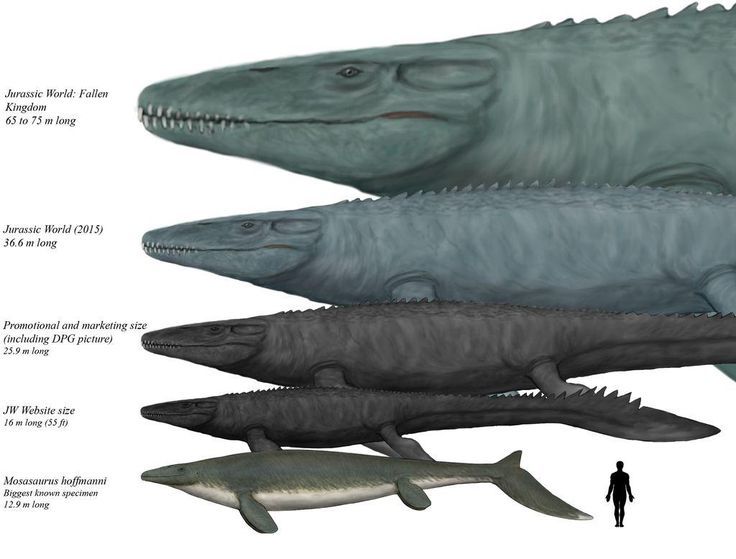
Mosasaurus had a relatively quiet existence in popular culture until 2015, when the film Jurassic World included a giant captive Mosasaurus as a stadium attraction. The film's Mosasaurus was depicted leaping from a pool to swallow a great white shark and later an entire Indominus rex. This version entered popular imagination instantly - the species went from a palaeontology footnote to a household name.
The on-screen Mosasaurus is, however, heavily exaggerated:
- Screen length: ~20-25+ metres (depending on shot)
- Actual late Cretaceous length: 11-17 metres
- Ratio of movie to reality: roughly 2-5 times too large
The film also shows the animal with smooth skin and a whale-like body form, missing the keeled scales and shark-like tail that fossil evidence supports. None of this is unusual for a monster film, and the visibility the franchise gave to Mosasaurus has arguably boosted public interest in mosasaur palaeontology more than any scientific publication could have.
Mosasaurus and Other Ocean Giants of Its Time
Mosasaurus did not rule the Cretaceous oceans alone. Several other apex or near-apex marine predators shared late Cretaceous seas.
| Animal | Group | Approximate size | Relationship |
|---|---|---|---|
| Mosasaurus hoffmannii | Mosasaur | 11-17 m | The subject of this entry |
| Tylosaurus proriger | Mosasaur | 12-14 m | Earlier and larger mosasaur cousin |
| Hainosaurus bernardi | Mosasaur | 12-15 m | European Maastrichtian contemporary |
| Elasmosaurus platyurus | Plesiosaur | 10-14 m | Long-necked, separate reptile lineage |
| Cretoxyrhina mantelli | Shark | 6-8 m | Earlier Cretaceous, largely extinct by Maastrichtian |
| Xiphactinus audax | Bony fish | 4-6 m | Fast-swimming predator, likely prey for large mosasaurs |
Mosasaurus was the dominant apex predator of its final interval in many regions, but the story of Cretaceous oceans is better understood as a diverse ecosystem of overlapping large predators, not a single ruler.
Related Reading
- Megalodon: Giant Shark of the Prehistoric Oceans
- Prehistoric Marine Life: Monsters of the Ancient Seas
References
Relevant peer-reviewed and governmental sources consulted for this entry include published research in Journal of Vertebrate Paleontology, Cretaceous Research, Palaeogeography, Palaeoclimatology, Palaeoecology, Nature, and Proceedings of the National Academy of Sciences, as well as museum records from the Muséum national d'Histoire naturelle (Paris) and the Natuurhistorisch Museum Maastricht.
Specific size estimates reflect current consensus ranges as of recent mosasaur reviews; isolated skull fragments continue to push the upper end of known body size for the species.
Frequently Asked Questions
How big was Mosasaurus?
Adult Mosasaurus hoffmannii individuals are estimated at 11 to 17 metres in length and 5 to 10 tonnes in weight, making it one of the largest mosasaurs ever to evolve. The upper size estimates come from isolated skull and jaw fragments from the Netherlands and North America; the more conservative 11-12 metre figure comes from the most complete skeletons.
For comparison, a modern killer whale reaches about 8-9 metres, so even a mid-range Mosasaurus was larger than any living toothed predator of the sea. The Jurassic World depiction showing a 20-metre-plus monster is heavily exaggerated - real Mosasaurus was enormous but not that enormous.
Was Mosasaurus a dinosaur?
No. Mosasaurus belongs to Squamata, the order that includes modern lizards and snakes. Its closest living relatives are monitor lizards (family Varanidae, including the Komodo dragon) and snakes. Dinosaurs are a separate reptile lineage (Dinosauria) that split off from squamates more than 100 million years before Mosasaurus evolved.
Mosasaurus also is not closely related to other famous marine reptiles like plesiosaurs or ichthyosaurs - those are entirely separate reptile groups. Mosasaurs descended from land-living lizards that returned to the sea roughly 100 million years ago, evolving paddle-like limbs, a tail fluke, and live birth independently of any other marine reptile lineage.
What did Mosasaurus eat?
Mosasaurus was the apex predator of late Cretaceous oceans and ate essentially anything it could catch and swallow. Stomach contents and bite mark evidence show a diet including bony fish, sharks, ammonites, sea turtles, plesiosaurs, seabirds like Hesperornis, and smaller mosasaurs of other species - and occasionally members of its own species.
Its massive conical teeth were designed for seizing and puncturing rather than slicing, and a second row of teeth on the palate (pterygoid teeth) helped ratchet large prey down the throat whole. Jaw mechanics allowed the lower jaw to flex outward, letting Mosasaurus swallow prey wider than its own head - similar to how modern snakes feed.
When and where did Mosasaurus live?
Mosasaurus lived during the late Cretaceous period, roughly 82 to 66 million years ago, with the best-known fossils dating to the final 6 million years of that interval - the stage now called the Maastrichtian. Fossils have been recovered from the Netherlands, Belgium, France, the United States (especially the Western Interior Seaway that split North America), Canada, Morocco, Russia, New Zealand, and Antarctica.
Mosasaurus inhabited warm, shallow continental shelf seas as well as deeper open oceans. The Cretaceous climate was much warmer than today, sea levels were higher, and shallow epicontinental seas covered large parts of every modern continent - ideal habitat for a large, mobile marine predator.
Why did Mosasaurus go extinct?
Mosasaurus vanished in the Cretaceous-Paleogene (K-Pg) mass extinction event approximately 66 million years ago, the same event that wiped out non-avian dinosaurs. A 10-12 kilometre asteroid impact near modern Chicxulub in Mexico triggered global wildfires, an impact winter that blocked sunlight for months to years, collapse of marine food webs, and acidification of ocean surface waters.
Mosasaurs were apex predators at the top of an oceanic food chain that depended on photosynthetic plankton; when sunlight was cut off, the whole system collapsed from the bottom up. The entire Mosasauridae family disappeared essentially simultaneously, along with plesiosaurs, ammonites, and most large marine vertebrates. Sharks, some bony fish, and sea turtles survived.
How was Mosasaurus discovered?
Mosasaurus was discovered in 1764 in a chalk quarry on Sint-Pietersberg mountain near Maastricht in the Netherlands. Quarry workers uncovered a massive, elongated skull nearly two metres long. The fossil - now known as the Beast of Maastricht or Mosasaurus hoffmannii holotype - passed through several owners before being studied by the Dutch anatomist Petrus Camper and later his son Adriaan.
In 1794, French revolutionary troops occupying Maastricht seized the skull as war loot and transported it to Paris, where Georges Cuvier studied it. Cuvier concluded in 1808 that it represented a giant extinct marine lizard - one of the first specific fossils used to prove the reality of extinction, at a time when many scholars still believed no species could truly disappear.
The name Mosasaurus (‘Meuse lizard’, after the local river Meuse) was formally coined by William Daniel Conybeare in 1822.
Did Mosasaurus give birth to live young?
Yes. Mosasaurs, including Mosasaurus, gave birth to live young at sea rather than returning to land to lay eggs. The key evidence comes from a 1996 discovery: a Plioplatecarpus specimen from South Dakota preserved with multiple embryos in its body cavity, closely related enough to confirm live birth across the Mosasauridae family.
Additional juvenile mosasaur fossils found in open marine sediments, rather than near shorelines, support the conclusion that mosasaurs gave birth in open water. This is the same reproductive strategy used by modern sea snakes and some monitor lizard relatives, consistent with Mosasaurus’s squamate ancestry. Live birth is a major reason mosasaurs were fully aquatic - unlike sea turtles, which must crawl ashore to lay eggs.
What did Mosasaurus look like?
Mosasaurus had a long, streamlined body with four paddle-shaped limbs, a powerful tail ending in a downward-pointing fluke, a long skull with conical teeth, and a body covered in small keeled overlapping scales. Fossil scale impressions from multiple mosasaur species confirm a lizard-like skin rather than smooth whale-like skin.
Recent research on tail anatomy shows mosasaurs had a true shark-like caudal fin, not a straight eel-like tail as older reconstructions suggested. Skull casts suggest a forked, snake-like tongue. Eyes were large and positioned for forward and lateral vision.
Coloration is unknown, but chemical analysis of related species (such as Platecarpus) suggests mosasaurs may have had dark, melanin-rich skin on the back for camouflage from above, with lighter undersides - classic countershading seen in modern marine predators.