
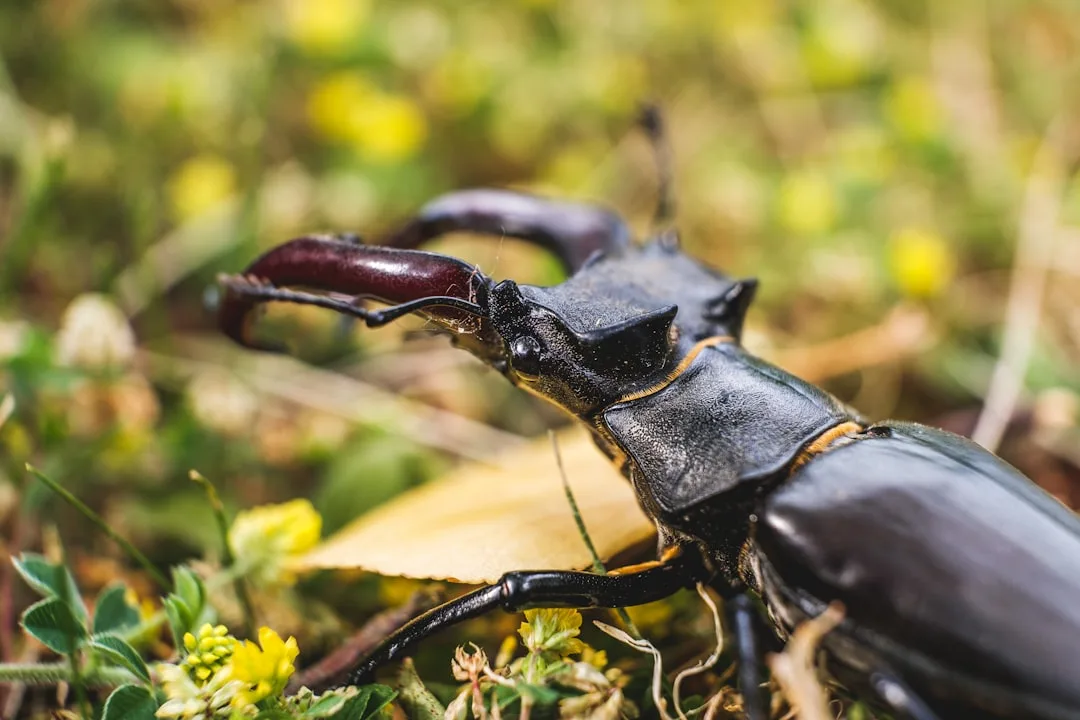
The European stag beetle is the largest terrestrial beetle in northern Europe, the flagship insect of every dead-wood conservation campaign on the continent, and one of the most unmistakable creatures a gardener in southern Britain or the Rhine valley is ever likely to encounter.
Males carry a pair of enormous antler-shaped mandibles that can account for a full third of their body length - a display weapon so exaggerated that the species was named after the red deer (cervus) it seems to imitate. Yet the swaggering, armoured adult is only the public face of a much stranger creature.
For every three months a stag beetle spends flying, fighting, and drinking tree sap, it has already spent three to seven years underground as a pale, legless grub chewing slowly through rotten heartwood.
This guide is a full wiki-style reference for Lucanus cervus: taxonomy, size and physical description, life cycle, the ecology of the larva, the short adult summer, the mechanics of male combat, habitat, range, cultural and folkloric reputation, and the conservation crisis that now protects the species under law in much of Europe. It is a reference entry, not a summary, so expect specifics: millimetres, years, temperatures, legal designations, and named places.
Etymology and Classification
The genus name Lucanus is ancient. Pliny the Elder, writing in the first century CE, records that it derives from the Lucani, an Italic people of southern Italy whose warriors were said to wear the heads of large horned beetles as helmet amulets. The species epithet cervus is simply the Latin word for red deer, a direct reference to the male's antler-like jaws. The binomial Lucanus cervus was formalised by Linnaeus in Systema Naturae in 1758 and has remained stable ever since.
In common speech almost every European language gives the beetle a name rooted in deer or cattle imagery. English 'stag beetle' mirrors German Hirschkafer (stag beetle), French cerf-volant (flying stag), Dutch vliegend hert (flying deer), Italian cervo volante, and Spanish ciervo volante. Older English dialect names include 'horse pincher', 'billywitch', and 'pinching Tom', all referring either to the mandibles or to the beetle's slow crawl.
Taxonomically Lucanus cervus sits inside the family Lucanidae - the stag beetles proper - within the enormous order Coleoptera. Roughly 1,200 stag beetle species are currently described worldwide, but L. cervus is the undisputed European flagship and the species most people mean when they say 'stag beetle' without a qualifier.
Several closely related species in the same genus are often confused with L. cervus, including Lucanus tetraodon in southern Italy and Lucanus ibericus around the Black Sea. Identification depends on mandible shape, colour saturation of the elytra, and subtle details of the male's head-shield.
Size and Physical Description
Stag beetles show pronounced sexual dimorphism. Males are larger on average, more heavily armoured, and carry the oversized mandibles that give the species its name. Females are smaller, rounder, and matte brown to almost black rather than the chestnut-red of a well-nourished male.
Males:
- Total length including mandibles: 35-75 mm (typical), up to 95 mm in record specimens
- Mandible length: up to one third of total body length
- Elytra (wing cases): deep chestnut red to mahogany brown
- Head and thorax: glossy black with a bronze sheen in fresh specimens
- Body mass: 2-10 g depending on larval feeding history
Females:
- Total length: 30-50 mm
- Mandibles: short, straight, sharply pointed, black
- Colour: more uniformly dark brown or black
- Build: stockier, with a broader abdomen to accommodate eggs
The difference in mandible size is extreme and is driven almost entirely by larval nutrition. A grub raised in a large, fungus-saturated oak stump finishes its larval period with surplus body reserves, which it channels into producing a 'major' male with huge antlers. A grub raised in a smaller or drier piece of wood emerges as a 'minor' male with noticeably shorter jaws.
Both morphs are the same species, interbreed freely, and employ different fighting tactics that reflect their respective armaments.
The elytra are smooth, slightly rounded, and beautifully polished. Under the elytra lie fully functional membranous flight wings. In flight the beetle hangs almost vertically with head and thorax raised and legs trailing, a distinctive silhouette that local people in Kent and Surrey have long described as like a small flying lobster or a tiny dark helicopter.
The Hidden Life of the Larva
More than ninety per cent of a stag beetle's biological life is spent underground, hidden inside rotten wood, as a pale C-shaped grub. This is the phase most people never see and the phase that drives almost every aspect of the species' conservation status.
Larval profile:
- Body: soft, whitish, plump, curled in a C-shape
- Head capsule: hard, orange-brown, with powerful cutting mandibles
- Length at maturity: up to 110 mm stretched out
- Legs: three pairs, very short relative to body size
- Duration: 3-7 years depending on climate and food quality
The larva eats only decaying hardwood. It cannot process living, sap-filled tissue and depends on white-rot fungi that have already partially broken down the lignin and cellulose of the wood. Preferred host woods in descending order of frequency are oak, beech, ash, willow, sweet chestnut, sycamore, fruit trees, and - increasingly often in urban populations - the buried stumps of garden shrubs.
Grubs are almost always found at or below ground level, deep inside stumps, in buried roots, in wooden fence posts rotting below the soil line, or in compost heaps containing substantial chunks of hardwood.
Larvae produce audible stridulations by rubbing ridges on their middle legs against a file on the hind legs. These vibrations travel through the surrounding rotten wood and are thought to let nearby larvae space themselves out so they do not compete for the same fibres. Larvae respond to recordings of stridulation by slowly moving away from the source.
Growth is slow, thermally limited, and strongly seasonal. A larva typically moults three times, passing through three instars before pupation. In warmer, wetter parts of the range such as southern France and northern Spain the cycle can complete in three years. In the cooler edges of the range such as southern England, Denmark, or the Baltic coast the cycle routinely takes five, six, or seven years.
Pupation happens in a roughly oval earthen cell, twice the length of the future adult, constructed by the final-instar larva from chewed wood fibre and soil bound with saliva. Inside this cell the larva undergoes metamorphosis, emerges as a teneral (soft-bodied, pale) adult, and then waits underground for months while the cuticle hardens and darkens. The new adult usually emerges above ground only in the summer following pupation.
The Short Summer of the Adult
After up to seven years underground, the winged adult emerges for a frantic, short-lived surface phase measured in weeks rather than years. Across most of Europe adults are on the wing between late May and early August, with peak activity in June and July.
Adult activity schedule:
- Emergence: late May to mid-June, triggered by soil temperature above about 16 degrees Celsius
- Peak flight: warm, still, humid evenings an hour before and after dusk
- Daily pattern: hidden in leaf litter or under bark by day, active at twilight
- Mating and oviposition: late June to late July
- Death: usually by the first cold nights of late August or early September
Adults do not feed on solids. Their mandibles, despite looking like weapons, are non-functional for chewing - in males the inner surfaces are specialised for gripping rival males, while in females the mandibles are shortened, stout, and serve as oviposition tools for excavating soft wood to lay eggs. Actual feeding is done by the labium, a soft pad covered in dense hairs that functions as a sponge for lapping up tree sap, rotting fruit juice, and honeydew.
The sap-feeding adults are surprisingly social at good sap runs. A single weeping oak wound can attract a dozen beetles, including both sexes, and provide a rendezvous where mating occurs. Males patrol sap sites aggressively, driving away rivals, while females visit briefly to drink and to assess potential mates.
Females lay eggs singly or in small groups in soft rotten wood close to or below ground level. A healthy female produces between twenty and thirty eggs over her brief adult life. Each egg hatches in two to three weeks into the first-instar grub, which immediately begins to feed on the surrounding wood. The cycle then restarts - another three to seven years underground before the next adult summer.
Male Combat and Sexual Selection
The oversized male mandibles are, from an evolutionary standpoint, the single most important feature of the species. They are a textbook example of sexual selection: a weapon shaped not by predators or prey but by competition for mates.
Mechanics of combat:
- Two males meet on a sap run, a branch, or the bark of an egg-laying tree.
- Both raise their forebodies and spread their mandibles wide in a threat display. In most encounters one male backs down at this point.
- If neither retreats, the larger male advances and locks mandibles with the rival.
- The aim is not to bite but to slide the mandibles underneath the opponent's body, grip the underside of the thorax, lift the opponent clear of the surface, and flip him off the branch.
- The loser, once dislodged, generally walks away uninjured. The winner holds the territory and, usually, access to any nearby female.
This combat style explains why the mandibles are so long yet so mechanically weak. A wrestler's advantage comes from reach, not bite force. The longer a male's mandibles relative to his body, the more easily he can slide them under a rival and lever him off the branch. Field studies of marked males have shown clear positive correlations between mandible length, combat win rate, and eventual mating success.
Minor males, with their shorter mandibles, adopt different tactics: they hide near sap runs, intercept females before the major males notice them, and mate quickly before being displaced. This alternative reproductive tactic is common in species with strongly size-dependent combat.
Contrary to a persistent myth, male stag beetles cannot meaningfully bite a human finger. The mandibles are too long for strong closure. Females are another matter: their shorter, straighter, sharper mandibles are perfectly capable of pinching hard enough to draw a droplet of blood from handling, though they are not venomous and do not pursue people.
Habitat, Range, and Population Hotspots
Lucanus cervus has a broad but increasingly patchy distribution across Europe and into western Asia.
Core range by country:
| Country | Status | Key hotspots |
|---|---|---|
| United Kingdom | Declining, legally protected | Greater London, Thames Valley, Surrey, New Forest |
| France | Widespread, locally common | Fontainebleau, Loire Valley, southwest oak forests |
| Germany | Declining, strictly protected | Rhineland parklands, Frankfurt oak woods |
| Spain and Portugal | Widespread in cork oak woodland | Extremadura, Alentejo, Catalan foothills |
| Italy | Locally common | Tuscan forests, southern chestnut groves |
| Poland, Czechia, Slovakia | Scattered remnants | Eastern beech and oak reserves |
| Turkey and Caucasus | Eastern range limit | Black Sea forests, Caucasus foothills |
| Netherlands, Denmark | Critically reduced or locally extinct | Few surviving populations, intensive monitoring |
The species reaches its northern limit at roughly the southern edge of Scandinavia and its southern limit in the hills of North Africa and the Levant. Within this range, stag beetles are not uniform: they are absent from intensively managed farmland, young plantations, conifer forests, and most tidy urban parks. They persist wherever three conditions overlap: mature native hardwoods, substantial dead wood buried in the soil, and mild summer temperatures above 16 degrees Celsius.
Crucially, in much of Britain and the Rhineland the strongest populations are now in suburban gardens and allotments rather than in forests. This is because gardens often retain buried stumps, old fence posts, and compost-heap woodpiles in exactly the configuration a larva needs, while modern forestry removes such material almost everywhere else.
Conservation Status and Legal Protection
The IUCN Red List classifies Lucanus cervus as Near Threatened with a decreasing population trend. This is a cautious assessment: several national Red Lists, including those of Germany, the Netherlands, and Denmark, classify the species as Endangered or even Critically Endangered within their borders.
Legal protection:
- EU Habitats Directive Annex II: species of community interest whose conservation requires the designation of Special Areas of Conservation
- EU Habitats Directive Annex V: regulated collection
- United Kingdom Wildlife and Countryside Act 1981 (Schedule 5): protection against sale
- Germany Federal Nature Conservation Act: strictly protected
- Multiple national statutes across the Netherlands, Belgium, Luxembourg, Czechia, and elsewhere
Principal threats:
- Loss of dead wood. Modern forestry, parkland management, suburban tidying, and the replacement of traditional hedgerows all strip away rotting stumps, buried roots, and fallen logs. Because larvae cannot relocate, the loss of a stump is the permanent end of that family line.
- Habitat fragmentation. Adults are weak flyers. Once a population is isolated from neighbouring populations by more than a kilometre of unsuitable land, genetic exchange effectively stops and local extinction risk rises.
- Road traffic. Flying adults are struck in large numbers on warm summer evenings, especially on roads that pass through oak woodland.
- Predation. Magpies, jays, crows, and foxes learn to intercept emerging adults at known breeding sites. Domestic cats take a meaningful toll on adult beetles in suburban gardens.
- Pesticides. Systemic insecticides used on garden trees and in orchards can poison both larvae in buried roots and adults feeding on sap.
- Climate change. Shifting emergence timing, increased summer drought, and warmer winters may desynchronise adults from nectar and sap resources and accelerate the drying of larval wood.
Active conservation measures:
Large-scale public monitoring programmes run by the People's Trust for Endangered Species in the United Kingdom and equivalent bodies across Europe depend on citizen reports of adult sightings. Gardeners are actively encouraged to leave stumps in place, bury hardwood logs vertically as 'log pyramids' or 'loggeries', and avoid pesticide use.
Several German and Dutch cities have declared municipal stag beetle protection zones where tree surgery leaves substantial dead wood on site. None of these measures addresses the forestry-scale loss of dead wood across most of the European continent.
Cultural History
Few insects carry as heavy a cultural load as the European stag beetle. The species appears in Roman natural history, medieval bestiaries, Renaissance oil painting, Victorian natural history cabinets, and contemporary European popular culture.
Pliny the Elder recorded that stag beetle heads were worn as protective amulets by children in first-century Italy. Albrecht Durer's 1505 watercolour Hirschkafer is one of the most celebrated insect portraits in the history of European art.
Medieval and early modern Europeans commonly believed that the beetles carried hot coals in their mandibles and could set fire to thatched roofs simply by landing - a superstition that led to organised killings in several countries and that almost certainly contributed to localised population collapses from which some regions have never recovered.
The beetle appears on heraldic coats of arms in parts of Germany and France. It has been used as a luxury pet throughout Japan, China, and continental Europe, where major males with very long mandibles fetch high prices. In Victorian England, a brief fashion for 'living jewellery' saw large beetles tethered to ladies' dresses with gold chains. Queen Victoria herself is reliably recorded as having worn a stag beetle in this way on at least one occasion.
Stag beetles also feature in folklore, children's literature, and modern conservation branding. The species is effectively the panda of European invertebrate conservation: large, charismatic, easy to recognise, easy to photograph, easy to explain to the public, and a genuine indicator of wider ecological health.
Stag Beetles and Humans Today
For most Europeans today, a stag beetle encounter is a summer evening novelty: a large, slow-flying, helicopter-shaped insect landing on a fence, a shed wall, or a warm pavement. The beetles are harmless, fascinating, and increasingly scarce, and nearly every national wildlife agency encourages the public to record sightings rather than remove the animals.
Practical advice issued by conservation charities is consistent across the continent: do not lift stag beetles by their mandibles, do not move them away from where they were found, do not relocate them to 'better' habitat because adults die within weeks regardless, and in particular do not dig up or move suspected larvae, which almost never survive transfer.
Gardeners wishing to help are advised to leave any existing buried wood undisturbed, bury additional hardwood logs vertically in shaded corners of the garden, avoid all use of systemic insecticides on trees, and report adult sightings to national monitoring schemes.
The long-term future of Lucanus cervus is uncertain but not hopeless. Unlike many threatened species the remedy is known, cheap, and popular with the public: leave dead wood in the landscape. Whether European forestry and parkland management will do so at scale is a political question as much as a biological one.
Related Reading
- Beetles: The Most Diverse Order of Life on Earth
- Why Beetles Are the Most Diverse Animal Group
- Hercules Beetle: The Giant of the Neotropics
- Dung Beetles and Galactic Navigation
- Fireflies: Why They Glow
References
Relevant peer-reviewed and governmental sources consulted for this entry include the IUCN Red List assessment of Lucanus cervus (2010, reviewed 2020), the EU Habitats Directive Annex II species account, the People's Trust for Endangered Species Great Stag Hunt surveys (2000-2024), national Red Data Books of Germany, the Netherlands, and the United Kingdom, Joint Nature Conservation Committee Species Action Plans, and peer-reviewed research published in Journal of Insect Conservation, Biological Conservation, European Journal of Entomology, and Insect Conservation and Diversity.
Specific mandible morphometrics and combat data draw on field studies conducted in France, Germany, the United Kingdom, and Italy between 1998 and 2023.
Frequently Asked Questions
How big do European stag beetles get?
Adult males of Lucanus cervus typically reach 35-75 mm in total length including the mandibles, with verified record specimens approaching 95 mm - making the species the largest terrestrial beetle in northern Europe and Britain. Females are consistently smaller, usually 30-50 mm, and lack the oversized jaws.
Mandible length in males is strongly correlated with larval nutrition: a grub that grew up in a well-rotted, fungus-rich oak stump becomes a ‘major’ male with huge antlers, while one raised in drier or poorer wood emerges as a ‘minor’ male with noticeably smaller jaws. Both morphs are the same species and interbreed freely.
Body mass ranges from roughly 2 to 10 grams, heavy enough that the insect produces an audible buzz and a distinctive vertical flight posture.
What do stag beetles eat?
Diet differs completely between life stages. The larva is a saproxylic detritivore: it feeds exclusively on decaying hardwood, especially oak, beech, ash, willow, and fruit trees. Larvae cannot digest fresh living wood and rely on white-rot fungi to partially break down the lignin and cellulose before they consume the fibres. Adults, in contrast, cannot chew solid food at all. Their mouthparts are reduced to a soft brush-like pad used to lap liquids.
Favourite adult foods include oozing oak sap, the juice of fallen overripe plums and pears, and sometimes honeydew secreted by aphids. Adults spend much of their brief aboveground lives simply topping up fluid reserves while searching for mates and egg-laying sites.
Where do European stag beetles live?
Lucanus cervus is found across mainland Europe from southern Britain, Iberia, and southern Scandinavia eastward to the Caucasus, Turkey, and parts of western Asia. The species is most strongly associated with mature oak and beech woodlands, ancient parklands, old hedgerows, traditional orchards, and - increasingly important - urban gardens and allotments that retain fallen logs, tree stumps, and dead wood in the soil.
In the United Kingdom, stag beetles are concentrated in the south-east, especially Greater London, Surrey, Essex, and the Thames basin, with scattered populations along the south coast. The species has already vanished from much of Denmark, the Netherlands, and Latvia, where intensive forestry removed the dead wood they depend on.
Are stag beetles dangerous to people?
No. Despite their intimidating appearance, male stag beetles cannot bite a human with their oversized antler-like mandibles - the jaws are leveraged for wrestling other males and are mechanically too weak to close on thick skin. Females, which have shorter and straighter mandibles, can deliver a brief pinch that may draw a droplet of blood if handled carelessly, but they are not venomous and never attack unprovoked.
Stag beetles do not sting, bite defensively when left alone, or transmit any disease to humans or pets. Their habit of crawling slowly across warm pavement at dusk can look alarming, but they are harmless and, in most of Europe, legally protected from deliberate harm.
How long do stag beetles live?
Total lifespan from egg to death is typically four to seven years, but the distribution is deeply skewed. The larva lives underground in rotting wood for three to seven years, slowly chewing through decomposing heartwood. It pupates in an earthen cell at the end of that period, emerges as an adult in late summer, overwinters below ground as a teneral beetle, and finally flies the following June or July.
From first flight to death, the winged adult survives only three to four months and usually dies by late August. This means more than ninety per cent of the insect’s biological life is spent underground as a grub, and the iconic flying stag beetle seen in European gardens is a short-lived reproductive cap on a much longer hidden existence.
Why are stag beetles endangered?
The IUCN lists Lucanus cervus as Near Threatened with a decreasing population trend, and the species is protected under the EU Habitats Directive Annex II, the UK Wildlife and Countryside Act, and comparable national laws across much of continental Europe. The dominant threat is loss of dead and decaying hardwood.
Modern forestry, tidy parkland management, the removal of old orchards, urban land clearance, and the replacement of traditional hedgerows with fenced gardens all strip away the rotting stumps, buried roots, and fallen logs the larvae must eat. Secondary threats include pesticides, road traffic that kills flying adults, predation by introduced and native animals, and climate-driven shifts in emergence timing.
Because larvae are immobile and tied to specific wood patches, local extinctions are usually permanent.
How do male stag beetles fight?
Male combat in stag beetles is ritualised, largely bloodless, and almost exclusively about access to females. When two males meet on a sap run or a mating tree, they raise their forebodies, spread their mandibles wide, and advance. Contact is physical: each male tries to slide his mandibles under the opponent’s body, grip, and lift. The winner hoists the loser clear of the branch and tosses him aside.
Injuries are rare because the mandibles are so long that their mechanical advantage is weak - they function more like wrestler’s arms than weapons. Studies of marked males show that the larger the mandibles, the higher the win rate, which is why sexual selection has driven such extreme jaw development in the species.
What role do stag beetles play in the ecosystem?
Stag beetles are flagship members of the saproxylic invertebrate community - the guild of organisms that depend on dead and decaying wood. Their larvae are major processors of rotten heartwood, breaking it down, mixing it with fungal mycelium, and returning its nutrients to forest soils. In so doing they aerate dead stumps, create galleries used by hundreds of other invertebrates, and recycle carbon and minerals locked in senescent trees.
Adult beetles, though short-lived, pollinate some flowers incidentally while feeding on sap, and serve as substantial prey items for crows, magpies, foxes, owls, and domestic cats. Because the species is so visible and so dependent on intact wood-decay cycles, conservation agencies use it as an indicator: a woodland that still supports breeding stag beetles is almost certainly also supporting a rich, healthy invertebrate fauna.