
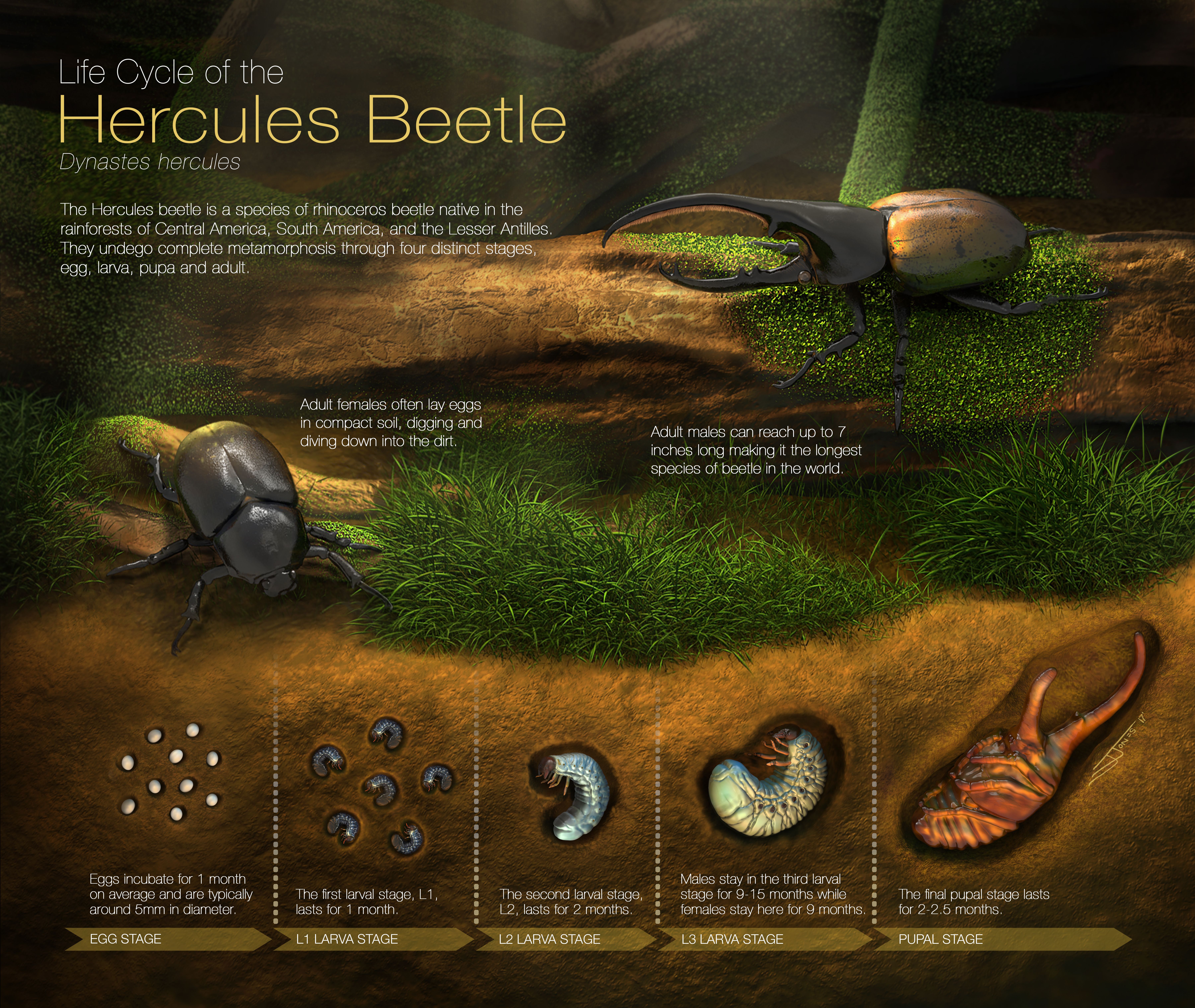
The Hercules beetle is one of the largest flying insects in the world, the heaviest member of the scarab family, and the insect most often cited when biologists talk about proportional strength. Males of Dynastes hercules carry a pair of enormous horns that can account for roughly two-thirds of their total body length, giving the species a silhouette more reminiscent of a pair of blacksmith's tongs than an insect.
The horns are not decoration: males use them to wrestle rivals off branches in fierce mating contests, and materials scientists study their lightweight composite structure for lessons in engineering.
This guide covers every important aspect of Hercules beetle biology and ecology: size and sexual dimorphism, strength, the hygrochromic cuticle that changes colour with humidity, diet, larval wood-mining, reproduction, subspecies, conservation pressures, and the strange cultural life the beetle leads as a prized pet in Japan. It is a reference entry, not a summary - so expect specifics: millimetres, grams, months, populations, and verified measurements from peer-reviewed sources.
Etymology and Classification
The genus name Dynastes comes from the Greek dynastes, meaning ruler or lord, a reference to the imposing appearance of the beetles. The species epithet hercules links the animal to the Greek hero Heracles, famous for feats of strength. The name was coined by Carl Linnaeus in 1758, making the Hercules beetle one of the earliest described beetles in modern scientific literature.
Within the family Scarabaeidae, the Hercules beetle sits in the subfamily Dynastinae, a group commonly known as rhinoceros beetles. Dynastinae contains nearly 1,500 species, of which the genus Dynastes holds several of the largest.
The closest relatives of the Hercules beetle are other New World giants such as the eastern Hercules beetle (Dynastes tityus) of the southeastern United States, the Grant's white beetle (Dynastes granti) of the American Southwest, and the Neptune beetle (Dynastes neptunus) of the Andes.
Molecular phylogenies show that Dynastes hercules split from its sister species several million years ago, coinciding with the uplift of the northern Andes.
Taxonomists recognise at least seven subspecies of Hercules beetle, each tied to a geographically distinct part of the range. These include D. h. hercules (Lesser Antilles), D. h. lichyi (northern Andes), D. h. occidentalis (Pacific lowlands of Colombia and Ecuador), D. h. ecuatorianus, D. h. septentrionalis (Central America), D. h. trinidadensis (Trinidad), and D. h. paschoali (southeastern Brazil).
Horn shape, body proportions, and cuticle colour vary noticeably between them, which is why specialist keepers and breeders treat each subspecies as a distinct bloodline.
Size and Physical Description
Hercules beetles are the largest beetles in the Americas and, depending on how length is measured, often the largest beetles on Earth. Sexual dimorphism is extreme: males dwarf females and carry huge horns that females entirely lack.
Males:
- Total length: 50-175 mm, occasionally approaching 180 mm
- Body length without horns: roughly 60-80 mm
- Horn length combined: up to around 100 mm
- Weight: up to about 85 g in the largest specimens
Females:
- Total length: 50-80 mm
- No horns; head and pronotum are smooth and rounded
- Weight: typically 25-50 g
Larvae (fully grown):
- Length: up to 120 mm curled, longer stretched
- Weight: up to 120 g, heavier than most adults
The male's two horns are arranged in a pincer. The upper horn projects forward from the pronotum, often curving gently downward, with small spines or teeth along its inner edge. The lower horn projects forward and upward from the head, meeting the upper horn near the tip. When the beetle closes its jaws (or more accurately, flexes its thorax), the two horns clamp together like forceps. This arrangement is a specialised weapon used almost exclusively in male-male combat.
The elytra, or hardened wing covers, are one of the most distinctive features of the species. In healthy adult males the elytra are broad, convex, and finely punctured. Colours range from bright khaki-yellow through olive to chocolate brown, often with dark spots or smudges. The head, pronotum, and legs are typically glossy black. Under each elytron lies a pair of membranous hind wings that unfold for flight.
The wings are surprisingly large relative to the body and, despite the beetle's bulk, carry it effectively over short distances.
The Hygrochromic Cuticle
Of all the strange features of the Hercules beetle, the colour-shifting cuticle is the most scientifically interesting. Depending on humidity, the elytra appear yellow-olive in dry conditions and dark brown to nearly black when wet.
Beetles do not normally change colour this way. Most insects rely on fixed pigments or static structural colour. Hercules beetles instead use a reversible optical mechanism built into the cuticle itself. Inside the elytra is a three-dimensional porous layer roughly three micrometres thick, riddled with microscopic voids.
In dry conditions these voids are filled with air, which scatters and reflects light strongly in yellow wavelengths. When water vapour condenses into the voids, the refractive contrast between the cuticle material and the filling drops, light transmits through more layers, and underlying dark melanin shows through. The elytra look almost black.
This hygrochromic behaviour has been measured in the laboratory under controlled humidity. Transition from yellow to dark brown can occur within minutes of humidity change and is fully reversible across many cycles.
Biologists believe the effect serves two functions: camouflage (blending with dry lichen during the day and wet bark at night) and possibly signalling during mating displays, where males approach receptive females on damp nights and therefore appear dark against the forest canopy.
Materials scientists have taken particular interest in the cuticle's architecture and have fabricated analogues for humidity-sensitive sensors and smart coatings.
Strength and the 850x Claim
For most of the twentieth century, textbooks repeated a striking claim: the Hercules beetle can carry 850 times its own body weight. Like the similar claim made for rhinoceros beetles, this figure has proven harder to verify than it sounds.
The original measurements were produced in the mid-1900s using weights suspended from a harnessed beetle while the beetle resisted on a platform. What was being measured was resistance to being pulled backward, not sustained lifting.
More recent experimental biology, particularly work on horned scarab beetles published in journals such as Journal of Experimental Biology, has quantified true lifting and pushing capacity at closer to 100 times the beetle's own body weight sustained over short distances. Even that figure is astonishing - a human-sized equivalent would be lifting a loaded shipping container.
Why are Hercules beetles so strong? Several factors combine:
- Cuticle stiffness. The exoskeleton is a layered composite of chitin and sclerotised proteins, stronger per unit weight than steel for comparable geometries.
- Muscle packing. Insects pack their muscle fibres extremely densely and generate higher specific force than vertebrate muscle at small scales.
- Square-cube law. Smaller animals lose weight faster than they lose muscle cross-section as they shrink, giving small bodies disproportionately large strength per gram.
- Horn leverage. The long horns function as lever arms that magnify force output for pushing and lifting rivals during fights.
Engineers study Hercules beetle horns for the same reason: they are hollow, light, and extraordinarily strong under bending loads. The internal microstructure consists of hexagonal fibre bundles arranged to resist cracking and bending simultaneously. Several research groups have used the horn architecture as inspiration for bio-inspired composite materials.
Diet and Feeding
Hercules beetles live two completely different culinary lives: one as a larva and another as an adult.
Larval diet. After hatching, the grub bores into decomposing hardwood and begins consuming the soft rotting fibre. It prefers older, fungal-inoculated wood that is already breaking down, because fresh hardwood is too tough and nutritionally poor. The larva's gut hosts a dense microbial community that ferments cellulose and hemicellulose, extracting sugars the larva's own digestive enzymes cannot reach.
Over 12 to 24 months it grows from a pale grub the size of a grain of rice into a colossus weighing more than 100 grams. Favoured wood species include rotting logs of tropical hardwoods such as Ceiba, Hura, Ochroma, and palm trunks, though larvae are flexible.
Adult diet. Once the beetle emerges from the pupa, its mouthparts are completely different. Adults cannot chew solids. Instead, they possess brush-like galeae - soft, hairy extensions of the maxillae - used to lap up liquids. Their preferred foods include:
- Fermenting fallen fruit (mango, banana, palm fruit, figs)
- Sap flows from wounded trees, particularly palms
- Honeydew from sap-feeding insects
- Occasional flower nectar
This shift from wood-eating grub to fruit-sipping adult is typical of large scarabs and is one reason the species can reach such enormous size. Larvae do all the structural growth on a high-bulk, low-quality diet, while adults focus purely on energy and reproduction using a liquid sugar diet.
Reproduction and Male Combat
Hercules beetle reproduction is dominated by fighting. During the mating season - which varies across the range but typically peaks in the wet season of each subspecies' region - males aggregate at sap flows and fruiting trees where females come to feed. There, males contest access to females through direct physical combat.
A Hercules beetle fight is unmistakable. Two males face off on a branch or trunk, lock horns, and try to pry, lift, and throw each other off the substrate. The winner is usually the bigger male with the longer horns, since leverage matters more than sheer muscle. Fights can last from seconds to several minutes.
Loser beetles are typically tossed clear of the branch; injury is rare, because the cuticle protects against the blunt forces involved, but decisive defeat sends the loser away for the evening.
After mating, the female burrows into soft soil or into a decomposing log and lays 10 to 100 eggs across several weeks. Eggs are roughly oval, cream-white, and about 4 mm long. They hatch after 4 to 6 weeks depending on temperature and humidity.
The larvae pass through three instars. Growth between instars can be dramatic, with body mass doubling or tripling in a single moult. After one to two years the final-instar larva constructs a pupal chamber from soil and wood paste, then moults into a pupa. Pupation takes roughly 4 to 8 weeks, during which the internal organs are completely reorganised. The new adult emerges pale and soft, sheds a thin cuticle, and hardens over several days before digging its way to the surface.
Lifecycle Summary
| Stage | Duration | Key events |
|---|---|---|
| Egg | 4-6 weeks | Laid in soil or rotting wood; develops to first-instar larva |
| Larva L1 | 1-2 months | Small grub begins feeding on rotting wood |
| Larva L2 | 3-6 months | Major growth; burrows extensively through substrate |
| Larva L3 | 8-18 months | Peak size; can exceed 100 grams |
| Prepupa | 2-4 weeks | Stops feeding; builds pupal chamber |
| Pupa | 4-8 weeks | Complete internal restructuring |
| Adult | 3-6 months (wild) | Feeds, flies, fights, mates, dies |
The disproportion between the long underground larval stage and the short aboveground adult stage is typical of large scarabs. More than 85 per cent of a Hercules beetle's life is spent as a grub inside wood and soil, out of sight.
Range, Habitat, and Subspecies Distribution
Hercules beetles occupy a belt of humid neotropical forest stretching from southern Mexico through Central America, across northern South America, and onto several islands in the Lesser Antilles. They favour primary and mature secondary lowland rainforest and mid-elevation cloud forest, where rotting hardwood is abundant and humidity stays high.
Approximate subspecies distribution:
| Subspecies | Region | Typical size |
|---|---|---|
| D. h. hercules | Guadeloupe, Dominica (Lesser Antilles) | Males to 170 mm |
| D. h. lichyi | Northern Andes (Colombia, Ecuador, Peru) | Males to 175 mm |
| D. h. occidentalis | Pacific Colombia and Ecuador | Males to 145 mm |
| D. h. ecuatorianus | Amazonian Ecuador | Males to 160 mm |
| D. h. septentrionalis | Mexico, Central America | Males to 125 mm |
| D. h. trinidadensis | Trinidad | Males to 130 mm |
| D. h. paschoali | Southeast Brazil | Males to 110 mm |
Within its range the species can be found from near sea level up to about 1,800 metres in elevation, though the largest recorded specimens tend to come from mid-elevation cloud forest between 500 and 1,500 metres. This elevational preference is probably driven by the combination of abundant rotting hardwood, stable humidity, and cooler temperatures that slow larval development and allow larger final adult sizes.
Flight and Movement
Despite their bulk, Hercules beetles fly. They unfold their membranous hind wings from beneath the elytra and take off with a loud buzzing hum audible from several metres away. Flight is laboured and direct, more like a helicopter than a fighter jet. The beetles use it mostly to move between feeding sites in the canopy and to locate mates by following fermentation-scent trails in the air.
Flight is expensive. A large male Hercules beetle burns through a significant fraction of his fat reserves on a single extended flight, which is one reason most movement is short-range. Adults are active mostly at night, guided by scent and by moonlight. During the day they typically wedge themselves into crevices, under bark, or inside hollow logs to avoid predators and desiccation.
Ground movement is slow and deliberate. Hercules beetles walk with a careful wide-legged gait that keeps their centre of mass low. On smooth surfaces they are clumsy, but on bark and rotting wood their tarsal claws grip superbly.
Predators and Defence
Adult Hercules beetles have few predators once they reach full size. The thick cuticle defeats most birds, and the sheer bulk makes swallowing difficult. Reported predators include large owls, toucans, coatis, opossums, and coatimundi that specialise in cracking hard-shelled prey. Some primates, including capuchins, have been observed crushing beetles against rocks.
The main anti-predator defences are:
- Nocturnal activity, which reduces exposure to most visual predators
- Cuticle hardness, which resists pecking and crushing
- Crevice-hiding during daylight
- Horned males present an imposing front when attacked
- Loud stridulation produced by rubbing the abdomen against the elytra
Larvae are more vulnerable. They face threats from parasitoid wasps, scoliid wasps, ants, predatory beetles, and insectivorous mammals that dig through rotting logs. Armadillos and tamanduas are noted log-rippers in their range. The larva's primary defence is depth: the deeper it burrows into hardwood, the safer it is.
Conservation Status and Threats
The IUCN has not formally assessed Dynastes hercules, so the species has no official global Red List category. This is typical of large invertebrates; most IUCN effort focuses on vertebrates and commercially important taxa. Nevertheless, entomologists who work on the species consistently report population declines across much of its range, driven by habitat change and climate pressure.
Primary threats:
- Deforestation. The neotropical forests where Hercules beetles live have been cleared at historic rates for cattle, soy, oil palm, and timber. Larvae depend on large, old, rotting hardwood logs, which disappear from secondary and managed forests.
- Climate change. Rising temperatures and shifting rainfall disrupt the humidity regime that triggers the beetle's hygrochromic cuticle and drives larval growth. Cloud forests are particularly sensitive, with the cloud base rising up mountains and squeezing mid-elevation habitats.
- Pesticide drift. Agricultural pesticides used near forest edges reduce insect populations generally and can affect beetles indirectly through prey collapse of the microbes that support larval digestion.
- Collection for the pet trade. Compared with habitat loss this is a minor factor, but heavy unregulated collection around breeding aggregations can dent local populations, particularly on small islands.
- Light pollution. Adults are strongly attracted to artificial lights at night, which draws them away from forest into roads, towns, and predators.
Several island subspecies - especially on Guadeloupe and Martinique - occupy tiny fragmented ranges and are considered locally threatened by regional entomologists, even in the absence of a global IUCN listing. National protected areas across the range provide some security for interior forest populations, but enforcement is inconsistent.
Hercules Beetles and Humans
Across much of the neotropics the Hercules beetle is a familiar part of rural life, known under dozens of local names and often associated with rainy-season activity and ferment trees. In Caribbean French the beetle is called scieur de long (long sawyer) in a reference to its noisy flight.
The Hercules beetle has also found an unlikely second life in Japan. Beetle-keeping has been a serious cultural hobby in Japan since at least the 1990s. Department stores stock live rhinoceros and stag beetles alongside tropical fish and reptiles. Specialist shops sell Dynastes hercules of various subspecies, and breeding enthusiasts trade larvae and adults through magazines, shows, and online marketplaces.
Top-quality males with horn lengths over 160 mm regularly fetch several hundred US dollars, and record specimens have sold for far more. Captive breeding is well established, and most pet beetles are now several generations removed from wild stock.
The pet trade has mixed conservation implications. On the positive side, captive breeding reduces pressure on wild populations and builds public interest in insect conservation. On the negative side, collection pressure on rare subspecies and the risk of escaped non-native beetles establishing in new regions are both legitimate concerns.
The United States restricts live imports of most foreign Hercules beetles under agricultural rules to prevent the establishment of a large scarab not native to North America.
Scientific interest is also strong. Materials scientists study the horn and elytra for structural inspiration. Physiologists study muscle scaling and strength. Ecologists use Hercules beetles as indicator species for intact neotropical forest, because their presence in an area signals healthy rotting wood cycles and high humidity.
Related Reading
- Beetles of the World: Diversity, Strength, and Strange Biology
- How Insects Lift Many Times Their Body Weight
- Rhinoceros Beetles: The Armoured Giants of the Tropics
- Stag Beetle: The Forest's Armed Logger
References
Relevant peer-reviewed and governmental sources consulted for this entry include taxonomic revisions of Dynastes published in Zootaxa, physiological work on insect strength published in Journal of Experimental Biology, structural colour research on Dynastinae elytra published in New Journal of Physics and Optics Express, conservation assessments by the Guadeloupe and Martinique national parks, and cultural-economic analyses of the Japanese pet-beetle industry published in Insect Conservation and Diversity.
Subspecies nomenclature follows the latest revisions in the Catalogue of Palaearctic Coleoptera supplementary neotropical treatments.
Frequently Asked Questions
How big is a Hercules beetle?
The Hercules beetle (Dynastes hercules) is one of the largest beetles on Earth and one of the largest flying insects overall. Males, including their long horns, stretch from 50 to 175 millimetres in total length, with record specimens approaching 180 mm. Females are considerably smaller at 50 to 80 mm and lack horns entirely. A large male can weigh up to around 85 grams - heavier than a house mouse.
The huge size difference between males and females is driven almost entirely by the male’s cephalic and thoracic horns, which together can make up about two-thirds of his total length.
How strong is a Hercules beetle?
Hercules beetles are often called the strongest animals on Earth in proportion to body size. A classic claim states that they can carry up to 850 times their own body weight, a figure that has appeared in textbooks and documentaries for decades. More recent experimental work suggests a realistic sustained lifting capacity closer to 100 times body weight, which is still extraordinary: a human-sized equivalent would be lifting a loaded shipping container.
The 850x figure likely reflects short-duration resistance rather than a genuine carried load. Either way, Dynastes hercules is among the strongest insects ever measured and uses this power to wrestle rival males during mating contests.
Where do Hercules beetles live?
Hercules beetles inhabit humid tropical and subtropical rainforests from southern Mexico through Central America and across much of northern South America. Key range countries include Panama, Colombia, Ecuador, Peru, Bolivia, Venezuela, and parts of Brazil. Populations also occur on several islands of the Lesser Antilles, including Guadeloupe, Martinique, and Dominica.
Within those forests the beetles prefer mid-elevation cloud forest and lowland humid forest with abundant rotting hardwood. Larvae live in decomposing logs and leaf litter; adults are most often found on fruiting or sap-leaking trees at night.
What do Hercules beetles eat?
Adults and larvae eat completely different things. Adult Hercules beetles feed on fermenting fruit, tree sap, and the sugary wounds left by other insects or birds on bark. They are attracted to fallen mangoes, bananas, and palm fruit, and they lick rather than chew their food thanks to brush-like mouthparts. Larvae, by contrast, are dedicated wood-eaters.
They spend one to two years burrowing through decaying hardwood logs, consuming the softening pulp and extracting nutrients with the help of microbial gut symbionts. This dual diet means adults and larvae never compete for the same food, which supports the species’ large body size.
How long do Hercules beetles live?
A Hercules beetle’s full life cycle typically runs two to three years, sometimes longer in captivity. The vast majority of that life is spent as a larva underground. After hatching, the grub feeds on rotting wood for 12 to 24 months, passing through three instars and reaching a weight of more than 100 grams. Pupation takes several additional weeks inside an earthen chamber.
Once the adult emerges, it lives only three to six months in the wild - long enough to feed, fly, find a mate, and reproduce. In controlled captive conditions with constant humidity and food, some adult males have survived close to a year.
Why do Hercules beetles change colour?
Hercules beetle elytra contain a microscopic three-dimensional porous network built into the cuticle. In dry conditions these pores are filled with air, which produces a bright yellow-olive or khaki appearance. When humidity rises, water seeps into the pores and changes the refractive index of the layer, causing the elytra to darken to brown or near-black.
This hygrochromic structural colour is entirely reversible - the beetle does not change pigment, it changes optics. Scientists believe the effect helps camouflage the beetle against wet, dark bark at night when humidity is high, and blends with dry lichen and leaves during cooler, drier daytime hours.
Do Hercules beetles make good pets?
Hercules beetles are kept as pets legally and openly in Japan, where the hobby is a multi-million-dollar industry, and increasingly among specialist keepers elsewhere. Captive care requires a tall, humid enclosure with rotting hardwood for larvae, fruit jelly or banana for adults, and stable temperatures around 22 to 26 degrees Celsius.
A single pairing can produce dozens of eggs, and commercial breeders in Japan, Taiwan, and parts of Europe supply live stock year-round. Import and export rules vary by country: the United States restricts live beetle imports for biosecurity reasons, while the EU requires CITES-style paperwork for certain subspecies. Wild collection for the pet trade is a minor pressure compared with habitat loss.
Are Hercules beetles endangered?
The Hercules beetle has not been formally assessed by the IUCN Red List, so it has no official global conservation status. In practice, populations across its neotropical range are shrinking as rainforest is cleared for cattle ranching, oil palm, soy, and logging. Because larvae depend on old rotting hardwood, secondary or degraded forest supports far fewer beetles than primary forest.
Some island subspecies, particularly on Guadeloupe and Martinique, occupy tiny fragmented ranges and are considered locally threatened by entomologists. Climate change compounds the pressure by disrupting the humid microclimates that trigger the beetle’s hygrochromic cuticle and drive larval development.