
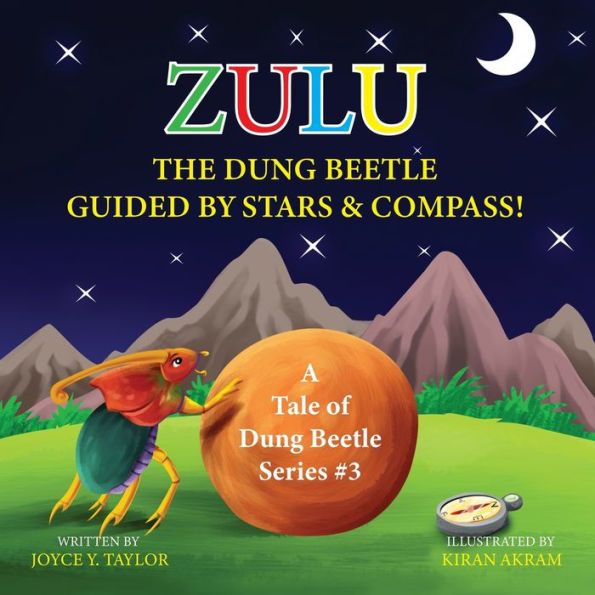
Do dung beetles really navigate by the Milky Way?
Yes, dung beetles are the only animals known to navigate using the Milky Way galaxy itself. Research published in 2013 by Marie Dacke and colleagues showed that African dung beetles (Scarabaeus satyrus) use the bright band of the Milky Way as a directional reference when rolling dung balls at night.
Rolling by Starlight
On a moonless night in southern Africa, a dung beetle pushes a ball of elephant dung across the savanna. The ball is many times the beetle's own body weight. The beetle walks backward, pushing with its hind legs, steering using its head.
To roll in a straight line away from the main dung pile (where thousands of competing beetles could steal its prize), the beetle must navigate. It cannot see its destination. It cannot follow trails. The sun has set. The moon is absent.
The beetle uses the Milky Way - the bright band of our galaxy running across the night sky - as its compass. This is the only animal on Earth known to navigate specifically by galactic structure. A small beetle rolling dung across an African savanna is using the structure of the Milky Way Galaxy as a reference point in ways humans only figured out how to do in the last century.
The Discovery
In 2013, researchers led by Marie Dacke at Lund University in Sweden published findings that overturned assumptions about insect navigation.
The experiments:
Dacke's team tested African dung beetles (Scarabaeus satyrus) in multiple conditions:
Test 1: Beetles with clear view of starry sky rolled dung balls in straight lines.
Test 2: Beetles with small hats blocking their view of the sky rolled in circles, unable to maintain direction.
Test 3: Beetles in a planetarium shown only specific bright stars rolled in variable directions.
Test 4: Beetles shown only the Milky Way projection (no individual bright stars) successfully rolled straight.
Conclusion: Dung beetles use the Milky Way as a directional reference, not specific stars.
Why this matters:
Using the Milky Way as a whole rather than specific stars provides navigation even when:
- Individual stars are obscured by clouds or haze
- Stars are washed out by partial moonlight
- Humidity reduces star visibility
- Light pollution dims individual stars
The broad band of galactic light remains visible when individual stars become invisible, providing a more reliable reference.
Why Navigate Straight?
The ability to roll straight is critical for dung beetle survival.
The competition problem:
When a large mammal deposits fresh dung, thousands of dung beetles may arrive within minutes. The resource is enormous but contested.
A beetle that rolls in circles around the dung pile wastes energy and loses the ball to stronger competitors. A beetle that rolls in a straight line away from the pile escapes competition quickly.
The speed advantage:
Dung beetles don't wander or search for hiding places. They roll fast and straight to distance themselves from rivals before any competitor can catch up and steal their ball.
The burial:
Once safely distant from the main pile, the beetle digs a burial chamber and buries the ball. This is where mating, egg-laying, and larval development occur.
Multiple Navigation References
Dung beetles use various celestial references depending on conditions.
Daytime:
- Sun position: primary reference
- Polarized sunlight patterns: even when sun is partly obscured
Moonlit nights:
- Moon position: direct reference
- Polarized moonlight: even subtle patterns help
Moonless nights:
- Milky Way: main reference
- Individual bright stars: backup references
Day-night transitions:
Beetles smoothly switch between references as light conditions change. During twilight, they use whatever reference provides the clearest directional signal.
Why Roll Dung?
Dung beetles roll dung for multiple reasons.
Food:
Adult dung beetles eat the liquid component of dung - bacteria-rich moisture containing nutrition from the herbivore's incomplete digestion.
Offspring food:
Females lay a single egg in each dung ball. The hatching larva eats the dung ball throughout its 2-3 month development. The ball size determines offspring size and survival.
Competition avoidance:
Moving dung away from the main pile secures food from competitors.
Burial protection:
Buried dung balls protect eggs and developing larvae from predators, parasites, and drying.
Ball structure:
Good dung balls are:
- Spherical: roll smoothly
- Firm: don't fall apart during rolling
- Moist: support egg development
- Nutrient-rich: feed larva adequately
Females choose partners and ball compositions carefully. Larger, healthier balls produce larger, healthier offspring.
The Strength Record
Some dung beetle species are proportionally the strongest animals on Earth.
Horn dung beetles:
Onthophagus taurus can pull 1,141 times its own body weight. Measured in controlled laboratory conditions at the University of London in 2010.
Scale comparison:
If a 70 kg human had equivalent strength, they could lift approximately 80 metric tons - more than a fully loaded passenger bus.
Why so strong:
Small animals have proportionally more power because:
- Muscle power scales with cross-sectional area (squared with size)
- Body weight scales with volume (cubed with size)
- Smaller animals have more muscle per unit weight
Insects generally have extreme strength by this measure. Ants routinely lift 10-50 times their weight. Dung beetles take this to extremes.
Uses for extreme strength:
- Pushing dung balls much heavier than themselves
- Male-male combat for mates and balls
- Digging tunnels through hard soil
- Burying heavy dung balls underground
Ecosystem Services
Dung beetles provide critical ecosystem services.
Dung removal:
In productive grasslands, dung beetles bury approximately 150 kg of dung per hectare per year. Without them, dung would:
- Smother vegetation under piles
- Breed enormous fly populations
- Spread pathogens
- Contaminate water
- Waste nutrients
Australian case study:
When cattle were introduced to Australia, native dung beetles couldn't handle cow manure (they evolved with smaller marsupial droppings). Fly populations exploded and pastures degraded.
The CSIRO Dung Beetle Program imported African and European dung beetle species adapted to cattle dung. These introduced beetles now provide critical agricultural infrastructure for Australian livestock industry.
Soil benefits:
- Aeration through burrowing
- Water penetration improvement
- Nutrient recycling
- Reduced erosion
Parasite control:
Buried dung removes parasite eggs (from livestock parasites) from the reach of grazing animals, reducing disease transmission.
Economic value:
Estimated $380 million annually to US agriculture alone through reduced fly populations, fewer livestock diseases, and better pasture productivity.
Species Diversity
Over 7,000 dung beetle species exist worldwide.
Three main behaviors:
Rollers. The most famous type - make balls and roll them away. Species like African Scarabaeus.
Tunnelers. Dig tunnels directly beneath dung piles and bring dung down to lay eggs. Most common type overall.
Dwellers. Live directly in dung without moving it. Typical of forest and wet environments.
Size range:
- Smallest: 2 mm (hard to see without magnification)
- Largest: 6 cm (giant tropical species)
- Typical: 1-3 cm
Habitat:
Dung beetles live wherever large herbivores exist:
- African savannas
- American grasslands
- European farmland
- Asian forests
- Australian outback
- Amazon rainforest
Dung Preferences
Different dung beetle species prefer different food sources.
Specialists:
Some species specialize on specific dung types:
- Elephant dung (tropical specialists)
- Cattle dung (temperate specialists)
- Monkey dung (forest species)
- Kangaroo dung (Australian endemics)
- Human dung (some species)
Generalists:
Other species accept most dung types, particularly in areas with variable herbivore communities.
Arrival speed:
Fresh dung attracts beetles within seconds. Some species have specialized antennae that detect volatile compounds from new dung kilometers away. A hot savanna elephant dung pile may have thousands of beetles within minutes.
Composition effects:
The specific microbial community in dung affects:
- Nutrient profile
- Moisture content
- Decomposition rate
- Beetle species preferences
Egyptian Cultural Significance
Dung beetles had profound cultural importance in ancient Egypt.
The scarab:
Ancient Egyptians revered dung beetles, calling them "kheper" and associating them with the god Khepri - a dawn god who pushed the sun across the sky (like a beetle pushing a dung ball).
Religious symbolism:
The daily dung ball rolling was seen as analogous to:
- The sun's daily journey across the sky
- Rebirth and resurrection
- Creation of the cosmos
Scarab jewelry:
Scarab beetles appeared extensively in Egyptian:
- Jewelry (pendants, rings, amulets)
- Funeral artifacts (heart scarabs placed in mummies)
- Royal symbols
- Hieroglyphs (the scarab hieroglyph meant "to come into being")
Modern cultural presence:
Scarab imagery continues in:
- Egyptian tourism and cultural products
- Modern jewelry
- Ancient Egyptian-themed art
- Tattoo designs
The cultural legacy of the dung beetle exceeds that of any other insect in the ancient world.
Conservation Concerns
Dung beetles face various threats.
Declines:
Many dung beetle species are declining due to:
- Pesticide use: particularly anti-parasitic drugs in livestock
- Habitat loss: conversion of grasslands to agriculture
- Climate change: altering habitat conditions
- Livestock population changes: fewer large herbivores = less food
- Wildlife decline: reduced native herbivore populations
Ivermectin impact:
The anti-parasitic drug ivermectin, widely used in livestock, passes through animal bodies into dung. Dung beetles that consume this dung often die or have reduced reproduction.
This has caused documented dung beetle declines in regions with intensive ivermectin use.
Protection efforts:
- Some protected areas specifically include dung beetle conservation
- Agricultural practices increasingly consider dung beetle impact
- Research into ivermectin alternatives
- Maintenance of wildlife populations that support beetle food supply
The Small Galaxy Watchers
Dung beetles navigating by the Milky Way remind us that extraordinary capabilities can hide in small, easily dismissed creatures.
A dung beetle rolling dung across the savanna is performing navigation that required humans millions of years of cognitive development and centuries of scientific research to understand. The beetle doesn't know it's using the Milky Way. It doesn't know what a galaxy is. It just uses the brightest band of light in the night sky as a reference for straight-line travel.
This is evolution solving a problem elegantly, without awareness of what it has solved. The result is a small insect whose sensory capabilities include reading our galaxy's structure - a capability humans only developed the scientific tools to recognize in the last few decades.
The dung beetle you might see pushing a ball across a paddock or savanna is not just cleaning up animal waste. It is operating at the intersection of ancient insect biology and galactic-scale navigation. The universe is full of strangenesses, and some of them are small, brown, and spend their lives with their heads down pushing fermented food.
The 2013 Experiment That Proved It
The paper that established dung beetle Milky Way navigation was published in Current Biology in 2013 by Marie Dacke and colleagues at Lund University. The experimental design was elegant: researchers took dung-rolling beetles from their natural African savanna and placed them in the Johannesburg planetarium, where the night sky could be turned on or off at will.
| Experimental Condition | Beetle Path Deviation | Straight-Line Performance |
|---|---|---|
| Full natural night sky | 10-15 degrees | High (good navigation) |
| Only Milky Way visible | 12-18 degrees | High (still good) |
| Only bright stars, no Milky Way | 40+ degrees | Poor (random walking) |
| Total darkness (no celestial cues) | Random | Very poor |
| Cap blocking dorsal vision | Random | Very poor |
"We found that dung beetles transport their balls across the savanna at night using the Milky Way as a compass cue. This was surprising because no insect had previously been shown to use the Milky Way for orientation. It turns out these small beetles are reading our galaxy's structure for their nightly navigation." - Marie Dacke, Lund University, Current Biology, 2013 [1]
The finding generated widespread scientific interest because it represented the first documented use of a galactic-scale cue by any animal. Dung beetles do not see individual stars clearly - their visual acuity is too low - but they can detect the broad band of brightness that is the Milky Way against the darker background of the rest of the night sky.
This is a form of celestial navigation much simpler than star-pattern recognition but still remarkable for an animal with fewer than a million neurons.
Dung Beetle Species in Detail
The family Scarabaeidae, which contains dung beetles, includes more than 7,000 species distributed across every continent except Antarctica. The Kalenux Team compiled notable species showing the behavioral diversity of the group.
| Species | Body Size | Behavior | Notable Feature |
|---|---|---|---|
| Scarabaeus satyrus | 3-4 cm | Roller | Milky Way navigation first documented |
| Phanaeus vindex | 1.5-2 cm | Tunneler | Iridescent green and copper coloration |
| Heliocopris dominus | 5 cm | Tunneler | Asia's largest dung beetle; buries elephant dung |
| Bubas bison | 2.5-3 cm | Tunneler | Major agricultural beneficial species in Australia |
| Kheper nigroaeneus | 3-3.5 cm | Roller | African savanna species |
| Onthophagus taurus | 0.7-1 cm | Tunneler | Strongest insect per body weight (1,141x) |
| Canthon pilularius | 1.2-1.8 cm | Roller | Common North American species |
The onthophagus dung beetle deserves special mention. A 2010 study by Rob Knell and Leigh Simmons in Proceedings of the Royal Society B documented that male Onthophagus taurus can pull 1,141 times their own body weight - making them the strongest insect, and possibly the strongest animal, relative to size ever measured. This prodigious strength is used in competitive pushing matches inside tunnels, where males fight for access to females [2].
Australia's Dung Beetle Import Program
One of the most successful biological control programs in history centers on dung beetles. Before European colonization, Australia had no large herbivores and therefore no dung beetle species adapted to the wet cow dung that European cattle produce. When cattle were introduced in the 1800s, their dung simply accumulated, smothering pastures, breeding parasitic flies, and consuming enormous areas of productive grassland.
"By the 1960s, cattle dung was destroying Australian pastures and supporting populations of bush flies that made rural life intolerable. We had no native dung beetles capable of processing cattle dung. The only solution was to import beetles from Africa and southern Europe, where they had co-evolved with similar herbivores." - George Bornemissza, CSIRO dung beetle researcher, Australian Journal of Ecology, 1976 [3]
The CSIRO Dung Beetle Project, which ran from 1965 to 1985, imported and established 23 species of dung beetle in Australia. The results were spectacular. Bush fly populations fell by more than 90 percent in treated regions. Cattle dung now disappears into Australian soils within 24-48 hours.
The program is estimated to save Australian agriculture roughly $600 million per year in pasture productivity and reduced veterinary costs. It remains the most successful beneficial insect introduction in the history of biological control.
References
- Dacke, M., Baird, E., Byrne, M., Scholtz, C. H., and Warrant, E. J. (2013). "Dung beetles use the Milky Way for orientation." Current Biology, 23(4), 298-300.
- Knell, R. J., and Simmons, L. W. (2010). "Mating tactics determine patterns of condition dependence in a dimorphic horned beetle." Proceedings of the Royal Society B, 277(1692), 2347-2353.
- Bornemissza, G. F. (1976). "The Australian dung beetle project 1965-1975." Australian Journal of Ecology, 6, 9-17.
- Nichols, E., Spector, S., Louzada, J., Larsen, T., Amezquita, S., and Favila, M. E. (2008). "Ecological functions and ecosystem services provided by Scarabaeinae dung beetles." Biological Conservation, 141(6), 1461-1474.
- Scholtz, C. H., Davis, A. L. V., and Kryger, U. (2009). Evolutionary Biology and Conservation of Dung Beetles. Pensoft Publishers.
Related Articles
- Honeybee Waggle Dance: Communication
- Arctic Tern: Pole-to-Pole Migration
- How Birds Navigate Using Earth's Magnetic Field
Frequently Asked Questions
Do dung beetles really navigate by the Milky Way?
Yes, dung beetles are the only animals known to navigate using the Milky Way galaxy itself. Research published in 2013 by Marie Dacke and colleagues showed that African dung beetles (Scarabaeus satyrus) use the bright band of the Milky Way as a directional reference when rolling dung balls at night.
When scientists placed small hats on dung beetles to block their view of the sky, the beetles became disoriented and rolled in circles rather than straight lines. When shown only the Milky Way projection in a planetarium (no individual bright stars), they still navigated straight. This makes dung beetles the only known species to navigate specifically by our galaxy’s stellar band. They also use the sun during the day and the moon during some nights.
Birds, bees, and other animals navigate by stars, but dung beetles use the Milky Way as a whole rather than specific constellations - allowing navigation even when individual stars are obscured by haze or cloud cover.
Why do dung beetles roll dung balls?
Dung beetles roll dung balls to secure food and safe spaces for their young. Adult dung beetles eat liquid components of dung, extracting nutrition from the bacteria-rich moisture. They roll portions of dung into balls, push them away from the main dung pile to avoid competition with other beetles, and bury the balls underground. There they mate, with females laying a single egg inside each buried ball.
The egg hatches into a larva that eats the dung ball as food for its entire larval development - approximately 2-3 months depending on species. Females choose the dung ball size and composition carefully - larger balls support larger, healthier offspring. Males help by rolling and occasionally fighting off rival beetles that try to steal their balls.
A single dung pile can attract thousands of beetles in hot savanna environments, with beetles arriving within seconds of fresh dung being deposited. This rapid dung removal provides critical ecosystem services including soil aeration, nutrient cycling, and pest control - dung beetles bury approximately 150 kg of dung per hectare per year in productive grasslands.
How strong are dung beetles?
Horn dung beetles (Onthophagus taurus) are proportionally the strongest animals on Earth - able to pull 1,141 times their own body weight. This is equivalent to a 70 kg human lifting approximately 80 metric tons. The next strongest proportional pulling is the rhinoceros beetle at 850x body weight. For comparison, ants typically pull 10-50 times their body weight, and humans can deadlift roughly 3-5 times their body weight.
The extreme strength of dung beetles comes from their proportionally massive muscles relative to small body size - physics favors small animals because muscle power scales with cross-sectional area (squared with size) while weight scales with volume (cubed with size). Smaller animals therefore have proportionally more power. Male dung beetles use their strength during horn-locking combat over females and dung resources.
Females use strength to push and roll dung balls much heavier than themselves. The horn beetle strength record was measured in controlled laboratory conditions in 2010 at the University of London.
What do dung beetles eat?
Dung beetles eat dung almost exclusively, though they specialize in different aspects of this food source. Most species eat the liquid portion of dung - the bacteria-rich moisture that contains nutrition from the herbivore’s incomplete digestion. They strain out solid particles and drink the bacteria-rich fluid. Their mouthparts are specifically adapted for this liquid-extraction process.
They don’t directly eat the solid fibers of dung but rely on the bacteria that multiply in herbivore waste. Some species prefer specific dung types - cow dung, elephant dung, monkey dung, or in forest environments, human dung. A single dung pile typically attracts many species that partition the resource by preferring different textures, moisture levels, and depositing times.
Adult beetles mostly consume the liquid component while their larval offspring eat the solid portion of the buried dung ball. This division means no portion of dung goes to waste. Dung beetles are therefore specialist detritivores whose entire life cycle depends on mammal waste - the relationship is remarkably specialized.
Are dung beetles important to ecosystems?
Yes, dung beetles provide critical ecosystem services that would be difficult to replace. They bury approximately 150 kg of dung per hectare per year in productive grasslands, rapidly removing dung that would otherwise breed flies, spread pathogens, and smother vegetation.
Australia’s introduction of non-native dung beetles (after native dung species couldn’t handle the cow manure from imported cattle) prevented a potentially catastrophic fly population explosion. Today, Australia maintains dung beetle breeding programs as agricultural infrastructure.
Dung beetles also aerate soil through their burrowing, improve water penetration, spread seeds mixed into dung, reduce livestock parasite levels (by burying parasite eggs deep underground), and fertilize soils with nutrients from buried dung balls. They support biodiversity of their own - dung beetles themselves host specialized mites, parasites, and predators.
Estimated economic value to US agriculture alone is \(380 million annually through reduced fly populations, fewer livestock diseases, and better pasture productivity. Globally, dung beetles' value likely exceeds \)2 billion yearly. Their decline due to pesticide use and habitat loss threatens significant ecological and agricultural consequences.