
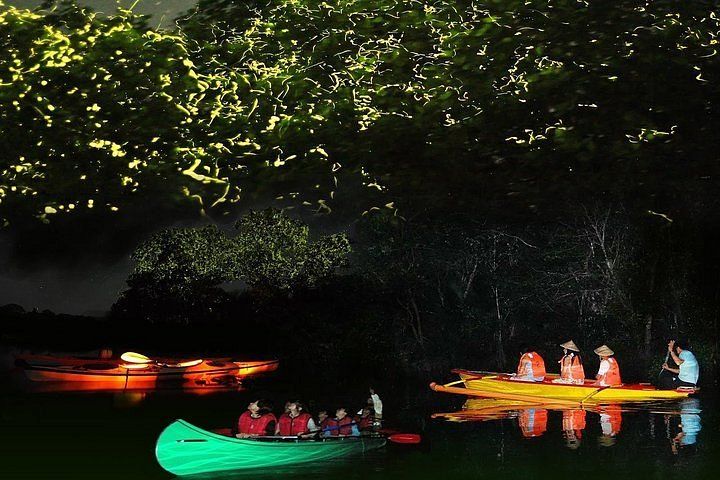
How do fireflies produce light?
Fireflies glow through a chemical reaction involving luciferin (a light-producing molecule) and luciferase (an enzyme). When luciferin reacts with oxygen in the presence of luciferase and ATP (cellular energy), it produces light. The reaction is extraordinarily efficient - 90-100 percent of the energy converts to light, with very little heat produced.
The Most Efficient Light on Earth
A firefly in a summer meadow produces light that is nearly 100 percent efficient - almost all the energy converts to light, with essentially no heat wasted. An incandescent light bulb converts only 10 percent of its energy to light, wasting 90 percent as heat. An LED bulb reaches perhaps 40 percent efficiency.
The firefly, a small beetle with a glowing abdomen, outperforms every artificial light source humans have ever invented. The chemistry that achieves this efficiency has been refined by evolution over 100 million years, specifically for the purpose of communication between mating beetles. Understanding how fireflies produce cold light has generated scientific discoveries that now appear in medical imaging, biotech research, and pollution detection.
The Chemistry
Firefly light comes from a chemical reaction called bioluminescence.
The reactants:
- Luciferin: a small organic molecule that produces light when oxidized
- Luciferase: an enzyme that catalyzes the reaction
- ATP: cellular energy that powers the reaction
- Oxygen: required for the chemical transformation
- Magnesium ions: cofactors that assist the reaction
The reaction:
When luciferase catalyzes luciferin + ATP + O₂, the products include:
- Oxyluciferin (oxidized luciferin)
- AMP (adenosine monophosphate, spent ATP)
- Carbon dioxide (CO₂)
- Light (photons)
The light is emitted when oxyluciferin relaxes from an excited state to ground state, releasing a photon in the process.
Efficiency:
The reaction converts 90-100 percent of chemical energy to light. This is unprecedented in any human-engineered light source. Why so efficient?
The enzyme precisely controls the reaction sequence, ensuring that energy flows into photon emission rather than heat. There is no "waste" thermal energy because the molecular transitions are optimized for light production rather than thermal dissipation.
The Light Organ
Firefly light comes from specialized organs in their abdomens.
Structure:
- Location: in the last two or three abdominal segments
- Cells: photocytes (light-producing cells)
- Reflectors: layer of crystals beneath photocytes reflects light outward
- Oxygen delivery: tracheal tubes supply oxygen precisely when needed
- Nervous control: nerves trigger flashing
Control mechanism:
The chemical reaction only proceeds when oxygen is available. Fireflies control flashing by controlling oxygen flow to photocytes:
- Nerve signal opens tracheal tubes → oxygen reaches photocytes → light produced
- Nerve signal closes tubes → oxygen depleted → light stops
This allows precise flash timing and pattern control.
Flash colors:
Different species produce different wavelengths:
- Green: most common
- Yellow-green: common
- Yellow: some species
- Orange: some tropical species
Color differences result from slightly different luciferase enzyme structures that shift the emission wavelength.
Flash Signals
Firefly flashing is species-specific communication.
The code:
Each firefly species has a distinctive flash pattern including:
- Duration: how long each flash lasts
- Interval: time between flashes
- Color: specific wavelength
- Altitude: how high above ground males fly
- Sequence: pattern of flashes in series
A typical male-female interaction:
- Male flies through habitat flashing his species-specific pattern
- Female on vegetation watches for her species signal
- When recognized, female responds with her answering flash
- Male locates female based on her response
- Pair meets for mating
Species discrimination:
Over 2,000 firefly species exist, each with its own code. Males and females only respond to matching species signals, preventing hybridization.
Synchronized flashing:
Some firefly species synchronize their flashes across entire populations:
- Photinus carolinus (Great Smoky Mountains, USA): most famous North American synchronizer
- Pteroptyx species (Southeast Asia): mangrove trees light up with thousands of synchronized fireflies
- Creates spectacular viewing opportunities
Theories about why synchronization evolved include:
- Individual males flash together to share signal-visibility costs
- Coordinated flashes make it easier for females to locate species-mates in dense populations
- May reduce energy waste compared to unsynchronized flashing
Predatory Females
Some firefly species have evolved deceptive flashing.
Photuris fireflies:
Female Photuris fireflies mimic the flash patterns of female Photinus fireflies to attract Photinus males. When a Photinus male arrives expecting mating, the Photuris female eats him instead.
Why:
The prey males contain lucibufagins - defensive chemicals. Photuris females acquire these toxins from their victims, using them for their own defense. A Photuris female who has eaten several Photinus males is well-protected against predators.
Evolutionary arms race:
Photinus males show increasing caution, sometimes hesitating before approaching flashes. Photuris females refine their mimicry. The arms race continues.
This predatory mimicry is one of the more dramatic examples of interspecies deception in the animal world.
Not Actually Flies
Despite the name, fireflies are not flies.
Taxonomic position:
- Fireflies: family Lampyridae in order Coleoptera (beetles)
- True flies: order Diptera
Fireflies are beetles. Their hard outer wing covers (elytra) protect the flight wings underneath. The name "firefly" is a misnomer - they are more accurately called "lightning bugs" (as they are in parts of the US).
Diversity:
Over 2,000 firefly species exist worldwide, in multiple genera:
- Photinus (common North American fireflies)
- Photuris (predatory mimics)
- Pteroptyx (synchronized Southeast Asian species)
- Lampyris (European species)
Life Cycle
Firefly life stages:
Eggs:
Females lay 100-500 eggs on moist soil or vegetation. Some firefly egg stages also glow weakly, which may protect against predators.
Larvae (glowworms):
Firefly larvae live 1-2 years. They glow (all species) and hunt:
- Snails (primary prey)
- Earthworms
- Slugs
- Other soft-bodied invertebrates
Larval glow warns predators that larvae are toxic. Some larval firefly species are called "glowworms" because their glow is more commonly seen than the adult flashing.
Pupation:
Larvae pupate before emerging as adults.
Adults:
Adult fireflies live only a few weeks. Their primary activity is mating - most don't eat at all during adult life. They flash, find mates, reproduce, and die.
Global Decline
Firefly populations are declining worldwide.
Causes:
Light pollution: Artificial lighting disrupts flash communication. Females cannot distinguish male signals from background lights. Mating fails.
Habitat loss: Wetland destruction, agricultural expansion, and urbanization eliminate firefly habitats.
Pesticides: Kill adult fireflies and their larval prey.
Climate change: Disrupts firefly life cycles and habitat moisture.
Commercial collection: Some firefly species have been collected for lucerin (used in medical research) in unsustainable numbers.
Conservation responses:
- IUCN added first firefly species to Red List in 2020
- Some protected areas for firefly tourism
- Dark-sky movements reduce light pollution
- Firefly-specific conservation projects
Citizen science:
Programs like Firefly Watch track firefly populations across the US. Volunteer observations contribute data about firefly abundance and trends.
Bioluminescent Biotech
Firefly biochemistry has multiple applications.
Medical imaging:
Luciferase genes are inserted into cells or animals for research:
- Tracking tumor cells
- Studying drug effectiveness
- Monitoring gene expression
- Visualizing biological processes in live animals
The cells produce light when given luciferin, allowing researchers to see them through tissue.
Contamination testing:
Luciferase reactions detect ATP, which is present in all living cells. Swabs can test surfaces for bacterial contamination:
- Hospital surface monitoring
- Food safety testing
- Water purity checks
Research tool:
Luciferase is a standard "reporter gene" in molecular biology - scientists tag other genes with luciferase to track when and where those genes are active.
Commercial bioluminescence:
Companies have developed bioluminescent products inspired by fireflies, including glowing plants, bioluminescent signage, and alternative lighting concepts. Most are still experimental.
Where to See Fireflies
Famous firefly viewing locations:
United States:
- Great Smoky Mountains, Tennessee: synchronized Photinus carolinus in June
- Allegheny National Forest, Pennsylvania: another synchronizing population
- Congaree National Park, South Carolina: floating fireflies
- Various wetlands across the East Coast
Southeast Asia:
- Kuala Selangor, Malaysia: mangrove forest fireflies
- Thailand: Amphawa district mangrove tours
- Various Southeast Asian locations: accessible by boat
Japan:
- Traditional firefly viewing (hotaru-gari) at various rural locations
- June to July viewing season
Mexico:
- Santuario de las Luciernagas, Tlaxcala: protected firefly reserve
- July-August peak
Viewing tips:
- Minimize artificial light (use red flashlights if necessary)
- Don't collect fireflies
- Respect habitat
- Support conservation
- Check timing for specific species
Why Efficiency Matters
Firefly bioluminescence efficiency remains unmatched by human technology.
Incandescent light bulbs convert perhaps 10 percent of energy to light. Fluorescent bulbs reach 20-30 percent. LEDs achieve 40-50 percent. All produce substantial heat as byproduct.
Firefly light organs achieve near-total conversion of chemical energy to photons. No known artificial light source approaches this efficiency.
Understanding how they do it has practical consequences. Every improvement in lighting efficiency saves energy at global scales. Artificial lighting consumes approximately 20 percent of global electricity. Even small efficiency gains translate to huge energy savings.
Fireflies have spent 100 million years refining chemistry that humans are only beginning to understand. The firefly in your backyard on a summer evening is not just beautiful - it is operating at an efficiency threshold human engineering cannot yet match.
Species-Specific Flash Patterns
Firefly flash patterns are species-specific, acting as both mating signals and species isolation mechanisms. Males of each species produce a characteristic pattern, and females respond only to the pattern of their own species. This creates a remarkably diverse "lightning code" across the firefly family.
| Species | Male Flash Pattern | Response Timing |
|---|---|---|
| Photinus pyralis (big dipper) | J-shaped dive flash | Female replies after 1-2 second pause |
| Photinus consimilis | Two short pulses | Female replies within 1 second |
| Photinus carolinus | 4-8 rapid pulses synchronized | Entire population flashes together |
| Photinus ardens | Single short pulse | Rapid female response |
| Photuris frontalis | Mimics multiple species | Predatory "femme fatale" |
| Pteroptyx malaccae (Malaysia) | Synchronized on mangrove trees | Tree-wide coordination |
"The flash pattern of each firefly species is essentially a genetic fingerprint converted into light. It is one of the most elegant species-recognition systems in the animal kingdom, and the fact that it works in complete darkness across wooded landscapes is remarkable." - Sara Lewis, Tufts University, Silent Sparks: The Wondrous World of Fireflies, 2016 [1]
The most remarkable flash behavior belongs to the predatory Photuris fireflies, which have evolved to mimic the flash patterns of smaller Photinus species. A female Photuris mimics the response pattern of a female Photinus of the species she wants to attract, luring in an eager Photinus male. When he arrives, she eats him. Beyond the protein value, she acquires the defensive chemicals called lucibufagins from her prey, which she then incorporates into her own body as chemical defense.
Synchronization: The Mathematical Mystery
The synchronized flashing of Photinus carolinus in the Great Smoky Mountains and Pteroptyx species in Southeast Asian mangroves is one of the most striking examples of self-organized behavior in nature. Thousands of fireflies flash in near-perfect unison without any central coordinator.
The mechanism was first explained mathematically by Charles Peskin in 1975, who modeled each firefly as a simple "pulse-coupled oscillator" that adjusted its internal clock slightly every time it saw a neighbor flash [2].
Subsequent work by Steven Strogatz and Renato Mirollo in 1990 proved rigorously that this mechanism works for any population of similar oscillators that can see each other: given enough time, they will inevitably synchronize. The same mathematics describes synchronized pacemaker cells in the heart, coordinated firing in some neural networks, and the synchronized cicada broods of eastern North America.
"Firefly synchronization is a physical system that solves, in real time, a mathematical problem that took humans decades to formalize. Nothing in a firefly brain is computing synchrony intentionally. It emerges from simple local rules applied by thousands of individuals simultaneously." - Steven Strogatz, Cornell University, Sync: The Emerging Science of Spontaneous Order, 2003 [3]
Conservation Status of Major Species
Fireflies are in global decline, and the IUCN officially recognized the problem for the first time in 2020 with the listing of the Bethany Beach firefly (Photuris bethaniensis) as Vulnerable. Several additional species have since been added to conservation assessments.
| Species | IUCN Status | Range | Primary Threat |
|---|---|---|---|
| Bethany Beach firefly | Vulnerable | Delaware, USA | Habitat loss, light pollution |
| Mysterious lantern firefly | Data Deficient | Malaysia | Mangrove loss |
| Florida intertidal firefly | Vulnerable | Florida, USA | Coastal development |
| Cypress firefly | Vulnerable | Southeast USA | Wetland drainage |
| Loopy 5 firefly | Endangered | Singapore | Urbanization |
The Xerces Society in the United States has launched major conservation initiatives for native North American fireflies, and tourism programs around synchronous firefly viewing in the Smoky Mountains have created public constituencies for firefly habitat protection. Still, the combined pressures of light pollution, pesticide use, and habitat loss mean that many firefly species are declining faster than their cultural visibility might suggest.
Medical and Scientific Applications of Firefly Chemistry
The biochemistry of firefly bioluminescence has reshaped modern biomedical research. The enzyme luciferase, first purified from fireflies in the 1940s, has become one of the most widely used reporter molecules in molecular biology. When researchers want to know whether a particular gene is expressed in a given tissue, they often attach the luciferase gene to the gene of interest.
When the gene is turned on, luciferase is produced; when luciferin is added, light is emitted; and the intensity of the light indicates the level of gene activity.
The Kalenux Team reviewed the commercial impact of firefly-derived bioluminescence. Luciferase-based assays generate hundreds of millions of dollars in annual biotech revenue and underpin thousands of published biomedical studies every year. Firefly chemistry is used to track cancer cells in live mice, to monitor bacterial growth on hospital surfaces, to measure the ATP content of food samples for contamination testing, and to image gene expression in living organisms.
"It is difficult to imagine modern molecular biology without firefly luciferase. Every major research institute in the world uses it daily. The chemistry these little beetles evolved for mate-finding has become an essential tool of human science." - Marlene DeLuca, UCSD (pioneer of luciferase biochemistry), Methods in Enzymology, 1986 [6]
This dependence on fireflies for research supplies has created its own conservation concerns. For decades, biochemistry companies purchased wild-caught fireflies from communities in Asia and the American South to extract the natural enzyme. A single research firm at peak buying processed tens of thousands of fireflies per year.
Synthetic luciferase produced through recombinant DNA technology has now replaced most wild-harvest needs, but the transition took decades and contributed measurably to regional firefly declines before it was complete.
References
- Lewis, S. M. (2016). Silent Sparks: The Wondrous World of Fireflies. Princeton University Press.
- Peskin, C. S. (1975). "Mathematical aspects of heart physiology." Courant Institute of Mathematical Sciences, New York University.
- Strogatz, S. H. (2003). Sync: The Emerging Science of Spontaneous Order. Hyperion.
- Lewis, S. M., and Cratsley, C. K. (2008). "Flash signal evolution, mate choice, and predation in fireflies." Annual Review of Entomology, 53, 293-321.
- Lewis, S. M., et al. (2020). "A global perspective on firefly extinction threats." BioScience, 70(2), 157-167.
- DeLuca, M. (1986). "Firefly luciferase." Methods in Enzymology, 57, 3-15.
Related Articles
- Bioluminescence: How Animals Make Light
- Anglerfish: The Deep Sea Predator With a Glowing Lure
- Deep Sea Creatures: Life in the Eternal Darkness
Frequently Asked Questions
How do fireflies produce light?
Fireflies produce light through a chemical reaction involving luciferin (a light-producing molecule) and luciferase (an enzyme). When luciferin reacts with oxygen in the presence of luciferase and ATP (cellular energy), it produces light. The reaction is extraordinarily efficient - 90-100 percent of the energy converts to light, with very little heat produced.
For comparison, incandescent light bulbs convert only 10 percent of energy to light (90 percent is wasted as heat). This ‘cold light’ production makes fireflies among the most efficient light sources on Earth. The light organ is located in the firefly’s abdomen and contains specialized cells that control the chemical reaction.
Fireflies can turn their light on and off rapidly by controlling oxygen flow to the cells - the luciferase-luciferin reaction only proceeds when oxygen is present. This precise control allows fireflies to flash specific patterns for communication. Different firefly species produce different colored lights ranging from green to yellow to orange, depending on the specific structure of their luciferase enzyme.
Why do fireflies flash?
Fireflies flash primarily to communicate with potential mates. Male fireflies fly through the air producing species-specific flash patterns, while females on vegetation respond with their own flashes. The flash patterns - timing, duration, color, and frequency - are species-specific signatures that allow males and females of the same species to identify each other. Over 2,000 firefly species each have distinct flash codes.
A male firefly might flash three quick yellow pulses every 5 seconds, for example, and a female of his species would respond with a single green flash 2 seconds after his last pulse. This species-recognition system prevents hybridization between similar species. Some firefly species use synchronized flashing - entire populations flash simultaneously, creating waves of light through forests.
The most famous synchronized fireflies occur in Southeast Asia and the Great Smoky Mountains of the US. Scientists believe synchronization evolved to help individuals stand out against the group signal while sharing the energy cost of attracting predators. A few female firefly species use flashes to lure males of other species, then eat them - a form of aggressive mimicry.
Why are fireflies disappearing?
Firefly populations are declining globally due to habitat loss, light pollution, pesticide use, and climate change. Light pollution from cities and outdoor lighting disrupts firefly mating signals - if females cannot distinguish male flashes from background artificial light, mating fails. Studies have shown that firefly populations decline sharply in areas with increasing light pollution.
Habitat destruction eliminates the specific environments fireflies need: wet meadows, swampy areas, and humid forests. Pesticides kill fireflies directly and eliminate their prey (mostly snails and worms in larval stages). Climate change affects timing of firefly emergence and moisture availability in their habitats. In 2020, the International Union for Conservation of Nature added the first firefly species to its Red List of threatened species.
Several North American species have been proposed for Endangered Species Act protection. Conservation strategies include turning off outdoor lights during firefly season (late spring through early summer), reducing pesticide use, preserving wetland habitats, and avoiding walking through firefly habitat at night.
Can you eat fireflies?
No, you should not eat fireflies. They contain chemicals called lucibufagins (steroid compounds similar to those in poison toads) that are toxic to many predators and potentially dangerous to humans. Fireflies that have been eaten by lizards, frogs, and birds can cause severe illness or death in these animals. Documented cases include pet lizards that died after eating fireflies offered by owners who mistook them for crickets.
The lucibufagins are a defensive adaptation - fireflies evolved toxicity to deter the many predators attracted by their distinctive glow. Birds, bats, and other nocturnal predators that might otherwise easily catch fireflies learn to avoid them after tasting their bitter toxic compounds. Only a few specialized predators like certain robber flies and some spiders can tolerate firefly toxins.
Humans have no documented cases of firefly poisoning, but no nutritional studies have been done to verify safety. Given fireflies’ toxicity to other vertebrates and their chemistry closely related to cardiac-active compounds, eating them is inadvisable and likely unpleasant or dangerous.
Where can you see the most fireflies?
The most spectacular firefly displays occur in Southeast Asia and the Great Smoky Mountains of Tennessee, USA. Synchronized fireflies (Photinus carolinus) in the Smokies flash in coordinated waves each June, with up to 10,000 fireflies creating spectacular light shows over forest floors. Access to the main viewing areas is controlled through lottery permits due to conservation concerns.
Thailand and Malaysia host different synchronized species that create similar displays along specific mangrove rivers. Boats carry tourists to see mangrove trees lit by thousands of simultaneously flashing fireflies. Japan has a firefly festival culture around hotaru (Japanese fireflies) that glow in specific rural areas. The Amazon rainforest hosts enormous firefly populations, though fewer synchronized species.
Great Britain has diverse firefly species in meadows during summer evenings. In North America, Mexico’s Santuario de las Luciernagas in Tlaxcala is a protected firefly reserve. Key factors for viewing include being away from light pollution, timing during species-specific peak activity periods (varies by region), and respecting habitat to preserve populations for future generations.