
How many beetle species are there?
Explaining beetle diversity starts with a count: approximately 400,000 beetle species have been formally described, with estimates of total beetle species (including undescribed) reaching 1-4 million. Beetles (order Coleoptera) represent approximately 40 percent of all insect species and 25 percent of all animal species. No other animal order comes close - the second-most diverse insect order (Lepidoptera, butterflies and moths) has only about 180,000 species.
The Most Diverse Order of Animal Life on Earth
When the British biologist J.B.S. Haldane was asked what his scientific studies had taught him about the Creator, he reportedly replied: "an inordinate fondness for beetles."
The line is probably apocryphal, but the underlying fact is correct. Of all the animal species on Earth, approximately 25 percent are beetles. Of all the insect species, 40 percent are beetles. The order Coleoptera contains more described species than vertebrates, molluscs, crustaceans, and spiders combined.
This is not a small margin. It is a staggering overrepresentation. If you randomly selected an animal species from Earth's biodiversity, you would have a 1 in 4 chance of selecting a beetle. Understanding why beetles dominate animal diversity reveals something important about how evolution actually works.
The Numbers
Species counts:
- Formally described beetle species: approximately 400,000
- Estimated total beetle species (including undescribed): 1-4 million
- New species described per year: approximately 1,000-2,000
For comparison:
| Animal Group | Described Species |
|---|---|
| Beetles (Coleoptera) | 400,000 |
| Butterflies/moths (Lepidoptera) | 180,000 |
| Flies (Diptera) | 160,000 |
| Bees/wasps/ants (Hymenoptera) | 150,000 |
| True bugs (Hemiptera) | 82,000 |
| Fish | 35,000 |
| Mammals | 6,500 |
| Birds | 10,000 |
| Reptiles | 11,000 |
Beetles outnumber all vertebrates combined by a factor of 6-to-1. They outnumber the second-most-diverse insect order (Lepidoptera) by 2-to-1. The category of "beetles" contains more species than most people even know exist in total biodiversity.
What Makes a Beetle
All beetles share defining characteristics that made their evolutionary success possible.
Hardened forewings (elytra):
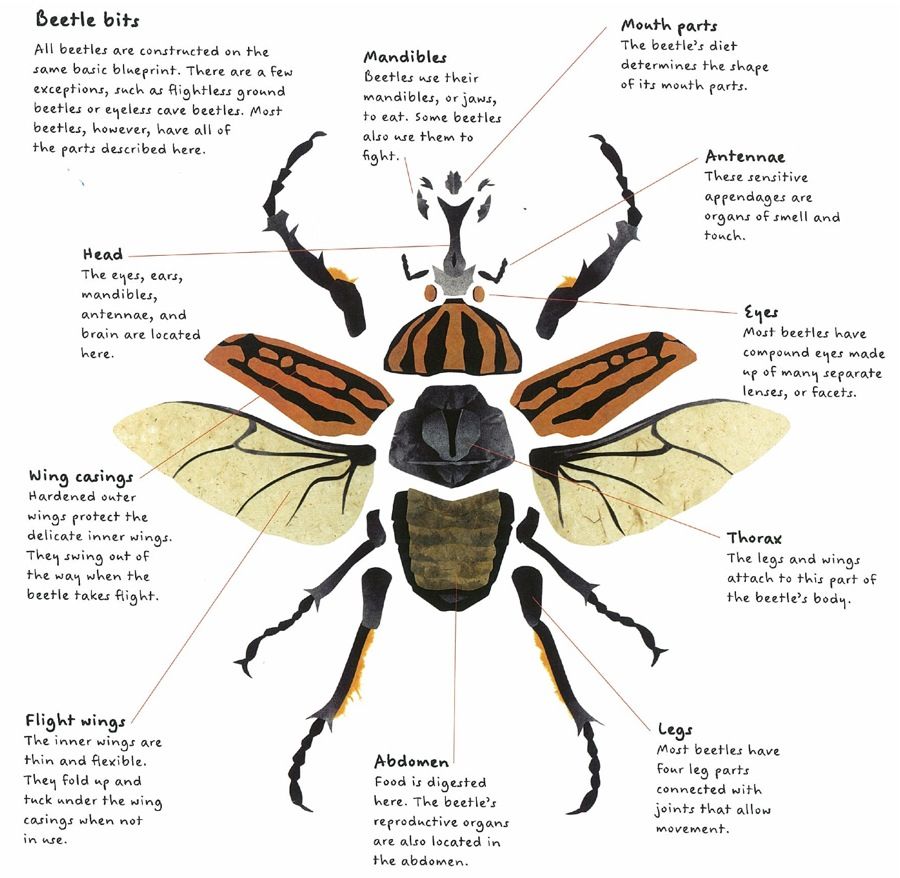
The most distinctive beetle feature is the transformation of the forewings into hard protective covers called elytra. These hardened wing covers protect the beetle's body from predators, mechanical damage, and dehydration.
Under the elytra are thin flight wings that unfold for flight. Most beetles can fly, though they first must open the elytra and extend the flight wings - making them less agile than insects with always-ready wings.
The elytra's protective function is profound. Beetles can:
- Burrow through soil without damage
- Hide in crevices where other insects would be crushed
- Survive attacks that would kill softer-bodied insects
- Live in environments that would damage less-protected bodies
This armor is the foundation of beetle diversity - it allowed them to exploit ecological niches other insects could not.
Complete metamorphosis:
Beetles undergo complete metamorphosis, meaning their larvae (usually called "grubs") look completely different from adults. Egg, larva, pupa, and adult are four distinct life stages.
This metamorphosis has enormous ecological advantages. Larvae and adults can:
- Live in completely different habitats
- Eat completely different foods
- Occupy different ecological niches
- Avoid competing with each other for resources
A beetle larva feeding on rotting wood does not compete with its parent adult, which may be drinking flower nectar. This niche separation allows beetle species to efficiently exploit multiple resources simultaneously.
Diverse feeding strategies:
Collectively, beetles eat:
- Living plants (leaves, stems, roots, flowers, seeds)
- Dead and decaying plant matter
- Wood (alive or dead)
- Fungi
- Other insects
- Dead animals (carrion)
- Dung
- Blood (some rare cases)
- Stored food products
- Almost any organic material
This dietary breadth is unmatched in other insect orders. Wherever there is organic matter on Earth, there is probably a beetle that eats it.
Why So Many Species
Several factors combine to produce beetle diversity.
1. Ancient Origin
Beetles first appeared approximately 270 million years ago during the Permian period. They survived the mass extinction at the end of the Permian (the "Great Dying" that killed 95 percent of marine species), the mass extinction at the end of the Triassic, and the asteroid impact that killed the non-avian dinosaurs.
Through all these extinctions, beetles continued diversifying. They have had approximately 270 million years to produce new species. Most other animal groups are younger or have experienced more severe population bottlenecks.
2. Small Body Size
Most beetles are small - typically 2-20 mm. This small size allows them to exploit niches unavailable to larger animals:
- Cracks and crevices too small for vertebrates
- Individual flowers or fruits as complete habitats
- Microhabitats within larger habitats (tree bark, leaf litter)
- Spaces between sand grains or soil particles
A single tree might contain 100+ different beetle species, each occupying a slightly different microhabitat. Multiply this across Earth's ecosystems and the number of available niches is enormous.
3. Morphological Plasticity
The basic beetle body plan (hardened elytra, six legs, segmented body) is remarkably flexible. Over 270 million years, evolution has modified this plan to produce:
- Giants (Goliath beetles at 100+ grams)
- Microscopic species (featherwing beetles at 0.25 mm)
- Aquatic beetles (water beetles, whirligigs)
- Wood borers (bark beetles, longhorn beetles)
- Dung specialists (dung beetles)
- Predators (ground beetles, ladybirds)
- Parasites (various rarer species)
- Herbivores (weevils, leaf beetles)
- Decomposers (carrion beetles, rove beetles)
Each adaptation has spawned further diversification. A single specialized feeding strategy often produces thousands of species over millions of years.
4. Host Specificity
Many beetles specialize on specific plant or animal species. This host specificity allows multiple beetle species to coexist without direct competition - each targets different hosts.
Plant-feeding beetles, for example, often specialize on specific plant families or genera. As plants diversify, their specialist beetles diversify alongside them. This coevolution has produced explosive diversification in both plants and beetles.
An estimated 100,000+ beetle species feed specifically on plants. Each has a specialized relationship with particular host plants or plant parts.
5. Sexual Selection
Many beetles have elaborate mating displays, specialized sexual anatomy, and complex mate choice behaviors. These sexual selection pressures drive rapid evolution of superficially small but reproductively important differences.
Two beetle populations separated by geographic barriers can evolve distinct mating signals in relatively short evolutionary time. If the populations later reunite, the different signals prevent interbreeding, producing two species where there was one.
This is rapid speciation through sexual selection. It has happened repeatedly in beetle evolution, producing many closely related but distinct species that differ primarily in mating behavior.
The Size Extremes
Beetles span an enormous size range, from microscopic to giant.
Smallest beetles:
Featherwing beetles (family Ptiliidae) are the smallest beetles - and among the smallest free-living insects. The smallest species measures just 0.25 mm long. At this size, they are barely visible without magnification.
Featherwings have fringed wings (hence the name) that function almost like fish gill-structures. Their bodies are reduced to the minimum structures required for insect life.
Largest beetles:
Goliath beetle (Goliathus goliatus): African species with adult males weighing up to 100 grams (3.5 oz). Larvae are even heavier - up to 120 grams. Goliath larvae are the largest insect larvae known.
Hercules beetle (Dynastes hercules): Central and South American species. Males reach 17 cm in total length including their massive prothorn (front horn). Body weight: up to 85 grams.
Titan beetle (Titanus giganteus): Amazon species. Longest beetle by body length alone (without horns) at 16.7 cm.
Elephant beetle (Megasoma elephas): Central American species. Adults reach 13-14 cm length and 40-50 grams.
These giant beetles live in tropical rainforests where abundant plant biomass supports their massive food requirements. They are some of the largest living insects.
The size range:
From 0.25 mm (featherwing) to 170 mm (Hercules beetle) is a range of 680x in length, or approximately 300,000x in weight. This is the largest size range within any animal order, reflecting the beetle body plan's extreme flexibility.
Economic Impact
Beetles cause substantial economic damage worldwide, though most species are ecologically beneficial.
Major pest species:
Bark beetles. Several species have destroyed vast forests in North America and Europe. Mountain pine beetles killed approximately 730 million cubic meters of lodgepole pine in British Columbia alone from 2001-2014. Climate change has enabled these beetles to expand beyond their historical ranges and survive through mild winters that previously limited them.
Colorado potato beetle (Leptinotarsa decemlineata): Major pest of potato crops globally. Has evolved resistance to essentially every insecticide used against it.
Boll weevil (Anthonomus grandis): Historically devastated cotton production in the American South. Eradication programs have largely controlled it in the United States but it remains a pest in other cotton-producing regions.
Red palm weevil (Rhynchophorus ferrugineus): Invasive pest destroying palm trees across Southern Europe, Middle East, and North Africa.
Grain storage pests. Various beetle species (rice weevils, maize weevils, lesser grain borers) attack stored grain, causing substantial food losses. Developing countries lose an estimated 20-40 percent of stored grain to insect pests, mostly beetles.
Structural damage. Powderpost beetles, furniture beetles, and others damage wooden structures. The economic cost of beetle damage to buildings runs into billions of dollars annually globally.
Beneficial beetles:
Despite pest concerns, most beetles are ecologically beneficial or neutral:
- Ladybirds (ladybugs) eat aphids and are widely used in agricultural pest control
- Ground beetles prey on many crop pest species
- Dung beetles clean up animal waste and fertilize soils
- Carrion beetles help decompose dead animals
- Rove beetles control various pest species
In total, beetles provide substantial ecosystem services that are largely invisible to casual observation.
Remarkable Beetle Species
Some beetle species have particularly striking biology.
Bombardier beetle (Brachinus and related genera).
Produces a chemical defense mechanism that shoots boiling hot toxic liquid from a specialized organ in the abdomen. The beetle mixes hydroquinones with hydrogen peroxide at the moment of discharge, producing a reaction that heats the fluid to nearly 100°C.
The spray is ejected in rapid pulses (up to 500 pulses per second), creating a sound like tiny gunshots. The hot fluid causes pain and tissue damage to attacking predators, driving them away.
This chemical defense has been extensively studied and used as an example of complex biological systems that would be difficult to evolve gradually. The beetle must evolve all components (chemicals, reaction chamber, timing mechanism) together for the system to work - a puzzle of evolutionary biology.
Tiger beetle (Cicindelidae family).
The fastest-moving insect relative to body size. Large tiger beetles can run at 2.4 meters per second - approximately 125 body lengths per second. Scaled to human proportions, this would equal running at about 750 km/h.
So fast that they actually outrun their own visual processing. They chase prey in bursts because at maximum speed, they cannot see detail well enough to track the prey accurately. Tiger beetles sprint, stop to look, sprint again, stop to look.
Stag beetles (family Lucanidae).
Males have enormous mandibles (like antlers) used in combat with other males for mating access. Combat involves lifting opponents and throwing them from logs or branches.
The mandibles are so large that they cannot be used for feeding - adult males rely on fluids they absorbed as larvae. They exist essentially as fighting and mating machines.
Hercules beetle (Dynastes hercules).
The Hercules beetle can lift 850 times its own body weight - among the strongest animals relative to size. A human with equivalent strength could lift approximately 65,000 kilograms (143,000 lb).
The strength comes from mechanical advantage (rather than pure muscle power) - the beetle's body plan is structured like a biological lever system that amplifies muscle force.
Whirligig beetles (family Gyrinidae).
Aquatic beetles that live on water surfaces. They have divided eyes - one half looking above the water, the other half looking below. This gives them simultaneous vision of both their airborne environment and underwater environment.
They also produce pheromones that stick to water surface tension, leaving chemical trails other whirligigs can follow. Groups of whirligigs form complex social behaviors on water surfaces.
Fireflies (family Lampyridae, though technically beetles not flies).
Produce bioluminescence for communication during mating. Different species produce different flash patterns - species-specific codes that allow mate identification.
Some predatory firefly species mimic the flash patterns of other species to attract males as prey. This interspecies deception represents one of the most sophisticated aggressive mimicry systems known.
The Environmental Sensitivity
Despite their evolutionary success, many beetle species face modern threats.
Climate change impacts:
Bark beetle range expansion. Warming temperatures allow bark beetles to survive through previously limiting winters, expanding northward and killing forests at unprecedented rates.
Habitat shifts. Many beetle species are closely tied to specific plants or environments. As climate change alters ecosystems, beetle distributions must shift or populations decline.
Extinction risks:
Some beetle species face serious extinction risk. The American burying beetle was once widespread across North America; it now survives in fragmented populations. Numerous island-endemic beetle species have gone extinct from habitat destruction.
Loss of undescribed species:
Perhaps the most concerning is the loss of beetle species that science never formally described. Tropical deforestation is destroying habitats before biologists can catalog the beetle species living there.
Estimates suggest the total beetle species count could be 1-4 million, meaning 75+ percent of beetle diversity remains undescribed. Much of this undescribed diversity may be going extinct before it is even identified.
Economic versus ecological value:
The widely reported pest beetles (bark beetles, weevils, etc.) receive substantial research attention due to economic importance. Most other beetle species receive minimal scientific attention despite potentially significant ecological roles.
This research bias means we know very little about the majority of beetle species. As their populations decline or species go extinct, we may lose ecosystem services we never documented.
Haldane's Creator
Returning to Haldane's quip about an "inordinate fondness for beetles" - what does beetle dominance actually tell us about biology?
The evolutionary lesson:
Beetle diversity demonstrates that evolution does not produce uniform distributions across species. Specific adaptive features (the elytra, complete metamorphosis, small body size) can enable extraordinary diversification. Groups with such features dominate biodiversity; groups without equivalent advantages do not.
The ecological lesson:
Many ecological niches are too small or specialized for vertebrates or larger animals. The majority of terrestrial ecological diversity exists at scales that insects, and particularly beetles, can exploit.
The scientific lesson:
We focus disproportionately on vertebrates in biology education, conservation policy, and public attention. The actual numerical majority of animal diversity - beetles specifically and insects generally - receives substantially less attention than their biological importance justifies.
The philosophical lesson:
When we think about what animal life on Earth looks like, the accurate picture is dominated by small, hard-shelled insects most of which most people cannot identify. The tigers, elephants, and whales we center in our conception of biology are minority representatives in a world fundamentally dominated by beetles.
Haldane's Creator, if imagining life on Earth, was creating predominantly beetles. Everything else was secondary to that main project.
The Taxonomic Challenge
Beetle diversity creates practical challenges for biologists.
The description backlog:
With 400,000 species described and 1-4 million total, approximately 75+ percent of beetle species exist without formal scientific description. Cataloging all beetles would take current taxonomists thousands of years at current rates.
The expertise shortage:
Few scientists specialize in beetle taxonomy. Training in beetle identification and description requires years of focused education. The global community of beetle experts is small relative to the scale of work needed.
The funding challenge:
Taxonomic research receives limited funding compared to research on charismatic species or applied biology. Pure descriptive biology (identifying and formally describing new species) has declined as a research focus since the mid-20th century.
The data challenge:
Integrating information about beetles from museum collections, field research, molecular analysis, and historical literature requires substantial database infrastructure. Projects like the Global Biodiversity Information Facility attempt to coordinate this information but face constant updating demands.
What this means for conservation:
We cannot effectively conserve species we have not documented. If tropical deforestation eliminates beetle species that science never formally described, those species were effectively invisible to conservation efforts.
The solution - more systematic biology, more museum funding, more graduate students in taxonomy - has been recommended for decades without significant action. Beetle diversity continues to be underdescribed, under-conserved, and under-appreciated.
What Beetle Diversity Teaches Us
Beetles are not just a curiosity of biodiversity. They demonstrate several important principles:
Evolution rewards specific adaptations disproportionately. Some features (like the elytra) enable diversification on a scale that other features do not. Understanding which adaptations are "diversification enablers" is important for understanding how biodiversity is produced.
Biodiversity has specific structures. It is not evenly distributed across taxonomic groups. Some groups dominate. Understanding this structure is important for biology, conservation, and ecological modeling.
Our perception of biodiversity is biased. We focus on vertebrates while the actual majority of diversity is invertebrate. Accurate biology education and conservation policy should reflect this reality.
Small size has huge evolutionary advantages. Many of Earth's ecological niches can only be exploited by small animals. The dominance of small insects (beetles particularly) reflects this.
Evolution has produced things we still do not understand. Most beetle species are not yet described. Most beetle biology is not yet studied. We have extensive catalogs of some groups and almost none of others. There is much biology still to be learned.
Next time you see a beetle - any beetle, anywhere - consider that you are looking at one of the most evolutionarily successful types of animals on Earth. There are more species like the one in front of you than there are species of mammals, birds, reptiles, amphibians, and fish combined.
The beetle has been evolving for 270 million years. It has survived every mass extinction since its origin. It has produced more diversity than any other animal group. It occupies almost every terrestrial and many aquatic ecosystems.
We think of biodiversity through the lens of large charismatic animals. The actual biodiversity of Earth is dominated by small hardened insects that most humans never notice and cannot identify. Haldane's inordinate fondness was not whimsy - it was an accurate observation about what life on Earth actually looks like at a species level.
Related Articles
- Beetles: The Most Diverse Order of Life on Earth
- How Much Do All Ants on Earth Weigh?
- Insect Superpowers: Abilities That Defy Belief
Frequently Asked Questions
How many beetle species are there?
Approximately 400,000 beetle species have been formally described, with estimates of total beetle species (including undescribed) reaching 1-4 million. Beetles (order Coleoptera) represent approximately 40 percent of all insect species and 25 percent of all animal species. No other animal order comes close - the second-most diverse insect order (Lepidoptera, butterflies and moths) has only about 180,000 species. When the famous British biologist J.B.S.
Haldane was asked what biology tells us about the Creator, he famously replied ‘an inordinate fondness for beetles,’ referencing the extreme over-representation of beetles in animal diversity. New beetle species are described by science at a rate of approximately 1,000-2,000 per year, with most undiscovered diversity existing in tropical regions.
Why are beetles so diverse?
Beetles owe their extreme diversity to several evolutionary advantages: (1) hardened forewings (elytra) protecting their bodies from predators, injuries, and dehydration, (2) the ability to colonize virtually every terrestrial habitat and many aquatic ones, (3) complete metamorphosis that allows larvae and adults to specialize in different food sources, reducing competition, (4) small body sizes enabling them to exploit tiny ecological niches unavailable to larger animals, (5) ancient origin (beetles first appeared approximately 270 million years ago) giving them extensive time to diversify, and (6) adaptability to feed on plants, other insects, carrion, dung, fungi, and almost anything organic. No other animal order has quite this combination of features. Their evolutionary success is a textbook example of how specific adaptations can drive exceptional diversity.
What is the largest beetle?
The largest beetle by weight is the Goliath beetle (Goliathus goliatus) of Africa, with adult males weighing up to 100 grams (3.5 oz). Their larvae are even heavier, sometimes reaching 120 grams - the largest insect larvae known. The longest beetle is the Hercules beetle (Dynastes hercules) of Central and South America, with males measuring up to 17 cm including their massive prothorn (front horn).
The Titan beetle (Titanus giganteus) of the Amazon can reach 16.7 cm body length (without horns), making it the longest beetle by body measurement alone. These giant beetles all live in tropical rainforests where abundant plant material supports their massive size. The smallest beetles, featherwing beetles (family Ptiliidae), measure just 0.25 mm - barely visible to the naked eye.
The size range from smallest to largest beetle spans four orders of magnitude.
Can beetles fly?
Most beetle species can fly, though they are typically less efficient fliers than other flying insects. Beetles have two pairs of wings: the hardened outer wings (elytra) that protect their bodies when folded, and thin membranous wings underneath used for flight. Before flying, a beetle must raise its elytra upward and unfold the hidden wings from beneath. This extra step makes beetles slower to initiate flight than bees, wasps, or flies.
Additionally, beetle flight is generally less agile and slower than that of other flying insects. However, beetles fly adequately for their ecological needs - escaping predators, finding mates, dispersing to new habitats, and locating food sources. Some beetle species (like many ground beetles and weevils) have lost flight capability entirely through evolution, becoming fully terrestrial.
Flightless beetles often have fused elytra and no functional wings underneath.
Are beetles dangerous to humans?
Very few beetles are dangerous to humans, though several species cause economic damage or minor injuries. Bark beetles have destroyed vast forests in North America and Europe, killing billions of trees and transforming landscapes. Weevils damage stored grain and cause significant food losses.
Blister beetles produce a toxin (cantharidin) that can cause skin irritation or serious harm if consumed - one case of horse mortality in the American Southwest occurred when hay contaminated with blister beetles was fed to the horses. Rove beetles in the genus Paederus produce toxins that cause skin burns from contact.
Bombardier beetles spray hot chemical defensive liquids at temperatures up to 100°C when threatened, though their sprays rarely cause serious human injuries. Direct beetle bites are typically minor and non-venomous. Overall, beetles cause far more economic damage (to crops, stored foods, and forests) than direct human injury.