
The Chinese mantis is the largest mantis species found in North America - and it is not native to the continent. Tenodera sinensis arrived in the United States in 1896 as an accidentally imported ootheca on a shipment of nursery stock delivered to Mt. Airy, near Philadelphia.
In the century and a quarter since, it has spread across most of the eastern and central United States and parts of southern Canada, aided enormously by deliberate sale of its egg cases as a garden biocontrol product. Gardeners buy the oothecae expecting the mantises to eat pests.
The mantises grow up to 11 centimetres long, strike prey in under 50 milliseconds, and eat whatever they can catch - including hummingbirds.
This guide covers every aspect of Chinese mantis biology and ecology: size, anatomy, the history of its introduction, hunting behaviour, diet, vertebrate predation including the well-documented hummingbird kills, reproduction, oothecae, sexual cannibalism, and the strange facts that make this East Asian insect one of the most successful non-native arthropods in North America.
It is a reference entry, not a summary - so expect specifics: measurements, dates, strike speeds, ootheca egg counts, and documented prey records.
Etymology and Classification
The scientific name Tenodera sinensis combines two roots. Tenodera is a genus name coined by the Swiss entomologist Henri de Saussure in 1869, derived from Greek elements loosely meaning "stretched neck" - a reference to the long, slender prothorax typical of the genus. Sinensis is a Latin adjective meaning "of China", reflecting the species' East Asian origin. The species was formally described by Saussure in 1871 based on specimens from China.
For much of the twentieth century, taxonomic literature treated Tenodera sinensis as a subspecies or synonym of Tenodera aridifolia, a closely related East Asian mantis. Molecular work and careful morphological comparison in the 1980s and 1990s confirmed T. sinensis as a full species in its own right. Most modern field guides and databases now use Tenodera sinensis as the accepted name. Some older North American literature still refers to the species as Tenodera aridifolia sinensis.
In Chinese the species is known as tang lang, a general word for praying mantis that also appears in the classical martial arts term for praying mantis kung fu. In Japanese it is called kamakiri. Across its introduced North American range it is most commonly just "Chinese mantis" or "praying mantis", the latter a name the species shares with several unrelated mantis species in the region.
Taxonomically the Chinese mantis sits within the family Mantidae, a large and diverse group of typical praying mantises. The order Mantodea contains roughly 2,400 described mantis species worldwide. Tenodera sinensis is one of the better studied members of the family thanks to its size, abundance in the pet and biocontrol trade, and ecological impact in North America.
Size and Physical Description
Chinese mantises are large, long-bodied, and boldly proportioned.
Females:
- Length: 8-11 cm from head to tip of abdomen, rare specimens approaching 12 cm
- Weight: 5-8 grams when gravid
- Colouration: pale green to straw-tan, usually with a contrasting green lateral stripe along the leading edge of the folded forewings
- Abdomen: broad and obvious when egg-bearing
Males:
- Length: 7-9 cm
- Weight: 2-4 grams
- Colouration: similar but more uniform tan or light brown in many individuals
- Abdomen: noticeably slimmer, with more visible segmentation
Nymphs at hatching:
- Length: 6-7 mm
- Colouration: pale brown-tan, resembling miniature wingless adults
- Number hatching from a single ootheca: 100-200
Several features separate the Chinese mantis from the native North American mantids it now lives alongside. Body length is the most obvious - the native Carolina mantis (Stagmomantis carolina) tops out around 6 centimetres, roughly half the size of a large female Chinese mantis.
The European mantis (Mantis religiosa), another introduced species, reaches 7-8 centimetres and can be confused with the Chinese mantis at a glance, but the European mantis shows a distinctive black-and-white bullseye mark on the inner surface of each foreleg, which the Chinese mantis lacks.
The raptorial forelegs of Tenodera sinensis are particularly well developed. Each foreleg is armed with two rows of sharp spines along the femur and tibia that interlock when the leg snaps closed around prey. The strike leaves almost no chance of escape for prey small enough to be fully gripped, and in the case of larger or vertebrate prey the spines often penetrate soft tissue on impact.
The compound eyes of adult Chinese mantises are large, semi-spherical, and highly mobile relative to the head. Each eye contains thousands of ommatidia - the individual optical units of an insect compound eye. The ommatidia pointed directly toward an observer absorb incoming light, while surrounding ommatidia reflect it, creating the illusion of a dark pupil that seems to track the observer from any angle.
This "false pupil" or pseudopupil is a common feature of mantis vision and is especially prominent in large-eyed species like T. sinensis.
The 1896 Introduction to North America
The Chinese mantis is one of the clearest examples of an accidental invasive insect with lasting ecological consequences. The introduction is well documented. In 1896 a shipment of nursery stock arrived at Mt. Airy, now part of Philadelphia, Pennsylvania. One or more Chinese mantis oothecae were attached to the plant material.
The nymphs hatched in the following spring and established the first North American population. Entomologists of the era recorded the event with curiosity rather than alarm - a large, handsome, visibly predatory insect seemed like an asset rather than a risk.
That perception shaped everything that followed. Over the next several decades, gardeners and farmers began actively collecting, distributing, and selling Chinese mantis oothecae as a biological pest control agent. By the mid-twentieth century the species was widely established across the eastern United States and spreading west. Today the Chinese mantis can be found from New England to Texas and into the Midwest, with records from parts of southern Canada and the Pacific coast.
Two parallel streams of dispersal have fuelled the spread. The first is natural reproduction and nymph dispersal. The second is the commercial sale of oothecae. Garden centres, organic gardening catalogues, and online retailers have sold Chinese mantis egg cases by the millions, and each case hatches up to 200 nymphs wherever it is placed.
Ecologists estimate that every spring tens of millions of Chinese mantis nymphs are released into North American gardens on top of whatever the wild population produces.
The ecological impact is mixed. Chinese mantises do eat garden pests. They also eat native pollinators, native mantis species, and beneficial predators. Field comparisons suggest that the Carolina mantis population has declined in areas where Chinese mantises have become abundant, though other factors - pesticide use, habitat loss, climate - complicate a clean attribution.
The species is not classified as a high-priority invasive in most jurisdictions, but its presence in the biocontrol trade has become a quiet ethical issue among conservation-minded gardeners.
Hunting and Diet
Chinese mantises are ambush predators. They sit still, sometimes for hours, and wait for prey to come within reach. Their famous "prayer pose" - forelegs folded and raised in front of the head - is not a display or a warning. It is the resting position from which the raptorial strike is launched. The folded legs sit loaded like a spring, and a slight shift in the head's orientation indicates that the mantis has locked onto a target.
Primary prey:
- Flies, mosquitoes, and other small Diptera
- Moths and butterflies
- Bees, wasps, hoverflies, and other pollinators
- Beetles, grasshoppers, crickets, and cockroaches
- Spiders and other arthropods
- Other mantises, including conspecifics
Vertebrate prey (documented):
- Ruby-throated hummingbirds, especially at backyard feeders
- Small songbirds on rare occasions
- Tree frogs and juvenile newts
- Small lizards and skinks
- Juvenile snakes in exceptional cases
Hunting techniques:
- Sit-and-wait ambush. The mantis perches on a plant stem, leaf, or garden structure and remains motionless. When prey lands within reach, the strike is launched.
- Slow stalk. On occasion a Chinese mantis will slowly advance on stationary prey, moving in short pulses that mimic wind-driven plant sway.
- Feeder ambush. A learned behaviour documented since at least the 1960s - mantises perch on or adjacent to hummingbird feeders, sugar bowls, or flowering garden plants with high pollinator traffic, and take whatever arrives.
The strike itself is explosive. High-speed video puts the full sequence - trigger detection, release, leg extension, seizure, and grip - at under 50 milliseconds, with some measured strikes as short as 30 milliseconds. The mantis appears to modulate strike speed and force depending on prey size, throwing a harder, faster strike at larger prey and a gentler strike at smaller prey that might otherwise be crushed or knocked away.
Hummingbird Predation
The most widely publicised aspect of Chinese mantis ecology in North America is its capacity to kill and eat hummingbirds. The phenomenon has been documented through still photographs, backyard video, and natural history accounts for decades, but serious scientific review came only recently. In 2017 a landmark study by Martin Nyffeler, Michael Maxwell, and J.
Van Remsen in The Wilson Journal of Ornithology compiled more than 140 records worldwide of mantises preying on small birds. The majority of North American records involved Chinese mantises, with ruby-throated hummingbirds as the most common victim.
The typical scene runs like this. A hummingbird arrives at a backyard feeder. A Chinese mantis, perched on or near the feeder, detects the bird and strikes. The raptorial legs seize the hummingbird around the neck or body. The bird struggles briefly, fails to escape, and is subdued. The mantis then begins to feed, usually starting with the head or throat, and consumes much of the bird's soft tissue over the following hours.
The phenomenon is not a curiosity. It is a meaningful local conservation issue. Backyard feeders artificially concentrate hummingbirds in places where mantises can ambush them, raising predation risk above natural levels. Bird conservation organisations now routinely advise feeder owners to check for perching mantises before putting feeders out, and to relocate any mantis they find.
Importantly, this is not a reason to stop feeding hummingbirds - overall benefit to the birds almost certainly outweighs the rare ambush risk - but it is a genuine ecological interaction worth understanding.
Life Cycle and Reproduction
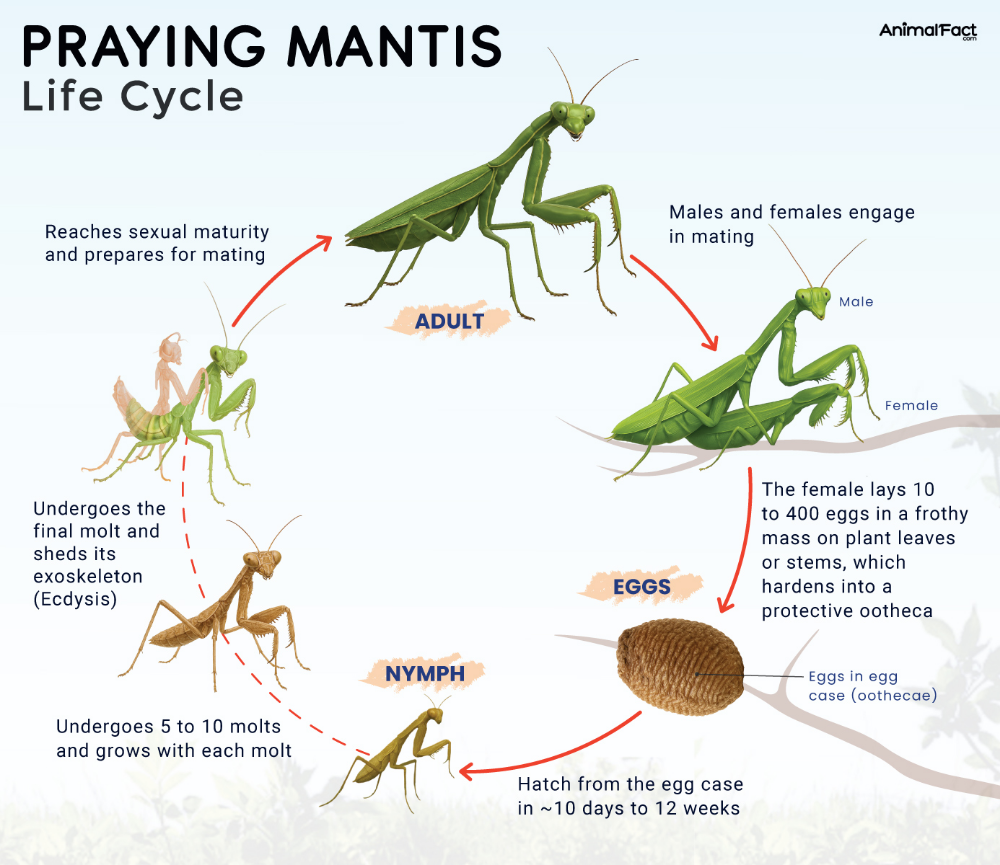
The Chinese mantis is an annual insect. One generation lives and dies each year, connected to the next by an overwintering ootheca.
Annual cycle:
| Month | Stage |
|---|---|
| April - May | Oothecae hatch; nymphs emerge |
| May - July | Nymphal growth, 6-9 moults |
| Late July - August | Final moult to winged adult |
| August - October | Mating, feeding, egg laying |
| September - October | Oothecae deposited on stems, fences, walls |
| October - November | Adults die with first hard frosts |
| November - April | Oothecae overwinter; development paused inside |
Mating takes place in late summer and autumn. Males take flight at dusk and search for females by scent, following pheromone trails. Approach behaviour is cautious - the male steps deliberately, often freezing if the female moves or turns. A successful male mounts from behind, grips with all three pairs of legs, and transfers a spermatophore over the course of several hours. A missed angle or a hungry female can end the encounter in a kill.
After mating the female begins producing oothecae. A single female typically lays two to six egg cases over her adult life. Each ootheca is a foam of specialised proteins that the female extrudes and whips into shape with her abdomen as it hardens in air. Inside the foam, 100-200 eggs are arranged in chambers separated by thin walls. The outer foam hardens to a tough, insulating crust that survives winter temperatures well below freezing.
Nymphs hatch the following spring when temperatures rise. They emerge from the ootheca in waves over a few hours, each nymph dropping down from the egg case on a thread of silk. The first moult occurs within minutes of hatching. Mortality is extremely high in the first days - newly hatched nymphs are eaten by ants, spiders, birds, and by each other. Of 100-200 hatchlings from a single ootheca, only a handful typically reach adulthood.
Sexual Cannibalism
Sexual cannibalism - the female killing and eating the male before, during, or after mating - occurs in many mantis species and is well documented in Tenodera sinensis. Measured rates in the wild run roughly 15-30 per cent of matings, with considerable variation. Rates rise sharply when females have been food-deprived before the encounter. Well-fed females cannibalise males less often.
Several hypotheses compete to explain the behaviour. Under the nutritional hypothesis, the male's body is a concentrated protein meal that the female converts directly into eggs, increasing the number or quality of offspring that carry the father's genes.
Under the aggressive spillover hypothesis, mantises that are good at killing prey are simply also good at killing mates, and the behaviour is a side effect of predatory temperament rather than an adaptation in its own right.
Under the male-signal-failure hypothesis, males who approach badly - too fast, from the wrong angle, at the wrong moment - get eaten as a natural outcome of mantis predation rules, and those who approach correctly mate safely.
Evidence supports elements of all three. What is clear is that male Chinese mantises have evolved a suite of behaviours that reduce risk: slow approach, wind-timed movement, preference for females that are busy feeding on other prey, rapid mounting, and a quick leap clear after mating when possible.
A famous series of experiments with related Tenodera species showed that a decapitated male can continue and complete copulation, because mating is driven by abdominal nerve ganglia rather than the brain - so even the worst-case outcome (being eaten head-first during copulation) does not automatically end reproductive success.
The Ootheca and Chinese Medicine
The Chinese mantis ootheca is a remarkable structure and, separately, a traditional medicinal product. The case itself is pale tan to brown, roughly oval or rounded-rectangular, about 2.5-4 cm long, with a visibly striped or ridged exterior. The foam matrix is made from proteins that harden quickly in air, creating an insulating shell that is both tough and breathable.
Oothecae are typically attached to stems, twigs, fence posts, walls, or other vertical surfaces at heights that keep them above snow.
In traditional Chinese medicine the mantis ootheca is called sang piao xiao - literally "mulberry drifting nest", a reference to oothecae commonly found attached to mulberry branches. The product appears in the Chinese materia medica dating back centuries. It is prescribed most often for conditions associated with urinary frequency, night-time urination, and reproductive complaints.
Modern pharmacology has isolated protein and amino acid profiles from the ootheca but has not confirmed most of the traditional indications in controlled studies. The ootheca remains in common use in East Asian herbal practice and is cultivated commercially for the trade.
Chinese Mantises and Humans
Most human interactions with Chinese mantises are friendly in one direction and indifferent in the other. The mantis is not dangerous to humans in any meaningful sense - it cannot break human skin with its forelegs and does not bite humans under normal conditions.
Its large size, imposing posture, and apparent calm while held on a finger make it a popular subject for backyard naturalists and children's nature walks. The species tolerates brief handling and, if approached slowly, can often be coaxed onto an extended hand.
The larger relationship between Chinese mantises and humans, however, runs through gardens. Every spring, garden centres and online retailers sell Chinese mantis oothecae as organic pest control, advertised as an alternative to insecticides. Gardeners place the oothecae in vegetable plots, flowerbeds, and orchards, and wait for the nymphs to hatch. As a pest control strategy the result is mixed at best.
The mantises do eat pests. They also eat pollinators, native mantis species, and beneficial insect predators. Field evaluations so far have not shown a consistent, measurable reduction in garden pest populations from Chinese mantis releases.
A separate concern comes from the accidental cost to pollinators. Native bees, honeybees, butterflies, and hoverflies are taken by Chinese mantises in significant numbers, especially where mantises concentrate near flowering plants. For gardeners deliberately trying to support pollinators, deploying Chinese mantises works against that goal. Many conservation-focused gardening groups now advise against buying oothecae and recommend encouraging native predators instead.
Related Reading
- Praying Mantis: The Ambush Predator of the Insect World
- Orchid Mantis: The Flower That Isn't a Flower
- Praying Mantises: The Ambush Predators of the Insect World
- Do Female Praying Mantises Really Eat Their Mates?
References
Relevant peer-reviewed and natural history sources consulted for this entry include Nyffeler, Maxwell, and Remsen (2017) "Bird predation by praying mantises: a global perspective", published in The Wilson Journal of Ornithology; entomological records compiled by the Academy of Natural Sciences of Drexel University documenting the 1896 Mt.
Airy introduction; taxonomic work by Saussure (1869, 1871); published research in The Journal of Orthoptera Research, Insect Biochemistry and Molecular Biology, and Ethology concerning mantis strike kinematics and sexual cannibalism; and United States Department of Agriculture extension bulletins on the role of Chinese mantises in biological control.
The 100-200 egg count and overwintering ootheca biology reflect consolidated figures from multiple North American entomology field guides published between 1990 and 2023.
Frequently Asked Questions
How big are Chinese mantises?
Chinese mantises (Tenodera sinensis) are the largest mantis species found in North America. Adult females typically reach 8-11 cm in body length, with exceptional specimens pushing 12 cm, making them comfortably bigger than native species like the Carolina mantis. Adult males are smaller and more slender, usually 7-9 cm long. Nymphs hatch at around 6-7 mm and go through six to nine moults before reaching adulthood.
Body colour ranges from pale green through straw-tan, usually with a distinctive green lateral stripe running along the leading edge of the folded forewings. Mass at full adulthood runs roughly 5-8 grams for gravid females.
Where did Chinese mantises come from?
Chinese mantises are native to East Asia. Their natural range covers China, Japan, Korea, Taiwan, Thailand, and several Micronesian islands. In 1896 an ootheca - the foam-hardened egg case - was accidentally imported on nursery stock to Mt. Airy, near Philadelphia, Pennsylvania. The nymphs hatched and established the first North American population.
Over the following decades the species spread across the eastern United States, helped enormously by deliberate sale of oothecae as a garden biocontrol agent. Today Chinese mantises occur throughout much of the United States east of the Rockies and parts of southern Canada, and the species has also established small populations in parts of Europe.
Do Chinese mantises really eat hummingbirds?
Yes. Chinese mantises are large and strong enough to catch, kill, and consume small vertebrates, and hummingbirds are well documented among their prey. A 2017 review published in The Wilson Journal of Ornithology by Nyffeler, Maxwell, and Remsen compiled more than 140 cases of mantises preying on birds worldwide.
The majority involved hummingbirds, and Chinese mantises waiting at backyard nectar feeders were among the most frequently recorded perpetrators in North America. The mantis perches on the feeder, strikes as the hummingbird hovers, and feeds on the body over several hours. Lizards, small frogs, and newts have been documented as well.
Are Chinese mantis egg cases good for gardens?
This is debated. Chinese mantis oothecae are widely sold at garden centres and online retailers as organic pest control, with packaging claiming they will reduce aphids, beetles, caterpillars, and other pests. The biological reality is more complicated. A single ootheca hatches 100-200 nymphs in spring, but most die or disperse within days, and the surviving mantises are indiscriminate ambush predators.
They eat beneficial insects - bees, butterflies, ladybirds, native mantises - as readily as they eat pests. Field studies have so far failed to show a consistent reduction in garden pest populations from Chinese mantis releases. Some conservation biologists argue that purchased oothecae contribute to the displacement of native North American mantis species.
How fast can a Chinese mantis strike?
A Chinese mantis strike is one of the fastest predatory movements in the insect world. High-speed video studies put the whole sequence - trigger, snap of the raptorial forelegs, and seizure of the prey - at under 50 milliseconds, with some strikes closer to 30 milliseconds. That is faster than a human blink (roughly 100-150 ms) and far faster than a conscious reaction.
The legs are modified with rows of sharp spines that interlock when closed, gripping prey so firmly that a captured insect usually has no chance to escape. Chinese mantises also appear to modulate the strike - slower for small prey, faster and stronger for larger prey - rather than using a fixed-speed action.
How long do Chinese mantises live?
Chinese mantises are annual insects. Total lifespan from hatching to death is roughly 8-12 months. Nymphs hatch in late spring from overwintering oothecae, go through a series of moults through summer, reach adulthood by late July or August, mate in late summer and autumn, and die with the first hard frosts in November or December.
Females outlive males in most cases because males are smaller, more mobile, and more exposed to predation during their search for mates, and some are killed and eaten during or after mating. The ootheca produced in autumn survives the winter and hatches the following spring, continuing the cycle. Captive Chinese mantises sometimes live slightly longer than wild ones when temperature is controlled and food is constant.
Why do female mantises sometimes eat males?
Sexual cannibalism in Tenodera species runs at roughly 15-30 per cent of matings in the wild, depending on female body condition and recent feeding history. Well-fed females cannibalise males less often. Hungry females almost always do. The behaviour has several plausible explanations. A male body is a concentrated protein meal that supports egg production, so a female who eats her mate often produces more or larger eggs.
From the male’s perspective, natural selection favours cautious approach behaviour: males approach slowly, wait for the female to be distracted by prey, mount quickly, and attempt to leap clear after mating. In laboratory experiments a decapitated male can still complete copulation, because mating is controlled by abdominal nerve ganglia, not the brain.
Can Chinese mantises be kept as pets?
Yes, and they are one of the easier mantis species to keep in captivity. Their large size, relatively long lifespan, and tolerance of a wide temperature range make them forgiving for first-time keepers. A tall, well-ventilated enclosure with vertical perches, ambient temperatures of 22-28 degrees Celsius, and moderate humidity (50-65 per cent) suits them well. They feed readily on crickets, locusts, flies, moths, and occasional larger prey.
In North America Chinese mantises are already established in the wild, so captive keeping does not raise escape concerns in the way it might for a tropical exotic. In regions where Chinese mantises are not already naturalised, keepers should take care that specimens do not escape or reproduce outdoors.