
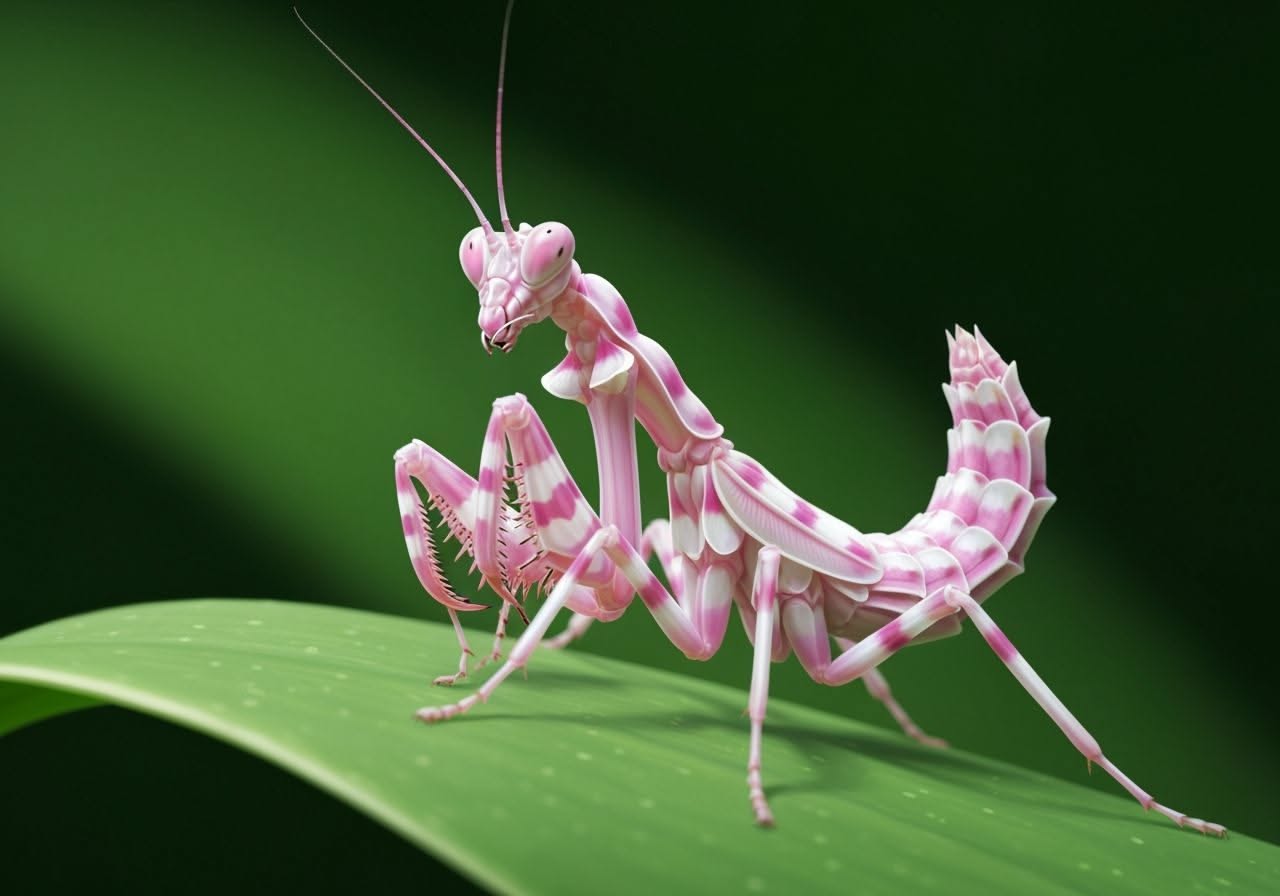
The orchid mantis is one of the most deceptive predators in the rainforest. Unlike most insects that evolve to look like their backgrounds in order to hide, Hymenopus coronatus evolved to look like a flower in order to attract prey. Flying pollinators - bees, wasps, butterflies, and flies - land directly on the mantis thinking it is a blossom, and are seized and eaten. This behaviour is called aggressive mimicry, and the orchid mantis is its best-studied example in the invertebrate world.
This guide covers every aspect of orchid mantis biology and ecology: size, sexual dimorphism, colour change, hunting behaviour, diet, reproduction, the 2014 research that overturned what biologists thought they knew about the species, and the strange facts that make this small Southeast Asian insect one of the most interesting mantises alive. It is a reference entry, not a summary - so expect specifics: measurements, pollinator counts, moult intervals, ootheca sizes, and documented prey records.
Etymology and Classification
The scientific name Hymenopus coronatus combines two Greek-derived elements. Hymenopus means "membrane foot" or "hymen-footed", a reference to the flattened, leaf-like expansions on the walking legs. Coronatus means "crowned", almost certainly a nod to the projecting plate on the head that gives the insect a regal, flower-like silhouette. The species was formally described in 1792 by the Dutch entomologist Olivier, though the insect had been known to local people in Southeast Asia for centuries.
In English the orchid mantis is also called the "walking flower mantis" and, informally, the "pink mantis" - though neither name is precise. In Malay it is sometimes called bunga berjalan, literally "walking flower". Vietnamese and Thai names also emphasise the walking-flower imagery rather than any specific orchid.
Taxonomically, the orchid mantis sits within the family Hymenopodidae, a group sometimes called the "flower mantises". Related species in genera such as Creobroter and Pseudocreobotra show similar floral colouration and flattened body shapes, though none match the extremity of H. coronatus in form or behaviour. The species belongs to the order Mantodea, the praying mantises, which together comprise roughly 2,400 described species worldwide.
Size and Sexual Dimorphism
Orchid mantises show one of the most extreme size differences between sexes of any mantis.
Females:
- Length: 6-7 cm from head to tip of abdomen
- Weight: 3-5 grams in gravid adults
- Colouration: white, cream, pink, or pale yellow
- Femoral lobes: broad, petal-like, prominent on all four walking legs
Males:
- Length: 2.5-3 cm
- Weight: typically under 0.5 grams
- Colouration: mostly white with brown or pink markings
- Femoral lobes: present but much reduced
Nymphs at hatching:
- Length: 4-5 mm
- Colouration: black body with bright red and orange markings - a mimic of assassin bugs, not flowers
The size gap between adults - females roughly three times longer and up to ten times heavier than males - has several biological consequences. Males reach adulthood after only five or six moults; females take seven or eight. Males fly readily and actively search for females. Females fly poorly and remain on their chosen perch, luring prey and waiting for males to approach. This asymmetry is typical of many mantises but reaches unusual extremes in H. coronatus.
The Flower That Isn't a Flower
For most of the twentieth century, biologists assumed the orchid mantis was a specialised mimic of a particular orchid flower. The assumption made intuitive sense - the insect clearly looks like a flower, and the pink-and-white colouring fits the palette of many tropical orchids. It was repeated in field guides, popular books, and documentary films for decades.
The problem is that nobody ever identified the orchid being mimicked. Researchers searched. No orchid matched the mantis in shape, proportion, or colour distribution. The assumption persisted anyway, bolstered by the force of repetition.
In 2014, Australian biologist James O'Hanlon and colleagues published a study in American Naturalist that upended the conventional story. They tested two competing hypotheses. The first was the traditional view: orchid mantises mimic a specific flower and hide in it. The second was more radical: orchid mantises resemble a generic, idealised flower, and actively attract pollinators who mistake them for blossoms in general.
O'Hanlon's team measured how often pollinators landed on orchid mantises compared to real flowers nearby. The result was startling. Pollinators were attracted to the mantises more often than to real flowers in the same environment. The mantis did not need to hide inside a blossom - it was the blossom, and in fact a better one than any specific real flower.
This is a biological phenomenon called supernormal stimulus: a signal that exaggerates or combines features of a natural signal in ways that trigger a stronger response than the natural version. The classic example involves gulls preferring to retrieve artificial eggs that are larger and more speckled than their own. Orchid mantises appear to do the same thing with flowers.
They combine the features of a generic attractive flower - symmetry, pale-but-contrasty colour, UV reflectance in the right ranges - into a stimulus that pollinators find more compelling than any actual flower in the habitat.
The implications go beyond this one species. Supernormal stimulus may be widespread in aggressive mimicry across nature, but the orchid mantis is currently its clearest documented case.
Colour Change and Colour Matching
Juvenile orchid mantises can shift their body colour between white and pink over the course of several days. The mechanism is not instant like an octopus or a chameleon - it involves slow pigment changes keyed to the dominant colour of the background, light intensity, and humidity.
Colour ranges observed in wild and captive populations:
| Form | Appearance | Conditions associated |
|---|---|---|
| Pure white | Cream-white body, no pink | Light-coloured backgrounds, high light |
| Classic pink | White base with pink bands on femoral lobes | Mixed backgrounds |
| Deep pink | Body tinged pink overall, strong lobes | Pink or magenta backgrounds |
| Pale yellow | Cream-yellow body, faint pink | Certain populations and backgrounds |
The colour shift takes three to seven days in most observations. Researchers have debated how functional this change is - whether it matters to prey attraction, prey avoidance, or predator avoidance. The best current guess is that the shift allows individual mantises to match the most common flower colour in their immediate habitat, maximising the probability that passing pollinators will include the mantis among candidate flowers to investigate.
Adults largely retain whatever colour they reached at their final moult, though subtle shifts can still occur. The four main walking legs are the most colour-flexible body parts. The head and thorax retain a more stable pale tone.
Hunting and Diet
Orchid mantises are sit-and-wait predators. They perch on a flower, stem, or bare leaf, raise their bodies into a flower-like posture, and wait. When a pollinator approaches and lands, the mantis strikes with the raptorial forelegs - the long, spined front limbs that are the mantis's primary weapon.
Primary prey:
- Honeybees, stingless bees, solitary bees
- Social and solitary wasps
- Hoverflies, bee flies, and other Diptera
- Butterflies (including species much larger than the mantis)
- Moths at dusk and dawn
Secondary and occasional prey:
- Small hummingbirds (documented in captivity and field reports)
- Juvenile geckos and anoles
- Other smaller mantises (cannibalism)
- Large beetles during the wet season
Hunting technique sequence:
- Perch selection. A mantis moves to a perch near active pollinator traffic - sometimes a real flower, often a nearby stem or leaf. The criterion is the quality of pollinator traffic, not the presence of flowers.
- Postural display. The mantis raises its body, spreads the four petal-shaped femurs, and holds the forelegs folded in the classic "praying" position.
- Waiting. The mantis remains motionless. Waits can last from minutes to hours.
- Strike. When a pollinator lands within reach, the raptorial forelegs extend in roughly 60-100 milliseconds and clamp onto the prey. The spined inner edges prevent escape.
- Feeding. The mantis brings the prey to its mandibles and begins to eat, usually starting with the head. Large prey may take thirty minutes or more to consume.
Hunting success is not well measured in the wild for this species, but captive observations suggest the mantis feeds one to two times per day under good conditions. During the dry season or when pollinator traffic is low, it may go days between meals, relying on stored fat reserves.
The reports of orchid mantises eating hummingbirds and small lizards are real but rare. They occur when a very large female and a very small vertebrate cross paths. The mantis is fully capable of subduing prey larger than itself thanks to the strength and spines of its raptorial legs.
Life Cycle and Reproduction
The orchid mantis life cycle is compressed into under a year, with distinct stages.
Life stages:
- Egg. Eggs are laid inside an ootheca - a frothy protein case produced by the female. The ootheca hardens on contact with air into a tan, foam-like structure about 2-3 cm long. Each ootheca contains 30 to 100 eggs.
- Hatching. After 5-8 weeks of incubation at tropical temperatures, nymphs emerge. The newly hatched nymphs are black and red with white legs - a pattern that mimics assassin bugs, which are distasteful to many predators. This colouration protects them during their most vulnerable stage.
- Nymph (L1 to L7). Nymphs pass through six or seven instars, moulting between each. The flower-like form emerges gradually. By the third or fourth moult the mantis begins to show the full petal-shaped femoral lobes.
- Adult. Final moult produces a winged adult. Males fly to search for females. Females stay on their perches and wait.
- Mating. Males approach cautiously, usually from behind, and mount rapidly. Sexual cannibalism is a real risk for males.
- Ootheca production. Mated females produce one or more oothecae over their adult life, usually one per week to one per month depending on condition.
- Death. Adults die within a few weeks to two months of reaching adulthood. No parental care of any kind is given to eggs, nymphs, or juveniles.
Ootheca data:
| Metric | Value |
|---|---|
| Eggs per ootheca | 30-100 |
| Incubation time | 5-8 weeks at 25-28 C |
| Nymph size at hatching | 4-5 mm |
| Moults to adulthood (female) | 7-8 |
| Moults to adulthood (male) | 5-6 |
| Time from hatch to adult | 4-6 months (female), 3-4 (male) |
The female lays the ootheca on a stem or leaf surface and leaves. There is no maternal care. Nymphs emerging from a single ootheca disperse rapidly, largely to avoid cannibalism from siblings, which is common in densely packed hatching sites.
Sexual Cannibalism and Mating Risk
Sexual cannibalism - the female eating the male before, during, or after mating - is a well-known feature of many mantis species. In orchid mantises the extreme size gap means that once a male is caught, escape is essentially impossible. A female can subdue, kill, and consume a male in a matter of minutes.
Males have evolved several behaviours that reduce the risk:
- Slow, wind-timed approach. Males move toward the female only when ambient air movement is present, which masks their motion and reduces the female's ability to detect them.
- Rear mounting. The male approaches from behind and mounts the female without circling to the front, where her raptorial legs can reach him easily.
- Rapid dismount. After copulation the male leaps off and flies away. Males that linger are often consumed.
- Repeated matings. Surviving males may mate with multiple females during their short adult lifespan.
From the female's perspective, eating a male provides a significant protein and fat bonus that supports egg production. Whether cannibalism is adaptive for the male - in the sense that being eaten improves his reproductive success - is debated. In some mantis species there is evidence that cannibalised males produce more offspring. In orchid mantises specifically the question is unsettled. What is clear is that the risk is real and has shaped male courtship behaviour extensively.
Habitat and Distribution
Orchid mantises inhabit the tropical and subtropical rainforests of Southeast Asia. Confirmed populations exist in:
- Malaysia (peninsular and Borneo)
- Indonesia (Sumatra, Java, Borneo)
- Thailand (central and southern regions)
- Southwest India (Western Ghats)
- Southern China (Yunnan, Guangxi)
They prefer forest edges, secondary growth, and disturbed areas where flowering plants are abundant within a few metres of the ground. They are not strictly associated with orchids. They are found on hibiscus, frangipani, and dozens of other flowering plants, as well as on bare stems and leaves where their flower-mimicry still lures pollinators.
Orchid mantises require warm, humid conditions year-round. Typical habitat parameters include:
- Temperature: 24-30 degrees Celsius
- Humidity: 60-80 per cent
- Light: dappled canopy shade
- Vegetation: mixed flowering plants within 0.5-3 metres of ground level
Outside these conditions the species struggles. This is why captive breeders must reproduce Southeast Asian climate conditions carefully to maintain healthy colonies.
Conservation Status
The orchid mantis has not been formally assessed by the IUCN Red List. No global population estimate exists. The species is locally common in suitable habitat across its range but faces the same pressures as other rainforest invertebrates: habitat loss from logging and agricultural expansion, pesticide use, and the exotic pet trade.
Threats:
- Habitat loss. Southeast Asian rainforests have been cleared at some of the highest rates on Earth over the past fifty years. Palm oil expansion in particular has fragmented or destroyed large areas of H. coronatus habitat in Malaysia and Indonesia.
- Pesticide use. Agricultural pesticides reduce pollinator populations, which removes the orchid mantis's food base.
- Wild collection for the pet trade. The species is popular in the exotic invertebrate market. Demand has historically driven wild collection, though captive-bred lines now account for most legal trade.
- Climate change. Shifts in temperature and rainfall patterns affect the flowering plants and pollinator communities that orchid mantises depend on.
The growth of the captive-breeding market is, from a conservation standpoint, positive - it reduces pressure on wild populations. Several European and North American breeders now produce captive-bred orchid mantises in numbers sufficient to satisfy most legal demand.
Orchid Mantises and Humans
Orchid mantises have no significant negative impact on humans. They do not bite effectively, do not damage crops, and are not vectors of disease. Their relationship with humans is primarily cultural and commercial.
In Southeast Asian folk traditions the orchid mantis is admired for its beauty and sometimes associated with local stories about flowers and hidden dangers. In modern Western culture the species has become a minor icon of evolutionary biology - appearing in documentaries, biology textbooks, and popular accounts of mimicry and deception in nature.
In the exotic pet trade, orchid mantises are among the most sought-after mantis species. Captive care requires a tall, well-ventilated enclosure with live or artificial flowers for perching, ambient temperatures of 25-30 degrees Celsius, humidity around 70 per cent, and a diet of flying insects such as flies, small moths, and bees. Handling should be minimal.
Breeding in captivity is possible but requires careful introduction of males to females to manage sexual cannibalism risk, and successful rearing of nymphs requires separating them quickly to avoid cannibalism among siblings.
Legal status varies by country. Some regions restrict the import of exotic invertebrates for ecological reasons. Prospective keepers should check local regulations before acquiring specimens.
Research History and Ongoing Questions
The 2014 O'Hanlon study was a turning point for orchid mantis research. Before it, the species was treated as a curious example of conventional camouflage mimicry. After it, the orchid mantis became a flagship case study for aggressive mimicry and supernormal stimulus in invertebrates. The study opened several new research directions that remain active.
Ongoing and open questions include:
- What is the precise visual signal? Which specific features of the orchid mantis's form, colour, and UV pattern drive the pollinator attraction? Experimental manipulation of these features in model mantises is one current research avenue.
- Does colour flexibility matter? Do pink individuals attract different pollinator species than white ones? Early results suggest yes, but quantifying this requires more field work.
- How widespread is supernormal stimulus in predatory mimicry? Are other flower-mimic invertebrates using the same trick, or is H. coronatus exceptional?
- What explains the extreme sexual dimorphism? The size difference is evolutionary puzzle. Several hypotheses exist - larger females producing more eggs, males needing mobility to find mates - but the specific selective pressures are still being untangled.
- How do nymphal mimicry transitions work? The shift from assassin-bug mimicry in hatchlings to flower mimicry in adults involves hormonal and developmental mechanisms that are not yet fully mapped.
These questions make the orchid mantis a living laboratory for biologists interested in evolution, perception, and deception.
Related Reading
- Praying Mantis: Masters of Ambush
- Aggressive Mimicry in Insects
- Supernormal Stimulus and Animal Perception
- Mantises of Southeast Asia
References
Relevant peer-reviewed sources consulted for this entry include O'Hanlon, J. C., Holwell, G. I., and Herberstein, M. E. (2014) "Pollinator deception in the orchid mantis" published in The American Naturalist, which established the supernormal stimulus hypothesis. Additional material draws on Svenson, G. J., and Whiting, M. F.
(2009) "Reconstructing the origins of praying mantises" in Cladistics; and regional surveys published in Entomological Science and Asian Entomology. Specific figures on habitat parameters and life cycle reflect consolidated field and captive observations from multiple breeders and researchers working with the species between 2010 and 2024.
Frequently Asked Questions
How big are orchid mantises?
Orchid mantises (Hymenopus coronatus) show one of the most extreme size differences between sexes of any mantis. Adult females reach 6-7 cm in body length and can weigh more than 5 grams when fully gravid. Adult males are roughly 2.5-3 cm long and typically weigh only a fraction of a gram. That makes the female about three times the length of the male and up to ten times his mass.
Nymphs start out at 4-5 mm and go through six or seven moults before reaching adulthood. The lobed femurs that give the mantis its flower-like appearance develop fully only after the second or third moult.
Where do orchid mantises live?
Orchid mantises live in the tropical and subtropical rainforests of Southeast Asia. Confirmed populations exist in Malaysia, Indonesia (including Sumatra and Java), Thailand, southwest India, and southern China. They prefer forest edges, secondary growth, and areas where flowering plants are abundant within a few metres of the ground.
Unlike the popular image, they are not strictly associated with orchids - they are found on a wide range of flowering plants and sometimes on bare stems, where their flower-like body still attracts pollinators. They require warm, humid conditions year-round, typically 24-30 degrees Celsius and 60-80 per cent humidity.
What do orchid mantises eat?
Orchid mantises are ambush predators that specialise in lured prey. Their diet centres on flying pollinators: bees, wasps, hoverflies, butterflies, moths, and flies. Unusually for a small mantis, they also take prey much larger than themselves, including large butterflies and small vertebrates such as hummingbirds and juvenile geckos when the opportunity arises.
The 2014 research by O’Hanlon and colleagues found that orchid mantises actively draw pollinators in - pollinators land on the mantis more often than they land on real flowers placed nearby. This turns the mantis from a camouflaged hider into an active lure. A healthy adult eats one or two prey items per day in the wild.
Are orchid mantises really flower mimics?
Not exactly. For decades biologists assumed the orchid mantis mimicked a specific real orchid. Careful investigation shows this is wrong. No known orchid matches the mantis closely. Instead, the orchid mantis resembles a kind of generic, idealised flower - a combination of features (symmetry, pale colour, UV reflectance, size) that pollinators find attractive in general.
The 2014 study by James O’Hanlon and collaborators showed that pollinators were attracted to the mantis at higher rates than to real flowers in the same environment. This is an example of supernormal stimulus: an artificial or evolved signal that exceeds the natural signal the receiver is tuned to. The orchid mantis is, in essence, a fake flower that is better at being a flower than real flowers are.
How long do orchid mantises live?
Orchid mantises live less than a year. Females typically survive 6-8 months from hatching to death, while males live only 4-6 months. Most of that life is spent as a nymph going through moults - adulthood lasts only a few weeks to two months, during which the mantis mates and, in the case of females, produces one or more egg cases.
Captive specimens with ideal temperature, humidity, and feeding can live slightly longer than wild ones, but the species has a hard-coded short adult lifespan regardless of care. Environmental stress, failed moults, and predation by birds, lizards, and larger insects all contribute to wild mortality.
Do orchid mantises change colour?
Yes, but slowly and only during the nymph stages. Juvenile orchid mantises can shift their body colour between white and pink over the course of several days in response to the dominant colour of their background - a form of ontogenetic colour change mediated by hormonal and pigment responses rather than rapid chromatophore activity. Light intensity, humidity, and the colour of the perch all influence the shift.
Adults largely retain whatever colour they reached at their final moult, though subtle changes can still occur. Researchers have also documented yellow and cream variants in some populations, suggesting the species has more colour flexibility than previously thought.
Why do female orchid mantises eat males?
Sexual cannibalism is common in many mantis species, and orchid mantises are no exception. Females are three times longer and up to ten times heavier than males, so a male who approaches at the wrong angle or mistimes his mount has essentially no chance of escape. From the female’s perspective, a male can be both a mate and a protein-rich meal that supports egg production.
From the male’s perspective, natural selection has produced a suite of cautious behaviours: slow approaches, wind-sensitive timing, and rapid mounting. Males often mate and leap off the female before she can turn. Whether cannibalism actually increases male reproductive success in orchid mantises specifically is still debated, but the risk is real and shapes courtship behaviour.
Can orchid mantises be kept as pets?
Yes, and they are one of the most popular mantises in the exotic pet trade. Captive-bred lines now account for most specimens sold, which is both ethical and practical because wild-caught individuals often carry parasites and adapt poorly.
A captive orchid mantis needs a tall, well-ventilated enclosure with live or artificial flowers for perching, ambient temperatures of 25-30 degrees Celsius, humidity around 70 per cent, and a diet of flying insects (flies, moths, small bees). Handling should be minimal. Females typically outlive males by several months, and breeding in captivity requires careful introduction to avoid sexual cannibalism.
Legal status varies by country - some regions restrict import of exotic invertebrates.