
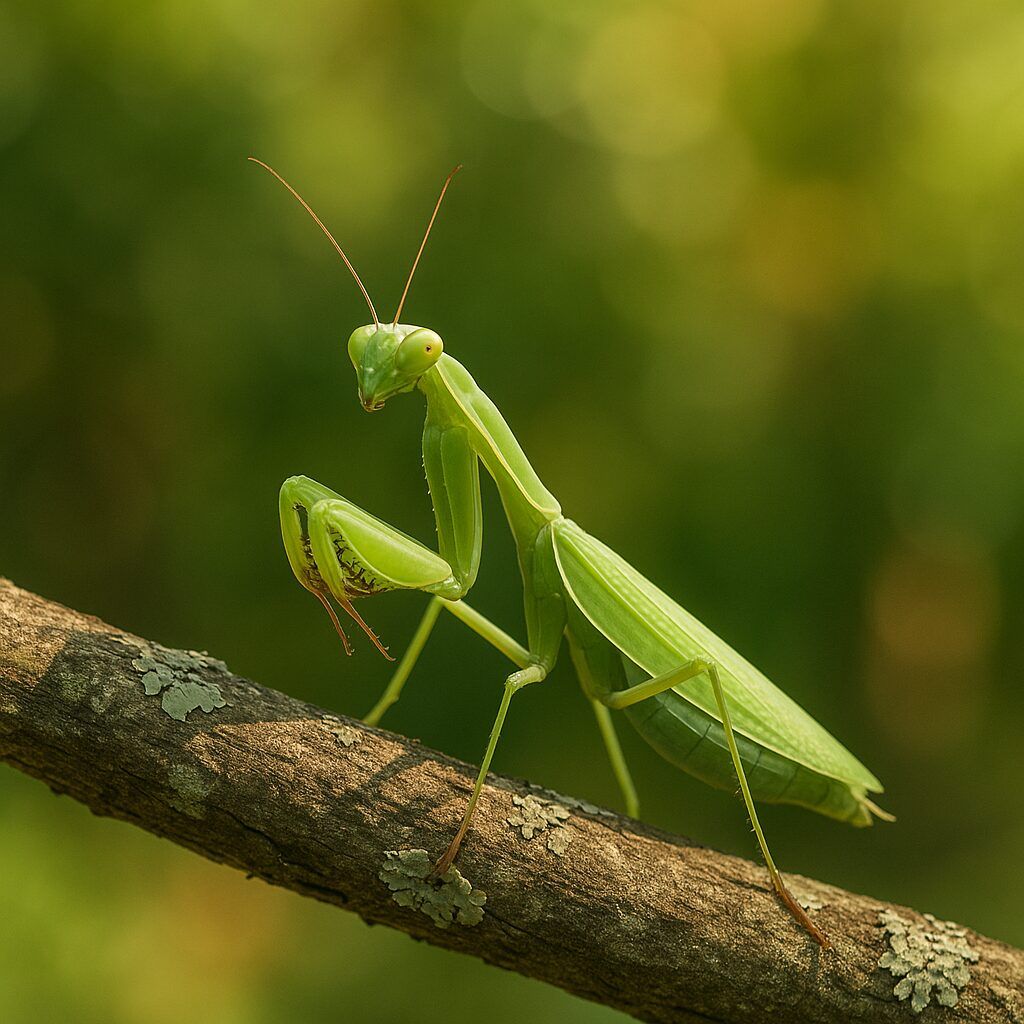
Can a praying mantis really turn its head to look over its shoulder?
Yes. The praying mantis is the only insect capable of rotating its head a full 180 degrees, allowing it to look directly behind itself over either shoulder. This extraordinary range of motion is made possible by a flexible joint connecting the head to the prothorax.
There is an insect that hunts with the patience of a sniper, strikes faster than a human eye can follow, and is the only member of its entire class that can turn its head to look you in the eye.
The praying mantis occupies a singular position in entomology - a predator so specialized, so efficient, and so visually bizarre that it has inspired martial arts styles, religious symbolism, and more than a century of scientific fascination. Yet popular understanding of mantises barely scratches the surface.
The real story involves 3D vision tested with miniature cinema glasses, flowers that are actually predators, fish pulled from streams by an insect, and a mating ritual whose reputation for gruesome violence turns out to be largely exaggerated.
The order Mantodea encompasses far more than the familiar green mantis perched on a garden stem. It is a global radiation of ambush predators that have colonized every warm continent and evolved camouflage strategies that rival anything in the vertebrate world.
A Staggering Diversity: 2,400 Species and Counting
The order Mantodea contains more than 2,400 described species distributed across approximately 430 genera and 33 families. Mantises are found on every continent except Antarctica, with the greatest diversity concentrated in tropical regions of Africa, Asia, and South America.
New species continue to be described annually - a 2019 revision of the family Nanomantidae added multiple new genera from the forests of Southeast Asia, and molecular phylogenetic studies continue to reshape our understanding of mantis evolutionary relationships.
The common name "praying mantis" refers to the characteristic resting posture in which the raptorial forelegs are held folded beneath the head, resembling hands clasped in prayer. Technically, "praying mantis" most accurately refers to species in the genus Mantis (particularly Mantis religiosa, the European mantis), but the term is universally applied to the entire order.
Size variation across the order is enormous. The smallest mantises, such as Mantoida species from Central and South America, measure barely 10 millimeters in length as adults. At the opposite extreme, the giant Asian mantis (Hierodula membranacea) and the African mega-mantis (Ischnomantis gigas) can exceed 160 millimeters - large enough to capture small vertebrates including lizards, frogs, and hummingbirds.
Between these extremes lies an astonishing range of body forms adapted to virtually every terrestrial hunting niche: bark-mimicking species flattened like paper, twig-mimicking species elongated like sticks, leaf-mimicking species with lateral extensions on their abdomens, and flower-mimicking species whose bodies have evolved to resemble orchid petals with uncanny precision.
The Raptorial Forelegs: Anatomy of a Lightning Strike
The defining feature of all mantises is the pair of raptorial forelegs - highly modified grasping appendages that are among the most effective prey-capture tools in the insect world. These forelegs are not merely strong. They are engineered for speed, precision, and inescapable grip.
Each foreleg consists of an enlarged coxa (the basal segment, which in mantises is unusually elongated), a muscular femur lined with sharp spines on its inner surface, and a tibia that also bears rows of spines and folds against the femur like a jackknife blade closing. When a mantis strikes, the femur and tibia snap together with the prey trapped between the opposing rows of interlocking spines. Escape is nearly impossible.
The speed of this strike is extraordinary. High-speed camera studies have recorded mantis strikes completing in as little as 50 to 70 milliseconds - roughly twice the speed of a human eye blink, which takes approximately 150 to 200 milliseconds. Some species strike even faster.
The key to this speed is not raw muscular force but a latch-and-spring mechanism: the mantis contracts its muscles to build tension while the foreleg remains locked in the folded position, then releases the latch to allow the stored energy to accelerate the strike far faster than muscle contraction alone could achieve.
"The mantis strike is not simply fast. It is ballistic - once initiated, it cannot be corrected or redirected. The entire success of the capture depends on the precision of the aim before the strike begins." - Dr. Gregory Sutton, Royal Society research fellow and biomechanics researcher, University of Lincoln
The hunting strategy that accompanies these weapons is pure ambush predation. A mantis selects a position - on a flower, a leaf, a branch - and remains motionless for hours. Its camouflage renders it invisible to prey.
When an insect ventures within the strike zone, typically a distance equal to the length of the outstretched forelegs, the mantis rocks gently forward to judge distance using binocular vision, then unleashes the strike. The entire sequence from detection to capture can occur before the prey has any opportunity to react.
The Swiveling Head: 180 Degrees of Awareness
Among all insects, the praying mantis holds a unique anatomical distinction: it is the only insect that can rotate its head a full 180 degrees. While other insects have some degree of head mobility, none approach the mantis's range of motion. A mantis can literally look over its own shoulder - an ability that no beetle, fly, butterfly, wasp, or ant possesses.
This mobility is made possible by an elongated, flexible prothoracic joint connecting the head to the first thoracic segment. The head sits atop what is effectively a neck - a feature so unusual among insects that it contributes significantly to the mantis's almost alien appearance.
Coupled with large, widely spaced compound eyes that provide a broad field of binocular vision, the mobile head gives the mantis the ability to track moving prey with smooth, deliberate head turns rather than repositioning its entire body. This matters enormously for an ambush predator. Moving the body would break camouflage and alert prey. Moving only the head preserves the illusion of an inanimate leaf or twig.
Each compound eye contains a dark spot called the pseudopupil - an optical artifact created by the geometry of the ommatidia (individual visual units) that are aligned with the observer's line of sight. As the mantis turns its head to track you, the pseudopupils appear to follow your movement, creating the disconcerting impression that the insect is making deliberate eye contact. It is not truly "looking at you" in the mammalian sense, but the visual effect is remarkably lifelike.
3D Vision in Miniature: The Newcastle University Experiment
For decades, scientists knew that mantises possess stereoscopic vision - the ability to perceive depth by comparing the slightly different images received by each eye. Mantises are among the very few invertebrates confirmed to have this ability, which they use to judge the precise distance to prey before striking. But how mantis stereopsis worked at a neural level, and whether it operated on the same principles as human depth perception, remained unclear.
In 2018, a research team at Newcastle University led by Dr. Vivek Nityananda devised an experiment that captured public imagination worldwide. They fitted praying mantises with tiny 3D glasses - miniature spectacles with one blue lens and one green lens, attached to the mantis's head with beeswax. The mantises were then shown images on a computer screen, with targets presented in simulated 3D (different images to each eye, just as in a human 3D cinema).
The results, published in Current Biology, revealed something unexpected. Mantis stereopsis operates on fundamentally different principles from human depth perception [1]. Humans compare the static positions of objects as seen by each eye - a system called static stereopsis.
Mantises, by contrast, rely primarily on motion-based stereopsis: they compute depth by comparing how objects move across each eye's visual field. When shown a static scene, mantises showed weak depth perception. When objects moved, their depth perception became highly accurate.
"This is a completely new form of 3D vision. It is based on the change in an object's position over time, rather than the comparison of images between the two eyes at any single moment. In computational terms, it is much simpler than the human system - and yet it works extremely well for what the mantis needs it to do." - Dr. Vivek Nityananda, Newcastle University, 2018 [1]
This discovery has implications beyond entomology. The mantis's computationally simple 3D algorithm could potentially be adapted for use in robot vision systems and autonomous vehicles, where rapid depth estimation with minimal processing power is valuable. The Newcastle team has continued exploring this possibility, publishing follow-up studies on the neural pathways underlying mantis stereoscopic processing [2].
| Feature | Human Stereopsis | Mantis Stereopsis |
|---|---|---|
| Type | Static (positional comparison) | Motion-based (temporal comparison) |
| Processing complexity | High (requires detailed image matching) | Low (requires only motion detection) |
| Effective for stationary objects | Yes | Weak |
| Effective for moving objects | Yes | Highly accurate |
| Neural substrate | Visual cortex (~30+ areas) | Relatively few neurons in optic lobes |
| Potential robotics application | Computationally expensive to replicate | Promising for low-power depth sensing |
The Orchid Mantis: A Predator More Attractive Than a Flower
The orchid mantis (Hymenopus coronatus) of Malaysia, Indonesia, and surrounding regions of Southeast Asia is arguably the most visually spectacular mantis species - and one of the most remarkable examples of aggressive mimicry in the entire animal kingdom.
The orchid mantis does not merely hide among flowers. Its body has evolved to become a flower. The four walking legs (the mid and hind pairs) bear broad, flattened, petal-shaped femoral lobes in shades of white, pink, and occasionally yellow. The abdomen is curved and colored to resemble a flower's central structure.
The overall effect is so convincing that early naturalists who encountered the species in the 19th century debated whether it was an insect mimicking a flower or a flower that happened to resemble an insect.
The scientific understanding of orchid mantis mimicry was transformed by a landmark 2014 study published in The American Naturalist by James O'Hanlon and colleagues from Macquarie University [3]. The study tested a long-standing assumption: that orchid mantises benefit from their flower-like appearance primarily by hiding among real orchids and ambushing visiting pollinators. The actual findings were far more extraordinary.
O'Hanlon's team placed orchid mantises on vegetation in the field - away from any flowers - and recorded the rate at which pollinating insects approached them. The result: pollinating insects approached the mantises at rates equal to or higher than they approached real flowers of comparable size and color. The orchid mantis was not hiding among flowers.
It was functioning as a standalone sensory trap, generating its own attractive signal and luring prey directly to itself without needing proximity to any bloom.
This finding elevated the orchid mantis from an example of conventional crypsis (blending in) to a case of active deception - the mantis exploits the innate color and shape preferences of pollinating insects.
Further analysis showed that the spectral reflectance (color properties) of the mantis's body falls within the range that is most attractive to hymenopteran pollinators such as bees and flies, suggesting that natural selection has fine-tuned the mantis's appearance to maximize prey attraction.
The Chinese Mantis: An Immigrant Predator in American Gardens
The Chinese mantis (Tenodera sinensis) is one of the largest mantis species found in North America, with adult females reaching lengths of 100 to 110 millimeters. It is not native to the continent. The species was accidentally introduced to the eastern United States in 1896, arriving on nursery stock imported from China.
It has since spread across much of North America and become the most commonly encountered mantis in many regions, including areas where it has partially displaced the smaller native Carolina mantis (Stagmomantis carolina).
The Chinese mantis achieved cultural prominence in the mid-20th century when garden supply companies began marketing mantis egg cases (oothecae) as a form of organic pest control. Gardeners were encouraged to purchase and distribute oothecae, each containing 100 to 200 eggs, in their gardens to reduce pest insect populations. The appeal was obvious - a natural predator, no pesticides required.
The ecological reality is more complicated. Chinese mantises are generalist predators. They do not discriminate between pest insects and beneficial ones. Studies have documented Chinese mantises consuming honeybees, butterflies, hoverflies, and other pollinators at rates comparable to their consumption of pest species such as aphids and caterpillars.
A 2017 study published in The Wilson Journal of Ornithology documented multiple instances of Chinese mantises capturing and killing hummingbirds at backyard feeders across North America, a phenomenon first reported anecdotally but confirmed with photographic and video evidence [4]. The mantis typically seizes the hummingbird by the head and feeds on its brain.
The introduction of Chinese mantises is now regarded by many ecologists as a cautionary example of biological control gone sideways - a well-intentioned intervention that failed to account for the indiscriminate nature of a generalist apex predator.
The Dead Leaf Mantis: Camouflage Perfected
The dead leaf mantis (Deroplatys desiccata) of Malaysia and Indonesia represents perhaps the most elaborate camouflage in the mantis order. While many mantises are cryptic, the dead leaf mantis has taken concealment to an extreme.
Its pronotum (the shield-like plate covering the first thoracic segment) is massively expanded into a broad, flat, leaf-shaped structure complete with a simulated midrib, vein patterns, and irregular edges that mimic the appearance of a dried, partially decayed leaf. The wings, when folded, extend the illusion further with brown coloration and dark patches resembling fungal decay spots.
The camouflage is not only visual. When disturbed, the dead leaf mantis performs a threat display in which it suddenly spreads its wings to reveal brightly colored hindwings with conspicuous eyespots - a startle defense known as deimatic behavior. The sudden transition from invisible dead leaf to a large, "eye-bearing" apparition is often sufficient to deter birds and lizards.
The Ghost Mantis: Ethereal and Efficient
The ghost mantis (Phyllocrania paradoxa), native to continental Africa and Madagascar, is a small species (typically 45 to 50 millimeters) with a distinctive leaf-like projection on the top of its head called a crown crest. Its body is adorned with flattened, irregular lobes and protrusions that break up its outline and make it resemble a fragment of dried vegetation or bark.
Ghost mantises are notable for their relatively docile temperament compared to many other mantis species, which has made them one of the most popular species in the exotic pet trade. They can be housed communally with relatively low rates of cannibalism among individuals of similar size - an unusual trait for mantises, which are generally solitary and will readily consume conspecifics. Their small size and minimal space requirements have contributed to their widespread availability in captivity.
Sexual Cannibalism: Separating Fact From Sensationalism
No aspect of mantis biology has captured public imagination more thoroughly - or been more consistently misrepresented - than sexual cannibalism. The popular narrative is simple and dramatic: the female mantis bites off the male's head during mating, and the decapitated male continues to copulate. This image, repeated endlessly in documentaries, textbooks, and popular science writing, implies that cannibalism is an inevitable or at least routine part of mantis reproduction.
The reality, established through decades of field research, is considerably more nuanced. Sexual cannibalism in praying mantises occurs in approximately 13 to 28 percent of mating encounters in the wild, depending on species and environmental conditions [5]. The majority of mantis matings are completed without any cannibalism whatsoever.
The inflated perception of cannibalism rates traces back to early laboratory studies, particularly those by Leland Ossian Howard in the late 19th century and subsequent researchers in the mid-20th century. These studies observed mating in small, brightly lit enclosures with females that were often underfed.
Under such stressed conditions, females are far more likely to treat any nearby organism - including a prospective mate - as prey. A 1992 study by Lawrence and Wisniewska published in Animal Behaviour compared cannibalism rates in laboratory versus field conditions and found that lab rates were dramatically higher due to artificial stress factors [5].
In the wild, male mantises are not passive victims. They employ a range of risk-reduction strategies:
- Assessing female condition: Males approach cautiously and are more likely to attempt mating when the female is actively feeding, reducing the probability of being treated as prey.
- Slow, stealthy approach: Males approach from behind or from the side, moving in incremental steps timed to moments when the female is distracted.
- Rapid disengagement: After mating, males dismount and flee rapidly, often leaping away before the female can reorient.
- Chemical assessment: Some species appear to use chemical cues to assess female receptivity and hunger levels before approaching.
When cannibalism does occur, it is not without biological significance. The consumed male provides a substantial nutritional contribution to the female, which can increase the size and number of eggs she produces.
Some researchers have proposed that males in poor condition - those unlikely to find another mate - may actually benefit reproductively by allowing themselves to be consumed, thereby investing their bodily resources directly into their offspring. This adaptive cannibalism hypothesis remains debated, but it reframes the phenomenon from senseless violence to a potential reproductive strategy.
Ootheca: The Mantis Egg Case
Female mantises produce their eggs inside a protective structure called an ootheca (plural: oothecae), derived from the Greek words for "egg" and "container." The ootheca is one of the most distinctive reproductive structures in the insect world.
The female produces the ootheca by extruding a frothy, protein-rich secretion from her abdomen while simultaneously depositing eggs into the foam. The secretion hardens upon contact with air into a tough, insulating casing with a texture resembling styrofoam or hardened meringue. The entire process takes several hours and is typically performed on a branch, stem, wall, or other elevated surface.
A single ootheca may contain anywhere from 30 to over 200 eggs, depending on the species. The Chinese mantis produces particularly large oothecae, roughly the size of a walnut, containing 100 to 200 eggs. The European mantis (Mantis religiosa) produces somewhat smaller cases with 50 to 100 eggs.
The foam structure provides excellent thermal insulation - critical for species in temperate regions where oothecae must overwinter through freezing temperatures - as well as protection against predators, parasitoids, and desiccation.
When spring arrives and temperatures rise, the nymphs emerge in a synchronized mass hatching. Dozens to hundreds of tiny mantis nymphs, each a perfect miniature replica of the adult form (mantises undergo incomplete metamorphosis, with no pupal stage), crawl out through the ootheca's exit pores and immediately disperse. This rapid dispersal is essential - mantis nymphs are cannibalistic from birth, and siblings that linger too close together quickly become each other's first meal.
Mantises vs. Hummingbirds: When Predator and Prey Roles Reverse
One of the most startling discoveries in recent mantis research is the documentation of praying mantises capturing and killing hummingbirds. While it may seem implausible that an insect could overpower a vertebrate, the evidence is extensive.
A comprehensive 2017 review published in The Wilson Journal of Ornithology compiled 147 documented cases from 13 countries of mantises capturing hummingbirds and other small birds [4]. The majority of cases involved large mantis species - particularly the Chinese mantis and the European mantis - ambushing hummingbirds at nectar feeders or flowering plants.
The mantis seizes the bird's head with its raptorial forelegs, and the spined grip prevents escape. Death typically occurs from the mantis piercing the skull and feeding on the brain.
These encounters disproportionately affect ruby-throated hummingbirds (Archilochus colubris) in eastern North America, where the introduced Chinese mantis overlaps extensively with hummingbird habitat. The birds weigh only 3 to 4 grams and are vulnerable during hovering, when their flight is stationary and their attention is focused on feeding. Conservation organizations now recommend that hummingbird feeder operators check for mantises on and around feeders and relocate any found.
Mantises Catching Fish: Expanding the Predatory Repertoire
In 2019, a study published in the Journal of Orthoptera Research documented a phenomenon that expanded our understanding of mantis predatory capabilities: mantises catching and eating fish [6]. The study compiled reports from multiple continents of mantises perching on aquatic vegetation or pond edges and snatching small fish - including guppies, swordtails, and juvenile goldfish - from the water surface.
The most detailed observations involved a wild mantis species in Karnataka, India, that was observed on five separate nights visiting a rooftop garden pond and successfully capturing and consuming guppy fish. The mantis used the same raptorial strike employed for insect prey, adjusted for the water surface interface. This behavior had not been previously documented in the scientific literature and suggests that mantis predatory flexibility is even greater than previously recognized.
Conservation and Ecological Role
Mantises occupy an important position in terrestrial food webs as mesopredators - mid-level predators that consume herbivorous insects and are themselves consumed by birds, bats, lizards, and spiders. Their ambush-style predation imposes a landscape of fear on prey insect populations: herbivorous insects in habitats with mantis presence alter their behavior, feeding less and moving more cautiously, which reduces plant damage beyond what direct predation alone would predict.
The conservation status of most mantis species remains poorly assessed. The IUCN Red List includes relatively few mantis species due to insufficient population data for the majority of the order. Habitat destruction - particularly deforestation in tropical regions where mantis diversity is highest - represents the primary threat. Several European mantis species, including some populations of Mantis religiosa, are declining due to habitat loss from agricultural intensification and urbanization.
Climate change is altering mantis distributions. Mantis religiosa, historically limited to southern and central Europe, has been expanding northward into Scandinavia and the British Isles, likely in response to warming temperatures. While range expansion benefits individual species, it can disrupt local ecosystems when a novel predator arrives in communities not adapted to its presence.
References
[1] Nityananda, V., Tarawneh, G., Rosner, R., Nicolas, J., Crichton, S., & Read, J. (2018). "A Novel Form of Stereo Vision in the Praying Mantis." Current Biology, 28(4), 588-593.
[2] Nityananda, V., & Read, J.C.A. (2017). "Stereopsis in animals: evolution, function, and mechanisms." Journal of Experimental Biology, 220(14), 2502-2512.
[3] O'Hanlon, J.C., Holwell, G.I., & Herberstein, M.E. (2014). "Pollinator Deception in the Orchid Mantis." The American Naturalist, 183(1), 126-132.
[4] Nyffeler, M., Maxwell, M.R., & Remsen, J.V. (2017). "Bird Predation by Praying Mantises: A Global Perspective." The Wilson Journal of Ornithology, 129(2), 331-344.
[5] Lawrence, S.E. (1992). "Sexual cannibalism in the praying mantid, Mantis religiosa: a field study." Animal Behaviour, 43(4), 569-583.
[6] Nyffeler, M., & Pusey, B.J. (2019). "Fish predation by semi-aquatic praying mantises: a global perspective." Journal of Orthoptera Research, 28(2), 143-149.
[7] Svenson, G.J., & Whiting, M.F. (2009). "Reconstructing the origins of praying mantises (Dictyoptera, Mantodea): the roles of Gondwanan vicariance and morphological convergence." Cladistics, 25(5), 468-514.
Frequently Asked Questions
Can a praying mantis really turn its head to look over its shoulder?
Yes. The praying mantis is the only insect capable of rotating its head a full 180 degrees, allowing it to look directly behind itself over either shoulder. This extraordinary range of motion is made possible by a flexible joint connecting the head to the prothorax.
Combined with large compound eyes that provide a wide field of vision and specialized pseudopupils that track focal points, this head mobility gives the mantis unmatched situational awareness among insects. It allows them to visually track prey and threats without moving their body and giving away their camouflaged position.
How common is sexual cannibalism in praying mantises in the wild?
Sexual cannibalism in praying mantises occurs in only about 13 to 28 percent of encounters in the wild, far less frequently than popular culture suggests. The misconception that females always devour males arose largely from early laboratory studies conducted in confined, brightly lit spaces where stressed and often starved females behaved abnormally.
Field observations reveal that male mantises employ careful approach strategies, including gauging female hunger levels and approaching from behind or during feeding, and the majority of mating encounters end with both partners alive.
How does the orchid mantis disguise itself as a flower?
The orchid mantis (Hymenopus coronatus) of Southeast Asia has evolved one of the most sophisticated examples of aggressive mimicry in the animal kingdom. Its four walking legs have flattened, petal-shaped lobes in white and pink hues, while its body coloration closely matches tropical orchid blossoms.
A 2014 study published in The American Naturalist by James O’Hanlon and colleagues demonstrated that the orchid mantis does not merely resemble a flower to hide among blooms - it actually attracts pollinating insects more effectively than real flowers. The mantis functions as a standalone sensory trap, luring prey directly to itself without needing to sit on an actual flower.