
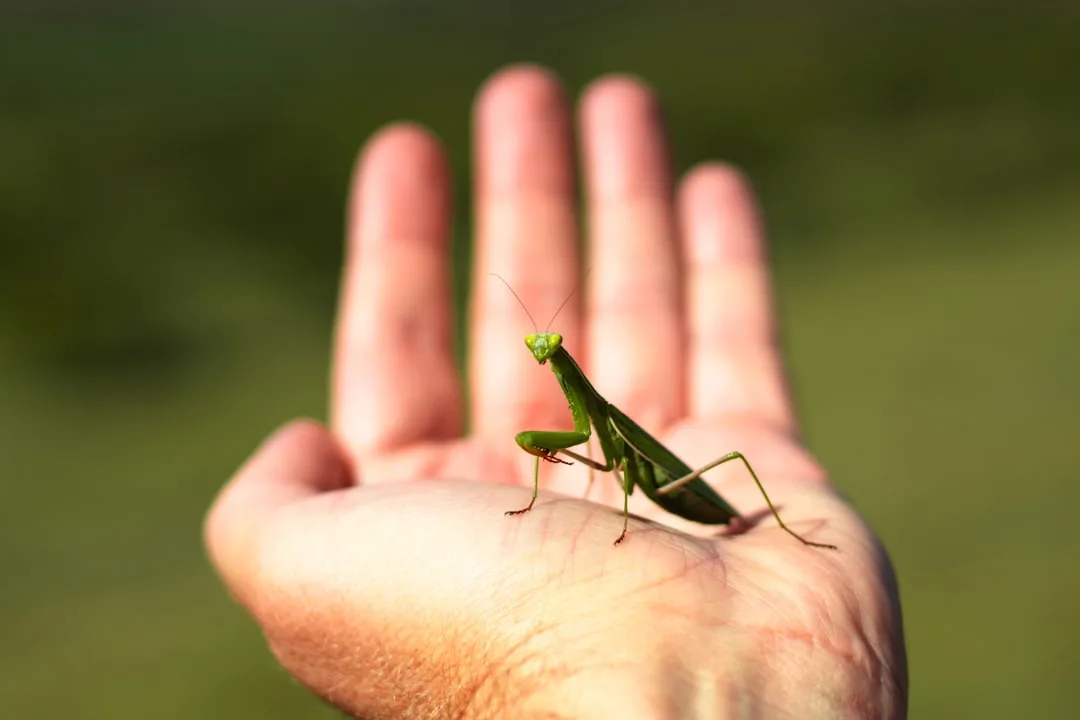
The European praying mantis has traits that make it one of the most specialised ambush predators in the animal kingdom and the insect most frequently compared - with some justification - to a miniature vertebrate. Unlike almost every other insect, Mantis religiosa has binocular stereoscopic vision, a head that rotates through 180 degrees, and a targeted limb strike that fires in around fifty milliseconds.
It hunts other insects, and with surprising regularity it kills small vertebrates: lizards, frogs, mice, even hummingbirds at garden feeders. It is alert, cryptic, patient, and uncommonly responsive to the movement of a human hand.
This guide covers the European praying mantis - the representative species for the roughly 2,400 mantises that make up the order Mantodea - in full: anatomy, vision, the raptorial strike, diet, the overstated but real story of sexual cannibalism, reproduction via the foam ootheca, distribution, cultural history across 8,000 years of Chinese medicine and martial arts, and the conservation status that separates the abundant European mantis from its more fragile tropical relatives.
As with every entry in this series, this is a reference page rather than a summary, and it carries the specifics: millimetres, milliseconds, egg counts, and dates.
Etymology and Classification
The scientific name Mantis religiosa was assigned by Carl Linnaeus in 1758. Mantis is a Greek word meaning 'seer' or 'prophet', and religiosa refers to the insect's distinctive posture: forelegs folded together in front of the thorax in a pose that early naturalists compared to prayer.
Common names in most European languages reflect the same idea - Gottesanbeterin ('God-worshipper') in German, mante religieuse in French, mantide religiosa in Italian. The posture has nothing to do with devotion. It is the ambush position. A mantis holding its arms in the prayer fold is loaded and waiting.
The order Mantodea contains approximately 2,400 described species distributed across every continent except Antarctica, organised into roughly 30 families. Mantises are most closely related to cockroaches (Blattodea) and termites - genetic and morphological evidence supports a shared ancestor with the cockroach lineage during the Cretaceous period, around 135 million years ago. Mantis religiosa itself belongs to the family Mantidae, the largest and most widely distributed mantis family.
The species was introduced to North America around 1899, reportedly on European nursery stock that arrived at Rochester, New York. It has since spread across most of the continental United States and southern Canada, where it coexists with the also-introduced Chinese mantis (Tenodera sinensis) and the smaller native Carolina mantis (Stagmomantis carolina).
Size and Physical Description
Praying mantises show pronounced sexual dimorphism, with females consistently larger and heavier than males. In Mantis religiosa this difference is on the order of 35 per cent by length and more still by mass.
Females:
- Body length: approximately 7.5 cm
- Broad, heavy abdomen that holds the developing eggs
- Wings present but short - females are poor fliers and typically glide
Males:
- Body length: approximately 5.5 cm
- Slender abdomen
- Full-length wings - males fly competently and are active at night during mating season
Other key anatomical features shared by both sexes:
- Triangular head with two large compound eyes
- Three ocelli (simple eyes) arranged in a triangle between the antennae
- Elongated prothorax that functions mechanically like a neck
- Two raptorial forelegs covered in opposed rows of sharp spines
- Four walking legs
- Colour morphs: green or straw-brown, determined during the final nymphal moult by environmental cues including humidity and light
Body colour in Mantis religiosa is not individually fixed. Nymphs maturing in dry, sun-bleached grass tend to emerge brown; those in lush green foliage emerge green. Once the final adult moult is complete the colour is locked for life. A distinguishing mark of the species is the black-and-white target spot on the inner face of each foreleg coxa, which other mantis species generally lack.
Vision - Stereoscopic Sight in an Insect
The praying mantis is the only insect known to possess true stereoscopic, binocular vision. Its two large compound eyes are set approximately 2 cm apart on a wide triangular head, and the brain behind them computes depth by comparing the two images in real time - the same principle that allows humans, owls, and other predators to judge distance.
Experimental evidence for mantis stereopsis is unusually strong. In 2018 researchers at Newcastle University fitted mantises with miniature 3D glasses - tiny lenses glued to the compound eyes with beeswax - and showed the insects moving targets on a specially calibrated screen. The mantises struck only when the targets appeared at the correct distance in the 3D field, exactly as a human viewer would see them.
This confirmed what had been suspected since the 1980s: mantis depth perception is not an artefact of motion parallax or body movement. It is a real binocular calculation performed by the optic ganglia.
Why this matters ecologically: most insects triangulate distance by moving their heads side to side and tracking parallax shifts, which works but wastes time. A mantis does the same calculation passively, from a stationary position, which preserves its ambush camouflage. Prey that would otherwise detect a moving insect sees only a leaf.
A triangular head sits atop the long flexible prothorax on a true neck joint. The mantis can rotate its head through a full 180 degrees to track prey without moving its body. No other insect can do this - most have rigidly fused neck segments. Combined with the compound eyes and ocelli, the rotating head gives the mantis close to a full hemispherical awareness of its surroundings.
The Raptorial Strike
The praying mantis strike is the fastest recorded attack in the insect world. From the moment the mantis decides to fire, the forelegs snap shut in around fifty milliseconds - roughly one-twentieth of a second - far below the reaction time of flies, bees, or even many small vertebrates.
The mechanics are elegant. The raptorial foreleg is divided into three working segments: the elongated coxa that projects forward like a forearm, the femur lined on its inner edge with paired rows of sharp spines, and the tibia which folds back against the femur to form a snap-shut trap. When the mantis strikes, the tibia closes against the femur and the two rows of spines interlock, pinning prey in place with no possibility of wriggling free.
The strike is triggered by the optic ganglia after stereoscopic distance is confirmed and any of three criteria match: the target is within reach, within the correct size class, and moving. The muscles that drive the strike are stored under tension in the femur and released explosively, similar in principle to the latch mechanism in a mantis shrimp or a trap-jaw ant.
Because the strike is open-loop - the mantis commits before visual feedback can correct it - prey selection depends heavily on the preceding stereoscopic calculation.
Laboratory studies consistently report strike success rates of around 85 per cent, which is exceptional for any predator. Field success is lower because real prey is less predictable and fewer strikes are attempted per hour, but the underlying weapon is the same.
Hunting and Diet
Praying mantises are strict carnivores and obligate ambush predators. They do not chase, they do not stalk, and they do not use venom. The hunt is always the same: hold position on a plant stem matching the mantis body colour, lock the eyes onto a moving target, wait, strike, hold, and eat.
Primary prey - insects:
- Flies and midges (especially abundant on warm afternoons)
- Crickets and grasshoppers
- Moths and butterflies
- Bees and wasps (handled carefully from above to avoid the sting)
- Beetles (smaller species; hard carapaces limit larger targets)
- Other mantises (routine when populations are dense)
Secondary prey - small vertebrates:
- Lizards and small snakes
- Tree frogs and juvenile salamanders
- Newborn mice and small rodents
- Hummingbirds, particularly at garden feeders in North America
The hummingbird predation is well documented. A 2017 review published in the Wilson Journal of Ornithology collated 147 records from 13 countries of mantises killing small birds, mostly at feeders where mantises lie in wait along the perch. Chinese mantises were the most frequent culprit, but Mantis religiosa accounts for a meaningful share of European records.
Prey is gripped by the spined forelegs and eaten head-first while still alive. A mantis will process an adult cricket in roughly 15 to 20 minutes, leaving only the wings, legs, and hollow thoracic shell. A hungry adult female can consume roughly her own body weight in prey in a good week.
Strike success rate approximates 85 per cent in laboratory studies, with failures driven mostly by prey that breaks line-of-sight or falls off the leaf before the strike completes.
Sexual Cannibalism - The Overstated Story
Few animal behaviours have generated more folk mythology than the female praying mantis eating her mate. The image is almost universally known: the female begins feeding on the male's head during copulation, the decapitated male continues mating, the female finishes him after fertilisation is complete. The physiology is real. The frequency is not.
Careful field observations of Mantis religiosa in southern Europe record sexual cannibalism in approximately 25 per cent of wild mating encounters. Captive studies under laboratory conditions - small cages, artificial lighting, food-deprived females, no escape routes - record rates above 60 per cent, which is where most of the famous historical footage comes from. The disparity matters because it means most popular accounts describe an artefact of captivity, not the wild baseline.
Why the behaviour occurs at all has been studied since the 1930s. Current evidence supports several partly overlapping explanations:
- Nutritional subsidy. A male represents a substantial protein meal at the exact moment the female is provisioning eggs. Cannibalised females produce larger and more numerous eggs.
- Opportunistic predation. The female is an obligate predator, and a nearby moving insect - even a conspecific male - triggers the strike response unless he approaches correctly.
- Paternal investment. From the male's perspective, being eaten passes on substantial biomass to his own offspring, which may be adaptive under some models.
The headless-mating phenomenon is genuine and well understood. The copulatory reflex is controlled by a ganglion in the abdomen, not the brain, so decapitation does not stop sperm transfer and can even release inhibition, prolonging copulation. This neurological decoupling is the reason the behaviour ever became folklore in the first place - it is spectacular, but not universal.
Reproduction and the Ootheca
Reproduction in Mantis religiosa is keyed to a single-season annual cycle. Adults mature in midsummer, mate in late summer and autumn, and die by early winter. Only the eggs, wrapped inside the foam ootheca, survive the cold months.
Seasonal cycle:
- Late May to early June: eggs hatch, nymphs emerge
- June to early August: nymphs pass through 6-9 instars (moults)
- Mid-July to August: final moult, adults emerge with wings
- August to October: mating season, males seek females by sight and scent
- September to November: females lay one to several oothecae
- November onward: adults die, eggs overwinter
The ootheca is the distinguishing reproductive structure of all mantises. The female secretes a liquid protein foam from specialised glands near the ovipositor and whips it into a froth while depositing eggs in orderly chambered rows inside. The foam hardens within about an hour into a tough, weatherproof, insulating capsule attached to a plant stem, rock, or wall.
A single M. religiosa ootheca contains between 50 and 400 eggs and survives freezing temperatures down to approximately minus 20 degrees Celsius. Internal chambers are arranged so that hatching nymphs emerge through dedicated exit channels, typically within minutes of each other in spring.
| Reproductive metric | Value |
|---|---|
| Eggs per ootheca | 50-400 |
| Oothecae per female | 1-4 across her lifespan |
| Incubation | Approximately 6 months (overwintering) |
| Cold tolerance | Down to roughly -20 degrees Celsius |
| Hatchlings per ootheca | Typically 50-200 surviving nymphs |
| Nymph instars to adult | 6-9 moults |
Nymphs are miniature, wingless versions of the adult and begin hunting on their first day. Cannibalism among siblings is routine - a hatch of 200 nymphs may produce only a dozen survivors by late summer, which is why female fecundity is so high.
Distribution, Habitat, and Introduced Range
Mantis religiosa is native to southern and central Europe, North Africa, and parts of temperate Asia. The species reaches as far north as southern Scandinavia, though populations at that latitude are scattered and weather-limited.
Preferred habitat:
- Warm, dry, sunny grassland and meadow
- Pasture edges, vineyards, orchards, abandoned lots
- Low shrubland and tall herbaceous vegetation
- Suburban gardens with mixed structure and sunlit borders
The mantis depends on vertical stems and leaves as ambush perches and on direct solar radiation to warm its flight muscles. It does not thrive in dense closed-canopy forest, marshland, or high mountain environments above approximately 1,500 metres.
Introduced populations:
- North America (1899 onward): established across most of the continental United States and southern Canada
- Australia: limited introductions, not widely established
- Isolated records in other temperate regions via the plant trade
In North America the species is legally protected in some jurisdictions as a beneficial garden predator. This protected status is occasionally misunderstood as conservation urgency, but M. religiosa is not a species of conservation concern anywhere in its range.
Cultural and Historical Significance
Few insects carry the cultural weight of the praying mantis. Across 8,000 years of recorded history the species has been a figure in medicine, martial arts, religion, and folklore.
Chinese traditional medicine. Mantis oothecae have been prescribed in Chinese medical practice for approximately 8,000 years under the name sang piao xiao, literally 'mulberry drifting nest'. Dried, ground, and prepared as decoctions, oothecae are still used today in the state-registered Chinese pharmacopoeia for conditions including nocturnal enuresis, urinary frequency, and various tonifying purposes.
Modern biochemical analysis has identified several bioactive peptides in the ootheca material, though clinical efficacy remains contested.
Kung fu mantis style. Northern Praying Mantis (tanglangquan) is one of the traditional Chinese martial arts, developed in 17th-century Shandong province by the swordsman Wang Lang, who - according to tradition - studied the striking patterns of real mantises and adapted them into a human-scale system of rapid hand strikes and grips.
Southern Praying Mantis is a separate, younger lineage with different lineage claims but a similar inspiration. Both styles emphasise short, fast, simultaneous attack-and-block movements that mirror the mantis raptorial strike.
Western folk symbolism. European folklore cast the mantis variously as a hermit, a prophet, a guide for lost travellers, or a pious creature in prayer. The Greek etymology of the genus name encodes this last reading. None of these interpretations has any basis in the animal's actual behaviour, which is essentially ambush predation.
Indigenous African symbolism. Among San and Khoekhoe peoples of southern Africa, the mantis appears as Kaggen, a trickster-creator figure in cosmological stories - though the species referenced is usually an African mantis rather than M. religiosa.
The Single Ear - Ultrasonic Bat Detection
Praying mantises possess a single functional ear, located on the ventral midline of the thorax between the hind legs. Unlike the paired ears of most other animals, this single cyclopean ear cannot provide directional information, and it is not tuned to the frequencies mantises themselves produce (mantises are nearly silent). It is tuned, very precisely, to the ultrasonic echolocation calls of hunting bats.
When a flying mantis detects an approaching bat, it executes a rapid evasive dive - the wings are folded and the insect drops vertically, often several metres, breaking away from the bat's attack line. Laboratory studies show the evasion reflex is triggered within about 30 milliseconds of bat call detection, comparable to the fastest defensive reflexes known in any insect.
The presence of this single specialised ear is one of the better examples of evolutionary arms races in the animal kingdom. Mantises evolved flight, bats evolved echolocation to hunt them, and mantises evolved ultrasonic ears to evade the echolocation. The ear is absent in wingless mantis groups and in species whose females are flightless.
Conservation Status
The IUCN Red List classifies Mantis religiosa as Least Concern. The species is widespread across Europe, North Africa, temperate Asia, and its introduced range in North America, with no overall population decline. Several regional red lists treat the species as locally protected at the northern edge of its range - for example historical restrictions on collection in parts of Germany - but these reflect local habitat concerns rather than any global threat.
Threats at the local level:
- Intensive agriculture and broad-spectrum pesticide use reduce insect prey
- Loss of unmown grassland and meadow habitat
- Habitat fragmentation between suitable sunlit patches
- Light pollution reduces nocturnal male flight activity
At the order level the picture is more mixed. Mantis religiosa itself remains abundant, but several specialist tropical mantises face real pressure from rainforest loss. The orchid mantis (Hymenopus coronatus), several dead-leaf mantises, and various range-restricted endemics are candidates for future listing even though the order Mantodea as a whole is under-assessed.
A 2023 review estimated that only about 20 per cent of the roughly 2,400 described mantis species have been evaluated against IUCN criteria, so for most species the conservation status is formally Data Deficient.
Praying Mantises and Humans
The European praying mantis is broadly welcomed by humans. As a general predator of garden pests, it is tolerated or actively encouraged in vineyards, orchards, and vegetable gardens across its range, and oothecae are sold commercially in the United States for garden release.
The mantis is not dangerous to people. It has no venom, its bite is mechanically weak, and it cannot puncture human skin with the foreleg spines. A mantis handled firmly may grip a finger and attempt a defensive bite, but no medically significant injury is on record. The species is commonly kept as a household pet - especially by entomology enthusiasts - and is one of the easier insects to maintain because it requires only a perch, a mist of water, and live insect prey.
Gardeners occasionally find the species controversial because it consumes bees and other pollinators alongside pest insects, a non-selectivity that reflects the ambush lifestyle rather than any real population-level harm to pollinator communities.
Related Reading
- Praying Mantises: The Ambush Predators of the Insect World
- Why Female Praying Mantises Eat Their Mates
- Orchid Mantis: The Flower That Hunts
References
Sources consulted for this entry include the IUCN Red List assessment for Mantis religiosa, peer-reviewed research published in Journal of Experimental Biology, Current Biology, Proceedings of the Royal Society B, Wilson Journal of Ornithology, and Behavioral Ecology, along with the Newcastle University stereoscopic vision experiments (Nityananda et al., 2018), the Nyffeler et al. review of mantis predation on vertebrates (2017), and standard reference works on Mantodea taxonomy.
Ootheca cold-tolerance data follow published European field studies; kung fu mantis lineage details follow established traditional Chinese martial arts histories.
Frequently Asked Questions
How big is a praying mantis?
The European praying mantis (Mantis religiosa) shows strong sexual dimorphism. Adult females reach roughly 7.5 cm in body length, while males top out closer to 5.5 cm. Females are also visibly heavier and broader across the abdomen, which carries the developing eggs. Both sexes have the same basic shape: a triangular head, an elongated prothorax that functions almost like a neck, and two large raptorial forelegs folded in the prayer position.
Colour varies between green and straw brown depending on the local vegetation an individual matured in. Larger tropical species such as the Chinese mantis or the giant Asian mantis can exceed 15 cm, but M. religiosa is a mid-sized mantis.
What does a praying mantis eat?
Praying mantises are strict carnivores and obligate ambush predators. The bulk of the diet is other insects - flies, crickets, grasshoppers, moths, butterflies, bees, wasps, beetles, and other mantises. Larger females regularly take prey up to their own body size, including grasshoppers, locusts, and even bees handled carefully to avoid the sting.
A mantis will also kill and eat small vertebrates when the opportunity arises: documented prey includes lizards, tree frogs, salamanders, small snakes, newborn mice, and hummingbirds caught at feeders. The mantis relies entirely on vision and the raptorial strike - it does not pursue prey or use venom. Prey is held in place by the spined forelegs and eaten alive, typically starting with the head.
Do female mantises really eat the males?
Sometimes, but the reputation is overstated. Field studies in Europe estimate sexual cannibalism in about 25 per cent of wild mating encounters of Mantis religiosa. In captive settings - small cages, poor lighting, hungry females - rates above 60 per cent have been recorded, which is where most famous laboratory footage comes from.
Research also shows that cannibalism is not required for successful reproduction: headless males can continue copulation because the nerve cord in the abdomen drives mating reflexes independently, but most matings in the wild end with both partners alive. When cannibalism does occur, the female gains a substantial protein meal that improves egg provisioning, which may be why the behaviour persists despite the cost to males.
Where do praying mantises live?
Mantis religiosa is native to southern and central Europe, North Africa, and parts of temperate Asia. It was introduced - reportedly accidentally on nursery plants - to North America around 1899 and has since spread across most of the continental United States and southern Canada. Preferred habitat is warm, dry, sunny grassland: meadows, pasture edges, shrubland, vineyards, abandoned lots, and suburban gardens with tall herbaceous plants.
The mantis depends on vertical stems and leaves for ambush perches and on solar heat to power its muscles. It does not thrive in dense forest, marshland, or high mountain environments. The species is widely tolerated and encouraged in gardens as a general insect predator.
How long do praying mantises live?
An adult praying mantis lives roughly 6 to 12 months under natural conditions, with almost all of that span compressed into a single warm season. Eggs are laid in autumn inside an ootheca, overwinter in dormancy, and hatch in late spring as miniature wingless nymphs. The nymphs pass through 6 to 9 moults, called instars, before reaching sexual maturity in midsummer. Mating, egg-laying, and the onset of autumn cold typically finish the adults by November.
Only the eggs inside the ootheca survive winter, so the next generation is biologically and behaviourally continuous with the last. Captive mantises kept above 20 degrees Celsius without a winter cycle can sometimes extend adult life by a few weeks but rarely much more.
Why is a mantis so good at catching prey?
Three features make Mantis religiosa one of the most effective ambush predators for its size class. First, stereoscopic vision: the two compound eyes are set about 2 cm apart, allowing the brain to compute distance to prey with real binocular depth perception - the only insect known to do this.
Second, a triangular head on a long flexible prothorax rotates up to 180 degrees, letting the mantis track prey without moving its body and losing its camouflaged outline. Third, the raptorial forelegs fire in about 50 milliseconds, faster than any other insect strike, far quicker than the reaction time of flies, bees, or even small vertebrates.
Together these traits deliver roughly an 85 per cent strike success rate in laboratory tests, which is exceptional for any predator.
Is the praying mantis endangered?
Mantis religiosa is listed as Least Concern by the IUCN. The species is widespread across Europe, North Africa, parts of Asia, and the introduced range in North America, with no sign of overall population decline. Several regional red lists treat the species as locally protected - for example Germany has historically restricted collection - but this reflects habitat concerns at the northern edge of the range rather than a global threat.
Pesticide use and intensive agriculture reduce local populations, as does loss of unmown grassland. At the order level, however, several tropical mantis species with highly specialised habitats (the orchid mantis, various rainforest endemics) face real pressure from deforestation. M. religiosa itself remains abundant and genetically healthy.
What is an ootheca and how does it work?
An ootheca is the protein foam egg case produced by female mantises. The female secretes a liquid protein mass from specialised abdominal glands and whips it into a froth with her ovipositor while simultaneously depositing eggs in orderly rows inside. The foam hardens within an hour into a tough, weatherproof, insulating capsule attached to a stem, wall, or rock.
A single Mantis religiosa ootheca contains between 50 and 400 eggs, arranged in layered chambers, and survives winter freezes down to approximately minus 20 degrees Celsius. The following spring the nymphs hatch simultaneously, chew their way out through escape channels, and disperse within minutes.
The ootheca was one of the earliest insect structures recorded in Chinese medical texts, where dried oothecae are still used today under the name ‘sang piao xiao’.