
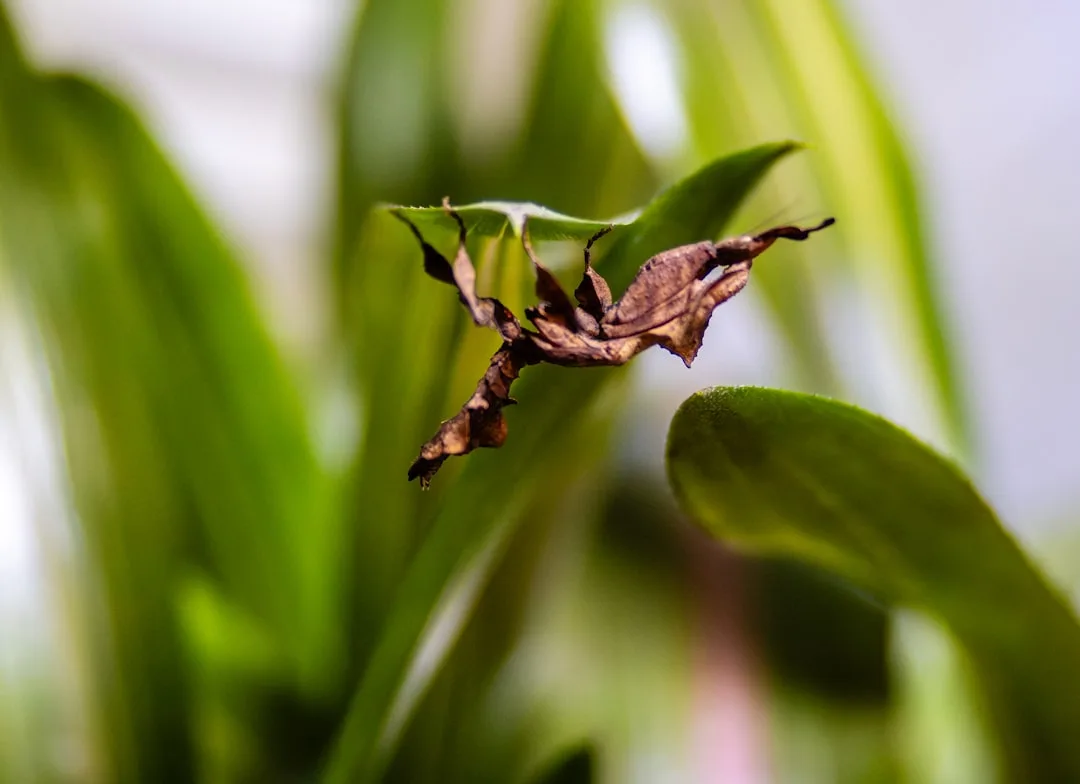
The ghost mantis is one of the most accomplished dead-leaf mimics in the insect world. Small, slow-moving, and covered in irregular flaps that break up every clean edge on its body, Phyllocrania paradoxa spends its life hanging from thin twigs and leaf-litter stems in sub-Saharan African woodland and across Madagascar.
It is so convincing at looking like a dried, partly decayed leaf that predators overlook it and small flying prey drift close enough to be struck - often within a few centimetres of the insect they never saw.
It is also, unusually for a mantis, a calm species. Sexual cannibalism is rare in ghost mantises. Females regularly accept males without killing them. Nymphs can be raised together in the same enclosure for weeks. Combined with its modest size, striking "dead-leaf with a Mohawk" body plan, and tolerant care requirements, this has made the ghost mantis one of the most popular invertebrate pets in the world.
This guide covers every aspect of ghost mantis biology and ecology: taxonomy, size, colour morphs, camouflage mechanics, diet, reproduction, lifespan, geographic range, the Madagascar population, and keeping the species in captivity. Specifics over summaries - expect centimetres, instar counts, humidity ranges, and verified behavioural observations.
Etymology and Classification
The genus name Phyllocrania comes from the Greek phyllon (leaf) and kranion (skull or head), referring to the pronounced leaf-like crown that projects from the top of the mantis's head. The species name paradoxa means "strange" or "contrary to expectation" - a reference to how unlike a normal insect the ghost mantis looks when encountered on a dry branch.
The common name "ghost mantis" reflects both its pale, near-translucent nymph stages and the way the insect seems to vanish into its background.
The species sits within family Hymenopodidae, the same family that includes the orchid mantis (Hymenopus coronatus) and the spiny flower mantises (Pseudocreobotra). Within Hymenopodidae, Phyllocrania forms a small genus of leaf-mimicking mantises, with P. paradoxa as the best-known and most widespread species.
Two subspecies have sometimes been recognised in the literature - the nominate African form and a Madagascar form with marginally longer wing pads and a larger head crown - though most modern taxonomic treatments keep them under a single species.
Ghost mantises share with their family a tropical to subtropical distribution, a predatory habit, raptorial forelegs modified for striking prey, and the mantis order's characteristic triangular head with excellent binocular vision.
Size and Physical Description
Ghost mantises are small mantises. At 4-5 cm in total length, an adult female is less than half the size of the giant Asian mantis and roughly the length of a human thumb. Adult males are only marginally smaller at 4-4.5 cm, though they are noticeably slimmer and have longer antennae used for detecting female pheromones over distance.
Adult females:
- Length: 4-5 cm from head crown to abdomen tip
- Body build: broader, heavier abdomen
- Wings: fully developed but flown only occasionally
- Weight: roughly 0.5-1 gram
Adult males:
- Length: 4-4.5 cm
- Body build: slender, narrow abdomen
- Wings: fully developed, used actively for mate-finding flights
- Antennae: longer and more feathered than females
- Weight: under 0.5 gram
Nymphs:
- Hatchlings: roughly 4-5 mm long, almost black, with early hints of leaf flaps
- Instars: six to eight moults before adulthood, depending on sex and temperature
- Development time: three to six months from hatching to final moult
The body is covered in flattened, irregular projections. The thorax carries a pair of wide lateral flaps that extend like leaf edges. The abdomen flares into a flattened shape rather than the tubular profile of most mantises. The four walking legs bear leaf-shaped cuticular lobes on the femurs, and even the tibiae carry smaller notches that mimic leaf veins.
The forelegs - the raptorial striking limbs - are smaller and more folded than those of larger mantis species, but they remain functional for snatching small prey at close range.
The most striking single feature is the head crown. A tall, asymmetric projection of chitin rises from the top of the head between the compound eyes, imitating the torn edge of a dried leaf. No other Hymenopodidae member carries a crown as exaggerated as the ghost mantis. Keepers frequently describe the outline as Mohawk-like, and it is one of the features buyers most often point to when choosing the species.
Colour Morphs and Pigment Change
Ghost mantises are not a single colour. Individuals across a wild population span a spectrum of earthy tones, from pale cream and tan through medium brown, deep chocolate, reddish-brown, olive green, grey-brown, and occasional near-black individuals. The morph that a given mantis displays depends on environmental conditions during its most recent moults.
| Morph | Typical trigger conditions |
|---|---|
| Pale tan / cream | Dry air, bleached backgrounds, direct sun |
| Medium brown | Standard woodland conditions, moderate humidity |
| Chocolate / reddish | Higher humidity, shaded backgrounds |
| Olive green | Prolonged exposure to green foliage, high humidity |
| Grey-brown / near-black | Cool, shaded, mossy substrate |
Colour change is slow. The pigmentation shift happens across successive moults, not within minutes or hours. A nymph raised on a chocolate-brown background for two instars will typically emerge from its next moult darker than it was before. Once an individual reaches its final moult and becomes an adult, the colour stabilises and remains largely fixed for the rest of its life, though subtle fading can occur with age.
The mechanism driving this colour flexibility is not fully understood but appears to involve a combination of hormonal cues set during the pre-moult phase and environmental inputs perceived through the eyes and cuticle. This slow, moult-by-moult adjustment stands in clear contrast to the rapid chromatic shifts seen in chameleons or cephalopods.
Camouflage and Defensive Behaviour
Ghost mantis camouflage relies on passive crypsis - being invisible rather than deceptive. Unlike the orchid mantis, which actively lures pollinators toward itself, the ghost mantis prefers to go unseen. Three features combine to achieve the effect.
Shape. The thorax, abdomen, and leg segments carry flattened lobes and asymmetric notches that break up the insect's outline. There are no clean curves or straight edges anywhere on the body - the silhouette reads as "irregular organic debris" rather than "animal".
Pigmentation. Mottled browns, tans, and greens with darker veining imitate leaf decay. The pigment pattern is irregular across the body, which prevents predators from identifying repeated features that would indicate a living animal.
Posture and motion. A resting ghost mantis hangs upside-down or sideways from a thin twig with its legs held close and its body flattened against the substrate. When a mild breeze moves nearby leaves, the mantis sways side to side at the same rhythm - a behaviour called phasic swaying that enhances the illusion of leaf-like debris caught in wind.
If a predator approaches close enough to trigger alarm, the mantis may drop to the ground and lie motionless among real leaf litter, where it is nearly impossible to find.
Ghost mantises do not display aggressive threat postures (wing flashing, abdomen curling) as readily as larger mantis species. Their primary defence is simply to avoid detection. If grasped, they may deliver a harmless pinch with the raptorial forelegs, but they cause no meaningful injury to humans or to most predators.
Diet and Hunting
Ghost mantises are ambush predators specialised on small flying insects. They hunt by staying motionless on a perch, waiting for prey to pass within strike range, and lashing out with the raptorial forelegs - a strike that completes in under 100 milliseconds.
Primary prey:
- Small flies (houseflies, fruit flies, midges)
- Moths and small butterflies
- Winged ants and small wasps
- Leafhoppers and small grasshoppers
- Occasional soft-bodied caterpillars
Hunting strategy:
- Choose a perch near flowering or leafy vegetation where flying insects are active.
- Hold a static, leaf-like posture that makes the mantis invisible to approaching prey.
- Track a nearby insect with the triangular head, which rotates up to 180 degrees independently of the body.
- Strike with the raptorial forelegs when prey enters the narrow kill zone.
- Feed slowly, head-first, over several minutes.
A documented side strategy involves subtle chemical luring. Ghost mantises appear to release tryptophan-derived volatile compounds from thoracic glands that resemble the pheromones of female moths. Male moths approach, mistaking the mantis for a receptive female, and are ambushed at close range. This behaviour has been observed in captive trials and remains an active area of research.
Wild ghost mantises eat one or two prey items per day when conditions are good. Feeding frequency drops during cool or dry periods. Because the species is small, it rarely takes prey larger than its own body length - another difference from the orchid mantis and other ambush specialists that routinely target oversized prey.
Life Cycle and Reproduction
Ghost mantis reproduction follows the standard Mantodea pattern of ootheca-laying females and short-lived adult males, but with two notable departures from the norm: low sexual cannibalism and modest sexual size dimorphism.
Courtship and mating. Males detect receptive females by pheromone signals carried on the air. Once within sight, the male approaches slowly, often pausing for many minutes between small movements. He mounts the female from behind, aligns his abdomen, and copulates for 30 minutes to several hours.
Unlike orchid mantises or European mantises, ghost mantis females almost never attack their mates during or after copulation. Breeders routinely leave paired adults together for days without significant losses. The exact behavioural and chemical basis for this calm temperament is still under study.
Egg-laying. Gravid females produce a foamy ootheca deposited against a thin twig, bark surface, or smooth substrate. The ootheca hardens within hours into a small, flattened, leaf-shaped structure that blends almost invisibly with surrounding bark. Each ootheca contains 20-40 eggs. A well-fed adult female can produce four or more oothecae across her adult life.
Incubation and hatching. Incubation lasts four to six weeks at 25-28 degrees Celsius. Nymphs emerge together over a period of minutes, hanging briefly from silk threads before dispersing. They are dark, almost black, at hatching, with only faint hints of the leaf-like projections that will develop later.
Development. Nymphs pass through six to eight instars over three to six months. Each moult gradually adds flap size, head-crown height, and pigment complexity. The final moult produces the winged adult and fixes adult colour.
Adult stage. Adult life lasts three to five months. Males tend to die somewhat earlier than females, especially after mating. Females continue feeding and producing oothecae until shortly before death.
Lifespan and Survival
Ghost mantises live 6-12 months from hatching to death. The bulk of that life is nymphal. Adulthood is short.
| Life stage | Typical duration |
|---|---|
| Egg (inside ootheca) | 4-6 weeks |
| Nymph (all instars) | 3-6 months |
| Adult female | 3-5 months |
| Adult male | 2-4 months |
| Total lifespan | 6-12 months |
Wild mortality is high at every stage. Predators include birds, lizards, spiders, ants, and larger insects. Failed moults are a significant cause of death - if humidity is too low during the moult, the nymph may become trapped in its old cuticle and die. Desiccation, cold snaps, and prolonged food scarcity add further losses.
Captive specimens with stable temperature, humidity, and feeding often reach the upper end of the range, and occasional individuals exceed 12 months. The species has a hard-coded short adult lifespan regardless of care - no amount of husbandry extends the adult stage much beyond five months.
Range and the Madagascar Population
Ghost mantises occupy an enormous geographic range across the warmer parts of Africa and Madagascar, and small introduced populations exist on the Canary Islands.
African mainland range:
- Senegal, Gambia, Mali (west)
- Ghana, Nigeria, Cameroon (west-central)
- Chad, Sudan, South Sudan, Ethiopia (central to east)
- Kenya, Uganda, Tanzania (east)
- Zambia, Zimbabwe, Mozambique, Botswana (south-central)
- Parts of northern and eastern South Africa (south)
Madagascar population. A separate and large population occurs across Madagascar, from dry western woodlands to the forested eastern slopes. Morphological studies suggest the Madagascar population tends toward slightly longer wing pads and larger head crowns than mainland African individuals. Whether this constitutes a full subspecies or a continuous gradient of variation remains unresolved.
Canary Islands. Introduced populations persist on several of the Canary Islands, likely arriving through the pet trade or ornamental plant shipments from the African mainland. These small populations are not considered invasive threats, since the species is a specialist ambush predator that does not displace native insects at scale.
Within the range, ghost mantises prefer dry woodland, savanna edges, scrub, and forest margins rather than dense closed-canopy rainforest. They are most abundant where thin, twiggy vegetation produces the kind of three-dimensional perch structure their camouflage is adapted for.
Keeping Ghost Mantises in Captivity
The ghost mantis has become one of the most popular invertebrate pets in the world. Several features explain its appeal: small size, striking leaf-mimic appearance, tolerance for a range of conditions, calm temperament, and - critically - low cannibalism that makes communal rearing possible.
Enclosure. A ventilated enclosure measuring roughly 20 cm by 20 cm by 30 cm is adequate for a single adult. The enclosure should offer multiple thin vertical perches - twigs, bark, silk leaves, or live plants - because ghost mantises prefer to hang upside-down from elevated surfaces.
Temperature and humidity. Ambient temperatures of 22-28 degrees Celsius by day, slightly cooler at night, work well. Humidity around 60-70 per cent is ideal and can be maintained with light daily misting. The species tolerates short dry spells better than more sensitive Hymenopodidae.
Diet. Flying insects make up the staple: fruit flies for young nymphs, houseflies and curly-wing flies for larger nymphs and adults, small crickets as occasional variety. Feed adults every two to three days, nymphs every day to every other day.
Communal rearing. Unlike almost all other popular mantis species, ghost mantis nymphs can be housed together in the same enclosure for the first several instars without significant losses to cannibalism. Breeders rely on this trait to raise large batches from a single ootheca with minimal space requirements. Cannibalism risk rises gradually as nymphs approach adulthood, at which point separation is advised.
Breeding. Pair a freshly moulted adult female, at least two weeks post-final-moult and well-fed, with an adult male. Copulation typically occurs within hours to a few days. Leave the pair together for three to seven days to ensure successful mating. Oothecae appear within two to four weeks and hatch after four to six weeks of incubation at 25-28 degrees Celsius.
Legal status. Rules on keeping exotic invertebrates vary by country. In most of Europe and North America the ghost mantis is legal to keep, but import and re-export of live specimens may require permits. Captive-bred lines now dominate the market and reduce pressure on wild populations.
Conservation and Threats
The ghost mantis has not been formally assessed by the IUCN Red List. The species is not considered at immediate risk of extinction because of its wide geographic range, its use of multiple habitat types, and its high reproductive output. Captive breeding for the pet trade means that collection pressure on wild populations is low compared with rarer species like the orchid mantis.
Localised threats are the usual ones for tropical and subtropical forest insects: habitat loss due to agricultural expansion, fire regime changes, pesticide drift, and climate change altering temperature and humidity patterns. Madagascar's population faces additional pressure from deforestation rates that remain among the highest in the world.
Because the species is small, cryptic, and widespread, it is likely underrecorded in scientific surveys. Distribution maps probably underestimate the true range.
Related Reading
- Orchid Mantis
- Chinese Mantis
- Praying Mantis
- Praying Mantises: The Ambush Predators of the Insect World
- Praying Mantis: Female Eats Male
References
Relevant sources consulted for this entry include peer-reviewed Mantodea taxonomy and behavioural studies published in Zootaxa, Insect Science, and Journal of Orthoptera Research, field guides to African Mantodea, Madagascar insect diversity surveys, and invertebrate husbandry literature from European and North American entomological societies.
Specific figures on lifespan, ootheca size, and instar count reflect consolidated observations from captive-bred lineages and wild-caught specimens documented in the mantis-keeper literature over the past two decades.
Frequently Asked Questions
How big are ghost mantises?
Ghost mantises (Phyllocrania paradoxa) are small compared to most popular pet mantis species. Adult females reach 4-5 cm in total length and weigh roughly 0.5-1 gram. Adult males are slightly shorter at 4-4.5 cm and are noticeably more slender, typically weighing less than half a gram.
Unlike many mantis species where the female dwarfs the male, ghost mantises show only modest sexual dimorphism in length - males are almost the same size as females but differ in build, antenna length, and wing development. Newly hatched nymphs are just 4-5 mm long and go through six to eight moults before reaching adulthood, gradually developing the leaf-like flaps and head crown that define the species.
Where do ghost mantises live?
Ghost mantises are native to sub-Saharan Africa and Madagascar. Confirmed populations span a huge range across the African continent, from Senegal in the west to Ethiopia and Tanzania in the east and down through Mozambique, Zimbabwe, Botswana, and parts of South Africa. A separate population occurs across Madagascar. Small introduced populations exist in the Canary Islands.
Within this range the species prefers dry woodland, savanna edges, scrub, and forest margins rather than dense closed-canopy rainforest. They perch on thin branches, dry twigs, and leaf litter at heights from ground level to a few metres, positioning themselves where their dead-leaf appearance blends with the surrounding foliage. Warm, moderately humid conditions between 22 and 30 degrees Celsius suit them best.
What do ghost mantises eat?
Ghost mantises are ambush predators that feed primarily on flying insects. Their diet in the wild centres on small flies, moths, midges, winged ants, small grasshoppers, and leafhoppers, with occasional soft-bodied caterpillars taken when encountered. Because they are small mantises, they rarely take prey larger than their own body length - unlike the orchid mantis, they do not specialise in oversized prey.
In captivity keepers typically feed fruit flies, houseflies, small crickets, and curly-wing flies scaled to the mantis stage. Adults eat every two to three days; nymphs eat daily or every other day to support moulting. The species uses a sit-and-wait strategy, relying almost entirely on visual ambush rather than active pursuit.
Why are ghost mantises so good at camouflage?
The ghost mantis is a textbook example of passive crypsis, meaning it avoids detection by looking exactly like something that predators and prey will ignore - in this case a dried, curled, partially decayed leaf. Three features combine to produce the effect. First, the body plan itself: the thorax, abdomen, and leg segments carry irregular flattened flaps, notches, and ridges that break up the insect’s outline.
Second, the pigmentation: mottled browns, tans, grey, and occasional green tones simulate dry leaf decay, and individuals can shift colour between moults depending on humidity and the dominant background hue. Third, the head crown: a tall asymmetric projection above the eyes that mimics the torn edge of a leaf.
Combined with phasic swaying - a gentle side-to-side motion that imitates wind-blown debris - the mantis is extremely hard to spot even at close range.
What colours do ghost mantises come in?
Ghost mantises occur in a spectrum of earthy tones rather than a single fixed colour. The most common morph is a medium dead-leaf brown, but individuals can also appear in pale tan, deep chocolate, reddish-brown, olive green, grey-brown, and occasionally near-black. Colour is not fixed at hatching. Across successive moults, nymphs shift their pigmentation in response to the humidity, light level, and dominant colour of their surroundings.
A nymph raised against a green-leaf background tends to moult greener; one raised against dry bark and leaf litter tends to moult browner. Once adult, the colour remains largely fixed until death. This makes the species particularly popular with keepers who enjoy watching the colour of their mantis evolve over time.
Is the ghost mantis a good pet?
Ghost mantises are widely considered one of the best beginner mantis species for several reasons. They are small, which reduces enclosure size requirements - a 20 by 20 by 30 cm ventilated container is sufficient for an adult. They tolerate a wider range of temperature and humidity than more sensitive species such as orchid mantises. They are calm and slow-moving, which makes handling safer than with more active mantises.
Most importantly, sexual cannibalism is rare in this species, and breeders often house multiple nymphs together for weeks without significant losses - a trait almost unheard of in other mantises. Captive-bred specimens now dominate the pet trade, which reduces the pressure on wild populations.
Keepers should still provide appropriate ventilation, perches, and prey-sized feeders scaled to the mantis stage, and legal import rules for live invertebrates vary by country.
How long do ghost mantises live?
Ghost mantises live between 6 and 12 months from hatching to death. Most of that time is spent as a nymph going through six to eight moults over three to six months, depending on temperature and feeding. The adult stage - when the mantis has fully developed wings and is capable of mating - lasts only about three to five months.
Males tend to live slightly shorter adult lives than females, especially once they have mated, because their metabolism is oriented toward mate-finding rather than long survival. Captive ghost mantises sometimes exceed 12 months under ideal temperature, humidity, and feeding, but the species has a hard-coded short adult lifespan regardless of care.
Females lay multiple oothecae during their adult life and continue producing eggs until shortly before they die.
Do female ghost mantises eat males?
Rarely. Sexual cannibalism is a defining feature of many mantis species - female orchid mantises, Chinese mantises, and European mantises regularly eat their mates. Ghost mantises are a notable exception.
Females almost never attack males during or after mating, a behavioural trait that is still under active study but appears linked to the species’ comparatively calm temperament, the modest size difference between sexes (females are only slightly larger than males), and possibly to chemical cues during courtship.
Keepers routinely pair ghost mantises with high success rates, and breeders report that even leaving a mated pair together for days does not usually result in cannibalism. This feature, combined with their small size and leaf-like appearance, is a major reason ghost mantises have become so popular in the global mantis pet trade.