
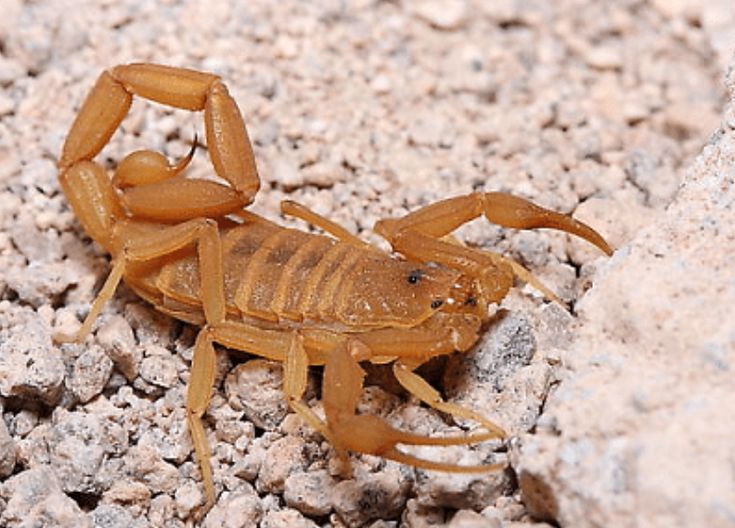
The Arizona bark scorpion is a small, pale, slender arachnid with an outsized reputation. It is the only scorpion in the United States whose venom is considered medically capable of killing a human, the only North American species for which the Food and Drug Administration has ever approved an antivenom, and one of the very few dangerous desert invertebrates that has successfully moved into a major American city.
Centruroides sculpturatus is genuinely common in Phoenix, Tucson, and surrounding Sonoran Desert communities - it climbs block walls, lives in roof tiles, shelters in pool equipment, and occasionally ends up in shoes, bedding, and laundry baskets.
This entry covers the species in depth: taxonomy, anatomy, venom chemistry, the 2011 arrival of Anascorp antivenom, climbing behaviour, the grasshopper mouse that eats it alive, ultraviolet fluorescence, reproduction, and life in a desert city. Although scorpions are arachnids and not insects, this guide is filed under the site's insects section because that is how most readers search for it.
Classification and Naming
The species was described by H.L. Ewing in 1928 from Arizona specimens and placed in the genus Centruroides, a large New World group within the family Buthidae.
Buthidae is the family that contains every scorpion species on Earth known to have killed a healthy adult human, including the deathstalker (Leiurus quinquestriatus), the Indian red (Hottentotta tamulus), the Brazilian yellow (Tityus serrulatus), and the fattail scorpions of North Africa.
The Arizona bark scorpion is the only Buthidae species whose range extends significantly north of the Mexico-United States border.
Taxonomic placement:
- Kingdom: Animalia
- Phylum: Arthropoda
- Class: Arachnida
- Order: Scorpiones
- Family: Buthidae
- Genus: Centruroides
- Species: C. sculpturatus
For much of the twentieth century the Arizona bark scorpion was treated as a subspecies or local form of Centruroides exilicauda, a Baja California species. Molecular work in the early 2000s confirmed that the two populations are genetically and venom-chemically distinct, and the Arizona form was formally re-elevated to full species status.
This matters clinically: C. exilicauda is far less dangerous, and older medical literature that conflated the two underestimated the Arizona species' venom toxicity.
The common name "bark scorpion" refers to its habit of sheltering under loose tree bark, inside woodpiles, and in rotting wood. The closely related striped bark scorpion (Centruroides vittatus) of Texas and Oklahoma shares the climbing habit but has much weaker venom.
Size and Physical Description
Arizona bark scorpions are small and slender compared to most scorpions that are widely known to the public. Adult body length, including the tail (metasoma) but measured to the tip of the telson, runs from roughly 60 to 80 millimetres. Females average slightly larger than males. The overall build is light - adults rarely exceed two grams.
The pedipalps (claws) are thin and elongated rather than bulky, and the tail is long, narrow, and curls forward over the back in the classic scorpion posture when the animal is alert.
Key identification features:
- Body colour: pale tan to light yellow, sometimes almost translucent after moulting
- Slender pedipalps with long, thin chelae
- Long, narrow tail with uniform colour (no black tip in most individuals)
- Subaculear tooth: a small dorsal spine just beneath the stinger, a diagnostic Buthidae feature
- Smooth, hairless exoskeleton with subtle granulation visible under magnification
The light colouration is not incidental. It provides camouflage on sun-bleached wood, dry leaf litter, weathered stucco, and pale desert stone. It also reflects more solar radiation than darker species, which matters during accidental daytime exposure. A closely related co-occurring species, the Arizona desert hairy scorpion (Hadrurus arizonensis), is much larger, hairier, and yellow-and-black - recognising the two at a glance is a basic skill for Phoenix homeowners.
Venom Chemistry
The medical importance of Centruroides sculpturatus comes down to a specific class of venom peptides that target voltage-gated sodium channels in mammalian nerve and muscle tissue. These peptides bind to sodium-channel site 4 and prolong channel opening, causing repeated and uncontrolled firing of nerves. Instead of a simple stimulus-and-response, the nervous system fires in sustained bursts.
Principal clinical effects of envenomation include:
- Intense burning local pain that spreads beyond the sting site
- Numbness, tingling, and paraesthesia near the sting
- Involuntary muscle twitching and "jittering" motor activity
- Roving, uncoordinated eye movements (a classic sign in children)
- Excessive salivation, tearing, and nasal discharge
- Tachycardia, hypertension, and occasional arrhythmia
- In severe cases, respiratory distress, pulmonary oedema, and seizures
Arizona poison control receives roughly 10,000 to 15,000 bark scorpion sting calls per year, with hundreds of those severe enough to require hospital evaluation and tens to low hundreds of paediatric cases severe enough for intensive care admission prior to the availability of Anascorp. Most healthy adults experience a painful but self-limited sting resembling an aggressive bee sting combined with long-lasting burning and tingling; full resolution typically takes 12 to 48 hours.
The venom does not include Loxosceles-style cytotoxins (those belong to recluse spiders) - bark scorpion venom is overwhelmingly neurotoxic rather than necrotic. Local tissue damage is minimal. The danger is systemic neuromuscular overactivity, which is why very young children with small airways are at greatest risk.
Anascorp: The First FDA-Approved Scorpion Antivenom
In August 2011, the Food and Drug Administration approved Anascorp, a Centruroides-specific antivenom manufactured in Mexico by Instituto Bioclon under the generic name Centruroides (scorpion) immune F(ab)2. This was the first scorpion antivenom ever licensed in the United States, and it marked a dramatic change in how severe paediatric stings are managed in Arizona emergency departments.
Before 2011, a severely envenomated child might spend three to four days in a paediatric intensive care unit receiving continuous benzodiazepine infusions to control muscle activity, sedation to tolerate the benzodiazepines, and mechanical ventilation to support breathing compromised by the combination. The venom itself was allowed to be metabolised and cleared over days.
Clinical trials led by Leslie Boyer and colleagues at the University of Arizona showed that intravenous Anascorp administered within a few hours of the sting resolved the neuromuscular syndrome within roughly four hours and typically allowed hospital discharge the same day.
Key facts about Anascorp:
- Active component: F(ab)2 fragments derived from horse plasma
- Manufacturer: Instituto Bioclon, Mexico City
- FDA approval: August 2011
- Primary indication: clinically significant scorpion envenomation by Centruroides sculpturatus
- Typical adult/paediatric dose: three vials IV, repeat as needed
Anascorp has shortened ICU stays, reduced mechanical ventilation rates, and essentially eliminated the small number of paediatric deaths that still occurred in the 1980s and 1990s. Arizona hospitals, particularly in Phoenix, Tucson, Yuma, and Flagstaff, now stock the drug as a routine emergency formulary item.
Habitat and Range
Arizona bark scorpions inhabit the hot deserts of the American Southwest and northwestern Mexico. The core of their range lies in the Sonoran Desert of Arizona and neighbouring Sonora, Mexico. Secondary populations extend into the Chihuahuan Desert of southwestern New Mexico, southern Utah, the southern tip of Nevada, and the extreme southeast corner of California. Isolated populations exist in West Texas as well, though most Texas scorpions are the striped bark scorpion.
Geographic distribution:
| Region | Status | Notes |
|---|---|---|
| Arizona | Abundant | Dominant scorpion in urban Phoenix, Tucson |
| Sonora, Mexico | Abundant | Native core of the range |
| New Mexico | Common | Southwestern counties, Las Cruces area |
| Southern Utah | Present | St George region, scattered populations |
| Southern Nevada | Present | Las Vegas Valley, mostly peripheral |
| Southeast California | Rare | Extreme desert corners only |
Within that range, C. sculpturatus is more of a structural generalist than most desert scorpions. Preferred natural habitats include rocky slopes, desert washes, loose bark on mesquite and cottonwood, packrat middens, and the undersides of flat rocks. The species is also strikingly well adapted to human construction.
Concrete block walls, stucco cavities, roof tiles, irrigation boxes, pool equipment housings, garages, attics, and garden sheds all provide the cool, shaded, humid crevices that bark scorpions need during the day. Phoenix's sprawling grid of block-walled suburbs may actually support higher bark scorpion density per square kilometre than the surrounding desert.
Bark scorpions also hitchhike well. Moving boxes, potted plants, pallets of firewood, and landscaping stone routinely carry isolated individuals and small populations to new locations outside the native range. Established outlying populations have been documented in parts of Utah and Nevada that were scorpion-free until decades of human migration from Arizona changed the picture.
Climbing: Why Bark Scorpions End Up on Ceilings
Most scorpions are heavy-bodied ground dwellers with short, thick legs built for burrowing. The bark scorpion is different. Its body is slender and light, its legs are long in proportion, and its tarsi carry fine setae and micro-structures that grip rough vertical surfaces. This lets it climb stucco walls, block walls, tree bark, ceiling tiles, curtains, bedsheets, and even smooth painted walls if the paint is slightly textured.
Three behaviours combine to put bark scorpions into contact with humans:
- Negative geotaxis. When startled or warm, bark scorpions preferentially move upward. A scorpion that enters a house under a door is likely to end up high - on walls, shelves, and ceilings - rather than staying on the floor.
- Nocturnal climbing for prey. At night, bark scorpions climb trees and walls to hunt insects attracted to outdoor lights. Flat rooflines, stucco facades, and lit patios become active hunting grounds.
- Shelter in narrow elevated cracks. Daytime rest sites include roof tiles, fascia boards, and attic spaces. Scorpions that return from a night's hunting move back into those elevated shelters rather than back to the ground.
The result is that bark scorpions are the most common scorpion found inside homes across their range, and they are often found in places that other species never reach: inside shoes on closet shelves, on pillows, inside light fixtures, in hanging clothes, and on ceilings. Phoenix pest-control operators routinely find them resting upside-down on ceilings during night inspections.
The Grasshopper Mouse: A Predator That Feels No Pain
The most remarkable fact in the bark scorpion's natural history is what happens when one encounters a southern grasshopper mouse (Onychomys torridus). This small, rodent-sized, aggressive, and carnivorous mouse attacks bark scorpions head-on, endures multiple stings during the fight, and then eats the scorpion alive, starting with the tail and working forward.
Research published in the journal Science in 2013 by Ashlee Rowe and colleagues explained how. Bark scorpion venom normally binds to Nav1.7 and Nav1.8 sodium channels in mammalian pain neurons, triggering burning pain. Grasshopper mice carry a specific amino acid substitution in their Nav1.8 channel that changes how the venom interacts with the protein.
Instead of prolonging the pain signal, the substitution causes the venom to block the channel, suppressing pain transmission. Remarkably, the grasshopper mouse is not merely immune - bark scorpion venom effectively acts as an analgesic in its nervous system.
Functionally this means:
- The mouse is stung during the attack
- The venom enters the mouse as normal
- The expected pain signal is converted to silence
- The mouse finishes the kill without distress
- The bark scorpion is consumed whole
Other animals that opportunistically eat bark scorpions include elf owls, burrowing owls, pallid bats, roadrunners, kit foxes, coyotes, larger scorpions such as Hadrurus arizonensis, tarantulas, giant desert centipedes, and various snakes. None of these approach the physiological speciality of the grasshopper mouse.
Ultraviolet Fluorescence
Every scorpion on Earth fluoresces blue-green under ultraviolet light, and the Arizona bark scorpion is no exception. The fluorescence comes from chemical compounds in the hyaline exocuticle layer of the chitinous exoskeleton. The two primary fluorophores identified so far are beta-carboline and 7-hydroxy-4-methylcoumarin. These compounds absorb UV light and re-emit it in the visible blue-green range.
Important points about scorpion fluorescence:
- Appears in all life stages except immediately after moulting
- A freshly-moulted scorpion does not glow until the new exoskeleton hardens, over several hours
- Present even in long-dead museum specimens, including fossils tens of thousands of years old
- Strongest under long-wave UV (365 nm); shorter wavelengths fluoresce less cleanly
Why scorpions evolved this feature remains unresolved. The leading hypotheses include whole-body UV-sensing, UV-screening to protect the nervous system, prey attraction, mate signalling, and an incidental cuticle chemistry with no adaptive purpose. The field is genuinely split.
Regardless of the evolutionary explanation, UV fluorescence is the single most useful tool for locating bark scorpions at night. A handheld long-wave UV flashlight makes even tiny juvenile scorpions visible from several metres away against dirt, gravel, block walls, and landscape. Phoenix homeowners, pest controllers, and researchers use UV scanning routinely.
In a half-hour walk around a Phoenix yard in summer, an observer with a UV torch often spots dozens of bark scorpions that would otherwise be invisible.
Reproduction and Life Cycle
Arizona bark scorpions are viviparous - they give birth to live young rather than laying eggs, which is universal across scorpions. Mating takes place in spring and summer and involves an elaborate courtship in which the male grips the female's pedipalps and leads her in a slow back-and-forth "promenade a deux" until he can deposit a spermatophore on the ground and manoeuvre her above it.
Gestation lasts several months. A single female typically produces a brood of 25 to 35 scorplings, occasionally more. The scorplings are born pale, soft, and translucent. Within minutes they climb onto their mother's back, where they remain for roughly two weeks until they complete their first moult. After this first moult, the juveniles disperse.
Life cycle timeline:
- Mating: late spring through summer
- Gestation: several months, timing varies
- Birth: live scorplings, 25-35 per brood
- Maternal carry: approximately 2 weeks on mother's back
- First moult: triggers dispersal
- Sexual maturity: around 2 years, after 5-6 moults
- Lifespan: typically 5-6 years in the wild
Bark scorpions are unusual among scorpions for sometimes aggregating in groups. In winter, dozens may shelter together under a single piece of bark, in a woodpile, or inside an attic void. This communal behaviour is partly thermal (shared microclimate) and partly opportunistic (limited cover in desert landscapes).
Conservation Status
The IUCN has not formally assessed Centruroides sculpturatus. Most scorpion species remain unassessed on the Red List. In the field, bark scorpions are abundant across their native range and are if anything benefiting from suburbanisation, which provides more structural cover than undisturbed desert. They are not considered at risk, and no meaningful conservation measures are in place for the species.
That said, populations are affected by broad-scale pesticide use, habitat conversion for agriculture, and pool construction that eliminates ground cover. Localised declines have been anecdotally reported in some heavily-sprayed neighbourhoods, although the species rebounds quickly when pressure lifts.
Living with Bark Scorpions in Phoenix
Phoenix is the largest urban area on Earth that co-exists with a truly medically dangerous scorpion. For most residents this means learning a handful of habits: shaking out shoes before putting them on, keeping beds a hand-span away from walls, avoiding barefoot trips across the yard at night, inspecting with a UV torch, sealing thresholds and weep holes, and knowing the route to the nearest hospital that stocks Anascorp.
Professional pest control focuses on three things: sealing entry points, non-repellent residual insecticides on the building perimeter, and reducing insect prey with exterior light management. Repellent products often make the problem worse by pushing scorpions from exterior cracks into wall voids and then into living space.
Well-managed homes can reduce bark scorpion encounters to near zero even in heavily-infested neighbourhoods, though total elimination is rare because new individuals arrive continuously from surrounding properties.
The species is a reminder that the Sonoran Desert's apex invertebrate predator did not retreat when humans built cities over its habitat. It simply moved in.
Related Reading
- Deathstalker Scorpion: World's Most Venomous Arachnid
- Emperor Scorpion: Rainforest Giant
- Scorpions: Ancient Arachnids That Glow in the Dark
References
Peer-reviewed and clinical sources consulted for this entry include the 2011 FDA approval documentation for Anascorp, Boyer et al. clinical trials on scorpion antivenom (New England Journal of Medicine, 2009), Rowe et al. on grasshopper mouse venom resistance (Science, 2013), the Banner Poison and Drug Information Center Arizona scorpion sting registry, the University of Arizona VIPER Institute publications on Centruroides envenomation, and taxonomic work by Fet, Sissom, and colleagues re-elevating C. sculpturatus from synonymy with C. exilicauda.
Frequently Asked Questions
How dangerous is the Arizona bark scorpion?
Centruroides sculpturatus is the most medically significant scorpion in the United States and the only species in the country whose sting is considered capable of causing death. Venom components target voltage-gated sodium channels in nerve tissue, producing intense local pain, numbness or tingling, involuntary muscle twitching, roving eye movements, excessive salivation, and in severe cases respiratory distress.
Most healthy adults experience a very painful sting but recover without hospitalisation. The highest-risk patients are infants, small children, the elderly, and anyone with a severe allergic response.
Fatalities in Arizona are now rare thanks to widespread emergency care and the availability of Anascorp antivenom, but bark scorpion stings still account for more than 10,000 calls to Arizona poison control each year and hundreds of paediatric hospitalisations.
What is Anascorp and why does it matter?
Anascorp is a Centruroides-specific antivenom made from horse plasma F(ab)2 fragments and manufactured in Mexico by Instituto Bioclon. In August 2011 the United States Food and Drug Administration approved it for the treatment of bark scorpion envenomation, making it the first scorpion antivenom ever licensed in the United States.
Before 2011, severe paediatric bark scorpion stings were treated with sedation, benzodiazepines, and supportive care in intensive care units, sometimes for days. Clinical trials in Arizona showed that Anascorp resolved the neuromuscular symptoms of severe envenomation within roughly four hours, compared with days of ICU support under the previous standard of care.
The drug is now stocked at hospitals throughout the bark scorpion’s range and has dramatically shortened admission times and reduced mortality in children.
Where do Arizona bark scorpions live?
The bark scorpion’s native range covers the Sonoran Desert of Arizona and neighbouring Sonora, extending into the Chihuahuan Desert of New Mexico and northern Mexico, southern Utah, the southern tip of Nevada, and the extreme southeast corner of California. Within that range they prefer rocky slopes, desert washes, loose bark on mesquite and cottonwood trees, packrat middens, and the undersides of flat rocks.
They are unusually well adapted to human-built structures - block walls, stucco cavities, roof tiles, pool equipment, irrigation boxes, garages, and attics all provide the shaded, humid crevices they need. Phoenix, Tucson, and smaller cities in the region host enormous urban populations. Bark scorpions also hitchhike in moving boxes, potted plants, and firewood, which spreads isolated populations beyond the core native range.
Why do bark scorpions climb walls and beds when other scorpions do not?
Most scorpions are heavy-bodied ground dwellers with short legs suited to burrowing. Bark scorpions evolved on trees and rocky cliffs, so their anatomy is different - they are slender, lightweight, and their tarsi have small specialised bristles and sticky pads that grip rough surfaces. This allows them to climb block walls, stucco, tree bark, curtains, ceilings, and bedding with ease.
Because they are negatively geotactic under some conditions (meaning they preferentially move upward when disturbed), they commonly end up in unexpected places - inside shoes on shelves, on pillows, inside light fixtures. Phoenix-area pest controllers routinely find bark scorpions resting upside-down on ceilings.
This climbing ability is also why bark scorpions are more commonly encountered in homes than their ground-dwelling relatives like the desert hairy scorpion.
Why do scorpions glow under ultraviolet light?
All scorpions, including the Arizona bark scorpion, fluoresce a bright blue-green colour under ultraviolet light because specific compounds in the hyaline exocuticle layer of their chitin absorb UV and re-emit it as visible light. The two identified fluorophores are beta-carboline and 7-hydroxy-4-methylcoumarin. Fluorescence appears only after the exoskeleton hardens; freshly-moulted scorpions do not glow. The biological purpose remains unresolved.
Leading hypotheses include UV-sensing (the whole body acting as a light meter), UV screening to protect against damage, prey attraction, and an incidental by-product of cuticle chemistry with no adaptive function. Regardless of why it evolved, the glow is extremely useful for humans.
Pest controllers, researchers, and homeowners hunt bark scorpions at night using handheld UV flashlights, which make even very small individuals visible from several metres away against dirt, brick, or plant matter.
What eats the Arizona bark scorpion?
Several predators tolerate or specialise on bark scorpions, but the most remarkable is the southern grasshopper mouse, Onychomys torridus. This small desert rodent attacks bark scorpions head-on, survives being stung repeatedly, and eats them alive tail-first.
Research published in Science in 2013 showed that grasshopper mice carry a specific amino acid substitution in their Nav1.8 sodium channel that actually blocks the bark scorpion’s pain signal - the venom still enters the mouse, but the channels close rather than open, and the signal that would normally register as burning pain is converted into an analgesic response. The mice can then finish the kill without distress.
Other predators that take bark scorpions opportunistically include elf owls, burrowing owls, pallid bats, roadrunners, coyotes, kit foxes, tarantulas, centipedes, and larger scorpion species such as the Arizona desert hairy scorpion.
How do I keep bark scorpions out of my house?
Bark scorpions get indoors through astonishingly small gaps - any crack wider than about 1.5 mm is enough for a juvenile. Effective exclusion focuses on sealing thresholds, weatherstripping doors, caulking cable penetrations and plumbing entries, installing fine mesh over weep holes in block walls, and removing harbourage in the yard (woodpiles, palm fronds, loose rocks, stacks of pavers).
Outdoor lights attract insects which attract scorpions; switching to yellow sodium-style bulbs and moving lights away from the house helps. Indoors, keep beds pulled away from walls, shake out shoes and clothing before use, and avoid leaving damp towels on the floor. Regular UV-light inspections at night around the foundation reveal active individuals before they enter.
Professional pest control using non-repellent residual insecticides on the perimeter is the standard approach in Phoenix; repellent products often push scorpions further indoors and can make the problem worse.
How long do bark scorpions live and how do they reproduce?
Wild bark scorpions typically live five to six years. Like all scorpions they give birth to live young rather than laying eggs - a reproductive style called viviparity. Mating involves an elaborate courtship dance in which the male grasps the female’s pedipalps and leads her across the ground until he can deposit a spermatophore that she then mounts. Gestation lasts several months.
A single female produces a brood of 25 to 35 pale white scorplings which climb onto her back immediately after birth. She carries them on her back for roughly two weeks while they undergo their first moult, after which they disperse. Scorplings reach sexual maturity at around two years and can reproduce for the remainder of their lives. Females often produce multiple broods across a lifetime, usually one per year under favourable conditions.