
Why do scorpions glow under ultraviolet light?
Scorpions fluoresce under UV light due to two specific compounds found in their exoskeleton cuticle: beta-carboline and 7-hydroxy-4-methylcoumarin. These molecules absorb ultraviolet radiation and re-emit it as visible blue-green light. The fluorescence develops as the cuticle hardens after molting, meaning newly molted scorpions do not glow. The exact evolutionary purpose of this fluorescence remains debated among researchers.
In the summer of 1954, during a series of nuclear weapons tests at the French nuclear testing grounds in the Sahara Desert, researchers made an observation that entered the folklore of biology. Among the animals subjected to radiation exposure in controlled field studies, scorpions survived doses that killed insects, reptiles, and mammals outright. The scorpions walked away.
They did not merely survive the blast - they endured radiation levels between 90 and 150 times the lethal dose for humans and continued functioning as if nothing had happened. This observation, while sometimes embellished in popular retellings, captures something fundamental about scorpions: these are organisms built for survival on a scale that borders on the incomprehensible.
Scorpions are not insects. They are arachnids, closer relatives of spiders, ticks, and mites than of beetles or ants. They have eight legs, not six. They lack antennae and wings. And they carry a lineage that stretches back 435 million years to the Silurian period, making them among the oldest terrestrial arthropods on Earth - and among the very first animals to transition from sea to land.
The cockroach, often cited as the ultimate survivor, is a relative newcomer by comparison, appearing roughly 320 million years ago. Scorpions predate the first dinosaurs by more than 200 million years.
Yet despite their antiquity, scorpions remain deeply misunderstood. Most people know two things about them: they sting, and they are dangerous. Both statements require significant qualification. Of the more than 2,500 described species of scorpions, only about 25 possess venom potent enough to kill a healthy adult human. The overwhelming majority are no more dangerous than a bee sting.
What makes scorpions genuinely remarkable is not their capacity to harm but their extraordinary biology - a fluorescent exoskeleton that glows under ultraviolet light, sensory organs of astonishing precision, venom compounds now being used to image brain tumors, and survival abilities that have allowed essentially the same body plan to persist through five mass extinction events.
435 Million Years on Earth: The Evolutionary Record
The earliest known scorpion fossils date to approximately 435 million years ago, during the late Silurian period. These ancient scorpions were aquatic or semi-aquatic, living in shallow marine and estuarine environments. Some were enormous by modern standards. Brontoscorpio anglicus, dating to about 412 million years ago, reached lengths of nearly one meter.
Pulmonoscorpius kirktonensis, from the Carboniferous period roughly 340 million years ago, grew to approximately 70 centimeters - about the length of a human arm.
"The scorpion body plan is one of the most conservative in the animal kingdom. The basic architecture - pedipalps with pincers, four pairs of walking legs, segmented metasoma ending in a telson with a venom gland - has remained essentially unchanged for over 400 million years." - Lorenzo Prendini, American Museum of Natural History, curator of arachnids and myriapods [1]
The transition from water to land occurred gradually over tens of millions of years, with scorpions among the earliest arthropods to make the shift. The anatomical evidence suggests they possessed book lungs - respiratory organs adapted for air breathing - by the Devonian period, approximately 400 million years ago. This places scorpions among the true pioneers of terrestrial life, colonizing land before amphibians, before reptiles, and long before any mammal existed.
What is extraordinary about scorpion evolution is not the change but the lack of it. While virtually every other major animal group has undergone dramatic morphological transformation over comparable timescales, the scorpion body plan has remained remarkably stable. Modern scorpions are recognizably similar to their Paleozoic ancestors.
This morphological conservatism suggests that the scorpion design - a robust exoskeleton, powerful pincers for prey capture, a venomous stinger for defense and subduing prey, and highly developed sensory systems - represents an exceptionally successful solution to the challenges of terrestrial predatory life. Natural selection has found little reason to alter it.
Global Diversity: 2,500 Species Across Six Continents
Scorpions are found on every continent except Antarctica. They inhabit deserts, tropical rainforests, grasslands, temperate forests, caves, and high mountain environments up to elevations of 5,500 meters in the Andes. The roughly 2,500 described species are classified into approximately 22 families, though scorpion taxonomy remains actively debated and revised.
The highest diversity is found in tropical and subtropical regions, particularly in Mexico, which hosts more scorpion species than any other country. Brazil, India, and the countries of North Africa and the Middle East also harbor significant diversity. But scorpions are not exclusively tropical animals. Species are found as far north as southern Canada and as far south as Patagonia.
In Europe, scorpions occur across the Mediterranean region, and introduced populations have established themselves in parts of England.
Despite their reputation as desert dwellers, many scorpion species are adapted to humid environments. The emperor scorpion (Pandinus imperator), one of the largest species in the world, inhabits the tropical rainforests and savannas of West Africa. Several species are obligate cave dwellers, having lost their pigmentation and, in some cases, their eyes over evolutionary time. The diversity of scorpion habitats reflects the adaptability of their fundamental body plan.
The Glow: UV Fluorescence and Its Mysteries
The most visually striking feature of scorpion biology - and one that has puzzled researchers for decades - is their fluorescence under ultraviolet light. When exposed to a blacklight, scorpions glow an intense blue-green or cyan color, visible from several meters away in complete darkness. This fluorescence is so reliable that researchers and pest control professionals routinely use portable UV lamps to survey scorpion populations at night.
The fluorescence is produced by two specific chemical compounds embedded in the hyaline layer of the scorpion's exoskeleton cuticle: beta-carboline and 7-hydroxy-4-methylcoumarin. These fluorescent molecules absorb ultraviolet radiation in the 350 to 400 nanometer wavelength range and re-emit it as visible light at approximately 440 to 500 nanometers.
The fluorescence is a property of the cuticle itself, not of any living tissue. Dead scorpions glow just as brightly as living ones. Scorpion fossils preserved in amber still fluoresce millions of years after death. Even fragments of shed exoskeleton retain the property.
Critically, newly molted scorpions do not fluoresce. The glow develops gradually as the new cuticle hardens and the fluorescent compounds accumulate, typically reaching full intensity within approximately two weeks after a molt. This observation has been central to research into the function of the fluorescence, since it demonstrates that the glow is tied to cuticle maturation rather than being an inherent property of scorpion tissue from birth.
The Debate Over Purpose
The evolutionary purpose of scorpion UV fluorescence remains one of the outstanding puzzles in arachnid biology. Several hypotheses have been proposed, none definitively proven:
UV detection hypothesis: Scorpions are nocturnal and actively avoid light. Research by Douglas Gaffin at the University of Oklahoma demonstrated that scorpions modify their behavior under UV light, becoming less active and seeking shelter.
Gaffin proposed that the entire exoskeleton functions as a whole-body UV sensor - the fluorescence converts ambient UV radiation into wavelengths detectable by the scorpion's simple eyes, allowing the animal to assess its exposure to moonlight and starlight and retreat to darker environments.
This hypothesis is supported by behavioral experiments showing that scorpions are more active on moonless nights and that shielding their exoskeleton from UV light alters their activity patterns [2].
Mate-finding hypothesis: Some researchers have suggested that the fluorescence may play a role in intraspecific communication, particularly in mate finding. If scorpions can detect the fluorescence of conspecifics, the glow could serve as a visual signal in low-light conditions. However, evidence for this hypothesis remains limited, and scorpion visual acuity is generally considered too low for reliable detection of fluorescence at ecologically relevant distances.
UV protection hypothesis: The fluorescent compounds may function as a sunscreen, absorbing potentially damaging UV radiation and converting it to harmless visible light, thereby protecting the underlying tissues. This would be particularly advantageous for species living in high-UV desert environments.
Vestigial or incidental hypothesis: Some researchers argue that the fluorescence may have no adaptive function at all and is simply a biochemical byproduct of cuticle hardening processes. The fluorescent compounds might serve structural or antimicrobial roles in the cuticle, with the fluorescence being an incidental side effect.
"It is tempting to assign adaptive significance to such a conspicuous trait, but the history of biology is littered with examples of features that were assumed to be adaptive and later turned out to be byproducts of other processes. The scorpion fluorescence question remains genuinely open." - Carl Kloock, California State University, Bakersfield [3]
Venom: Lethal Chemistry in a Tiny Gland
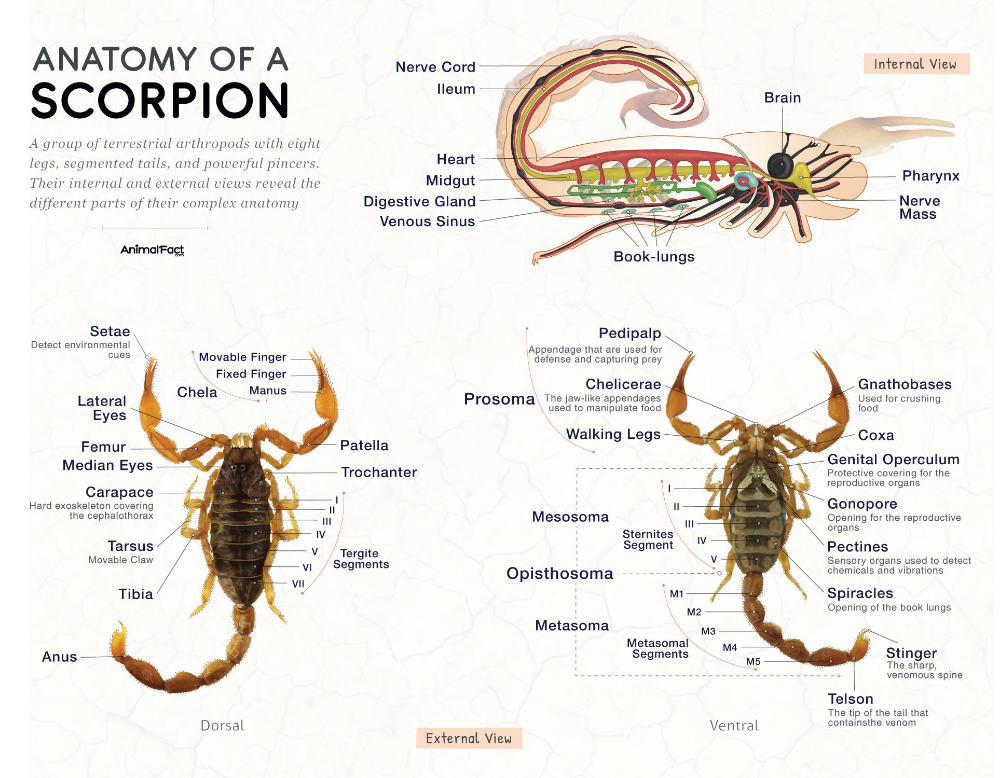
The scorpion's telson - the bulbous structure at the tip of its tail - contains a pair of venom glands surrounded by muscles that can inject venom through a sharp, curved aculeus (stinger). Scorpion venom is a complex cocktail of hundreds of bioactive compounds, including neurotoxins, enzymes, enzyme inhibitors, salts, and organic compounds. The composition varies dramatically between species and even between populations of the same species.
Of the approximately 2,500 scorpion species, only about 25 are considered medically significant - that is, capable of producing envenomation severe enough to kill a healthy adult human. These species belong primarily to the family Buthidae, which includes the most venomous scorpions in the world.
The Deathstalker (Leiurus quinquestriatus)
The deathstalker is widely regarded as the most dangerous scorpion species. Found across North Africa, the Middle East, and parts of Central Asia, this slender, yellow-green scorpion measures only 5 to 10 centimeters in length.
Its venom contains a potent blend of neurotoxins that target sodium and potassium ion channels in nerve cells, causing intense pain, convulsions, respiratory failure, and, in vulnerable individuals, death. The deathstalker is responsible for the majority of fatal scorpion stings in its range.
Paradoxically, the deathstalker's venom is also the source of one of the most promising developments in cancer medicine. A peptide in the venom called chlorotoxin has the remarkable ability to bind specifically to glioma cells - the cells that form the most aggressive type of brain tumor.
This discovery has led to the development of "tumor paint", a fluorescent imaging agent that uses chlorotoxin to illuminate brain tumor cells during surgery, allowing surgeons to identify and remove cancerous tissue that would otherwise be invisible to the naked eye. Clinical trials led by Jim Olson at the Fred Hutchinson Cancer Research Center have shown promising results [4].
The Bark Scorpion (Centruroides sculpturatus)
The Arizona bark scorpion is the most dangerous scorpion in North America. Found throughout the Sonoran Desert and surrounding regions, it is small (5 to 8 centimeters), pale tan, and distinguished by its ability to climb vertical surfaces including walls and ceilings - a behavior unusual among scorpions. Its venom causes severe pain, numbness, and, in rare cases, respiratory failure.
Before the development of effective antivenom, bark scorpion stings were a significant cause of death in Arizona, particularly among children. An antivenom produced in Mexico, Anascorp, was approved by the FDA in 2011 and has dramatically reduced mortality.
Fat-Tailed Scorpions (Androctonus species)
The genus Androctonus - the name literally means "man-killer" in Greek - includes several species of fat-tailed scorpions found across North Africa, the Middle East, and parts of South Asia. These are robust, medium-sized scorpions (up to 10 centimeters) with characteristically thick, powerful tails.
Their venom is highly neurotoxic, and Androctonus australis is responsible for a significant proportion of scorpion-related deaths in North Africa. The fat-tailed scorpions are aggressive and quick to sting, making them particularly hazardous in regions where they cohabit with human populations.
| Species | Region | Size | Venom Type | Lethality | Notable Feature |
|---|---|---|---|---|---|
| Deathstalker (L. quinquestriatus) | North Africa, Middle East | 5-10 cm | Neurotoxic | High | Chlorotoxin used in tumor imaging |
| Arizona bark scorpion (C. sculpturatus) | Southwestern North America | 5-8 cm | Neurotoxic | Moderate | Climbs walls and ceilings |
| Fat-tailed scorpion (A. australis) | North Africa, Middle East | Up to 10 cm | Neurotoxic | High | Name means "man-killer" |
| Emperor scorpion (P. imperator) | West Africa | Up to 20 cm | Mild | Very low | Largest living species, popular pet |
| Indian red scorpion (H. tamulus) | Indian subcontinent | 5-9 cm | Cardiotoxic | High | Causes pulmonary edema |
| Brazilian yellow scorpion (T. serrulatus) | Brazil | 5-7 cm | Neurotoxic | Moderate-High | Parthenogenetic reproduction |
The Emperor Scorpion: Gentle Giant of the Arachnid World
The emperor scorpion (Pandinus imperator) is one of the largest scorpion species in the world, reaching lengths of up to 20 centimeters (approximately 8 inches) and weighing up to 30 grams. Native to the tropical rainforests and savannas of West Africa, the emperor scorpion is a glossy black animal with massive pedipalps (pincers) that it uses primarily for catching prey - primarily insects, other arthropods, and occasionally small vertebrates.
Despite its imposing size and appearance, the emperor scorpion has relatively mild venom, comparable in pain and effect to a bee sting. It relies primarily on its powerful pincers rather than its venom to subdue prey. This combination of impressive size, docile temperament, and harmless sting made the emperor scorpion one of the most popular exotic pets in the world.
However, overcollection for the pet trade, combined with habitat destruction, led to the species being listed under CITES Appendix II, which regulates international trade. The emperor scorpion is now subject to export quotas and permit requirements in its native range countries, particularly Ghana and Togo.
Emperor scorpions are also notable for their social behavior, which is unusual among scorpions. They frequently share burrows and can be found in groups, a level of gregariousness rare in a group of animals typically described as solitary and cannibalistic.
Pectines: The Most Sophisticated Sensory Organs You Have Never Heard Of
On the underside of every scorpion, between the last pair of walking legs, are two feather-shaped structures called pectines. These comb-like organs are unique to scorpions and represent one of the most remarkable sensory systems in the animal kingdom.
Each pectine consists of a row of teeth (typically between 6 and 50, depending on species and sex) lined with thousands of tiny sensory pegs called peg sensilla. A single pectine can bear up to 100,000 sensory neurons - an extraordinary density of sensory receptors packed into an organ measuring just a few centimeters.
The pectines function primarily as chemosensory and mechanosensory organs. They brush against the ground as the scorpion walks, detecting chemical gradients, surface textures, and vibrations. Males use their pectines to detect pheromone trails left by females, and the pectines play a critical role in identifying suitable substrate for spermatophore deposition during mating.
Research has also demonstrated that pectines can detect humidity gradients, ground vibrations from approaching prey, and possibly even magnetic fields, though the last claim remains controversial.
The pectines are sexually dimorphic in most species, with males possessing larger, more densely innervated pectines than females - consistent with their role in mate detection and tracking.
Scorpion Mothers: Carrying the Next Generation
Scorpion reproduction involves some of the most distinctive parental behavior found in arachnids. Mating begins with an elaborate courtship dance called the "promenade a deux", in which the male grasps the female's pedipalps with his own and leads her in a back-and-forth movement that can last from minutes to hours. During this dance, the male deposits a spermatophore (a packet of sperm) on the ground and maneuvers the female over it so that she can take it up into her genital opening.
Unlike most arachnids, which lay eggs, scorpions are viviparous or ovoviviparous - they give birth to live young. Gestation periods vary enormously between species, ranging from 2 months to over 18 months. Some species of Opisthacanthus have gestation periods approaching two years, among the longest of any arthropod.
When the young are born - typically between 6 and 100 offspring depending on species - they immediately climb onto their mother's back. The first-instar nymphs ride on the mother's dorsal surface, often covering her entire body in a squirming white mass. The mother carries them for one to three weeks, until they complete their first molt and their cuticle hardens sufficiently for independent life.
During this period, the mother provides protection but does not feed the young. She may, however, selectively cannibalize weak or dead offspring.
This investment in live birth and maternal care is energetically expensive but provides significant survival advantages. The young are protected from predators and desiccation during their most vulnerable stage, and the mother's body serves as a mobile microhabitat with regulated temperature and humidity.
Survival Beyond Reason
The resilience of scorpions is not limited to nuclear radiation survival. Their catalog of survival abilities reads like a list of biological impossibilities:
Starvation resistance: Scorpions can survive without food for up to 12 months. They achieve this by radically reducing their metabolic rate to as little as one-third that of comparable arthropods. Some species can reduce their oxygen consumption to near-zero levels, entering a state of metabolic torpor while remaining capable of rapid response to threats. A scorpion in metabolic depression can go from apparent dormancy to a full-speed strike in less than a second.
Freezing tolerance: Researchers have frozen scorpions overnight in blocks of ice, then thawed them the following day to observe them walk away apparently unharmed. The mechanisms behind this cold tolerance are not fully understood but likely involve the production of cryoprotectant compounds - antifreeze-like molecules that prevent the formation of damaging ice crystals within cells.
Submersion survival: Scorpions can survive being submerged underwater for up to 48 hours. They accomplish this by sealing their spiracles (breathing openings) and entering a state of anaerobic metabolism, effectively holding their breath for two days. Upon removal from water, they resume normal respiratory function within minutes.
Radiation resistance: The Cold War-era observations of scorpion radiation resistance have been partially corroborated by laboratory studies. Scorpions appear to possess exceptionally efficient DNA repair mechanisms that allow them to tolerate radiation doses far exceeding those lethal to most multicellular organisms.
The precise molecular mechanisms remain under investigation, but they may involve enhanced expression of repair enzymes and protective compounds in the exoskeleton that shield underlying tissues from ionizing radiation [5].
Desiccation resistance: Desert scorpions have among the lowest rates of water loss of any terrestrial arthropod. Their waxy cuticle is extremely impermeable to water vapor, and their excretory system produces highly concentrated waste, minimizing water expenditure. Some species can survive losing up to 40 percent of their body weight in water and recover fully upon rehydration.
Venom in Medicine: From Death to Cure
The same venom that makes a handful of scorpion species dangerous to humans is proving to be a treasure trove for biomedical research. Scorpion venom contains an estimated 100,000 distinct bioactive compounds across all species combined, of which fewer than 1 percent have been characterized. This chemical library, refined by hundreds of millions of years of natural selection, represents one of the most promising frontiers in drug discovery.
Tumor paint and cancer imaging: As noted earlier, chlorotoxin from the deathstalker scorpion binds specifically to glioma cells. Researchers at the Fred Hutchinson Cancer Research Center attached a fluorescent molecule to chlorotoxin, creating a compound called BLZ-100 (tozuleristide).
When injected into patients before brain surgery, the compound crosses the blood-brain barrier and causes tumor cells to glow under near-infrared light, providing surgeons with a real-time visual map of cancerous tissue. Phase I clinical trials demonstrated safety and efficacy, and the compound has received FDA Breakthrough Therapy designation [6].
Antimicrobial peptides: Scorpion venom contains numerous peptides with potent antimicrobial activity against bacteria, fungi, and even some viruses. With the global crisis of antibiotic resistance rendering many conventional antibiotics ineffective, scorpion-derived antimicrobial peptides are being investigated as potential next-generation antimicrobials.
Several compounds have shown activity against methicillin-resistant Staphylococcus aureus (MRSA) and other drug-resistant pathogens in laboratory studies.
Pain treatment: Paradoxically, the venom of an animal that causes excruciating pain is also a source of potential analgesic compounds. Certain scorpion venom peptides selectively block specific subtypes of sodium ion channels (particularly Nav1.7) that are critical for pain signaling in humans.
By targeting these channels with high specificity, scorpion-derived compounds could theoretically provide pain relief without the addiction risk of opioids. Research published in Cell identified a peptide from the Chinese scorpion Mesobuthus martensii that blocks Nav1.7 with high selectivity, demonstrating analgesic effects in animal models [7].
Immunosuppressive compounds: Some venom components show potential as immunosuppressive agents that could be useful in preventing organ transplant rejection and treating autoimmune diseases. Kaliotoxin and other potassium channel-blocking peptides from scorpion venom are under investigation for their ability to selectively suppress overactive immune responses.
The economic scale of scorpion venom is staggering. High-purity scorpion venom is among the most expensive liquids on Earth, with prices reaching $39 million per gallon for certain pharmaceutical-grade preparations. This extraordinary value reflects both the difficulty of collection - a single scorpion produces only about two milligrams of venom per milking - and the immense potential of its components.
A Body Plan That Refuses to Become Obsolete
The scorpion's persistence through 435 million years of evolutionary time - surviving the End-Ordovician, Late Devonian, End-Permian, End-Triassic, and End-Cretaceous mass extinctions - is not merely a biological curiosity.
It is a testament to the effectiveness of a design that combines robust physical protection, lethal chemical weaponry, extraordinary sensory acuity, and metabolic flexibility that borders on the absurd. While more charismatic animals rose and fell, while entire phyla vanished from the fossil record, scorpions endured.
They endured not by adapting dramatically to new conditions but by being so well-suited to their fundamental niche - small-to-medium nocturnal predator in terrestrial environments - that even catastrophic environmental upheaval could not dislodge them. The lesson of the scorpion is not about innovation. It is about optimization. When a design works, natural selection keeps it.
The next time a blacklight reveals a scorpion glowing cyan against the desert sand, it is worth pausing to consider what that glow represents: a 435-million-year experiment in survival, still running, still successful, and still keeping its secrets.
Are There Animals That Glow in the Dark?
Yes - scorpions are the most striking terrestrial example, fluorescing intense blue-green under ultraviolet light due to two compounds in their exoskeleton hyaline layer: beta-carboline and 7-hydroxy-4-methylcoumarin. These absorb UV radiation at 350-400 nm and re-emit at 440-500 nm, visible from several meters in complete darkness.
This is fluorescence, not true bioluminescence - scorpions require external UV input from moonlight or blacklights. Genuine bioluminescence (chemical light production from luciferin-luciferase reactions) appears in fireflies, deep-sea fish, some jellyfish, dinoflagellates, and certain fungi.
Newly molted scorpions do not glow because the fluorescent compounds accumulate as the new cuticle hardens, reaching full intensity within roughly two weeks.
Do Animals' Eyes Glow in the Dark?
Yes, but for different reasons than scorpion fluorescence. Cat, dog, deer, and cattle eyes reflect light from a layer called the tapetum lucidum behind the retina, which improves night vision - this is eyeshine, not glow. Scorpions fluoresce across their entire exoskeleton, not through their eyes, thanks to beta-carboline and 7-hydroxy-4-methylcoumarin embedded in cuticle.
Douglas Gaffin at the University of Oklahoma proposed that the entire scorpion exoskeleton functions as a whole-body UV sensor, converting ambient ultraviolet from moonlight into wavelengths detectable by the scorpion's simple eyes. Nocturnal scorpions become less active under UV light, consistent with using their glow to gauge exposure and find shelter on moonlit nights.
Do Animals Glow in the Dark?
Some do - scorpions fluoresce cyan under UV light from compounds in their cuticle, but this requires an external UV source. True bioluminescent animals include fireflies, anglerfish, vampire squid, and jellyfish such as Aequorea victoria, which produce their own light through luciferin-luciferase chemistry.
Scorpion fluorescence is so reliable that researchers and pest controllers use portable UV lamps to survey populations at night across all 2,500 described species on six continents. The fluorescence persists in dead specimens and even in amber-preserved fossils millions of years old.
The evolutionary purpose remains debated - hypotheses include UV sensing (Gaffin), sunscreen protection in high-UV desert habitats, mate signaling, and the possibility that it is simply an incidental byproduct of cuticle biochemistry.
References
Prendini, L., & Wheeler, W.C. (2005). Scorpion higher phylogeny and classification, taxonomic anarchy, and standards for peer review in online publishing. Cladistics, 21(5), 446-494.
Gaffin, D.D., Bumm, L.A., Taylor, M.S., Popov, N.V., & Mann, S. (2012). Scorpion fluorescence and reaction to light. Animal Behaviour, 83(2), 429-436.
Kloock, C.T. (2005). Aerial insects avoid fluorescing scorpions. Euscorpius, 21, 1-7.
Veiseh, M., Gabikian, P., Bahrami, S.B., et al. (2007). Tumor paint: A chlorotoxin:Cy5.5 bioconjugate for intraoperative visualization of cancer foci. Cancer Research, 67(14), 6882-6888.
Udayakumar, M., Chandrasekar, E.L., & Sivanandan, M. (2015). Radiation tolerance studies on scorpion Heterometrus swammerdami. Journal of Entomology and Zoology Studies, 3(4), 294-297.
Butte, P.V., Mamelak, A., Parrish-Novak, J., et al. (2014). Near-infrared imaging of brain tumors using the Tumor Paint BLZ-100 to achieve near-complete resection of brain tumors. Neurosurgical Focus, 36(2), E1.
Rong, M., Chen, J., Tao, H., et al. (2011). Molecular basis of the tarantula toxin jingzhaotoxin-III inhibiting the Nav1.7 sodium channel. FASEB Journal, 25(9), 3177-3185.
Possani, L.D., Merino, E., Corona, M., Bolivar, F., & Becerril, B. (2000). Peptides and genes coding for scorpion toxins that affect ion-channels. Biochimie, 82(9-10), 861-868.
Frequently Asked Questions
Why do scorpions glow under ultraviolet light?
Scorpions fluoresce under UV light due to two specific compounds found in their exoskeleton cuticle: beta-carboline and 7-hydroxy-4-methylcoumarin. These molecules absorb ultraviolet radiation and re-emit it as visible blue-green light. The fluorescence develops as the cuticle hardens after molting, meaning newly molted scorpions do not glow. The exact evolutionary purpose of this fluorescence remains debated among researchers.
Leading hypotheses include that it may help scorpions detect moonlight and UV radiation to avoid exposure, assist in finding mates, or function as a form of UV protection for the exoskeleton.
What is the most dangerous scorpion in the world?
The deathstalker scorpion (Leiurus quinquestriatus), found across North Africa and the Middle East, is widely considered the most dangerous scorpion species. Despite its relatively small size of 5 to 10 centimeters, its venom contains a potent cocktail of neurotoxins that can cause severe pain, respiratory failure, and death in vulnerable individuals such as children, the elderly, and those with compromised health.
However, only about 25 of the world’s 2,500-plus scorpion species possess venom potent enough to be lethal to healthy adult humans.
What extreme conditions can scorpions survive?
Scorpions are among the most resilient animals on Earth. They can survive being frozen overnight and resume normal activity upon thawing. They can endure starvation for up to 12 months by radically slowing their metabolism to as little as one-third the rate of comparable arthropods. Scorpions can survive being submerged underwater for up to 48 hours by entering a state of suspended animation.
Perhaps most remarkably, scorpions survived nuclear radiation tests conducted during the Cold War era, enduring radiation doses that would be lethal to most other animals, likely due to their extremely efficient DNA repair mechanisms.