
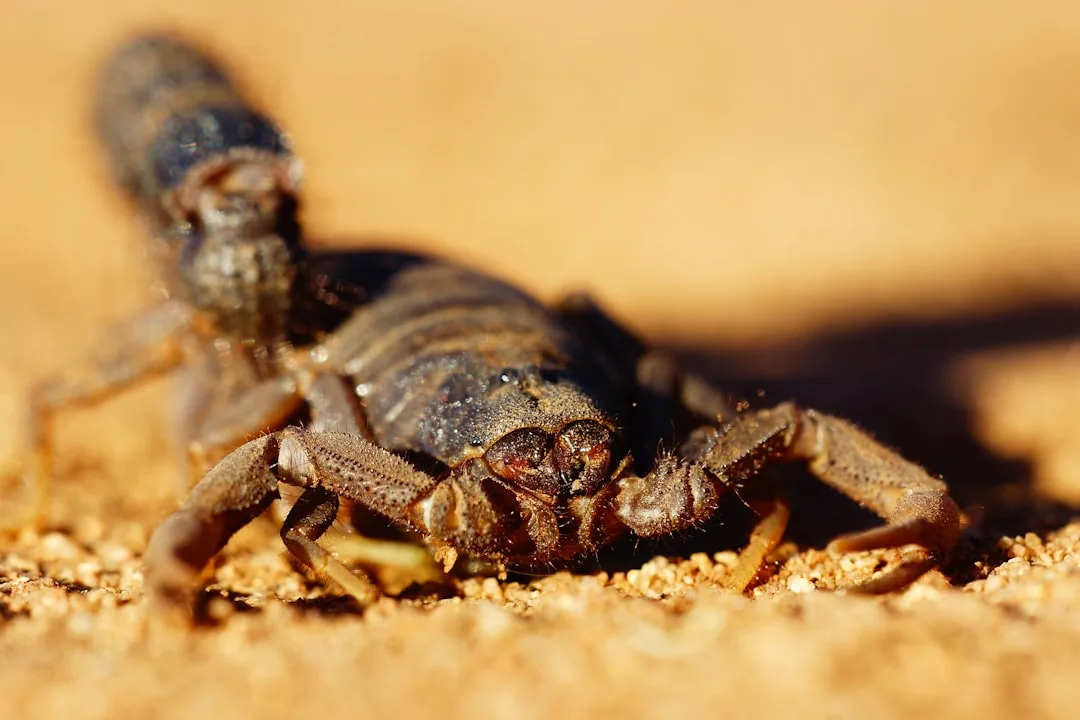
The deathstalker is the most medically important scorpion on Earth. Its venom is among the three most potent ever measured in the order Scorpiones, yet the same venom contains a single peptide - chlorotoxin - that has reshaped how surgeons find brain cancer in living patients.
A litre of crude deathstalker venom is routinely quoted at around ten million United States dollars, making it one of the most expensive liquids on the planet. The animal that produces it is a slender, yellow arachnid roughly the length of a thumb, usually sitting motionless at the mouth of a burrow in the deserts of North Africa and the Middle East.
This entry covers Leiurus quinquestriatus as a complete biological subject: its classification, anatomy, behaviour, habitat, venom chemistry, medical applications, reproduction, and relationship with humans. It is written as a reference article, not an overview - numbers, ranges, and species-specific details come first.
Etymology and Classification
The genus name Leiurus is built from Greek roots meaning "smooth tail", a nod to the relatively unadorned metasoma compared to rougher-tailed buthid cousins. The species epithet quinquestriatus means "five-striped" and refers to the pattern of longitudinal grooves on the mesosoma.
The common name "deathstalker" emerged in the English-language exotic pet and popular science literature during the late twentieth century; regional common names are older and more varied.
In Arabic-speaking communities it is commonly known as al-aqrab al-asfar, meaning "the yellow scorpion", and in parts of the Levant it has been called the Palestine yellow scorpion or the Omdurman scorpion after the Sudanese locality where early specimens were catalogued.
The deathstalker sits within Arthropoda, class Arachnida, order Scorpiones, and family Buthidae. Buthidae is the most species-rich scorpion family and contains the majority of scorpions dangerous to humans. Although the species is filed under "insects/scorpions" on this site for navigation convenience, the deathstalker is not an insect. It is an arachnid, closely related to spiders, mites, and harvestmen.
Arachnids have eight legs, two body segments (prosoma and opisthosoma), and no antennae, all of which the deathstalker displays clearly.
Several populations once considered L. quinquestriatus have been split into separate species over the last two decades - L. hebraeus, L. abdullahbayrami, L. jordanensis, L. macroctenus, among others. This reflects both genuine biogeographic divergence and better molecular tools. The scientific literature up to roughly 2000 treats "deathstalker" as a single widespread species, and much of the older venom research was performed on populations now classified under other Leiurus names.
Size and Physical Description
The deathstalker is a medium-sized buthid. Adult total length ranges from 30 to 77 millimetres, with typical specimens falling between 50 and 60 millimetres. Females tend to be slightly larger than males, but sexual dimorphism is modest.
Key dimensions:
- Total length including tail: 30-77 mm
- Body (prosoma plus mesosoma): roughly 18-30 mm
- Tail (metasoma plus telson): roughly 15-45 mm
- Pedipalp chelae width: 2-4 mm
- Adult fresh mass: 1-3 g
The overall impression is of a slender, pale, long-tailed animal. The pedipalps - the pincers - are thin and finger-like, nothing like the heavy crushing claws of an emperor scorpion. This matters ecologically: a scorpion with slim pincers has evolved to rely on venom rather than mechanical force to subdue prey. Deathstalkers sting quickly and often, whereas thick-clawed species frequently subdue prey without using venom at all.
Colouration ranges from yellow to pale straw, occasionally with a greenish, olive, or light brown tint. The segment margins often carry slightly darker bands, and the tip of the telson is darker than the rest of the tail. This pale livery is strong camouflage on sun-bleached limestone, sand, and dried plant litter. Juveniles are paler than adults and acquire their stronger markings through successive moults.
The chitinous exoskeleton fluoresces a vivid blue-green under ultraviolet light, a trait shared with every scorpion species examined to date. The fluorescence is produced by small molecules - including beta-carboline and 7-hydroxy-4-methylcoumarin - in the hyaline layer of the cuticle. Biologists still debate its function.
Proposed explanations include a built-in UV dosimeter that helps the animal choose how long to stay above ground, enhanced prey detection in starlight, and a side effect of cuticle tanning with no adaptive value. Freshly moulted scorpions do not fluoresce until the cuticle hardens.
Habitat and Range
The deathstalker is a classic desert and semi-desert specialist. Its natural range runs across North Africa, through the Levant, over the Arabian Peninsula, and eastward into Iran and parts of Central Asia. Confirmed range states include Algeria, Egypt, Libya, Sudan, Tunisia, Israel, Jordan, Lebanon, Syria, Iraq, Saudi Arabia, Kuwait, Qatar, the United Arab Emirates, Oman, Yemen, and Iran.
Taxonomic revisions mentioned above mean that older records from Turkey, the eastern Mediterranean, and parts of South Asia may now refer to sister species in the same genus.
Preferred habitat features:
- Arid or semi-arid climate with low annual rainfall
- Stony ground, broken rock, or compact sand with embedded stones
- Rodent burrows, rock cracks, and shallow scrapes for daytime refuge
- Sparse vegetation rather than dense cover
- Night-time access to insect prey
The animal avoids deep mobile sand dunes and dense vegetation alike. It thrives at the transitional edges - wadi margins, stony plains, the rocky lower slopes of desert mountains, and the edges of irrigated agriculture where insect prey is abundant.
Temperature tolerances are wide. Deathstalkers remain active at surface temperatures above 40 degrees Celsius, retreat underground during the hottest daylight hours, and enter a sluggish state during cool desert winters. They tolerate body temperatures up to roughly 47 degrees Celsius briefly and can survive days of sub-zero nights provided daytime conditions warm enough for normal function.
Activity, Hunting, and Diet
The deathstalker is strictly nocturnal. It shelters during the day in rock cracks, shallow burrows scraped under stones, or abandoned rodent tunnels. At sundown it emerges near the entrance of its refuge and adopts a characteristic ambush posture - pincers held open, tail arched over the back, body just clear of the burrow mouth.
Typical prey:
- Crickets and grasshoppers
- Beetles
- Cockroaches
- Spiders and other scorpions
- Small lizards, especially juveniles
- Occasional small mammals and nestling birds
Prey detection relies on mechanoreceptors in leg tarsi and pectines, which pick up substrate vibration from walking insects; on chemoreceptors that sample air-borne molecules; and on short-range touch as prey brushes the pedipalps. Vision is poor. The median eyes and lateral eyes can distinguish light levels and broad movement, not detail.
The attack sequence is stereotyped. The scorpion seizes prey with the pedipalps, whips the tail forward over the body, and delivers one or more stings to the softest body part it can reach. Small prey is paralysed and killed by a single sting; large or armoured prey receives multiple stings and is held until the venom takes effect. Feeding is slow. The scorpion shreds prey with the chelicerae and ingests a semi-liquid slurry over a period that can stretch to several hours.
Ambush efficiency means a deathstalker eats rarely by mammalian standards. A well-fed adult can go weeks between meals and has been shown in captivity to survive at least six months without food by lowering its metabolic rate to roughly one-tenth of normal. Water balance is maintained through prey fluids, minimal cuticular water loss, and concentrated nitrogen excretion as guanine crystals.
Venom Chemistry and Medical Significance
Deathstalker venom is a dense chemical library rather than a single toxin. Mass spectrometry and transcriptomics have catalogued more than three hundred distinct peptides and proteins in the venom of Leiurus quinquestriatus and its close relatives. Broadly, these include:
- Sodium channel toxins that prolong or alter the firing of nerve and muscle cells
- Potassium channel toxins including charybdotoxin and agitoxins
- Chloride channel toxins led by chlorotoxin
- Calcium channel modulators such as scyllatoxin
- Antimicrobial peptides with activity against bacteria and fungi
- Enzymes and other proteins including phospholipases and hyaluronidases that aid venom spread
Lethal potency in mammalian assays is high. The subcutaneous LD50 in laboratory mice is approximately 0.16 mg per kilogram body weight. Values across older studies range from about 0.16 to 0.4 mg/kg depending on population and assay method; the lower figure places the deathstalker among the three most potent scorpion venoms ever measured.
Chlorotoxin and Tumor Paint
The best known deathstalker peptide is chlorotoxin, a compact 36 amino acid neurotoxin stabilised by four disulfide bridges. Chlorotoxin was first characterised in 1993 as a blocker of small-conductance chloride channels. Clinical interest started when researchers discovered that chlorotoxin binds selectively to glioma cells - aggressive brain tumours - while showing very little affinity for healthy brain tissue.
The binding appears to involve a surface complex that includes matrix metalloproteinase 2, annexin A2, and chloride channel components, all of which are up-regulated on many solid tumour cell surfaces.
This specificity transformed chlorotoxin into a targeting vehicle. The leading application is the surgical imaging agent tozuleristide, developed under the code name BLZ-100 and popularly called Tumor Paint. Tozuleristide pairs chlorotoxin with a near-infrared fluorescent dye. Injected intravenously hours before surgery, the molecule accumulates in tumour tissue.
A specialised camera illuminates the surgical field with near-infrared light, and tumour deposits glow against dark healthy brain. The technique is designed to help surgeons remove more cancer with less damage to adjacent brain, a clinically important problem in paediatric gliomas and adult glioblastoma. The molecule has progressed through phase II and phase III trials.
Other chlorotoxin-based products in development include radiolabelled conjugates for PET imaging, drug carriers that ferry chemotherapy directly to tumour cells, and CAR-T cell receptors that use chlorotoxin as a recognition element for glioblastoma.
Why venom costs ten million dollars per litre
Deathstalker venom is routinely described as one of the most expensive liquids on Earth, at approximately USD 10.3 million per litre. The price reflects brute economics. A single adult deathstalker yields about 2 mg of crude venom per milking session, and the animals tolerate milking only every few weeks.
A litre of crude venom therefore represents roughly half a million extractions from living, individually housed, fed, hydrated, and electrically stimulated scorpions. Bulk labour, veterinary oversight, licensing, and quality control add to the cost.
Synthetic chlorotoxin is now produced at scale and has reduced demand for crude venom in chlorotoxin-specific work, but natural venom fractions remain valuable for research that needs the full chemical complexity of the real product.
Stings and Human Medicine
The deathstalker's reputation among humans is built on the severity of its sting. Victims describe a sharp initial jolt followed by a spreading burning pain that can last many hours, often accompanied by sweating, restlessness, elevated pulse, and local swelling. Severe cases progress to systemic effects: profuse sweating, salivation, muscle twitching, vomiting, respiratory difficulty, and, in the worst outcomes, pulmonary oedema or cardiac failure. Untreated severe stings can kill within hours.
Despite this, fatalities in healthy adults are rare. A deathstalker delivers a small venom volume - typically 0.1 to 0.6 mg per sting - and adult body mass usually provides enough dilution to survive without life-threatening systemic failure when prompt medical care is available.
Deaths concentrate among children under roughly 10 kg body weight, the elderly, people with pre-existing cardiac disease, and people who develop anaphylactic allergic reactions.
Regional case series from Egypt, Israel, Jordan, and Saudi Arabia consistently place overall fatality rates in the low single digits of severe envenomations when antivenom is available, and well under one per cent of total stings in modern hospital settings.
Treatment follows standard scorpion envenomation protocols: rapid transport, monitoring of cardiac and respiratory function, symptomatic care for pain and autonomic symptoms, and antivenom when available. Several regional antivenom products target Leiurus venom, produced by hyperimmunising horses with crude venom and purifying the plasma.
Reproduction and Life Cycle
Like all scorpions, the deathstalker is viviparous - females give birth to live, fully formed young rather than laying eggs. Courtship involves the "promenade a deux", a ritual in which the male grips the female's pedipalps and leads her in a back-and-forth dance while he deposits a spermatophore on suitable substrate and manoeuvres her over it.
Mating is energetically intense and occasionally hazardous; females of some Leiurus populations will cannibalise males after copulation, although this is less common than in some other arachnids.
Gestation lasts several months, often four to five. Brood size ranges from about thirty to ninety pale, soft-bodied offspring, called scorplings. The mother carries her entire brood on her back for one to three weeks after birth, until the scorplings complete their first moult and their cuticle hardens.
During this period she shields them from predators, regulates their temperature by moving between sun and shelter, and may transfer moisture through cuticle contact. After the first moult the young disperse. Mortality during dispersal is high; cannibalism from other scorpions, desiccation, and predation by geckos, birds, centipedes, and solifugids account for most losses.
Growth continues through seven or eight moults to maturity. Sexual maturity is usually reached in the second or third year. Wild lifespan is typically 5 to 6 years, with well-fed captives occasionally reaching 7 to 8 years. Females may produce one to three broods over a lifetime, depending on food supply and environmental conditions.
Conservation and Regulation
The IUCN Red List currently classifies Leiurus quinquestriatus as Least Concern. The global range is large, habitat conversion affects only a fraction of that range, and local population density can be high where conditions suit. This is the baseline picture.
At a regional level, several pressures have produced measurable effects. Commercial venom harvesting for pharmaceutical and research markets has caused documented population declines in accessible desert areas of Egypt, Jordan, and parts of North Africa, because extraction teams remove large numbers of adults from small, repeatedly worked sites.
Egypt now regulates deathstalker collection and export to protect regional populations, treating venom extraction as a monitored wildlife trade rather than an open commodity. Habitat conversion through irrigation, urban expansion, and large infrastructure projects reduces available rocky desert habitat, particularly in the Arabian Peninsula and the Nile Delta edge.
Pesticide use on nearby agriculture reduces local prey insects and can poison scorpions directly. Climate change is projected to alter the distribution of arid habitat bands across North Africa and the Middle East, which may shift the species' range over the coming century without necessarily reducing its global population.
Legal keeping in captivity varies widely. Several United States states and many European countries ban private ownership of Leiurus quinquestriatus outright under dangerous wild animal laws, while other jurisdictions permit keeping with no specific restriction.
Responsible invertebrate keepers regard the species as suitable only for very experienced handlers because of the combination of genuine medical danger, limited antivenom availability outside the native range, and the animal's rapid, nervous defensive behaviour.
Related Reading
- Deathstalker Scorpion: The Most Venomous Scorpion and Its Medical Value
- Emperor Scorpion
- Scorpions: Ancient Arachnids That Glow in the Dark
References
Relevant peer-reviewed and governmental sources consulted for this entry include the IUCN Red List assessment for Leiurus quinquestriatus, the World Health Organization guidance on scorpion envenomation, published venom proteome studies in Toxicon and the Journal of Proteomics, clinical reports from regional case series across Egypt, Israel, Jordan, and Saudi Arabia, and the clinical trial literature on chlorotoxin-based imaging agents including tozuleristide (BLZ-100).
Taxonomic notes reflect recent revisions of the Leiurus genus in the arachnological literature.
Frequently Asked Questions
How venomous is the deathstalker scorpion?
The deathstalker (Leiurus quinquestriatus) produces one of the most potent scorpion venoms ever measured, with a subcutaneous LD50 in mice of approximately 0.16 mg/kg. The venom is a cocktail of neurotoxins including chlorotoxin, agitoxins, charybdotoxin, and scyllatoxin, which together disrupt sodium, potassium, and chloride channels in nerve and muscle cells.
A full envenomation causes intense local pain, sweating, muscle twitching, accelerated heart rate, and in severe cases pulmonary oedema or cardiac failure. Even so, the species delivers a relatively small volume of venom per sting - typically 0.1 to 0.6 mg - which is why healthy adult humans usually survive.
Fatal outcomes concentrate among children under roughly 10 kg, elderly patients, and anyone with a severe allergic reaction or pre-existing cardiac illness.
Where do deathstalker scorpions live?
Deathstalker scorpions are desert specialists distributed across North Africa, the Levant, the Arabian Peninsula, and into Iran and parts of Central Asia. Confirmed range states include Algeria, Egypt, Libya, Sudan, Tunisia, Israel, Jordan, Lebanon, Syria, Iraq, Saudi Arabia, Kuwait, Qatar, the United Arab Emirates, Oman, Yemen, and Iran.
They favour arid and semi-arid habitats - rocky desert, stony wadi beds, sand and gravel plains, and scrubland - usually where cracks, loose rocks, or abandoned rodent burrows offer daytime shelter. They avoid dense vegetation and deep dune fields, preferring the transitional zones where rock meets sand. Temperatures in occupied habitat swing from near-freezing winter nights to more than 45 degrees Celsius at midday in summer.
Why is deathstalker venom so expensive?
Deathstalker venom costs roughly USD 10.3 million per litre because it is biologically expensive to produce and extract. Each adult scorpion yields only about 2 mg of crude venom per milking, so a single litre requires approximately 500,000 extractions from living animals that must be individually housed, fed, and hydrated. Venom is milked by mild electrical stimulation of the telson, and scorpions can only be safely milked every few weeks.
On top of production cost, the product has real commercial demand for pharmaceutical research - particularly chlorotoxin-based cancer imaging agents. Synthetic chlorotoxin is now produced at scale, which has reduced reliance on crude venom for that specific peptide, but many research programs still prefer natural venom fractions for comparative studies, so the bulk price remains extreme.
What is Tumor Paint and how is it related to the deathstalker?
Tumor Paint, developed under the code name BLZ-100 and known generically as tozuleristide, is an imaging agent that makes cancer cells glow under near-infrared light during surgery. It consists of chlorotoxin - a 36 amino acid peptide originally isolated from deathstalker venom - conjugated to a fluorescent dye.
Chlorotoxin binds selectively to glioma cells and several other solid tumour types, attaching to a complex involving matrix metalloproteinase 2 and annexin A2 that is expressed on cancer cells but largely absent from healthy brain tissue. When a surgeon shines a specialised camera on the brain during tumour resection, cancerous tissue fluoresces while healthy tissue does not.
The technique is designed to help surgeons remove more cancer with less damage to adjacent brain, particularly in paediatric gliomas. Clinical trials have progressed through phase II and III in both adult and paediatric patients.
How big is a deathstalker scorpion?
Deathstalker scorpions are medium-sized within the Buthidae family. Adult body length ranges from roughly 30 to 77 mm including the tail, with most individuals measuring between 50 and 60 mm. Females are on average slightly larger than males. The overall build is slender - the pedipalps (claws) are thin rather than bulky, and the metasoma (the tail) is narrow and long, ending in a pronounced telson with a prominent venom gland.
The body colour is yellow to pale straw, sometimes with a greenish or olive tint, usually with darker margins on the segments and a darker tip on the stinger. This light colouration provides camouflage on sand, limestone, and weathered rock. Unlike robust species such as the emperor scorpion, the deathstalker relies on venom rather than crushing power, so its claws are delicate and its tail heavily muscled.
How long do deathstalker scorpions live?
Wild deathstalkers typically live 5 to 6 years, with a few individuals reaching 7 or 8 years under favourable conditions. Captive specimens housed at stable temperature, humidity, and prey availability sometimes exceed captive averages of other Buthidae species, but the deathstalker is considered shorter-lived than thick-tailed groups such as the emperor scorpion. Growth proceeds through seven or eight moults from birth to adulthood.
Young remain on their mother’s back for one to three weeks after birth, completing their first moult before dispersing. Sexual maturity is usually reached in the second or third year. Predation, parasitism by mites, and desiccation during droughts are the main causes of early mortality in the wild.
Are deathstalker scorpions endangered?
The deathstalker is currently listed as Least Concern on the IUCN Red List. The species is widely distributed across a large, relatively inaccessible desert range, and local populations appear healthy where habitat is intact. However, conservation concerns exist at a regional scale.
Commercial venom harvesting for pharmaceutical use has caused measurable declines in some Egyptian and Jordanian populations, which is why Egypt regulates collection and export. Habitat loss from agricultural expansion, irrigation projects, and rapid urban growth across the Middle East can fragment local populations. Pesticide drift from nearby farmland reduces prey availability.
There is no coordinated international monitoring program for the species, so population trends are not well quantified beyond anecdotal and regional studies.
Can you legally keep a deathstalker scorpion as a pet?
Legality varies by country, state, and municipality. In several United States states, parts of Europe, and much of Asia, private keeping of Leiurus quinquestriatus is either banned outright or restricted under dangerous wild animal licensing laws. Other jurisdictions allow keeping with no specific regulation.
Export from range states such as Egypt is regulated because of venom harvesting pressure, and some import countries require CITES-style permits even though the species is not listed on CITES appendices. Beyond legality, the deathstalker is considered unsuitable for the vast majority of keepers.
Its venom is genuinely dangerous, antivenom is not stocked at most general hospitals outside the native range, and the species is fast, nervous, and quick to sting when disturbed. Experienced invertebrate keepers who do maintain them use forceps, protective gloves, and secure enclosures as a matter of routine.