
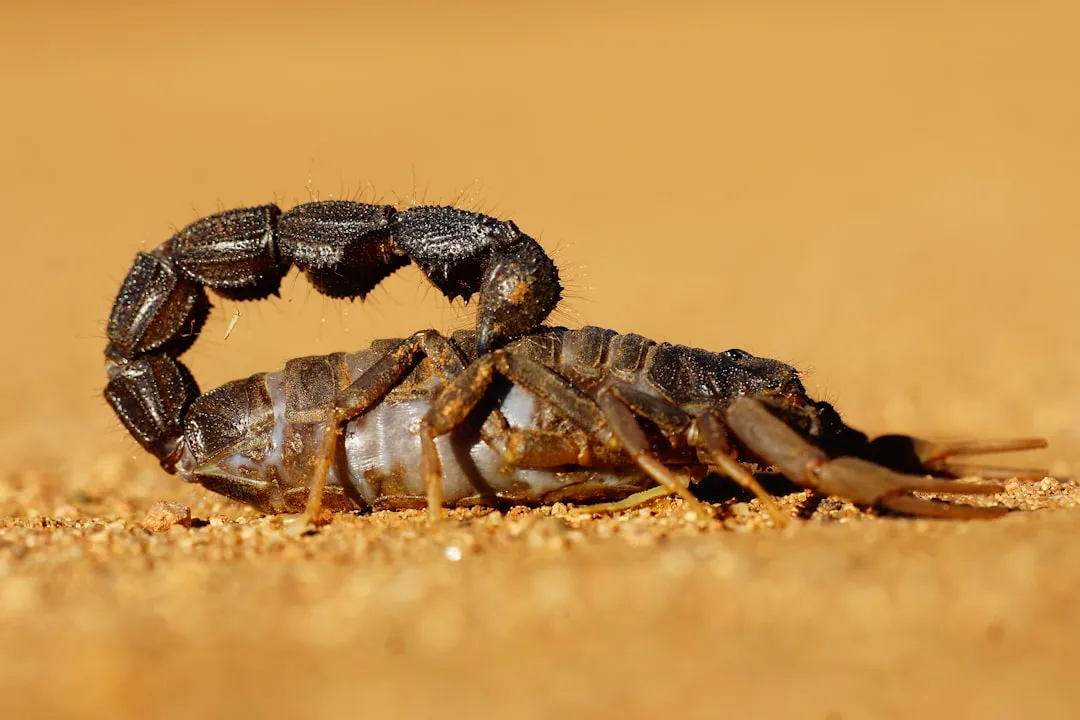
The emperor scorpion is one of the largest scorpion species alive today and by far the most recognisable. Glossy black, heavily armoured, and armed with pincers that look borrowed from a small lobster, Pandinus imperator belongs to an animal lineage that was already old when the first dinosaurs appeared. Scorpions as a group date back more than 430 million years, and the emperor scorpion still carries a body plan recognisable from Silurian fossils.
Despite their intimidating size - up to twenty centimetres from pincer tip to tail tip - emperor scorpions are among the least medically dangerous scorpions on the planet. Their venom is mild. They are famously gentle in captivity.
They glow under ultraviolet light for reasons science has not fully solved, they give birth to live young, they carry their babies around on their backs, and they live for years - extraordinary for an arachnid.
This guide covers everything about the species: classification, size, habitat, venom, hunting, reproduction, social life, UV fluorescence, conservation, and the peculiar biology that keeps emperor scorpions at the centre of research on arachnid evolution.
Etymology and Classification
The genus Pandinus was erected by the French naturalist Maurice Thorell in 1876. The species name imperator - emperor - was applied by C.L. Koch in 1841 in reference to the scorpion's commanding size rather than any behavioural trait.
In the local languages of West Africa the animal has many names; in parts of Ghana it is known as a forest scorpion, in Togo it is simply the large black scorpion. Commercial and hobbyist English usage settled on "emperor scorpion" in the twentieth century as the pet trade expanded.
Taxonomically the emperor sits inside the family Scorpionidae, the burrowing scorpions, which is one of around twenty recognised scorpion families. Within Pandinus there are more than twenty described species and subspecies, including the closely related Pandinus dictator and Pandinus gambiensis, both sometimes mis-sold as emperors in the pet trade.
Genetic and morphological work over the past two decades has repeatedly reshuffled the group, splitting and reassigning species. Misidentification in older literature is common.
Scorpions as an order are classified within the arachnids, alongside spiders, mites, ticks, and harvestmen. They are not insects. Scorpions have eight legs, two body segments, book lungs, and pedipalps modified into pincers - all classic arachnid features. The "insects" classification used on some pages of this site is an organisational shortcut, not a biological statement.
Size and Physical Description
The emperor scorpion is routinely listed among the world's three largest scorpion species. Only the closely related Pandinus dictator and the Asian forest scorpion Heterometrus swammerdami rival or exceed it in length and mass.
Adults:
- Total length: 15-20 cm (pincer tip to telson)
- Body length (without tail): 8-12 cm
- Weight: 30-50 g (exceptional individuals to 60 g)
- Pincer span: 4-6 cm across
Newborn scorplings:
- Length: about 1 cm
- Weight: less than 0.5 g
- Colour: pale white, darkening after the first moult
The body is divided into the prosoma (head and legs) and the segmented mesosoma and metasoma (abdomen and tail). The tail ends in the telson, which contains the venom gland and the sting. The pedipalps - front "arms" - are enormous, disproportionate even for a scorpion, and carry the species' trademark rust-red to dark-maroon pincers against an otherwise jet-black body. Under bright lighting the cuticle can appear almost green-black; in shaded natural conditions it looks more like polished coal.
Emperor scorpions are heavily built rather than lean. Their legs are short and strong, their exoskeleton is thicker than most scorpions of comparable size, and their entire body suggests burrowing power rather than speed. In open conditions they move ponderously; inside a burrow system or tight crevice they are startlingly fast and flexible.
Habitat and Distribution
Emperor scorpions are animals of the humid tropical forests of West Africa. Their core range covers Nigeria, Ghana, Togo, Benin, and Burkina Faso, with peripheral populations reaching Cameroon, Sierra Leone, and parts of Guinea. They are not found in East or Central Africa, despite persistent confusion in older reference material.
Preferred microhabitat:
- Shaded rainforest floor thick with leaf litter
- The bases of large trees, particularly trees with buttress roots
- Termite mounds - both active and abandoned
- Loose-soil riverbanks and sandbank forests
- Forest-savanna ecotone edges, occasionally into open gallery forest
Climate tolerances are fairly narrow. Emperors prefer ambient temperatures between twenty-four and thirty degrees Celsius and humidity between seventy and eighty per cent. They cannot survive prolonged exposure to dry conditions or temperatures below about eighteen degrees Celsius. They avoid direct sunlight almost entirely, spending the day in burrows or beneath fallen wood and emerging at dusk.
A single burrow system can be extensive - up to a metre deep in loose soil, with multiple side chambers, a humid terminal chamber, and one or two main entrances. Several scorpions may share the same burrow system, which is unusual for the order.
Venom and Defence
Despite their imposing appearance emperor scorpions are among the least medically dangerous scorpions on Earth. Their venom is primarily defensive and is weaker in potency and far lower in yield than that of desert species such as the deathstalker (Leiurus quinquestriatus) or the Indian red scorpion (Hottentotta tamulus).
Effects of a typical emperor scorpion sting on humans:
| Symptom | Description |
|---|---|
| Local pain | Moderate, comparable to a bee or wasp sting |
| Swelling | Minor, localised to the sting site |
| Redness | Common, typically fades within hours |
| Systemic reaction | Rare, usually allergic rather than toxic |
| Medical intervention | Rarely required for healthy adults |
For small children, the elderly, or individuals with known allergy to hymenopteran venom, any scorpion sting warrants medical attention, but emperor stings almost never produce the severe systemic toxicity associated with buthid scorpions.
The emperor's real weapon is its pincers. Adult pedipalps can exert enough pressure to crack the exoskeletons of large beetles and crush the bones of small rodents. A pinch from a fully grown emperor can break human skin. Faced with a threat, an emperor scorpion first adopts a raised-pincer warning posture. Only if harassed further will it arch the tail and sting.
Defensive behaviour is ritualised. Emperors prefer retreat over confrontation and will usually back into a burrow or crevice if given a chance. They almost never strike unprovoked, which makes them a popular invertebrate in educational and captive settings.
Diet and Hunting
Emperor scorpions are opportunistic nocturnal predators. They hunt almost exclusively at night, emerging from their burrows at dusk and patrolling leaf litter, fallen logs, and riverbanks in search of prey.
Primary prey:
- Crickets, grasshoppers, and other orthopterans
- Cockroaches
- Beetles and beetle larvae
- Termites, especially during swarming
- Spiders and centipedes
Secondary prey (less common, opportunistic):
- Frogs and small toads
- Lizards, including geckos and skinks
- Newborn rodents
- Other scorpions, including conspecifics in lean conditions
Most hunting follows a sit-and-wait pattern. The scorpion positions itself at the mouth of a burrow, in a leaf-litter depression, or under a fallen branch, and waits for prey to pass within range. Vibrations are detected through specialised slit sensilla on the legs and through the pectines, which rake the substrate. Once prey is within reach, the scorpion lunges and seizes it with the pincers.
Adult emperors rely primarily on crushing. Their pincer strength is sufficient to kill most typical prey outright, and they only use the sting against larger, tougher, or actively struggling animals. This preference for mechanical force over venom is one of the clearest clues that the emperor's venom is genuinely weaker, rather than simply unused.
Digestion is external. The scorpion tears prey apart with its chelicerae, releases digestive fluids, and ingests the resulting liquid. A single large prey item can fuel the animal for a week or more; adults routinely eat only every five to ten days.
Fluorescence Under Ultraviolet Light
One of the most famous features of emperor scorpions - and of scorpions generally - is that the entire body glows blue-green under ultraviolet light. The effect is dramatic: a scorpion almost invisible in leaf litter under normal conditions lights up like a neon sign under a UV torch. Researchers routinely use this property to survey wild populations.
The fluorescence comes from compounds embedded in the thin hyaline layer of the cuticle. Beta-carboline is the most important of these; 7-hydroxy-4-methylcoumarin is another. These molecules absorb near-ultraviolet light and re-emit it at visible blue-green wavelengths.
Why scorpions fluoresce is still unresolved. Current hypotheses include:
- Whole-body UV sensor. The scorpion detects when it is exposed to dangerous sunlight by "feeling" the glow of its own cuticle and retreats before ultraviolet damage accumulates.
- Prey lure. The fluorescence may confuse nocturnal insects that rely on moonlight and starlight for orientation, drawing them closer to the waiting scorpion.
- Sexual or rival signalling. Fluorescence intensity differs between individuals and may carry information during courtship or territorial interactions.
- Structural side effect. The pigments may primarily serve a mechanical or UV-filtering function in the cuticle, and the glow is simply a by-product.
Newly moulted scorpions do not fluoresce until their cuticle hardens. Captive emperors kept in darkness retain full fluorescence for their entire lives. Fossilised scorpion cuticle fragments preserve fluorescent compounds for tens of millions of years, long after the animal is dead.
Reproduction and Maternal Care
Emperor scorpions reach sexual maturity around four years of age after five or six moults. Reproduction involves one of the most elaborate and conspicuous courtship sequences in the arachnid world, followed by an unusually long gestation and a striking episode of maternal care.
Courtship:
- A male encounters a female and grips her pedipalps with his own - the classic scorpion "dance", or promenade a deux.
- The male guides the female over a spermatophore he has deposited on the substrate.
- The female takes up sperm from the spermatophore into her genital aperture.
- The pair separates. Unlike some other arachnids, cannibalism during or after mating is rare in emperors.
Gestation and birth:
- Gestation: 7-9 months
- Reproductive mode: viviparous - live birth, not egg-laying
- Litter size: 10-30 scorplings, occasionally more
- Birth location: inside a protected burrow chamber
Emperor scorpions do not lay eggs. They are fully viviparous, with embryos nourished through a placenta-like connection to the mother. This is a rare reproductive strategy even among scorpions, which include egg-laying, egg-carrying, and viviparous lineages.
Maternal care:
After birth, the pale scorplings immediately climb onto the mother's back and settle into a tight mass between her pedipalps and the base of her tail. They remain there for two to three weeks, through the first moult, which turns them from pale white to a darker cream and eventually black.
During this period:
- The mother does not feed.
- She defends the scorplings aggressively against any disturbance.
- She may tear pieces of prey and pass them to larger juveniles.
- Humidity and temperature in the burrow are actively maintained by her position.
After the scorplings disperse from her back, they may remain in the same burrow system for weeks or months. Some family groups remain together until the juveniles approach adult size, which is highly unusual among arachnids.
Social Life
Most scorpions are solitary and intolerant of conspecifics outside brief mating encounters. Emperor scorpions are one of the few genuine exceptions. Multiple adults, subadults, and juveniles can share a single burrow system without lethal conflict, provided food is abundant and space is sufficient.
Group sizes of two to fifteen animals have been documented in wild West African populations. Groups typically consist of related females and their offspring, with immigrant males moving between groups. Tolerance breaks down under stress: during droughts, food shortages, or extreme crowding, cannibalism becomes common.
In captivity, communal housing is possible for emperor scorpions but risky. Responsible keepers provide multiple retreats, generous floor area, and constant food availability. Even then, periodic fights and occasional deaths occur. Most professional keepers today house emperors singly except during deliberate breeding attempts.
Sensory World
Scorpions are old-lineage arachnids with a rich sensory toolkit, and emperors are no exception.
Primary sensory organs:
- Median eyes: two simple eyes atop the prosoma, primarily for light level detection rather than image formation.
- Lateral eyes: two to five pairs along the front edge of the prosoma, also simple and low-resolution.
- Pectines: unique to scorpions. A pair of comb-like appendages on the underside of the body, bearing thousands of chemosensory peg sensilla. Pectines sweep the substrate and simultaneously detect chemical traces and ground vibrations.
- Trichobothria: specialised hairs on the pedipalps that detect air movement and low-frequency sound.
- Slit sensilla: tiny cuticular slits distributed along the legs that detect mechanical strain and vibration.
Vision is poor. A hunting emperor does not rely on eyes to find prey; it senses the vibration and scent trail of a moving insect through the pectines and leg sensilla, then lunges on contact. This sensory pattern works equally well in total darkness, which is why emperors are unaffected by the cycle of day and night except in terms of preferred activity periods.
Evolutionary History
Scorpions are one of the oldest terrestrial animal lineages on Earth. Fossils from the Silurian period, dating to about 430-440 million years ago, already show a recognisably scorpion-like body plan. Early scorpions were aquatic or semi-aquatic, and the transition to fully terrestrial life happened gradually over tens of millions of years.
The emperor scorpion's modern genus, Pandinus, is considerably younger, but the body architecture has changed remarkably little. Compared to a 400-million-year-old scorpion fossil, a living emperor looks like a slightly modernised edition of the same design. Scorpions as a group predate dinosaurs by roughly 200 million years and outlasted every mass extinction since.
One consequence of this deep evolutionary history is extreme robustness. Scorpions, including emperors, can survive environmental stresses that would kill most modern animals outright. Experiments have shown that scorpions can tolerate ionising radiation doses of 100,000-150,000 rads - hundreds of times the human lethal dose - before experiencing major physiological disruption. They can also survive weeks underwater, months without food, and wide swings in temperature and humidity.
Conservation Status
Emperor scorpions are not currently assessed as endangered by the IUCN but they are regulated internationally. The species has been listed on CITES Appendix II since 1995 because of the pressure that the international pet trade placed on wild populations during the 1980s and 1990s. Appendix II means international commercial trade is permitted only under permit, with annual export quotas.
Primary pressures on wild populations:
- Pet trade collection. Hundreds of thousands of wild-caught emperors were exported from Ghana and Togo during the peak years of the trade. Several accessible forest zones saw measurable local declines.
- Habitat loss. Deforestation across West Africa - driven by agricultural expansion, logging, and urban growth - reduces available rainforest habitat and isolates remaining populations.
- Climate change. Shifts in rainfall regimes and dry-season length affect the humid microhabitats emperors depend on.
- Pesticides and pollution. Agricultural runoff affects leaf-litter invertebrate communities and may accumulate in scorpion tissues.
Captive breeding has shifted most of the legal pet market away from wild collection. Many popular keeping guides now explicitly recommend captive-bred specimens over wild-caught imports. CITES permits continue to cover limited wild exports from range countries, but volumes are a fraction of what they were in the 1990s.
Emperor Scorpions and Humans
Emperor scorpions have a long history of interaction with human populations in West Africa, where they occur in farmland edges and village gardens as often as in true forest. Local attitudes vary. In some communities they are feared and killed on sight; in others they are regarded as benign forest residents and left alone. Their mild venom and calm disposition mean that serious medical incidents are extremely rare even in areas of high density.
Outside West Africa the emperor's main cultural role is as a pet and educational animal. Their size, handleability, and striking appearance have made them a mainstay of invertebrate keeping since the 1980s. They are used in film and television as a generic "scorpion", often standing in for far more dangerous desert species. They appear in museum exhibits, zoo invertebrate houses, and university arachnology teaching collections worldwide.
Research on emperor scorpion venom has contributed to medical and pharmacological studies, particularly on peptide toxins that interact with ion channels. Although the overall venom is mild, individual components are useful in laboratory work. Research on their UV fluorescence has influenced forensic, ecological, and materials science research well beyond arachnology.
Related Reading
- Scorpions of the World
- Why Do Scorpions Glow Under UV Light
- Deathstalker Scorpion: The Most Dangerous Scorpion
- Arachnids vs Insects: Key Differences
References
Relevant peer-reviewed and governmental sources consulted for this entry include CITES Appendix II species listings and review documents, the IUCN Red List entries for Scorpionidae, and published research in Journal of Arachnology, Toxicon, Zootaxa, and Proceedings of the Royal Society B. Specific husbandry figures reflect standard keeper references and the consolidated literature on Pandinus imperator through 2024.
Frequently Asked Questions
How big does the emperor scorpion get?
Adult emperor scorpions (Pandinus imperator) typically reach 15-20 cm from the tips of the pincers to the tip of the telson, with some exceptional individuals approaching 23 cm. Adults weigh 30-50 g, making them one of the heaviest scorpions alive and one of the largest by mass. Females are usually slightly bulkier than males but males have proportionally longer tails.
Newborn scorplings are about 1 cm long and pale white, darkening to the adult glossy black over several moults during their first two years.
Are emperor scorpions dangerous?
Emperor scorpions are among the least medically significant scorpions in the world. Their venom is mild and primarily defensive - most people compare a sting to a bee or wasp sting, with localised pain, swelling, and redness that resolves within hours. Serious reactions are almost always allergic rather than toxic. The real damage an emperor can inflict comes from its enormous pincers, which can deliver a painful pinch and break skin on small vertebrates.
By contrast, the deathstalker (Leiurus quinquestriatus) from North Africa, a much smaller scorpion, has venom thousands of times more dangerous.
Why do emperor scorpions glow under UV light?
All scorpions, emperor scorpions included, fluoresce blue-green under ultraviolet light because their exoskeleton contains beta-carboline and other related chemicals embedded in the thin hyaline layer of the cuticle. The function is still debated.
Leading hypotheses include: the scorpion uses its whole body as a UV sensor to detect when it is exposed to dangerous sunlight, the glow helps prey confuse moonlight with safe conditions and wander closer, the fluorescence signals to potential mates or rivals, or the pigments primarily serve a structural or UV-protective role and the glow is simply a side effect.
Newly moulted scorpions do not glow until their cuticle hardens, which supports the structural hypothesis but does not rule out the others.
Where do emperor scorpions live?
Emperor scorpions inhabit the humid tropical rainforests and forest-savanna mosaic of West Africa, primarily in Nigeria, Ghana, Togo, Benin, and Burkina Faso, with scattered populations reaching into Cameroon and Sierra Leone. They prefer shaded leaf litter, the bases of large trees, termite mounds, and riverbanks with loose soil suitable for burrowing.
Humidity between 70 and 80 per cent and temperatures between 24 and 30 degrees Celsius characterise their natural conditions. They rarely tolerate dry open habitat and never occur in montane cold zones.
How long do emperor scorpions live?
Emperor scorpions live 5-8 years both in the wild and in captivity, which is extremely long compared to most other arachnids. Many spiders complete their entire life cycle within a year. Females typically reach sexual maturity around four years old after five or six moults, and may produce only one or two litters in a lifetime. Captive animals given stable temperature, humidity, and diet commonly reach the upper end of that range.
Poor husbandry - particularly low humidity or over-handling - tends to shorten lifespan significantly.
Do emperor scorpions take care of their young?
Yes, and emperor scorpions are one of the most striking examples of maternal care in arachnids. After 7-9 months of gestation the female gives birth to 10-30 live scorplings, which immediately climb onto her back and ride there for the first two to three weeks of life. During that time the mother does not feed, defends the scorplings aggressively, and may tear pieces of prey to share with larger juveniles.
After the scorplings complete their first moult and darken, they gradually leave her back and begin hunting small prey independently, though they may continue to share the burrow for months.
Are emperor scorpions endangered?
Emperor scorpions are not listed as endangered by the IUCN but they have been regulated by CITES Appendix II since 1995 because of heavy pressure from the international pet trade. Collection for export peaked in the 1990s, when annual quotas from Ghana and Togo allowed tens of thousands of wild-caught individuals to leave West Africa each year. Populations in several accessible forest zones declined measurably.
Modern captive-breeding operations supply most of the legal international pet market, which has reduced but not eliminated pressure on wild populations. Ongoing deforestation in West Africa is a separate and growing threat.
What do emperor scorpions eat?
Emperor scorpions are opportunistic carnivores. Their diet is dominated by large insects - crickets, cockroaches, beetles, termites - and includes spiders, centipedes, and small vertebrates such as frogs, lizards, and newborn rodents when the opportunity arises. They hunt primarily at night and ambush prey from the mouth of a burrow or leaf litter.
Adults rely mainly on their enormous pincers to crush prey outright, reserving the sting for large, tough, or actively struggling targets. In captivity they feed readily on farmed crickets, roaches, and mealworms, typically eating every 5-10 days.