
How large can an ant colony actually get?
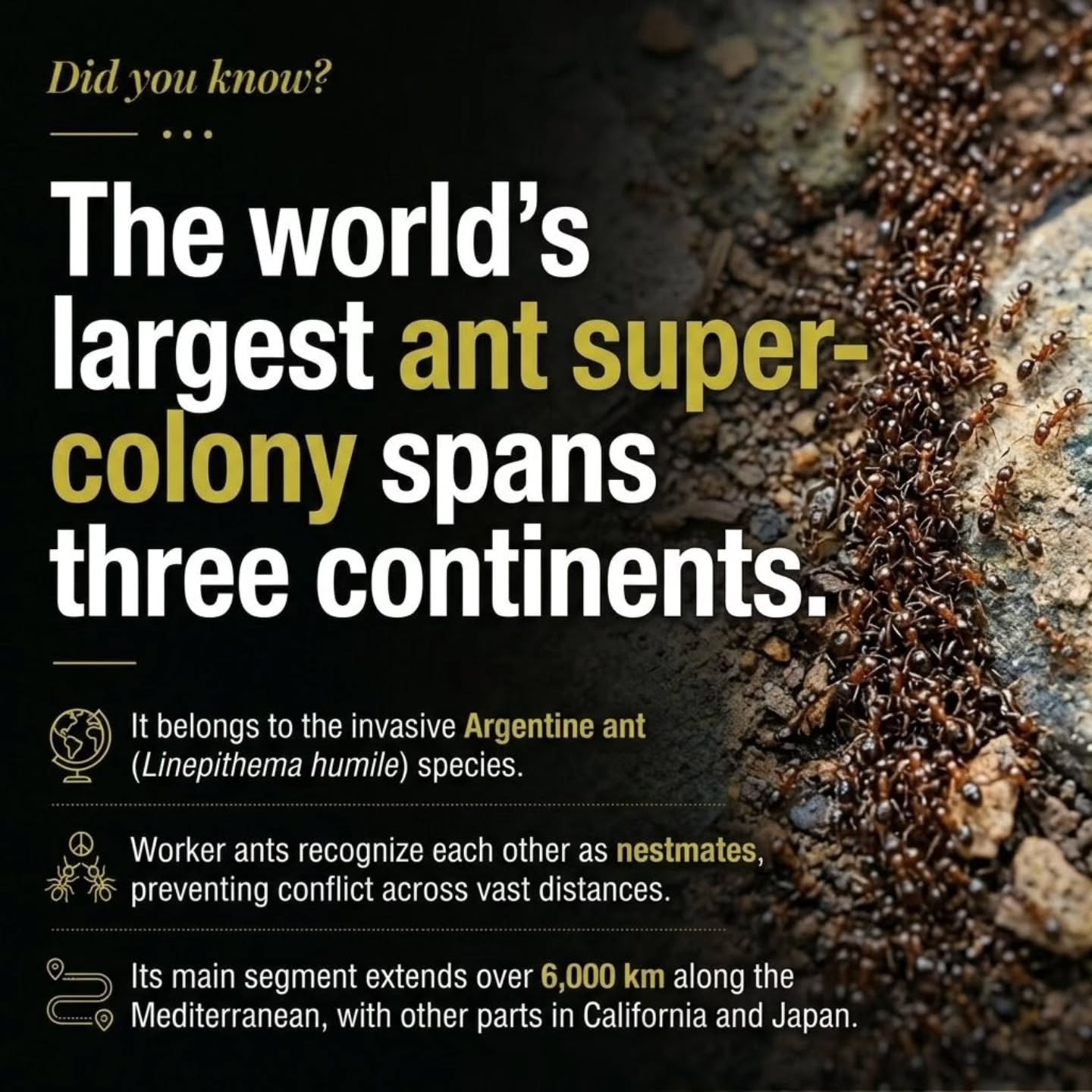
Ant colonies range from a few dozen individuals in some primitive lineages to hundreds of millions in the largest supercolonies. The Argentine ant (Linepithema humile) supercolony along the Mediterranean coast of Europe extends over 6,000 kilometers and may contain more than one trillion individuals across an interconnected network of nests.
Step outside at almost any temperate latitude and you are standing on top of an ant colony. You may be standing on ten of them.
The ants beneath you are processing soil at a volumetric rate exceeding the combined output of earthworms, ventilating their galleries with an active airflow system, raising dozens of sister queens, chemically signaling one another through pheromones that persist for hours, and operating at a collective decision-making intelligence that does not exist in any single ant's nervous system.
Ants have been on Earth for roughly 140 million years. They survived the extinction that killed the dinosaurs. They radiated into over 14,000 described species distributed across every continent except Antarctica. Their total biomass exceeds that of all wild birds and wild non-human mammals combined. The study of their colonies has been revolutionizing our understanding of eusocial evolution, distributed computation, and collective behavior for the better part of a century.
The Architecture of a Colony
An ant colony is not simply a nest. It is a superorganism composed of interconnected compartments, each functionally specialized. A mature leaf-cutter ant (Atta sexdens) nest excavates up to 40 cubic meters of soil and contains chambers specialized for fungus gardens, brood rearing, trash disposal, reproductive activity, and communal queen habitation. Total colony size may exceed 8 million individuals.
Workers excavate ventilation chimneys that exploit passive airflow. A 2015 study by Oxford researchers used CT scanning to show that Atta ants construct nest geometries that maintain oxygen levels within 2 percent of atmospheric concentrations across 6-meter-deep colonies, despite the respiratory demands of millions of individuals and the cultivated fungus itself.
| Colony type | Species example | Worker population | Nest area | Lifespan |
|---|---|---|---|---|
| Leaf-cutter | Atta sexdens | 3-8 million | 30-250 m2 | 15-20 years |
| Army ant bivouac | Eciton burchellii | 300,000-700,000 | Mobile | Queen dies after ~5 years |
| Driver ant | Dorylus wilverthi | Up to 22 million | Mobile | Variable |
| Supercolony | Linepithema humile | 1 trillion+ | 6,000 km along coastline | Indeterminate |
| Weaver ant | Oecophylla smaragdina | 500,000 | Multiple tree canopies | 8-10 years |
| Honeypot ant | Myrmecocystus mexicanus | 5,000-15,000 | Small | 15+ years |
| Carpenter ant | Camponotus pennsylvanicus | 10,000-50,000 | Wood galleries | 10-15 years |
| Fire ant | Solenopsis invicta | 100,000-500,000 | Soil mound | 6-7 years (queen) |
The Argentine ant supercolony along Europe's Mediterranean coast is the largest cooperative network ever documented in a non-human species. Genetic studies by Laurent Keller and colleagues showed that workers taken from nests 6,000 kilometers apart do not fight when introduced and will exchange food freely, meeting the operational definition of a single colony.
The Caste System
Most ant species exhibit a pronounced caste system. Queens are the reproductive females, workers are the sterile female majority, and males exist primarily for a single nuptial flight before dying. Some species, particularly the leaf-cutters and army ants, add additional polymorphic worker castes, including minor workers, major workers, and soldiers with specialized mandibles.
The caste of a worker is determined in the larval stage by nutrition. A female ant larva that receives protein-rich food develops into a reproductive queen. Less-fed larvae develop into workers. This developmental plasticity is coordinated through epigenetic mechanisms, particularly DNA methylation patterns that vary between castes.
Genetic studies of the carpenter ant Camponotus floridanus have shown that worker-to-soldier caste determination in the pupal stage can be chemically manipulated by experimentally altering methylation with 5-azacytidine.
"When we talk about ant caste systems, we are talking about animals with essentially identical genomes that express such different phenotypes they might as well be different species. The queen of an Atta colony will outlive every worker she ever produces by a factor of ten or twenty. The same DNA, but radically different biological destinies." - Laurent Keller, Professor of Evolution and Ecology, University of Lausanne
Pheromone Communication
Ants communicate primarily through chemical signals. A mature ant colony uses 10 to 20 distinct pheromones for tasks including trail marking, alarm, recruitment, queen recognition, nestmate identification, and funeral detection of dead workers.
Trail pheromones allow foraging ants to mark successful food routes for their nestmates. A foraging ant returning to the nest with food lays down a trail of pheromones that other workers follow. Each worker adds its own trail pheromone as it travels, reinforcing the signal. Unsuccessful paths see no reinforcement and the pheromones evaporate within minutes.
This positive feedback loop is mathematically equivalent to the ant colony optimization algorithms used in modern computer science for solving traveling salesman and network routing problems.
Alarm pheromones, typically formic acid or undecane, spread through the colony within seconds when a threat is detected. They trigger mass recruitment of soldiers to the threat site. Different alarm pheromones signal different levels of threat intensity.
Queen pheromones maintain colony cohesion. The presence of the queen's volatile cuticular hydrocarbons suppresses ovarian development in workers. When the queen dies, these signals disappear within 24 hours, and workers may begin laying unfertilized male-producing eggs.
For researchers documenting these pheromone dynamics in structured field studies, maintaining reproducible observation logs across colony visits requires careful field notebook and data-logging infrastructure that digital scientific platforms have made standard in behavioral entomology.
Leaf-Cutter Ants: The Farmers
Among the most studied ant societies are the leaf-cutter ants of the New World tropics. Atta and Acromyrmex species cultivate fungus gardens that form the sole food source for the colony. They collect leaf fragments, which they chew into pulp and inoculate with a symbiotic fungus, Leucoagaricus gongylophorus. The fungus produces swollen hyphal tips called gongylidia that the ants harvest for food.
The relationship is one of the most complex documented mutualisms in biology. The ants provide the fungus with substrate, antibiotic-producing bacteria cultivated on the ants' bodies that suppress competing fungi, and protection from environmental stressors. The fungus provides the ants with food they cannot otherwise digest.
A mature leaf-cutter colony can defoliate an entire tree in a single night. On a per-hectare basis, Atta colonies consume more vegetation than any large herbivorous mammal. They are the dominant herbivores of many Central and South American forests.
| Leaf-cutter metric | Value |
|---|---|
| Average colony population | 3-8 million workers |
| Daily leaf biomass collected | 50-150 kg |
| Fungal garden volume | 50-200 L per mature colony |
| Queen lifespan | 15-20 years |
| Soldier mandible force | 2.5 N (sufficient to pierce human skin) |
| Foraging trail length | Up to 250 m from nest |
| Worker polymorphism | 4 distinct castes by size |
For researchers producing taxonomic or behavioral papers on leaf-cutter systems, structured scientific writing platforms with LaTeX compatibility, such as those accessible through academic writing tools at Evolang, handle the reference management and multi-author editing that modern entomology publications increasingly require.
Army Ants: The Nomadic Swarm
Army ants (Eciton, Dorylus, and related genera) do not build permanent nests. They form bivouacs, temporary living structures composed of the workers' own bodies interlocked by leg grips around the queen and brood. Bivouacs can contain 300,000 to 700,000 individuals in Eciton burchellii and up to 22 million in the African driver ant Dorylus wilverthi.
The colony alternates between nomadic and statary phases. During the nomadic phase, the colony migrates every 24 hours, with foraging swarms up to 15 meters wide that capture prey ranging from other insects to small vertebrates. During the statary phase, the colony stops for 2 to 3 weeks to allow the queen to lay a large batch of eggs and for the previous brood to pupate.
The foraging swarm itself is a marvel of emergent behavior. Millions of workers, none of whom possess any map or plan, collectively advance in a coherent raid front through the forest. Individual ants follow only local rules: if another ant is ahead and laying pheromone, follow; if no trail is visible, search locally. The combined result is a raid that can cover 200 meters in a single day and process the equivalent of 30 grams of prey biomass per minute.
Swarm Intelligence and Collective Cognition
The behavioral repertoire of an individual ant is tiny. Ants have only a few hundred thousand neurons, compared with 86 billion in a human brain. Yet a colony of a million ants makes collective decisions that appear intelligent and planned.
Deborah Gordon at Stanford has documented in harvester ant colonies (Pogonomyrmex barbatus) how worker task allocation responds to local environmental signals in real time. The number of ants returning with food triggers or suppresses the rate at which additional foragers leave the nest. This simple feedback loop, combined with pheromone signaling, produces colony-level responses that approximate optimal resource allocation.
Nigel Franks at the University of Bristol studied nest relocation in Temnothorax albipennis and showed that colonies use an emergent quorum sensing system to select new nest sites. Scouts visit candidate sites, return to the colony, and recruit additional inspectors. When the number of inspectors at one site exceeds a threshold, the colony initiates migration.
Colonies faced with a choice between two sites consistently choose the higher-quality option, even when individual scouts cannot directly compare sites.
"What we see in ant colonies is a form of distributed computation that works extraordinarily well without any central processor. The colony solves problems through the parallel work of thousands of agents following local rules. It is the original biological analog computer." - Nigel Franks, Emeritus Professor of Animal Behaviour, University of Bristol
This emergent cognition connects deeply to broader discussions about how animal intelligence is measured and compared, particularly where colony-level performance in problem-solving tasks is juxtaposed with individual performance in vertebrates such as corvids, cetaceans, and primates.
The Australian Ant Fauna
Australia is home to one of the most distinctive ant faunas on Earth, including the aggressive bulldog ants (Myrmecia) that possess medically significant stings. Myrmecia pilosula, the jack jumper ant, is responsible for roughly 90 percent of ant-sting fatalities in Australia, killing an average of one to two people per year through anaphylaxis. The species is native to Tasmania and southeastern mainland Australia.
Green tree ants (Oecophylla smaragdina) construct nests by weaving leaves together with larval silk, with worker teams holding leaves in position while other workers manipulate larvae to secrete silk along the joins. These ants are common in tropical Queensland and feature in traditional Indigenous Australian cuisine.
The broader Australian wildlife context for these species is documented across Australian wildlife observation resources covering northern Queensland's tropical ecosystems where weaver ant and bulldog ant populations coexist with other characteristic invertebrate fauna.
Global Biomass and Ecological Impact
A 2022 study published in the Proceedings of the National Academy of Sciences provided the first comprehensive global estimate of ant biomass and abundance. Patrick Schultheiss and colleagues synthesized data from 1,306 field studies across all continents and estimated:
- Total individual ants: approximately 20 quadrillion (2 x 10^16)
- Total dry biomass: approximately 12 megatons of carbon
- Comparison with wild mammals: ant biomass exceeds all wild non-human mammals combined
- Comparison with wild birds: ant biomass exceeds all wild birds combined
- Per-person ratio: approximately 2.5 million ants per human
The biomass is concentrated in tropical forests and savannas, where ant biomass per hectare can exceed 2 kilograms dry weight. Forest ecosystems depend on ants for seed dispersal, soil aeration, decomposition, and predation on herbivorous arthropods.
Invasive Ants and Economic Impact
A handful of invasive ant species cause significant ecological and economic damage globally. The red imported fire ant (Solenopsis invicta), native to South America, has invaded the southeastern United States, eastern Australia, and parts of Asia. Its economic impact in the US alone is estimated at 6 billion dollars annually through agricultural damage, medical costs from stings, and infrastructure repair.
The Argentine ant supercolony has displaced native ant species across California, Spain, and large portions of the Mediterranean. The yellow crazy ant (Anoplolepis gracilipes) devastated the endemic red crab population of Christmas Island after accidental introduction, contributing to ecosystem collapse on the island.
Professional entomologists, pest management specialists, and agricultural researchers working on invasive ant programs often pursue formal credentials through professional certification programs in entomology and wildlife biology, which structure the examination and continuing-education requirements for USDA, state department of agriculture, and international regulatory roles.
Specimen Curation and Taxonomy
With over 14,000 described species and thousands more awaiting description, ant taxonomy depends on rigorously maintained museum specimen collections. The Museum of Comparative Zoology at Harvard, the American Museum of Natural History, the California Academy of Sciences, and the Museum of Natural History in London together hold millions of ant specimens, each cataloged under institutional voucher codes.
Modern collections increasingly attach QR-coded specimen labels to each pinned specimen, linking it to the digital database entry that tracks collection date, locality, coordinates, collector identity, habitat notes, and any DNA barcode sequences derived from tissue subsamples. This eliminates the transcription errors that historically corrupted large collections during cross-institutional loan programs.
Researchers processing historical specimen labels, georeferenced locality data, or photographed habitus images often use tools to inspect and normalize the embedded metadata, including image metadata viewers that maintain provenance chains across digitization pipelines.
Ecotourism and Commercial Myrmecology
Ant-focused ecotourism is a small but distinctive segment of nature travel, particularly leaf-cutter observation expeditions in Costa Rica, Panama, and Brazil. Weaver ant observation and the related tradition of kai-mot-daeng (weaver ant larvae cuisine) has become a documented cultural experience in northern Thailand and Laos.
Ant farming as a commercial and educational product has expanded dramatically in the past decade. Specialized companies selling queenright colonies, formicaria, and feeding supplies operate as niche biological supply entities, and the business formation workflow for such operators is documented in nature and biological specialty business registration resources.
Social Parasitism and Slave-Making Ants
A surprising fraction of ant species are not independent but parasitize the colonies of other ant species. Slave-making ants (Polyergus and Formica sanguinea) raid neighboring colonies of related species, stealing pupae that develop into workers in the parasite colony and serve it as if it were their own. Some of these parasitic species have lost the ability to feed themselves independently and depend entirely on captured slaves.
Ultimate social parasitism occurs in species such as Teleutomyrmex schneideri, a tiny parasite that lives on the body of the host queen, feeding from her and producing sexual offspring without any workers of its own. These represent some of the most extreme evolutionary simplifications known in insect biology.
Colony Lifespan and Evolution
A queen ant can live decades. A queen black garden ant (Lasius niger) was kept alive in a laboratory for 28 years and 8 months, the longest verified lifespan of any insect. Leaf-cutter queens routinely live 15 to 20 years in the wild. When the queen dies, the colony usually cannot raise a replacement, and the colony dies out within months to a year.
Some species exhibit multiple-queen social structures (polygyny) and outlive any individual queen. Argentine ant supercolonies, with millions of queens and continuous queen replacement, may have no natural endpoint at all. The oldest known supercolony along the Mediterranean Spanish coast has been dated at over 100 years through genetic analysis.
The study of ant colony evolution, caste determination, and social organization remains one of the richest fields in modern behavioral ecology, with implications that extend from computer science optimization to the foundations of eusocial theory in evolutionary biology. An ant colony is not a metaphor for society. It is a society, built from the bottom up by processes that we are only beginning to understand.
References
- Schultheiss, P., Nooten, S. S., Wang, R., et al. (2022). The abundance, biomass, and distribution of ants on Earth. Proceedings of the National Academy of Sciences, 119(40), e2201550119. DOI: 10.1073/pnas.2201550119
- Franks, N. R., Pratt, S. C., Mallon, E. B., et al. (2002). Information flow, opinion polling and collective intelligence in house-hunting social insects. Philosophical Transactions of the Royal Society B, 357(1427), 1567-1583. DOI: 10.1098/rstb.2002.1066
- Gordon, D. M. (2016). The evolution of the algorithms for collective behavior. Cell Systems, 3(6), 514-520. DOI: 10.1016/j.cels.2016.10.013
- Keller, L., Tsuji, K., & Fournier, D. (2013). Evolution of the insect societies. In The Evolution of Organismal Form and Function (pp. 243-265). Springer. DOI: 10.1007/978-3-642-36948-4_14
- Holldobler, B., & Wilson, E. O. (1990). The Ants. Harvard University Press. DOI: 10.2307/j.ctv22jnscm
- Bonabeau, E., Dorigo, M., & Theraulaz, G. (2000). Inspiration for optimization from social insect behaviour. Nature, 406(6791), 39-42. DOI: 10.1038/35017500
- Bonasio, R., Zhang, G., Ye, C., et al. (2010). Genomic comparison of the ants Camponotus floridanus and Harpegnathos saltator. Science, 329(5995), 1068-1071. DOI: 10.1126/science.1192428
- Mueller, U. G., Rehner, S. A., & Schultz, T. R. (1998). The evolution of agriculture in ants. Science, 281(5385), 2034-2038. DOI: 10.1126/science.281.5385.2034
Frequently Asked Questions
How large can an ant colony actually get?
Colony sizes range from a few dozen individuals in some primitive ant lineages to hundreds of millions in the largest supercolonies. The Argentine ant (Linepithema humile) supercolony along the Mediterranean coast of Europe extends over 6,000 kilometers and may contain more than one trillion individuals across an interconnected network of nests. In North America, driver ants and army ants form bivouacs containing up to 22 million workers.
Individual leaf-cutter ant colonies routinely exceed 8 million individuals and consume more vegetation per hectare than any large mammal.
Do ant colonies exhibit real intelligence?
Ant colonies show a form of collective intelligence known as swarm cognition or distributed cognition. No individual ant possesses the knowledge or planning capacity to solve problems such as optimal foraging routes, nest relocation decisions, or resource allocation across thousands of workers. However, the colony as an emergent unit solves these problems through pheromone signaling, threshold-based task switching, and iterative feedback loops.
Studies by Deborah Gordon at Stanford and Nigel Franks at the University of Bristol have demonstrated that ant colonies make collective decisions that mirror optimal algorithms from computer science, including the Pareto front for search optimization.
What is the total biomass of ants on Earth?
A 2022 global biomass assessment published by Patrick Schultheiss and colleagues in the Proceedings of the National Academy of Sciences estimated the total ant biomass at 12 megatons of dry carbon, or roughly 20 quadrillion individual ants. This exceeds the combined biomass of all wild birds and wild non-human mammals on Earth. Ants play critical roles as soil engineers, seed dispersers, pollinators, and predators of other arthropods.
Their ecological influence scales with their biomass, and many forest ecosystems would collapse without them.