
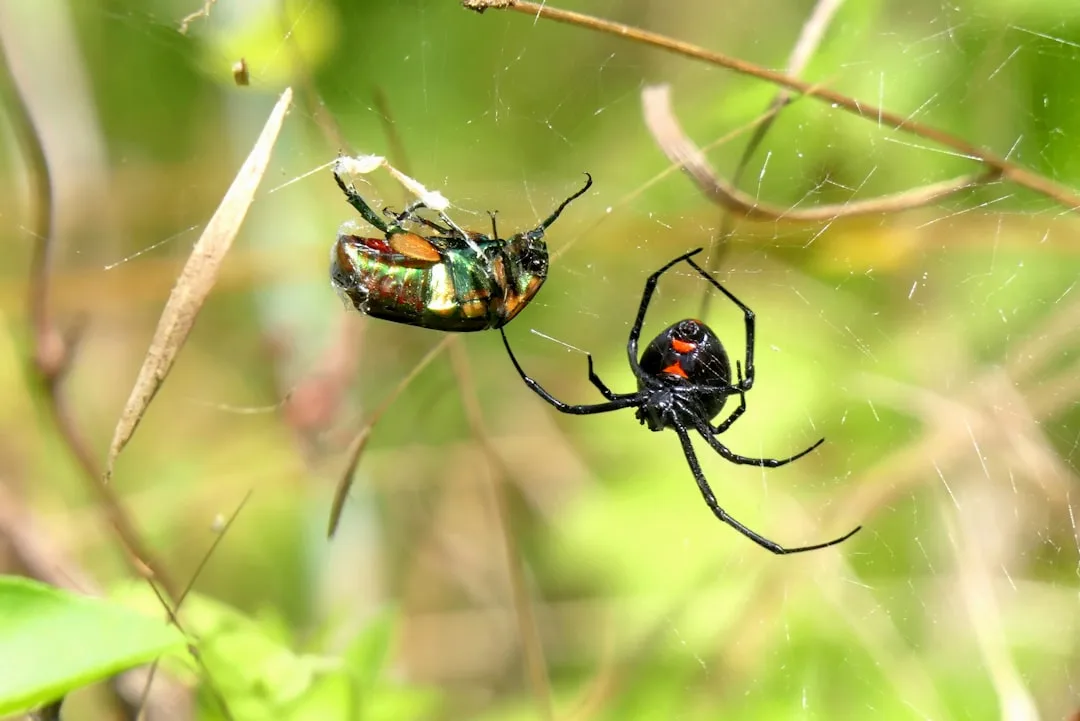
The black widow spider is one of the most recognisable and most misunderstood arachnids on Earth. A shiny black body the size of a pencil eraser, a scarlet hourglass on its underside, a tangled web in a woodpile, and a name that has echoed through horror films, noir novels, and childhood warnings for more than a century.
Latrodectus mactans, the southern black widow, is the classic North American member of a worldwide genus of roughly thirty-one widow species. Despite its fearsome reputation, the species is small, shy, slow-moving, and poorly armoured - a fragile predator whose only real weapon is a venom so chemically specialised that neuroscientists now use it as a laboratory tool.
This guide covers every aspect of black widow biology and ecology: anatomy, sexual dimorphism, web construction, hunting, venom chemistry, bite outcomes, reproduction, the true story of sexual cannibalism, introduced populations, and the strange corners of widow behaviour that rarely make it into popular coverage. It is a reference entry, not a scare piece - so expect specifics: milligrams, millimetres, survival rates, instar counts, and verified records.
A taxonomic note before the rest of this page. Spiders are arachnids, not insects. They belong to the class Arachnida, not Insecta, and differ from insects in body segmentation, leg count, and respiratory anatomy. This site files spiders under "insects/spiders" purely as a browsing convenience for visitors who arrive searching for creeping things. The taxonomy table on this page reflects the scientifically correct placement.
Etymology and Classification
The genus name Latrodectus comes from the Greek latros (servant or robber) and dektes (biter). The species epithet mactans is Latin for "murderous" - a flourish from an era when naturalists were not shy about describing their subjects in theatrical terms. The English common name "black widow" refers to the historical assumption that females routinely killed and consumed males after mating, an idea that turns out to be largely wrong for this species, as discussed later on this page.
Widow spiders belong to the family Theridiidae, the cobweb spiders or tangle-web spiders. The family contains more than 2,500 species across the globe, most of them small, round-bodied, and responsible for the irregular dusty webs found in the corners of garages and basements. Within Theridiidae, the genus Latrodectus contains approximately thirty-one recognised species, including:
- Latrodectus mactans - southern black widow, eastern and southern United States
- Latrodectus hesperus - western black widow, western North America
- Latrodectus variolus - northern black widow, northeastern United States
- Latrodectus geometricus - brown widow, tropical worldwide, introduced to North America
- Latrodectus tredecimguttatus - European black widow or Mediterranean widow
- Latrodectus hasselti - redback spider, Australia and New Zealand
- Latrodectus katipo - katipo, native New Zealand
- Latrodectus curacaviensis - South American widow
All widow species share the same general anatomy, the same web structure, and similar venom chemistry. Details of potency, colour, and behaviour vary between species.
Size and Physical Description
Black widows are small spiders by any measure, but size differences between males and females are among the most extreme in the spider world. The contrast is so striking that early naturalists sometimes described males and females as separate species.
Adult females (Latrodectus mactans):
- Body length: 8-13 mm (cephalothorax plus abdomen)
- Leg span: up to 38 mm across
- Colour: glossy jet black, occasionally very dark brown
- Abdomen: spherical, noticeably larger than the cephalothorax
- Signature mark: bright red hourglass on the underside of the abdomen
- Weight: roughly 1 gram at full maturity
Adult males:
- Body length: 3-6 mm
- Colour: tan, light brown, or grey with faint stripes or spots
- Abdomen: smaller and more elongated than the female's
- No hourglass; most males are visually forgettable
- Often mistaken for cobweb or house spiders
Spiderlings and juveniles:
- Hatchlings: under 1 mm
- Juvenile colour: mottled grey, brown, or striped - nothing like the adult
- Red markings develop gradually across successive moults
The famous hourglass is never present in males and not always perfect in females. The mark can appear as two separate triangles, a solid red bar, or an irregular blot depending on the individual and the species. In Latrodectus mactans the hourglass is usually bright scarlet against a deep black abdomen and is visible only when the spider hangs belly-up in its web - the natural resting position.
In other widow species the marking may be orange, yellow, or a pair of dots, and may be visible on the upper surface of the abdomen as well as below.
Female widows pass through seven to nine moulting stages called instars before reaching adulthood. Males moult fewer times and reach maturity faster, which is one reason their lifespan is so much shorter.
The Web
Black widow webs are immediately identifiable by how disorganised they look. There is no elegant spiral, no geometric pattern, nothing that would appear on a nature documentary about spider engineering. A widow web is a messy three-dimensional scaffold of irregular strands strung between a fixed anchor (usually under an overhang, a log, a deck step, or a piece of equipment) and the ground or a nearby object. The structure has three functional components.
1. The retreat. A small funnel-shaped shelter at the top of the web where the spider spends most of the day.
2. The tangle. A dense network of dry, strong scaffolding silk that forms the bulk of the web. The tangle provides structure but is not directly sticky.
3. The trip lines. Vertical threads strung from the tangle down to the ground or a flat surface. These are the actual trap. They are coated with sticky droplets near the bottom and break away cleanly under tension.
When a walking insect blunders into a trip line, the line snaps at the ground anchor and the insect is hoisted upward by the tension in the rest of the web. The prey is now suspended, struggling, and broadcasting vibrations directly to the resting spider above. The widow descends along the scaffold lines, wraps the prey in swathing silk, and delivers a venomous bite. Prey is either consumed on the spot or cached in the tangle for later.
Widow silk is mechanically exceptional. Studies of Latrodectus silk report tensile strength among the highest recorded for any spider: comparable to or exceeding the silk of the famous golden orb weavers on a per-weight basis, and far stronger than many steel alloys by the same measure. The silk is also elastic, allowing prey struggles to be absorbed without breaking the overall structure.
This combination is what allows webs containing a ten-millimetre spider to occasionally hold large beetles, crickets, small lizards, and even baby mice.
Hunting and Diet
Black widows are generalist carnivores. They will eat almost anything small enough to subdue and digest, which in practice includes:
- Flies, moths, and mosquitoes
- Crickets, grasshoppers, and roaches
- Beetles of many sizes
- Ants, including species that would defeat most other spiders
- Other spiders, including much larger species
- Scorpions, in regions where ranges overlap
- Centipedes and millipedes
- Occasionally: small lizards, baby mice, small snakes
Widows locate prey through vibration, not sight. Their eyes, though numerous (eight, as with most spiders), are poor at forming images. Once a struggle is detected the spider moves quickly along familiar scaffold lines, wraps the prey in dense silk from a distance, and only then approaches to bite.
This wrap-first approach protects the thin-legged spider from kicking or stinging prey and is one reason widow venom targets nervous system function: a paralysed prey item stops struggling before it can injure the spider.
Digestion is external. The widow injects digestive enzymes into the prey, waits for internal tissues to liquefy, and drinks the resulting fluid. Solid parts of the carcass - chitin shells, wing cases - are discarded from the web over several days.
Fasting tolerance is extreme. Captive widows have been recorded surviving more than 200 days without food and resuming normal feeding afterward. In the wild, food availability varies enormously by season and microhabitat, and the ability to wait out lean periods is critical.
Venom and Bite Outcomes
Widow venom is a mixture of peptides and proteins. The most clinically important component is alpha-latrotoxin, a large protein that forces synapses in the prey's nervous system to release all of their stored neurotransmitters at once. In insects this causes instant paralysis. In mammals, including humans, the same mechanism produces the syndrome clinicians call latrodectism.
Typical human symptoms:
- Immediate sharp pain at the bite site, sometimes described as a pinprick, sometimes missed entirely
- Two small puncture marks, often barely visible
- Onset within 20-60 minutes of widespread muscle cramping
- Severe abdominal rigidity that mimics appendicitis or a perforated ulcer
- Pain in the back, chest, and legs
- Profuse sweating, elevated blood pressure, rapid heartbeat
- Nausea, vomiting, headache
- Anxiety and restlessness
- Symptoms peak at 12-48 hours and typically resolve within 72 hours
Venom potency by the numbers:
| Metric | Value |
|---|---|
| Venom potency vs. rattlesnake | ~15x more potent per unit volume |
| Dose delivered per bite | Tiny - often sub-milligram |
| Dry-bite rate (estimate) | 15-50% depending on study |
| Historical mortality rate | ~5% before antivenom |
| Modern mortality rate | Near 0% where medical care is available |
| Antivenom introduced | 1930s, refined through the 20th century |
The dramatic drop in mortality is the single most important fact about black widow bites. Before antivenom and modern supportive care, widow bites killed a meaningful fraction of otherwise healthy adults, particularly young children. Today, with equine-derived antivenom available in most hospitals and access to intravenous calcium, muscle relaxants, opioid analgesia, and blood-pressure management, deaths are effectively zero in the developed world.
Dry bites are common. Producing venom is metabolically expensive, and the spider has no reason to waste it on a creature too large to eat. When a widow is pressed against skin and forced to bite defensively, it often closes its fangs without injecting venom. The bite is painful and may leave small marks, but no systemic symptoms develop. This partly explains why many people report "black widow bites" that cause only local pain - they were probably real bites that happened to be dry.
The reason the venom is so potent in the first place is an evolutionary arms race, not a plan to hurt mammals. A thin-legged spider small enough to fit on a fingertip cannot afford a drawn-out fight with a scorpion, a large beetle, or a large ant. Alpha-latrotoxin immobilises such prey almost instantly, and natural selection has favoured ever-more-potent variants.
That this venom is also dangerous to mammals a thousand times heavier than the spider is incidental - an evolutionary side effect, not a target.
Reproduction and the Cannibalism Myth
Black widow reproduction is where popular culture diverges most sharply from biological reality.
The basic cycle:
- Female releases pheromones from her web to advertise receptivity.
- Male detects the pheromones from a distance, sometimes many metres.
- Male approaches the web cautiously, often plucking signature vibration patterns on the scaffold lines to identify himself as a mate rather than prey.
- Mating occurs on the female's web.
- Female deposits fertilised eggs into silken sacs attached to the retreat.
Egg sacs:
- A single female typically produces 4-9 egg sacs per breeding season.
- Across her full lifespan, 30-120 sacs is documented, though most females make fewer.
- Each sac contains 100-400 eggs.
- Sacs are pale tan, teardrop-shaped, and about 10 mm across.
- Development time to emergence: 2-4 weeks depending on temperature.
Spiderling survival:
Hatchlings are tiny, pale, and cannibalistic. Most emerge into the retreat and spend several days inside the sac before dispersing. Once dispersal begins, the spiderlings balloon on silk threads carried by the wind, often travelling hundreds of metres from the natal web. Survival from egg to adult is low - perhaps one or two per cent in most years - and is limited primarily by predation (wasps, other spiders, lizards, birds) and starvation.
The cannibalism question:
The phrase "black widow" comes from the assumption that females routinely kill and eat males after mating. In Latrodectus mactans this appears to be wrong in nearly every respect.
Early reports came from laboratory studies in small enclosures where the male could not leave the web. In those conditions the female often ate the male. In the wild, field observations of the same species indicate that males typically escape the web after mating and go on to seek other females. Mortality does occur, but it is closer to an occasional event than a universal rule.
The confusion is worsened by the fact that some other widow species genuinely do exhibit routine post-mating cannibalism. The Australian redback (Latrodectus hasselti) is the most striking example. Redback males physically somersault into the female's fangs during mating and are consumed as a normal part of the reproductive sequence.
This appears to benefit the male by extending copulation time and increasing the number of eggs fertilised. Redback behaviour has been extrapolated to all widows in popular coverage, which is inaccurate.
In short: the name "black widow" is a combination of real biology, amplified lab artefact, and species-to-species confusion.
Lifespan and Life Cycle
Black widow lifespans are strongly sex-biased.
Female lifespan:
- Typical in the wild: 1-2 years
- Maximum documented (wild): roughly 3 years
- Maximum in captivity: 4+ years with consistent feeding and no predators
Male lifespan:
- Typical: 3-6 months after the final moult
- Males stop feeding once sexually mature and dedicate all remaining energy to finding mates
- Death from starvation, predation, or cannibalism usually follows within weeks of successful mating
Developmental stages:
- Egg - within the silken sac
- Hatchling - emerges pale and small
- Instar stages 1 through 7-9 (females) or fewer (males) - mottled, non-black colouration
- Final moult - adult colouration appears
- Reproductive adulthood - breeding begins days to weeks after the final moult
Temperature and food availability strongly affect development time. In warm southern climates a spiderling may reach adulthood in four to six months. In cooler regions the full cycle takes a year or more, and widows may overwinter as juveniles in sheltered retreats.
Distribution and Introduced Populations
Latrodectus mactans is native to the southeastern United States, with a historical core range stretching from Florida and Georgia through Texas and as far north as parts of the mid-Atlantic. Closely related species fill the ecological role across the rest of North America: L. hesperus in the west, L. variolus in the northeast, and L. geometricus (the introduced brown widow) along the Gulf coast and increasingly northward.
Introduced and invasive widow populations:
| Region | Species typically involved | Status |
|---|---|---|
| Japan | L. hasselti (Australian redback) | Established since the 1990s |
| New Zealand | L. hasselti and L. katipo (native) | L. hasselti expanding |
| Australia | L. hasselti (native) | Widespread |
| Middle East | Several Latrodectus species | Established |
| Mediterranean Europe | L. tredecimguttatus | Native |
| Hawaii and Pacific | L. geometricus | Widespread |
Most introductions occur through shipping. Cargo containers, pallets, and shipments of garden equipment offer ideal dark, dry, undisturbed microhabitats for egg sacs and juveniles. Once established in a new region, widows often expand quickly because they tolerate a wide range of climates and have few specialised predators.
Predators and Defence
Despite the venom, black widows are not apex predators. They are a moderate-level hunter in a much larger food web and are themselves preyed upon by a surprising range of species.
Known widow predators:
- Mud dauber wasps (genus Sceliphron and relatives) - specialist widow hunters that paralyse widows and seal them in mud nests as living food for larvae
- Spider-eating spiders, including some jumping spiders and cellar spiders
- Praying mantises
- Lizards and small snakes
- Birds, including some songbirds and shrikes
- Parasitic wasps targeting egg sacs
- Ants, if the widow is caught away from her web
The widow's defence strategy is avoidance. When threatened, the spider either retreats to its funnel, drops from the web on a dragline, or plays dead by curling its legs inward and remaining motionless on the ground. Biting is a last resort and is used against threats large enough that escape has already failed.
Black Widows and Humans
Black widow bites on humans are rare and almost always accidental. The species does not hunt humans, does not patrol territory aggressively, and does not defend a web unless the web itself is being crushed against its occupant. Most documented bites happen in one of a few scenarios:
- Reaching under outdoor furniture, into a woodpile, or into a stored box
- Pulling on boots, gloves, or clothing that was left in a shed or garage
- Rolling over in bed after a widow has wandered indoors
- Cleaning or sorting stored items in a garage or cellar
- Outdoor toilet use in regions where widows colonise outhouses
Prevention is straightforward. Shaking out footwear and gloves before use, wearing thick gloves when moving woodpiles, sealing sheds and outbuildings, reducing outdoor clutter, and keeping beds away from exterior walls all reduce encounter rates to near zero. When bites do occur, rapid medical attention - emergency room visits, analgesia, and antivenom if indicated - resolves nearly all cases without lasting harm.
Medical interest in widow venom goes well beyond treating bites. Alpha-latrotoxin has become a standard research tool in neuroscience because it provides a reliable way to trigger massive neurotransmitter release in isolated neurons.
Studies of how it binds to its receptor have contributed to understanding of synaptic vesicle fusion, calcium signalling, and the mechanics of neurotransmission. A compound best known for hospital emergency departments quietly underpins a meaningful slice of basic brain research.
Related Reading
- Spider Venom: How Small Predators Take Down Large Prey
- Why Sexual Cannibalism Happens in Spiders
- How Spider Silk Compares to Steel
- The Widow Spiders: A Global Guide to Latrodectus
References
Relevant peer-reviewed and governmental sources consulted for this entry include clinical reviews of latrodectism in Annals of Emergency Medicine and Clinical Toxicology, venom biochemistry studies in Toxicon and the Journal of Biological Chemistry, field studies of widow behaviour and sexual cannibalism in Animal Behaviour and Behavioral Ecology, and species accounts maintained by the World Spider Catalog and the American Arachnological Society.
Specific mortality figures reflect consolidated modern case series rather than any single outbreak.
Frequently Asked Questions
How dangerous is a black widow bite to humans?
A black widow bite is painful and medically serious but rarely fatal. Alpha-latrotoxin triggers a syndrome called latrodectism, with symptoms including severe muscle cramps, abdominal rigidity, sweating, high blood pressure, nausea, and restlessness lasting 24-72 hours. Historical mortality was roughly 5% before antivenom and modern supportive care. In countries with hospital access, deaths are now essentially zero. Most healthy adults recover fully.
Children under 16, the elderly, and people with cardiovascular conditions face higher risk and should always seek emergency care after a confirmed bite.
Where do black widow spiders live?
The genus Latrodectus contains about 31 species distributed worldwide across temperate and tropical zones. Latrodectus mactans, the southern black widow, is native to the southeastern United States. Other widow species range from Mediterranean Europe to southern Africa, Australia, and South America.
Widows prefer sheltered, undisturbed microhabitats close to the ground: woodpiles, sheds, outhouses, cellars, hollow stumps, rodent burrows, the underside of garden furniture, and cluttered garages. They avoid high-traffic areas and rarely enter well-lit, regularly swept living spaces.
Do female black widows really eat their mates?
Sometimes, but far less often than popular culture suggests. Sexual cannibalism was first described in laboratory enclosures where males could not escape. In the wild, field studies indicate males escape the majority of matings. In Latrodectus mactans specifically, post-mating cannibalism appears to be rare.
In other widow species, such as the Australian redback (L. hasselti), males actively somersault into the female’s fangs and cannibalism is closer to the norm. Species vary enormously, and the ‘black widow eats her mate’ image is a blanket myth applied unevenly across a large genus.
How can I tell a black widow from a harmless spider?
An adult female Latrodectus mactans is shiny jet black with a globular abdomen 8-13 mm across and a bright red hourglass mark on the underside of the abdomen. The hourglass is only visible when the spider hangs underside-up in its web, which is the natural resting position. Males and immature females look completely different: smaller, tan-brown, with faint stripes or spots, and no hourglass.
The web is a messy, irregular three-dimensional tangle, not an orderly wheel. If you see a shiny black spider hanging upside down in a tangled web under a porch bench or woodpile, it is almost certainly a widow.
What do black widows eat?
Black widows are generalist carnivores that eat whatever struggles into their web. Typical prey includes flies, moths, beetles, crickets, grasshoppers, ants, scorpions, centipedes, and other spiders. Large females occasionally subdue prey much bigger than themselves: small lizards, baby mice, and even snakes have been documented in widow webs.
The spider detects a trapped animal through vibration, sprints along the tangle lines, wraps the prey in silk, and delivers a venomous bite that liquefies tissue for external digestion. Widows can fast for months when prey is scarce.
How long do black widow spiders live?
Female black widows can live up to three years in favourable conditions, with most surviving one to two years in the wild. Males have dramatically shorter lives: they rarely persist more than a few months after their final moult because they stop feeding once sexually mature and focus entirely on finding mates. Widows grow through seven to nine juvenile moults called instars before reaching adulthood.
Captive females kept away from predation and kept fed have been recorded living four or more years, but such conditions are rare in the wild.
Why do black widows have such potent venom if they only eat bugs?
Alpha-latrotoxin is effective against a wide range of prey, from insects to small vertebrates, because it targets a neuron-level mechanism shared by most animals with synapses. A spider built for ambushing small invertebrates does not strictly need this much firepower.
The leading explanation is evolutionary arms race: widow species evolved potency high enough to quickly immobilise dangerous prey such as scorpions, ants, and beetles that could otherwise injure or escape a small, thin-legged spider. The lethality to mammals - including humans - is an incidental side effect, not a target.
Are black widows aggressive toward humans?
No. Black widows are shy, defensive spiders that almost never bite unless pressed directly against skin. Accidental bites typically happen when someone reaches into a woodpile, pulls on boots or gloves that were left outside, or rolls over in a bed that a widow has entered. Even then, many bites are ‘dry’ - the spider closes its fangs without injecting venom because producing venom is metabolically expensive.
A widow given any chance to retreat will run or drop from its web. Simple precautions - shaking out gloves and shoes, wearing thick gloves when moving woodpiles, and sealing sheds - prevent almost all bites.