
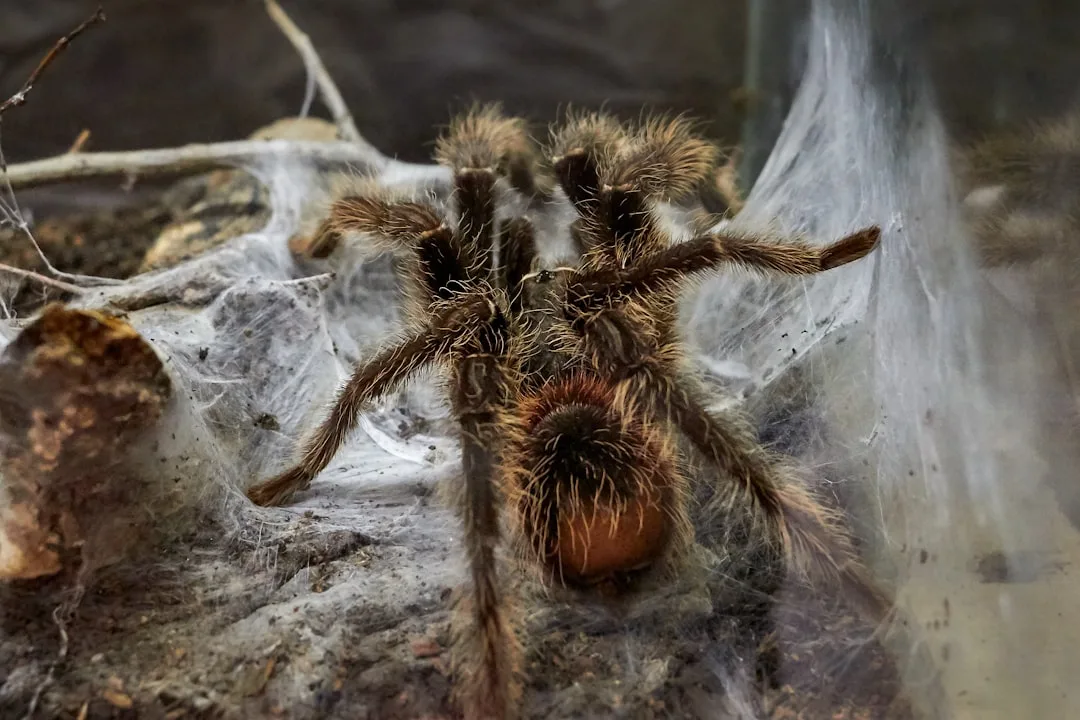
The Goliath birdeater tarantula is the heaviest spider in the world. An adult female can weigh up to 175 grams, stretch across a 30-centimetre leg span, and live for a quarter of a century in a silk-lined burrow under the leaf litter of a northern South American rainforest.
Despite a name that conjures images of avian predators, the species eats crickets and beetles far more often than birds, and its venom is less medically significant than a wasp sting. What makes Theraphosa blondi remarkable is not danger but scale, longevity, and a suite of bizarre biomechanical quirks that set tarantulas apart from nearly every other kind of spider.
This guide covers every aspect of Goliath birdeater biology and ecology: size, anatomy, habitat, diet, venom, urticating hair defence, reproduction, lifespan, taxonomy, conservation status, and the relationship between this enormous arachnid and the humans who share its forests. It is a reference entry, not a summary - so expect specifics: grams, centimetres, years, egg counts, and verified field records.
Etymology and Classification
The scientific name Theraphosa blondi was coined in 1804 by the French zoologist Pierre Andre Latreille. The genus name Theraphosa combines Greek roots meaning roughly "hunting beast" and the species name honours a contemporary naturalist. The common name has a more curious history.
In 1705 the German-Dutch naturalist Maria Sibylla Merian published an engraving in her book Metamorphosis insectorum Surinamensium that depicted a large tarantula devouring a hummingbird on a branch in Suriname. The image caused a sensation in Europe and the generic label "birdeater" was glued to the whole genus, regardless of the fact that most tarantulas - including this one - rarely encounter birds at all.
The Goliath birdeater sits inside the family Theraphosidae, a group that contains roughly 1000 described tarantula species across the tropics and subtropics. Theraphosidae belongs to the suborder Mygalomorphae, an ancient lineage of spiders distinguished from the more familiar "modern" spiders (Araneomorphae) by fangs that strike downward rather than inward.
Mygalomorphs are the older branch of spider evolution; fossils attributable to the group extend back more than 300 million years. The tarantulas are, in evolutionary terms, living representatives of a design that predates the dinosaurs.
Within Theraphosa itself, taxonomists now recognise three species: the Goliath birdeater (T. blondi), the Burgundy Goliath birdeater (T. stirmi), and the pinkfoot Goliath (T. apophysis). All three are enormous, all three occupy northern South American rainforests, and all three are frequently confused with each other in the exotic pet trade and in older literature.
Size and Physical Description
The Goliath birdeater is one of the largest spiders alive today. The record for maximum body mass belongs to this species; the record for longest leg span is contested with the giant huntsman spider (Heteropoda maxima) and the salmon pink birdeater (Lasiodora parahybana).
Adult female dimensions:
- Body length: up to 12 centimetres
- Leg span: up to 30 centimetres
- Mass: up to 175 grams
- Fangs: up to 2 centimetres long
Adult male dimensions:
- Body length: 9-11 centimetres
- Leg span: similar to females, sometimes longer relative to body
- Mass: 80-100 grams
- Considerably more gracile, with longer legs and a smaller abdomen
The spider's body plan follows the standard arachnid pattern: a front segment called the cephalothorax or prosoma, which carries the eight legs, two pedipalps, and two chelicerae with fangs; and a rear segment called the abdomen or opisthosoma, which contains the heart, book lungs, digestive tract, silk glands, and reproductive organs. The connection between the two is narrow. The abdomen is soft and balloon-like, distended after a meal and thin during fasts.
Goliath birdeaters are covered in short, dense bristles that range from pale pink-brown to deep chestnut depending on individual, age, and time since last moult. Freshly moulted spiders appear velvet-dark and glossy; older specimens fade to dusty brown. The bristles serve multiple functions: sensory reception, thermal regulation, water repellence, and - critically for the genus - defence.
Eight eyes are arranged in a compact cluster on top of the prosoma, but eyesight is poor. Tarantulas rely almost entirely on mechanical sensing through their leg bristles and slit sense organs, which detect vibration through substrate, silk, and air.
The Hydraulic Legs
Among the Goliath birdeater's stranger features, the mechanism by which it walks deserves special attention. Tarantulas have no extensor muscles in their legs. Flexor muscles pull the limbs inward, but the outward extension is performed by hydraulic pressure - the spider pumps haemolymph (a blood-like internal fluid) into the leg, inflating it like a rigid fire hose.
This has practical consequences. A dehydrated tarantula literally cannot walk. Its legs curl inward and it adopts the characteristic "death curl" posture, often mistaken by new keepers for a moult or actual death. Rehydration can, in many cases, restore mobility.
The hydraulic system also explains why tarantulas are terrible jumpers: generating rapid extension requires an instantaneous spike in internal pressure, and above a certain jump distance the spider's exoskeleton cannot contain the burst. Short hops are possible; long leaps are not.
Habitat and Range
The Goliath birdeater is native to the lowland rainforests of the Guiana Shield and northern Amazon basin. Its confirmed range includes:
- Guyana
- Suriname
- French Guiana
- Venezuela (south of the Orinoco)
- Northern Brazil (Roraima, Amapa, parts of Para)
Within this range the spider favours swampy, humid primary rainforest at elevations from sea level up to about 800 metres. It requires relative humidity above 80% and stable temperatures between 24 and 28 degrees Celsius year-round, which the interior of intact rainforest provides consistently.
Individual Goliath birdeaters live in burrows, usually modified from pre-existing holes dug by rodents or other burrowing animals. The spider enlarges the entrance, lines the tunnel and chamber with silk, and installs a silk "welcome mat" at the threshold that detects vibrations from any approaching insect. Burrows are typically 15 to 30 centimetres deep and feature a single expanded chamber at the back where the spider rests, digests, and moults.
The species is almost purely terrestrial. Unlike most smaller tarantulas, which climb readily, Goliath birdeaters are too heavy to safely manoeuvre in vegetation. A fall from even a modest height can rupture the soft abdomen, which is often lethal.
Diet and Hunting Behaviour
Goliath birdeaters are ambush predators. The spider waits inside or just outside the burrow for a prey animal to trigger a vibration signature it recognises, then lunges the short distance needed to strike with its 2-centimetre fangs. The bite injects paralysing venom along with digestive enzymes that begin to liquefy tissue before the prey is carried back into the burrow.
Typical prey:
- Crickets, beetles, cockroaches
- Earthworms and millipedes
- Frogs and toads
- Small lizards
- Small snakes (occasional)
- Nestling rodents
- Small ground-nesting birds (rare)
External digestion is the rule. The spider injects enzymes, waits, and then sucks up the resulting nutrient slurry, leaving behind a tidy, hollow shell of indigestible parts. Feeding bouts can last several hours. An adult Goliath birdeater might consume nothing for three or four weeks between meals, then devour a 30-gram frog in a single extended sitting.
Young spiderlings and juveniles focus on smaller invertebrates and cannot yet tackle vertebrates. As the spider grows through successive moults, its prey range expands. A fully grown adult female is capable of subduing any animal that fits into her burrow and weighs less than her own body mass.
The Urticating Hair Defence
The most distinctive defensive feature of tarantulas in the New World - including the Goliath birdeater - is urticating hair. These are modified bristles on the upper surface of the abdomen, each covered in microscopic barbs. When threatened, the spider braces against the ground, lifts the abdomen, and rubs its hind legs rapidly across the hair patch, ejecting a cloud of bristles toward the attacker.
The effect on vertebrate predators is severe. The barbed hairs embed in eyes, nasal passages, mouth, and skin, producing intense itching, inflammation, and sometimes lasting allergic reactions. Mammals that sniff too closely at a Goliath birdeater frequently suffer facial swelling and respiratory distress. Humans exposed to heavy urticating-hair doses can experience symptoms for a week or more.
Keepers of tarantulas in captivity learn to avoid bending over enclosures during moult cycles, when shed hairs accumulate on the substrate and can be stirred into the air by any small disturbance.
The spider pays a price for this defence. Urticating hairs take energy to produce and deploy, and bald patches on the abdomen indicate recent defensive events. Freshly moulted spiders have the thickest, glossiest hair coat; long-unmoulted specimens may show considerable bare skin.
Venom, Fangs, and the Bite
The venom of Theraphosa blondi is mild for such a large spider. No human fatalities have been documented. Bite symptoms typically include local pain, swelling, and redness, sometimes accompanied by mild systemic effects such as nausea, sweating, or muscle cramps for several hours. Most healthy adults recover without medical intervention.
The mechanical severity of the bite, however, is real. The two-centimetre fangs puncture human skin easily and can produce wounds comparable to a deep staple injury. Pain at the bite site can persist for 24 to 48 hours. Secondary bacterial infection is a more serious concern than the venom itself, particularly in humid tropical environments.
The venom is a cocktail of small peptides and larger proteins. Its composition is increasingly of interest to pharmacological researchers, not because of toxicity to mammals but because certain peptides selectively block ion channels in a way that may be useful for pain research and neurological drug development.
Sound Production: Stridulation and Rustling
Goliath birdeaters can produce two distinct acoustic signals, both rare among spiders.
The first is stridulation - a hissing sound generated by rubbing specialised bristles on the pedipalps and front legs against each other. The noise is audible to humans from roughly one metre away and serves as a warning to potential predators, similar to a rattlesnake's tail. The defensive display combines stridulation with a rearing posture, exposing the fangs and lifting the front legs high.
The second is a passive rustling sound produced when the spider walks across dry leaf litter. Observers have compared it to wet paper being crumpled or a large beetle scuttling through undergrowth. The noise is a byproduct of the spider's enormous bristled feet dragging across forest debris and has no apparent communicative function, though it probably reveals the spider's presence to discerning predators.
Moulting and Growth
Like all spiders, tarantulas grow by shedding their old exoskeleton in a process called ecdysis, or moulting. What distinguishes tarantulas from most other spiders is how many times they moult and how long each cycle takes.
Female Goliath birdeaters moult more than 25 times over a long adult life. Each moult allows the spider to grow, regenerate lost limbs, replace worn urticating hair patches, and refresh the lining of its book lungs and digestive tract. The process takes several hours and leaves the spider soft, vulnerable, and unable to feed for roughly a week afterward.
Moulting sequence:
- Pre-moult: the spider stops eating, retreats into its burrow, and becomes sluggish for days to weeks.
- Overturn: the spider lies on its back, a posture unique to moulting in most tarantula species.
- Shed: the cephalothorax splits along defined lines and the spider pulls itself out of the old skin, pedipalps and legs first.
- Post-moult: for several days the new exoskeleton is pale and soft; the spider cannot defend itself effectively and avoids any activity.
- Hardening: over roughly one week the new cuticle darkens and hardens, and normal feeding resumes.
Males follow a different trajectory. After their final moult, usually between ages 3 and 6, males cannot moult again. Their reproductive organs mature and they leave the burrow permanently to search for females. Most die within a year of the final moult, either from starvation, predation, or mating-related injury.
Reproduction and Life Cycle
Reproduction begins when a mature male wanders the forest floor in search of female burrows. He detects them primarily by scent - pheromones deposited on silk threads at the burrow entrance. On locating a candidate female, he drums rhythmically on the silk to signal his presence. The drumming pattern identifies him as a conspecific male rather than a prey item.
If the female responds positively, mating takes place at the burrow entrance. The male uses specialised hooks on his front legs - known as tibial spurs - to prop up the female's fangs during copulation, reducing the risk of being bitten. Sperm is transferred from the male's pedipalps (which function as delivery organs in spiders) into the female's reproductive opening.
The female lays 100 to 400 eggs into a large silk egg sac, usually weeks to months after mating. She guards the sac fiercely inside the burrow, rotating it periodically to ensure even humidity and defending it aggressively against intruders. Spiderlings hatch after six to eight weeks and remain with the mother for a brief period before dispersing to find their own shelter.
Mortality among hatchlings is enormous. Of several hundred spiderlings, only a handful reach sexual maturity. Predators include ants, centipedes, birds, lizards, and larger arthropods. Cannibalism by siblings occurs once food runs low.
Lifespan
Female Goliath birdeaters are among the longest-lived spiders on Earth. Field-documented lifespans range from 15 to 25 years. Captive females under good husbandry conditions have exceeded 30 years. Males live dramatically shorter lives, typically 3 to 6 years total, with no more than a year or two after final maturation.
This lifespan disparity is common across the family Theraphosidae and reflects an evolutionary strategy in which females invest heavily in long reproductive lives and males invest everything in a single mate-searching phase.
Predators and Parasites
Despite the spider's size and defensive arsenal, Goliath birdeaters have several predators and parasites.
Major predators:
- Tarantula hawk wasps (Pepsis spp.): large wasps that paralyse tarantulas with a sting and lay a single egg on the body; the hatching larva eats the still-living spider from inside.
- Large colubrid and boid snakes
- Coatimundis and other small mammalian carnivores
- Large birds of prey occasionally
- Army ants in passage - capable of overwhelming any spider whose burrow lies in their path
The tarantula hawk is perhaps the most famous natural enemy. The wasp's sting is ranked among the most painful in the insect world, and the wasp is specifically adapted to overcome the spider's defences, including immunity to urticating hairs.
Conservation Status
The IUCN Red List has not formally assessed Theraphosa blondi, so the species carries no official global conservation designation. Available field evidence suggests that the spider remains locally common across intact rainforest habitat in its range countries, but the species faces several pressures:
- Deforestation. Large-scale clearance for agriculture, cattle ranching, and timber in Brazil and Venezuela removes critical habitat. Secondary forest regrowth does not provide the humidity and leaf litter depth the species requires.
- Gold mining. Alluvial and industrial gold mining in the Guianas and northern Brazil is a major driver of rainforest fragmentation and soil disturbance.
- Exotic pet trade. Wild-caught adult Goliath birdeaters are exported internationally. Several range states regulate or prohibit collection. Responsible keepers acquire only captive-bred specimens.
- Climate change. Rising temperatures and altered rainfall patterns threaten the narrow humidity range the spider requires.
A formal IUCN assessment would help clarify status. In the meantime, protection of large intact rainforest blocks such as the Iwokrama Forest, the Kaieteur National Park, and the Tumucumaque National Park provides de facto refuge.
Tarantulas and Humans
Human interactions with the Goliath birdeater fall into three broad categories: food, fear, and fascination.
Among indigenous communities in French Guiana and parts of northern Brazil, Goliath birdeaters are occasionally eaten. The spider is roasted over coals after the urticating hairs are burned off, producing a dish described variously as shrimp-like in texture and smoky in flavour. The practice is traditional rather than widespread, but it documents a long-standing human-spider relationship far older than the exotic pet trade.
Among exotic keepers worldwide the species is a prestige animal, valued for its size, handled rarely, and housed in specialised terraria that replicate deep rainforest humidity. Ethical keepers avoid wild-caught specimens.
Among the general public, tarantulas - especially this species - remain a durable source of fear. The reputation outstrips reality: the Goliath birdeater has never killed a human, and most keepers who have worked with the species for years report the spider as essentially docile unless directly threatened. The combination of enormous size, hairy bulk, and a name that evokes predation on vertebrates continues to fuel misconceptions that the animal itself does little to justify.
Related Reading
- Goliath Birdeater: The Largest Spider on Earth
- Spiders: The Master Weavers of the Animal Kingdom
- Black Widow Spider
- Most Dangerous Spiders in the World
References
Relevant peer-reviewed and governmental sources consulted for this entry include field reports from Guyana's Iwokrama International Centre, the American Arachnological Society, published research in the Journal of Arachnology, Zootaxa, and Toxicon, and the World Spider Catalog maintained by the Natural History Museum Bern. Taxonomy follows the current World Spider Catalog entry for Theraphosidae.
Range and habitat data reflect the most recent consolidated field reports from the Guiana Shield and northern Amazon basin.
Frequently Asked Questions
How big is the Goliath birdeater tarantula?
Adult females of Theraphosa blondi reach a body length of roughly 12 centimetres, a leg span up to 30 centimetres, and a mass of up to 175 grams. That places the species at the top of the spider world by weight, rivalled only by close relatives in the same family. For comparison, a 175-gram spider weighs about the same as a baseball or a fully grown rat. Males are slightly smaller and considerably lighter, with longer legs relative to body size.
The spider’s enormous fangs measure up to 2 centimetres, long enough to puncture human skin easily.
Does the Goliath birdeater actually eat birds?
Rarely. Despite its common name, the Goliath birdeater’s diet consists almost entirely of invertebrates and small vertebrates it encounters on or near the forest floor: crickets, beetles, cockroaches, frogs, lizards, small snakes, and occasionally rodents. Attacks on ground-nesting birds or nestlings do occur but are uncommon.
The misleading name traces back to a 1705 engraving by the German-Dutch naturalist Maria Sibylla Merian, who depicted a large tarantula consuming a hummingbird in Suriname. European naturalists generalised the behaviour to the whole genus, and the name stuck for three centuries despite limited field evidence.
Is the Goliath birdeater dangerous to humans?
Not seriously. Theraphosa blondi has never been confirmed to kill a human. Its venom is comparable in effect to a wasp sting - painful, locally swelling, sometimes causing nausea or cramps for several hours, but rarely medically significant for a healthy adult. The more common hazard is the spider’s urticating hairs, which it flicks at perceived threats.
These barbed bristles embed in skin, mucous membranes, and especially eyes, producing intense itching and inflammation that can last a week or more. A direct bite is also mechanically painful because the fangs are nearly two centimetres long. People with allergies or compromised immune systems should seek medical attention after any bite.
Where does the Goliath birdeater live?
The Goliath birdeater is native to the rainforests of northern South America, primarily in Brazil (north of the Amazon), Venezuela, Guyana, Suriname, and French Guiana. It favours deep, swampy, lowland rainforest with high humidity and dense leaf litter. Individual spiders construct silk-lined burrows under tree roots, fallen logs, or rock cavities, often enlarging existing rodent burrows rather than digging from scratch.
The species is almost exclusively terrestrial; unlike many smaller tarantulas it does not climb well and spends its life within a few metres of its burrow. The rainforest canopy is left to other spiders.
How long do Goliath birdeaters live?
Female Goliath birdeaters are among the longest-lived spiders in the world, with field-documented lifespans of 15 to 25 years. Some captive specimens have exceeded 30 years. Males live dramatically shorter lives: they mature sexually between three and six years of age, set out to search for females, and rarely survive more than a year or two after that final maturation moult. Once mature, males lose the ability to moult again and their lifespans are fixed.
Females continue to moult throughout life, replacing lost legs, refreshing their external skeletons, and even regenerating parts of their internal respiratory surfaces.
How does the Goliath birdeater defend itself?
Theraphosa blondi has a layered defensive repertoire. First line of defence is hiding - the spider retreats into its burrow at the first sign of disturbance. If cornered, it rears up on its back legs, exposes its fangs, and hisses loudly by rubbing specialised bristles on its legs together, a process called stridulation.
If the threat persists, the spider rubs its hind legs rapidly across its abdomen, releasing a cloud of microscopic urticating hairs that are barbed and deeply irritating to eyes, nasal passages, and skin. Only as a last resort does the spider bite. The two-centimetre fangs deliver a painful but mild venom.
How does the Goliath birdeater reproduce?
Mating occurs when a mature male, after his final moult, abandons his burrow and wanders the forest floor in search of female burrows. He drums on silk threads at the burrow entrance to signal his presence without provoking a predatory attack. If the female accepts him, mating takes place at the burrow threshold, often with the male propped up on specialised hooks on his front legs that hold the female’s fangs away from him.
The female subsequently lays 100 to 400 eggs into a large silk sac that she guards fiercely inside the burrow. Spiderlings hatch after roughly six to eight weeks and remain with the mother briefly before dispersing.
Is the Goliath birdeater endangered?
The IUCN Red List has not formally assessed Theraphosa blondi, so the species has no official global conservation status. Available field evidence suggests the spider remains locally common across intact rainforest habitat in Guyana, Suriname, French Guiana, Venezuela, and northern Brazil. The main long-term threats are habitat loss from deforestation, gold mining, and agricultural conversion, plus collection pressure from the exotic pet trade.
Several exporting countries now restrict or regulate wild capture. Tarantula enthusiasts generally recommend captive-bred specimens, both for conservation reasons and because wild-caught adults are often parasitised and difficult to keep alive.