
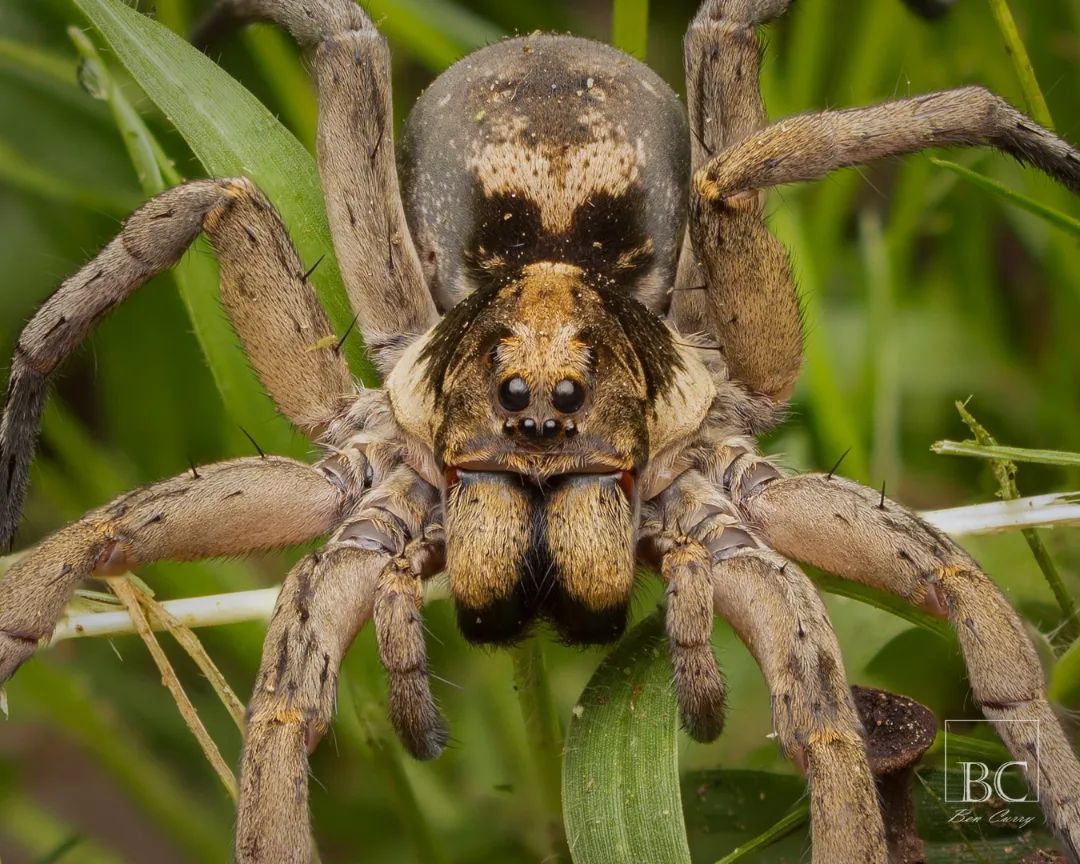
The wolf spider is the name given to any member of the family Lycosidae, a group of roughly 2,400 species spread across every continent except Antarctica. Unlike the familiar orb weavers and cobweb spiders, wolf spiders do not build capture webs. They are cursorial hunters - running predators that track, chase, and pounce on prey the way a wolf or fox runs down a rabbit.
The family name itself comes from the Greek word for wolf, chosen by early naturalists who watched these spiders stalk insects across open ground.
This guide uses Hogna carolinensis, the Carolina wolf spider, as the representative species. It is the largest wolf spider in North America, one of the best-studied members of the family, and a reliable stand-in for the broader Lycosidae wherever generalisation is honest. Where other species differ sharply - in eye arrangement, burrow behaviour, or life cycle - the differences are flagged. Expect specifics throughout: millimetres, numbers of eyes, egg counts, and field-verified hunting data.
Note on placement. Wolf spiders are arachnids, not insects. This entry is filed under the insects and spiders section purely to match the broader site layout, which groups arthropods together for navigation. Wolf spiders have eight legs, two body segments, and no antennae, all clear markers of class Arachnida.
Etymology and Classification
The family name Lycosidae derives from the Greek lykos meaning wolf. The association reflects an old European folk idea that these ground-hunting spiders pursued prey in coordinated packs - which they do not. Wolf spiders are solitary hunters, and the name has survived only because the individual behaviour of a single wolf spider stalking an insect looks uncannily mammalian.
The spiders freeze, orient, creep, and pounce with timing and posture that would not look out of place in a predatory cat or canid.
Within the order Araneae - the true spiders - Lycosidae belongs to the infraorder Araneomorphae, the modern spiders, as distinct from the older Mygalomorphae that contains tarantulas and trapdoor spiders. The family contains about 125 recognised genera and roughly 2,400 described species. The genus Hogna alone contains more than 200 species, making it one of the largest genera in the family.
The representative species here, Hogna carolinensis, was first described by Hentz in 1844. It is native to the southern and central United States. Its common name - Carolina wolf spider - reflects the type locality where it was first collected. In 2000 it was named the official state spider of South Carolina, one of the very few spiders to hold any official designation anywhere in the world.
Full classification:
- Kingdom: Animalia
- Phylum: Arthropoda
- Class: Arachnida
- Order: Araneae
- Infraorder: Araneomorphae
- Family: Lycosidae
- Genus: Hogna
- Species: H. carolinensis
Size and Physical Description
Wolf spiders range dramatically in size depending on species. The smallest members of the family have a body length of only a few millimetres. The largest, Hogna carolinensis, reaches approximately 35 millimetres in body length with a leg span well over 100 millimetres. Most wolf spiders that people encounter in gardens, basements, and fields fall in the 10 to 20 millimetre body range.
Body structure:
- Cephalothorax: a single fused head-and-thorax region carrying the eyes, mouthparts, and eight walking legs
- Abdomen: roughly oval, often marked with longitudinal stripes or a central cardiac mark
- Legs: long, heavily built, covered in sensory hairs that detect air movement and ground vibration
- Chelicerae: the forward-pointing fangs and the muscular bases that drive them
- Pedipalps: the short leg-like appendages beside the chelicerae, used for handling prey and, in males, for sperm transfer
Colour and camouflage. Wolf spiders are almost always brown, grey, or mottled black with pale stripes or patches. The pattern is cryptic - it breaks up the outline of the spider against soil, bark, and leaf litter. Very few wolf spider species are brightly coloured, because most hunt on the ground where conspicuous colour would be fatal.
Males and females usually share the same colour scheme, though males tend to be slightly more contrast-marked on the legs and pedipalps during the mating season.
Sexual dimorphism. Females are larger and heavier-bodied than males, sometimes noticeably so. Males have proportionally longer legs and larger pedipalps. In many species the male pedipalps appear swollen at the tip, a feature that stores sperm for transfer during mating.
The Eyes: Four Rows, Eight Cameras
The eye arrangement of wolf spiders is the single most useful feature for distinguishing them from other spider families at a glance. They have eight eyes - the typical spider count - but the arrangement is distinctive and gives Lycosidae the common nickname of three-rowed spiders.
Row layout from bottom to top:
- Bottom row (anterior row). Four small eyes in a roughly straight line along the front of the cephalothorax. These are the anterior median and anterior lateral eyes. They handle wide-field motion detection and low-resolution imaging.
- Middle row (posterior median eyes). Two very large eyes pointed forward and slightly upward. These are the spider's main image-forming eyes. They are big, shiny, and unmistakable when you look a wolf spider in the face.
- Top row (posterior lateral eyes). Two medium eyes set back and outward from the posterior median pair, angled to cover the rear and sides.
The two large posterior median eyes carry a dense concentration of photoreceptors and, uniquely among ground spiders of this size, a tapetum lucidum - a reflective layer that bounces incoming photons back through the retina for a second pass. This doubles the amount of light each photoreceptor sees and is the reason wolf spiders function so well at low light levels. Laboratory tests place their low-light visual acuity on par with that of a domestic cat at equivalent scale.
The eyeshine phenomenon. The tapetum lucidum is also why wolf spiders are so easy to survey at night. Point a flashlight forward with the beam close to your line of sight and sweep it across short grass or leaf litter. Wolf spider eyes appear as pin-sized points of light in white, pale green, or emerald. The reflection is strongly directional - if you move the light away from your eye the shine disappears.
Arachnologists routinely use head-mounted torches to count wolf spider populations, and densities of dozens of spiders per square metre are common in suitable habitat.
The other six eyes handle wide-angle motion detection. Put together, the wolf spider has near-panoramic awareness plus high-resolution forward vision - an unusual combination among spiders, most of which rely primarily on touch and vibration rather than sight.
Cursorial Hunting: No Web, All Chase
The defining behaviour of the wolf spider is the way it takes prey. Wolf spiders do not build capture webs. They produce silk - for drag lines, for egg sacs, and for lining burrows - but never the aerial traps that define most other spider families. Instead they hunt on foot.
Two major hunting styles within the family:
- Active pursuit hunters. Species that roam open ground, detect prey visually and through vibration, then close with a short sprint and pounce. Many Pardosa and smaller Hogna species hunt this way.
- Ambush hunters from burrows. Species that dig or occupy silk-lined burrows and wait at the entrance for prey to pass. Hogna carolinensis is primarily an ambush hunter, using a vertical burrow 20-30 centimetres deep as a base of operations. At dusk the spider rests near the rim and strikes at any insect that walks within range.
The strike itself is explosive. A wolf spider can cover several body lengths in a single jump-run, driven by hydraulic leg extension rather than muscular joint extension. Spider legs lack the extensor muscles found in insect legs. Instead the spider raises internal body fluid pressure to hyperextend the legs, a mechanism that delivers extreme acceleration over very short distances.
Prey is gripped with the chelicerae and envenomated. The venom is a cocktail of neurotoxic peptides tuned for arthropods. Digestion is external - the spider injects digestive enzymes into the prey and sucks out the liquefied tissues, leaving a dry husk.
Typical prey includes crickets, grasshoppers, cockroaches, beetles, ants, smaller spiders, and - for the largest species - occasional small vertebrates such as juvenile frogs and lizards. The largest Hogna carolinensis individuals have been documented taking prey up to their own body length.
Venom and the Question of Danger
Wolf spider venom is designed to kill insects quickly and is not adapted for defence against vertebrates. A bite on human skin produces a brief sharp pain similar to a bee sting, followed by local redness, mild swelling, and sometimes itching around the puncture. Symptoms resolve without treatment within 24 to 48 hours.
| Aspect | Typical outcome |
|---|---|
| Immediate sensation | Sharp pinch, similar to a bee sting |
| Local reaction | Redness, swelling up to 1-2 cm diameter |
| Duration | 12-48 hours |
| Systemic effects | Very rare; mild malaise at worst |
| Confirmed fatalities | None in the modern medical literature |
| Medical treatment | Supportive only; antihistamines if needed |
Historical reports of necrotic wolf spider bites in South America were reassigned decades ago to recluse spiders (Loxosceles), whose venom chemistry is entirely different. Wolf spiders lack the sphingomyelinase enzymes responsible for dermonecrosis. The persistent folk belief that wolf spider bites cause tissue death is, in every documented case, a misidentification.
Wolf spiders are shy. They flee rather than confront, and bites on humans almost always happen when the spider is trapped - caught in clothing, pressed into bedding, or cornered in a shoe. The practical danger posed by wolf spiders is negligible.
Reproduction and the Egg Sac
Wolf spider reproduction is notable for two features that set the family apart from most other spiders: the egg sac is physically carried by the mother, and the spiderlings ride on her back after hatching.
Courtship. Male wolf spiders locate females using pheromone trails and ground vibration. On encountering a female, the male performs a species-specific courtship dance involving pedipalp waving, leg tapping, and body rocking. In several species the male also plucks at strands of drag-line silk to produce courtship signals that travel through the substrate.
One remarkable behaviour, documented in some wolf spider species and related lycosoids, is the presentation of a silk-wrapped prey item as a nuptial gift - the male hands over an edible package and mates while the female is occupied with it. The gift reduces the risk of being eaten and increases mating duration.
Mating. Once the female accepts the male, copulation proceeds with the male inserting his sperm-loaded pedipalps into the female's genital opening. The act lasts from a few minutes to an hour depending on species. Cannibalism of the male post-mating does occur but is less common in the wild than in constrained laboratory conditions, where the male cannot escape.
Egg sac construction. After mating the female builds a round silk egg sac. She lays dozens to hundreds of eggs inside, seals the sac, and then attaches it directly to the spinnerets at the rear of her abdomen. From that point on she carries the sac with her everywhere - while hunting, while retreating to a burrow, while basking in morning sun to warm the developing eggs.
Hatching and spiderling dispersal. When the eggs are ready to hatch the mother helps open the sac by tearing at the seam with her chelicerae. The newborn spiderlings emerge and climb onto her abdomen, clinging to specialised hairs arranged in dense patches. A single mother may carry more than one hundred spiderlings at once, stacked several deep on her back.
She continues to hunt and move normally while carrying them. After several days to a few weeks - depending on species and temperature - the young disperse by ballooning (climbing to a high point, releasing silk threads, and riding air currents) or by simply walking away to establish their own territories.
This level of parental investment is rare among spiders. Most species lay eggs and abandon them. The wolf spider strategy exchanges raw egg count for protection during the earliest, most vulnerable phase of the spiderling's life.
Life Cycle and Growth
A typical wolf spider life cycle runs between one and two years, with some variation by species and climate.
| Stage | Duration (typical) |
|---|---|
| Egg development | 2-4 weeks inside the sac |
| Spiderling on mother | 1-3 weeks |
| Juvenile free-living | Several months to over a year |
| Sexual maturity | Reached after 5-10 moults |
| Adult lifespan | 6-18 months |
Spiders grow by moulting - shedding the entire exoskeleton, including the lining of the book lungs and the chelicerae. Between moults the spider cannot grow. Each moult is risky; a poorly timed or incomplete moult is one of the most common causes of juvenile mortality in the family.
In cold-climate species juveniles often overwinter at an intermediate stage, slowing metabolism and sheltering in burrows or leaf litter until spring. In warm climates some species complete a generation in under a year. The very largest species, including Hogna carolinensis, may take two full years to reach adult size.
Males usually die shortly after their first mating season. Females are longer-lived and may produce two or three egg sacs over their adult lifespan.
Habitat and Range
Wolf spiders are one of the most geographically successful spider families on Earth. Species in Lycosidae are found on every continent except Antarctica, in virtually every terrestrial biome.
Representative habitats:
- Temperate grasslands and meadows - high densities of Pardosa and Alopecosa species
- Deserts and semi-arid scrub - burrowing Geolycosa and Hogna species
- Boreal and alpine zones - cold-adapted Pardosa and Arctosa species
- Tropical rainforest floor - diverse Lycosidae across multiple genera
- Wetland margins and river banks - semi-aquatic species that can run on water
- Human-modified environments - gardens, farmland, basements, outbuildings
Wolf spiders typically need two things: ground-level cover for daytime retreat and relatively open hunting lanes for nocturnal activity. The family tolerates a wide range of moisture levels, from desert sand to waterlogged marsh. A few species in the genus Pirata specialise in wet habitats and can run across the surface of still water using the same surface-tension mechanics seen in fishing spiders.
Burrow-building species are especially well-studied. Hogna carolinensis digs a vertical tunnel 20-30 centimetres deep in sandy or loamy soil, lines the upper part with silk, and sometimes builds a small turret of pebbles and debris around the entrance. The burrow serves as a daytime refuge, a moulting chamber, and an ambush post.
Ecological Role
Wolf spiders sit in the middle of terrestrial food webs. They are numerous, widespread, and predatory, which makes them important regulators of insect populations - particularly of crop pests in agricultural settings.
Prey impact. In temperate grasslands wolf spider densities commonly exceed 50 individuals per square metre, and in peak season can exceed 200. At that density their collective insect consumption is significant. Studies in cereal fields and vineyards have documented measurable reductions in pest insect numbers directly attributable to resident wolf spider populations.
Predator impact. Wolf spiders themselves are eaten by birds, small mammals (particularly shrews), reptiles, amphibians, larger spiders, and many parasitoid wasps. Pompilid wasps - the spider wasps - specialise in hunting wolf spiders, paralysing them with a sting and laying an egg on the still-living body, which the wasp larva then eats alive from the inside.
Indicator species. Because wolf spiders are abundant, easy to survey (eyeshine makes censusing straightforward), and sensitive to habitat quality, they are frequently used as ecological indicators for grassland health, pesticide exposure, and habitat restoration outcomes.
Wolf Spiders and Humans
Wolf spiders frequently enter human buildings - basements, garages, sheds, barns, and ground-floor rooms. They do not establish permanent indoor populations in most cases. They wander in through ground-level gaps while hunting at night and either leave again or die inside without reproducing. The large, fast, brown spider found sprinting across a basement floor at night is very often a wolf spider.
Public perception is mixed. The combination of size, speed, and hairiness makes wolf spiders genuinely startling to encounter. They also have the disconcerting habit of freezing when a light hits them, then sprinting unpredictably when the observer moves. Despite the reaction they provoke, they are essentially harmless.
Pest control targeting wolf spiders is rarely justified; sealing ground-level gaps and reducing outdoor lighting (which attracts the insects wolf spiders pursue) is far more effective than insecticide.
In some cultures wolf spiders have modest symbolic weight. The Italian tarantella dance takes its name from the town of Taranto and the wolf spider Lycosa tarantula, from medieval folklore in which a bite was supposed to cause a condition called tarantism cured only by frenzied dancing. Modern medical consensus places that story firmly in the realm of cultural history rather than toxicology; L. tarantula's bite is no more dangerous than that of any other wolf spider.
Conservation Status
The family Lycosidae as a whole has not been assessed by the IUCN. Individual species are rarely red-listed. Most wolf spiders are abundant, widespread, and resilient to a wide range of habitat conditions, which makes them low priority for formal conservation attention.
A small number of highly localised species - particularly cave-restricted and island-endemic wolf spiders - are considered vulnerable or endangered at regional level. The Kauai cave wolf spider (Adelocosa anops), for example, is known from only a handful of lava tubes in Hawaii and has been listed as endangered under United States law since 2000. These narrow-range species are exceptions; the family overall is secure.
The broader threats facing wolf spiders, where they exist, mirror threats to other terrestrial arthropods: habitat loss, pesticide exposure, invasive predators and competitors, and climate shifts that alter soil moisture and prey availability.
Related Reading
- Spiders: The Master Weavers of the Animal Kingdom
- Black Widow Spider
- Tarantula
- Goliath Birdeater: The Largest Spider
- Most Dangerous Spiders in the World
References
Relevant peer-reviewed and institutional sources consulted for this entry include the World Spider Catalog (maintained by the Natural History Museum of Bern, 2024 update), Foelix's Biology of Spiders (3rd edition, Oxford University Press), species accounts from the American Arachnological Society, and published research in the Journal of Arachnology, Animal Behaviour, and Invertebrate Biology.
Eye anatomy and vision data reflect experimental work by Land, Barth, and collaborators on lycosid visual ecology. Population density figures draw on long-term grassland surveys published in Ecological Entomology and Pedobiologia.
Frequently Asked Questions
How big are wolf spiders?
Wolf spider body length ranges from about 10 millimetres in the smaller species to 35 millimetres in the largest North American species, Hogna carolinensis. Leg span can exceed 100 millimetres, making a large wolf spider comparable in visible footprint to a human palm. Females are typically larger and heavier-bodied than males. Most wolf spiders people actually encounter in gardens, basements, and grasslands fall in the 10-20 millimetre body range.
The family Lycosidae as a whole spans almost the full range of sizes possible for a ground-hunting spider.
Do wolf spiders build webs?
No. Wolf spiders belong to a class of hunters biologists call cursorial, meaning they pursue or ambush prey on foot. They produce silk - for drag lines, for egg sacs, and for lining burrows - but they do not spin capture webs. This is the single most important difference between wolf spiders and the web-building families like orb weavers or cobweb spiders.
A wolf spider finds prey using a mix of eyesight, vibration sensing through the legs, and direct tactile contact, then closes the distance in a short sprint or a single explosive pounce.
Are wolf spiders dangerous to humans?
Wolf spider venom is designed to immobilise insects, not to harm vertebrates. A bite produces a painful local reaction - redness, swelling, mild itching - comparable to a bee sting, and it resolves without treatment in a day or two. No confirmed human fatalities from wolf spider bites exist in the medical literature. Historical cases blamed on wolf spiders in South America were later traced to recluse spiders with very different venom chemistry.
Wolf spiders are shy, fast, and strongly prefer retreat over confrontation. Bites happen almost exclusively when the spider is trapped against skin.
Why do wolf spiders have so many eyes?
Wolf spiders have eight eyes arranged in three rows. The bottom row contains four small eyes that detect movement and light direction across a wide field of view. The middle row holds two very large eyes pointed forward - these are the main image-forming eyes and give the spider its sharp central vision. The top row contains two medium eyes angled slightly backward and outward, providing rear awareness.
A reflective layer called the tapetum lucidum sits behind the large eyes, which is why wolf spider eyeshine is so striking under a flashlight. Together the three rows give near-panoramic awareness plus high-resolution forward vision for hunting.
How do wolf spiders care for their young?
Female wolf spider parental investment is among the strongest in the spider world. After mating, the female produces a round silk egg sac containing dozens to hundreds of eggs. She attaches the sac to the spinnerets at the rear of her abdomen and drags it with her everywhere - through burrows, across open ground, even when hunting.
When the spiderlings are ready to emerge, the mother helps open the sac, and the newborns climb onto her abdomen and cling to specialised hairs. They ride on her back for days to weeks, sometimes until they outgrow the space, before dispersing to hunt on their own. A single mother may carry more than one hundred spiderlings at once.
Where do wolf spiders live?
Wolf spiders live on every continent except Antarctica and occupy an enormous range of habitats. Different Lycosidae species are found in grasslands, forests, deserts, tundra, wetlands, riverbanks, sand dunes, farmland, gardens, basements, and the margins of human buildings. Some species dig vertical burrows up to 30 centimetres deep and line them with silk. Others wander freely in leaf litter or on open soil.
Their preferred microhabitats tend to share two features: ground-level cover for daytime retreat and open hunting lanes for nocturnal pursuit. The family is so widespread that most people in most climates have several wolf spider species living within walking distance, whether they notice them or not.
Can you really see wolf spider eyes shine at night?
Yes, and it is one of the easiest field observations in all of arachnology. The tapetum lucidum - a reflective layer behind the retina of the four large eyes - bounces light back toward the source. At night, hold a flashlight or headlamp level with your eyes and sweep it across a lawn, meadow, or forest floor. Wolf spider eyes appear as small bright points ranging from pale white-green to emerald.
Experienced surveyors routinely count dozens of spiders per square metre in suitable habitat using this method. The trick only works when the beam passes close to your line of sight, because the reflection is highly directional.
How long do wolf spiders live?
Most wolf spiders live one to two years from hatchling to adult death. Males generally die soon after mating in their second year. Females often live long enough to produce two or three egg sacs, depending on the species and climate. Larger burrowing species in the genus Hogna and related genera can live several years, particularly in climates where growth is slow and generations are stretched.
Cold-climate species often take two full years to reach maturity, overwintering as juveniles. Tropical species can complete a generation in under a year where food is abundant and the season is long.