
Introduction
In the coastal heathlands and scrublands of southeastern Australia lives the peacock spider, so small that it can rest on a human fingernail, yet so visually arresting that it has become one of the most photographed and beloved arachnids in the world.
Maratus volans, the Peacock Spider, measures barely 5 millimetres in body length, but the adult male carries on his abdomen a raised and folded fan of iridescent scales, blue, red, orange, and white, that he deploys during courtship performances of extraordinary complexity, dancing, waving, and vibrating in a display that must, apparently, satisfy a highly discriminating female audience or result in his death.
The Peacock Spider is a jumping spider, a member of the family Salticidae, the largest family of spiders by species count, with over 6,000 described species worldwide. Jumping spiders are characterised by their large, forward-facing eyes, their active hunting strategy, and their remarkable visual acuity.
Maratus represents a genus within this family in which male ornament and courtship behaviour have been taken to spectacular extremes, a biological phenomenon directly analogous to the elaborate plumage and dances of birds of paradise or peacocks, though implemented in a body weighing less than a rice grain.
The discovery and photography of Peacock Spiders by citizen scientists and macro photographers in the 2010s triggered an explosion of scientific and public interest in the group. Since 2011, over 90 new Maratus species have been described, nearly doubling the known diversity of the genus in little over a decade.
Etymology and Classification
The genus name Maratus has unclear etymology; it was erected by the British arachnologist Octavius Pickard-Cambridge in 1874 and may derive from a proper name or a Latinised form of an informal descriptive term. The species epithet volans is the Latin present participle of volare, meaning ‘flying’ or ‘soaring’.
This name, applied by Carl Ludwig Koch in 1867 when the species was originally placed in the genus Salticus, was based on a misinterpretation of the folded abdominal flaps as potential gliding structures. The name has persisted despite the demonstrated absence of any aerodynamic function.
Maratus volans is classified within the family Salticidae, the jumping spiders, which is placed within the infraorder Araneomorphae (the modern spiders), within the order Araneae. Salticidae is the most species-rich family of spiders, with over 6,000 described species on every continent except Antarctica. Jumping spiders are generally small to medium-sized, active hunters that rely on exceptional vision for both prey detection and conspecific communication.
The genus Maratus has been the subject of ongoing taxonomic revision, particularly following the application of molecular phylogenetic methods. Several analyses have suggested that the genus as currently defined is not monophyletic, meaning the elaborate display system may have evolved independently multiple times within the group, rather than being inherited from a single common ancestor. This remains an active area of research.
Physical Description
Male and female Peacock Spiders are dramatically different in appearance. Males, measuring 4 to 5 millimetres in body length, are among the most colourful spiders on Earth.
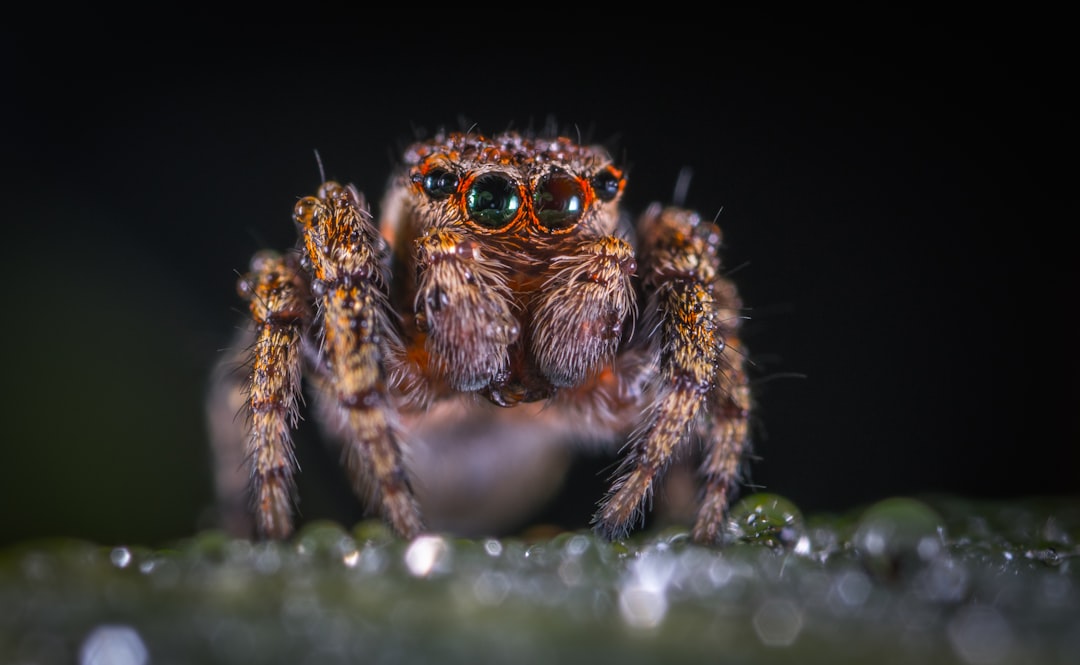
The anterior (front) portion of the body, the cephalothorax, bears the characteristic jumping spider arrangement of eight eyes: two large, forward-facing principal eyes that provide high-resolution colour vision, flanked by two pairs of smaller eyes that detect motion in the peripheral visual field. The cephalothorax is typically grey-brown, with some metallic scaling.
The abdomen of the male bears the defining feature of the species: a fan-like flap of specialised scales on the upper surface, which is normally folded flat against the abdomen but can be raised, spread, and rotated during display.
The scales of this fan are of two types: those bearing biological pigments (producing the reds, oranges, and yellows of the pattern) and those with nanostructured surfaces that produce structural colours through light interference (producing the blues, greens, and iridescents).
The combination creates a pattern of remarkable complexity that changes its appearance as viewing angle shifts, the iridescent portions in particular vary dramatically in colour with even small changes in the angle of illumination.
The third pair of legs in males are also modified for display: they bear prominent fringes of white-tipped setae (hairs) that are raised and waved during the courtship display, functioning as visual signals in conjunction with the abdominal fan.
Female Peacock Spiders are cryptically coloured in mottled brown and grey, an adaptation that reduces their conspicuousness to predators and provides no selective advantage for visual display, as females assess mates rather than competing for them. Females are slightly larger than males (5-6 mm) and are visually indistinguishable at a glance from many other female jumping spiders.
Habitat and Range
Maratus volans inhabits coastal scrubland, heathland, and dry sclerophyll woodland in eastern and southern Australia, with records from Queensland, New South Wales, Victoria, and South Australia. It is most commonly found at low elevations in warm, dry environments where the vegetation consists of coastal heather, banksia scrub, and eucalypt woodland with a dense low understorey.
The spider lives in the low vegetation layer and on the ground, hunting among leaf litter and the stems of small plants. It is active during the warm months when insect prey is abundant and ambient temperatures allow the thermoregulation required by a small, ectothermic predator.
The broader genus Maratus displays significantly higher diversity in Western Australia, where arid and semi-arid environments host a remarkable number of species, many restricted to small geographic ranges. The expansion of systematic Maratus surveys into remote and poorly sampled areas of inland Western Australia has produced the majority of new species descriptions in recent years.
Diet and Feeding Behaviour
The Peacock Spider, like all jumping spiders, is an active, visually guided predator. It hunts during the day, using its large forward-facing principal eyes to detect, identify, and track prey before launching a precisely aimed jump to capture it.
The principal eyes of jumping spiders, and Maratus in particular, provide spatial resolution and colour discrimination that is exceptional for an arthropod: the retinae can detect colour across a range including ultraviolet, blue, green, and red wavelengths, and the eyes are capable of perceiving the fine detail of other individuals’ colouration and movement.
Prey consists of small invertebrates: flies, springtails, small beetles, small moths, and similar-sized animals encountered in the spider’s microhabitat. The spider stalks its prey carefully, keeping the prey within the field of the principal eyes and adjusting its approach direction as the prey moves, before executing a precisely timed jump that pins the prey against the substrate. A silk dragline, anchored before the jump, prevents the spider from falling if the jump misdirects.
Courtship and Display Behaviour
The courtship behaviour of male Peacock Spiders is among the most complex and multimodal in the arthropod world, and understanding it has become a major focus of arachnological research since the genre was popularised by macro photographer and researcher Jürgen Otto in the early 2010s.
When a male detects a female, through visual and chemical cues, he begins a cautious approach, simultaneously initiating his display. The display is multimodal: it incorporates visual, vibratory, and possibly chemical components.
The visual component involves the raising of the abdominal fan (the opisthosomal flap), the spreading of the lateral edges of the abdomen to increase the apparent width of the display, and the waving of the third leg pair with its white-tipped setae fringes. The fan is not simply raised and held but actively vibrated, trembled at a characteristic frequency that varies between species.
The seismic (substrate-borne vibration) component has been characterised only since the late 2010s. Males tap their legs and abdomen against the substrate in complex rhythmic patterns during the display, producing vibrations that the female detects through slit sensilla (vibration receptors) in her legs.
Females may attend as much to these vibratory signals as to the visual display, and a 2021 study demonstrated that playback of vibratory signals alone influenced female receptivity in related salticid species.
The social intelligence embedded in the display is remarkable for an animal with such a small nervous system. Males monitor the female’s orientation and facing direction during the display and adjust their own position accordingly, moving laterally to maintain face-to-face alignment when the female turns.
They have also been observed to pause the display entirely when the female looks away, resuming when she re-orients towards them. This responsiveness requires the male to continuously model and respond to the attentional state of his audience.
If the female is receptive, she remains motionless and allows the male to approach, mount, and copulate. If she is not receptive, if the male’s display has been insufficiently impressive or if she is not in reproductive condition, she may rapidly turn and attack the male.
Female Peacock Spiders are physically capable of capturing and consuming males of their own species, and sexual cannibalism occurs in a meaningful proportion of observed encounters in captivity. The male’s performance is, therefore, genuinely a life-or-death audition.
Reproduction and Life Cycle
Following successful mating, the female Peacock Spider constructs a silk egg sac that she attaches to vegetation or conceals within leaf litter. The egg sac is small, containing only a few dozen eggs, consistent with the spider’s small body size. The female guards the egg sac for the duration of the incubation period but provides no further parental care after the eggs hatch.
Juvenile spiders pass through a series of moults before reaching adulthood. The number of moults and the duration of each instar have not been characterised in detail for Maratus volans, but data from related jumping spiders suggest that spiderlings grow relatively quickly under warm conditions and reach adulthood within a few months.
In Australia, adult Peacock Spiders are most commonly observed in spring (September to November), consistent with a life cycle in which juveniles overwinter and complete their development into adults during the warming season.
The annual cycle of most Maratus species appears to be tightly coupled to temperature and rainfall seasonality, with adults active for only a few months before dying and leaving the next generation as eggs or juveniles to overwinter.
The Discovery of New Species
The explosion of new Maratus species descriptions since the early 2010s is a remarkable chapter in modern taxonomy. As recently as 2010, only a few dozen Maratus species were known. By 2023, the count had surpassed 100, and new species continue to be described at the rate of several per year.
This surge has been driven primarily by the widespread availability of high-quality macro photography equipment and the participation of trained and enthusiastic citizen scientists in systematic surveys of Australian habitats.
Jürgen Otto, an Australian researcher who has described dozens of new Maratus species, has characterised the discovery process as depending critically on patient observation of small spiders in the field, followed by high-magnification photography that allows the fine details of male colour patterns and structural features to be compared with known species.
Each new species tends to have a distinct colour pattern and often a distinct geographic range, consistent with the hypothesis that female preference drives rapid evolutionary divergence in male ornament among isolated populations.
The Maratus radiation represents one of the most rapid and visible episodes of species diversification currently accessible to scientific study, and the group has become a model system for investigating the evolutionary genetics of sexual selection and visual signal evolution.
Conservation Status
No Maratus species has been formally assessed by the IUCN. Maratus volans is not currently considered threatened and maintains populations across a substantial area of coastal and inland southeastern Australia. Some newly described species with very restricted distributions, known from a single hillside or small reserve, could potentially be at risk from habitat disturbance, urban expansion, or altered fire regimes that change the structure of Australian heathland.
Conservation of Australian heathland and scrubland habitats, under pressure from urban development, inappropriate fire management, and invasive species, is the most important precautionary measure for protecting the full diversity of the Maratus genus.
Related Reading
- Goliath Birdeater (Theraphosa blondi): the world’s largest spider, representing the opposite extreme of spider size
- Orchid Mantis (Hymenopus coronatus): another invertebrate using visual mimicry and display for reproductive advantage
- Blue-Ringed Octopus (Hapalochlaena lunulata): another small Indo-Pacific invertebrate with extraordinary visual signalling
References
Otto, J.C. & Hill, D.E. (2012). Maratus volans and M. sceletus, two peacock spiders with unusual courtship (Araneae: Salticidae: Euophryinae). Peckhamia, 98(1), 1-27.
Girard, M.B., Kasumovic, M.M. & Elias, D.O. (2011). Multi-modal courtship in the peacock spider, Maratus volans. PLOS ONE, 6(9), e25390. https://doi.org/10.1371/journal.pone.0025390
Morehouse, N.I. & Rutowski, R.L. (2010). Developmental responses to variable diet composition in a butterfly: the role of nitrogen, carbohydrates and genotype. Functional Ecology, 24, 1196-1209. https://doi.org/10.1111/j.1365-2435.2010.01742.x
Lim, M.L.M., Land, M.F. & Li, D. (2007). Sex-specific UV and fluorescence signals in jumping spiders. Science, 315(5811), 481. https://doi.org/10.1126/science.1134254
Elias, D.O., Mason, A.C., Maddison, W.P. & Hoy, R.R. (2003). Seismic signals in a courting male jumping spider (Araneae: Salticidae). Journal of Experimental Biology, 206(22), 4029-4039. https://doi.org/10.1242/jeb.00634
Maddison, W.P. & Hedin, M.C. (2003). Jumping spider phylogeny (Araneae: Salticidae). Invertebrate Systematics, 17(4), 529-549. https://doi.org/10.1071/IS02044
Frequently Asked Questions
How big is the Peacock Spider?
Peacock Spiders are tiny, measuring only 4 to 6 millimetres in body length. Males are typically slightly smaller than females (4-5 mm versus 5-6 mm) but are vastly more colourful. Despite their diminutive size, their large forward-facing eyes give them a surprisingly prominent, even endearing appearance when viewed close-up. The abdominal fan, when raised and spread, approximately doubles the visual width of the spider as perceived by a potential mate.
What do Peacock Spiders eat?
Peacock Spiders are active hunters that feed on small insects and other invertebrates including flies, springtails, small moths, and similar-sized prey. Like all jumping spiders, they hunt by stalking prey visually and then launching a precisely aimed jump to capture it. They do not build webs for prey capture, relying instead on their exceptional vision and agility. They anchor a silk dragline before jumping to prevent falls.
Where do Peacock Spiders live?
Maratus volans is found in coastal scrubland, heathland, and woodland habitats of eastern and southern Australia, including Queensland, New South Wales, Victoria, and South Australia. Other Maratus species are distributed more widely across Australia, with particularly high diversity in Western Australia. The spiders inhabit low vegetation, leaf litter, and the bark of shrubs and small trees.
How long do Peacock Spiders live?
The lifespan of Peacock Spiders is approximately one year in the wild, encompassing the full cycle of egg, juvenile, and adult stages across the seasons. Adults are most active and visible during the warmer months when courtship and breeding occur. The precise seasonal timing varies by region and species, but for most Australian Maratus species, adult activity peaks in spring and early summer.
How do Peacock Spiders reproduce?
Male Peacock Spiders perform elaborate multimodal courtship displays to attract and convince females to mate. The display involves raising the coloured abdominal fan, waving the third pair of legs (which may bear white-tipped setae acting as visual signals), and vibrating both the abdomen and legs to produce seismic signals in the substrate. If the female is receptive, she remains stationary and allows the male to approach and copulate.
If unimpressed, she may flee or attack the male. After mating, the female produces a small silk egg sac attached to vegetation.
What makes the Peacock Spider's colours so vivid?
The colours of male Peacock Spiders are produced by two distinct mechanisms. Pigment colours, reds, yellows, and oranges, result from biological pigment molecules that absorb certain wavelengths of light.
Structural colours, blues, greens, and iridescents, result from light interacting with nanoscale structures on the surfaces of scales (modified hairs), which scatter or reflect specific wavelengths through thin-film interference and diffraction, similar to the iridescence of morpho butterfly wings. The combination of these two mechanisms produces the spectacularly complex patterns that make Maratus males so visually striking.
Is the Peacock Spider endangered?
No Maratus species have been formally assessed by the IUCN. Maratus volans is not currently considered threatened. However, some of the more recently described species with highly restricted distributions, known from a single locality or a small area of Western Australia, could potentially be at risk from habitat loss through urban development or altered fire regimes.
Systematic surveys of Maratus diversity and population health are lacking for most species.
Do Peacock Spiders really fly?
No, despite the species epithet ‘volans’ (flying or soaring), Maratus volans cannot fly or glide. The name arose from a misinterpretation of the coloured abdominal flaps by the original describer, who suggested they might function as parachutes or gliding surfaces. In reality, the flaps are courtship display structures and have no aerodynamic function.
The spider can jump considerable distances relative to its body size, as all jumping spiders can, but this is achieved through leg musculature, not any form of wing or gliding apparatus.