
Are American black bears and Asiatic black bears the same species?
No. They are two distinct species that share a common ancestor but diverged roughly 5 million years ago and now live on different continents. The American black bear is Ursus americanus, ranging across North America with about 700,000 animals and an IUCN status of Least Concern.
The Asiatic black bear, also called the moon bear, is Ursus thibetanus, ranging across 18 Asian countries with about 50,000 animals and an IUCN status of Vulnerable. The two share a common name and a genus, but they differ in chest markings (Asiatic carries a bold white V, American is mostly solid), ear length (longer in the Asiatic), foot proportions, climbing behaviour, and conservation outlook. The Asiatic black bear is the species at the centre of the bear bile farming crisis.
Same Colour, Same Name, Different Animals
There is a stubborn confusion in popular writing that lumps every black-furred bear together as if "black bear" were a single species. It is not. The colour black appears in at least four different bear species worldwide, including some brown bears, sloth bears, sun bears, and the two species this article is about.
Among the two that actually carry "black bear" in their common name, the difference is not a matter of subspecies or regional variation. It is a matter of taxonomy at the species level.
For the full biological profile of the North American animal, see our main page on the American black bear. This article focuses on the cross-continental comparison: how the two species line up on body, range, behaviour, diet, and conservation, and why one is thriving while the other is in serious trouble.
The short version is that the two species split in the late Miocene or early Pliocene, around 5 million years ago, when an ancestral ursine population was divided by the closing and opening of land bridges across what is now the Bering Strait region. The North American descendants became Ursus americanus.
The Asian descendants, retreating into the forests of the eastern Palearctic, became Ursus thibetanus. Both retained the dark coat and omnivorous habit of the ancestor, but each evolved in response to its own continent.
Side-by-Side Species Comparison
The simplest way to see the differences is in a single table. The figures below summarise mature wild adults of each species, drawn from peer-reviewed monographs and the IUCN Red List assessments.
| Trait | American black bear (U. americanus) | Asiatic black bear (U. thibetanus) |
|---|---|---|
| Continent | North America | Asia |
| Adult male weight | 60-300 kg (typical 80-180) | 60-200 kg (typical 100-160) |
| Adult female weight | 40-180 kg | 40-125 kg |
| Body length (head and body) | 130-190 cm | 120-180 cm |
| Shoulder height | 70-105 cm | 70-100 cm |
| Ears | Short, rounded, modest in profile | Conspicuously long, often described as Mickey Mouse ears |
| Chest mark | Mostly solid black; occasional small white blaze | Bold white V or crescent, almost always present |
| Coat colours | Black, cinnamon, blond, grey-blue, white (Kermode) | Black almost universal, very rarely brown |
| Snout | Tan to brown muzzle on a black face | Black face; sometimes pale chin |
| Front claws | 4-5 cm, dark, curved | 5-6 cm, dark, slightly more hooked |
| Foot size relative to body | Standard | Proportionally larger feet, broad soles |
| Tree climbing | Frequent, all ages | Frequent, often more arboreal as adults |
| IUCN status | Least Concern | Vulnerable |
| Estimated population | ~700,000 | ~50,000 |
| Genetic divergence | Sister species, split ~5 mya | Sister species, split ~5 mya |
The two animals can look nearly identical at a distance in poor light. Up close, the chest crescent, ears, and foot proportions resolve the question almost every time.
"The Asiatic black bear and the American black bear are sister species. They look superficially alike, but morphometrically they are as distinct from each other as the polar bear is from the brown bear. Treating them as variants of one animal is a category error that has slowed conservation action for the Asian species." - Christopher Servheen, former co-chair, IUCN/SSC Bear Specialist Group
The Chest Crescent: The Single Most Reliable Field Mark
Of all the differences between the two species, the chest mark is the one a field biologist will check first. The Asiatic black bear carries a bright white or cream V-shaped or crescent-shaped patch across the upper chest, with the open end of the V pointing toward the throat and the legs of the V trailing down toward the forelimbs.
The mark is present on the great majority of wild Asiatic black bears, and it is the source of the species' alternative common name in English (moon bear), Mandarin (yueguang xiong, "moon-light bear"), Korean (bandalgaseumgom, "half-moon-chest bear"), and Vietnamese (gau ngua, "chest-moon bear").
The mark is variable. Some bears show a thin pale crescent only a few centimetres wide, others wear a broad blaze that extends from collar to belly. The shape ranges from a tight V to a wider U or even a broken Y. What the marks share is contrast: the surrounding fur is jet black and the patch is sharply defined.
American black bears almost never carry this pattern. Some individuals show a small irregular white blaze on the chest, sometimes called a star or a saddle blaze, but the mark is small, often just a few centimetres in diameter, and it lacks the bold V geometry.
The cinnamon, blond, and Kermode (white) colour phases of the American black bear, which are covered in detail in our piece on black bear color phases: cinnamon, blond, and Kermode, have nothing to do with the Asian crescent. They are alternate base coat colours, not chest markings.
If you see a black bear with a clear bright V on its chest, you are looking at Ursus thibetanus. If you see a uniformly black or cinnamon bear with at most a small irregular blaze, you are looking at Ursus americanus.
Range: Different Continents, Different Geographies
The two species occupy entirely separate continents and have done so for millions of years.
Where the American black bear lives
The American black bear ranges across most of forested North America. It is present in 41 of the 50 US states, every Canadian province and territory except Prince Edward Island, and the Sierra Madre Occidental of northern Mexico.
The animal occupies an extraordinary range of habitats, from the boreal taiga of the Yukon to the cypress swamps of Florida, the deserts edges of Arizona, and the temperate rainforests of the Pacific Northwest. For a continent-by-continent breakdown of the species' distribution, see our article on where do black bears live.
Where the Asiatic black bear lives
The Asiatic black bear ranges across 18 countries in a long arc from western Asia to the Pacific. Working west to east, it occurs in:
- Iran: a small population in the Alborz and Zagros mountains, regionally endangered
- Afghanistan and Pakistan: scattered montane populations
- India: north-eastern states, Himalayan foothills, and parts of Jammu and Kashmir
- Nepal and Bhutan: middle-altitude forests
- Myanmar, Laos, Cambodia, Vietnam, Thailand: shrinking forest patches
- China: still the country with the largest population, fragmented across many provinces
- Korea: tiny remnant population in the Jirisan reintroduction zone
- Russia: Primorsky Krai and adjacent areas of the Far East
- Mongolia: a marginal population in the eastern forests
- Japan: Honshu and Shikoku, absent from Hokkaido (where brown bears live)
- Taiwan: a few hundred individuals, the Formosan black bear
The two species have never met in the wild during the Holocene. The Bering Strait separates them, and the cold northern latitudes that an ancestral population once crossed are no longer suitable for either modern species.
Range and Conservation at a Glance
| Region | American black bear | Asiatic black bear |
|---|---|---|
| Continents | North America only | Asia only |
| Countries occupied | 3 (US, Canada, Mexico) | 18 |
| Estimated wild population | ~700,000 | ~50,000 |
| IUCN Red List status | Least Concern | Vulnerable |
| Trend | Stable to increasing | Decreasing |
| Major threat 1 | Habitat fragmentation | Habitat loss and fragmentation |
| Major threat 2 | Vehicle collisions | Bile farming and gallbladder trade |
| Major threat 3 | Conflict shooting | Poaching for paws (luxury food trade) |
| Cubs trafficked | Rare | Common (for bile farms historically) |
| National parks as strongholds | Yellowstone, Great Smokies, Algonquin | Sichuan reserves, Jirisan, Shiretoko-adjacent |
| Reintroduction projects | Arkansas (1958-1968, successful) | South Korea Jirisan (2004-present) |
The contrast between the two columns is the heart of the story. One species is doing well because it lives on a continent with low human population density across most of its range, robust forest cover, and active wildlife management.
The other species is in trouble because it lives on a continent with the highest human density and longest agricultural history on Earth, where forests have been shrinking for millennia and where its body parts have entered a multi-billion-dollar traditional medicine economy.
Body Plan and Physical Differences
Beyond the chest mark, several skeletal and proportional differences distinguish the two species. None of them is dramatic when seen on a single bear, but together they form a recognisable Gestalt that experienced biologists pick up immediately.
Ears
The Asiatic black bear has noticeably longer ears than the American black bear, both in absolute terms and proportionally to skull size. The ears stand out further from the head and give the animal a distinctly different head silhouette, sometimes informally compared to the round prominent ears of a teddy bear or even, less flatteringly, to Mickey Mouse. The American black bear's ears are shorter, more rounded against the skull, and less obvious in profile.
Feet
Asiatic black bears have proportionally larger feet and broader paw soles than American black bears of the same body mass. The trait is functional. Larger soles give better purchase on tree bark and rock faces in the rugged montane terrain that the Asian species favours. Tracks left in mud or snow show wider hindfoot impressions for thibetanus than for americanus of comparable size.
Skull and dentition
The two species share a generalised omnivore skull, but Asiatic black bear skulls tend to be slightly shorter and broader, with more robust zygomatic arches. The dentition is similar, with both species showing the reduced premolars and broad molars characteristic of an omnivore. Detailed cranial measurements are summarised in the species accounts of Ursus (the journal of the IUCN Bear Specialist Group), where the two species are routinely treated as morphometrically distinct.
Coat and base colour
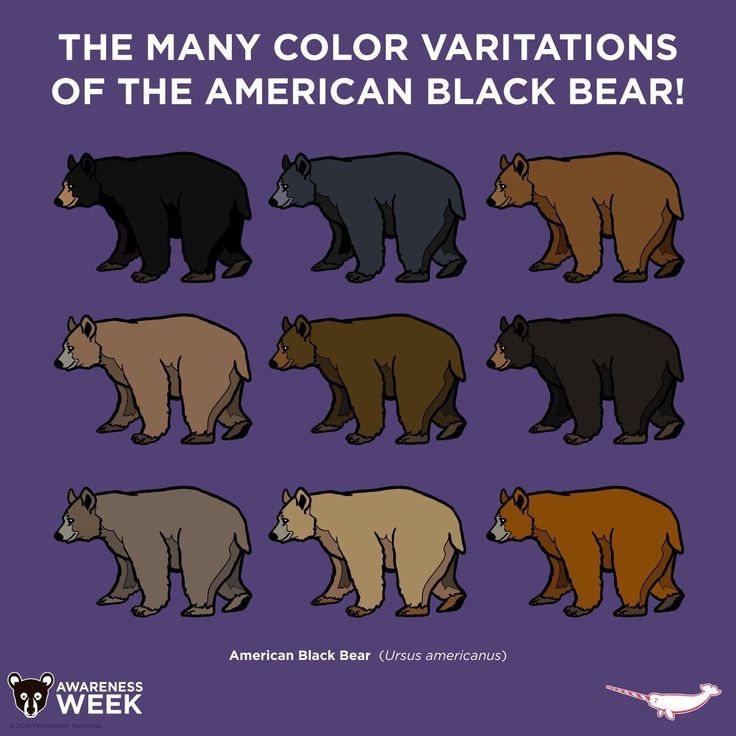
The American black bear shows the most colour variation of any bear in the world. Black is the default, but populations across western North America carry significant proportions of cinnamon, blond, and grey-blue ("glacier") individuals, and a recessive locus on the British Columbia coast produces the white Kermode bear.
The Asiatic black bear is almost universally black, with rare brown or reddish individuals reported from western parts of the range. The visual richness of the American species is something the Asian one lacks.
Tail and rump
Both species have very short tails. The Asiatic black bear's rump is slightly higher relative to the shoulders than the American's, giving the body a marginally more level back line when on all fours. The difference is subtle and not a useful field mark on its own.
Behaviour: Climbers, Both, but Different
Both species climb trees, both den in winter, and both are largely solitary. The behavioural differences are matters of degree, not of kind, but the degrees matter.
Arboreality
The Asiatic black bear is the more arboreal of the two as an adult. American black bear cubs and yearlings climb readily, but adult American black bears spend most of their active hours on the ground. Adult Asiatic black bears climb routinely, build feeding platforms in oaks and chestnuts, and in some populations sleep in trees during the warm months.
This is the source of the regional Chinese folk name "tree bear" (shu xiong). The Asiatic black bear's larger feet and stronger forelimbs are adaptations to the more vertical lifestyle.
Aggression toward humans
Both species are usually shy of humans, and both can become dangerous when surprised, defending cubs, defending a food cache, or habituated to garbage.
Per encounter, the Asiatic black bear has a higher rate of attacks on humans than the American black bear, possibly because of higher human-density overlap in mountainous farmland, possibly because the species is more often surprised in dense bamboo and forest understorey where sight lines are short.
Detailed regional statistics on the American species are covered in our article on are black bears dangerous to humans.
Activity rhythms
Both species are crepuscular and nocturnal where humans are abundant, and more diurnal in remote habitat. American black bears in unhunted populations of Alaska and remote Canada are happily active during the day. Asiatic black bears in remote sections of Russian Primorye are similar. The more humans on the landscape, the more both species shift toward night work.
Hibernation
Both species den and reduce metabolism through winter at the colder ends of their ranges. Northern American black bears in Alaska may den for six months. Northern Asiatic black bears in Primorye and Korea den for four to five. In the southern parts of each species' range, denning is shorter or skipped entirely. Tropical Asiatic black bears in Laos and Cambodia do not den at all.
"Asiatic black bears are arboreal in a way American black bears never are as adults. We routinely film mothers feeding cubs in oaks 15 metres above the ground, and we have GPS data showing collared bears resting in trees for 8 hours at a stretch in summer. They use the canopy as functional habitat, not just as a refuge." - Dajun Wang, Peking University, Center for Nature and Society
Diet: Omnivores With Different Emphases
Both species are opportunistic omnivores. Both eat berries, nuts, leaves, insects, roots, carrion, the occasional young deer, and human-associated foods when those are available. The differences are about which items dominate in each forest type.
What the American black bear eats
The American black bear's diet is dominated, across most of its range, by soft and hard mast: blueberries, huckleberries, manzanita, cherries, and acorns, hazelnuts, beechnuts, and hickory nuts in autumn. Insects are important for protein, particularly ant brood and yellowjacket nests. Salmon and other fish enter the diet in coastal Pacific populations.
Garbage, beehives, orchards, and livestock occur in the diet wherever bears overlap with farms and towns. For a full breakdown, see our piece on what do black bears eat.
What the Asiatic black bear eats
The Asiatic black bear shares much of the same shopping list but adds, conspicuously, a bark-stripping habit that the American species shows much less often. Asiatic black bears strip bark from cedar, fir, hemlock, and oak in spring to reach the cambium layer underneath. The behaviour is well documented in Honshu, Korea, and Russian Primorye, where it is a real economic concern in commercial forestry.
American black bears occasionally strip Douglas-fir on the Pacific coast, but the practice is regional and seasonal in americanus and far more widespread in thibetanus.
Asiatic black bears also rely more heavily on hard mast in the form of acorns, walnuts, and chestnuts, especially in autumn fattening. Apiaries, agricultural crops (corn, sweet potato), and wild bee nests round out the diet. Like their American cousins, they are not specialists, but the bark-stripping signature is the dietary tell.
Reproduction and Cubs
Reproduction is similar in the two species, with delayed implantation, winter parturition, and small litters of altricial cubs nursed through the den period. Asiatic black bears tend to den at slightly lower latitudes than the American species and may have somewhat shorter denning periods on average, but the underlying cycle is identical.
Litter size in both averages 2 cubs, with 1 to 4 possible. Cubs stay with the mother for 18 months in both species. Sexual maturity in both is reached at 4 to 6 years.
The single biggest reproductive concern for Ursus thibetanus is not biology. It is the trafficking of cubs into bile farms, captive performance, and the pet trade. Where mother bears are killed for paws, gallbladders, or because they raid crops, surviving cubs are often taken alive and sold. This is a major demographic pressure in parts of Vietnam, Laos, and historically China, and it is part of the reason wild population recovery has been slow even where forest cover is improving.
The Bile Farming Crisis
The Asiatic black bear is the species at the centre of one of the most contentious wildlife welfare issues of the modern era. Bear bile contains ursodeoxycholic acid, a compound used historically in traditional Chinese medicine for liver and gallbladder ailments.
The compound has been synthesised cheaply and at high purity since the 1950s, and synthetic ursodeoxycholic acid is the standard treatment for several real medical conditions in modern hospitals worldwide. Despite the availability of synthetics, demand for bear bile from live or wild-killed bears persists in parts of east Asia.
Bile farming, the industrial extraction of bile from caged live bears through surgical fistulas or permanent abdominal catheters, expanded in China and Vietnam from the 1980s onward. At its peak in the early 2000s, roughly 10,000 Asiatic black bears were being held on bile farms across the two countries, often in cages too small for the bears to stand or turn around. Welfare conditions were widely documented as catastrophic.
Two organisations led the response. Animals Asia, founded by Jill Robinson in 1998, campaigned against bile farming and built rescue sanctuaries in Chengdu, China and outside Hanoi, Vietnam. Free the Bears ran parallel work in Laos, Cambodia, and Vietnam. Together they have rescued well over a thousand individual bears across two decades.
"When we started, the Chinese bile industry held more than 7,000 bears in cages and the Vietnamese industry held about 4,000. The cages were too small, the wounds were chronic, and the suffering was immense. Twenty-five years later we have closed every legal Vietnamese farm and we are working bear by bear in China. The point is not just animal welfare. Every farm bear takes pressure off wild populations because farms once depended on wild cubs for restocking." - Animals Asia Foundation, public statement, 2024
The legal landscape has shifted:
- Vietnam: bile farming banned in 2005; remaining farms wound down through the 2010s; legal industry effectively closed by the early 2020s.
- South Korea: gradual phase-out culminating in the closure of the country's last legal bile farm in 2025, marking the end of bile farming as a legal industry in Korea.
- China: still permits regulated farming under licence, although the number of operating farms has declined and several large operators have transitioned to herbal alternatives.
- Laos, Cambodia, Myanmar: bile farming was never legal at scale, but illegal operations and gallbladder trafficking persist.
The crisis has shaped the public profile of the Asiatic black bear in ways that have no parallel for the American species. American black bears appear in conservation literature as a recovery success story; Asiatic black bears appear as a welfare emergency.
Conservation Outlook
The two species have similar core ecology, similar climbing skill, similar diet, similar reproductive biology, and almost diametrically opposite conservation futures. The reasons are external rather than biological.
Why the American black bear is doing well
- Continental habitat: extensive forest cover from Alaska to the southern Appalachians.
- Low rural human density across most of the range.
- Active state and provincial wildlife management with quotas, monitoring, and population modelling.
- No commercial body-part trade of significance: no bile farms, no luxury paw market.
- Public tolerance that has improved markedly since the 1970s as bears have become symbols of national parks.
- Range expansion in the eastern United States, where bears have recolonised parts of New Jersey, Connecticut, and the Ozarks.
Why the Asiatic black bear is in trouble
- Continental habitat loss: forest cover has declined for millennia and continues to fragment.
- High rural human density across nearly the entire range.
- Limited and underfunded wildlife management in most range countries.
- Persistent body-part trade: bile, gallbladders, paws, and live cubs still command high prices.
- Conflict killing: bears that strip bark or raid orchards are routinely shot, even in protected areas.
- Tiny isolated populations: the Korean and Iranian populations are in low double or low three digits and require active reintroduction or genetic management.
The international policy frameworks that govern the two species also differ. The American black bear is on CITES Appendix II, primarily because look-alike rules require it to share Appendix II status with the Asiatic species. The Asiatic black bear is on CITES Appendix I, the strictest international protection category, banning all commercial international trade in the species or its parts.
"Ursus thibetanus will not recover on its own. Forest cover alone is not enough. We need enforcement against the bile and gallbladder trade, conflict mitigation programmes that keep bears off farmer's lists of pests, and connectivity work that links the small isolated populations into something demographically viable. The species' biology is fine. Its political economy is the problem." - IUCN/SSC Bear Specialist Group, regional review of Ursus thibetanus
How to Tell Them Apart in the Field
For the rare birder, hiker, or wildlife photographer who finds themselves in habitat where confusion is plausible (which in practice means a few border zones in the Russian Far East and parts of mainland Asia's tourist trails, since the two species' ranges do not actually overlap), here is the simple field ID flow chart:
- Where am I? If you are in North America, every black bear you see is Ursus americanus. If you are anywhere in Asia, every black bear you see is Ursus thibetanus. Range alone settles 99% of cases.
- Is there a bold V or crescent on the chest? Yes -> Asiatic. No, or only a small irregular blaze -> American.
- Are the ears strikingly long and prominent? Yes -> Asiatic. Short and rounded -> American.
- Is the bear in a tree, as an adult, settled in for hours? Strongly suggests Asiatic. American black bear adults climb for short bursts, less often as long-term resting habit.
Confusing the Asiatic black bear with other Asian bears is more common than confusing it with the American species. The sun bear is much smaller, with shorter fur and a different chest crescent shape. The sloth bear is shaggier and has a much paler chest mark. The giant panda is unmistakable in coat colour, and its split from black bears is a separate story covered elsewhere.
For comparison with the other dark bear that shares North America with the American black bear, see our piece on American black bear vs grizzly bear. For comparison with the brown bear's Eurasian forms, see brown bear subspecies explained.
Hybridisation and Captive Confusion
The two species do not hybridise in the wild, since their ranges are separated by the entire Pacific Ocean and the Bering Strait. They have not been recorded interbreeding in captivity either, although they have on rare occasions been housed together in older zoo facilities without producing offspring. The species are reproductively compatible enough at the molecular level that hybrids might be possible, given the relatively recent divergence, but no documented case has produced viable young.
Captive confusion runs the other way. Rescue centres in Asia occasionally receive American black bears that have been smuggled, escaped from private collectors, or surrendered from ageing private zoos that imported them in the 1970s and 80s. These animals are rare but not unheard of in Vietnamese and Chinese sanctuaries. Identification is straightforward: the chest mark, the ears, and the foot proportions resolve the question on first inspection.
What This Comparison Means for Conservation Communication
A real obstacle in Asiatic black bear conservation is that English-language audiences often do not realise the species exists. The phrase "black bear" defaults in popular culture to Ursus americanus, the bear of Yogi cartoons, national park signage, and North American hunting magazines. When campaigners talk about "saving the black bears," American audiences picture an animal that is doing well and assume the campaign is misguided.
Using the names Asiatic black bear and moon bear correctly is part of the conservation work. The animal at the centre of the bile farming crisis is a different species from the one that raids garbage cans in Yosemite, and treating them as separate animals on the page (and in headlines, captions, and public communications) is the first step in any serious recovery effort.
Visitors interested in the wider scientific story of writing accurately about animals may find tools and writing references at Evolang, and readers who want to test their general knowledge of species differences can try the comparison-style questions at What's Your IQ. For converting field guide PDFs and image files into more usable formats while researching this kind of material, File Converter Free is a free option.
References
- Garshelis, D. L., & Steinmetz, R. (2020). Ursus thibetanus (errata version). The IUCN Red List of Threatened Species 2020. https://doi.org/10.2305/IUCN.UK.2020-3.RLTS.T22824A166528664.en
- Garshelis, D. L., & Hristienko, H. (2017). Ursus americanus. The IUCN Red List of Threatened Species 2017. https://doi.org/10.2305/IUCN.UK.2017-3.RLTS.T41687A114251609.en
- Hwang, M. H., Garshelis, D. L., & Wang, Y. (2002). Diets of Asiatic black bears in Taiwan, with methodological and geographical comparisons. Ursus, 13, 111-125. https://doi.org/10.2192/1537-6176(2002)013
- Kim, B. J., et al. (2011). Population genetic structure of Asiatic black bears in South Korea using mitochondrial DNA. Genes & Genetic Systems, 86(2), 119-127. https://doi.org/10.1266/ggs.86.119
- Krause, J., et al. (2008). Mitochondrial genomes reveal an explosive radiation of extinct and extant bears near the Miocene-Pliocene boundary. BMC Evolutionary Biology, 8, 220. https://doi.org/10.1186/1471-2148-8-220
- Servheen, C. (1999). Status and conservation of the bears of the world. International Conference on Bear Research and Management Monograph Series, 2, 1-32. https://doi.org/10.2192/IBRM-2-1
- Loeffler, I. K., et al. (2009). Welfare and morbidity of bears farmed for bile in China. Journal of Wildlife Diseases, 45(2), 277-287. https://doi.org/10.7589/0090-3558-45.2.277
- Foley, K. E., Stengel, C. J., & Shepherd, C. R. (2011). Pills, Powders, Vials & Flakes: The bear bile trade in Asia. TRAFFIC Southeast Asia. https://doi.org/10.13140/RG.2.2.36018.32966
Related Reading
- American black bear
- Where do black bears live
- Are black bears dangerous to humans
- Black bear color phases: cinnamon, blond, and Kermode
- What do black bears eat
- American black bear vs grizzly bear
- Giant panda vs black bear
- Brown bear subspecies explained
- Sun bear
For broader writing and learning resources, Evolang and What's Your IQ are useful tools alongside When Notes Fly for note management and Pass4-Sure for study workflows.
Frequently Asked Questions
Are American black bears and Asiatic black bears the same species?
No. They are two genuinely separate species that diverged roughly 5 million years ago and have lived on different continents ever since. The American black bear is Ursus americanus, restricted to North America from the Mexican Sierra Madre to northern Canada and Alaska, with a population near 700,000 animals classed as Least Concern by the IUCN.
The Asiatic black bear is Ursus thibetanus, distributed across 18 countries from Iran through the Himalayas to Russian Primorye, Korea, Japan, and Taiwan, with about 50,000 animals classed as Vulnerable. The two share a common ancestor and a colour name, and they sit in the same genus, but they do not interbreed in the wild and they differ in skull morphology, ear length, foot proportions, and chest markings.
The most reliable single field mark is the white V-shaped or crescent-shaped chest patch carried by almost every Asiatic black bear, which gave the species its other common name, moon bear. American black bears occasionally show a small white chest blaze but never the bold inverted V of the Asian species.
Why is the Asiatic black bear called the moon bear?
The name comes from the bold white or cream V-shaped or crescent-shaped patch on the chest of nearly every adult Asiatic black bear. Seen straight on, the marking resembles a crescent moon lying on its side or a wide V opening upward across the upper chest. The mark is variable in width and brightness from one bear to another, but the overall pattern is consistent enough that early Western naturalists used it as a primary diagnostic.
In Mandarin the species is yueguang xiong (literally moon-light bear), in Korean it is bandalgaseumgom (half-moon-chest bear), and in Vietnamese it is gau ngua (chest-moon bear). The American black bear is named simply for its predominant fur colour and almost never carries the same marking, although some American black bears do show a small irregular white blaze that is genetically and developmentally distinct from the Asian crescent.
If you see a black bear with a clear V on its chest, you are looking at a moon bear, not an American black bear.
What is bear bile farming and why does it threaten Asiatic black bears?
Bear bile farming is the industrial extraction of bile from the gallbladders of live captive bears, primarily Asiatic black bears, for use in traditional Chinese medicine. The bile contains ursodeoxycholic acid, a compound used historically to treat liver and gallbladder conditions, although safe and inexpensive synthetic versions have been available since the 1950s.
At the practice’s peak in the early 2000s, roughly 10,000 Asiatic black bears were held in farms across China and Vietnam, often in coffin-sized cages with surgical fistulas or permanent catheters in their abdomens for daily bile drainage. The animal welfare cost is severe and the conservation cost is also real, because farms historically replenished stock with wild-caught cubs, accelerating decline in already fragmented populations.
Vietnam banned bile farming in 2005, although enforcement has been gradual, and South Korea completed a full phase-out in 2025 with the closure of the country’s last legal bile farm. China still permits regulated farming. Animals Asia, founded by Jill Robinson in 1998, has rescued more than 600 individual bears and operates sanctuaries in Chengdu and outside Hanoi.
The cumulative effect of bile farming, habitat loss, and the gallbladder trade is the reason the Asiatic black bear is listed as Vulnerable while its American cousin is Least Concern.