
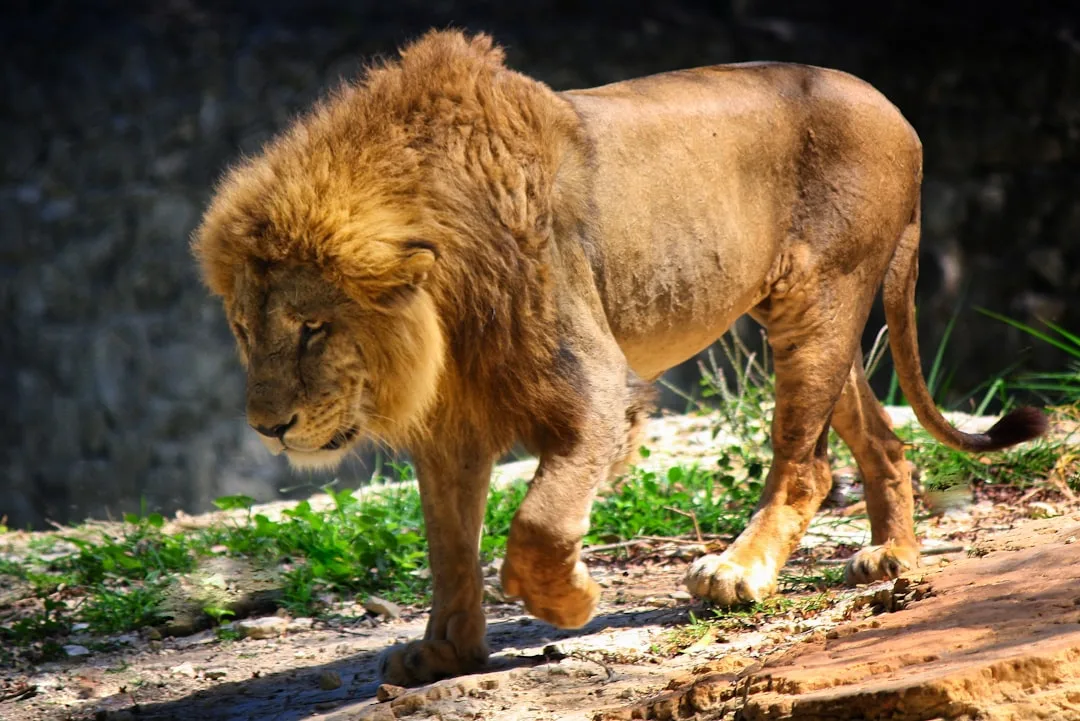
The lion is the only truly social member of the cat family. Every other big cat - tigers, leopards, jaguars, snow leopards, cougars - lives and hunts alone. Panthera leo is the exception, forming organised groups called prides built around related females and defended by coalitions of males.
That single evolutionary choice changes almost everything about the species: how it hunts, how it raises young, how it fights, and how it communicates across the vast open landscapes where it lives. The lion is the second largest living cat after the tiger, the heaviest cat in Africa, and one of the most recognisable animals on Earth. It is also a species in steep decline, having lost roughly 88 per cent of its global population over the past century.
This guide covers every aspect of lion biology and ecology: size and strength, mane biology, pride structure, hunting cooperation, reproduction, the brutal logic of male takeovers, conservation status, and the long, complicated relationship between lions and the humans who share their range. It is a reference entry, not a summary - so expect specifics: kilograms, kilometres per hour, pride sizes, population figures, and verified records.
Etymology and Classification
The scientific name Panthera leo comes from Greek panther (originally a generic word for a spotted large cat) and Latin leo meaning "lion", ultimately from Greek leon. The species was formally described by Carl Linnaeus in 1758 in the tenth edition of Systema Naturae, where he also named the tiger, jaguar, and leopard.
Historically, biologists recognised a dozen or more lion subspecies. Genetic analysis in the 2010s and 2020s has collapsed that list. Modern taxonomy recognises two valid subspecies:
- Panthera leo leo - the "northern" lion, which includes all populations in West and Central Africa and the Asiatic lion of Gir Forest.
- Panthera leo melanochaita - the "southern" lion of East and Southern Africa.
This grouping overturns the older idea that Asiatic and African lions were entirely separate lineages. Mitochondrial DNA shows that Asiatic lions are more closely related to West African lions than either is to East African lions, a pattern that makes geographic sense once you trace the historic range across North Africa and the Middle East. Throughout this entry "Asiatic lion" refers to P. l. persica in the older nomenclature, which modern taxonomy treats as a population within P. l. leo.
The genus Panthera itself is united by a specialised larynx that allows its members to roar. Four species - lion, tiger, leopard, and jaguar - can roar; snow leopards, despite their classification within the genus, cannot produce a true roar. The lion is the loudest.
Size and Physical Description
Lions show strong sexual dimorphism. Males are substantially larger than females and carry the species-defining mane.
Males:
- Body length: 1.7-2.5 metres (excluding tail)
- Tail length: 90-105 cm
- Shoulder height: 1.1-1.2 metres
- Weight: typically 150-250 kg, record 313 kg (wild), over 370 kg (captive)
Females:
- Body length: 1.4-1.75 metres (excluding tail)
- Tail length: 70-100 cm
- Shoulder height: around 1 metre
- Weight: typically 110-180 kg
Cubs at birth:
- Length: roughly 30 cm
- Weight: 1.2-2 kg - smaller than a newborn human
- Coat: pale tawny with dark rosette-like spots that fade with age
Lions are built for power rather than endurance. Their shoulders and forelimbs are heavily muscled for grappling prey, with retractable claws up to 4 centimetres long. The skull is the largest within Felidae - larger even than a tiger's when compared on a proportional basis - and houses canine teeth around 7 to 8 centimetres long that can puncture vertebrae and crush windpipes. The jaw delivers a bite force estimated at 4,450 newtons, roughly four times that of a domestic dog.
The tongue is covered in backward-facing papillae so rough that they can scrape meat cleanly off bone and strip hair from hide. This same roughness is why a lion's lick can draw blood from human skin within a few passes. The eyes have a reflective layer behind the retina called the tapetum lucidum, which increases low-light sensitivity by roughly six times compared to human vision. This is why lions hunt most effectively during dusk, dawn, and moonless nights.
Coat colour ranges from pale buff through tawny yellow to deep ochre. The belly and inner legs are paler. The tail ends in a distinctive tuft of darker hair that conceals a small horny spine - a vestigial structure whose function is still debated.
The Mane
The mane is the single most famous feature of the species and occurs only in males. It is also a relatively late developmental feature: cubs are born maneless, young males begin growing a mane around 1 to 2 years of age, and the mane reaches full density between 4 and 5 years.
Mane colour and density are honest biological signals. Research in the Serengeti led by Craig Packer and colleagues has shown that:
- Mane darkness correlates with testosterone levels, age, and overall body condition.
- Mane fullness correlates with nutrition, fighting success, and freedom from serious parasite load.
- Females prefer to mate with dark-maned males in controlled choice experiments.
- Rival males are more likely to retreat from a dark-maned rival without escalating to combat.
The mane carries a thermoregulatory cost. Dark-maned males run hotter than pale-maned males, which limits how far south into open, high-heat environments dense manes can be carried. In the hot, low-lying Tsavo region of Kenya, most males are sparsely maned or effectively maneless - including the famous Tsavo man-eaters of 1898. In cooler high-altitude populations like the Ngorongoro Crater, dark, thick manes are the norm.
Rare cases of maned females have been documented in Botswana, Kenya, and captive populations. These usually trace to elevated androgen levels, sometimes from malformed ovaries, and typically the animals also display more aggressive, male-typical behaviours.
Prides and Social Structure
The pride is what makes lions unique among big cats. A pride is not simply a pack - it is a matrilineal kin group with a semi-permanent escort of adult males.
Pride composition:
- 2 to 18 adult related females (mothers, daughters, sisters, cousins)
- Their dependent cubs and subadults
- A coalition of 1 to 9 adult males, usually but not always related to each other
- Total size: typically 13-15 individuals, occasionally up to 30
Female pride members are the stable core. Most females spend their entire lives in the pride where they were born. When a pride becomes too large, young females may split off with sisters to form a daughter pride in a neighbouring range. Males, in contrast, are always immigrants. Young males are forced out of their natal pride at 2 to 3 years of age and spend a nomadic phase - often with brothers or cousins - before challenging an established coalition for control of a pride.
Male tenure is short. Average control of a pride lasts only 2 to 3 years before a stronger coalition displaces them. Coalitions of 3 or more males hold prides longer, father more cubs, and in the long run leave more descendants than smaller coalitions. Solo males almost never succeed in taking a pride at all. This is one of the strongest selection pressures in favour of cooperation among male lions.
When a new coalition takes over, they almost always kill any cubs under about 9 months of age. This is infanticide, and it serves a harsh but clear evolutionary function: nursing mothers do not come into oestrus, so the incoming males cannot father their own cubs until the existing ones are gone. Females try to defend their cubs and sometimes succeed, sometimes at the cost of their own lives. Infanticide accounts for a substantial share of cub mortality during and after coalition turnover.
Hunting is primarily the job of the females. Lionesses hunt in coordinated groups that use flanking, ambush, and driving tactics to catch prey in short chases. Males typically arrive at the kill after the females have brought down the animal, using size and intimidation to claim the best portions.
This division of labour is real but not absolute: males hunt on their own when necessary, particularly during the nomadic phase, and males are the primary hunters of large and dangerous prey like buffalo and giraffe.
Hunting and Diet
Lions are hypercarnivores and opportunistic apex predators. An adult consumes an average of 5 to 7 kilograms of meat per day, though intake is highly uneven - a successful hunt may be followed by several days of rest.
Primary prey across Africa:
- Blue wildebeest
- Plains zebra
- Cape buffalo
- Gemsbok
- Kudu, waterbuck, hartebeest, topi
- Warthog
- Giraffe (usually juveniles, occasionally adults by experienced prides)
Primary prey in Gir Forest:
- Chital (spotted deer)
- Sambar
- Nilgai
- Wild boar
- Domestic livestock (a source of conflict with local pastoralists)
Hunting techniques:
- Ambush and short sprint. Lions rely on surprise and short bursts of speed up to 80 km/h over distances under 100 metres. They cannot sustain a chase beyond a few hundred metres before overheating.
- Cooperative drives. Several lionesses form a loose crescent, with some stalking prey directly while others circle to cut off escape routes. Individual lionesses often occupy consistent "centre" or "wing" roles across multiple hunts.
- Strangulation bite. Large prey is usually killed by a throat clamp that crushes the trachea and suffocates the animal, rather than the neck bite used by smaller cats. This is safer for the lion against horned prey.
- Cooperative takedown of big game. Buffalo and giraffe require multiple lions working together, often with males leading the final attack. Lion prides in Botswana and Chobe have learned to tackle young elephants during drought.
Success rates are modest. Single-lion hunts succeed roughly 17 to 19 per cent of the time. Group hunts push that to 30 per cent or higher for favourable prey, with some studies reporting more than 50 per cent for experienced prides on familiar ground. Lions also scavenge heavily and will displace hyenas, cheetahs, leopards, and wild dogs from kills whenever possible. In parts of the Serengeti more than a third of lion food is scavenged rather than hunted.
After a large kill a lion can eat up to 30 kilograms in a single sitting - roughly a quarter of its own body weight - and then rest and digest for 18 to 24 hours before eating more.
The Roar
The lion's roar is the loudest sound produced by any cat, reaching approximately 114 decibels at close range and carrying across 8 kilometres of open savanna in still air. The roar serves several functions: territorial advertisement, coordination within a coalition or pride, and intimidation of rivals.
The roar is anatomically unusual. Most vertebrate vocal folds are shaped like convex lenses, which stretch under air pressure and produce sound through oscillation. Lion vocal folds are unusually large, flat, and square, filled with fat and elastin. They absorb air pressure rather than stretching, which lets the animal produce extremely loud sound with relatively little effort.
Tigers share this structural adaptation. Research published in PLOS ONE in 2011 showed that the shape of the folds is the primary physical driver of the deep, low-frequency roar.
Lions also produce a range of softer vocalisations: grunts, moans, snarls, growls, purrs (unlike big cats in the genus Panthera, lions purr only during exhalation), and the distinctive soft "hah" contact call used between pride members at close range.
Life Cycle and Reproduction
Lions do not have a fixed breeding season. Females come into oestrus opportunistically, though pride-wide synchronisation does occur. A female in oestrus will mate with one or more pride males repeatedly over 3 to 4 days - often 20 to 40 times per day - with each copulation lasting less than a minute. The high frequency may help induce ovulation and may also reduce competition among coalition males by keeping all of them invested.
Gestation lasts 100 to 120 days. Females give birth alone, away from the pride, in dense vegetation, a rocky outcrop, or a thicket. Litters contain 1 to 6 cubs, with 2 to 4 being typical. Cubs are born blind, weigh 1.2 to 2 kilograms each, and carry the dark juvenile spotting pattern that fades as they mature.
Early development:
- 0-7 days: eyes closed, entirely dependent on the mother
- 2-3 weeks: eyes open, first attempts at walking
- 6-8 weeks: introduction to the pride
- 10-12 weeks: weaning begins, cubs start eating meat
- 6 months: fully weaned, but still dependent on pride for protection
- 2 years: approaching full size; young males begin to be driven off
One of the most remarkable features of pride life is synchronised birth. Lionesses often come into oestrus together, give birth within weeks of one another, and pool their cubs into a shared creche. Mothers nurse each other's cubs indiscriminately, a behaviour called allosuckling that is rare in mammals and unusual among carnivores. The creche provides safety in numbers against hyenas, leopards, and invading males.
Cub mortality is severe. Roughly half of cubs die in their first year. Major causes include starvation during lean times, predation by hyenas and leopards, accidents, and infanticide. Only about one male cub in eight survives to hold a pride of his own as an adult.
Conservation Status and Threats
The IUCN Red List classifies lions as Vulnerable with a decreasing population trend. The African lion has lost an estimated 43 per cent of its population over the last three lion generations (approximately 21 years). The West African lion is listed separately as Critically Endangered with fewer than 250 mature individuals spread across isolated protected areas. The Asiatic lion is Endangered with roughly 700 individuals confined to the Gir Forest landscape of Gujarat, India.
Primary threats:
- Habitat loss. Conversion of savanna and woodland to cropland, livestock grazing, and settlements has fragmented lion range into shrinking islands. More than 90 per cent of historic African range is gone.
- Prey depletion. Commercial and subsistence bushmeat poaching has emptied many "protected" areas of the ungulates lions depend on, creating empty forests and empty savannas even where habitat still looks intact.
- Retaliatory killing. Livestock predation triggers poisoning and spearing by herders. A single poisoned carcass can kill an entire pride along with scavenging vultures.
- Trophy hunting. Poorly regulated hunting that targets prime-age males destabilises coalitions and triggers infanticide in the resulting turnovers.
- Wildlife trade. Lion bones and body parts are increasingly trafficked as substitutes for tiger parts in traditional Asian medicine, creating a poaching pressure that barely existed 20 years ago.
- Disease. The 1994 canine distemper outbreak killed roughly a third of Serengeti lions. The single Gir Forest population is particularly vulnerable to any disease event because of its genetic uniformity and tight geographic concentration.
Conservation responses include community conservancies in Kenya and Tanzania, livestock compensation schemes, predator-proof bomas for livestock at night, anti-poaching patrols, and proposals to establish a second Asiatic lion population in Kuno National Park, Madhya Pradesh, to reduce the catastrophic risk of keeping the entire subspecies in one place. Progress on the Kuno reintroduction has been slow for political reasons, and Kuno has instead received cheetahs translocated from Africa.
Lions and Humans
Few animals have loomed as large in human culture. Lions appear in Paleolithic cave art at Chauvet in France - the Lion Panel is dated to roughly 32,000 years ago. They are central figures in Mesopotamian, Egyptian, Greek, Persian, Hebrew, and Indian mythology and iconography.
The lion is the symbol of dozens of nations, cities, and dynasties, from the lions of Singh dynasties in India to the lions on British royal arms to the lion of Judah. For most of recorded history, lions and humans lived in overlapping ranges across Africa, southern Europe, the Middle East, and South Asia.
Relationships with people today are practical and often fraught. In pastoralist communities across Kenya, Tanzania, Zambia, and Mozambique, livestock losses to lions are a direct economic hardship, and the typical local response is to kill the lions responsible.
Conservation organisations have invested heavily in reducing this conflict: predator-proof night enclosures, compensation funds, early-warning systems, and community conservancies that share tourism revenue with residents have all reduced retaliatory killing in specific landscapes.
Lions kill and injure people every year, but the numbers are modest compared to other large African animals. The most infamous case is the Tsavo man-eaters, a pair of maneless males shot by John Patterson in 1898 after they killed an estimated 28 to 135 railway workers over several months.
A more recent wave in southern Tanzania killed roughly 550 people between 1990 and 2005, concentrated in villages where bushpigs raided crops at night and drew people out of their homes into lion territory. Most attacks involve specific individuals - old, injured, or cornered - rather than healthy pride animals in normal hunting mode.
Photographic safari tourism is now a major economic driver across lion range and provides some of the strongest financial incentives for keeping wild lions on the landscape. A single habituated male lion in the Maasai Mara may generate more tourism revenue over his lifetime than any plausible trophy fee.
The long-term future of the species depends heavily on whether that economic logic can be made to work for the communities living next to lions, not just the governments and tour operators profiting from them.
Related Reading
- Tiger: Stripes, Strength, and Solitude
- Leopard: The Solitary Climber
- Cheetah: Built for Speed
- Jaguar: Apex of the Americas
References
Relevant peer-reviewed and governmental sources consulted for this entry include IUCN Cat Specialist Group status reports (2023, 2024), the Panthera Lion Program reports, long-term research from the Serengeti Lion Project, Hwange Lion Research Project, and Gir Lion Monitoring programmes, and published research in PLOS ONE, Proceedings of the Royal Society B, Journal of Mammalogy, Animal Behaviour, and Science.
Population figures reflect the most recent consolidated estimates as of the 2024 African Lion Database and the Gujarat Forest Department 2025 Asiatic lion census.
Frequently Asked Questions
How big are lions?
Adult male lions (Panthera leo) typically weigh 150 to 250 kilograms and measure 1.7 to 2.5 metres in body length, with an additional 90 to 105 centimetre tail. Shoulder height is around 1.2 metres. Females are notably smaller at 110 to 180 kilograms and 1.4 to 1.75 metres body length. The heaviest wild lion on record weighed 313 kilograms, shot in South Africa in 1936. Captive lions have reached over 370 kilograms.
Lions are the second largest living cat after the tiger, but they hold the record for the largest skull within the family Felidae. Cubs are born weighing just 1.2 to 2 kilograms and do not open their eyes for the first week of life.
What do lions eat?
Lions are obligate carnivores and hypercarnivores, meaning more than 70 per cent of their diet is meat. They specialise in medium-to-large ungulates: wildebeest, zebra, buffalo, gemsbok, kudu, and various antelope species. In Gir Forest, Asiatic lions prey primarily on chital deer, sambar, and nilgai. An adult lion consumes around 5 to 7 kilograms of meat per day on average, but can gorge up to 30 kilograms at a single kill and then fast for several days.
Prides will occasionally tackle larger prey including giraffe, hippo calves, and young elephants through coordinated attacks. Lions also readily scavenge, driving hyenas, cheetahs, and leopards off their kills whenever the opportunity arises.
Where do lions live?
Lions today occupy two distinct regions. The African lion (P. l. leo) is scattered across sub-Saharan Africa, with strongholds in Tanzania, Kenya, Botswana, South Africa, Zimbabwe, Zambia, and Mozambique. They prefer savanna, grassland, open woodland, and scrub habitats where prey congregates and visibility favours ambush hunting. Lions avoid dense rainforest and true desert.
The Asiatic lion (P. l. persica) survives in a single relict population in and around Gir Forest National Park in Gujarat, India, occupying dry deciduous forest and scrubland. Historically lions ranged across most of Africa, southern Europe, the Middle East, and into South Asia. They disappeared from Europe in classical antiquity and from most of the Middle East and India during the 19th and 20th centuries.
Are lions endangered?
The IUCN Red List classifies lions as Vulnerable with a decreasing population trend. The global wild population is estimated at around 23,000 individuals in Africa, down from roughly 200,000 a century ago - an 88 per cent decline. The West African lion subpopulation is listed as Critically Endangered with fewer than 250 mature individuals.
The Asiatic lion is Endangered and restricted to a single population of roughly 700 animals in Gir Forest, which makes it vulnerable to disease outbreaks, natural disasters, and inbreeding. Primary threats include habitat loss to agriculture, prey depletion from bushmeat poaching, retaliatory killing by herders, poorly regulated trophy hunting, and targeted poaching for bones and body parts used in traditional medicine.
How long do lions live?
Wild lions typically live 10 to 14 years, with females generally outliving males. Male lions rarely exceed 12 years in the wild because the physical demands of pride defence, territorial fighting, and coalition competition tend to catch up with them. Females can reach 15 to 18 years if they remain in a stable pride. In captivity lions regularly live to 20 years and a few have reached 25.
Cub mortality in the wild is brutal: roughly 50 per cent of cubs die in their first year, primarily from starvation during lean times, predation by hyenas and leopards, accidents, and infanticide by incoming males. Only around one in eight male cubs will live long enough to hold a pride of their own.
How does a lion pride work?
A lion pride is built around a core of related females - sisters, mothers, daughters, cousins - who share a territory, raise cubs together, and hunt cooperatively. Pride sizes range from 3 to 30 individuals, averaging around 13. Females almost never leave the pride they were born into. Attached to each pride is a coalition of 1 to 9 adult males, usually brothers or cousins, who defend the territory against rival coalitions and father the cubs.
Male tenure averages only 2 to 3 years before a stronger coalition displaces them. When takeover happens, the new males almost always kill any cubs under 9 months old to bring the females back into oestrus. This infanticide is genetically rational from the incoming male’s perspective and is the single greatest source of cub mortality in many populations.
Why do male lions have manes?
The mane is a sexually selected ornament found only in male lions. It is absent in all other cat species. A mane’s darkness, length, and density are honest signals of the male’s testosterone levels, nutrition, parasite load, and overall fitness. Studies in the Serengeti show that females prefer dark-maned males for mating, while rival males are more likely to avoid challenging them.
Manes also provide some physical protection during fights, particularly around the vulnerable throat. However, dark manes carry a thermoregulatory cost: dark-maned males run hotter and struggle more in extreme heat, which is why lions in hotter, lower-altitude areas like Tsavo often have sparse or absent manes.
A small number of maneless males occur naturally in several populations, and maned females have been documented on rare occasions when hormonal abnormalities produce male-pattern features.
Are lions dangerous to humans?
Lions can and do kill humans, but fatal attacks are far less common than popular culture suggests. The best-documented cases are the Tsavo man-eaters of 1898, a pair of maneless males that killed an estimated 28 to 135 railway workers in Kenya, and outbreaks in Tanzania that killed roughly 550 people between 1990 and 2005.
Most attacks involve specific individuals - often old, injured, or displaced lions - who have lost access to normal prey and drift toward settlements. Risk factors include sleeping outdoors, poor livestock husbandry, and the absence of large wild prey. Well-managed national parks see almost no unprovoked attacks on tourists, and ranger-guided walking safaris remain statistically very safe.
Conservation programmes increasingly focus on reducing livestock conflict, because every retaliatory killing removes a lion from already fragile populations.