
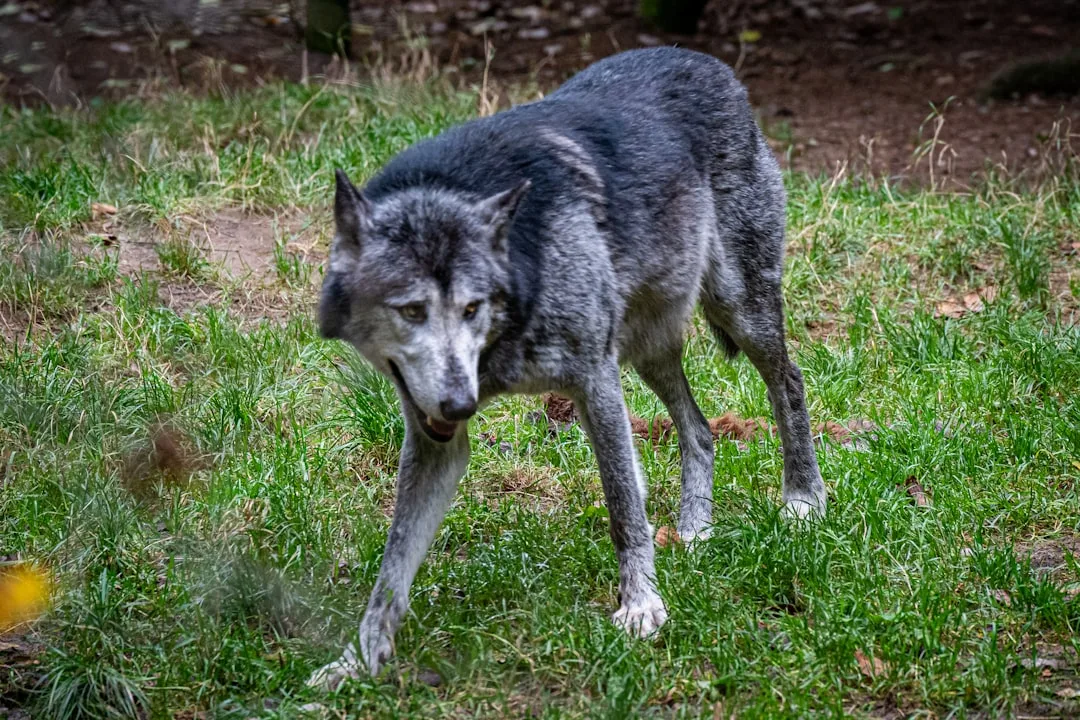
The gray wolf is the largest wild member of the dog family and, after humans, the most widely distributed large land mammal on Earth. Across its range Canis lupus spans Arctic tundra, boreal forest, temperate woodland, mountain ranges above three thousand metres, open steppe, and even desert. It is the ancestor of every domestic dog alive today, the protagonist of more folklore than any other predator, and the keystone carnivore of ecosystems from Yellowstone to the Carpathians.
This guide covers every important aspect of gray wolf biology and ecology: size and strength, pack structure, hunting, communication, reproduction, conservation status, the myth of the alpha wolf, and the complicated relationship between wolves and people. It is a reference entry, not a summary - so expect specifics: kilograms, kilometres, decibels, populations, and verified records.
Etymology and Classification
The scientific name Canis lupus was assigned by Carl Linnaeus in 1758 in the tenth edition of Systema Naturae. Canis is the Latin word for dog; lupus is the Latin word for wolf. In most European languages the common name is some variant of the Proto-Indo-European root wlkwo-: wolf in English, Wolf in German, ulv in Danish, volk in Slavic languages, and lobo in Spanish and Portuguese.
The common English name 'gray wolf' distinguishes it from the red wolf (Canis rufus) and Ethiopian wolf (Canis simensis), both much rarer species.
Genetic analysis places the gray wolf firmly at the centre of the genus Canis. Molecular data indicate that modern gray wolves diverged from a common canid ancestor roughly 800,000 years ago. The species then radiated across the Northern Hemisphere during the Pleistocene, interbreeding at different points with coyotes, golden jackals, and extinct wolf-like canids.
The domestic dog, Canis lupus familiaris, is not a separate species at all. It is a subspecies of the gray wolf, descended from one or more now-extinct wolf populations domesticated between 15,000 and 40,000 years ago. Every poodle, husky, and chihuahua on Earth carries the genome of a wolf.
Taxonomists currently recognise around 37 subspecies of gray wolf, though the exact count shifts as new genetic data arrive.
Notable subspecies include the Eurasian wolf (C. l. lupus), the Arctic wolf (C. l. arctos) of the Canadian high Arctic, the Mexican wolf (C. l. baileyi) of the American Southwest and Mexico, the eastern wolf (sometimes treated as a full species, C. l. lycaon), the Indian wolf (C. l. pallipes), the Arabian wolf (C. l. arabs), and the Tibetan wolf (C. l. chanco). Body size, coat colour, and ecology vary sharply between these forms.
Size and Physical Description
Gray wolves are the largest living wild canids. They are built for sustained travel over rough country and for tackling prey much larger than themselves. Sexual dimorphism is moderate - males are larger than females but not by as much as in bears or big cats.
Males:
- Body length: 1.0-1.6 metres from nose to base of tail
- Tail: an additional 30-50 cm
- Shoulder height: 60-90 cm
- Weight: typically 30-80 kg, record around 80 kg in Alaska and Russia
Females:
- Body length: 0.9-1.5 metres
- Shoulder height: 55-85 cm
- Weight: typically 23-55 kg
Pups at birth:
- Length: roughly 25-30 cm
- Weight: 300-500 grams - about the size of a small kitten
Size varies enormously across subspecies. Arctic and northwestern subspecies are the largest, with fully grown males routinely exceeding 60 kg. Mexican and Arabian wolves are the smallest, with adult females sometimes weighing under 20 kg. The heaviest verified wild gray wolf, killed in Alaska in 1939, weighed 79 kg. Unverified reports claim larger animals but lack reliable documentation.
Coat colour is not actually grey in most populations. Wolves come in a mix of grizzled grey, black, white, cream, rust, brown, and silver. Arctic wolves are almost pure white year-round. Forest-dwelling subspecies tend toward darker browns and blacks. Black coats in North American wolves carry a gene (CBD103) that was acquired through past interbreeding with domestic dogs tens of thousands of years ago, and the gene may confer immune advantages in forested environments.
Gray wolves have a double-layer coat. The dense underfur traps air for insulation; the longer guard hairs shed water and snow. In winter the underfur thickens enough that wolves can lie down on snow at minus forty degrees Celsius and lose almost no body heat. Adult wolves shed the underfur heavily in spring, sometimes in dramatic clumps.
Their heads are broad and heavy compared to coyotes or domestic dogs, with a powerful jaw capable of generating roughly 400 pounds per square inch of bite pressure - nearly double that of a large domestic dog. The muzzle is longer and more robust than a dog's, housing an enormous olfactory surface. Wolves have an estimated 200 million scent receptors in their nasal epithelium, compared to around 5 million in humans, giving them a sense of smell tens of millions of times more sensitive than ours.
Eyes are almost always yellow-gold in adults. All wolf pups are born with blue eyes that gradually change to yellow between 8 and 16 weeks of age. Blue-eyed adult wolves are extremely rare and usually indicate recent dog ancestry.
Built for Long-Distance Travel
Gray wolves are endurance athletes. Unlike big cats, which rely on short sprints, wolves hunt by wearing prey down over long distances. Their skeleton and physiology are tuned for this.
Locomotor features:
- Long legs relative to body length
- Narrow chest with long stride
- Fused wrist bones in the forelimbs for stability
- Large lungs and oversized heart for sustained aerobic effort
- Non-retractable claws that grip hard ground at speed
Typical travel data:
- Walking pace: 8-9 km/h
- Trotting pace: 16-25 km/h (sustained for hours)
- Sprint speed: 60-70 km/h in short bursts
- Typical daily travel: 20-50 km
- Longest recorded single-day travel: over 200 km during dispersal
A dispersing young wolf leaving its natal pack to find a mate and unoccupied territory may cover 1,000 kilometres or more over several months.
Documented dispersals include a wolf that travelled from the northern Rocky Mountains to Colorado, a female that crossed from France to Spain, and OR-7, a male that left northeastern Oregon in 2011 and wandered through California before eventually establishing a pack in the Cascades. GPS-collared dispersers regularly cross international borders and entire mountain ranges.
Wolves are competent swimmers and will cross rivers, lakes, and even short arms of ocean to reach prey or new territory. They are also capable climbers of moderate slopes and deep snow, with paws that spread to act as snowshoes.
Pack Structure - and the Alpha Wolf Myth
Popular culture still talks about 'alpha' and 'beta' wolves. The concept is largely wrong. Almost everything casual readers know about alpha wolves comes from studies of captive wolves forced together in artificial groups during the mid-twentieth century. In those conditions unrelated adults did compete for access to food and mates, and dominance hierarchies did form.
Biologist L. David Mech popularised the alpha concept in his 1970 book The Wolf. Mech then spent decades studying wild wolves on Ellesmere Island and elsewhere and realised the captive model did not describe wild pack life at all. He has since publicly retracted the alpha terminology and now refers to 'breeding pairs' and 'breeders' instead. Mech has been outspoken about the error, but the alpha idea remains stubbornly alive in self-help literature.
A real wild wolf pack is a family. It consists of:
- A breeding pair (the parents)
- Pups of the year
- Yearlings from the previous litter
- Occasionally two- and three-year-old offspring who have not yet dispersed
Pack size varies from 2 to about 15 in most regions, with an average of 5-8. Exceptionally large packs of 30 or more have been documented in Yellowstone and Alaska when prey is abundant. The breeding pair leads the pack because they are the parents, not because they defeated rivals. Disputes within packs are rare and usually resolved with body language rather than serious fighting.
Young wolves typically disperse between 11 months and three years of age. A dispersing wolf leaves its natal pack, travels alone, and tries to find a mate of the opposite sex plus unoccupied territory with enough prey to support a new pack. This is the most dangerous phase of a wolf's life - lone wolves are exposed to rival packs, starvation, vehicles, and human persecution.
Wolves are monogamous. Breeding pairs stay bonded until one partner dies, and the survivor sometimes takes years to re-pair or never does. This pair-for-life pattern is rare among mammals.
Hunting and Diet
Gray wolves are obligate carnivores specialised for hunting large hooved mammals. Their primary prey depends on region:
- North America: white-tailed deer, mule deer, elk, moose, caribou, bison, mountain sheep, mountain goats
- Europe: red deer, roe deer, wild boar, reindeer, chamois, moose
- Asia: wild boar, sika deer, saiga antelope, argali sheep, yak, Tibetan gazelle
Secondary prey includes beavers, hares, marmots, smaller rodents, fish, waterfowl, and carrion. Wolves occasionally scavenge bear kills, though the reverse happens more often. In coastal British Columbia and Alaska, wolves fish for salmon along rivers during spawning runs. Packs near human settlement sometimes take livestock, which drives most of the conflict between wolves and people.
Daily food intake runs 2-5 kg on average but can spike dramatically after a successful kill. A hungry adult wolf can swallow up to 9 kilograms of meat in a single sitting - roughly a fifth of its body weight. Wolves cache excess meat by burying it and return later.
Hunting techniques:
- Test and chase. A pack approaches a herd, watches for vulnerability signs (limp, lethargy, age, injury, pregnancy), then rushes. Healthy prey escapes; compromised prey falls behind and is caught.
- Ambush at bottlenecks. River crossings, trail junctions, and narrow mountain passes allow part of the pack to block escape while others chase.
- Relay pursuit. Long chases over snow or soft ground exhaust large prey. Some wolves drop behind while others press; fresh wolves take over.
- Solo opportunism. Single wolves take smaller prey - beavers, hares, fawns, fish - without pack coordination.
Success rates against large prey are low. Studies in Yellowstone and Isle Royale report successful kill rates between 5 and 15 per cent of serious attempts. Moose and bison are particularly dangerous: a single kick from a bull moose can shatter a wolf's skull. Pack hunting reduces per-wolf risk by spreading attention and allowing some wolves to strike while others distract.
Wolves rarely kill more than they can eat. Occasional reports of 'surplus killing' in sheep flocks involve domestic prey that cannot flee properly and triggers continued attack behaviour the wolves are normally unable to execute on wild herds.
Communication
Wolves communicate through vocalisations, body language, scent, and facial expression. The system is rich and precise.
Vocalisations:
- Howls: assemble pack, mark territory, coordinate hunts, locate missing members
- Barks: short alarm or challenge signals
- Whines and whimpers: submission, greeting, care-soliciting between pups and adults
- Growls: threat, food defence, close-range warning
A howl in open terrain carries more than 10 kilometres. In dense forest, under calm conditions, howls have been recorded at up to 16 kilometres. Packs howl most often at dawn and dusk and during the late-winter breeding season. Modern spectrogram analysis can identify individual wolves from howls alone with over 95 per cent accuracy, meaning howls encode personal identity - each wolf has a recognisable voice to other pack members.
Body language:
- Tail position: high for confidence, low for submission, tucked for fear
- Ear angle: forward for attention, flat for appeasement or aggression depending on context
- Mouth shape: closed and relaxed, open pant, bared teeth (offensive), pulled-back lips (defensive)
- Hackles: raised along spine for arousal, threat, or excitement
- Gaze: direct stare is a challenge; averted eyes are appeasement
Scent marking:
- Urine: raised-leg urination on prominent objects marks territory
- Scat: often deposited at trail intersections
- Scent glands: glands on the tail base, paws, and muzzle deposit identifying chemical signatures
Territories are delineated by urine marks refreshed every few weeks. Wolves generally avoid each other's territories because encounters between packs are dangerous - inter-pack conflict is a significant cause of adult wolf mortality.
Life Cycle and Reproduction
Only the breeding pair in a pack reproduces. Other adults help raise the pups.
Mating takes place between January and April, with earlier dates in southern latitudes. Pairs are monogamous, and re-pairing after the death of a mate can take years. Gestation runs 62-75 days, and pups are born in a den - usually a hole dug into a hillside, a burrow expanded from another animal's work, a rock cavity, or a hollow tree.
Denning cycle:
- Late winter: breeding pair selects or refurbishes den
- Spring: 4-6 pups (range 1-11) born blind, deaf, and almost helpless
- Weeks 2-3: eyes and ears open
- Weeks 3-5: pups emerge from den mouth, still nursing
- Weeks 5-10: weaning, introduction to solid food regurgitated by adults
- Weeks 10-26: pups travel with the pack at rendezvous sites
- Months 6-12: pups begin hunting with adults
- Year 1-3: dispersal or continued pack membership
Pups weigh 300-500 grams at birth and reach near-adult size by their first winter. Mortality is high: roughly 30-60 per cent of pups die before their first birthday, mainly from starvation, disease (parvovirus, distemper, mange), predation, and accidents.
Sexual maturity is reached at about two years, but most wolves do not breed until they become the breeding pair in their own pack. This typically requires dispersal, survival as a lone wolf, pairing with another disperser of the opposite sex, and establishing a territory with enough prey.
Populations and Conservation
The IUCN Red List classifies the gray wolf as Least Concern globally, with a stable population estimated at 200,000-250,000 animals. That global figure hides major regional problems.
Approximate distribution:
| Region | Approximate population |
|---|---|
| Canada | 50,000-60,000 |
| Russia | 40,000-50,000 |
| Mongolia and China | 20,000-30,000 |
| Europe (excluding Russia) | 17,000-21,000 |
| United States (lower 48) | 6,000-7,000 |
| Alaska | 7,000-11,000 |
| Mexico | ~300 (Mexican wolf) |
| India and Middle East | 3,000-5,000 |
The species has been extirpated from Japan, most of Western Europe (though it is now recolonising France, Germany, Denmark, the Netherlands, and Belgium), Mexico (where it is slowly being restored), and nearly all of the contiguous United States outside the northern Rockies and western Great Lakes.
Primary threats:
- Human persecution. Direct killing remains the dominant mortality source in most populations. Poaching, legal hunting, and retaliatory killing for livestock loss combine to suppress populations where they overlap with humans.
- Habitat fragmentation. Roads, fences, and urban expansion fragment wolf home ranges and disrupt dispersal corridors. Vehicle strikes kill dispersing wolves.
- Livestock conflict. Wolves kill sheep, cattle, reindeer, and occasionally dogs, prompting retaliatory killing and loss of public tolerance.
- Disease. Canine parvovirus, distemper, and sarcoptic mange can devastate small or reintroduced populations.
- Hybridisation with domestic dogs. In several regions feral and stray dogs interbreed with wolves, diluting wolf-specific adaptations.
Reintroduction milestones:
- 1995-1996: 41 wolves translocated from Canada to Yellowstone National Park and central Idaho
- 1998: Mexican wolves reintroduced to the Blue Range Wolf Recovery Area in Arizona and New Mexico
- 2011 onward: natural recolonisation of Oregon, Washington, California
- 2020-2023: natural recolonisation continuing through Central and Western Europe
- 2023: Colorado begins state-sanctioned reintroduction following 2020 ballot initiative
The Yellowstone Trophic Cascade
Gray wolves were eradicated from Yellowstone National Park by 1926 as part of predator extermination programmes across the American West. For the next seventy years the park lacked its apex terrestrial predator. Elk populations ballooned, stripping willow, aspen, and cottonwood from river valleys. Beavers declined because they depend on willow. Stream banks eroded. Songbird and amphibian populations declined in overbrowsed riparian zones.
In 1995 and 1996, 31 wolves from Canada were released into Yellowstone, followed by 10 more. Within a decade the ecosystem began to shift.
Documented changes:
- Elk population in the northern Yellowstone herd fell from over 19,000 in the mid-1990s to around 4,000-6,000 by the late 2010s
- Elk behaviour changed - herds avoided dangerous ambush zones in river valleys
- Willow and aspen regrowth resumed in those valleys
- Beaver colonies recolonised several streams and built new dams
- Stream bank erosion decreased
- Coyote numbers dropped, benefiting red fox, small rodents, and raptors
- Scavengers including ravens, eagles, magpies, and grizzly bears received a steady year-round food supply from wolf kills
Ecologists continue to debate the exact magnitude of each downstream effect and how much is attributable to wolves versus other factors like climate, drought, and human hunting outside the park. The broader finding, however, is well established: wolves function as a keystone species whose presence or absence reshapes ecosystems.
Wolves and Humans
The relationship between wolves and humans is older than almost any other mammal-human relationship. Tens of thousands of years ago, one or more populations of gray wolves began domestication - the only large carnivore to become a companion species. Every domestic dog alive today traces back to those wolves.
Despite that connection, wolves have been persecuted by pastoralist cultures for most of recorded history. Folklore across Europe and Asia cast wolves as demons, witches, or werewolves. Bounty systems in North America, Europe, and Russia paid for wolf carcasses well into the twentieth century. By the mid-1900s the species was functionally extinct across most of the lower-48 United States, Western Europe, and Japan.
Attitudes have partially shifted since the 1970s. Legal protection under the US Endangered Species Act, the European Union Habitats Directive, and national laws in many range states has allowed populations to stabilise or recover. Scientific understanding has replaced folklore in most academic settings. Ecotourism around wolves - in Yellowstone, in the Romanian Carpathians, in Finland and Poland - generates hundreds of millions of dollars annually.
Wolf attacks on humans are extremely rare. A comprehensive review covering Europe and North America over the last several decades documented fewer than two dozen fatal attacks, most involving rabid animals or habituated wolves near landfills. Healthy, non-habituated wild wolves almost always avoid humans. The practical danger posed by a wild gray wolf to a person in the field is lower than that posed by domestic dogs, moose, bison, or vehicle traffic.
Conflict with livestock remains the main point of friction. Non-lethal mitigation methods - guardian dogs, electrified fladry, range riders, night corrals, and compensation programmes - have reduced livestock losses in most regions where they have been implemented seriously.
Related Reading
- Wolves of the World: Pack Behaviour and Communication
- Arctic Wolf: Life in the High Arctic
- How Domestic Dogs Descended from Wolves
- Coyote: North America's Adaptable Canid
References
Relevant peer-reviewed and governmental sources consulted for this entry include IUCN Canid Specialist Group assessments (2018, 2023), the U.S.
Fish and Wildlife Service Gray Wolf Recovery Plan, Parks Canada and Canadian Wildlife Service monitoring reports, Yellowstone Wolf Project annual reports, and published research in Journal of Mammalogy, Ecological Applications, Journal of Animal Ecology, Nature Ecology and Evolution, and Science.
Subspecies taxonomy follows Mammal Species of the World (3rd ed.) with updates from recent genomic studies. Population figures reflect the most recent consolidated estimates as of the 2024 range-state assessments.
Frequently Asked Questions
How big are gray wolves?
Adult male gray wolves (Canis lupus) typically weigh 30-80 kg and measure 1.0-1.6 m from nose to base of tail, with another 30-50 cm of tail on top. Shoulder height runs 60-90 cm. Females are smaller, averaging 23-55 kg. Size varies dramatically by subspecies and latitude: Arctic and northwestern subspecies are the largest, while Arabian and Mexican wolves are the smallest, with some adult Arabian wolves weighing under 20 kg.
The heaviest verified wild gray wolf, killed in Alaska in 1939, weighed 79 kg. Pups weigh 300-500 grams at birth and reach near-adult size by their first winter.
What do gray wolves eat?
Gray wolves are obligate carnivores specialised for hunting large hooved mammals. Their primary prey includes deer, elk, moose, caribou, bison, wild boar, and mountain sheep depending on region. A single adult wolf consumes roughly 2-5 kg of meat per day on average but can gorge up to 9 kg in one sitting after a successful kill.
Packs target the most vulnerable members of prey herds - the old, sick, injured, or very young - because healthy adult ungulates are dangerous and often escape. When large prey is unavailable, wolves eat beavers, hares, rodents, fish, birds, carrion, berries, and occasionally livestock, which drives most human-wolf conflict.
Where do gray wolves live?
Gray wolves historically had the largest range of any wild land mammal on Earth, covering almost all of the Northern Hemisphere above about 15 degrees latitude.
Today they inhabit Canada, Alaska, the northern contiguous United States (Montana, Idaho, Wyoming, Michigan, Minnesota, Wisconsin, Oregon, Washington, and returning populations in California and Colorado), Mexico, most of Russia, Scandinavia, parts of Eastern and Southern Europe, the Middle East, Central Asia, Mongolia, China, and the Indian subcontinent.
They tolerate an extraordinary range of habitats: Arctic tundra, boreal and temperate forests, mountains above 3,000 m, steppe grasslands, and even deserts. Their only true requirement is enough wild prey and low enough human persecution to survive.
Are gray wolves endangered?
Globally the gray wolf is classified as Least Concern by the IUCN, with a stable population estimated at 200,000-250,000 animals. That global figure hides major regional problems. The species has been extirpated from large portions of its historic range across Western Europe, Mexico, Japan, and most of the contiguous United States.
Several subspecies are critically threatened: the Mexican gray wolf numbers under 300 individuals in the wild, and the red wolf (sometimes considered a wolf-coyote hybrid species) has fewer than 20 known wild individuals. Reintroduction programmes have restored wolves to Yellowstone (1995), central Idaho, Mexico, and parts of Europe. Human persecution, habitat fragmentation, and livestock conflict remain the main ongoing threats.
Is the alpha wolf idea real?
No, at least not in the way most people imagine. The ‘alpha male’ concept was popularised by biologist L. David Mech in his 1970 book ‘The Wolf’, based on studies of captive wolves forced together in artificial conditions. Mech himself spent the next several decades studying wild wolves on Ellesmere Island and elsewhere and publicly retracted the alpha concept. Wild wolf packs are family groups, not dominance hierarchies.
A pack is typically a breeding pair (the parents) plus their offspring from the last one to three years. The parents lead because they are the parents, not because they defeated rivals. Ranking-based dominance behaviour shows up primarily in captive groups of unrelated wolves.
How do wolves communicate?
Wolves communicate through a rich system of vocalisations, body language, scent marking, and facial expression. Howling is the most famous component: wolves howl to assemble the pack, announce territory, locate missing members, and coordinate before and after hunts. Howls carry more than 10 kilometres across open country and appear to encode individual identity - researchers can identify specific wolves by spectrogram analysis with over 95% accuracy.
Wolves also bark, whimper, whine, and growl at closer range. Body language is precise: tail position, ear angle, mouth shape, hackles, and gaze direction all communicate mood and status. Scent marking with urine and scat defines territory edges and conveys information about sex, reproductive status, and individual identity.
How long do gray wolves live?
Wild gray wolves typically live 6-8 years, with very few reaching 13 or more. Captive wolves in zoos and sanctuaries routinely live to 14-16 years because they avoid the main wild causes of mortality: starvation, injuries from large prey, conflicts with other wolves, disease (especially parvovirus, distemper, and mange), vehicle strikes, and human persecution.
Pup mortality is high - roughly 30-60% of pups die before their first winter, mostly from starvation and disease. Wolves reach sexual maturity at about two years old, though most do not breed until they become the breeding pair in their own pack, which often requires dispersal and finding a mate in unoccupied territory.
Did Yellowstone really change because of wolves?
Largely yes, though the full story is nuanced. Gray wolves were reintroduced to Yellowstone National Park in 1995 after a 70-year absence. Elk populations, which had ballooned without their main predator, dropped and shifted behaviour - particularly avoiding river valleys where ambush risk was high. Willows, aspens, and cottonwoods began regrowing in those valleys.
Beavers, which depend on willow, recolonised several streams and built dams that reshaped water flow. Stream bank erosion decreased. Coyote numbers fell, allowing red fox, small rodents, and raptors to rebound. Scavengers including ravens, eagles, and grizzly bears benefited from wolf kills.
Ecologists debate the exact magnitude of each downstream effect, but the Yellowstone trophic cascade remains one of the best-documented examples of a keystone predator reshaping an entire ecosystem.