
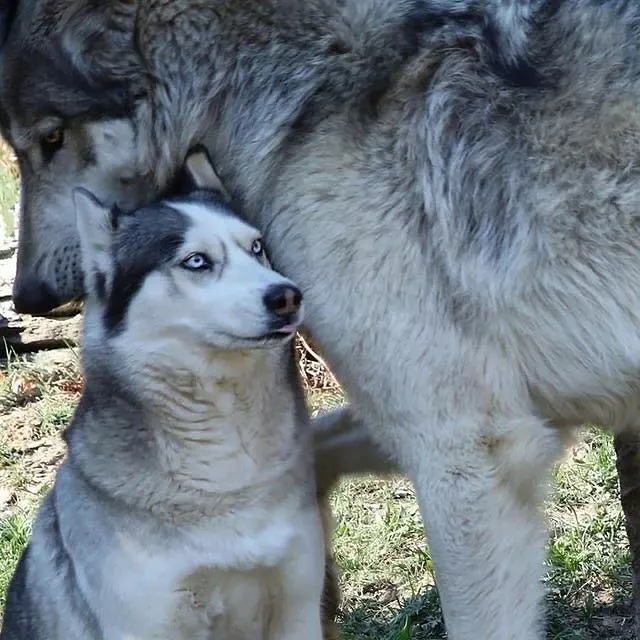
Are dogs really descended from wolves?
Wolf vs dog begins with shared ancestry: all domestic dogs are descended from gray wolves (Canis lupus). DNA evidence shows the split between dogs and modern wolves occurred approximately 15,000 to 40,000 years ago, with genetic studies narrowing the most likely domestication period to between 20,000 and 25,000 years ago.
The Same Species, Two Different Worlds
A gray wolf in the Yukon and a Chihuahua in a handbag are genetically the same species. They can interbreed. Their DNA differs by less than one percent. And yet one hunts moose in sub-zero wilderness while the other wears sweaters and eats from a ceramic bowl.
This is what 15,000 to 40,000 years of evolutionary pressure can do. Domestication is the most dramatic and fastest transformation any large mammal species has ever undergone, and it happened not because humans deliberately engineered it, but because a subset of wolves made a strange and consequential choice.
The Genetic Timeline
DNA evidence places the wolf-dog split between 15,000 and 40,000 years ago, with most recent studies narrowing the window to 20,000 to 25,000 years ago. This was during the last Ice Age, when humans were still hunter-gatherers living in small nomadic bands.
The specific wolves that became dogs are now extinct. Every modern dog, from a Great Dane to a Yorkshire Terrier, is descended from a single ancient wolf population that no longer exists. Today's living wolves and today's dogs share a common ancestor but neither is descended from the other - they are evolutionary cousins, not parent and child.
The original domestication likely happened only once. Later wolf-to-dog crosses have been rare, and nearly all current dog genetic diversity traces back to that founding population. This means the ancestor of every dog that has ever lived was a relatively small group of wolves, possibly numbering only a few hundred individuals, that began interacting differently with humans around 20,000 years ago.
How Domestication Probably Happened
The conventional story is that humans captured wolf pups, raised them, and gradually tamed them into dogs. This is almost certainly wrong.
The more likely story, supported by archaeological and behavioral evidence, is self-domestication. As humans became more sedentary and accumulated food waste around campsites, the wolves that were bold enough to scavenge from human refuse had an enormous survival advantage. A wolf willing to live near humans had access to calorie-dense leftovers and partially protected from predators.
The only cost was tolerating human presence. Most wolves found that cost unacceptable. A few did not.
Over many generations, this scavenging wolf population became genetically distinct from forest wolves. They were smaller (they did not need to hunt large prey), less wary of humans, and eventually began cooperating with humans rather than merely tolerating them. Humans, in turn, benefited from having alert, protective, and food-motivated animals around their camps.
The transformation from wolf to dog was not a human project. It was a mutualistic evolutionary arrangement that benefited both species.
Physical Differences
Despite being the same species, wolves and dogs differ significantly in body structure.
Size
- Gray wolf (adult male): 30-80 kg (66-176 lb)
- Average dog (all breeds): 20-35 kg (44-77 lb)
- Largest dog breeds (Great Dane, Saint Bernard): 60-100 kg
- Smallest dog breeds (Chihuahua): 2-3 kg
Dogs have evolved into both much smaller and slightly larger sizes than their wolf ancestors. The enormous size diversity of dogs is unmatched in any other domesticated species.
Skull and Teeth
Wolves have longer, narrower muzzles and larger teeth. A wolf's canine teeth are up to 6 cm long; a dog's canines are typically 2-3 cm. The skull itself is broader in dogs, with a shorter braincase in most breeds.
Bite Force
- Gray wolf: approximately 1,200 PSI
- Large dog (Rottweiler, Mastiff): 300-330 PSI
- Medium dog (German Shepherd): 238 PSI
- Small dog (Chihuahua): less than 100 PSI
Wolves bite approximately four times harder than even the largest dog breeds. The difference is not just muscle strength but skull geometry - wolves evolved to kill large prey by crushing vertebrae and windpipes, while dogs have had those requirements relaxed over thousands of generations.
Coat
Wolves have uniformly colored coats - typically gray, brown, white, or black in relatively natural patterns. Dogs show an enormous range of coat types (curly, straight, wiry), colors (including pink, blue, merle, and brindle patterns that do not exist in wolves), and patterns. This coat diversity emerged primarily through human selection during the last few thousand years of breeding.
Tails
Wolves have straight, low-hanging tails. Dogs display an extreme range of tail shapes: curled over the back (spitz breeds), stubby (corgis), plumed (Afghan hounds), docked, and absent entirely in some breeds.
Behavioral Differences
This is where wolves and dogs diverge most dramatically.
Response to Humans
Wolves: Wary, cautious, and actively avoid humans in the wild. Even wolves raised in captivity from pups retain significant shyness toward unfamiliar humans. A socialized captive wolf is not the same as a dog - it typically bonds with one or two humans and remains skittish around everyone else.
Dogs: Actively seek human contact. Domestic dogs are the only non-human mammal that routinely forms bonds across species. A dog raised around humans will approach unfamiliar humans with interest rather than fear.
Eye Contact and Oxytocin
Dogs and humans engage in something called "gaze bonding" - extended mutual eye contact that triggers oxytocin release in both species. This is the same hormone released during mother-infant bonding. No other animal relationship outside mother-child is known to produce this neurochemical response across species.
Wolves do not do this with humans. Even hand-raised wolves maintain brief, strategic eye contact rather than the soft, bonding gaze dogs display. Gaze bonding appears to have evolved specifically during dog domestication.
Reading Human Gestures
Dogs understand human pointing. Point at a hidden food bowl, and a dog will go to the indicated bowl. This seems trivial, but almost no other animal does it naturally. Chimpanzees cannot follow human points without training. Wolves cannot either.
Dogs acquired this ability through thousands of generations of selection for working cooperatively with humans. They also read human facial expressions, respond to voice tone, and follow visual cues like head direction.
Play
Dogs play throughout life. Adult dogs still chase balls, wrestle, and engage in mock combat with toys, other dogs, and humans. This "neoteny" - retaining juvenile traits into adulthood - is one of the defining features of domestication.
Wolves play as pups but largely stop in adulthood. An adult wolf does not chase sticks or wrestle for fun. Play in adult wolves is usually related to pack cohesion, hunting practice, or dominance displays.
Sexual Maturity and Breeding
Wolves: Reach sexual maturity at 2-3 years. Breed once per year (usually January-March). Females produce a single litter annually.
Dogs: Reach sexual maturity at 6-12 months depending on breed. Can breed year-round, with most females having two heat cycles per year. Can produce 2-3 litters per year.
Dogs' accelerated breeding capacity means dog populations can grow much faster than wolf populations. It is part of why feral dogs establish themselves quickly in new environments while feral wolves do not.
Behavioral Capabilities Dogs Have That Wolves Do Not
Research over the past two decades has identified specific cognitive abilities dogs have evolved that wolves lack.
Social referencing. Dogs look at their human's face to gauge how to respond to an unfamiliar situation. If the human looks calm, the dog relaxes. If the human looks tense, the dog becomes alert. Wolves do not do this with humans.
Learning from humans through observation. Dogs learn from watching humans perform tasks. Show a dog how to open a door, and it often learns to open it. Wolves do not generalize human behavior this way.
Attention seeking. Dogs actively try to get human attention - barking, pawing, fetching objects to humans. Wolves do not.
Submission to human authority. Dogs accept humans as leaders in ways that wolves do not even accept wolf leaders in some contexts. A wolf's social hierarchy is negotiated through physical dominance. A dog's is largely given freely.
These are not trained behaviors. They emerge spontaneously in dogs raised without any specific training. They are built into the species.
The Famous Russian Fox Experiment
The speed of dog domestication was replicated in a 20th-century experiment that reshaped how biologists understand the process.
Starting in 1959, Soviet geneticist Dmitri Belyaev selectively bred silver foxes for a single trait: tameness. Foxes that approached humans voluntarily were allowed to breed. Those that remained fearful or aggressive were not.
Within 10 generations, the foxes showed the early stages of domestication. Within 40 generations, the tame foxes displayed almost every trait associated with domesticated animals: curly tails, floppy ears, piebald coats, shorter muzzles, smaller teeth, higher breeding frequency, and dog-like social behavior toward humans.
None of these traits were selected for directly. Belyaev selected only for tameness. The other traits emerged as genetic consequences of selecting for reduced fear of humans.
This suggests domestication is a package deal. When an animal becomes less fearful of humans, its entire developmental biology shifts - producing the suite of physical and behavioral traits we recognize as domesticated. The Russian fox experiment essentially repeated what happened to wolves 20,000 years ago, but in 60 years rather than 20,000.
Can a Dog Become a Wolf Again?
Feral dogs - dogs that have reverted to living without human contact - do not become wolves. They become a separate type of canid called "pariah dogs" or "village dogs" that live near human settlements, survive on garbage, and maintain a loose, lower-intensity social structure very different from wolf packs.
The changes introduced by 20,000 years of domestication are genetic. They cannot be undone by a single dog escaping into the wilderness. Feral dogs retain dog-like traits - reduced fear of humans, year-round breeding, smaller body size, reduced bite force - even across multiple generations in the wild.
The only way to reverse dog domestication would be thousands of generations of wild natural selection, and most feral dog populations are not evolving in that direction. They are specializing in the niche of human-adjacent scavenger, which is the niche their ancestors originally occupied.
What Dogs Are, Really
A dog is not a tamed wolf. It is a genetically, anatomically, and behaviorally distinct variant of the wolf species, produced by one of the most successful inter-species evolutionary partnerships in natural history.
Your dog, even if it looks nothing like a wolf, shares with every other dog on Earth an extraordinary evolutionary heritage: the moment when some ancestor of every modern dog made a choice that most wolves would never make, and stayed close to humans. That choice, repeated across thousands of generations, turned a predator into a companion, a hunter into a helper, and a wild canid into the first domesticated animal in human history.
We often say dogs are "man's best friend." The biology behind that phrase is stranger and more fragile than it sounds. It took 20,000 years to create, it is encoded in thousands of genes that differ between wolves and dogs, and it represents one of the few times in evolutionary history that two species changed each other profoundly by choosing, mostly accidentally, to live together.
Genetic Changes That Made a Dog
Our research team finds that the genetic distance between wolves and dogs is small in raw terms but concentrated in functionally important regions. A 2013 genome-wide study published in Nature identified 36 genomic regions showing clear signatures of positive selection during domestication [1]. Among them were genes involved in brain development, behavior, and - unexpectedly - starch digestion.
"The results of this study suggest that amylase and other starch digestion-related genes were critical in early dog domestication, and that a shift in dietary preference between the wolf and the early dog may have been one of the essential adaptations." - Axelsson et al., Nature, 2013 [1]
The gene AMY2B, which produces pancreatic amylase, is duplicated in dogs. Wolves typically carry 2 copies. Most dog breeds carry between 4 and 30 copies, with some Asian breeds carrying more. This duplication allows dogs to digest the starchy food waste that accumulated around early human settlements. It is, in a very literal sense, the genetic fingerprint of self-domestication through scavenging.
Other selected regions include genes linked to neural crest cell migration. The neural crest is an embryonic cell population that develops into facial cartilage, pigment cells, adrenal glands, and parts of the peripheral nervous system.
Selection for tameness appears to reduce neural crest cell activity, which simultaneously produces floppy ears, piebald coats, shorter snouts, smaller adrenal glands (and therefore lower fear responses), and other traits seen across every domesticated mammal species. Biologists call this constellation of traits domestication syndrome.
Dog Breed Diversity vs Wolf Genetic Diversity
| Metric | Gray wolf (wild populations) | Domestic dog (all breeds) |
|---|---|---|
| Effective population size | ~20,000 | ~6,000 (severe bottleneck) |
| Recognized morphotypes | Fewer than 10 | More than 400 breeds |
| Body mass range | 30-80 kg | 1-110 kg (over 100 fold) |
| Lifespan (median) | 6-8 years (wild) | 10-13 years (domestic) |
| Heat cycles per year | 1 | 2 in most breeds |
| Coat color alleles | Limited palette | More than 30 distinct loci |
| Skull shape variation | Narrow range | Extreme (dolichocephalic to brachycephalic) |
The surprising line in this table is the effective population size. Despite hundreds of breeds and more than a billion dogs alive today, the breeding population that sits behind modern dog genetics is smaller than the global wolf population. Breed closure - the practice of refusing to cross certain breeds outside themselves - has locked dog genetic diversity into narrow compartments.
Cognition and the Domestication Brain
The comparative cognition of wolves and dogs has become one of the most productive subfields of animal behavior research in the last 25 years. Brian Hare's work at Duke University and Adam Miklosi's team at Eotvos Lorand University in Budapest have run hundreds of controlled experiments directly comparing hand-raised wolves with pet dogs and village dogs.
The pattern is consistent: dogs outperform wolves on tasks that involve reading human social cues, and wolves outperform dogs on tasks that involve physical problem-solving without social assistance.
"Dogs are smarter than wolves about humans, and wolves are smarter than dogs about the physical world. Dog cognition is not a reduced version of wolf cognition. It is a specialized form of social cognition aimed at one particular species - us." - Brian Hare, The Genius of Dogs, 2013 [2]
In one classic experiment, wolves and dogs were presented with an unsolvable puzzle box containing food. Wolves kept trying to solve it on their own. Dogs quickly gave up on the box and looked at the human in the room, as if asking for help. This "looking back" behavior appears in puppies as young as 6 weeks. Hand-raised wolf pups do not develop it even after intensive socialization.
Cognitive Differences in Controlled Trials
| Task | Dogs (success rate) | Hand-raised wolves (success rate) |
|---|---|---|
| Following a human point to hidden food | 85-95% | 20-40% |
| Looking at human face when puzzle unsolvable | 90% (within 1 minute) | Less than 10% |
| Opening a latched door after human demo | 70-80% | 5-15% |
| Extracting food from box independently | 30-50% | 80-90% |
| Gaze-triggered oxytocin release (owner) | Present | Absent |
| Separation distress when owner leaves | Common | Rare |
These numbers come from studies summarized by Miklosi (2015) and Udell and Wynne (2008) among others [3][4]. The takeaway is not that dogs are smarter. It is that dogs evolved a cognitive toolkit specialized for collaborating with humans, and that toolkit is absent in wolves even when they are raised in human homes.
Conservation Status and Human Interaction
While dogs have become the most numerous large carnivore on Earth - there are an estimated 900 million to 1 billion dogs alive today, most of them free-ranging village dogs rather than pets - gray wolves are under active pressure across their historic range.
The IUCN Red List currently classifies the gray wolf (Canis lupus) as Least Concern globally, but several subspecies are threatened. The Mexican wolf (C. l. baileyi) was reduced to 7 individuals in captive breeding by the 1970s before reintroduction efforts. The red wolf (Canis rufus), considered by some taxonomists a separate species, has fewer than 20 wild individuals remaining in North Carolina as of 2024.
"Wolves are not the villains of fairy tales. They are keystone predators, and ecosystems that have lost them show measurable changes in vegetation, hydrology, and prey population dynamics." - Douglas Smith, Yellowstone Wolf Project lead biologist [5]
The 1995 reintroduction of 31 gray wolves to Yellowstone National Park has become a textbook case study in trophic cascades. Elk populations declined as expected. Willows and aspens recovered where elk no longer overgrazed them. Beaver colonies increased from one to nine. Stream temperatures dropped as trees returned. Coyote numbers fell by about 50%, which allowed mesopredators like foxes and raptors to rebound.
The dog-wolf contrast is particularly vivid here. While humans actively reintroduce wolves to restore ecological function, feral and free-ranging dogs are often listed as an invasive threat to wolves themselves. Dog attacks on livestock are routinely attributed to wolves, which leads to retaliatory killings. Hybridization between dogs and wolves, particularly in southern Europe, is steadily eroding the genetic distinctiveness of some wolf populations.
Hybridization: When the Line Blurs
Because wolves and dogs are the same species biologically, they can interbreed and produce fertile offspring. This happens both in captivity (as in the wolf-dog hybrid pet trade) and in the wild where ranges overlap.
Italy's wolf population carries detectable dog ancestry in 5 to 15% of individuals depending on region [6]. In some eastern European populations, recent hybridization has introduced dog coat colors, dog-typical dewclaws, and even the merle coat gene into wild wolves. Conservation biologists debate whether to cull visibly hybridized individuals to preserve wolf genetic integrity, an ethically fraught question because the hybrids are also wild animals filling a wolf's ecological role.
Captive wolf-dog hybrids are legal in some US states and prohibited in others. They typically show unpredictable behavior because they inherit dog-like sociability at juvenile stages but revert to wolf-like wariness at sexual maturity. Animal welfare organizations consistently discourage keeping them as pets. Most end up surrendered to sanctuaries within the first 3 years.
Notable Research Findings
Recent work has reshaped several earlier beliefs about wolf and dog biology. The Kalenux Team tracks these findings closely because they illustrate how much our understanding has shifted.
The old "alpha wolf" model of rigid pack hierarchy - a staple of 20th-century dog training - has been discarded by the researcher who originally proposed it. L. David Mech, whose 1970 book The Wolf popularized the alpha concept, later wrote that the behavior he observed in captive wolves was an artifact of forcing unrelated adults into a confined enclosure. In the wild, wolf packs are family units.
The "alpha male" and "alpha female" are almost always just the breeding pair, which is to say, the parents. Mech has publicly asked that the term "alpha" be retired.
Other recent findings include:
- Dogs recognize their own names even when spoken by strangers, and can learn 1000+ object labels with enough training (the border collie Chaser learned 1022).
- Dogs yawn contagiously in response to human yawns, an empathy marker previously thought to be limited to primates.
- MRI studies at Emory University show that dogs activate brain regions analogous to human reward centers when they hear their owner's voice or smell their owner's scent [7].
- Wolves live substantially shorter lives in the wild (median 3-4 years from the day they leave the natal pack) than in captivity (12-16 years). Most wild wolf deaths are from starvation, disease, other wolves, or humans.
- Free-ranging village dogs, not pet breeds, most closely resemble the ancestral dog morphotype. Our research team notes that village dogs across Asia, Africa, and Latin America converge on a remarkably similar medium-sized, short-coated, curled-tail phenotype. Breed dogs are the anomaly, not the rule.
Related Articles
- Wolves and Wild Canines: Pack Hunters of the Wild
- Smartest Animals: How We Measure Animal Intelligence
- Primates: Our Closest Relatives in the Animal Kingdom
References
[1] Axelsson, E., Ratnakumar, A., Arendt, M. L., et al. (2013). The genomic signature of dog domestication reveals adaptation to a starch-rich diet. Nature, 495, 360-364. DOI: 10.1038/nature11837
[2] Hare, B., & Woods, V. (2013). The Genius of Dogs: How Dogs Are Smarter Than You Think. Dutton.
[3] Miklosi, A. (2015). Dog Behaviour, Evolution, and Cognition (2nd ed.). Oxford University Press.
[4] Udell, M. A. R., & Wynne, C. D. L. (2008). A review of domestic dogs' human-like behaviors. Journal of the Experimental Analysis of Behavior, 89(2), 247-261. DOI: 10.1901/jeab.2008.89-247
[5] Smith, D. W., Peterson, R. O., & Houston, D. B. (2003). Yellowstone after wolves. BioScience, 53(4), 330-340.
[6] Pilot, M., Greco, C., vonHoldt, B. M., et al. (2018). Widespread, long-term admixture between grey wolves and domestic dogs across Eurasia. Evolutionary Applications, 11(5), 662-680. DOI: 10.1111/eva.12595
[7] Berns, G. S., Brooks, A. M., & Spivak, M. (2015). Scent of the familiar: An fMRI study of canine brain responses to familiar and unfamiliar human and dog odors. Behavioural Processes, 110, 37-46.
[8] IUCN Red List. (2023). Canis lupus assessment. International Union for Conservation of Nature.
Frequently Asked Questions
Are dogs really descended from wolves?
Yes, all domestic dogs are descended from gray wolves (Canis lupus). DNA evidence shows the split between dogs and modern wolves occurred approximately 15,000 to 40,000 years ago, with genetic studies narrowing the most likely domestication period to between 20,000 and 25,000 years ago. The specific ancestor of modern dogs was a now-extinct population of wolves, not the direct ancestors of any living wolf lineage today.
This means modern gray wolves and modern dogs are more like cousins than parent and child - they share a common ancestor but neither is descended from the other. All 400+ recognized dog breeds, from Chihuahuas to Great Danes, trace their genetic lineage back to this single wolf-descended founding population.
Can dogs and wolves breed together?
Yes, dogs and wolves are the same species (Canis lupus) biologically and can produce fertile offspring. Wolf-dog hybrids, called wolfdogs, are bred both accidentally in the wild where dog and wolf ranges overlap and intentionally in captivity. However, hybrids are often difficult to keep as pets. They typically retain wolf behaviors like prey drive, territorialism, and shyness around humans while lacking a wolf’s natural wariness of human habitats.
They are legal in some U.S. states but banned or restricted in many others. Studies of feral wolf-dog hybrids in Europe show the hybrids generally cannot survive independently as well as pure wolves can, though they threaten wolf genetic purity where they are common.
How are wolves and dogs different physically?
Wolves are significantly larger than most dogs (adult males 30-80 kg versus an average dog at 20-35 kg), with longer legs, larger paws, longer muzzles, and more powerful jaws. A wolf’s bite force is approximately 1,200 PSI compared to 230-320 PSI for most large dog breeds. Wolves have straighter tails (dogs have various tail shapes from curly to stub), more uniformly colored coats, and wider heads with narrower snouts.
Internal anatomy differs too - wolves have larger teeth, larger hearts relative to body size, and a digestive system optimized for raw meat. Even the most wolf-like dog breeds (huskies, Malamutes, German shepherds) show clear physical distinctions from true wolves when examined closely.
How are wolves and dogs different behaviorally?
The behavioral differences are profound. Wolves are extremely wary of humans and actively avoid human contact in the wild. Dogs seek out humans and form emotional bonds with them across species - a trait called ‘gaze bonding’ in which dogs hold eye contact with their humans, triggering oxytocin release in both species (this does not happen between wolves and humans). Wolves reach sexual maturity later (2-3 years) and have one breeding season per year.
Dogs can reach sexual maturity at 6-12 months and can breed year-round. Wolves have intense pack social structures with strict hierarchies. Dogs are socially flexible and can live successfully in a wide range of social arrangements including living alone with humans. Wolves learn primarily through observation and trial-and-error.
Dogs have evolved specific cognitive abilities for reading human gestures - they follow pointing fingers, understand human facial expressions, and respond to voice tones in ways wolves do not.
Which came first, wolves or dogs?
Wolves came first by a large margin. Modern gray wolves (Canis lupus) as a species existed approximately 1 million years ago. Dogs diverged from wolves only 15,000 to 40,000 years ago - a tiny evolutionary window. Before dogs existed, wolves had already been hunting across the Northern Hemisphere for hundreds of thousands of years alongside early humans.
The domestication event almost certainly began when wolves started scavenging around human camps, and the bolder, more human-tolerant individuals gradually formed a separate population that became the ancestor of all modern dogs.
This transition was likely gradual rather than an intentional human project - early humans did not decide to create dogs, but rather the friendliest wolves chose to stay close to humans, which over generations produced a new type of animal.