
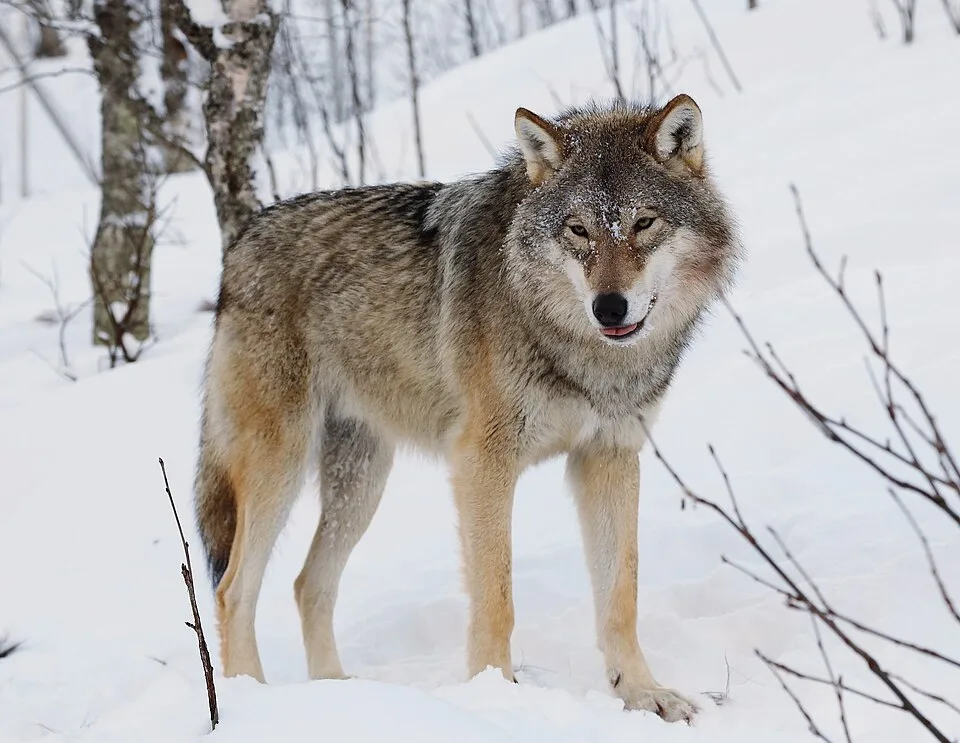
Is the alpha wolf real?
The alpha wolf concept is a myth that has been thoroughly debunked by modern wildlife biology. The term originated from studies of captive wolves in the 1940s-1970s that were placed together as unrelated adults, who naturally fought for dominance. Dr.
A Family, Not a Dominance Hierarchy
The most widely believed fact about wolves is wrong. The "alpha wolf" - the dominant male who fights his way to the top of the pack hierarchy and rules through strength - does not exist in wild wolf society. It never did. The entire concept was based on captive wolves studied in artificial conditions during the mid-20th century, and the researcher who popularized it has spent decades trying to correct the error.
Wild wolves live in families. The "alpha male" and "alpha female" are just the parents. The pack is parents and their children, much like any human household. There is no constant battle for dominance, no ritualized challenges from young upstarts, no alpha-enforced hierarchy. Young wolves leave home when they reach breeding age, just as human children grow up and move out.
This correction matters not just for wolves but for how we think about cooperation, leadership, and social structure across the animal world - including ourselves.
Where the Myth Started
The alpha wolf concept has a specific origin that illustrates how bad science can become popular truth.
Schenkel's Swiss zoo study (1947):
Biologist Rudolf Schenkel studied wolves in Swiss zoos, observing captive groups that had been assembled from unrelated adult wolves. These wolves did not know each other. They had no family ties. They were forced to share small enclosures indefinitely.
Under those artificial conditions, the wolves fought repeatedly for dominance. A "top wolf" emerged through violence. Schenkel described this structure and called the dominant individuals alphas.
What Schenkel missed:
Wild wolves never live this way. In nature, wolf packs form from family groups - a breeding pair and their descendants. Unrelated adults do not simply encounter each other and form mixed groups. Schenkel was describing an artifact of captivity, not natural wolf behavior.
Mech's popularization (1970):
In 1970, wildlife biologist L. David Mech published "The Wolf: The Ecology and Behavior of an Endangered Species" - a comprehensive work that adopted Schenkel's alpha terminology. The book was hugely influential in wildlife biology, dog training, popular culture, and even management theory.
The alpha wolf became a cultural icon. Managers aspired to be alpha leaders. Dog trainers taught owners to establish alpha status over their pets. Popular media portrayed alpha wolves fighting for pack leadership.
Mech's retraction:
Beginning in the 1990s and continuing for decades since, Mech has publicly reversed his position. After spending years studying wild wolves in Canada and Alaska, he realized that his earlier book was based on faulty captive-wolf research.
Mech has published academic papers specifically refuting the alpha concept. He has asked publishers to stop reprinting his 1970 book because of its erroneous content. He has appeared in interviews, lectures, and popular articles explaining that wolf packs are families, not dominance hierarchies.
Despite these efforts, the alpha myth persists in popular culture. The correction has not spread nearly as well as the error.
What Wolf Packs Really Are
In nature, a wolf pack is a family.
Typical pack structure:
- Breeding pair (the "alphas"): a mated male and female, usually together for multiple years
- Current year pups: puppies born in spring of the current year
- Yearlings: offspring from previous year, still living with parents
- Sometimes older siblings: 2-3 year old wolves who have not yet dispersed
Pack size:
Typical packs contain 5-10 wolves. Exact size depends on:
- Prey availability (more food supports larger packs)
- Territory size
- Age of the breeding pair
- Recent breeding success
Lifecycle:
- Pups are born in spring (typically April-May)
- They remain with parents through their first year
- Yearlings help raise the next year's pups
- At age 2-3 years, most wolves disperse to find mates and establish their own territories
This is the same basic pattern seen in any family-based social structure - parents, offspring, helpers from older siblings, departure at maturity.
Breeding and Reproduction
Wolves reproduce differently from most mammals, with only one pair per pack breeding each year.
Monogamous breeding:
The breeding pair produces all the pups in the pack. Adult offspring still living with parents do not breed. This is not because they cannot physically reproduce - it is hormonal suppression maintained by social conditions.
Why suppression works:
In the presence of their parents, young wolves show reduced reproductive hormone production. This mechanism likely evolved to prevent incest within family groups and concentrate reproductive effort on the established breeding pair.
When young wolves disperse, their hormones return to normal levels. They can then form their own breeding pairs and establish their own packs.
Pup-rearing cooperation:
All pack members help raise the pups. Yearlings babysit, guard the den, bring food, and play with pups. This cooperative rearing is why pack structure exists - it provides helpers to improve pup survival.
From the yearling's perspective, helping raise younger siblings has kin-selection value (their siblings share their genes) and provides practice for eventual pup-rearing in their own future packs.
Dispersal
At 2-3 years of age, wolves typically leave their natal pack.
Why disperse:
- Find unrelated mates (avoiding inbreeding)
- Establish independent territories
- Escape competition for food with growing pack
- Ability to reproduce (suppressed while in parental pack)
How dispersal works:
Young wolves begin making exploratory trips, venturing beyond pack territory. Eventually they leave for good, sometimes traveling hundreds of kilometers to find unclaimed territory and potential mates.
Dispersal distance:
Wolves have been tracked dispersing over 1,000 km in search of new territory. One famous wolf - OR7 in the United States - traveled over 1,000 miles from northeastern Oregon to California, becoming the first wolf in California in nearly 90 years.
Survival:
Dispersal is the most dangerous time in a wolf's life. Lone wolves face:
- Other wolf packs defending territory
- Unfamiliar terrain and prey
- Human-caused mortality (traffic, hunting)
- Starvation without pack hunting support
Many young wolves die during dispersal. Those who survive and find mates establish new packs, continuing the cycle.
Coordinated Hunting
Wolves hunt cooperatively, though their coordination is less elaborate than popularly portrayed.
Prey selection:
Wolf packs target vulnerable prey - old, young, sick, or injured individuals. Healthy adult moose, elk, or caribou are usually too dangerous to attack successfully.
Wolves assess prey before committing to a chase. They test a herd by approaching, looking for individuals who run less quickly, limp, or otherwise show vulnerability.
Chase dynamics:
When a chase begins, wolves spread out naturally rather than following specific assigned roles. Faster wolves press the prey forward; slower wolves work the flanks or angle to cut off escape. Individual wolves adjust their position based on the specific situation.
There is no formal hunting strategy. Wolves are intelligent and flexible, responding to conditions rather than following a fixed plan.
Success rates:
Wolf hunts fail more often than they succeed. Published success rates vary but typically fall between 10-20 percent of attempts. Elk and moose frequently escape, turn to fight, or hold their ground until the wolves give up.
Final takedown:
Once prey is cornered or exhausted, multiple wolves close in. Adult wolves make the primary attacks, grabbing the prey by the throat, nose, or hindquarters. Bites are delivered repeatedly until the prey collapses.
Yearlings and pups often hang back during the kill, watching and learning. They join the feeding once the prey is dead.
Pack Communication
Wolves communicate through vocalizations, body language, scent, and facial expressions.
Vocalizations:
- Howls: long-distance communication, pack assembly, territorial warning
- Barks: alarm calls, aggressive warnings
- Growls: close-range warnings
- Whimpers: affiliative communication, pup-parent bonding
- Yips and whines: social communication within the pack
Howls are remarkably complex. Individual wolves have distinctive howl signatures. Packs howl together in chorus, both to communicate with each other and to advertise territorial occupation to rival packs.
Body language:
Wolves have a rich repertoire of postures and expressions:
- Tail position (held high for confidence, low for submission)
- Ear position (forward for alert, flat for submission or aggression)
- Eye contact (direct for confrontation, averted for appeasement)
- Body posture (upright for dominance, crouched for submission)
Scent marking:
Wolves mark territory with urine and scat. Pack members can identify specific individuals and their reproductive status from scent. Territorial borders are clearly demarcated through scent-marking.
Facial expressions:
Wolf faces show complex expressions indicating emotional state. Dogs inherited this facial-communication system from wolf ancestors, making wolf facial expressions recognizable even to human observers familiar with dog behavior.
Wolves and Humans
Wolves have a complicated historical relationship with humans.
Pre-agricultural history:
For most of human history, wolves and humans coexisted across much of the Northern Hemisphere. Early humans likely learned hunting techniques from wolves. Some early wolves gave rise, through domestication, to modern dogs (the divergence happened roughly 20,000-40,000 years ago).
Agricultural conflict:
Once humans domesticated livestock and settled in agricultural communities, wolves became pests. Wolves killed sheep, cattle, and other livestock. Humans responded by persecuting wolves systematically.
European extermination:
By the 1800s, wolves had been extirpated from most of Europe. The British Isles lost their last wolves in the 1700s. Continental Europe retained wolves only in remote mountainous regions.
North American near-extinction:
North American wolves were nearly eliminated by the early 1900s. Government-funded bounty programs aimed to kill every wolf in the contiguous United States. By 1930, wolves survived only in northern Minnesota and Alaska.
Recovery:
Environmental movements in the late 20th century led to wolf protection and reintroduction programs. The 1995 reintroduction of wolves to Yellowstone National Park is one of the most famous conservation projects in history. Wolf populations are now recovering across parts of Europe and North America.
Current status:
Wolves remain controversial in areas where they coexist with ranching operations. Conflicts continue over compensation for livestock losses, hunting quotas, and protection status. Modern wolf management tries to balance ecosystem benefits, livestock protection, and public opinion.
Why the Myth Mattered
The alpha wolf concept influenced more than just wolf biology.
Dog training damage:
For decades, popular dog training assumed that dogs would try to "become alpha" over their owners. Training methods taught dominance displays: alpha rolls (pinning dogs on their backs), physical corrections, and assertion of human dominance.
These methods caused harm. Dogs do not understand alpha behavior. Physical intimidation from owners creates fear and aggression rather than trust. Modern dog training based on positive reinforcement has produced better results and strengthened human-dog bonds.
Management theory misuse:
Popular management books drew on alpha wolf imagery to describe leadership. "Be the alpha" became shorthand for dominant, authoritarian leadership. The implication was that this was the natural, evolved way of structuring groups.
In fact, wild wolf leadership is parental - patient guidance, teaching through example, accepting primary responsibility for the welfare of dependents. This is quite different from the "dominant through strength" image the alpha metaphor conveyed.
Cultural implications:
The alpha male concept spread into popular culture around human relationships and society. Pickup-artist subcultures, certain self-help movements, and various ideologies about masculinity leaned on alpha wolf imagery to justify dominance behaviors.
Since the underlying biology was wrong, all the cultural conclusions drawn from it rested on a false foundation. Aggressive dominance is not how successful social mammals typically structure themselves - cooperation among relatives is.
What Wolves Actually Teach Us
If wolf packs are families rather than dominance hierarchies, what do they actually teach us about social structure?
Cooperation is more common than competition.
Wolves survive through cooperation within family groups, not through constant competition. This is typical of social mammals broadly - most social species are family-based rather than competition-based.
Leadership through experience and investment, not force.
The breeding pair leads the pack because they are the parents - the most experienced members with the greatest stake in pack success. They do not lead through violence. They lead through knowing the territory, finding food, and defending their offspring.
Dispersal maintains genetic health.
Young wolves leaving home to find unrelated mates prevents inbreeding and maintains genetic diversity. This pattern appears across many social mammals and shows how evolution has solved the problem of genetic stagnation in family groups.
Social structure is context-dependent.
Captive wolves form dominance hierarchies. Wild wolves form families. The difference shows that social behavior adapts to circumstances. Understanding any species requires studying it in natural conditions, not in artificial captivity.
Bad science takes decades to correct.
The alpha wolf concept has been wrong for decades, formally retracted by its original promoter, and publicly corrected through extensive scientific work. It persists anyway. This pattern - where incorrect science becomes popular fact and resists correction - shows the importance of constantly updating public understanding as scientific evidence evolves.
The wild wolves of Yellowstone, the Arctic, and the remnant European forests are doing something far more interesting than fighting for alpha status. They are raising families, defending territories, and hunting cooperatively - living lives recognizable, in broad outline, to any parent who has ever watched children grow up and leave home.
Wolf Populations Worldwide
The Kalenux Team compiled current wolf population estimates from IUCN Red List assessments, government wildlife agencies, and peer-reviewed population studies. Wolves are distributed more widely than most people realize, with significant populations in Canada, Russia, and parts of Europe.
| Region | Estimated Population | Trend |
|---|---|---|
| Canada | 50,000-60,000 | Stable |
| United States (lower 48) | 7,500-8,500 | Recovering |
| Alaska | 7,000-11,000 | Stable |
| Russia | 25,000-30,000 | Variable |
| Mongolia | 10,000-30,000 | Declining |
| China | 12,500 | Declining |
| European Union (all) | 17,000+ | Increasing |
| Italy | ~3,300 | Increasing |
| Spain | ~2,400 | Stable |
| Poland | ~2,200 | Increasing |
| Germany | ~1,300 | Rapidly increasing |
| India (Indian wolf subspecies) | 2,500-3,000 | Vulnerable |
| Middle East (Arabian wolf) | <1,500 | Endangered |
| Ethiopia (Ethiopian wolf) | <500 | Critically Endangered |
"The European wolf recovery is one of the great and under-appreciated conservation success stories of the past 50 years. Wolves are now breeding in Belgium, the Netherlands, Denmark, and parts of France where they had been extinct for more than a century. This is happening largely without active reintroduction - the wolves are recolonizing on their own, thanks to habitat recovery, prey abundance, and legal protection." - Luigi Boitani, Sapienza University of Rome, Science, 2014 [1]
The Yellowstone Reintroduction: A Case Study in Ecosystem Restoration
The 1995 reintroduction of gray wolves to Yellowstone National Park has become the most-studied predator reintroduction in the history of conservation biology. Eight wolves from Canada were released that January; by 2023, the Greater Yellowstone Ecosystem contained roughly 500 wolves distributed across dozens of packs.
The ecological consequences of wolf return have been dramatic and complex. Elk populations, which had grown to approximately 19,000 by the late 1980s in the absence of predators, declined by roughly 50 percent as wolves returned. The reduced elk browsing allowed riparian vegetation - particularly aspen, willow, and cottonwood - to recover along streams. Beaver populations increased. Stream morphology began changing as vegetation stabilized banks. Songbird diversity grew.
"Yellowstone taught us that apex predators restructure ecosystems in ways that cascading effects reach all the way to the stream channels and soil chemistry. The ecosystem without wolves was not a neutral baseline. It was a system missing a critical regulatory component, and its recovery has been measurable across dozens of ecological parameters." - William Ripple, Oregon State University, BioScience, 2014 [2]
Some effects have been exaggerated in popular accounts. The famous claim that wolves changed the course of rivers in Yellowstone through their influence on elk grazing has been partially walked back by later research, which has pointed out that climate and other factors were also involved in the vegetation recovery. But even the more conservative interpretations confirm that wolf return has had significant and widespread ecological consequences.
Communication: The Wolf Language
Wolves communicate through a remarkably rich repertoire of vocalizations, body postures, scent marks, and facial expressions. The howl, the most famous wolf sound, serves multiple functions: territorial announcement, pack reunion, long-distance coordination, and social bonding. Individual wolves have identifiable howl signatures, and researchers have used howl analysis to census wolf populations without direct observation.
| Vocalization | Primary Function | Typical Range |
|---|---|---|
| Howl | Territorial, reunion, long-distance | Up to 16 km |
| Bark | Alarm, warning | Short |
| Yip | Submission, greeting | Close |
| Growl | Threat, defense | Close |
| Whine | Submission, affection | Close |
| Chirp | Affectionate communication | Close (pup-adult) |
Scent marking is equally important. A wolf pack's territory boundaries are effectively marked with urine and scat at regular intervals along the edge, with additional markings at particularly valuable resources like carcasses and den sites. Neighboring packs read each other's markings carefully, and most territorial conflicts are resolved through scent detection and avoidance rather than physical confrontation.
Direct fights between packs are rare but sometimes fatal, with more than 15 percent of wolf deaths in some populations attributable to territorial conflict.
References
- Chapron, G., Kaczensky, P., Linnell, J. D. C., von Arx, M., Huber, D., Andren, H., Lopez-Bao, J. V., et al. (2014). "Recovery of large carnivores in Europe's modern human-dominated landscapes." Science, 346(6216), 1517-1519.
- Ripple, W. J., Beschta, R. L., Fortin, J. K., and Robbins, C. T. (2014). "Trophic cascades from wolves to grizzly bears in Yellowstone." Journal of Animal Ecology, 83(1), 223-233.
- Mech, L. D., and Boitani, L. (2003). Wolves: Behavior, Ecology, and Conservation. University of Chicago Press.
- Smith, D. W., Peterson, R. O., and Houston, D. B. (2003). "Yellowstone after wolves." BioScience, 53(4), 330-340.
- vonHoldt, B. M., et al. (2016). "Whole-genome sequence analysis shows that two endemic species of North American wolf are admixtures of the coyote and gray wolf." Science Advances, 2(7), e1501714.
Related Articles
- African Wild Dogs: Nature's Most Successful Hunters
- Domesticated Dogs: How Wolves Became Our Best Friends
- Coyotes: The Wolf's Smaller Cousin Thriving in Cities
Frequently Asked Questions
Is the alpha wolf real?
The alpha wolf concept is a myth that has been thoroughly debunked by modern wildlife biology. The term originated from studies of captive wolves in the 1940s-1970s that were placed together as unrelated adults, who naturally fought for dominance. Dr. David Mech, who originally popularized the alpha terminology in his 1970 book, has since publicly retracted the concept after decades of studying wild wolves.
In the wild, wolf packs are simply families - a breeding pair (the parents) and their offspring from one or several years. The ‘alpha’ is just the mother or father of the pack. There is no fighting for dominance, no challenge for leadership position, no strict hierarchy that younger wolves must navigate through aggression. Young wolves leave when they reach breeding age (2-3 years old) to form new packs, just as children leave their parents’ homes.
The dominance-hierarchy model applies only to artificially constructed captive groups of unrelated adults, not to natural wolf families.
How big is a typical wolf pack?
Typical wild wolf packs contain 5-10 wolves, though pack size varies considerably based on prey availability and territory conditions. A pack usually consists of a breeding pair, their pups from the current year, and yearlings from previous years. Small packs may have only 2-4 wolves when young disperse. Exceptionally large packs have been documented with 20-40 members, usually where prey like bison or moose requires coordinated group hunting.
Pack size increases when food is abundant (more pups survive) and decreases during harsh winters or when prey declines. Members disperse naturally as they reach breeding age at 2-3 years old. The persistent myth of huge wolf packs of 30+ members surrounding prey is based on unusual circumstances and rarely reflects normal wolf society.
Most of the time, wolf packs resemble human families in size: parents and their children living together until the children are old enough to leave.
How do wolves hunt together?
Wolf hunting is coordinated but not in the elaborate military-style way often portrayed in popular media. Wolves select targets based on vulnerability - usually old, young, sick, or injured prey that can be caught more easily. They approach prey by stalking, then initiate chases when close enough. During chases, wolves spread out naturally rather than following specific assigned roles. Individual wolves test the prey, probing for weakness.
When prey tires or stumbles, multiple wolves close in simultaneously. Adult wolves are larger and stronger, so they typically make the final kill while yearlings and pups hang back. Success rates for wolf hunts are surprisingly low - typically only 10-20 percent of attempts result in kills. Large prey like moose or bison usually escape. Wolves succeed through persistence, running prey long distances until it exhausts.
A single adult wolf can bring down a deer, but hunting larger prey requires multiple wolves attacking simultaneously to overcome the prey’s ability to defend itself.
Do wolves mate for life?
Wolves generally form long-term pair bonds that often last for life, though the ‘mating for life’ description is somewhat oversimplified. When a breeding pair forms, they usually stay together for many years, raising multiple generations of pups. If one mate dies, the survivor typically finds a new partner within one or two breeding seasons. The pair bond is reinforced by cooperative pup-rearing, shared territory defense, and coordinated hunting.
Only the breeding pair in a pack reproduces - their adult offspring do not breed while remaining in the parental pack. This hormonal suppression of subordinate reproduction is maintained by the presence of the breeding pair. When young wolves reach breeding age (2-3 years), they typically disperse to find unrelated mates and establish their own territories. This dispersal pattern prevents inbreeding and promotes genetic diversity.
Individual wolves may pair-bond with one mate for 10-15 years before either death or territorial disputes separate them.
How did the alpha wolf myth start?
The alpha wolf concept originated from studies of captive wolves in the mid-20th century, particularly work by Rudolf Schenkel in 1947. Schenkel observed wolves in Swiss zoos and described dominance hierarchies with alpha wolves at the top. The problem: these were unrelated adult wolves forced into captivity together, a situation that never occurs in nature. Wild wolves always live in family groups, not in collectives of strangers. Dr.
David Mech adopted Schenkel’s terminology in his 1970 book ‘The Wolf: Ecology and Behavior of an Endangered Species’ which became hugely influential. For decades afterward, the alpha wolf became fixed in popular culture, dog training methods, and even management theory.
Mech has since spent years publicly trying to correct the misinformation, publishing academic papers specifically debunking the alpha concept and requesting that his old book be removed from print. The term ‘alpha’ persists in popular culture despite being biologically meaningless for wild wolves. It has been particularly damaging in dog training, where ‘alpha rolling’ and similar dominance-based techniques were promoted based on false wolf biology.