
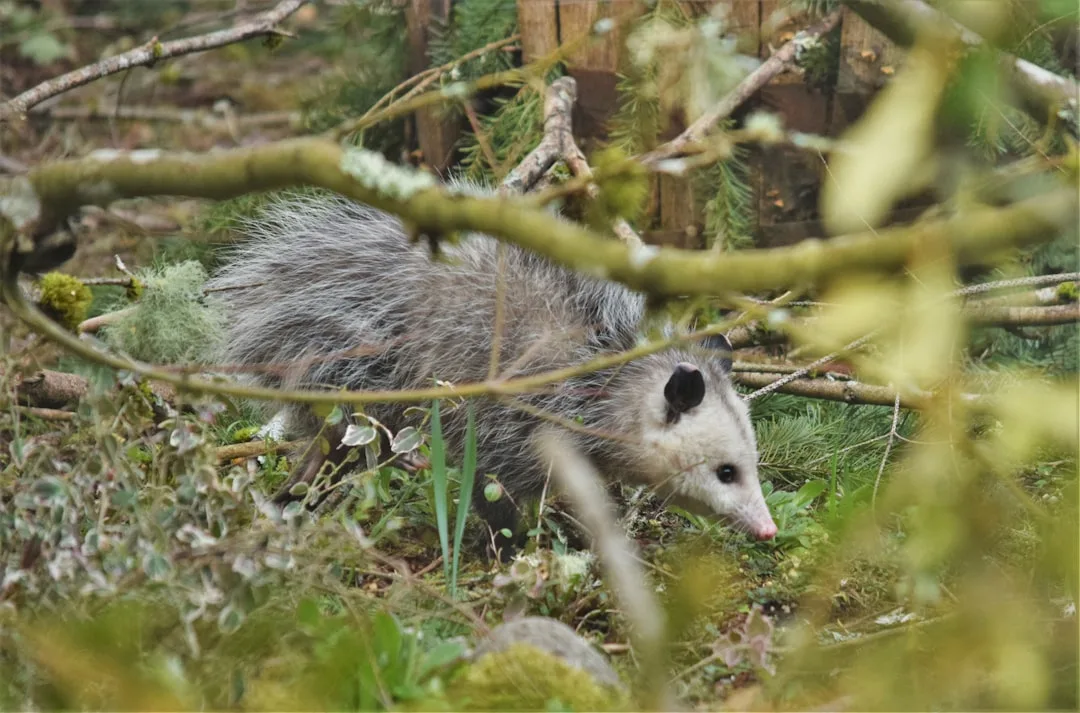
The Virginia opossum is the only marsupial native to North America. While more than 330 marsupial species live in Australia, New Guinea, and the forests of South America, just one pouched mammal has managed to colonise the continent north of Mexico, spreading from the forests of Costa Rica to the suburbs of southern Ontario. That one species is Didelphis virginiana.
It is cat-sized, prehistoric in lineage, immune to rattlesnake venom, covered in fifty sharp teeth, and famous for an involuntary death-feign so convincing that the phrase 'playing possum' entered the English language more than four centuries ago.
This guide covers every aspect of Virginia opossum biology and ecology: size and anatomy, the truth behind playing possum, the remarkable blood chemistry that neutralises snake venom, tick consumption and Lyme disease suppression, reproduction at the edge of physiology, rabies resistance, range expansion, and the ongoing scientific interest in this animal's unusual body. It is a reference entry, not a summary - expect specifics: teeth counts, body temperatures, gestation days, and litter sizes.
Etymology and Classification
The word opossum comes from the Powhatan word aposoum, meaning 'white animal', recorded by English colonists in Virginia in the early 1600s. The scientific name Didelphis is Greek for 'two wombs', a reference to the female's paired reproductive tract - marsupials have two uteri and two lateral vaginae separated by a median birth canal that forms only during labour. The species epithet virginiana reflects the type locality in colonial Virginia.
The Virginia opossum belongs to the order Didelphimorphia, the New World opossums, which contains about 120 species distributed across Central and South America. Didelphimorphs are the oldest surviving marsupial lineage on Earth.
Fossils morphologically similar to modern opossums have been recovered from late Cretaceous deposits over 70 million years old, placing the ancestors of Didelphis virginiana on the continent before the extinction of non-avian dinosaurs.
The genus Didelphis itself is roughly 5 million years old, meaning the Virginia opossum as a recognisable form has outlasted every North American sabre-toothed cat, dire wolf, and mammoth.
Molecular studies show that American opossums diverged from the Australian marsupial lineage during the Cretaceous, when Gondwana was breaking apart. Despite this enormous time gap, American and Australian marsupials share the fundamental pattern of brief gestation followed by prolonged external development. That pattern is older than the continents themselves in their current arrangement.
Size and Physical Description
The Virginia opossum is roughly the size of a housecat, with wide regional variation.
Body size:
- Total length (nose to tail tip): 60-90 cm
- Head and body length alone: 33-50 cm
- Tail length: 25-40 cm
- Shoulder height: 15-20 cm
- Weight: 1.8-6.4 kg (males typically larger than females)
Northern populations tend to be larger than southern ones, a pattern consistent with Bergmann's rule for mammals in colder climates. Body mass also varies seasonally - opossums put on fat through late summer and autumn, then lose it through winter.
Coat and colouration:
The fur has two layers: a soft grey underfur and long coarse guard hairs that range from silver-grey to nearly black. The face is white or cream, with dark rings around the eyes and a pink nose. Ears are hairless, thin, rounded, and black. The feet are pink, the forefeet with five clawed digits and the hindfeet with four clawed digits plus an opposable clawless thumb used for grasping branches and food. The opposable hind thumb is a marsupial feature shared with many of their Australian cousins.
The tail:
The tail is prehensile and nearly naked, covered in scaled skin rather than fur. It can grip branches and is often used as a fifth limb when climbing. It is also used to carry nesting material - a female gathering leaves will loop them with her tail and trot back to the den hauling a bundle. A widely repeated myth claims adult opossums sleep hanging from their tails.
They do not. Adults are simply too heavy. Young opossums can hang briefly while playing, but hanging is not a resting posture for the species.
Dentition:
The opossum has 50 teeth - the dental formula is I 5/4, C 1/1, P 3/3, M 4/4 per half-jaw. This is more teeth than any other land mammal in North America. The teeth include long canines used for seizing prey and crushing insects, and a full array of molars for grinding. The abundant dentition is a primitive mammalian trait; more derived mammals have generally lost teeth over evolutionary time.
Range and Habitat
The Virginia opossum has one of the fastest-expanding ranges of any North American mammal. Five hundred years ago the species was largely confined to the American southeast and parts of Mexico. Today it occupies:
- Southern Canada (Ontario, Quebec, southern British Columbia pockets)
- Nearly all of the continental United States
- Mexico
- Central America as far south as Costa Rica
Introductions and range shifts have carried the species to the Pacific Coast of the United States (after releases in the early 1900s), and opossums now occur on the outskirts of cities from Los Angeles to Vancouver. Mild winters and abundant anthropogenic food sources - pet food, compost, garbage, road kill - have enabled the northward push.
In the north of the range, opossums often lose ears and tail tips to frostbite; these losses are so common that northern populations are recognisable by their truncated ears.
Opossums are habitat generalists. They occupy deciduous forests, mixed woodland, wetlands, riparian corridors, grasslands, farmland, and suburban neighbourhoods. They need three things: cover, water, and food - and humans conveniently provide all three.
Dens are rarely self-constructed; opossums occupy whatever cavity is available, including hollow logs, rock crevices, abandoned burrows of groundhogs and skunks, brush piles, woodsheds, crawl spaces, attic corners, and - in cities - drainage culverts and abandoned vehicles.
Playing Possum: The Involuntary Death-Feign
The behaviour that gave English the verb 'to play possum' is not a conscious performance. It is an involuntary neurological shutdown called tonic immobility, triggered automatically when threat exceeds the animal's ability to escape.
When a fight-or-flight response fails - for example, when a dog pins the opossum - the nervous system tips into a catatonic state that looks extraordinarily like death. The observable signs include:
- Collapse onto one side, body stiff
- Lips drawn back, tongue lolling, teeth bared
- Eyes glazed and partly open
- Drastically slowed breathing, sometimes imperceptible
- Heart rate drops to a fraction of resting
- Muscles become partially rigid
- Greenish, foul-smelling fluid released from anal glands, mimicking carrion
Most predators rely on cues of freshness to decide whether prey is worth eating. Rotten carcasses carry bacterial risk and, in the wild, are generally abandoned after a cursory sniff. The opossum's chemical decoy exploits this behaviour.
The feign can last from about 40 minutes to more than 4 hours. Crucially, the opossum cannot choose to end it. Researchers who have measured brain activity in feigning opossums describe a state similar to shock: elevated cortisol, profound bradycardia, and a dissociation between sensory input and motor output. The animal regains motor control only as the stress response winds down on its own timeline. If a predator returns too soon, the opossum is literally unable to flee.
This involuntary nature is a double-edged adaptation. It is extraordinarily effective against most mammalian predators, including coyotes and dogs. It is much less effective against human vehicles, which do not share the distaste for pre-rotted meat.
Snake Venom Immunity and LTNF
One of the most remarkable pieces of opossum biology is their resistance to pit viper venom. Rattlesnakes, copperheads, and cottonmouths are among the most medically important venomous snakes in the Americas, and their bites kill dogs, cats, livestock, and humans every year. Opossums are largely unfazed.
The protective agent is a serum protein called Lethal Toxin-Neutralizing Factor, or LTNF. It is found in the blood plasma of opossums and binds components of snake venom, preventing them from damaging tissue and nerves. In laboratory experiments, LTNF has neutralised the venoms of:
- Western diamondback rattlesnake
- Eastern diamondback rattlesnake
- Copperhead
- Water moccasin (cottonmouth)
- Indian cobra
- Russell's viper
- Taipan (Australian)
- Even non-snake toxins including scorpion venom and botulinum toxin
The breadth of LTNF's activity - spanning unrelated venom families and even non-venom toxins - is why it has attracted biomedical research attention. A universal antivenom based on opossum serum, or on synthetic peptides modelled on LTNF, could address a major public health problem.
Snake envenomation kills an estimated 80,000-140,000 people each year globally, most of them in rural agricultural communities that lack access to species-specific antivenom. Research groups in the United States, Brazil, and Asia have been investigating LTNF and its synthetic analogues for over two decades.
Wild opossums eat venomous snakes as part of their normal diet. Rattlesnakes, copperheads, and cottonmouths are recorded in opossum stomach contents, and the behaviour has been filmed. Even in direct confrontations where snakes strike, opossums often continue the meal.
The Tick-Eating Lyme Ally
A study published by researchers at the Cary Institute of Ecosystem Studies measured how many ticks different forest mammals carry, how many they groom off, and how many they kill. The opossum came out as an extraordinary tick sink. A single Virginia opossum can consume more than 5,000 larval ticks in one tick season.
The mechanism is not targeted predation - opossums are not hunting ticks. The mechanism is grooming. Opossums groom obsessively, almost as much as cats, licking and scratching their fur constantly. Ticks that climb onto an opossum and attempt to feed are detected, removed, and swallowed. Because opossums wander widely through leaf litter and understory, they pick up huge numbers of questing tick larvae and nymphs, and then ingest nearly all of them.
The ecological consequence is meaningful. Blacklegged ticks (Ixodes scapularis) are the principal vectors of Lyme disease in the eastern United States. A habitat that supports healthy opossum populations removes a large fraction of the larval tick pool before those ticks can acquire Borrelia from reservoir hosts like white-footed mice. In this sense opossums function as a public health service in forested communities.
Rabies Resistance
Opossums are one of the few North American mammals in which rabies is functionally rare. The reason is thermal. Opossum body temperature averages 34-35 degrees Celsius, substantially lower than the 37-39 degrees Celsius typical of placental mammals. The rabies virus replicates poorly at lower body temperatures.
This means that while opossums can be infected in principle - the virus is not strictly excluded - infection events are rare, transmission is inefficient, and symptomatic cases are statistically uncommon. Rabies surveillance data from state public health laboratories consistently shows opossums contributing a tiny fraction of confirmed rabid wildlife, well below raccoons, skunks, foxes, and bats in the same regions.
Opossums have evolved this low body temperature for reasons probably unrelated to rabies. Lower metabolism tracks with their generally slow, low-energy lifestyle. The rabies resistance is a useful side effect.
Opossums do still carry other pathogens, including leptospirosis, tularaemia, and a variety of internal and external parasites, so they should never be handled. But the popular fear that hissing, teeth-baring opossums are likely rabies vectors is not supported by data.
Reproduction: Twelve Days to Daylight
Opossum reproduction operates on one of the fastest schedules in the mammalian world.
Mating: Opossums breed from late winter through early summer, with up to two litters per year in the southern range and one in the north. Females are polyoestrous, cycling every 28-30 days during the breeding season if not pregnant.
Gestation: Only 12-13 days. This is one of the shortest gestations of any mammal.
Birth: Up to 20 young can be born in a single litter. Each neonate weighs roughly 0.13 grams - about the size of a honeybee. The entire litter could fit on a teaspoon. They are pink, hairless, blind, and look like larvae more than mammals. They have, however, functional forelimbs and a working sense of smell.
The crawl: Neonates are born from a central birth canal that forms only during labour between the paired vaginae. They must then climb unaided up through the mother's fur into the pouch, a journey of perhaps 5 centimetres that feels astronomical at their scale. The mother does not help.
The nipple bottleneck: Inside the pouch there are only 13 nipples. The young that reach a nipple first latch on, and the nipple swells in their mouth, locking them in place. Pups that fail to latch within a few minutes die. Mothers that give birth to 20 young lose at least 7 immediately.
Pouch life: The young remain attached to a nipple for 50-70 days, growing from 0.13 grams to roughly 30 grams. During this time they do not release the nipple and their mouth is physically sealed around it. Eyes open around day 60.
Post-pouch life: After leaving the pouch at about 10 weeks, joeys ride on the mother's back, clinging to her fur, during her nightly foraging trips. This phase lasts another 4-6 weeks. They then begin to disperse, though siblings sometimes forage together briefly before separating.
Maturity: Sexual maturity is reached at 6-8 months. Because of this and short gestation, the opossum's generational turnover is extremely rapid.
Life Cycle Data
| Metric | Value |
|---|---|
| Gestation | 12-13 days |
| Neonate weight | ~0.13 g |
| Neonates per litter | 6-13 typical, up to 20 |
| Nipples in pouch | 13 |
| Time attached to nipple | 50-70 days |
| Total maternal care | ~100 days |
| Sexual maturity | 6-8 months |
| Litters per year | 1 (north), up to 2 (south) |
| Wild lifespan | 1-2 years typical, 3-4 maximum |
| Captive lifespan | up to 8 years |
Diet and Foraging
Opossums are omnivorous generalists, probably the most flexible eaters of any similarly sized North American mammal. Recorded food items include:
- Insects, spiders, millipedes, centipedes
- Ticks and mites (grooming-mediated consumption)
- Earthworms, slugs, snails
- Small rodents (mice, voles)
- Frogs, salamanders, lizards
- Snakes, including venomous species
- Carrion of all kinds, including roadkill
- Eggs of ground-nesting birds
- Fruit and berries (persimmon is a favourite)
- Seeds and nuts
- Garden vegetables
- Pet food, garbage, compost
Opossums are nocturnal foragers. They navigate primarily by smell and touch, with eyesight playing a secondary role. A foraging opossum typically moves along established routes through its home range, checking den sites, water sources, and reliable food patches. Home ranges are small by mammal standards, typically 10-20 hectares for adults, though males roam more widely during the breeding season.
They cache food poorly and do not store fat extensively for winter. In cold regions this is a liability - opossums often emerge on winter nights to forage when food is scarce and suffer cold injuries as a result.
Aging and Lifespan
The Virginia opossum has one of the shortest lifespans of any mammal its size. In the wild, most individuals live only 1-2 years, and very few exceed 3. Mortality sources stack at every life stage:
- Neonatal mortality from the 13-nipple bottleneck (up to 35-40% of neonates lost)
- Juvenile predation by owls, foxes, coyotes, and free-roaming dogs
- Road mortality - opossums are among the most frequently killed mammals on North American roads
- Parasite load, including fleas, ticks, mites, and intestinal worms
- Frostbite damage in northern populations
- Accelerated senescence that appears to be intrinsic to the species
Studies on Sapelo Island, Georgia, by Steven Austad in the 1980s showed that opossums on a predator-free island lived noticeably longer and aged more slowly than mainland conspecifics, suggesting that high-predation environments may drive the evolution of accelerated aging. Opossums have since become a model organism for research on mammalian senescence.
Behaviour and Intelligence
Opossums are solitary outside of mating and maternal care. Encounters between adults typically involve hissing, teeth-baring, and one animal retreating. Fighting is rare - most intimidation displays end without contact.
Brain-to-body ratio in opossums is low compared with placental mammals, and by some measures they underperform on problem-solving tasks. However, opossums excel at some cognitive benchmarks. In studies of maze learning, opossums outperform dogs, cats, and rats in remembering where food was hidden. Their sense of smell is sophisticated and used for foraging, navigation, and recognising individual conspecifics.
They are not aggressive. The teeth-baring, hissing posture that many people find alarming is a bluff aimed at avoiding confrontation. Opossums faced with a determined threat are far more likely to flee, play dead, or simply endure than to attack.
Conservation and Status
The Virginia opossum is listed as Least Concern by the IUCN. The population is stable and, in most of the species' range, expanding. There are no major conservation threats at the species level. Regional threats include:
- Road mortality (very high in suburban and rural areas)
- Predation by free-roaming dogs
- Habitat loss (largely offset by adaptation to human landscapes)
- Winter mortality in the expanding northern range
- Legal hunting and trapping in some states, though pelts have low value
The species' rapid reproduction, flexible diet, and tolerance of human habitats make it one of the ecological winners of post-European North America. While many native mammals have retreated, opossums have spread.
Opossums and Humans
Opossums are broadly beneficial neighbours. They suppress ticks, kill rodents, consume garbage, and eat roadkill that would otherwise rot in the open. They rarely carry rabies, generally avoid conflict, and do not typically damage gardens or structures beyond what dens in crawl spaces cause.
Suburban residents who find an opossum in an attic or under a deck can usually encourage the animal to leave by removing attractants (pet food, garbage) and waiting a few nights. Opossums do not form long-term dens the way raccoons do; they rotate through many dens in their home range. Lethal removal is unnecessary and unwise, because the niche will simply be filled by another opossum or, worse, by a rabies-prone carnivore.
The opossum's image in popular culture has shifted from 'ugly scavenger' to 'weird little tick-eating ally' over the past two decades, as scientific findings about LTNF, rabies resistance, and Lyme suppression have reached general audiences. Wildlife rehabilitators who care for orphaned opossums report that the species is hard to dislike on close acquaintance: largely placid, curious, and remarkably patient with handling.
Related Reading
- Marsupials: Australia's Extraordinary Pouched Mammals
- How a Kangaroo Pouch Works
- Koala
- Tasmanian Devil
- Quokka: The Happiest Animal Smile
References
Relevant peer-reviewed and governmental sources consulted for this entry include the IUCN Red List account for Didelphis virginiana, research on Lethal Toxin-Neutralizing Factor published in Toxicon and the Proceedings of the National Academy of Sciences, tick consumption data from the Cary Institute of Ecosystem Studies, aging and senescence studies by Steven Austad and colleagues, and range-expansion mapping from state wildlife agencies across the United States and Canada.
Reproductive timing figures follow standard reference data from Mammalian Species accounts published by the American Society of Mammalogists.
Frequently Asked Questions
Are opossums marsupials?
Yes. The Virginia opossum (Didelphis virginiana) is a marsupial, meaning females give birth to extremely underdeveloped young that complete their development attached to nipples inside an abdominal pouch. It is the only marsupial native to North America and the only one whose range extends north of Mexico. All other living marsupials are found in Australia, New Guinea, and Central and South America.
Opossums belong to the order Didelphimorphia, which diverged from Australian marsupials roughly 70-80 million years ago.
Why do opossums play dead?
‘Playing possum’ is an involuntary reflex called tonic immobility, not a conscious strategy. When threatened beyond the point of fight or flight, the opossum’s nervous system triggers a shock-like state. The animal collapses, its heart rate and breathing slow dramatically, its lips pull back to bare its teeth, its eyes glaze, and it releases a foul-smelling greenish secretion from its anal glands. The odor mimics a decaying carcass.
Most predators lose interest in apparently rotten prey. The feign can last from about 40 minutes to more than 4 hours, and the opossum cannot snap out of it on command - recovery happens only as the fear response subsides.
Are opossums immune to snake venom?
Opossums are resistant to venom from North American pit vipers such as rattlesnakes, copperheads, and cottonmouths. Their blood contains a peptide called Lethal Toxin-Neutralizing Factor (LTNF) that binds and neutralises many venom components. Opossums that are bitten typically survive bites that would kill other similarly sized mammals.
Their resistance is not absolute - massive doses or bites to vulnerable tissues can still cause serious harm - but field and laboratory evidence consistently shows strong immunity. LTNF has attracted biomedical interest as the basis for a potential broad-spectrum antivenom that could work across multiple venomous species.
Do opossums carry rabies?
Opossums very rarely carry rabies, despite looking intimidating when they bare all 50 of their teeth. Their body temperature is approximately 34-35 degrees Celsius, which is several degrees cooler than most placental mammals. The rabies virus replicates poorly at this temperature, making opossums an inhospitable host. Confirmed rabid opossums do exist but are statistically scarce compared with raccoons, skunks, foxes, or bats.
Opossums can still carry other pathogens, so they should never be handled, but the popular fear that hissing opossums are likely rabies vectors is not supported by surveillance data.
How many babies do opossums have?
A female opossum can give birth to up to 20 young after a gestation of only 12-13 days - one of the shortest gestations of any mammal. The newborns, called joeys, are the size of a honeybee and weigh less than a gram each. They must crawl unaided from the birth canal through the mother’s fur and into the pouch. Inside the pouch there are only 13 nipples. Any joey that fails to latch on within minutes does not survive.
Of those that latch, usually 6-9 make it to weaning. The pups remain attached to a nipple for about 50-70 days, then ride on the mother’s back for several weeks before dispersing.
What do opossums eat?
Opossums are generalist omnivores with one of the most flexible diets of any North American mammal. They eat insects, slugs, snails, earthworms, ticks, carrion, small rodents, frogs, lizards, snakes (including venomous species), bird eggs, fruit, nuts, seeds, garden vegetables, pet food, garbage, and compost. Their willingness to eat carrion and road-killed animals makes them important natural clean-up crews.
Research published by the Cary Institute of Ecosystem Studies estimated that a single opossum can consume more than 5,000 ticks per season, giving them a meaningful role in suppressing tick-borne diseases such as Lyme.
Where do opossums live?
The Virginia opossum has one of the fastest-expanding ranges of any mammal in North America. It is found from southern Canada through nearly all of the continental United States, into Mexico, and south through Central America to Costa Rica. They occupy forests, wetlands, grasslands, farmland, and - increasingly - suburban backyards and urban edges.
Opossums have pushed their range northward and westward over the last century, partly due to milder winters and partly due to human landscapes providing food and shelter. They are adaptable den users: hollow logs, brush piles, abandoned burrows, woodpiles, sheds, crawl spaces, and attic corners all work.
How long do opossums live?
Virginia opossums have one of the shortest lifespans of any mammal their size. In the wild, most individuals live only 1-2 years, and very few exceed 3 years. Mortality is high at every life stage: newborns compete for 13 nipples, juveniles face predation by owls, foxes, coyotes, dogs, and cars, and adults suffer from parasites, frostbite to the ears and tail, and the cumulative cost of accelerated aging.
The species matures sexually at 6-8 months and can produce two litters per year in the south of the range. In captivity with veterinary care and no predators, opossums can reach 6-8 years, but even captive animals show rapid senescence compared with similarly sized placental mammals.