
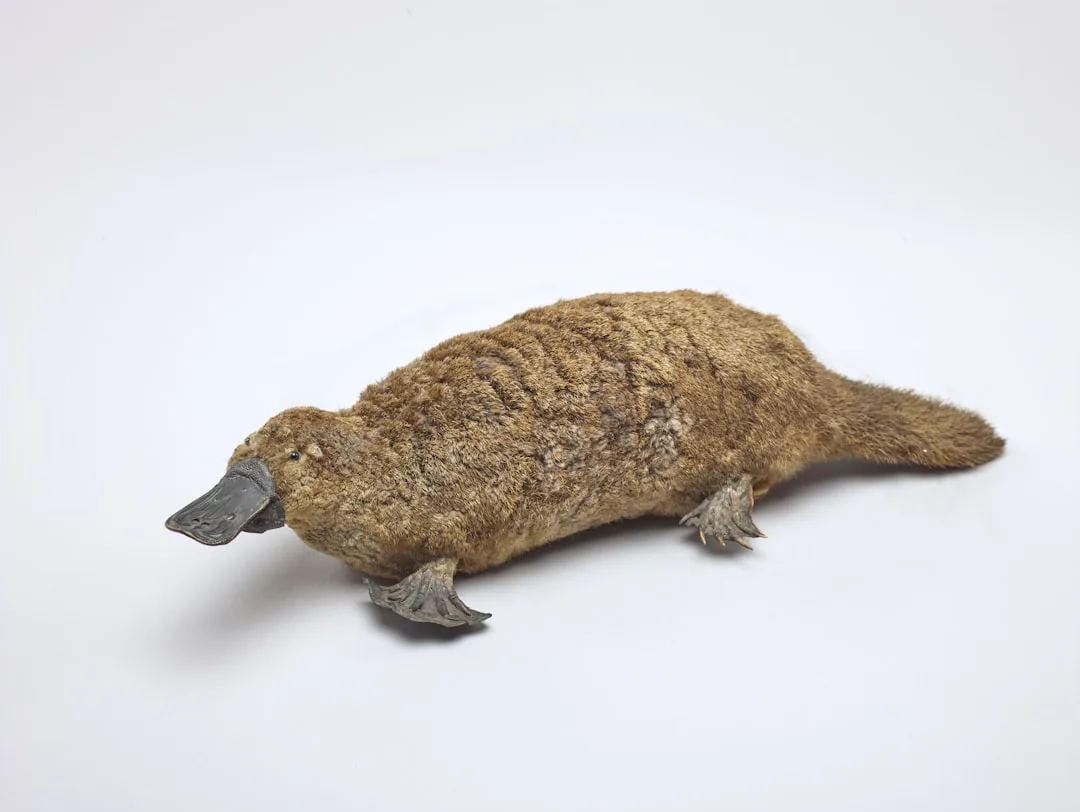
The platypus is one of the strangest mammals alive. It lays eggs instead of giving birth to live young, yet it nurses those young on milk. The males carry functional venom in spurs on their hind legs - the only living mammals that envenomate in this way. Its duck-like bill hides nearly 40,000 electroreceptors that detect the muscle twitches of invisible prey beneath murky water.
Its fur glows blue-green under ultraviolet light, a fact not discovered until 2020. It has no stomach, ten sex chromosomes, and an evolutionary history stretching back more than 160 million years to a branch of the mammal family tree that nearly everything else has forgotten.
A quick taxonomic note. The platypus is a monotreme, not a marsupial. Monotremes are a separate mammal lineage that diverged long before marsupials and placental mammals split from each other. Only five living species remain: the platypus and four echidna species. This guide is filed under the marsupials section for site navigation convenience only. Biologically the platypus belongs to its own order, Monotremata, and nothing about its biology is marsupial.
This reference entry covers every major aspect of platypus biology: classification, anatomy, electroreception, venom, reproduction, genetics, habitat, conservation, and the cultural place of Ornithorhynchus anatinus in Australia. Expect specifics - receptor counts, chromosome numbers, bill dimensions, river systems - rather than summaries.
Etymology and Classification
The genus name Ornithorhynchus combines the Greek words ornithos (bird) and rhynkhos (snout), literally meaning 'bird-snouted'. The species name anatinus means 'duck-like' in Latin. Together the scientific name translates roughly to 'duck-like bird-snout' - a reflection of just how confused European naturalists were when the first specimens reached London in 1798.
That first preserved skin, sent from the Hawkesbury River in New South Wales by Governor John Hunter, was initially dismissed as a fraud. British zoologist George Shaw examined it for stitching, certain that a taxidermist had sewn a duck's bill onto the body of a beaver or mole. No such stitches existed. Shaw published the species in 1799 under the name Platypus anatinus.
The genus name Platypus (Greek for 'flat-foot') was already in use for a beetle genus, so the animal was eventually renamed Ornithorhynchus anatinus, although the common name 'platypus' stuck in English.
Monotremes are the oldest surviving mammalian lineage. Molecular and fossil evidence places the split between monotremes and the rest of the mammal family tree at roughly 166 million years ago, during the Jurassic. Echidnas and the platypus themselves diverged from a common monotreme ancestor about 50 to 60 million years ago. The platypus is the only living member of its family, Ornithorhynchidae, and the only living species in its genus.
Size and Physical Description
Platypuses are small to mid-sized aquatic mammals. Tasmanian platypuses tend to be larger than those on the Australian mainland, and males are consistently heavier than females within any given population.
Adults:
- Total length: 40-50 cm (including tail)
- Body length (head to rump): 30-40 cm
- Tail length: 10-15 cm
- Weight (males): 1.0-2.4 kg
- Weight (females): 0.7-1.6 kg
Hatchlings:
- Length: roughly 15 mm at hatching
- Weight: less than 1 gram - small enough to sit on a thumbnail
The platypus is a mosaic of features that do not normally appear together. The bill is soft, rubbery, and superficially duck-like, but it is a mammalian structure covered in sensory skin, not a bird's keratin beak. The body is low-slung and streamlined, resembling a small otter. The tail is flat, broad, and paddle-shaped, much like a beaver's - used as a rudder during swimming and as a fat-storage organ.
The feet are fully webbed in the front, partially webbed in the back, and tipped with strong claws for digging. When walking on land, the platypus folds its webbing back under its feet, exposing the claws; in the water, the webbing extends for paddling.
The fur is extraordinarily dense. Estimates put hair density at around 900 hairs per square millimetre, denser than a sea otter's pelt. The coat consists of two layers: long, water-repellent guard hairs on the outside and an insulating undercoat beneath. Trapped air in the undercoat keeps the skin dry even during extended dives. The fur is a rich dark brown on the back and a paler cream on the underside, and it biofluoresces blue-green under ultraviolet light - a property confirmed only in 2020.
The Bill and Electroreception
The bill is the platypus's defining sensory organ. It is roughly the size and shape of a duck's bill but is a soft, rubbery, highly vascularised structure covered in tough skin and packed with sensory receptors. It is, in effect, a biological radar dish for detecting prey.
Sensory architecture of the bill:
- Approximately 40,000 electroreceptors arranged in longitudinal stripes
- Approximately 60,000 mechanoreceptors that detect water pressure changes
- Push-rod mechanoreceptors sensitive to direct touch
- No taste or smell receptors in significant numbers - the bill is almost entirely touch and electricity
The electroreceptors detect the faint electrical fields generated by muscle contractions in prey animals - freshwater shrimp, worm bodies wriggling in sediment, insect larvae, small fish. The sensitivity is extreme. Laboratory tests suggest platypuses can detect electrical fields as weak as 50 microvolts per centimetre, which is comparable to the best electroreceptive systems found in sharks and rays.
The arrangement of receptors in parallel stripes allows the platypus to triangulate targets by measuring the tiny time delays between a signal reaching different parts of the bill.
When the platypus dives, reflexes close the eyes, the ear openings, and the nostrils. Vision, hearing, and smell all become unavailable underwater. The platypus swings its head side to side across the substrate and relies entirely on the bill to locate prey. This sensory strategy - electroreception combined with mechanoreception - is unique among living mammals.
A few dolphins have been shown to detect very weak electrical fields through modified whisker pits, but nothing approaches the resolution of the platypus bill.
Venom and the Spur
Adult male platypuses carry a hollow, keratin-tipped spur about 15 millimetres long on the inside of each hind ankle. The spur connects by a narrow duct to a crural venom gland in the thigh. Females are born with spur rudiments but shed them before reaching adulthood, and the venom gland is essentially absent.
The venom gland enlarges seasonally, reaching maximum size during the platypus breeding season in late winter and spring, then shrinking dramatically outside the breeding period. This seasonal pattern, combined with the fact that only males produce venom, strongly supports the interpretation that platypus venom evolved as a weapon for male-on-male combat rather than for defence or hunting.
What the venom is:
- A complex cocktail of at least 83 distinct peptides
- Includes defensin-like proteins, neurotrophins, and C-type natriuretic peptides
- No component evolved from insect or snake venom - the platypus re-purposed existing mammalian proteins
- Not primarily lethal, but extraordinarily painful
What it does in humans:
- Immediate, intense, burning pain at the puncture site
- Rapid localised swelling, sometimes spreading to the entire limb
- Chronic pain sensitivity (hyperalgesia) lasting weeks or months
- Resistant to standard opioid painkillers, including morphine
- No confirmed human fatalities
A spur strike can kill a medium-sized dog, and reports from early 20th-century stockmen describe horses collapsing after being struck. Recovering a venomated human patient typically requires specialised pain management, nerve blocks, and prolonged physiotherapy. Research into platypus venom has become medically interesting because some components may provide models for novel pain-management drugs.
Hunting and Diet
Platypuses are opportunistic bottom-feeders that hunt primarily at dawn, dusk, and through the night. They forage by diving to the bottom of streams and rivers and searching the sediment with the bill. Dives typically last 30 to 40 seconds, though platypuses can stay submerged for several minutes when necessary. Between dives they surface briefly to breathe, chew, and swallow.
Typical prey items:
- Caddisfly, mayfly, and dragonfly larvae
- Freshwater shrimp and yabbies
- Aquatic worms
- Small fish and fish eggs
- Freshwater molluscs and snails
- Occasional frogs and tadpoles
A platypus stores food in the cheek pouches during a dive, then chews and swallows at the surface. Because the adult platypus has no functional teeth, prey is ground between hardened keratin pads inside the cheeks. Platypuses regularly ingest small amounts of gravel, and this gravel helps pulverise harder-bodied prey like crustaceans.
Daily food requirements are substantial. A typical adult eats roughly 20 per cent of its body weight per day - a consequence of the high energetic cost of swimming, diving, and maintaining body heat in cold water. Pregnant and lactating females consume proportionally more.
The Missing Stomach
The platypus has no true stomach. The oesophagus connects directly to the small intestine via a small mixing region that lacks the acid-secreting glands and enzyme-producing cells that define a vertebrate stomach. Genetic analysis confirms that the platypus and all echidnas have inactivated or lost the genes that produce stomach acid, pepsin, and several other gastric enzymes.
This loss is not a primitive trait retained from early mammals. It is a secondary loss - monotreme ancestors did have stomachs, and the genes were switched off or deleted over tens of millions of years. Parallel losses have occurred in several unrelated fish and amphibians that eat soft prey. The explanation seems to be that soft invertebrate diets simply do not require strong acid digestion, so the expensive machinery of a stomach was evolutionarily dispensable.
Digestion instead happens via mechanical grinding in the cheek pouches, mucus secretion in the small intestine, and enzymes produced further down the gut. The arrangement is unusual enough that comparative anatomists use the platypus regularly as a textbook example of major organ loss.
Reproduction and Life Cycle
The platypus reproduces once a year. Mating takes place in the water from late winter through spring, and courtship involves a prolonged underwater chase in which males pursue females in slow, looping patterns near the riverbed.
After mating, the female digs an elaborate nesting burrow - distinct from her ordinary resting burrow - in the bank. Nesting burrows can be 20 metres long, dug through hard earth, and sealed behind multiple earth plugs that the female rebuilds each time she leaves. These plugs help maintain humidity, regulate temperature, and exclude predators.
Reproductive timeline:
| Stage | Duration / detail |
|---|---|
| Gestation | ~28 days internal, including delayed development |
| Egg incubation | ~10 days against the mother's belly |
| Eggs per clutch | 1-3 (most commonly 2) |
| Egg size | 10-15 mm, leathery, grape-sized |
| Hatchlings at emergence | Blind, hairless, about 15 mm long |
| Weaning | Approximately 4 months |
| First emergence from burrow | 3-4 months after hatching |
| Sexual maturity | 2-3 years |
Because the platypus has no nipples, milk is secreted through specialised patches of skin on the mother's belly. The milk pools in grooves in the fur, and the hatchlings lap it up. This exposed feeding method would normally be a serious bacterial risk, so platypus milk contains an unusual concentration of antimicrobial proteins.
One of these, a compound researchers nicknamed 'Shirley Temple' for its ringlet-shaped structure, has attracted pharmaceutical interest as a potential model for new antibiotics.
Females typically raise one litter per year. Males do not participate in caring for young.
Genetics and the Ten Sex Chromosomes
The platypus genome is one of the strangest in the animal kingdom. While most mammals have two sex chromosomes - XX in females and XY in males - the platypus has ten. Males carry 5X and 5Y chromosomes, females carry 10X chromosomes, and the chromosomes form a long chain during meiosis rather than pairing up independently.
Stranger still, platypus sex chromosomes more closely resemble the Z and W chromosomes of birds than the X and Y of other mammals. Genetic analysis suggests that placental mammal X and Y chromosomes evolved from a different ancestral chromosome pair than the monotreme sex chromosomes, meaning the mammalian sex-determination system evolved twice independently - once in monotremes, once in everything else.
The full platypus genome was first sequenced in 2008 and re-sequenced at higher quality in 2021. It contains a mix of mammal, reptile, and bird-like gene families. Genes associated with venom show clear origins in standard mammalian defensin genes, recruited and duplicated for a new purpose. Genes for stomach function are absent or degraded. Genes for electroreception appear to be modified mechanoreceptor and taste-bud genes.
Biofluorescence
In 2020, researchers examining preserved platypus specimens under ultraviolet light discovered that platypus fur glows a soft blue-green. The biofluorescence was visible across multiple museum specimens, suggesting the effect is universal rather than accidental. The mechanism involves compounds in the hair shafts absorbing UV light and re-emitting it at visible wavelengths.
The function is not yet clear. Hypotheses include camouflage under moonlight-rich conditions, communication between platypuses (whose own UV vision is limited), or a simple by-product of fur chemistry with no adaptive value. Biofluorescence has since been reported in other mammals as well, suggesting this trait is more widespread than previously suspected and was simply never looked for.
Habitat and Range
Platypuses live exclusively in eastern Australia. Their range extends from the tropical streams of far north Queensland southward through New South Wales and Victoria, and throughout Tasmania, where populations remain dense. A small introduced population exists on Kangaroo Island, South Australia.
Habitat preferences:
- Freshwater streams, rivers, and lakes - never saltwater, rarely brackish
- Stable earthen banks suitable for burrowing
- Year-round water availability
- Moderate flow with deeper pools and shallower feeding runs
- Abundant aquatic invertebrate prey
Individual home ranges vary by sex and habitat, but most adults occupy 1 to 7 kilometres of waterway. Males typically maintain larger ranges than females and often overlap multiple female ranges. Platypuses are generally solitary and maintain individual burrows except during mating and rearing.
The species is conspicuously absent from most of western, central, and northern Australia, despite seemingly suitable habitat. This reflects ancient geographic and climate barriers rather than modern limitations.
Conservation Status and Threats
The IUCN lists the platypus as Near Threatened with a decreasing population trend. Regional assessments within Australia are often more severe - the species is listed as Vulnerable in some states and Endangered in localised ranges.
Primary threats:
- Climate-driven drought and altered river flow. Platypuses cannot survive in waterways that dry out seasonally. Prolonged droughts, amplified by climate change, are reducing habitat in marginal areas.
- Dams, weirs, and fragmentation. Physical barriers prevent platypuses from moving between river reaches, isolating populations and reducing genetic diversity.
- Water extraction and pollution. Agricultural extraction reduces flow, and runoff introduces sediment, pesticides, and fertilisers that damage invertebrate prey.
- Land clearing along riverbanks. Bank stability and overhanging vegetation are critical for burrow sites and shade.
- Entanglement. Illegal yabby traps (opera-house traps) drown platypuses that enter looking for prey. Discarded fishing line and plastic also cause injury.
- Introduced predators. Foxes and dogs take platypuses when they cross overland between waterways.
- Bushfires. The 2019-2020 Australian fires destroyed riparian vegetation across large sections of platypus habitat.
Conservation responses include trap regulations, riparian restoration programmes, captive research colonies, and citizen-science monitoring projects such as platypusSPOT. A nationwide species recovery plan has been proposed repeatedly; implementation has been slow.
Platypuses and Humans
The platypus has occupied a central place in Australian cultural and scientific identity since colonisation. It appears on the Australian 20-cent coin, serves as a mascot for numerous organisations, was the official emblem of the 2000 Sydney Olympics alongside two other native species, and regularly features on currency, stamps, and state insignia.
Indigenous Australian cultures across the platypus's range have long recognised the animal. The Dharug word mallangong and the Wiradjuri word boondaburra predate European contact. Several Aboriginal creation stories explain the platypus as the offspring of a duck and a water-rat, neatly capturing the mosaic appearance that confused European naturalists.
Modern scientific interest in the platypus is intense. Researchers study the animal for insights into mammal evolution, the origin of venom systems, electroreception, genome architecture, and antimicrobial milk chemistry.
Zoos outside Australia have almost never been permitted to keep platypuses - they are extremely difficult to maintain in captivity, and Australian law tightly restricts export. The San Diego Zoo was the first non-Australian institution to display platypuses, briefly in 1947 and again in 2019.
Related Reading
References
Relevant peer-reviewed and governmental sources consulted for this entry include IUCN Red List assessments for Ornithorhynchus anatinus, the Australian Department of Climate Change, Energy, the Environment and Water species profile, the 2008 and 2021 platypus genome papers published in Nature, research on electroreception in Proceedings of the Royal Society B, venom peptide studies in Venoms and Toxins, and the 2020 biofluorescence paper published in Mammalia.
Population figures and distribution data reflect the most recent assessments from the Australian Platypus Conservancy and state wildlife agencies.
Explore more about unique egg-laying mammals in our monotremes section.
Frequently Asked Questions
Is the platypus a marsupial?
No. The platypus (Ornithorhynchus anatinus) is a monotreme, not a marsupial. Monotremes are a separate and much older lineage of mammals that lay eggs rather than give birth to live young. Only five living species qualify: the platypus and four echidna species. Marsupials such as kangaroos, koalas, and opossums give birth to live but undeveloped young that finish development in a pouch.
Monotremes split from the rest of the mammal family tree more than 166 million years ago, long before marsupials and placental mammals diverged. The platypus is filed alongside marsupials here only for site navigation convenience - biologically it belongs to its own order, Monotremata.
How does the platypus hunt if it closes its eyes underwater?
The platypus hunts entirely with its bill. When it dives, reflexes seal the eyes, ear openings, and nostrils shut. The rubbery bill contains approximately 40,000 electroreceptors and 60,000 mechanoreceptors arranged in parallel stripes. Electroreceptors detect the tiny electrical fields generated by muscle contractions in prey like shrimp, worms, and insect larvae. Mechanoreceptors detect water pressure changes from moving prey.
The platypus sweeps its head side to side through the sediment at the bottom of streams, triangulating targets using time differences between signals hitting different parts of the bill. This sensory system is more like a shark’s than a mammal’s and is one of the most sensitive electroreceptive systems in the animal kingdom.
Are platypuses really venomous?
Yes - but only the males, and only seasonally. Each adult male platypus has a hollow, keratinous spur about 15 millimetres long on the inside of each hind ankle, connected by a duct to a crural venom gland in the thigh. The venom gland enlarges dramatically during the breeding season (late winter to spring) and shrinks the rest of the year, which strongly suggests the venom evolved for male-on-male combat rather than defence or prey capture.
The venom contains at least 83 distinct peptides. In humans, a spur strike produces immediate, extreme pain, localised swelling, and chronic pain sensitivity that can last weeks or months. Standard opioid painkillers including morphine reportedly do little to relieve it. No human deaths have been recorded, but dogs have been killed by envenomation.
Where do platypuses live?
Platypuses live in freshwater systems along the eastern coast of Australia, from the tropical rivers of far north Queensland down through New South Wales, Victoria, and across Tasmania. They prefer streams, rivers, and lakes with stable banks where they can excavate burrows, moderate flow, reliable year-round water, and abundant invertebrate prey. A typical home range covers a few kilometres of waterway.
They are notably absent from Western Australia, the Northern Territory, and most of South Australia, despite otherwise suitable habitat - a distribution that reflects their evolutionary history rather than modern ecology. A small introduced population exists on Kangaroo Island. They are sensitive to drought, habitat fragmentation, and water pollution.
How do platypuses lay eggs and raise their young?
Platypuses reproduce once a year, typically in late winter or early spring. After mating in the water, the female digs an elaborate nesting burrow up to 20 metres long in the riverbank and seals herself inside behind a series of earth plugs. She lays one to three small, leathery, grape-sized eggs (typically two), curls around them, and incubates them against her belly for about 10 days. The hatchlings emerge blind, hairless, and bean-sized.
Because the platypus has no nipples, the mother secretes milk through specialised patches of skin on her belly; the milk pools in grooves in her fur and the hatchlings lap it up. The young remain in the burrow for three to four months before emerging to swim. Platypus milk is unusually rich in antimicrobial proteins - an adaptation to the exposed feeding method - and this has attracted medical interest for antibiotic research.
Why doesn't the platypus have a stomach?
The platypus genuinely lacks a true glandular stomach. The oesophagus connects almost directly to the small intestine, without a sac that secretes hydrochloric acid and pepsin for protein digestion. Genetic analysis confirms that the ancestors of the platypus lost the genes for producing stomach acid and digestive enzymes - a loss shared with echidnas and a handful of unrelated fish and amphibians.
Instead, the platypus grinds food between keratinous pads inside its cheek pouches, often using ingested gravel to help pulverise hard prey shells. The evolutionary explanation is that soft invertebrate prey simply does not require strong acid digestion, so the energetically expensive stomach machinery was lost over millions of years. This is one of several features that make the monotreme digestive system unusual even among mammals.
Are platypuses endangered?
The IUCN lists the platypus as Near Threatened, with a decreasing population trend. Recent surveys suggest the species has disappeared from roughly 22 per cent of its historical range, with steep declines in some river systems.
Primary threats include drought and altered river flows linked to climate change, habitat fragmentation from dams and weirs, water extraction for agriculture, pollution, land clearing along riverbanks, and entanglement in illegal yabby traps and fishing gear. Introduced predators, particularly foxes and dogs, take platypuses when they travel overland between waterways.
The catastrophic 2019-2020 Australian bushfires destroyed large sections of platypus habitat. Several Australian states have upgraded the platypus to ‘Vulnerable’ or ‘Endangered’ status at the regional level, and conservation groups lobby for national listing.
How long do platypuses live?
Wild platypuses typically live 6 to 14 years. Long-term river studies have documented individuals reaching 21 years in the wild, which is exceptional. Captive platypuses have reached similar ages, though they are notoriously difficult to keep in captivity - only a handful of institutions globally have ever successfully bred them.
Juvenile mortality is high: predation by foxes, water rats, large fish, raptors, and even introduced redfin perch takes a significant toll on young platypuses in their first year. Adults have few natural predators once they reach full size, so population health depends mainly on habitat quality, water availability, and protection from entanglement hazards.