
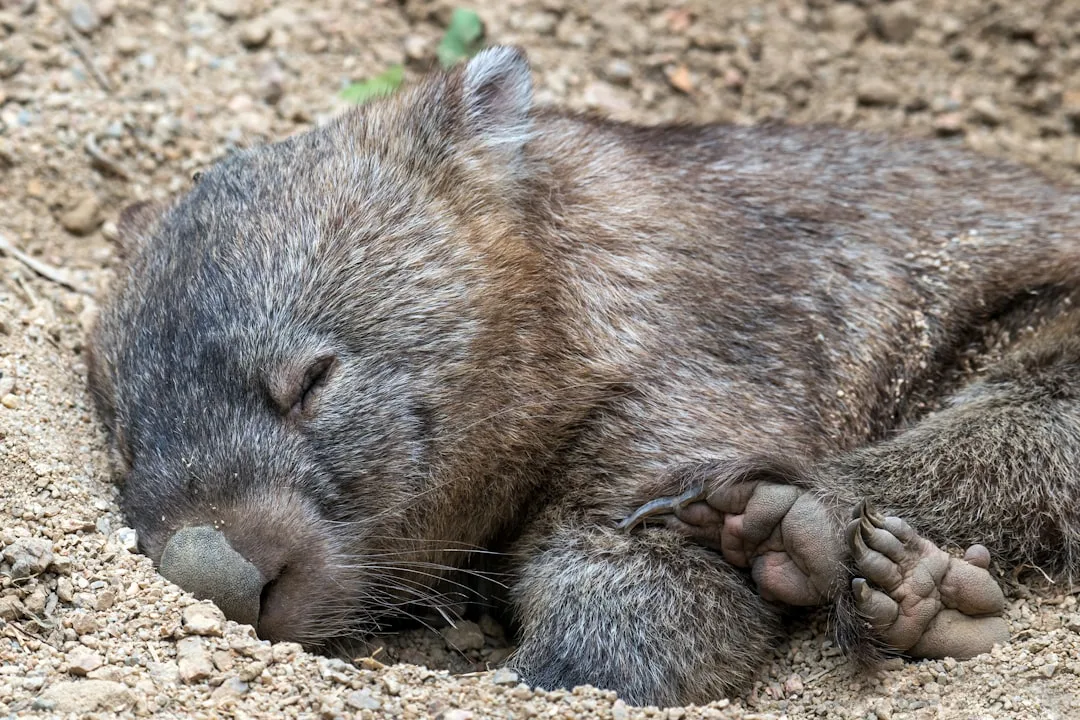
The wombat is one of Australia's strangest mammals - a barrel-shaped, short-legged, burrow-digging marsupial that looks like a small bear, crushes predators with its rear end, sleeps in tunnels up to thirty metres long, and produces the only genuinely cube-shaped droppings found anywhere in the animal kingdom.
Three living species make up the family Vombatidae: the common or bare-nosed wombat (Vombatus ursinus), the southern hairy-nosed wombat (Lasiorhinus latifrons), and the Critically Endangered northern hairy-nosed wombat (Lasiorhinus krefftii), which is one of the rarest large mammals on Earth with a single wild population of roughly 315 individuals.
This guide covers every aspect of wombat biology and ecology: size and anatomy, the famous cube poo, the backward-opening pouch, the bony rump defence, burrow architecture, digestion, reproduction, species differences, conservation status, and the relationship between wombats and the humans who share their range in south-east Australia and Tasmania. It is a reference entry, not a summary - so expect specifics: kilograms, kilometres, temperatures, populations, and verified records.
Etymology and Classification
The scientific name Vombatus ursinus pairs the Latinised form of the Dharug word wombat (from the Eora and Darug people of the Sydney Basin) with the Latin adjective ursinus, meaning 'bear-like'. Early European colonists frequently described the animal as a 'badger' or 'small bear', and a few pockets of rural Tasmania still use 'badger' as a local name.
Wombats belong to the order Diprotodontia, the large group of Australian marsupials that includes kangaroos, possums, and koalas. Within Diprotodontia they sit in the family Vombatidae, which today contains just two genera and three species:
- Vombatus ursinus - the common or bare-nosed wombat
- Lasiorhinus latifrons - the southern hairy-nosed wombat
- Lasiorhinus krefftii - the northern hairy-nosed wombat
Molecular studies consistently show that wombats are most closely related to the koala, their sister group within the suborder Vombatiformes. Kangaroos and possums sit on separate branches. The wombat and koala lineages split from a common ancestor roughly forty million years ago, when Australia was greener and wetter than it is today.
Extinct members of the wombat line include Diprotodon, the rhino-sized herbivore that vanished around forty thousand years ago, and Phascolonus gigas, a giant wombat weighing up to two hundred kilograms.
Size and Physical Description
The common wombat is stocky, muscular, and built low to the ground - every line of the animal optimised for burrowing rather than running.
Common wombat adults:
- Head-body length: 85-115 cm
- Tail: a vestigial 2-3 cm stub, almost invisible under fur
- Shoulder height: 30-40 cm
- Weight: typically 20-35 kg, rarely up to 40 kg
Southern hairy-nosed wombat:
- Slightly smaller, 77-94 cm
- Weight 19-32 kg
- Fur softer and silvery-grey
- Larger, rounder ears covered in white fur
Northern hairy-nosed wombat:
- Largest of the three, 100-120 cm
- Weight up to 40 kg
- Broader skull, silkier coat, pronounced white ear fur
The body is shaped like a short cylinder with legs. Limbs are short, powerful, and tipped with long curved claws built for digging in compacted clay, sandy loam, or quartz gravel. The forepaws bear five claws; the hind paws have four functional claws plus a vestigial first toe. The front legs are noticeably more muscular than the back, reflecting a lifetime of scraping soil.
The face is flat, the nose prominent, and the eyes small and dark. Hearing is acute, vision modest, and scent is the dominant sense. The common wombat has a naked, leathery nose pad; the two hairy-nosed species are named for the fine fur covering theirs. Fur colour in the common wombat ranges from sandy brown to deep charcoal-black, with Tasmanian animals usually the darkest.
One feature unique to the wombat family among large marsupials is a posterior cartilage and bone plate fused across the rump, forming a natural shield. More on that below.
The Famous Cube-Shaped Droppings
If wombats are known for one thing outside Australia, it is their faeces. The common wombat is the only animal on Earth that produces genuinely cube-shaped droppings. Each cube is roughly two centimetres on a side, dry, dense, and stacked neatly - an adult produces 80 to 100 cubes per night.
The mystery of how a round intestine produces a square output was solved in a 2018-2021 research programme led by Patricia Yang at the Georgia Institute of Technology. Yang's team examined the colons of wombats that had died after vehicle strikes and mapped the stiffness of the intestinal wall along its length.
What they found was that the final seventeen per cent of the colon has two rigid longitudinal ridges separated by two softer, more flexible regions. As the already-dry faecal mass is squeezed along this section by peristaltic contractions, the uneven stiffness flattens the sides while the corners hold their shape. Over roughly a hundred contraction cycles, a round pellet becomes a cube.
The work earned the team the 2019 Ig Nobel Prize in Physics and was published in Soft Matter in 2021, with follow-up coverage in Nature Communications.
The behavioural purpose of the shape is just as unusual. Wombats are solitary and communicate largely through scent. They place their cubes on prominent objects - fallen logs, rocks, mushrooms, even piles of leaf litter - to mark territory and signal reproductive status. Flat-sided cubes do not roll off those markers. A round pellet would roll away within hours; a cube stays put for days. The droppings effectively function as long-duration scent billboards.
The Backward-Opening Pouch
Wombat mothers carry their joeys in a pouch, like other marsupials, but the opening of that pouch faces backward - toward the tail rather than toward the head. A similar arrangement exists in koalas, bandicoots, and Tasmanian devils, all of which either climb or dig.
In wombats the reason is direct and practical: a forward-facing pouch would fill with soil the first time the mother started excavating a burrow. By reversing the opening, she can dig through clay and gravel without burying her joey.
The trade-off is that a pouched wombat cannot easily be lifted up to nurse face-to-face or be groomed from the front. Joeys simply roll out of the pouch when they are ready to emerge, and rejoin it rear-first. Fur surrounding the pouch opening is dense and oily, shedding water and filtering fine dust. By the time a young wombat permanently leaves the pouch - at roughly six to ten months - it is a small, fully furred animal capable of following its mother on short foraging trips.
Reinforced Rump and Defence Behaviour
The wombat's most famous piece of anatomy, after the cube factory, is its rear end. The pelvic region is reinforced by a thickened cartilage and bone plate fused to the ilia and sacral vertebrae, and covered in tough skin and coarse fur. This bony shield is present in all three wombat species.
Defence behaviour centres on the burrow. When a predator - historically the thylacine or the Tasmanian devil, today the dingo, red fox, or domestic dog - gives chase, a wombat sprints for the nearest burrow entrance and dives in head-first. It wedges its armoured rump firmly into the tunnel. If the attacker sticks its head in after it, the wombat does not turn around to bite.
Instead it rears upward using its powerful hind legs, pinning the predator's skull against the roof of the burrow. Field accounts from both nineteenth-century naturalists and modern wildlife officers describe dingoes found dead with crushed crania still stuck in wombat burrow entrances.
Bites to the rump itself rarely penetrate. Foxes and dogs that attempt to grab an exposed wombat tail or flank usually get a mouthful of hide and cartilage with little to no damage inflicted. Combined with the wombat's surprising sprint speed of up to 40 km/h in short bursts - roughly the pace of a human Olympic sprinter - the rear-end defence makes adult wombats a poor target for any small to medium predator.
Burrows and Underground Architecture
Wombats are among Australia's most accomplished engineers. A single common wombat will maintain several burrows across a home range of five to twenty-three hectares, rotating between them with the seasons.
Typical common wombat burrow system:
| Feature | Value |
|---|---|
| Total tunnel length | 10-30 m |
| Maximum depth | 2-3 m |
| Number of entrances | 1-5 |
| Entrance width | 40-60 cm |
| Sleeping chamber dimensions | ~1 m across, lined with grass and bark |
| Internal temperature range | 13-18 C (stable year-round) |
| Lifespan of a burrow | Decades; some shared across generations |
Southern hairy-nosed wombats go further. They dig communal warrens covering thousands of square metres that can house up to ten adults. These warrens concentrate in semi-arid country where soil allows stable tunnels and surface water is scarce. Northern hairy-nosed burrows cluster around sandy rises within the narrow Epping Forest National Park remnant in central Queensland.
Burrow temperature regulation is a major reason wombats thrive in climates ranging from Tasmanian alpine slopes to the arid interior. Surface temperatures can swing from minus five to forty-five degrees Celsius over a year, but inside a wombat burrow conditions stay cool in summer and mild in winter, buffering the animal from both heat stress and cold exposure.
Wombat burrows also form crucial shelter for other species. Camera-trap studies document echidnas, lizards, small macropods, possums, skinks, and bettongs using wombat burrows - and during the 2019-2020 Black Summer bushfires, post-fire surveys found that burrows had served as survival refuges for dozens of species while the surface forest burned.
Digestion, Diet, and Slow Guts
Wombats are strict herbivores. Their diet consists almost entirely of native grasses, sedges, rushes, roots, and sometimes the inner bark of fallen trees. They forage at night, emerging from burrows shortly after dusk and covering anywhere from one to four kilometres per night between grazing patches and shelter.
What makes wombats physiologically distinctive is not what they eat but how slowly they digest it. Food moves through a wombat's gut in 14 to 18 days - one of the slowest transit times ever measured in a terrestrial mammal. The colon is disproportionately long and muscular, providing an enormous fermentation chamber where symbiotic bacteria break down fibrous, silica-rich Australian grasses that would starve most grazers of comparable size.
Slow digestion and low metabolic rate combine to give wombats very modest water requirements. A common wombat in temperate forest will drink from surface water when it is available, but hairy-nosed species in semi-arid country can go weeks or months without drinking, extracting enough moisture from their food and recycling urea through the gut wall. Their dry, dense cube-shaped faeces reflect this aggressive water-reclamation strategy.
Wombat teeth are another oddity. Unlike most marsupials, wombat teeth grow continuously throughout life - an open-rooted pattern otherwise associated with rodents. The abrasive silica content of native grasses and the frequency of accidental grit ingestion during grazing would quickly wear down conventional enamel, so wombats evolved teeth that keep replacing themselves.
Reproduction and Life Cycle
Common wombats reach sexual maturity at about two years of age. Breeding in the temperate south occurs year-round with a peak in autumn and winter; in drier and more seasonal country it concentrates around periods of reliable rainfall.
Reproductive cycle:
- Gestation: 20-21 days
- Time in pouch: 6-10 months
- Emergence weight: 3-5 kg
- Weaning: 12-15 months
- Time at heel: 5-8 months after pouch exit
- Sexual maturity: 2 years
- Typical reproductive rate: one joey every 2 years
Newborn wombats are the size of a jellybean and weigh about 1 gram. They crawl unassisted from the cloaca to the backward-facing pouch, latch onto a teat, and remain attached for the next several months. Joeys begin to emerge briefly from the pouch at around six months, fully emerge around eight to ten months, and follow their mother on foot for another several months while still returning to nurse. Females usually raise one joey at a time; twins are rare and rarely survive to independence.
The northern hairy-nosed wombat reproduces more slowly still. Females typically produce one joey every two to three years, and the narrow reproductive window is one of the main reasons the species has been so slow to recover from a twentieth-century population crash.
The Three Living Species
| Species | Scientific name | Range | Population (est.) | IUCN status |
|---|---|---|---|---|
| Common wombat | Vombatus ursinus | SE Australia, Tasmania, Flinders Island | ~300,000+ | Least Concern |
| Southern hairy-nosed wombat | Lasiorhinus latifrons | Arid SA, SW NSW, WA | Tens of thousands | Near Threatened / LC |
| Northern hairy-nosed wombat | Lasiorhinus krefftii | Epping Forest NP, QLD | ~315 | Critically Endangered |
The northern hairy-nosed wombat is one of the rarest large mammals on Earth. Its historical range once extended across New South Wales and southern Queensland, but by the 1980s the entire species was reduced to a single small population inside Epping Forest National Park.
Predator-proof fencing, dingo control, supplementary feeding during droughts, and the establishment of an insurance colony at Richard Underwood Nature Refuge have slowly lifted numbers from a low of about 35 in the early 1980s to roughly 315 today. Every individual is effectively tracked.
Conservation Status and Threats
The IUCN lists the common wombat as Least Concern. Populations are stable or increasing across most of south-east Australia and Tasmania, and the animal remains locally abundant in many national parks. That headline figure, however, hides real problems.
Main threats to common wombats:
- Sarcoptic mange. The introduced mite Sarcoptes scabiei causes severe skin disease, hair loss, blindness, and eventual death. Mange outbreaks have wiped out local populations across Victoria, New South Wales, and Tasmania. Treatment with topical moxidectin in wild populations is effective but labour-intensive.
- Vehicle strike. Wombats walk roads at dawn and dusk. Road kill is a significant ongoing cause of mortality near settled areas, and orphaned pouch young are a routine casualty.
- Habitat loss. Clearing for agriculture, urban expansion, and forestry continues to reduce available range, particularly in the more fertile lowlands.
- Competition and persecution. Wombats are sometimes treated as pests by graziers whose fences they undermine. Control permits still exist in parts of Victoria.
- Drought and climate change. Prolonged dry periods reduce grass quality and force wombats to range further from burrows, increasing predation and road-strike risk.
For the southern hairy-nosed wombat, habitat fragmentation, drought, and mange remain concerns. For the northern hairy-nosed wombat, the main risks are demographic - the small, concentrated population is vulnerable to disease outbreak, fire, flood, or predation by a single dingo incursion. A new insurance colony is crucial precisely because keeping the entire species in one place is bad risk management.
Wombats and Humans
Wombats feature in the stories, ceremonies, and place-names of many Indigenous Australian nations across their range. They have been hunted as food and their pelts worn as clothing for thousands of years. The word wombat itself comes from Dharug, the language of the Eora people.
European settlers encountered wombats with a mixture of curiosity and hostility. Farmers resented the burrows, which undermined fences; naturalists found the animals fascinating. By the late nineteenth century bounty schemes had eliminated wombats from large parts of the mainland. Legal protection followed in the twentieth century, and populations in the core range have rebuilt.
Today wombats are broadly popular. They feature on currency, postage stamps, tourism branding, and children's books. Wildlife carers who raise orphaned pouch young document the remarkable intelligence and individual personalities of hand-reared wombats, and animals like Patrick the Wombat - who lived to 32 at Ballarat Wildlife Park in Victoria - became minor celebrities. Patrick was also, by some counts, the oldest captive wombat ever recorded.
Responsible wombat encounters focus on observation rather than interaction. Adult wombats are strong, territorial, and capable of inflicting serious bites and claw wounds if cornered or threatened. Approaching a wild wombat, especially near a burrow, is discouraged.
Supporting research into mange treatment, reporting mange-affected animals to local wildlife groups, slowing down at dawn and dusk on rural roads, and fencing farms in wombat-aware designs are the practical ways members of the public contribute to the species' long-term survival.
Related Reading
References
Relevant peer-reviewed and governmental sources consulted for this entry include IUCN Red List assessments for Vombatus ursinus, Lasiorhinus latifrons, and Lasiorhinus krefftii (2016-2023); the Australian Department of Climate Change, Energy, the Environment and Water Species Profile and Threats Database (SPRAT) entries for all three wombat species; the Queensland Department of Environment and Science Northern Hairy-nosed Wombat Recovery Plan; Yang et al.
(2021) on cube-shaped faeces formation in Soft Matter; and published research in Journal of Zoology, Australian Mammalogy, and Wildlife Research. Specific population figures reflect consolidated estimates as of the most recent state and federal monitoring reports.
Frequently Asked Questions
Why do wombats produce cube-shaped droppings?
The common wombat (Vombatus ursinus) is the only animal on Earth known to produce genuinely cube-shaped faeces - roughly 80 to 100 cubes per night, each about 2 cm on a side. The geometry is formed inside the colon, not at the anus. Research led by Patricia Yang at Georgia Tech and published in Soft Matter in 2021 showed that the final 17 per cent of the wombat intestine has two rigid ridges and two softer, more flexible regions.
As the dry, compact faecal mass moves along, those variable stiffness zones squeeze unevenly, pressing the sides flat while leaving the corners sharp. The team was awarded the 2019 Ig Nobel Prize in Physics for the work. Wombats use the cubes for communication, placing them on rocks, logs, and mushrooms as scent markers - the flat faces stop them rolling off their markers.
Why does the wombat's pouch open backward?
The wombat’s pouch opens toward the tail rather than toward the head, a rare arrangement shared with a handful of other burrowing or digging marsupials such as the koala, bandicoot, and Tasmanian devil. The reason is mechanical: wombats spend much of their waking life digging with their powerful front claws, and a forward-facing pouch would quickly fill with soil. By reversing the opening, mothers can excavate burrows without burying their joeys alive.
The arrangement comes with one obvious trade-off - a young wombat in a backward pouch cannot easily be lifted up to face its mother - but for an animal that tunnels through dense clay and quartz gravel, keeping grit out of the nursery is worth the awkwardness.
How do wombats defend themselves with their rear end?
Wombats have one of the most unusual defence systems in the mammal world. The rear of the animal is reinforced with a dense cartilage plate fused over the pelvis, forming a bony shield covered by thick skin and coarse fur. When a predator - historically the thylacine and Tasmanian devil, today dingoes, foxes, and domestic dogs - gives chase, the wombat dives head-first into its burrow and wedges its armoured backside into the entrance.
If the attacker forces its head into the tunnel the wombat explosively pushes upward, trapping and often crushing the predator’s skull against the burrow roof. Field reports document dingoes killed by this behaviour. Bites to the rump bounce off the cartilage plate.
How big are wombat burrows?
Common wombat burrows are among the most elaborate structures built by any Australian mammal. A single well-established burrow system can stretch 30 metres in total tunnel length, reach 3 metres below the surface, and include multiple entrances, side chambers, and a grass-lined sleeping alcove.
An adult wombat will maintain several burrows across its home range and rotate between them through the year, often moving in response to rainfall and seasonal temperature. Southern hairy-nosed wombats take the engineering further, digging communal warrens covering thousands of square metres that shelter extended family groups.
Burrow temperatures stay remarkably stable - typically 13 to 18 degrees Celsius - regardless of whether the surface is 2 degrees at dawn or 40 degrees at noon. Other species, from echidnas to lizards to wallabies, routinely shelter in wombat burrows.
Are wombats endangered?
It depends which wombat. The IUCN lists three living wombat species with very different fortunes. The common wombat (Vombatus ursinus) is classified as Least Concern - widespread across south-east Australia, Tasmania, and Flinders Island, with stable populations in much of its range. The southern hairy-nosed wombat (Lasiorhinus latifrons) is also Near Threatened to Least Concern depending on subpopulation.
The northern hairy-nosed wombat (Lasiorhinus krefftii) is Critically Endangered and one of the rarest large mammals on Earth, with a single wild population of around 315 individuals inside Epping Forest National Park and a small insurance colony at Richard Underwood Nature Refuge in Queensland.
Main threats to all three species include sarcoptic mange, vehicle strikes, habitat loss to clearing and agriculture, drought, and competition with introduced rabbits and livestock.
How long do wombats live?
In the wild, common wombats typically live between 5 and 15 years. Mortality drops sharply once a wombat is large enough to outmatch foxes and dingoes - a healthy 25 kg adult has few natural predators in mainland Australia. Most wild deaths are from sarcoptic mange, drought, and vehicles, not predation. In captivity, with veterinary care and consistent food, wombats can live remarkably long lives.
Patrick the Wombat at Ballarat Wildlife Park in Victoria reached 32 years before his death in 2017, making him one of the oldest wombats on record. Several zoo animals have passed 25 years. The gap between wild and captive lifespans is larger in wombats than in most marsupials, reflecting how heavy the environmental toll on wild populations really is.
Did wombats really rescue other animals during the 2019-2020 bushfires?
Partly true, partly myth. During the 2019-2020 Black Summer bushfires in eastern Australia, viral social media posts claimed wombats actively herded smaller animals such as wallabies, possums, echidnas, and lizards into their burrows to save them from the flames. Ecologists and wildlife carers pushed back on the herding story - wombats are largely solitary and do not organise rescue missions.
However, the underlying observation is real and well documented: wombat burrows stay cool and oxygen-rich even when fire passes over them, and many species spontaneously shelter in burrow networks during fires. Camera-trap studies after the fires confirmed dozens of species using wombat burrows as refuges. The wombats themselves often survived below ground while the surface forest burned.
What do wombats eat and how does their digestion work?
Wombats are strict herbivores. Their diet is dominated by native tussock grasses, sedges, rushes, roots, and the inner bark of fallen trees. They graze mostly at night, covering several kilometres between burrows and feeding patches. What makes wombats biologically unusual is not what they eat but how slowly they digest it.
Gut transit time runs 14 to 18 days - among the slowest of any mammal on Earth - and the colon is disproportionately long and muscular. This extended fermentation lets wombats extract water and nutrients from coarse, silica-rich Australian grasses that would starve most grazers.
Slow digestion also means very low drinking needs: desert-dwelling southern and northern hairy-nosed wombats can survive for extended periods without any surface water, drawing moisture entirely from their food and recycling urea through the gut.