
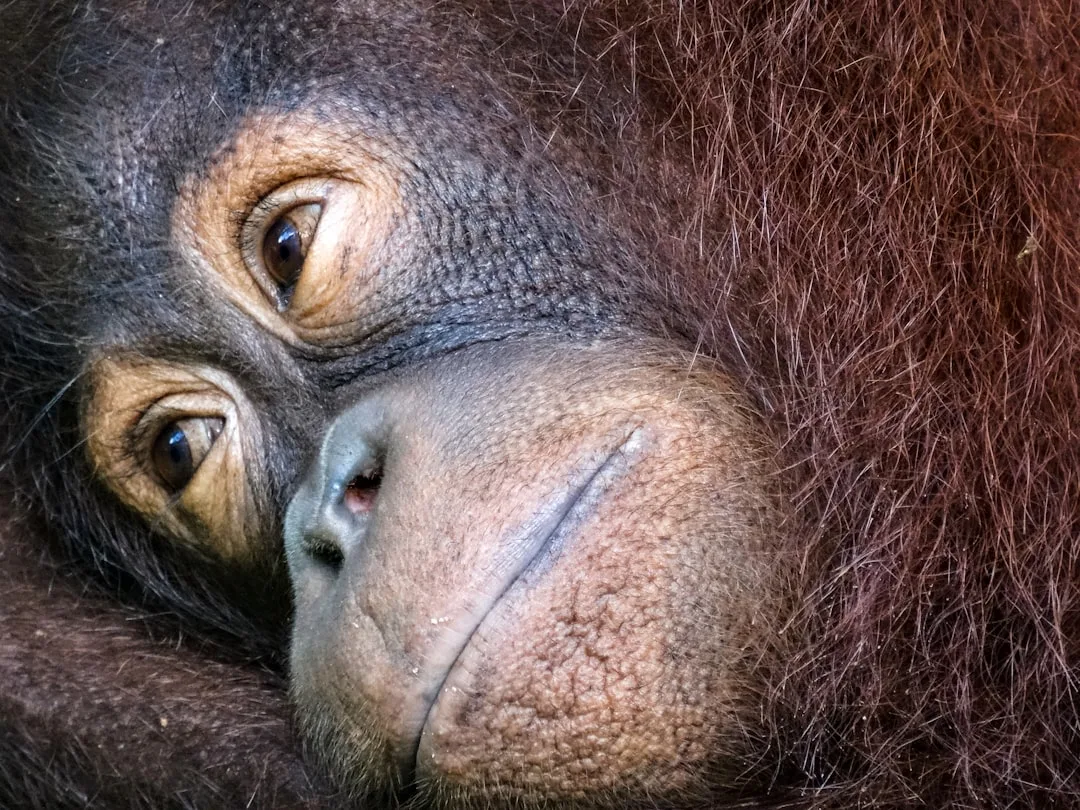
What is an aye-aye?
The aye-aye (Daubentonia madagascariensis) is the world's largest nocturnal primate and one of Madagascar's most bizarre lemur species. They grow to 35-45 cm body length plus a 50-55 cm bushy tail, weighing 2-3 kg. Their most distinctive features include huge sensitive ears, large forward-facing eyes, rodent-like ever-growing incisors (unusual for primates), and an extraordinarily long, skeletal middle finger that's three.
Nature's Woodpecker That Happens to Be a Primate
In the Madagascan rainforest at night, a small furry animal with huge ears and enormous eyes taps rapidly on a tree branch. It listens intently. The sound changes; it has found a hollow cavity. Its rodent-like teeth gnaw through the bark. Then it inserts its middle finger, three times longer than its other fingers, skeletal and strange, into the hole. The finger pulls out an insect larva.
This is an aye-aye, and it is one of the most bizarre primates on Earth. It has combined features from multiple animal groups, rodent teeth, woodpecker-like foraging, large-eyed night vision, and lemur body, into a creature that seems genuinely alien to most humans.
It's also highly endangered, partly because some Madagascan cultures consider it cursed.
The Animal
Aye-ayes (Daubentonia madagascariensis) are technically lemurs but unlike any other primate.
Physical features:
- Weight: 2-3 kg
- Body length: 35-45 cm
- Tail: 50-55 cm (longer than body)
- Ears: large and highly sensitive
- Eyes: huge, forward-facing
- Teeth: rodent-like, ever-growing incisors
- Signature feature: extraordinarily long middle finger
Family:
Aye-ayes are the only surviving member of the family Daubentoniidae. A second species (Daubentonia robusta) existed until approximately 1000 CE but went extinct.
The Middle Finger
The aye-aye's most distinctive feature is its specialized middle finger.
Properties:
- Three times longer than other fingers
- Skeletal appearance (reduced muscle and flesh)
- Ball-and-socket joint at the base for multi-directional movement
- Specialized sensory organs at the tip
- Hollow channel structure for extracting prey
The foraging technique:
Aye-ayes use the middle finger in percussive foraging:
- Tap: rapid tapping on tree branches (about 8 taps per second)
- Listen: detect acoustic signatures of hollow cavities
- Gnaw: use rodent-like front teeth to open the bark
- Extract: insert the long middle finger to pull out insect larvae
This technique is unique to aye-ayes among all primates. Woodpeckers do something similar with their beaks, but no other mammal has evolved this specific foraging method.
Finger protection:
The middle finger is too long for normal primate activities. Aye-ayes carry it tucked out of the way when not foraging. This protects it from damage and keeps it ready for precise foraging work.
The Big Ears
Aye-aye ears are proportionally huge.
Purpose:
The oversized ears serve as highly sensitive acoustic sensors for:
- Detecting the sound of insect larvae moving in wood
- Hearing the tapping differences between solid wood and hollow cavities
- Locating prey through subtle acoustic cues
- Night navigation
Sensitivity:
Aye-ayes can detect insect larvae chewing wood from considerable distance. Their hearing is among the most acute in any mammal of their size.
Why so big:
Percussive foraging requires very precise hearing. Evolution amplified the aye-aye's hearing by enlarging the ears, creating their distinctive appearance.
The Teeth
Aye-aye teeth are unusual for primates.
Structure:
Aye-ayes have two enormous front incisors that:
- Grow continuously throughout life (like rodent teeth)
- Are chisel-shaped for gnawing wood
- Include specialized enamel on the front surface
- Create self-sharpening edges through wear patterns
Why unusual:
No other primate has rodent-like teeth. This is a striking case of convergent evolution, aye-ayes developed teeth similar to unrelated rodents because both needed to gnaw through hard materials.
Uses:
- Breaking through bark
- Gnawing into hollow cavities containing larvae
- Processing tough fruits and seeds
- Cracking nuts (rare, when food available)
Where They Live
Aye-ayes are endemic to Madagascar.
Historical range:
Much of Madagascar's eastern, northern, and western coasts, in rainforest and dry deciduous forest habitats.
Current range:
Fragmented, much smaller than historical range. Confined primarily to:
- Masoala National Park (largest protected area for aye-ayes)
- Mantadia National Park
- Andasibe-Mantadia Reserve
- Ankarana National Park
- Various smaller protected areas
Habitat requirements:
- Primary forest with large trees
- Hollow cavities in trees for nesting
- Canopy continuity for movement between trees
- Insect prey availability
- Fruit trees for supplemental diet
Population:
- Estimated wild population: 1,000-5,000 individuals
- Trend: declining
- IUCN status: Endangered
Diet
Aye-ayes have a varied diet focused on high-value foods.
Primary foods:
- Insect larvae (primary source, via percussive foraging)
- Fruits (especially ramy nuts)
- Nuts and seeds
- Fungi
- Occasional bird eggs
- Honey when available
Seasonal variation:
- Dry season: more emphasis on hidden larvae
- Wet season: more fruit and accessible insects
- Fruit season: mostly fruit, depending on availability
Eating strategy:
Aye-ayes are efficient foragers. They focus on high-value food sources (energy-dense insect larvae and rich fruits) and spend relatively less time than many primates actively feeding.
Behavior
Aye-ayes have unusual behavior patterns.
Activity pattern:
Strictly nocturnal, active only at night. They spend daylight hours in nests built in tree hollows.
Nest building:
Aye-ayes construct elaborate leaf nests in tree canopies:
- Made from leaves, twigs, and plant material
- Usually spherical, 1-2 meters in diameter
- Have a single entrance
- Built high in canopy (10-30 meters up)
- May use multiple nests (one per individual)
Solitary nature:
Unlike most primates, aye-ayes are largely solitary:
- Adult males and females meet only for mating
- Mothers raise young alone
- Territories may overlap but social interactions are minimal
Territorial behavior:
Males defend territories of 100-200 hectares. Females have smaller territories within male territories. Boundaries are marked with scent.
Reproduction
Aye-aye reproduction is slow.
Mating:
- Occurs throughout the year (no specific season)
- Male and female meet briefly
- Gestation: 150-170 days
Births:
- Single offspring (rarely twins)
- Born in tree nests
- Weight at birth: 100-150 g
- Carried by mother for weeks to months
Development:
- Extended maternal care: 2-3 years
- Slow development compared to most mammals
- Learn percussive foraging from mother over months
- Sexual maturity: 3-5 years
Lifespan:
- Wild: estimated 20-30 years
- Captive: up to 25+ years
- Slow reproduction extends population recovery time
Cultural Superstitions
Madagascan cultural traditions have harmed aye-ayes.
Fady beliefs:
In parts of Madagascar, aye-ayes are considered "fady" (taboo or cursed). Traditional beliefs include:
- An aye-aye pointing its long finger at someone foretells death
- Aye-ayes visiting villages bring misfortune
- Killing an aye-aye prevents bad luck
- Seeing an aye-aye is an omen of disaster
Consequences:
These beliefs have led to:
- Aye-ayes killed on sight in some regions
- Fear of protecting aye-ayes (believed to bring bad luck)
- Cultural resistance to conservation programs
Conservation response:
Conservation efforts increasingly include:
- Cultural outreach to local communities
- Educational programs
- Economic alternatives to destructive practices
- Integration of traditional knowledge with conservation science
Some communities have revised traditional beliefs, replacing "aye-ayes bring bad luck" with "aye-ayes are special Madagascar animals we must protect."
Conservation
Multiple factors threaten aye-aye survival.
Primary threats:
Habitat loss:
- Deforestation for agriculture (rice, coffee, cocoa)
- Slash-and-burn land clearing (tavy)
- Commercial logging
- Road construction
Direct killing:
- Superstition-driven killing
- Snares set for other animals
- Retaliation for crop raiding (when aye-ayes eat fruit)
Population fragmentation:
- Small isolated populations
- Genetic bottlenecks
- Reduced resilience
Conservation efforts:
Protected areas:
- Multiple national parks provide habitat
- Strict enforcement needed
Community engagement:
- Education programs about aye-aye biology
- Economic alternatives to forest destruction
- Community-based forest management
Captive breeding:
- Zoos worldwide maintain captive populations
- Duke Lemur Center in North Carolina has significant breeding program
- International Species Information System coordinates breeding
Research:
- Population studies
- Genetic management
- Behavioral research
- Habitat requirements
Evolution
Aye-ayes represent an extreme evolutionary specialization.
Lineage:
The Daubentoniidae family evolved approximately 60 million years ago, making aye-ayes among the oldest living primate lineages. They diverged from other lemurs early in lemur evolution and developed their unique features in isolation on Madagascar.
Extinct relative:
Daubentonia robusta, a larger aye-aye species, existed until approximately 1000 CE when it went extinct, probably due to human hunting and habitat loss after human arrival in Madagascar.
Why Madagascar:
Madagascar separated from Africa 88 million years ago. Lemurs arrived approximately 60 million years ago (possibly on rafts of vegetation) and evolved in isolation.
Without competition from other primates or placental mammals typical of mainland Africa, lemurs diversified dramatically. The aye-aye represents the extreme end of this diversification, a primate that evolved into a nocturnal insect-extraction specialist unlike any other mammal.
The Misunderstood Primate
The aye-aye challenges assumptions about what primates can look like.
Most primates are recognizable as primates, grasping hands, forward-facing eyes, social behavior, complex vocalizations. The aye-aye has some of these but also features usually found in unrelated animal groups:
- Rodent-like teeth
- Woodpecker-like foraging behavior
- Extreme acoustic sensitivity (more like bats)
- Specialized prey-extraction tool (the middle finger)
This combination makes the aye-aye look "strange" to human observers, which, combined with its nocturnal habits and unusual facial features, has contributed to negative cultural perceptions.
In reality, every aye-aye feature evolved for a specific ecological purpose. Each trait reflects 60+ million years of evolutionary fine-tuning for one particular foraging strategy that no other animal in the world has adopted.
The aye-aye tapping on tree branches in the Madagascar night is performing a behavior that represents the end result of evolution solving a specific problem: how to access food hidden in wood that other animals can't reach. The solution, long finger, big ears, rodent teeth, looks bizarre to us but is perfectly adapted for its purpose.
As Madagascar's forests shrink, aye-aye populations shrink with them. Whether this extraordinary evolutionary experiment continues depends on human choices about forest conservation and cultural change in Madagascar. The aye-aye cannot adapt quickly enough to changed environments - its specialization is its strength in intact forests but vulnerability everywhere else.
The Middle Finger in Detail
The aye-aye's middle finger is among the most specialized biological structures documented in any primate. A 2019 study published in Science Advances used high-resolution imaging to describe its unique anatomy in detail [1]. The finger is controlled by a ball-and-socket joint rather than a standard hinge joint, allowing it to swing in multiple directions independently of other fingers. The distal phalanx is exceptionally thin and long, with reduced soft tissue to maintain flexibility.
Perhaps most surprisingly, the same study found that aye-ayes also possess a small pseudothumb on each hand - a finding that had been missed for more than 150 years of primate anatomy. The pseudothumb is a cartilaginous structure that gives aye-ayes a functional sixth digit. Our research team finds this extraordinary: a well-studied primate harboring an undescribed anatomical feature well into the 21st century.
"The aye-aye's hand is arguably the most morphologically innovative among primates. Every finger has a distinct role, and the discovery of the pseudothumb shows how much we still have to learn even about primates that have been in zoos for decades." - Dr. Adam Hartstone-Rose, North Carolina State University [1]
Aye-Aye Hand Specialization
| Digit | Function | Key features |
|---|---|---|
| Thumb | Grasping | Opposable, standard primate form |
| Pseudothumb | Grip stabilization | Newly described 2019, cartilaginous |
| Index finger | Grasping | Short relative to others |
| Middle finger | Larval extraction | 3x longer, ball-socket joint, sensory tip |
| Ring finger | Grasping | Long, flexible |
| Little finger | Hook-like grip | Standard primate form |
The middle finger tip contains specialized thermoreceptors and touch-sensitive cells, allowing the aye-aye to feel for temperature gradients inside tree cavities - a potential heat signature of grub metabolism that helps locate prey.
Percussive Foraging as Convergent Evolution
Percussive foraging - tapping a substrate to detect prey through acoustic feedback - has evolved independently in at least four distinct animal lineages: aye-ayes, woodpeckers, striped possums (an Australian marsupial), and certain species of pocket mice. This is a striking example of convergent evolution. Four unrelated animals living on three continents evolved similar solutions to the problem of extracting insects from wood.
The aye-aye is the only primate to do this. A 2013 comparative study at the University of California Davis measured tapping frequencies across aye-ayes and striped possums and found remarkable similarity: both species tap at 7 to 11 Hz, close to the optimal frequency for distinguishing solid from hollow wood acoustically [2].
Percussive Foraging Species
| Species | Taxonomic group | Region | Tapping rate |
|---|---|---|---|
| Aye-aye | Primate | Madagascar | 8 Hz average |
| Striped possum | Marsupial | New Guinea, Australia | 7-10 Hz |
| Woodpeckers (various) | Bird | Global | 10-20+ Hz |
| Pocket mice (some) | Rodent | North America | Variable |
"When you see the same solution evolve four separate times in mammals and birds, you are looking at a fundamental property of the environment itself. Wood-boring insects are an abundant, calorie-rich food source, and acoustic detection is one of the few effective ways to find them. The aye-aye's middle finger is the most exquisite of these solutions, but it is not the only one." - Dr. Erin Ehmke, Duke Lemur Center [3]
Notable Research Findings
- Aye-ayes can detect grub movement through up to 1 cm of solid wood. This is the best cross-medium acoustic detection documented in any mammal.
- Duke Lemur Center in North Carolina has maintained the primary captive breeding population of aye-ayes since 1987. As of 2023, the program has produced more than 30 successful captive births and contributes to the global ex-situ backup of the species.
- Aye-aye genome sequencing in 2016 confirmed their deep evolutionary position among strepsirrhine primates. They are the most genetically distinctive living primate species, with a lineage separated from all other lemurs by roughly 60 million years.
- A 2018 study found that aye-ayes can pick noses in a way few other animals do, inserting their long middle finger up to 8 cm into the nasal cavity. The function is debated; hypotheses include mucus sampling for pathogen detection and scent marking.
- Our research team notes that aye-ayes are the only primate known to chew through the outer shell of the ramy nut (Canarium madagascariense), which is too hard for any other lemur to process. This makes them potentially important seed dispersers for species whose reproduction may depend on aye-aye activity - a conservation concern extending beyond the aye-aye itself.
Related Articles
- How Similar Are Chimpanzees to Humans?
- How Strong Is a Gorilla?
- Primates: Our Closest Relatives in the Animal Kingdom
References
[1] Hartstone-Rose, A., Dickinson, E., Boettcher, M. L., & Herrel, A. (2019). A primate with a panda-like thumb: The anatomy of the pseudothumb of Daubentonia madagascariensis. American Journal of Physical Anthropology, 171(1), 8-16. DOI: 10.1002/ajpa.23936
[2] Sterling, E. J., & McCreless, E. E. (2006). Adaptations in the aye-aye: A review. In L. Gould & M. L. Sauther (Eds.), Lemurs: Ecology and Adaptation (pp. 159-184). Springer.
[3] Erickson, C. J. (1991). Percussive foraging in the aye-aye, Daubentonia madagascariensis. Animal Behaviour, 41(5), 793-801.
[4] Perry, G. H., Reeves, D., Melsted, P., et al. (2012). A genome sequence resource for the aye-aye (Daubentonia madagascariensis), a nocturnal lemur from Madagascar. Genome Biology and Evolution, 4(2), 126-135. DOI: 10.1093/gbe/evr132
[5] IUCN Red List. (2020). Daubentonia madagascariensis assessment. International Union for Conservation of Nature.
[6] Simons, E. L., & Meyers, D. M. (2001). Folklore and beliefs about the aye-aye (Daubentonia madagascariensis). Lemur News, 6, 11-16.
[7] Randimbiharinirina, D. R., Raharivololona, B. M., Hawkins, M. T. R., et al. (2021). Aye-aye (Daubentonia madagascariensis) presence and ecology in the dry forests of north-western Madagascar. Primate Conservation, 35, 1-11.
Frequently Asked Questions
What is an aye-aye?
The aye-aye (Daubentonia madagascariensis) is the world’s largest nocturnal primate and one of Madagascar’s most bizarre lemur species. They grow to 35-45 cm body length plus a 50-55 cm bushy tail, weighing 2-3 kg.
Their most distinctive features include huge sensitive ears, large forward-facing eyes, rodent-like ever-growing incisors (unusual for primates), and an extraordinarily long, skeletal middle finger that’s three times longer than their other fingers. This long finger is used for percussive foraging - tapping on tree branches to locate hollow cavities where insect larvae live, then extracting the larvae through a hole in the bark.
Aye-ayes are the only primates that find food this way. They are primarily solitary, active only at night, and spend most of their time in trees. The species was long thought to be extinct before being rediscovered in 1961. They remain one of Madagascar’s most endangered and culturally misunderstood animals.
Why do aye-ayes have such long fingers?
Aye-ayes have an extraordinarily elongated middle finger - three times longer than their other fingers - as a specialized tool for extracting insect larvae from tree bark. The technique is called percussive foraging and is unique to aye-ayes among primates. The aye-aye taps rapidly on a branch with its long finger (roughly 8 taps per second) while listening intently with its huge ears.
When the tapping sound changes - indicating a hollow cavity where larvae might be - the aye-aye uses its rodent-like front teeth to gnaw a hole in the bark, then inserts the long finger to extract the grub. The middle finger also has a ball-and-socket joint at the base, allowing it to move in multiple directions. The finger is so long that the aye-aye cannot use it normally for climbing - it tucks the finger out of the way when not foraging.
This combination of enlarged finger, rodent-like teeth, and precise hearing represents one of the most specialized foraging adaptations in any primate.
Are aye-ayes scary or dangerous?
Aye-ayes are harmless to humans but culturally feared in parts of Madagascar due to their unusual appearance. They are small (2-3 kg), eat primarily insects and fruit, and have no history of attacking humans. However, traditional Malagasy belief in some regions considers aye-ayes ‘fady’ (taboo) or bearers of bad luck.
Various traditions hold that aye-ayes pointing their long middle finger at someone foretells that person’s death, or that aye-ayes visiting a village herald misfortune. These beliefs have historically led to aye-ayes being killed on sight in some regions. Combined with habitat loss, these cultural attitudes have contributed significantly to their endangered status.
Conservation efforts include educational programs to change local perceptions and integrate aye-aye protection with community interests. The species is actually ecologically beneficial - by eating wood-boring insect larvae, they help control forest pests. Their apparent ‘scary’ appearance (huge eyes, large ears, skeletal finger) developed purely as foraging adaptations, not for defense.
Where do aye-ayes live?
Aye-ayes live exclusively in Madagascar, in rainforests and dry deciduous forests along the eastern, northern, and western coasts. They prefer primary forest habitat with large trees that provide hollow cavities for nest-building and food sources. They have a discontinuous distribution, meaning their populations are scattered across suitable habitat rather than continuous. Total population estimates suggest only 1,000-5,000 individuals remain in the wild.
Major threats include deforestation for agriculture (particularly rice cultivation), slash-and-burn land use (tavy), habitat fragmentation, and direct killing due to cultural superstitions. Aye-ayes have been extirpated from much of their historical range. They are now found primarily in protected areas including Masoala National Park, Mantadia National Park, Andasibe-Mantadia Reserve, and a few other protected areas.
They require continuous canopy for movement between trees and prefer forests with diverse tree species that provide year-round food sources.
How do aye-ayes find food?
Aye-ayes use a sophisticated four-part technique to find hidden insect larvae in tree bark. First, they tap rapidly on branches with their long middle finger (percussive foraging) while listening intensely. Second, they analyze the sound patterns - different sounds indicate solid wood versus hollow cavities where larvae live. Third, when they detect a likely cavity, they use their rodent-like incisors to gnaw through bark.
Fourth, they insert their long middle finger to extract the larva and pull it out. This entire process takes just seconds in practiced aye-ayes. They also eat fruits, nuts, fungi, insects on plant surfaces, and bird eggs. During fruit season, they may eat mostly fruit. During insect season, they rely heavily on percussive foraging for larvae. Their hearing is so acute that they can detect insect larvae chewing wood from considerable distance.
The technique is so specialized that aye-ayes can find food resources other animals cannot access, giving them access to an exclusive food niche. Young aye-ayes learn percussive foraging over months of practice with their mothers.