
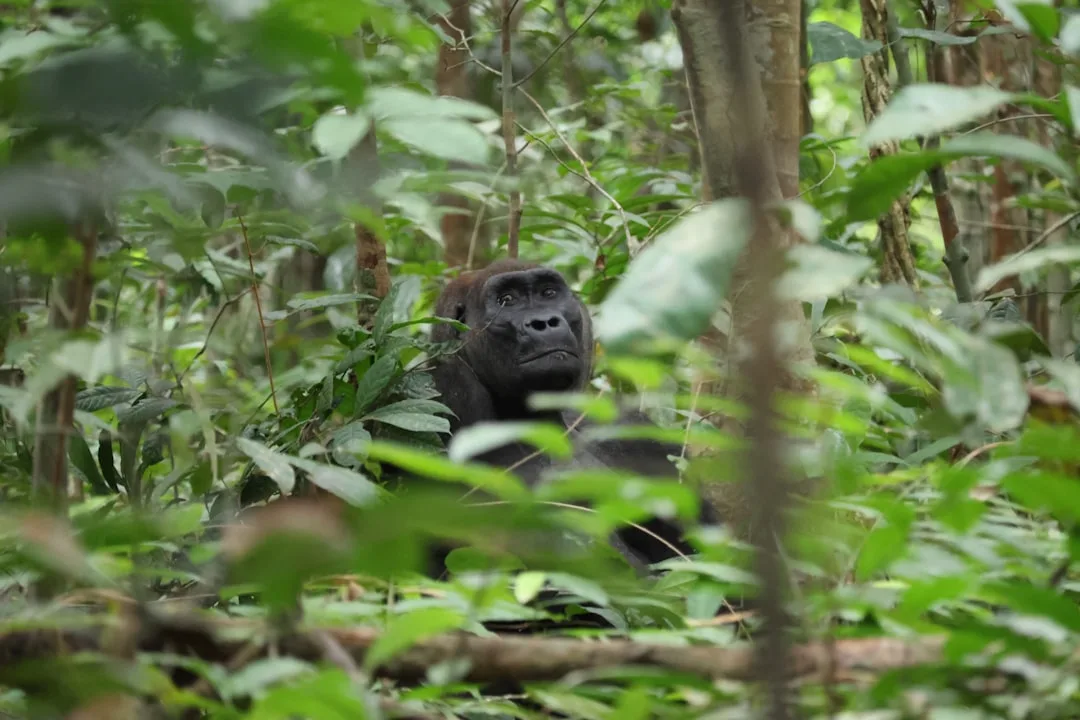
The mountain gorilla is the rarest great ape on Earth and, against almost every trend in modern conservation, the only one whose population is currently growing.
Found in only two places - the Virunga volcano chain and the Bwindi Impenetrable Forest - Gorilla beringei beringei survives on steep, misted slopes between 2,200 and 4,300 metres, feeds on leaves for most of its waking life, and lives in tightly bonded family groups led by the massive silverback males that have become the face of African primate conservation.
This guide covers the full biology and ecology of the mountain gorilla: taxonomy and evolutionary position, physical size and dimorphism, cloud-forest habitat, diet, social structure, reproduction, intelligence and tool use, the long road from the brink of extinction, and the relationship between gorillas and the humans who share - and protect - their tiny range.
Where polar bears define an entire ocean, mountain gorillas define a handful of volcanoes. Both stories end with human beings making a decision.
Etymology and Classification
The scientific name Gorilla beringei honours Captain Robert von Beringe, a German colonial officer who, in 1902, shot two large apes on the slopes of Mount Sabyinyo and sent the remains to Berlin. The specimens proved to be a previously undescribed species, eventually split from the better-known western gorillas in the 1960s and 1970s. The subspecies name beringei repeats the tribute.
Local names exist in several East African Bantu languages, including ingagi in Kinyarwanda and enkuzi y'ensiki in Rukiga.
Modern genetics places the mountain gorilla firmly within the great ape family Hominidae, alongside chimpanzees, bonobos, orangutans, and humans. Within the genus Gorilla, there are two full species - the western gorilla (G. gorilla) and the eastern gorilla (G. beringei).
The eastern gorilla is then split into two subspecies: Grauer's gorilla (G. b. graueri) of the lowland rainforests of the eastern DRC, and the mountain gorilla (G. b. beringei) of the high volcanic and montane forests. The split between the mountain and lowland eastern gorillas is estimated at roughly 400,000 years ago.
Mountain gorillas share approximately 98.3% of their DNA with modern humans. Differences in that tiny remaining fraction produce a very different animal: a 200-kilogram herbivore at home in freezing cloud forest, with arms longer than legs, no tail, and a digestive system that can process several kilograms of nettles and bamboo per day without discomfort.
Size and Physical Description
Mountain gorillas are among the largest primates that have ever lived. Sexual dimorphism is extreme - mature males can be more than twice the mass of mature females - and body proportions are adapted for a life spent walking on the knuckles, sitting while feeding, and occasionally climbing moderate-sized trees.
Silverbacks (adult males):
- Standing height: 1.5-1.8 metres
- Weight: typically 130-220 kg, with outliers over 250 kg
- Arm span: 2.3-2.6 metres
- Canine length: up to 5 cm
- Distinctive silver-grey saddle from around age 12
Adult females:
- Standing height: 1.3-1.5 metres
- Weight: 70-100 kg
- Slimmer build with shorter canines
- Retain black back hair throughout life
Infants:
- Birth weight: 1.8-2 kg
- Able to cling to the mother's fur from day one
- Walk independently by 8-9 months
Compared with the western lowland gorilla, the mountain subspecies is more stoutly built, with longer and denser fur. This coat, often several centimetres thick across the chest and upper arms, is a direct adaptation to the cold cloud forest: nighttime temperatures at 3,000 metres routinely fall below freezing, and heavy rain can soak an animal for days at a time. The face is black and mostly hairless; the chest and torso thicken noticeably in mature males because of layered fat and muscle.
Mountain gorilla anatomy is unmistakably that of a great ape. Arms are longer than legs to support knuckle-walking. The pelvis is broad and short compared with a human's. The brain is roughly 500 cubic centimetres, about a third of a human brain but well above most other mammals of comparable body size.
Fingerprints and footprints are unique to each individual, as in humans, and field researchers use nose prints - patterns of wrinkles above the nostrils - to identify individuals from photographs.
Habitat and Range
Mountain gorillas live in only two contiguous regions, separated by roughly 25 kilometres of farmland that no gorilla is known to cross.
The Virunga Massif stretches across the borders of Rwanda, Uganda, and the Democratic Republic of the Congo and contains eight volcanoes, three of them active. Protected areas inside the Virungas include Volcanoes National Park (Rwanda), Mgahinga Gorilla National Park (Uganda), and Virunga National Park (DRC). Altitudes where gorillas feed range from about 2,500 to 4,000 metres.
Bwindi Impenetrable Forest sits in southwestern Uganda at altitudes of 1,160-2,600 metres, slightly lower and warmer than the Virungas. Its dense, tangled undergrowth - the source of the 'impenetrable' name - makes ground travel difficult for humans and ideal for gorillas.
The total global range of the subspecies is approximately 780 square kilometres. For comparison, polar bears occupy several million square kilometres of ice. The full world population of mountain gorillas could fit, loosely, inside a single city.
Within this range, gorilla groups move through a mosaic of habitat zones:
- Bamboo zone (2,400-2,800 m): seasonal, heavily used during the rainy season when new shoots emerge
- Hagenia woodland (2,800-3,400 m): open canopy with dense ground herbs; key year-round feeding zone
- Giant senecio and lobelia subalpine (3,400-4,300 m): rarer visits, mainly during long sunny days
- Afromontane rainforest (in Bwindi only): multi-layered canopy with higher fruit availability
Each gorilla group has a home range of roughly 6 to 40 square kilometres, overlapping heavily with other groups. Gorillas are not territorial in the way most cats or canids are. Groups encounter each other frequently, avoid direct fights when they can, and tolerate a great deal of overlap.
Diet and Feeding Ecology
Mountain gorillas are essentially vegetarian. Their massive bodies, unlike those of most large predators, are fuelled almost entirely by leaves, stems, shoots, pith, and the occasional fruit or invertebrate.
Typical diet composition:
| Food type | Share of diet | Examples |
|---|---|---|
| Leaves and shoots | ~70% | Wild celery, nettles, thistles, galium vines |
| Stems and pith | ~15% | Bamboo shoots, wild ginger stems |
| Fruit | 3-15% | Bwindi figs, mimulopsis; much higher in Bwindi |
| Bark and roots | 3-5% | Mineral-rich roots dug from volcanic soil |
| Insects | ~1% | Ants, grubs, occasional termites |
An adult silverback eats 18-25 kg of vegetation per day. Females eat 10-15 kg. Feeding takes up roughly 30% of daylight hours, split between a long morning feed, a midday rest, and an afternoon session before building nests at dusk. Because the diet is low in calories per kilogram, gorillas must process enormous volumes of material. Their large intestines and complex gut flora ferment fibrous plant matter in a way more reminiscent of a horse than a carnivore.
Despite their size and canine teeth, mountain gorillas do not hunt. The ~40 grams per day of ants and occasional grubs appear to be a targeted protein and micronutrient supplement rather than a meaningful energy source. Field researchers have documented gorillas tolerating repeated ant stings to get at particular nests, suggesting the nutritional payoff outweighs the irritation.
Mountain gorillas rarely drink standing water. Plant moisture from daily fog, rain, and sap provides nearly all their hydration. In captivity (where no mountain gorillas now live but where western gorillas are common), animals drink readily, suggesting the no-drinking behaviour in the wild is opportunistic rather than physiological.
Social Structure and Behaviour
Mountain gorilla society revolves around the silverback. A typical group contains:
- 1 dominant silverback (sometimes a second subordinate silverback)
- 3-6 adult females
- 1-3 blackback or subadult males
- 2-6 juveniles
- 1-4 infants
Group sizes range from 2 to over 30 individuals, with an average near 10. Unlike chimpanzee communities, which are fission-fusion societies, gorilla groups stay together day and night, travel together, and rest together. Infants cling to their mothers' backs; juveniles play and wrestle constantly; adult females groom each other and their offspring.
Silverbacks do relatively little grooming but spend a great deal of time watching, listening, and making decisions about where the group will feed next.
Communication in mountain gorillas includes:
- Chest-beating. The classic cupped-hand drumming on the chest produces a hollow sound carrying more than a kilometre through dense forest. Each silverback's beat pattern is individually distinct. It is used as long-distance identification, threat display, and a warning to subordinates.
- Vocalisations. Researchers have catalogued at least 25 distinct calls, including soft grunts during feeding, screams during conflict, hoot series used by silverbacks, and a recently described humming-and-singing behaviour that appears during contentment while eating favoured foods.
- Facial expressions and posture. Stiff-legged walks, lowered heads, and open-mouth displays serve as clear warnings without the need for physical contact.
- Nest building. Every night, each individual over about three years old builds a fresh sleeping nest of bent branches and leaves. Nest counts are how researchers estimate population sizes from the ground.
Conflict within a group is rare and mostly ritualised. Serious violence is usually reserved for encounters between silverbacks - typically a resident silverback defending his females against a lone challenger. These fights can involve biting and serious wounds, though lethal outcomes are uncommon. More dangerous for the group is a takeover, where a new silverback may kill existing infants in order to bring females back into oestrus.
Reproduction and Life Cycle
Mountain gorillas reproduce slowly even by great ape standards. Females reach sexual maturity around age 8 and give birth for the first time at roughly age 10. Gestation lasts 8.5 months - almost identical to humans. A healthy female typically produces a single infant every four years, and sometimes goes six years between births when conditions are poor or when a previous infant dies.
Life-stage summary:
- Infant (0-3.5 years): clings to mother, nurses, begins solid food around 5 months
- Juvenile (3.5-6 years): independent locomotion, plays with peer group, begins to be weaned
- Subadult (6-8 years): weaned, socially mobile, males may consider leaving the group
- Blackback (8-12 years): fully grown but without silver markings, peripheral in group
- Silverback (12+ years): sexual maturity, potential group leadership
- Prime silverback (15-25 years): typical period of reproductive dominance
- Senior (25-40 years): slower, fewer offspring, often displaced by younger males
Infant mortality is significant. Roughly 25-35% of infants die before age three, a much higher rate than in humans and comparable to that in many wild great ape populations. Primary causes are infanticide during silverback takeovers, respiratory disease, parasites, and falls. Females who have lost an infant to infanticide often bond quickly with the new silverback, a pattern with clear evolutionary logic but deep costs at the individual level.
Older females sometimes experience a menopause-like decline in fertility, with few births after age 40. This makes mountain gorillas one of a small number of mammals other than humans and certain whales in which post-reproductive life is documented.
Intelligence and Tool Use
Mountain gorillas are highly intelligent, though less publicised than chimpanzees and orangutans for tool use because wild observations are harder to collect in the dense cloud forest. Key documented capacities include:
- Tool use in the wild. A female in the Virungas was filmed using a long stick to test the depth of a swampy pool before crossing. Another gorilla used a flat rock as a support to process nettles. Both events are rare but well-documented.
- Problem solving. Gorillas remove snares set by poachers - a behaviour particularly documented in juveniles in the Karisoke groups, who have been filmed working together to free trapped group members.
- Vocal innovation. The recently documented humming-and-singing behaviour during favoured meals was not described in the early Fossey literature and may represent either cultural learning or previously missed behaviour.
- Mirror and self-recognition. No wild mountain gorilla has been tested, but captive western lowland gorillas pass modified mirror self-recognition tests, suggesting some form of self-awareness is likely present in the mountain subspecies as well.
- Long-term memory of individuals. Silverbacks reliably recognise other silverbacks from previous encounters years earlier, even at long range through sound alone.
Taken together, mountain gorilla cognition fits the pattern expected for a large-brained, socially complex great ape: powerful memory for individuals, flexible problem solving under ecological pressure, and a rich communicative repertoire that is almost certainly still being under-described.
Conservation Status and Recovery
The IUCN currently lists mountain gorillas as Endangered with an increasing population trend. This status is the result of a specific and deliberate conservation campaign, and the subspecies is one of the few large mammals on Earth whose numbers are rising.
Population trajectory:
| Year | Estimated population | Notes |
|---|---|---|
| 1960s | ~450 | Baseline surveys |
| 1981 | ~254 | Lowest documented point; Dian Fossey active in Virungas |
| 2003 | ~380 | First clear signs of sustained increase |
| 2010 | ~480 (Virungas) | Virunga-only census |
| 2018 | ~1,063 | Combined Virunga and Bwindi census; uplisted to Endangered |
| 2024 | ~1,100 (est.) | Latest partial surveys |
Active threats remain serious despite this recovery:
- Disease transmission from humans. Because mountain gorillas share 98.3% of our DNA and their immune systems have no evolutionary experience with many human pathogens, respiratory infections, measles, and Ebola can spread rapidly. Tourism has tightened face-mask rules and minimum approach distances for this reason.
- Snares set for other game. Snares intended for duikers and bushbuck regularly catch gorillas, particularly juveniles. Snare-removal patrols pull thousands of snares per year out of the parks.
- Armed conflict. The eastern DRC has seen repeated waves of civil conflict that spill into Virunga National Park. Park rangers have been killed in greater numbers than almost any other protected area on Earth.
- Habitat loss at the edges. The gorilla habitat is almost completely surrounded by dense human settlement and agriculture. Any loss of buffer habitat has outsized effects.
- Climate-driven range shift. As temperatures rise, the habitat zones gorillas depend on move upslope. Several volcanoes offer limited room above current gorilla range.
Even with these pressures, the recovery is real and ongoing. The combination of strict protection, veterinary intervention through the Mountain Gorilla Veterinary Project, aggressive anti-poaching patrols, and a funding model that channels ecotourism revenue back into protection has worked in a way that few other great ape conservation programmes have matched.
Dian Fossey and the Human Story
No account of mountain gorillas is complete without Dian Fossey. The American zoologist arrived in the Virungas in 1967 at the invitation of anthropologist Louis Leakey and established the Karisoke Research Center between the Bisoke and Karisimbi volcanoes.
Over the next eighteen years she habituated multiple gorilla groups to human presence, producing the first close-range behavioural data on the subspecies and writing Gorillas in the Mist, later adapted into a 1988 film that made mountain gorillas internationally famous.
Fossey was also openly hostile to poachers. She cut snares, destroyed traps, publicly confronted local authorities she suspected of collusion, and ran Karisoke as a strictly defended research enclave. On 26 December 1985 she was murdered in her cabin, struck down with a panga. The case has never been solved. Her grave at Karisoke sits next to Digit, her favourite silverback, who had been killed by poachers in 1977.
The Dian Fossey Gorilla Fund she founded continues daily patrols, veterinary interventions, and community engagement work. Multiple population assessments credit the fund - alongside Rwandan and Ugandan national park authorities and international NGOs - with much of the quadrupling of the Virunga population since Fossey's death.
Mountain Gorillas and Ecotourism
Mountain gorilla trekking is the single largest source of conservation funding for the subspecies. Permits are sold by national park authorities in Rwanda, Uganda, and the DRC. 2024 prices are USD 1,500 in Rwanda, USD 700 in Uganda, and USD 400 in DRC. Rules are strict and uniform:
- Maximum eight visitors per habituated group per day
- Maximum visit length of one hour
- Minimum approach distance of seven metres
- Mandatory face masks to reduce disease transmission
- No flash photography, no food or drink in the gorillas' presence
- Trekkers showing signs of illness are turned back
A meaningful share of permit revenue is returned to surrounding communities through revenue-sharing schemes, school construction, and employment in parks. This model, pioneered in Rwanda and extended throughout the region, converted mountain gorillas from a liability for local landholders - a crop-raiding rare species that took up scarce land - into a direct source of income. The result is one of the rare examples of a tourism-based conservation model that has almost certainly saved a species.
Related Reading
- How Strong Is a Gorilla? Silverback Power Measured
- Chimpanzee: Our Closest Living Relative
- How Similar Are Chimpanzees to Humans?
- Primates: Our Closest Relatives in the Animal Kingdom
- Aye-Aye: The Weirdest Primate
References
Relevant peer-reviewed and governmental sources consulted for this entry include IUCN SSC Primate Specialist Group assessments (2018, 2022), the International Gorilla Conservation Programme census reports (2010, 2018), Dian Fossey Gorilla Fund annual scientific reports, Uganda Wildlife Authority and Rwanda Development Board visitor statistics, and published research in Primates, American Journal of Primatology, Oryx, and PLOS ONE.
Population figures reflect the most recent consolidated census from the combined Virunga and Bwindi surveys.
Frequently Asked Questions
How big are mountain gorillas?
Adult male mountain gorillas, known as silverbacks, weigh 130-220 kg and stand 1.5-1.8 m tall when upright. Females are considerably smaller at 70-100 kg and 1.3-1.5 m. Arm spans on large silverbacks reach 2.3-2.6 m - longer than the bears they share documentary screen time with.
Despite this mass, mountain gorillas have slightly shorter limbs and denser, longer fur than their western lowland cousins, an adaptation to the cold, wet cloud forests they inhabit. Newborns weigh roughly 1.8-2 kg, about half the birth weight of a human infant.
What do mountain gorillas eat?
Mountain gorillas are folivores - leaf eaters. Roughly 70% of their diet is foliage, including wild celery, nettles, thistles, bamboo shoots, and the pith of dozens of plant species. Fruit makes up less than 15% of intake, mostly because little fruit grows above 2,500 m. They also eat roots, bark, rotten wood for minerals, and around 40 grams of ants per day as a protein supplement.
An adult silverback processes 18-25 kg of vegetation daily, which is why gorilla troops spend about a third of every daylight hour feeding and another third resting to digest. They rarely drink standing water; plant moisture meets their hydration needs.
Where do mountain gorillas live?
Mountain gorillas exist in only two places on Earth, both at high elevation in central Africa. The first is the Virunga Massif, a chain of eight volcanoes straddling the borders of Rwanda, Uganda, and the Democratic Republic of the Congo, protected by Volcanoes National Park, Mgahinga Gorilla National Park, and Virunga National Park. The second is Bwindi Impenetrable Forest in southwestern Uganda, approximately 25 km away and genetically distinct.
Both populations live between 2,200 and 4,300 metres above sea level in Afromontane cloud forest, bamboo zones, and subalpine meadows. The entire global range covers roughly 780 square kilometres - smaller than many city limits.
Are mountain gorillas endangered?
The IUCN currently lists mountain gorillas as Endangered. In 2018 the status was upgraded from Critically Endangered after repeated censuses showed the population had grown to roughly 1,063 individuals, split between about 459 in Bwindi and 604 in the Virungas. This makes the mountain gorilla the only great ape subspecies whose population is increasing.
Threats remain serious, however: habitat loss, disease transmission from humans and livestock, poaching snares set for other animals, regional armed conflict in eastern DRC, and climate-driven shifts in their narrow altitudinal range. A single new disease outbreak could erase decades of recovery.
How long do mountain gorillas live?
Wild mountain gorillas typically live 35-40 years. The oldest documented wild individual, a female named Poppy studied by the Dian Fossey Gorilla Fund, reached at least 43. Captive western lowland gorillas have lived into their late 50s and early 60s, but no mountain gorilla has ever been held in captivity successfully, so captive longevity records do not apply.
Infant mortality in the wild is relatively high - roughly 25-35% of infants die before age three, mostly from disease, falls, or infanticide when a new silverback takes over a group. Females typically give birth to their first offspring at age 10 and produce one infant every four years until their mid-thirties.
What is a silverback and how does a gorilla become one?
A silverback is a fully mature male mountain gorilla, named for the band of silver-grey hair that develops across the back and flanks from around age 12. Before that, males are called blackbacks. Silverbacks are the decision makers of a gorilla troop: they choose travel routes, feeding sites, and sleeping areas, mediate disputes between females, and defend the group from predators, rival males, and poachers.
A troop normally contains one dominant silverback, though roughly 40% of Virunga groups now include a second subordinate silverback as well. Becoming a dominant silverback requires either inheriting a group through attrition or challenging and defeating another silverback - a high-risk path that can end in serious injury.
Who was Dian Fossey and why does she matter for mountain gorillas?
Dian Fossey was an American zoologist who established the Karisoke Research Center in the Virungas in 1967 and spent eighteen years studying mountain gorillas at close range. Her habituation work made long-term behavioural observation possible, her book Gorillas in the Mist brought global attention to the subspecies, and her aggressive anti-poaching campaigns directly saved many individual gorillas.
Fossey was murdered in her cabin at Karisoke in December 1985; her killer has never been conclusively identified. The Dian Fossey Gorilla Fund she founded continues to run daily patrols, veterinary interventions, and community programmes, and is one of the main reasons the population has more than quadrupled since her death.
Can humans visit mountain gorillas in the wild?
Yes. Regulated gorilla trekking is available in four national parks: Volcanoes (Rwanda), Mgahinga and Bwindi (Uganda), and Virunga (DRC). Permits are strictly limited, with only eight visitors allowed per habituated group per day and a maximum visit length of one hour. Costs in 2024 are USD 1,500 per permit in Rwanda, USD 700 in Uganda, and USD 400 in DRC.
Rules prohibit approaching closer than seven metres, require masks to prevent respiratory disease transmission, and forbid flash photography. Permit fees fund park operations, ranger salaries, veterinary care, and revenue-sharing with local communities. Tourism is now the single largest source of conservation funding for mountain gorillas and is credited with much of the recent population recovery.