
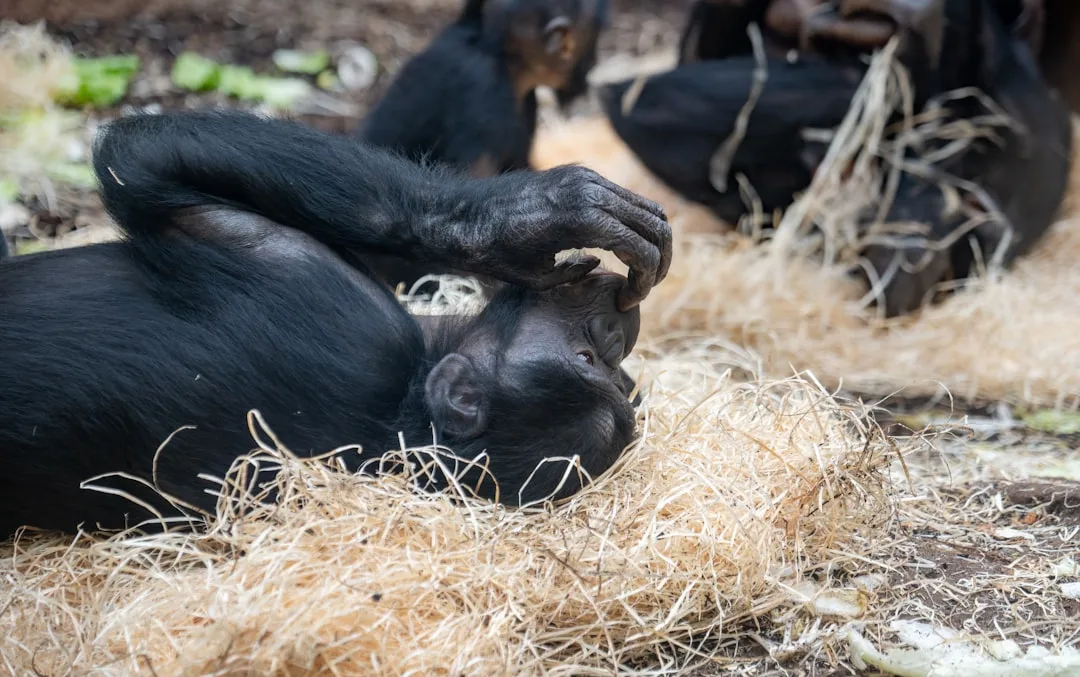
The chimpanzee is the closest living relative of the human species, tied only with its sister species the bonobo.
Pan troglodytes shares roughly 98.8% of its DNA with Homo sapiens, and the split between the human and chimpanzee lineages is estimated to have occurred only six to seven million years ago - recent enough that much of our shared biology, behaviour, and cognition remain clearly recognisable on both sides of the family tree.
Understanding chimpanzees is, in a very direct sense, an exercise in understanding the biological scaffolding of humanity itself.
This guide covers every major aspect of chimpanzee biology and behaviour: anatomy, subspecies, habitat, diet, tool culture, social structure, warfare, reproduction, cognition, conservation status, and the long and uneasy history between chimpanzees and humans. It is a reference entry, not a summary - expect specific numbers, named field sites, documented dates, and verified records.
Etymology and Classification
The scientific name Pan troglodytes combines the Greek god Pan - a woodland deity associated with wild, goat-legged forms - with the Greek troglodytes, meaning 'cave-dweller', a label applied by 18th-century European naturalists who assumed (incorrectly) that the animals lived in caves. The English word 'chimpanzee' derives from the Tshiluba term kivili-chimpenze, meaning roughly 'mock man' or 'ape', and entered European languages via Angolan Bantu in the 1730s.
Chimpanzees sit inside the family Hominidae, the great apes, alongside gorillas, orangutans, and humans. The genus Pan contains two species: the common chimpanzee (Pan troglodytes) covered here, and the bonobo (Pan paniscus), restricted to the forests south of the Congo River. Molecular evidence indicates the bonobo and chimpanzee lineages diverged roughly one to two million years ago, most likely when the formation of the Congo River cut a population in two.
Four subspecies of common chimpanzee are currently recognised:
- Central chimpanzee (P. t. troglodytes) - the most numerous, centred on Gabon, Cameroon, and the Republic of Congo.
- Eastern chimpanzee (P. t. schweinfurthii) - found from the Central African Republic across the DRC to Uganda, Rwanda, and Tanzania. Includes the famous Gombe and Mahale populations.
- Western chimpanzee (P. t. verus) - west African from Senegal to Ghana, separately classified as Critically Endangered.
- Nigeria-Cameroon chimpanzee (P. t. ellioti) - the rarest and most range-restricted subspecies, confined to a small area on either side of the Nigeria-Cameroon border.
Despite the long scientific assumption that humans were uniquely separated from the rest of the great apes, molecular taxonomy now places humans so deep inside the Hominidae that some authorities argue chimpanzees and humans should share a genus - a proposal that remains contested but illustrates just how close the evolutionary relationship is.
Size and Physical Description
Chimpanzees are medium-sized great apes, substantially smaller than gorillas and slightly smaller than orangutans. Sexual dimorphism exists but is milder than in gorillas.
Males:
- Standing height: 1.2-1.7 m
- Weight: typically 40-70 kg
- Knuckle-walking shoulder height: 0.9-1.0 m
Females:
- Standing height: 1.0-1.3 m
- Weight: typically 27-50 kg
- Slightly shorter arms and lighter build
Infants at birth:
- Weight: 1.5-2.0 kg
- Cling to mother's belly fur within hours, ride on her back from several months
The most distinctive structural feature of the chimpanzee body is its arm span, which exceeds the standing height by roughly one and a half times. This elongated upper body is an adaptation for brachiation - swinging through the forest canopy using the arms alone. The shoulder joint rotates through a nearly complete circle, the forearm is long, and the hand is large with long curved fingers and an opposable thumb.
The feet, while adapted for a grip on branches, also support a knuckle-walking gait on the ground in which the animal bears weight on the middle phalanges of the fingers.
Chimpanzee skin is lightly pigmented in infancy, typically pale pink around the face, hands, and feet, darkening with age to near-black in many adults. The coat is black or very dark brown, often with grey or silvery patches on the back and rump in older animals. Males develop a conspicuous white rump tuft that disappears around adulthood, a visual signal roughly analogous to a juvenile badge.
Their dentition resembles the human pattern - incisors, canines, premolars, molars - but with enlarged canines, especially in males. The braincase averages 300 to 500 cubic centimetres, roughly one-third the size of the human cranium, but the cortical surface is heavily folded and supports a comparable level of cognitive complexity on a smaller absolute scale.
Habitat and Range
Chimpanzees are forest animals at heart, but they are more ecologically flexible than either gorillas or orangutans. Their range spans roughly 21 African countries in a broad equatorial belt from Senegal and Guinea in the west through the Congo basin to western Tanzania in the east. They occupy three main habitat types:
- Tropical rainforest. Closed-canopy forest in the Congo basin, west African lowlands, and isolated montane pockets. This is the classic chimpanzee habitat.
- Forest-savanna mosaic. Patchy habitat where gallery forests along rivers give way to open woodland and grass. Populations such as the Fongoli chimpanzees in Senegal are famous for adapting to the heat and fire regime of savanna.
- Montane forest. Up to roughly 3,000 metres elevation in eastern parts of the range.
Within these habitats, chimpanzees use home ranges that vary enormously with food availability, from as little as five square kilometres in rich forest to more than 400 square kilometres in savanna habitat. Individual communities hold specific territories that they patrol and defend against neighbouring groups.
Diet and Feeding Ecology
Chimpanzees are omnivores with a strong frugivore bias. Ripe fruit dominates the diet across all studied populations, averaging roughly 60% of calorie intake when available. The specific fruit species consumed run into the hundreds - figs, Uvariopsis, Saba, Ficus, Landolphia, and countless others. Leaves, seeds, bark, flowers, piths, honey, mushrooms, and occasionally soil are also eaten.
| Food category | Approximate share of diet | Notes |
|---|---|---|
| Ripe fruit | 50-65% | Dominant when available |
| Leaves and herbaceous veg | 15-25% | Fallback during fruit scarcity |
| Seeds and nuts | 5-10% | Some populations crack open with stones |
| Insects | 3-7% | Termites, ants, grubs, bees |
| Meat | 2-5% | Red colobus, bushbabies, small ungulates |
| Medicinal plants | <1% | Anti-parasitic or anti-inflammatory |
Meat-eating is one of the most striking aspects of chimpanzee ecology. Unlike most primates, chimpanzees hunt in coordinated groups, most famously at Gombe and Tai, where red colobus monkeys are the primary prey. Hunts involve individuals taking distinct roles - blockers, drivers, ambushers - and a single successful hunt can yield several kilograms of meat that is then shared, often in patterns that reflect political alliances more than kinship.
Medicinal plant use is equally remarkable. Chimpanzees in multiple populations swallow rough Aspilia leaves whole, folding them into small balls that pass through the gut and mechanically scour out intestinal parasites. At other sites they chew the bitter shoots of Vernonia amygdalina when they show signs of parasitic infection - the plant contains compounds with documented anti-parasitic activity.
Tool Use and Material Culture
Before 1960, tool use was considered a uniquely human trait. That changed in October of that year when Jane Goodall, working in what is now Gombe National Park in Tanzania, observed a male chimpanzee she had named David Greybeard stripping leaves off a twig and using it to fish termites out of a mound. Her mentor, the paleoanthropologist Louis Leakey, responded with the now-famous line: 'Now we must redefine tool, redefine Man, or accept chimpanzees as humans.'
Today the chimpanzee is known to use one of the richest tool repertoires in the animal kingdom:
- Termite and ant fishing. Thin flexible probes, often carefully modified, inserted into insect nests.
- Ant dipping. Longer, stiffer sticks used to collect aggressive driver ants while avoiding bites.
- Nut cracking. Hard nuts such as Coula edulis and Panda oleosa placed on a stone or root anvil and struck with stone or wooden hammers. Some anvil sites have been in continuous use for centuries.
- Leaf sponges. Chewed leaves dipped into tree hollows to extract rainwater that cannot be reached by mouth.
- Leaf napkins. Leaves used to wipe blood, dirt, or sticky food from the body.
- Spears. At Fongoli in Senegal, chimpanzees sharpen sticks with their teeth and jab them into hollows to kill bushbabies - the first documented hunting weapon made by a non-human animal.
- Moss sponges. Observed at Budongo in Uganda for extracting mineral-rich water.
- Seat and rain cover. Large leaves folded and used as insulation or shelter.
Crucially, these tool kits differ between chimpanzee communities. The Tai community in Ivory Coast cracks nuts with stone hammers; the Gombe community a few thousand kilometres away does not, despite having access to the same nuts and similar stones. The Fongoli spears are not used at any other site. These are not genetic differences.
They are cultural traditions learned by young chimpanzees watching adults, then passed on to the next generation. Infants have been filmed watching their mothers crack nuts for years before attempting the skill themselves, and mothers have been observed adjusting their daughters' grips in what looks like deliberate instruction.
Chimpanzee culture therefore represents one of the clearest examples of non-human tradition. At least 39 behavioural variants have been documented as being population-specific, covering tools, grooming styles, communication, and food preferences.
Social Structure
Chimpanzees live in multi-male, multi-female communities of 20 to 150 individuals. Communities hold fixed territories and are structured around a dominance hierarchy in which an alpha male - backed by coalition partners - holds the top position. Alpha tenure varies from months to more than a decade.
The social system is described as fission-fusion: the full community rarely assembles at once. Instead, members split into small temporary parties of a few individuals each, merging and splitting throughout the day based on who is feeding where, who is in oestrus, and who is allied with whom. This flexibility allows the group to exploit patchy fruit resources that could not support the whole community at a single tree.
Political life within a community is notoriously complex. Adult males form coalitions and counter-coalitions that can overthrow alphas, reward supporters with meat, and punish rivals. Primatologists have documented deliberate deception, strategic alliance-breaking, and reconciliation behaviours following conflict.
Females develop longer-term friendships, often centred on grooming networks, and transfer between communities at maturity - a rare pattern among mammals, and one shared with human societies.
Grooming is the glue of chimpanzee social life. Hours each day are spent picking through another animal's fur. This is only secondarily about parasites. Primarily, grooming reinforces bonds, defuses tension, and builds the coalitions on which political life depends.
Reproduction and Life Cycle
Chimpanzees have a slow reproductive cycle typical of great apes. Females reach sexual maturity at 11 to 13 years, males at roughly 13 to 16 years. Oestrus is visually conspicuous: the female develops a pronounced pink genital swelling that signals receptivity and triggers intense male interest.
Reproductive statistics:
- Gestation: 230-240 days (roughly 8 months)
- Typical interbirth interval: 5-6 years
- Infant weight at birth: 1.5-2.0 kg
- Weaning: 4-5 years
- Full social independence: 8-10 years
- Maximum lifetime offspring: 5-7 in the wild
Mothers and offspring form extraordinarily close bonds. Infants ride clinging to the mother's belly in the first months, then ride on her back, and nurse for four to five years. Even after weaning, sons and daughters often remain socially close to their mother for life - or, in the case of females, until they emigrate to a new community.
Cases of chimpanzee adoption have been documented at several sites. Unrelated adults, including adult males, have been observed caring for orphaned infants through years of dependency, despite significant energetic cost. These adoptions are hard to explain under simple genetic models and add to the picture of chimpanzees as socially complex beings.
Warfare and Coalition Killing
For most of the 20th century, chimpanzees were portrayed as gentle forest apes. That picture shattered in 1974, when Jane Goodall's team at Gombe watched a group of males from the Kasakela community systematically hunt down and kill members of the breakaway Kahama community. The Gombe chimpanzee war lasted four years, ended with the complete annihilation of the Kahama community, and remains the single best-documented case of inter-group coalition killing in any non-human species.
Similar patterns have since been recorded at multiple long-term study sites: Kibale in Uganda, Tai in Ivory Coast, Mahale in Tanzania, and elsewhere. The characteristic features are:
- Border patrols. Groups of adult males travel silently to the edges of their territory, listening for neighbouring calls.
- Ambushes of lone individuals. If an isolated member of a neighbouring group is detected, the patrolling coalition attacks in force.
- Lethal violence. Victims suffer severe bite wounds, broken bones, and occasionally castration or disembowelment. Many die outright; survivors often die of wounds or starvation.
- Territorial outcomes. Successful extermination campaigns allow the aggressor community to expand its range, gaining food and reproductive access.
Whether chimpanzee warfare is analogous to human warfare in a strict sense is a contested question, but the structural similarities - coordinated, lethal, coalition-based intergroup violence aimed at territorial gain - are striking.
Cognition and Emotion
Chimpanzees demonstrate cognitive abilities that overlap with those of human children of around three to five years in several domains, though they fall behind in others, notably language and long-range future planning.
Documented abilities include:
- Mirror self-recognition. When marked surreptitiously with dye, chimpanzees who see themselves in a mirror inspect the mark on their own bodies, demonstrating self-recognition.
- Tool manufacture and future planning. Captive chimpanzees have stockpiled rocks for later use, anticipating events hours in advance.
- Symbolic learning. Individuals such as Washoe, Nim Chimpsky, Kanzi (a bonobo), and others have learned hundreds of lexigrams or sign-language symbols and combined them in novel ways.
- Theory of mind. Chimpanzees track what other individuals can or cannot see and adjust behaviour accordingly - stealing food when a rival is facing away, for instance.
- Numerical cognition. Individuals such as Ai and Ayumu at Kyoto University outperform human adults on certain short-duration numerical memory tasks.
- Empathy and mourning. Wild chimpanzees have been filmed sitting with, grooming, and returning repeatedly to the bodies of dead companions, behaviour that resists purely mechanical explanation.
- Laughter. When tickled or during rough play, chimpanzees produce a breathy panting vocalisation that acoustic analysis places on a continuous spectrum with human laughter.
Whether these abilities constitute 'intelligence' comparable to a human's depends on how the term is defined. They are certainly sufficient to overturn any clean line separating human and non-human minds.
Population and Conservation Status
The IUCN Red List classifies chimpanzees as Endangered with a decreasing population trend. The western subspecies is separately classified as Critically Endangered. Current estimates place the global wild population at roughly 170,000 to 300,000, down from an estimated one million or more a century ago.
Distribution of current population by subspecies (approximate):
| Subspecies | Approximate population | Conservation status |
|---|---|---|
| Central | 100,000-150,000 | Endangered |
| Eastern | 50,000-100,000 | Endangered |
| Western | 18,000-65,000 | Critically Endangered |
| Nigeria-Cameroon | 3,500-9,000 | Endangered |
Primary threats:
- Habitat loss. Logging, palm oil and cocoa plantations, subsistence agriculture, and mining fragment chimpanzee habitat and eliminate feeding trees. Satellite analysis suggests that suitable habitat has shrunk by more than 30% across the range since 1990.
- Bushmeat hunting. Commercial hunting for urban bushmeat markets now reaches deep into previously inaccessible forest via logging roads. Adult chimpanzees are shot for meat; the slow reproductive rate means populations cannot absorb significant hunting pressure.
- Illegal pet and entertainment trade. Infants are captured for the exotic pet market, typically by killing the mother and several defending adults. Estimates suggest five to ten adults die for every infant that reaches a buyer alive.
- Disease transmission. Respiratory viruses and Ebola have caused massive die-offs in several central African populations. A single Ebola outbreak in the early 2000s is estimated to have killed roughly a third of the gorillas and chimpanzees in parts of the Republic of Congo and Gabon.
- Human-wildlife conflict. As agriculture expands into forest edge, chimpanzees crop-raid and are shot or trapped in response.
- Climate change. Shifting rainfall patterns affect fruit phenology, the backbone of the chimpanzee diet.
Protected areas exist across the range, but enforcement varies. Community conservation agreements, sanctuary networks for orphaned chimpanzees, and long-term research sites all play meaningful roles, but the underlying drivers - demand for land, timber, minerals, and meat - remain largely intact.
Chimpanzees and Humans
Humans have captured, traded, and killed chimpanzees for centuries. From the 19th century onward, chimpanzees were exported in large numbers for medical research, entertainment, and the pet trade. Biomedical use peaked in the 20th century, with thousands of chimpanzees held in research facilities in the United States and Europe. Invasive research on chimpanzees has been phased out in most jurisdictions since the 2010s, and retired research chimpanzees now live out their lives in sanctuaries.
Legal protection is patchy. The United States listed captive chimpanzees as Endangered in 2015, effectively ending biomedical use. The European Union banned great ape experimentation in 2010. In range states, chimpanzees are protected by law but enforcement is uneven. International trade is regulated by CITES Appendix I, which prohibits commercial trade in wild-caught individuals.
On the cultural side, chimpanzees occupy a unique position in human imagination. They appear in folklore across their African range, often as figures of cleverness or mischief. Western popular culture has variously cast them as clowns, surrogate children, and existential mirrors - each framing saying more about the humans doing the framing than about the animals themselves.
Serious engagement with chimpanzees in popular science, beginning with the work of Jane Goodall, Dian Fossey, and Frans de Waal, has done as much as anything in the last sixty years to erode the notion that humans are a category apart from the rest of the natural world.
Related Reading
- Chimpanzee: The Closest Living Relative of Humans
- Great Apes of the World: Intelligence, Culture, and Survival
- Primate Tool Use: From Termite Fishing to Stone Hammers
- Bonobo: The Peaceful Ape of the Congo
References
Relevant peer-reviewed and governmental sources consulted for this entry include IUCN Primate Specialist Group Section on Great Apes status reports (2023, 2024), Jane Goodall Institute long-term monitoring data from Gombe, published research in Nature, Science, Current Biology, Animal Behaviour, American Journal of Primatology, and the Pan African Programme: The Cultured Chimpanzee database of behavioural variation.
Subspecies population figures reflect the most recent consolidated estimates from the IUCN Red List and the A.P.E.S. database.
Frequently Asked Questions
How big are chimpanzees?
Adult male chimpanzees (Pan troglodytes) weigh 40-70 kg and stand 1.2-1.7 m upright. Females are smaller at 27-50 kg and 1.0-1.3 m. On all fours they move in a knuckle-walking posture with a shoulder height of roughly 0.9-1.0 m. Their arm span exceeds their standing height by roughly one and a half times, an adaptation for brachiation through forest canopy. Newborns weigh about 1.8 kg and cling to their mother’s belly fur from the first hours of life.
What do chimpanzees eat?
Chimpanzees are omnivores with a fruit-dominated diet. Ripe fruit makes up roughly 60% of calories, supplemented by leaves, seeds, bark, flowers, insects, eggs, and meat. Termites and ants are fished out of mounds with carefully shaped twigs. Meat consumption varies by community but can include red colobus monkeys, bushbuck fawns, and other small mammals taken through cooperative hunts.
Some populations crack open nuts with stone or wooden hammers, and several groups eat medicinal plants with anti-parasitic properties.
Where do chimpanzees live?
Chimpanzees inhabit a belt of equatorial Africa stretching from southern Senegal in the west to western Tanzania in the east, spanning roughly 21 countries. They occupy tropical rainforest, forest-savanna mosaic, and gallery woodland, generally at elevations below 3,000 m. Four subspecies are recognised: central (P. t. troglodytes), eastern (P. t. schweinfurthii), western (P. t. verus), and Nigeria-Cameroon (P. t. ellioti).
Central chimpanzees are the most numerous; the Nigeria-Cameroon subspecies is the rarest and most range-restricted.
Are chimpanzees endangered?
The IUCN lists chimpanzees as Endangered with a decreasing population trend. Current estimates place the global wild population at roughly 170,000 to 300,000 individuals, down from more than one million a century ago. The primary threats are habitat loss from logging, agriculture, and mining; commercial bushmeat hunting; capture of infants for the illegal pet trade; and disease transmission, particularly Ebola and respiratory viruses spread from humans.
The Nigeria-Cameroon and western subspecies are in the steepest decline, with western chimpanzees separately classified as Critically Endangered.
How intelligent are chimpanzees?
Chimpanzees demonstrate cognitive abilities that overlap substantially with human children. They manufacture and use tools, plan ahead for future needs, pass the mirror self-recognition test, learn and teach local cultural traditions, understand causation, and show evidence of empathy and deception.
Laboratory chimpanzees can learn hundreds of lexigrams or sign-language symbols and combine them in novel ways, although whether this constitutes language in the human sense remains debated. Field studies show they hold detailed mental maps of fruit tree locations and seasons across their home range.
Do chimpanzees really wage war?
Yes. The first documented case was the Gombe chimpanzee war of 1974 to 1978, observed by Jane Goodall’s team in Tanzania. The Kasakela community systematically raided and killed members of the neighbouring Kahama community over four years, eventually annihilating the rival group and absorbing its territory. Similar inter-group coalition killings have since been recorded at multiple long-term study sites.
These events involve coordinated border patrols, ambushes of isolated males, and lethal attacks, meeting most definitions of organised intraspecific violence.
How strong is a chimpanzee compared to a human?
Chimpanzees are estimated to be roughly four to seven times stronger than humans pound for pound, depending on how strength is measured.
The difference comes from three factors: a higher proportion of fast-twitch muscle fibres, longer muscle fibre lengths relative to human equivalents, and different neural recruitment - chimpanzees can fire a larger proportion of their muscle fibres simultaneously, whereas humans evolved finer motor control at the cost of raw output. Adult males can tear apart prey, break thick branches, and lift weights well beyond any untrained human.
How long do chimpanzees live?
Wild chimpanzees typically live 40 to 50 years, with a few individuals reaching into their sixties in well-studied communities. Captive chimpanzees routinely live 60 years or more thanks to veterinary care and consistent food, with the oldest documented individuals exceeding 70. Infant mortality is high - roughly 20 to 30% of infants die before their fifth birthday.
Females reach reproductive maturity at around 11 to 13 years and typically produce one infant every five to six years, a reproductive pace far slower than most mammals and a major reason populations recover slowly from losses.