
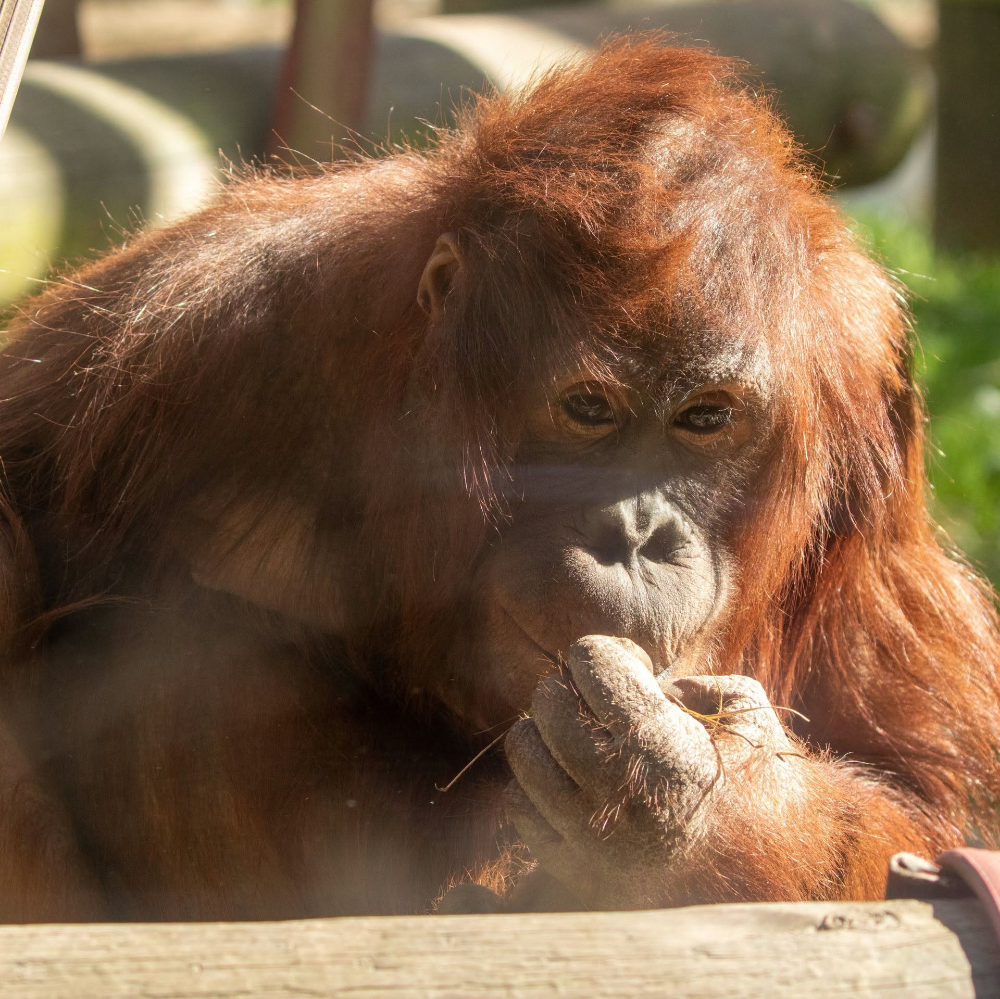
The orangutan is the largest tree-dwelling mammal alive on Earth. Unlike gorillas, chimpanzees, and bonobos - its closest living relatives - the orangutan lives almost entirely in the rainforest canopy, spends most of its life alone, and carries the longest period of parental dependency of any non-human animal. The genus Pongo is the only great ape genus found in Asia, and every single wild population now clings to fragmented forest on just two islands: Borneo and Sumatra.
This guide covers every biological and ecological layer of the orangutan story: the three recognised species, size and strength, intelligence and tool use, the striking 'flanged' transformation of dominant males, reproduction, conservation, and the accelerating collision between orangutan habitat and industrial agriculture.
It is a reference entry, not a summary - so expect specifics: kilograms, metres, years, population figures, and the kind of strange details that separate Pongo from every other great ape.
Etymology and Classification
The word orangutan comes from the Malay and Indonesian phrase orang hutan, meaning 'person of the forest'. Early European naturalists initially confused the animal with several other apes, and it was not formally placed in its own genus until Lacepede established Pongo in 1799.
The Bornean orangutan (Pongo pygmaeus) received its scientific name from Linnaeus in 1760, from the Greek pygmaios meaning dwarf - a peculiar label for an animal that can weigh 90 kilograms, reflecting early confusion between orangutans and the smaller gibbons.
For most of the twentieth century scientists recognised a single species. Genetic evidence then split the Bornean and Sumatran populations into two species in 2001, and in 2017 a third species - the Tapanuli orangutan (Pongo tapanuliensis) - was described from a tiny population in the Batang Toru ecosystem of Sumatra.
This makes the Tapanuli orangutan the newest great ape species recognised by modern science, and probably the rarest. All three species sit inside the family Hominidae, the great ape family that also contains gorillas, chimpanzees, bonobos, and humans.
Molecular clock analyses suggest the Tapanuli lineage diverged first, more than three million years ago, while Bornean and Sumatran orangutans split only about 400,000 years ago when sea level changes isolated their ancestors on separate islands. Despite being on different landmasses, captive Bornean and Sumatran orangutans have produced fertile hybrids - a clear signal of how recently they separated.
The Three Species
The three orangutan species are visually similar but behaviourally and genetically distinct.
Bornean orangutan (Pongo pygmaeus)
- Population: roughly 104,000
- Range: across Borneo in disjunct populations
- Coat: darker, slightly coarser
- Body shape: broader, stockier
- Behaviour: more terrestrial than the other two species
Sumatran orangutan (Pongo abelii)
- Population: roughly 13,800
- Range: northern Sumatra, concentrated in Gunung Leuser
- Coat: lighter, longer, more cinnamon-red
- Face: leaner, with longer beards on males
- Behaviour: more social tolerance and more documented tool use
Tapanuli orangutan (Pongo tapanuliensis)
- Population: fewer than 800
- Range: Batang Toru ecosystem, about 1,000 square kilometres
- Coat: frizzier and more cinnamon than Sumatran
- Skull: narrower, with distinctive tooth proportions
- Status: rarest great ape on Earth
The Tapanuli orangutan's discovery was unusual. Researchers noticed a male skeleton with skull dimensions that did not match either of the previously known species. Combined with genetic sequencing of live individuals, this led to the 2017 description - an astonishing addition to the great ape family at a time when very few large mammal species remain undescribed.
Size and Physical Description
Orangutans are large, powerful apes built for an arboreal lifestyle. Like gorillas and chimpanzees, they show strong sexual dimorphism - adult males are roughly twice the size of adult females.
Males:
- Standing height: 1.2-1.4 metres
- Weight: typically 50-90 kg, occasionally over 100 kg in captivity
- Arm span: up to 2.2 metres
- Distinctive features: large cheek flanges, throat sac, dark coarse hair
Females:
- Standing height: 1.0-1.2 metres
- Weight: typically 30-50 kg
- Arm span: about 1.5-1.8 metres
- Distinctive features: no flanges, slimmer face, lighter coat
Infants at birth:
- Weight: 1.5-2.0 kg
- Coat: sparse reddish fur, pale face darkening with age
- Dependent on mother for 7-8 years
Orangutans are unmistakable. The reddish-brown coat, long arms, and slow deliberate movement through the canopy set them apart from every other primate. Their arms are so long that, standing upright, the fingertips brush the ground. The legs are short and weak by comparison, suited to gripping branches but poor for walking. Hands and feet are both prehensile - all four limbs effectively function as hands, giving orangutans a grip in the canopy unmatched by any other great ape.
The skull is large, with heavy brow ridges in males and surprisingly human-like dentition. The cranial capacity averages 400 cubic centimetres, similar to other great apes. Adult males develop laryngeal air sacs that inflate to amplify long-distance calls - booming vocalisations that carry more than a kilometre through dense forest.
The Flanged-Male Phenomenon
Of all great ape secondary sex characteristics, the orangutan's flanged face may be the most striking. Dominant adult males grow semicircular fatty cheek pads - flanges - that frame the face, sometimes doubling its apparent width. They also develop thick throat sacs, coarser dark hair, and a dramatic increase in body mass.
Yet not every adult male has flanges. Orangutans exhibit bimaturism: two adult forms. Unflanged males can be fully sexually mature but retain a female-like face and smaller body indefinitely, sometimes for decades. The transition from unflanged to flanged appears to be hormonally suppressed by the presence of a nearby dominant flanged male.
When that male disappears - through death, displacement, or migration - a previously unflanged male can undergo full flange development in a matter of months. This rapid 'pumpkin-face' transformation is one of the most unusual hormonally driven morphological shifts documented in any mammal.
Flanged and unflanged males pursue different mating strategies. Flanged males advertise their presence with loud long calls and attract females who approach them. Unflanged males are silent, sneak through the canopy, and mate opportunistically - often forcibly. Paternity studies suggest both strategies succeed, which is why the bimaturism persists.
Habitat and Range
Orangutans inhabit tropical rainforests on two islands in Southeast Asia. All three species depend on continuous forest rich in fruit-bearing trees, usually below 1,500 metres elevation. Preferred habitats include peat swamp forest, lowland dipterocarp forest, and hill forest.
| Species | Island | Range | Approx. population |
|---|---|---|---|
| Bornean | Borneo | Indonesia, Malaysia, Brunei | ~104,000 |
| Sumatran | Sumatra | Northern Sumatra (mostly Leuser) | ~13,800 |
| Tapanuli | Sumatra | Batang Toru ecosystem only | ~800 |
Orangutans spend more than 90 per cent of their lives in the canopy, typically 20 to 40 metres above the forest floor. Bornean orangutans will occasionally descend to the ground to travel between feeding areas, particularly where forest fragmentation leaves no alternative. Sumatran and Tapanuli orangutans almost never come down - the presence of Sumatran tigers in their range makes ground travel dangerous.
Diet and Foraging
Orangutans are primarily frugivorous. In most seasons, fruit accounts for around 60 per cent of their intake. Preferred fruits include figs of many species, durian, rambutan, mangosteen, lychee relatives, and various wild mangoes. When fruit is scarce, orangutans switch to leaves, young shoots, bark, flowers, pith, and the inner vascular tissue of stems and roots. They also eat insects, bird eggs, termites, honey, and occasionally small vertebrates including slow lorises.
Seasonal boom-and-bust:
Southeast Asian rainforests are notorious for their irregular fruiting cycles. Entire forests may synchronise in 'mast fruiting' events every two to seven years, producing enormous fruit crops for a few weeks, then falling silent for extended periods. Orangutans are adapted to this volatility.
During mast events they gorge themselves, gaining substantial fat reserves, and during the long lean periods between mast years they rely on bark, pith, and low-quality fallback foods that other frugivores cannot digest.
Researchers have documented orangutans feeding on more than 400 plant species across their range. Each individual orangutan learns its local food tree map from its mother over the course of its childhood - which is one reason the seven- to eight-year dependency period is so long.
Intelligence, Tool Use, and Culture
Orangutans are among the most cognitively advanced non-human animals on Earth. In controlled studies, orangutan infants outperform human toddlers at several short-term memory and spatial reasoning tasks. Adults pass the mirror self-recognition test, solve multi-step mechanical puzzles, plan canopy routes a day in advance, and remember the fruiting schedules of individual trees across years.
Wild tool use:
- Stick probes for extracting honey from bee nests and seeds from hard fruit
- Leaf-sponges chewed into absorbent wads and used to drink water from hollows
- Leaf-umbrellas held overhead during rain
- Leaf-gloves to handle spiny fruits or irritating plants
- Bundles of leaves used as cushions on sharp branches
- Stick spears used by some Sumatran populations to probe tree cavities
More than 30 distinct tools have been documented across orangutan populations, and importantly, different populations use different toolkits. This is one of the clearest examples of non-human culture: tools are invented by individuals, taught by mothers to offspring, and passed down through generations as traditions specific to a local population.
Sign language:
Several captive orangutans have been taught American Sign Language or simplified gesture systems. Chantek, a Sumatran orangutan raised by anthropologist Lyn Miles at the University of Tennessee, reportedly used more than 150 signs to communicate needs, identify individuals, and on at least one occasion request to be driven to a favoured restaurant.
Other individuals - including Princess at Camp Leakey in Borneo - demonstrate comparable sign-language learning. Researchers debate how closely this resembles human language, but the evidence for symbolic representation is strong.
Social Life and Solitude
Orangutans are the most solitary of the great apes. Adult males spend around 90 per cent of their time alone, encountering other adults only to mate or to fight. Adult females are slightly more tolerant - they may forage within sight of other females, particularly relatives - but they do not form stable groups the way chimpanzees or gorillas do.
The strongest social bond in orangutan life is between mother and offspring. Infants ride on their mothers continuously for the first two years, sleep in her nest, and remain close through childhood and adolescence. Weaning does not finish until age six or seven, and juveniles may continue to follow their mother for another year or two after that. This seven- to eight-year dependency is the longest documented in any non-human animal.
Communication between dispersed orangutans relies heavily on sound. Flanged males produce long calls - booming sequences that can last more than a minute and carry more than a kilometre through dense canopy. These calls advertise identity, location, and dominance. Females and other males appear to use them to navigate social space: avoid rivals, approach potential mates, or give wide berth to hostile neighbours.
Reproduction and Life Cycle
Orangutan reproduction is extraordinarily slow. Females reach sexual maturity at around 10 to 15 years and give birth to a single infant after a gestation of roughly 8.5 months - 254 days. Twins are extremely rare in the wild.
Interbirth interval:
- Typical: 7 to 9 years
- Longest recorded: more than 10 years
- Cause: mother does not cycle until current offspring is nearly weaned
This is the longest interbirth interval of any land mammal. Over an entire lifetime, a female orangutan may raise only four or five offspring - a reproductive rate that makes the species extremely vulnerable to any additional mortality.
Nest construction:
Every single night, an orangutan - including young infants learning the skill - builds a new sleeping nest in the canopy. The nest is woven from bent and broken branches, lined with leaves, and constructed in about five minutes. On rainy nights a second smaller nest may be built above the first as an improvised roof. Over a lifetime an adult orangutan may build more than 30,000 nests. Abandoned nests are a primary tool used by field researchers to census wild populations.
Males play no role in rearing offspring. After mating the male and female separate, often permanently. The female raises the infant alone, teaching it the full rainforest survival package: food tree locations, fruiting schedules, tool use, nest construction, predator avoidance, and safe canopy routes.
Movement and Locomotion
Orangutans move through the canopy with a deliberate, distinctive style called quadrumanous scrambling - using all four limbs as hands. Large adults rarely swing freely the way smaller gibbons do; their mass is too great. Instead they climb, bridge gaps using the flex of thin branches, and transfer weight slowly between supports. This method is slow but remarkably energy-efficient for such a heavy arboreal animal.
| Metric | Value |
|---|---|
| Canopy travel speed | 0.5-1 km/h |
| Ground speed (rare) | up to 4 km/h |
| Typical daily travel distance | 500-1,000 m |
| Home range (males) | 10-40 km^2 |
| Home range (females) | 3-8 km^2 |
| Fall height observed | up to 20 m, often survived |
Orangutans were long assumed unable to swim, and in captivity they generally avoid water. However, rare but well-documented observations in the wild now include orangutans swimming short distances across river channels in Borneo - overturning a century of assumptions. Swimming is still the exception rather than the rule.
Conservation Status and Threats
All three orangutan species are classified by the IUCN Red List as Critically Endangered, the highest threat category before Extinct in the Wild. Populations have collapsed by roughly 80 per cent over the past century, driven overwhelmingly by habitat loss.
Primary threats:
- Palm oil plantations. Industrial oil palm cultivation has replaced enormous areas of lowland rainforest in Borneo and Sumatra, the exact habitat orangutans depend on. A single cleared square kilometre can displace or kill dozens of orangutans in a single season.
- Pulpwood forestry. Plantations of acacia and eucalyptus for pulp and paper production have expanded rapidly since the 1990s, fragmenting habitat further.
- Illegal logging and mining. Selective logging damages fruit trees and opens the canopy, while gold mining pollutes rivers and degrades floodplain forests.
- Forest fires. Human-set fires for land clearing, particularly on drained peat soils, consume millions of hectares during El Nino dry years and kill orangutans directly.
- Illegal pet trade. Infant orangutans are trafficked as pets. Capturing each infant typically requires killing the mother, so the pet trade produces heavy population losses.
- Retaliatory killing. Hungry orangutans sometimes raid crops, and farmers kill them in response.
- Infrastructure. Roads fragment habitat and allow further incursion by loggers and poachers. A proposed hydroelectric dam in the Batang Toru ecosystem threatens the only habitat of the Tapanuli orangutan directly.
Conservation responses include protected areas (Gunung Leuser, Tanjung Puting, Sebangau, Batang Toru), reintroduction programmes for confiscated infants, anti-poaching patrols, and certification schemes for sustainable palm oil. None of these fully counteract the scale of habitat loss. With a seven- to nine-year interbirth interval, orangutan populations recover so slowly that even modest additional mortality can drive local extinction.
Orangutans and Humans
Orangutans have shared forests with humans for tens of thousands of years. Indigenous communities in Borneo and Sumatra have rich oral traditions about them, often treating the species with respect and folkloric awe. The name itself - 'person of the forest' - carries cultural weight. In some communities orangutans were traditionally avoided as ancestors or forest-spirits, a cultural prohibition that may have acted as informal protection.
Modern interactions are mostly destructive. Orangutans now live alongside palm oil plantations, logging roads, and small-scale gold mines. Research stations at Camp Leakey, Suaq Balimbing, Ketambe, and Tuanan have generated the bulk of scientific knowledge about wild orangutans and provide economic arguments for forest protection through tourism and research employment. Rehabilitation centres in Nyaru Menteng, Samboja, and Bukit Lawang care for thousands of confiscated or displaced individuals.
Future survival depends almost entirely on whether enough continuous rainforest is preserved in Borneo and Sumatra to sustain viable populations. Local action can slow decline; only systemic change in land use policy and global demand for palm oil, pulp, and tropical timber can stabilise it.
Related Reading
- Primates: Our Closest Relatives in the Animal Kingdom
- How Similar Are Chimpanzees to Humans?
- Mountain Gorilla
- Chimpanzee
- How Strong Is a Gorilla?
- Aye-aye: The Weirdest Primate
References
Relevant peer-reviewed and governmental sources consulted for this entry include IUCN Red List assessments for Pongo pygmaeus, Pongo abelii, and Pongo tapanuliensis (2016-2024), the Nater et al.
(2017) description of the Tapanuli orangutan in Current Biology, Population and Habitat Viability Assessment workshops coordinated by the IUCN SSC Primate Specialist Group, long-term field data from Camp Leakey, Suaq Balimbing, Ketambe, and Tuanan research stations, and published research in the American Journal of Primatology, Primates, Animal Behaviour, and Science.
Population figures reflect the most recent consolidated estimates as of the latest Indonesian Ministry of Environment and Forestry Orangutan Population and Habitat Viability Assessment.
Frequently Asked Questions
How many species of orangutan are there?
There are three recognised orangutan species, all in the genus Pongo. The Bornean orangutan (Pongo pygmaeus) is the most numerous, with roughly 104,000 individuals across the island of Borneo. The Sumatran orangutan (Pongo abelii) survives in the forests of northern Sumatra with around 13,800 individuals.
The Tapanuli orangutan (Pongo tapanuliensis), described only in 2017 from a small population in the Batang Toru ecosystem of Sumatra, has fewer than 800 individuals remaining and is the rarest great ape on Earth. All three species are classified as Critically Endangered by the IUCN.
Bornean and Sumatran orangutans diverged roughly 400,000 years ago, while the Tapanuli lineage split much earlier - genetic studies suggest more than 3 million years ago - making Tapanuli orangutans the most evolutionarily distinct of the three.
How big are orangutans and how strong?
Adult male orangutans typically weigh 50-90 kg and stand about 1.2-1.4 metres tall when upright, while females are substantially smaller at 30-50 kg and 1.0-1.2 metres. Their arms are disproportionately long, with arm spans reaching 2.2 metres - longer than their standing height. Orangutans are the largest tree-dwelling mammal in the world.
Despite their size they move through the canopy with remarkable control, pulling themselves along branches with grips strong enough to support their full body weight from a single hand. Studies of captive orangutans suggest they are roughly four to seven times stronger than an average human in upper-body pulling strength, though they rarely use that strength in aggression because of their largely solitary lifestyle.
Where do orangutans live?
Orangutans live only on two islands in Southeast Asia: Borneo (shared between Indonesia, Malaysia, and Brunei) and Sumatra (Indonesia). Within these islands they depend on lowland and hill tropical rainforest, usually below 1,500 metres elevation, with a strong preference for peat swamp forest and dipterocarp forest rich in fruit trees. The Bornean species occupies the broadest range, spread across multiple disjunct populations.
The Sumatran species is confined to the northern tip of the island, mostly in and around Gunung Leuser National Park. The Tapanuli species occupies a single small area - the Batang Toru ecosystem - of about 1,000 square kilometres. Orangutans spend more than 90 per cent of their lives in the canopy, rarely descending to the forest floor.
What do orangutans eat?
Orangutans are primarily frugivores - fruit is the core of their diet, accounting for roughly 60 per cent of intake in most seasons. Favourite foods include figs, durian, rambutan, mangosteen, and lychee relatives. When fruit is scarce, orangutans switch to leaves, shoots, bark, flowers, pith, and inner stems. They also eat insects, bird eggs, honey, small vertebrates, and in rare cases meat from slow lorises or other small mammals.
Their nutritional strategy is built around the boom-and-bust fruiting cycles of Southeast Asian rainforests. During mast fruiting events, when entire forests fruit simultaneously every few years, orangutans gorge and build up fat reserves that carry them through the long lean periods between mast years.
How intelligent are orangutans?
Orangutans are among the most cognitively sophisticated non-human animals on Earth. They plan routes through the canopy a day in advance, remember the fruiting schedules of individual trees across years, and use a toolkit of more than 30 distinct objects in the wild. Captive studies show that orangutans pass the mirror self-recognition test, solve multi-step puzzles, and transmit tool-use techniques across generations as local cultural traditions.
Several individuals have been taught sign language - most famously Chantek, a Sumatran orangutan who learned more than 150 signs - and have used it to communicate needs, identify individuals, and even deceive handlers. Their learning is so prolonged that infants depend on their mothers for seven to eight years, copying foraging routes, nest construction, and tool use in a period that scientists now treat as a true apprenticeship.
Why do some males have giant cheek flanges and others don't?
Adult male orangutans exhibit one of the most dramatic examples of bimaturism in mammals. Dominant males develop large fatty cheek pads called flanges, a throat sac used to produce booming ‘long calls’, coarser dark hair, and a doubling of body mass. Unflanged males, despite being sexually mature, retain a female-like face and smaller body for years or even decades.
The switch is hormonally driven and appears to be suppressed by the presence of an already-dominant flanged male nearby. When a dominant male dies or leaves an area, a previously unflanged male can transform within months - sometimes developing full flanges in under a year. This rare ‘pumpkin-face’ transformation is one of the most unusual secondary-sex-character shifts documented in any mammal.
Are orangutans endangered?
All three orangutan species are classified as Critically Endangered by the IUCN - the highest threat category before Extinct in the Wild. Populations have collapsed by roughly 80 per cent over the past century. The Bornean orangutan stands at about 104,000 individuals, down from several hundred thousand a century ago. The Sumatran orangutan has declined to roughly 13,800.
The Tapanuli orangutan, with about 800 individuals in a single fragmented habitat, is the rarest great ape alive. The dominant threat is habitat loss from palm oil plantations, pulpwood forestry, mining, and road construction. Secondary threats include illegal pet trade - mothers are killed to capture infants - forest fires, and retaliatory killings when hungry orangutans raid crops.
A further hazard specific to Tapanuli is a proposed hydroelectric dam that would fragment their last remaining habitat.
How long do orangutans live and how do they reproduce?
Orangutans live 30-40 years in the wild and frequently pass 50 in captivity, with several documented individuals reaching 60. Females reach sexual maturity around age 10-15 and give birth to a single infant after a gestation of roughly 8.5 months. The interbirth interval is among the longest in the animal kingdom - typically 7 to 9 years - because mothers do not resume cycling until their current offspring is nearly independent.
A female may raise only four or five offspring during her entire life. Infants ride on their mother’s body for the first two years, sleep in her nest, and learn every aspect of rainforest survival through direct observation. Males do not participate in raising offspring and typically leave immediately after mating. This slow reproductive rate is one of the central reasons orangutan populations recover so poorly from hunting, capture, and deforestation.