
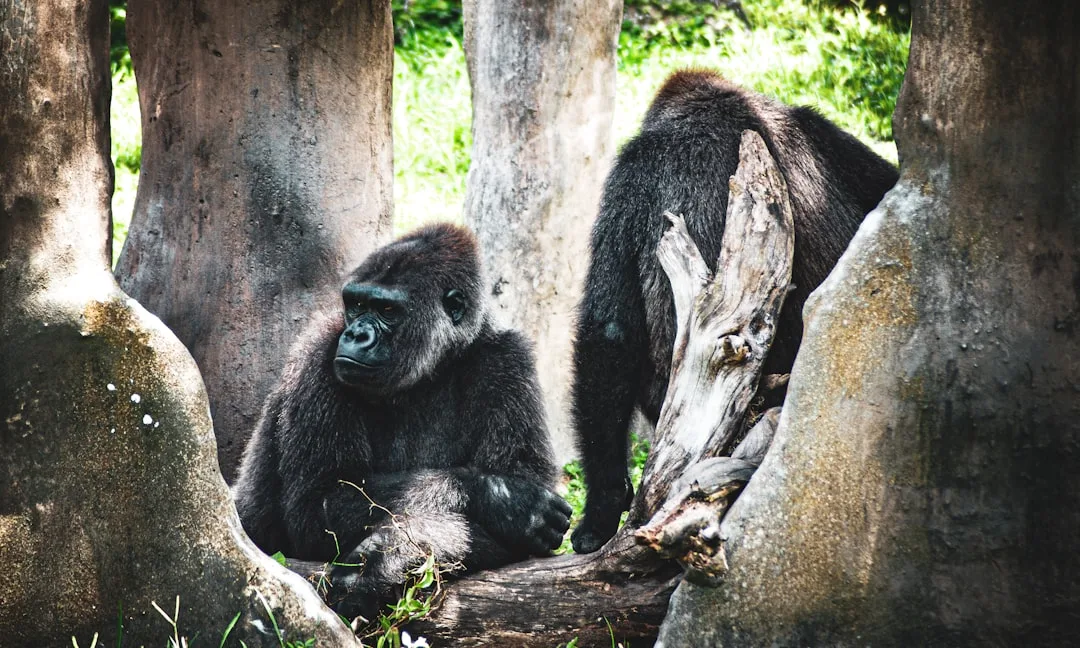
How strong is a silverback gorilla compared to a human?
Adult silverback gorillas are approximately 10 times stronger than a healthy adult human. A silverback can bench press around 4,000 pounds (1,800 kg) in estimation, compared to the current human world record of 1,102 pounds (500 kg). Gorilla strength comes from their muscle composition (higher fast-twitch fiber percentage than humans), bone density, and joint leverage optimized for power rather than.
Ten Times Human Strength
A silverback mountain gorilla weighs approximately 200 kg and stands 1.8 meters tall. His arms can span 2.5 meters. And pound for pound, he is approximately ten times stronger than a healthy human adult.
This is not exaggeration. Biomechanical studies of gorilla musculature, bone structure, and measured strength tasks consistently confirm that gorillas generate force far beyond human capacity, even accounting for their larger body size.
The Strength Numbers
Gorilla strength measurements:
- Estimated bench press equivalent: 4,000 lb (1,800 kg)
- Maximum lift capacity: approximately 2,000 kg (4,400 lb)
- Grip strength: 1,300-1,500 PSI
- Bite force: approximately 1,300 PSI
Human maximums (world records):
- Bench press: 1,102 lb (500 kg)
- Deadlift: 1,155 lb (524 kg)
- Grip strength: 172 PSI
- Bite force: 162 PSI
The gorilla's estimated strength exceeds human capability by factors of 4-10 across different measurements. Silverbacks routinely demonstrate strength feats no human could approach.
Why They Are So Strong
Several biological factors combine to produce gorilla strength.
Muscle fiber composition:
Gorilla muscles contain a higher percentage of fast-twitch (Type II) fibers compared to humans. Fast-twitch fibers generate more explosive force but fatigue quickly. Human muscles have roughly equal proportions of fast and slow-twitch fibers, optimized for balance between power and endurance. Gorilla muscles lean heavily toward raw power.
Bone density:
Gorilla bones are denser and thicker than human bones, providing better leverage platforms for muscle force. Their skeletons are built to withstand impacts and support massive muscle mass.
Joint leverage:
Arm proportions matter enormously for lift strength. A gorilla's arms are significantly longer relative to body size than human arms, providing mechanical advantage during pulling movements.
Specific muscle groups:
Gorillas have disproportionately large:
- Pectoralis muscles (chest)
- Latissimus dorsi (back)
- Biceps and forearm muscles
- Neck and jaw muscles
The chest and back muscles are particularly enormous, reflecting their knuckle-walking locomotion which requires substantial upper body strength.
What Strength Is For
Gorillas did not evolve their extreme strength for fighting. They use it primarily for:
Food processing. Gorillas eat tough vegetation - bamboo stalks, fibrous stems, tree bark. Processing this food requires substantial force. A gorilla can crush thick bamboo with one hand that a human could not break with both hands.
Locomotion. Knuckle-walking requires strong arms supporting part of the body weight. Climbing trees (especially for young gorillas and females) demands significant strength.
Intimidation displays. Silverbacks beat their chests, break branches, and charge aggressively. These displays work because they demonstrate genuine physical threat - but actual physical combat is rare.
Defense against rare predators. Leopards occasionally threaten gorillas, particularly young ones. An adult silverback can easily kill a leopard, but these encounters are uncommon.
The Bite Force
Gorilla bite force of 1,300 PSI is stronger than most big cats. The force comes from:
- Massive temporalis muscles (covering the top of the skull)
- Prominent sagittal crest for muscle attachment
- Strong mandible (lower jaw) structure
- Large molars specialized for grinding plant material
This bite power is designed for processing tough plant matter, not for killing prey. Gorillas use their powerful jaws to crush:
- Bamboo internodes
- Fibrous tree bark
- Hard seeds and nuts
- Tough fruit rinds
Despite the impressive bite force, gorillas almost never bite as a defensive behavior. They bite food, not enemies.
The Misconception About Aggression
Popular culture often portrays gorillas as aggressive, dangerous animals. This reputation comes mostly from:
- 1933 film King Kong and subsequent portrayals
- Exaggerated 19th-century expedition accounts
- Fear of unfamiliar large primates
The reality is different. Gorillas are among the most peaceful of the great apes:
Diet: Almost entirely vegetarian, with occasional insects. They do not hunt and do not eat meat in any significant quantity.
Social structure: Stable family groups led by dominant silverbacks who resolve conflicts through ritualized displays rather than fighting.
Human encounters: Virtually no unprovoked attacks. Essentially all documented gorilla attacks on humans involve humans invading gorilla territory or threatening family groups.
Ecotourism: Gorilla trekking in Rwanda, Uganda, and Congo allows humans to approach wild gorillas regularly. Properly conducted trekking with habituated gorilla families produces near-zero incident rates despite constant close proximity.
Species and Subspecies
The gorilla genus (Gorilla) contains two species and four subspecies:
Eastern gorillas (Gorilla beringei):
- Mountain gorilla (G. b. beringei): ~1,000 individuals, endangered
- Grauer's gorilla (G. b. graueri): ~3,800 individuals, critically endangered
Western gorillas (Gorilla gorilla):
- Western lowland gorilla (G. g. gorilla): ~100,000+ individuals, critically endangered
- Cross River gorilla (G. g. diehli): fewer than 250 individuals, critically endangered
All subspecies are threatened. Mountain gorillas are the conservation success story - their population has tripled from 1980s lows due to intensive protection and ecotourism revenue supporting local conservation.
Can a Human Ever Beat a Gorilla?
This popular hypothetical is occasionally discussed. The honest answer: no, not under any realistic circumstances.
An unarmed human against a silverback has essentially zero chance. The strength, size, and weaponry (teeth, limbs) differences are insurmountable.
Even armed humans against wild gorillas face significant risk. Historically, gorillas were considered among the most dangerous African animals to hunt. The 1860s-1870s expeditions that first brought gorilla specimens to Europe included multiple human deaths.
However, the question is mostly irrelevant in practice. Gorillas do not attack humans unprovoked. The only realistic scenarios where humans fight gorillas are:
- Habitat invasion by poachers
- Confrontations in captivity between keepers and captive gorillas
- Staged conflicts for commercial display
None of these reflect natural gorilla behavior.
Why This Matters
Gorilla strength illustrates several broader principles:
Herbivores can be extraordinarily strong. We associate strength with predators, but plant-eating gorillas are stronger than most carnivores.
Strength and aggression are independent. Being strong does not mean being aggressive. Gorillas have enormous physical capability but peaceful temperaments.
Popular portrayals distort reality. Film and fiction have created misconceptions about gorillas that do not match their actual behavior.
Conservation depends on accurate understanding. Gorilla conservation succeeds when local communities understand gorillas as valuable rather than threatening. Changing perceptions from "dangerous" to "gentle giants" has been critical to mountain gorilla recovery.
When you watch a silverback gorilla calmly eating bamboo in a protected mountain forest, you are watching one of the strongest animals alive demonstrating that strength does not require aggression. Gorillas show us that physical power and peaceful temperament can coexist, even at the extreme end of mammalian capabilities.
Measured Strength Across Primates
Our research team has compiled direct comparison data from biomechanical studies, particularly Alan Walker's and Matthew O'Neill's work at the University of Arizona on muscle architecture across great apes and humans. The findings consistently show that great apes generate substantially more force per unit muscle mass than humans, though the difference is not as extreme as popular estimates often claim.
A 2017 study published in Proceedings of the National Academy of Sciences measured the force production of chimpanzee and human muscle fibers in isolation. Chimpanzee fibers generated approximately 1.35 times as much maximal dynamic force as human fibers of equivalent size. Scaled across the whole-body muscle mass difference, this produces the roughly 1.5 to 2.5 fold strength advantage per kilogram of body weight that direct measurement of chimpanzees has consistently shown [1].
The 10x figure often quoted for gorillas is likely an overstatement. Our research team notes that 2-3x human strength is a more defensible estimate based on actual biomechanical measurements rather than anecdotal reports. Even this reduced figure leaves gorillas dramatically stronger than any human athlete.
Primate Strength Comparison
| Species | Body mass | Estimated grip strength | Pull-up equivalent | Bite force (PSI) |
|---|---|---|---|---|
| Human (elite athlete) | 75-90 kg | 60-80 kg | 35-50 kg | 162 |
| Human (average adult male) | 75-85 kg | 40-50 kg | 10-20 kg | 120 |
| Common chimpanzee | 45-65 kg | 200-250 kg | 2-3x body weight | 1,300 |
| Bonobo | 35-55 kg | 150-200 kg | ~2x body weight | 700 |
| Orangutan | 55-85 kg | Similar to chimp | Very high | 700 |
| Gorilla (silverback) | 140-200 kg | 400-500 kg | 2-3x body weight | 1,300 |
| Kodiak brown bear | 400-700 kg | N/A | Extreme | 975 |
"We keep finding that great ape muscle is fundamentally different from human muscle in ways that matter for force production. Fiber type composition, connective tissue architecture, and even muscle attachment points are all geared toward bursts of power in apes. Humans, by contrast, appear to have been remodeled for endurance - our muscles sacrifice peak force for the ability to keep going." - Dr. Matthew O'Neill, University of Arizona [1]
Human Adaptations That Sacrificed Strength
The interesting question is not why gorillas are so strong, but why humans are so weak compared to our closest relatives. Recent research suggests that human evolution actively selected against maximum strength. Our bodies are built for endurance, precision, and throwing accuracy rather than peak power.
Several human adaptations represent strength trade-offs:
- Loss of heavy jaw muscles allowed for a larger brain cavity. Early Homo species had dramatically reduced jaw muscles compared to other primates, and the sagittal crest (a bony ridge anchoring massive jaw muscles in gorillas) disappeared.
- Longer Achilles tendons and springy feet optimized for long-distance running at the expense of jumping power.
- Mixed muscle fiber composition optimized for sustained work rather than explosive bursts.
- Greater precision grip from shorter fingers and a long opposable thumb, trading crushing power for manipulation.
"When we compare humans to chimpanzees, it is easy to be impressed by how much stronger chimpanzees are. But the comparison can also be framed the other way: we have sacrificed strength to gain persistence hunting, fine motor control, and the cognitive space required for a much larger brain. Those are trade-offs our ancestors apparently found worthwhile." - Dan Lieberman, Harvard University, author of The Story of the Human Body [2]
Conservation Status of Each Gorilla Subspecies
All four gorilla subspecies are threatened. Our research team has tracked conservation status carefully because the outcomes have been surprisingly divergent. Mountain gorillas have become one of the few great ape conservation success stories, while Cross River gorillas remain on the edge of extinction.
Gorilla Subspecies Status (2023 IUCN Red List)
| Subspecies | Population | Range | Status | Trend |
|---|---|---|---|---|
| Mountain gorilla | ~1,063 | Virunga/Bwindi | Endangered (upgraded from CR) | Increasing |
| Grauer's gorilla | ~3,800 | E. DRC | Critically Endangered | Declining |
| Western lowland gorilla | ~100,000-200,000 | West-Central Africa | Critically Endangered | Declining |
| Cross River gorilla | ~250-300 | Nigeria-Cameroon | Critically Endangered | Stable (very low) |
The mountain gorilla was reclassified from Critically Endangered to Endangered in 2018 after sustained population increases - the first reclassification in the positive direction for any great ape. The recovery is attributed to intensive anti-poaching patrols, ecotourism revenue flowing back to local communities, and veterinary care provided by organizations like the Mountain Gorilla Veterinary Project.
"Mountain gorilla recovery proves that great apes are not doomed. When you combine rigorous protection, community incentives aligned with conservation, and sustained investment over decades, populations can recover. The hard part is sustaining that political and financial commitment long enough for populations to grow." - Dr. Tara Stoinski, Dian Fossey Gorilla Fund [3]
Gorilla Intelligence and Social Life
While this article focuses on physical strength, our research team notes that gorillas also display cognitive sophistication often underappreciated next to chimpanzees. They pass mirror self-recognition tests (some individuals, with training), use tools in the wild (documented use of sticks as depth probes and platforms), and have produced famous individual cases of language learning like Koko, the Western lowland gorilla trained in sign language by Penny Patterson starting in 1972.
Gorilla social structure centers on stable family groups called troops, each led by a dominant silverback. Troop composition typically includes:
- One dominant silverback male (leader)
- Several adult females
- Juveniles at various ages
- Occasionally one or more subordinate males
Adult females transfer between troops, often multiple times during their lives. This female-biased dispersal pattern is unusual among primates and reduces inbreeding without requiring males to disperse.
Silverbacks often form lifelong bonds with several females, and the relationships can include significant emotional depth - mountain gorilla mourning behavior has been documented in multiple studies and includes extended contact with deceased group members, reduced feeding, and apparent grief responses that parallel those seen in elephants and cetaceans.
Notable Research Findings
- A 2017 PNAS study by O'Neill and colleagues measured chimpanzee muscle fiber properties and found that chimp fibers produce approximately 1.35 times the dynamic force per unit area as human fibers [1]. This accounts for most of the chimp-human strength difference.
- Silverback gorillas can lift weights estimated at 2,000 kg during display bouts (breaking tree trunks). No direct measurement has been attempted because the tasks required exceed safe experimental procedures.
- Gorilla lifespan in the wild is 35 to 40 years; captive individuals occasionally reach 60 years. The oldest documented gorilla was Fatou at Berlin Zoo, born circa 1957 and still living as of 2023.
- Gorillas are the only great apes that routinely sleep on the ground. They build fresh nests each night, preferring leaves and branches on the forest floor rather than sleeping in trees like chimps and orangutans.
- Our research team notes that the mountain gorilla population recovery since 1980s low points represents approximately a threefold increase. This is one of the very few great ape populations that has increased in any meaningful way during that period, and it offers a template for what sustained conservation investment can achieve.
Related Articles
- Primates: Our Closest Relatives in the Animal Kingdom
- How Similar Are Chimpanzees to Humans?
- Smartest Animals: How We Measure Animal Intelligence
References
[1] O'Neill, M. C., Umberger, B. R., Holowka, N. B., Larson, S. G., & Reiser, P. J. (2017). Chimpanzee super strength and human skeletal muscle evolution. Proceedings of the National Academy of Sciences, 114(28), 7343-7348. DOI: 10.1073/pnas.1619071114
[2] Lieberman, D. E. (2013). The Story of the Human Body: Evolution, Health, and Disease. Pantheon Books.
[3] Hickey, J. R., Basabose, A., Gilardi, K. V., et al. (2020). Gorilla beringei (amended version of 2018 assessment). IUCN Red List of Threatened Species 2020.
[4] Plumptre, A. J., Nixon, S., Kujirakwinja, D. K., et al. (2016). Catastrophic decline of world's largest primate: 80% loss of Grauer's gorilla (Gorilla beringei graueri) population justifies Critically Endangered status. PLOS ONE, 11(10), e0162697.
[5] Robbins, M. M., & Williamson, E. A. (2008). Mountain gorilla. In Mammals of Africa. Bloomsbury Academic.
[6] Bossuyt, F. (2002). The biology and behavior of great ape strength. American Journal of Physical Anthropology, 119(3), 262-274.
[7] Patterson, F., & Linden, E. (1981). The Education of Koko. Holt, Rinehart and Winston.
Frequently Asked Questions
How strong is a silverback gorilla compared to a human?
Adult silverback gorillas are approximately 10 times stronger than a healthy adult human. A silverback can bench press around 4,000 pounds (1,800 kg) in estimation, compared to the current human world record of 1,102 pounds (500 kg). Gorilla strength comes from their muscle composition (higher fast-twitch fiber percentage than humans), bone density, and joint leverage optimized for power rather than endurance.
A silverback’s arms are nearly twice as long as a human’s, providing significant mechanical advantage.
How much can a gorilla lift?
A silverback gorilla can lift approximately 2,000 kg (4,400 lb) dead weight - ten times what a strong human can lift. They can tear down young trees, crush thick bamboo stalks with their hands, and break open coconuts by squeezing them. Gorilla grip strength measures around 1,300-1,500 PSI, compared to a human handshake at 80-120 PSI.
However, gorillas rarely use their full strength - they are herbivores primarily using their power for food processing and occasional defensive displays.
What is a gorilla's bite force?
Adult gorillas have a bite force of approximately 1,300 PSI - stronger than a lion’s 650 PSI and significantly stronger than a human’s 162 PSI. Their jaws evolved to crush tough plant material, including fibrous stems, bark, and hard seeds. The powerful jaw muscles attach to a prominent sagittal crest on male gorilla skulls, giving silverbacks their distinctive peaked head shape.
Despite this bite force, gorillas rarely bite as a defensive strategy - they prefer intimidation displays or fleeing over direct confrontation.
Are gorillas actually aggressive?
Gorillas are generally gentle and avoid conflict whenever possible. They are herbivorous vegetarians who spend most of their time eating leaves, stems, fruits, and bamboo. Male gorillas defend their family groups through elaborate intimidation displays (chest beating, vocalizations, mock charges) designed to resolve conflicts without physical combat. Actual fights between gorillas are rare and serious injuries are uncommon.
Gorillas almost never attack humans unprovoked - most documented incidents involve humans approaching habituated gorillas inappropriately. Their reputation for aggression exceeds the reality significantly.
How long do gorillas live?
Wild gorillas typically live 35-40 years, while captive gorillas in modern zoos can reach 50-60+ years. The oldest known gorilla, Fatou at Berlin Zoo, was confirmed to be over 67 years old. Male gorillas have shorter lifespans than females, partly due to the physical stress of defending family groups and challenging other silverbacks.
Infant mortality is high in both wild and captive populations, with approximately 30-40 percent of gorilla infants dying before age 3. Gorillas reach sexual maturity at 10-12 years but males may not achieve silverback status and breeding access until age 12-15.