
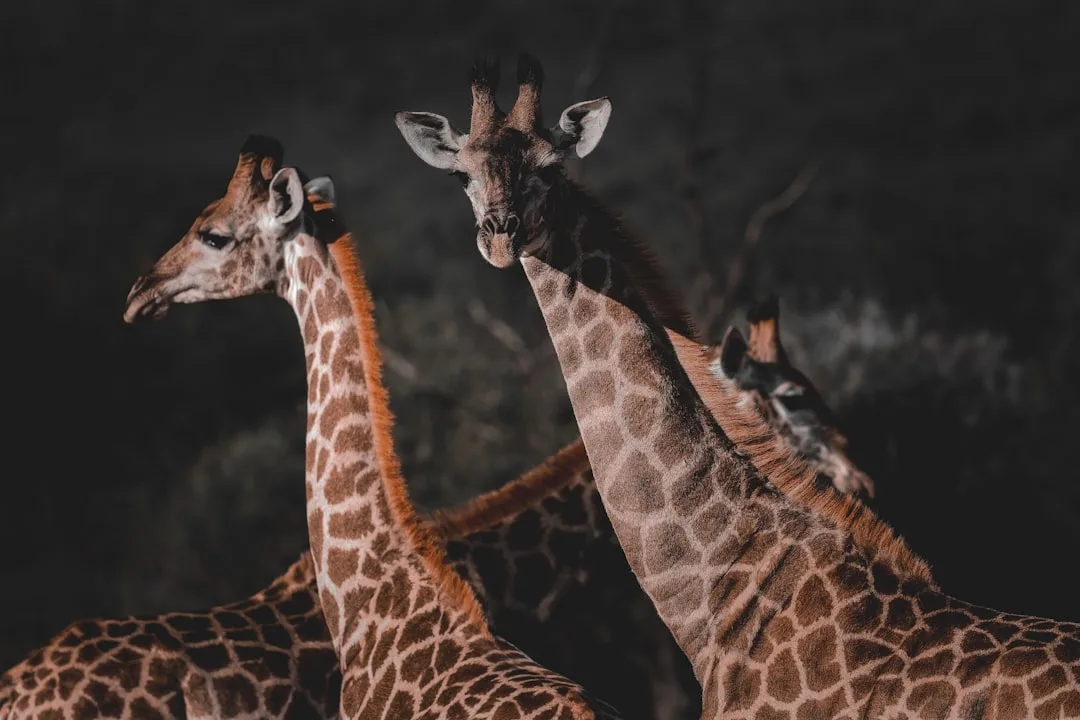
The giraffe is the tallest land animal alive. A full-grown bull stands five and a half metres from hoof to ossicone tip, browses on leaves that no other savanna herbivore can reach, and carries a neck so long it has rewritten textbook assumptions about mammalian anatomy.
Despite a silhouette that looks almost cartoonish against an African skyline, the giraffe is a formidable, fast, and biologically extreme mammal whose body represents one of the most specialised solutions to high-canopy browsing on Earth.
This guide covers every major aspect of giraffe biology and ecology: size and build, neck and cardiovascular adaptations, diet, reproduction, social behaviour, range, conservation status, and the relationships between giraffes and the people sharing their habitat. It is a reference entry, not a summary - so expect specifics: kilograms, centimetres, blood pressures, population numbers, and verified behavioural records.
Etymology and Classification
The scientific name Giraffa camelopardalis was assigned by Carl Linnaeus in 1758 and literally means "camel-leopard." Early Greek and Roman naturalists believed the giraffe was a hybrid of those two animals - it had the overall body plan of a camel and the spotted coat of a leopard. The common English name "giraffe" descends through Italian giraffa from the Arabic zarafah, a word of debated origin that may reference the animal's fast, graceful gait.
Giraffes sit within the order Artiodactyla (even-toed ungulates) alongside cattle, deer, antelope, camels, hippos, and whales, and in the family Giraffidae, which today contains only one other living genus: the okapi (Okapia johnstoni), a shorter-necked forest cousin from central Africa. Giraffidae once contained dozens of species with varying neck lengths; only two genera survive today.
Taxonomic debate is active. The traditional view treats Giraffa camelopardalis as a single species with nine subspecies: Nubian, reticulated, Rothschild's, Masai, Thornicroft's, South African, Angolan, Kordofan, and West African.
Genetic work published from 2016 onwards proposes four distinct species - northern, southern, reticulated, and Masai giraffes - with several of the traditional subspecies collapsing into one of those four. The four-species model is supported by substantial divergence in mitochondrial and nuclear DNA.
The IUCN is currently reassessing the genus in light of this evidence, and conservation status may change sharply depending on which taxonomy prevails. Under the split model, several populations that looked secure within a lumped species become individually endangered.
Size and Physical Description
Giraffes are the tallest terrestrial animals on Earth. Sexual dimorphism is pronounced but not as extreme as in polar bears or elephant seals.
Males (bulls):
- Total height: 4.5-5.5 m (record individuals approach 6 m)
- Shoulder height: 2.8-3.3 m
- Neck length: roughly 2-2.4 m
- Weight: typically 800-1,400 kg, record individuals close to 1,900 kg
Females (cows):
- Total height: 3.5-4.5 m
- Shoulder height: 2.5-2.9 m
- Weight: typically 450-900 kg, occasionally up to 1,180 kg
Calves at birth:
- Height: 1.7-2 m
- Weight: 50-70 kg
The giraffe body plan is built around the neck. Legs are proportionally very long, with forelegs slightly longer than hind legs, producing the sloped back that is diagnostic even at a distance. The chest is deep but narrow, allowing the animal to pivot its neck and shoulders around scattered tree trunks.
Hooves are large, roughly 30 cm across on adult males, and deliver the force behind a kick powerful enough to kill a lion. The tail is long and ends in a dark tuft of hair used to flick biting flies from the flanks and hindquarters.
The coat pattern - irregular dark patches separated by lighter lines - is one of the most recognisable in the animal kingdom. Patterns vary between subspecies: reticulated giraffes have sharp polygonal patches separated by thin white lines, while Masai giraffes carry jagged, star-shaped patches with fuzzy borders.
Within any population the pattern is unique to each animal like a fingerprint, and researchers now use photographic pattern-matching software to identify individuals across years of field data. The patches are not merely cosmetic.
Beneath each patch sits a dense network of blood vessels that helps dump heat, and the patterns likely provide camouflage in dappled acacia shade from the perspective of lions hunting at ground level.
The Neck: Seven Bones and a Pressure Pump
Contrary to common assumption, giraffes have the same number of cervical vertebrae as humans - seven. What is extreme is the length of each vertebra. In an adult giraffe a single cervical vertebra can exceed 28 centimetres, compared with about 1.5 centimetres in a human. The total cervical column reaches roughly 2-2.4 m in a large bull.
The neck serves two primary functions. The first is feeding: a giraffe can browse on foliage four to five metres above the ground, a layer of the canopy inaccessible to every other African mammal except elephants (which reach it differently) and the nearly extinct Kordofan giraffe's closest cousins. The second function is combat.
Male giraffes fight by standing shoulder to shoulder and swinging their necks sideways in a behaviour called necking. The ossicones at the top of the skull act as the striking head of a long club, and a hard blow can break ribs, snap jawbones, or in rare cases kill an opponent outright.
Holding a two-metre column of blood against gravity requires extraordinary cardiovascular engineering. The giraffe heart weighs up to 11 kg and generates systolic blood pressures around 280/180 mm Hg, roughly twice those of a healthy human. Pumping that hard continuously across a 20-year lifespan demands thick-walled ventricles and an exceptionally efficient contraction pattern.
The same high pressure that pushes blood up the neck would slam into the brain when the giraffe lowers its head to drink. Three adaptations prevent this.
- One-way jugular valves. The major veins of the neck contain valves that prevent gravitational backflow toward the brain.
- Rete mirabile. A dense network of fine blood vessels at the base of the skull acts as a pressure buffer, dampening the spike in arterial pressure when the head drops.
- Tight lower-leg skin. The skin over the legs is unusually inelastic and functions like the compression stockings worn by astronauts, preventing blood from pooling in the extremities and keeping venous return high.
Together these adaptations let a giraffe bend to drink from a waterhole and then rear back up into full height without fainting, blacking out, or rupturing cranial vessels.
The Tongue, Mouth, and Diet
Giraffes are browsing herbivores, specialised for stripping leaves and shoots from thorny trees. Acacia species dominate the diet across most of the range, with combretum, myrrh, and various other woody species providing seasonal variety. In the wet season giraffes consume fresh leaves and flowers; in the dry season they take more woody material including pods and bark.
The tongue is one of the most striking feeding tools in mammalian biology.
- Length: up to 45 cm
- Colour: dark purple-black
- Structure: prehensile, muscular, highly mobile
The dark pigment is thought to provide UV protection, since the tongue spends much of the day exposed to direct equatorial sun while the animal strips leaves. The prehensile tip wraps around acacia branchlets, drawing them into the mouth past the thorns. Thick lips and a tough palate handle remaining spines, and copious saliva coats and neutralises any acacia spines that do pierce soft tissue.
Feeding occupies 16-20 hours of every 24-hour period. An adult male consumes roughly 30-45 kg of plant material per day. Giraffes are ruminants with a four-chambered stomach and will chew cud while walking, a trait that compresses rest and rumination into the brief intervals between bouts of active browsing.
Water intake is low relative to body mass. Giraffes can go days or even weeks without drinking, extracting most of their water needs from fresh leaves. When they do drink they must splay their forelegs out sideways and lower the head to ground level, an awkward posture that briefly makes them vulnerable to ambush predators. Herds often drink in rotation, with some animals standing sentinel while others lower their heads.
Ossicones: Not Horns
The growths on a giraffe's head are not horns. They are ossicones, a distinct anatomical structure found in the Giraffidae family. Ossicones form from ossified cartilage, are covered in skin and fur, and fuse to the skull only after birth. Both males and females have them.
- Males develop thicker, often balder ossicones, worn smooth by years of necking combat.
- Females retain the fur tuft at the tip and generally have thinner ossicones.
- Many giraffes grow a third median ossicone on the forehead, and older bulls frequently develop calcium deposits on the skull that produce the appearance of additional bumps or a "crown."
Because ossicones are fused ossified cartilage rather than keratin sheaths over bone, they grow differently from the horns of antelope or cattle. They are also far more useful as clubs. The skull of an adult male giraffe thickens substantially with age from continual combat, a feature clearly visible in radiographs and in museum specimens.
Locomotion and Speed
Giraffes walk with a pacing gait: both legs on the same side move together. This is unusual among large mammals - most use a diagonal gait in which opposing legs swing together. The pacing gait suits the giraffe's long legs and broad body, preventing the legs from clipping each other as they swing. It produces the characteristic swaying motion visible in any herd on the move.
At a gallop the gait changes dramatically. The giraffe brings its hind legs forward past the front legs in a rocking-horse stride that can cover 4-5 metres in a single bound. Top speed is around 60 km/h over short distances, fast enough to outrun a pursuing lion across open savanna, though a giraffe cannot sustain the pace for long.
The giraffe's vertical reach and open-country speed, combined with a ground-shaking kick, make predation risk relatively low for healthy adults. Lions are the only non-human predator capable of routinely killing adult giraffes, and even lion prides usually target calves, subadults, drinking adults, or animals weakened by injury or drought.
Life Cycle and Reproduction
Giraffe reproduction runs on a long, slow calendar reflecting the species' size and low-predation adult ecology. Males (bulls) do not reproduce until they have reached full size, established dominance, and successfully out-necked rivals - typically around seven or eight years of age. Females (cows) can reproduce from about four years old.
Oestrus is detected by males through flehmen response: a bull sniffs a cow's urine, curls his upper lip to push chemical signals onto the vomeronasal organ, and evaluates her reproductive state. Dominant bulls roam widely in search of receptive females and fight off rivals with necking displays and contact combat. Courtship and mating are brief, often completed within a few minutes.
Reproductive calendar:
| Stage | Duration |
|---|---|
| Gestation | 430-465 days (~15 months) |
| Interbirth interval | 18-24 months |
| Weaning age | 12-15 months |
| Sexual maturity (F) | 4-5 years |
| Sexual maturity (M) | 7-8 years (social maturity) |
Females give birth standing up. The calf drops nearly two metres to the ground - a fall that would injure most mammals but which breaks the amniotic sac, stimulates breathing, and seems to pose no risk to a healthy calf. Within an hour the calf is standing; within a day it can run with the herd.
Mothers nurse calves for 12-15 months and protect them with powerful kicks. A well-placed kick from an adult cow can break a lion's spine. Despite this defence, predation remains the largest cause of calf mortality. Roughly half of all calves die in the first year, with the majority lost to lions, leopards, hyenas, and African wild dogs. Some populations form loose creches in which several cows watch over a pooled group of calves, taking turns browsing away from the group.
Twins are extraordinarily rare. Most documented giraffe twin births end in early death of one or both calves.
Social Behaviour
Giraffe social structure was long considered loose or essentially absent - individuals appeared to wander between loose groups with no stable associations. Long-term tracking studies have since revised that picture substantially. Giraffes form fission-fusion societies with measurable preferences for certain associates. Matrilineal bonds between adult females and their daughters can persist for years.
Older females occupy central positions in social networks and may serve as knowledge-holders for the herd, remembering water sources, safe resting sites, and seasonal foliage patches.
Males follow a different pattern. Young bulls form loose bachelor groups in which they spar and practise necking without serious injury. As they mature they leave those groups and roam alone or among cows searching for mating opportunities. Dominant bulls do not hold territories in the classical sense; they hold a social rank that travels with them and is tested at every new encounter.
Communication includes visual displays, ossicone posture, scent cues, and vocalisations. For most of the twentieth century giraffes were described as essentially silent. Modern recording technology has changed that picture. Giraffes produce low-frequency humming sounds below roughly 92 Hz, especially at night, that are audible to the human ear but had escaped serious scientific attention. Whether the humming is communicative, involuntary, or a form of contact call is still under investigation.
Sleep and Rest
Adult giraffes sleep less than any other large mammal studied. Total sleep time averages about 30 minutes in a 24-hour cycle, split into very short naps of a few minutes each. Most naps are taken standing, with the animal dropping into a light doze between feeding bouts.
True deep sleep - in which the giraffe folds its long legs, tucks its head onto its flank, and enters REM sleep - occurs only briefly and rarely, often for just one to three minutes at a time. Adults who do lie fully down typically keep at least one herd member on watch.
The short sleep schedule reflects the cost of being a very large, very visible prey animal with a long, vulnerable recovery time from lying down. Calves sleep more, curling up frequently under their mother's watch, but even calves shift to adult-like fragmented sleep within their first year.
Range, Habitat, and Subpopulations
Giraffes are endemic to sub-Saharan Africa. Historical range covered a wide arc from the Sahel across the savannas and open woodlands of East, Central, and Southern Africa. Today the range is heavily fragmented, with many formerly contiguous populations now reduced to isolated pockets separated by farmland, infrastructure, or conflict zones.
Present-day distribution by region:
| Region | Subspecies or species (lumped / split) | Notes |
|---|---|---|
| East Africa | Masai, Reticulated, Rothschild's / Nubian | Largest populations; core of reticulated giraffe range |
| Southern Africa | South African, Angolan / southern giraffe | Stable or increasing in several countries |
| West Africa | West African / northern giraffe | Critically reduced; Niger population under active recovery |
| Central Africa | Kordofan / northern giraffe | Small, declining populations in Chad and CAR |
Giraffes favour scattered acacia-dominated savanna and open woodland, avoiding both dense closed-canopy forest (too dark and too tangled for their body plan) and true desert (too little forage). They can, however, tolerate very dry conditions - desert-adapted populations in Namibia's Hoarusib River system persist in terrain that resembles the Atacama more than classic savanna.
Conservation Status and Threats
The IUCN lists Giraffa camelopardalis as Vulnerable, with a roughly 40% decline in the total population since 1985. Continental estimates place the current wild population at approximately 117,000 individuals. Some subspecies or proposed species are in substantially worse condition. Kordofan and Nubian giraffes number only a few thousand individuals each and are listed as Critically Endangered or Endangered under the split taxonomy.
Primary threats:
- Habitat loss and fragmentation. Savannas across Africa are converted to farmland, grazing, and infrastructure at rapid rates. Fragmentation isolates populations and disrupts the long-distance movements on which giraffes depend for seasonal forage and genetic exchange.
- Illegal hunting. Giraffes are poached for meat, tail hair (used in traditional jewellery and talismans), hides, and bone marrow, which is associated in some regional beliefs with health benefits.
- Civil unrest. Populations in Central and West Africa have been devastated by decades of conflict in range states, which disrupts park management, increases unregulated hunting, and displaces human communities into formerly remote wildlife areas.
- Drought and climate stress. Prolonged drought reduces available forage, concentrates animals around shrinking water sources, and compounds nutritional stress during calving years.
- Road and power-line collisions. Tall animals crossing modern infrastructure are surprisingly vulnerable to vehicle strikes and, in certain corridors, to electrocution on low-slung power lines.
- Predator imbalance. In fenced reserves where lion populations are managed above natural densities, calf mortality can exceed sustainable levels.
Conservationists describe the giraffe decline as a silent extinction because the species has attracted far less attention than elephants, rhinos, or great apes despite losing a larger proportion of its population.
Key conservation actions include community-based conservancies in East Africa, active translocations to restore extirpated populations (notably into Niger and Uganda), anti-poaching patrols, and long-term photographic monitoring networks that let researchers track individual giraffes across their lifetimes.
Giraffes and Humans
Giraffes have been part of the African cultural landscape for as long as humans have shared it. San rock art in southern Africa depicts giraffes with striking accuracy; ancient Egyptian reliefs show them among tribute animals delivered from the south; medieval Chinese envoys returned from East Africa with a giraffe that was presented at the Ming court as a symbol of cosmic harmony. The animal's distinctive silhouette has made it an enduring emblem of the African savanna.
Modern relationships are more complicated. Giraffe tourism generates meaningful income for communities bordering East African reserves, with photographic safaris anchoring economies in parts of Kenya, Tanzania, and South Africa. Conservancy models - in which local communities share revenue from wildlife tourism - have produced some of the most successful giraffe recoveries on record.
At the same time, trophy hunting remains legal in parts of southern Africa, and the international trade in giraffe products (bone carvings, hides, bone marrow) sparked a successful push to list the species under CITES Appendix II in 2019, tightening regulation of cross-border trade.
Giraffes are rarely dangerous to humans, but they are not harmless. A startled giraffe defending a calf can kill a person with a single kick, and captive handlers occasionally sustain serious injuries. Wild giraffes are generally wary of humans on foot and tolerant of vehicles, making them one of the more approachable large mammals in well-managed reserves.
Related Reading
- Giraffe: Africa's Gentle Skyline Giant
- Ungulates of the African Savanna
- How Tall Animals Handle Blood Pressure
- Silent Extinctions: Species Declining Without Attention
References
Relevant peer-reviewed and governmental sources consulted for this entry include IUCN Red List assessments for Giraffa camelopardalis (2016, 2018, 2024 updates), Giraffe Conservation Foundation population reports, and published research in Current Biology, Journal of Mammalogy, African Journal of Ecology, and BMC Evolutionary Biology, including the Fennessy et al. (2016) paper proposing the four-species taxonomy.
Population figures reflect the most recent continental estimates from the Giraffe Conservation Foundation as of the 2024 assessment cycle.
Frequently Asked Questions
How tall are giraffes?
Adult male giraffes (Giraffa camelopardalis) stand 4.5-5.5 m from hoof to the tip of the ossicones, with the tallest verified individuals reaching just under 6 m. Females are shorter at 3.5-4.5 m. The neck alone accounts for roughly 2-2.4 m of that height in a full-grown bull. Shoulder height is typically 2.7-3.3 m. Newborn calves are already 1.7-2 m tall at birth, making them taller than most adult humans from day one.
Males weigh 800-1,900 kg and females 450-1,180 kg, so giraffes combine extreme height with substantial mass.
What do giraffes eat?
Giraffes are browsing herbivores specialised for feeding on the upper canopy of trees that other savanna herbivores cannot reach. Their diet is dominated by the leaves, shoots, flowers, and seedpods of acacia and combretum trees, supplemented by a range of other woody species depending on region and season. An adult male can consume roughly 30-45 kg of vegetation per day.
Feeding occupies 16-20 hours of every 24, with most of the remainder spent walking, ruminating, or resting. The 45 cm prehensile tongue strips leaves from thorny branches, and thick lips plus a tough palate handle acacia spines that would injure other browsers.
Where do giraffes live?
Giraffes inhabit sub-Saharan Africa across a fragmented range that once extended continuously from the Sahel to South Africa. Today populations persist in savannas, open woodlands, and semi-arid shrublands in countries including Kenya, Tanzania, Uganda, Zambia, Botswana, Namibia, South Africa, Niger, Chad, Ethiopia, and parts of the Democratic Republic of the Congo.
They favour habitats with scattered tall trees and reliable access to acacia species, but they avoid dense forest where their body plan is a liability. Different subspecies (or species, under some taxonomic schemes) occupy distinct regional ranges and rarely overlap.
Are giraffes endangered?
The IUCN lists Giraffa camelopardalis as Vulnerable, with a roughly 40% decline in continental population since the mid-1980s. The total wild population is estimated at about 117,000 individuals as of recent assessments, down from roughly 155,000 in 1985. Some regional populations are critically endangered - Kordofan and Nubian giraffes have fewer than a few thousand individuals each and are in active decline.
Primary threats include habitat loss from agricultural expansion, illegal hunting for meat and tail hair, civil unrest in range states, and ecological disruption from drought and land fragmentation. Conservationists describe the situation as a silent extinction because giraffe declines receive far less attention than those of elephants or rhinos.
How long do giraffes live?
Wild giraffes typically live 20-25 years. Females generally outlive males by several years, in part because males sustain serious injuries during necking combat. Captive giraffes can exceed 30 years with consistent nutrition and veterinary care, though captive longevity does not reflect wild ecology. Calf mortality is extreme - about 50% of calves die in their first year, mainly to predation by lions, leopards, hyenas, and wild dogs.
Mothers defend calves fiercely with powerful kicks that can kill a lion outright, but calves left unguarded during group rotation are vulnerable. Females typically calve every 18-24 months after first reproducing at four to five years old.
How many giraffe species are there?
The answer depends on which taxonomy you accept. The long-standing convention treats all giraffes as a single species, Giraffa camelopardalis, with nine recognised subspecies. Genetic analyses published from 2016 onwards argue for splitting the genus into four distinct species: northern giraffe (G. camelopardalis), southern giraffe (G. giraffa), reticulated giraffe (G. reticulata), and Masai giraffe (G. tippelskirchi).
The four-species model is supported by mitochondrial and nuclear DNA data showing limited gene flow between populations. The IUCN is currently reviewing its assessments in light of this work. Under the split model, some populations that looked secure within a single lumped species appear endangered as separate species.
How do giraffes sleep?
Giraffes sleep dramatically less than any large mammal studied - about 30 minutes in a 24-hour period on average. Sleep is fragmented into naps lasting a few minutes each, usually taken standing up. True deep sleep, during which the giraffe folds its legs and rests its head on its flank, is rare and lasts only a few minutes at a time because it leaves the animal vulnerable to predators.
The short sleep schedule likely reflects the cost of being a very tall prey animal that must remain vigilant. Calves sleep more than adults but still curl up only briefly, usually under their mother’s watch.
Why don't giraffes pass out when they lower their heads?
Because they have one of the most specialised cardiovascular systems of any mammal. A giraffe’s heart weighs up to 11 kg and generates roughly 280⁄180 mm Hg of pressure - about double a human’s - to pump blood up two metres of neck to the brain. When the giraffe lowers its head to drink, gravity would otherwise drive that pressurised blood straight into the brain.
Three adaptations prevent injury: jugular veins contain one-way valves that prevent backflow, a network of fine blood vessels at the base of the skull called the rete mirabile dampens pressure surges, and tight skin on the lower legs acts like compression stockings to stop blood pooling. Together these let giraffes swing between drinking, running, and browsing without losing consciousness.