
Why do giraffes have long necks?
The traditional explanation - that giraffes evolved long necks to reach tall tree leaves - is increasingly questioned by biologists. A competing hypothesis, the 'necks for sex' theory, proposes that giraffe necks evolved primarily through sexual selection. Male giraffes fight for mating access by swinging their necks and striking each other with their heads (a behavior called 'necking').
The Evolution Nobody Expected
For over a century, the standard explanation of giraffe evolution was that their necks grew longer over generations so they could reach higher leaves in African trees. This was the textbook example of how natural selection works - an iconic adaptation to an iconic environmental challenge.
Recent research suggests this explanation is mostly wrong.
The real story of giraffe necks involves sexual selection, male-on-male combat, and an evolutionary pressure that has more to do with fighting than feeding. Understanding why we got this wrong, and what actually happened, reveals something important about how science corrects itself when new evidence arrives.
The Classical Explanation
Jean-Baptiste Lamarck first proposed in 1809 that giraffes evolved long necks through generational stretching to reach tall tree leaves. Darwin refined this to natural selection - giraffes with slightly longer necks survived droughts better because they could reach food other giraffes could not.
This became the textbook explanation. It appeared in every biology book for over a century. It made intuitive sense. Tall necks reach high leaves; high leaves are more abundant; giraffes with longer necks survived better; the species evolved ever-longer necks.
The problem: it does not match the evidence when examined carefully.
The Evidence That Broke the Story
Multiple observations have challenged the feeding explanation for giraffe neck evolution.
Giraffes often eat at lower heights.
When researchers carefully observed giraffe feeding behavior, they found that giraffes frequently browse at heights where shorter ungulates could also feed - around 1.5-3 meters off the ground. They reach high leaves only about 25-40 percent of the time.
If neck length evolved primarily to reach tall trees, you would expect giraffes to preferentially feed at their maximum height. They do not.
Female giraffes have shorter necks than males.
If long necks were primarily for feeding, male and female giraffes eating the same food types should have similar neck proportions. They do not. Adult males have significantly longer necks than adult females - a pattern consistent with sexual selection where one sex develops elaborate features through mating competition.
Drought studies show mixed results.
During droughts, researchers expected to find evidence that longer-necked giraffes survived better by reaching remaining high leaves. The results were mixed. In some droughts, giraffes died in roughly proportional numbers regardless of neck length. This does not suggest strong feeding-based selection.
Neck structure shows combat adaptations.
Giraffe neck bones have features that make more sense for fighting than for feeding:
- Thickened vertebrae that could absorb impact
- Reinforced skull plates that resist blunt force
- Specific bone growth patterns in males during puberty
- Robust ossicones (horn-like protrusions) on the skull used in combat
These features appear more consistent with weapons than with feeding specialization.
The "Necks for Sex" Hypothesis
In 1996, Dr. Robert Simmons and Dr. Lue Scheepers proposed an alternative hypothesis: giraffe necks evolved primarily through sexual selection. Males compete for mating access by swinging their necks and striking each other with their heads - a behavior called "necking."
How necking works:
Two male giraffes face each other or stand parallel. They swing their long necks in arcing motions, striking each other with their heads (which contain the ossicones). The impact force from a mature male's swing can be tremendous - strong enough to knock opponents unconscious or kill them.
The male with the longer, stronger neck wins these contests. Winning males gain mating access with females. Losers retreat or suffer serious injury.
Why this drives neck evolution:
In a population where males compete this way:
- Males with longer necks win more fights
- Winning males mate with more females
- Offspring inherit genes for longer necks
- Over generations, male necks become progressively longer
This creates selection pressure specifically on male neck length. Females experience weaker selection on neck length - explaining the sex difference.
Supporting evidence:
- Male necks grow disproportionately during puberty
- Male skulls develop features for impact resistance
- Necking behavior is documented across giraffe populations
- Sex-specific neck length differences match sexual selection predictions
- Behavioral observations show necking as major mating competition
The Synthesis
Modern consensus is moving toward a combined view: feeding benefits and sexual selection likely both contributed to giraffe neck evolution, with sexual selection possibly being the stronger factor.
The feeding benefit:
Giraffes can reach food unavailable to other ungulates. Even if this was not the primary evolutionary driver, it provides ongoing ecological advantage.
The fighting benefit:
Male competition drove evolution toward ever-longer necks in males. Females inherited somewhat longer necks as a side effect of shared genetics.
The combined effect:
Starting with moderately-necked giraffe ancestors, the species experienced dual selection pressures. Long-necked males won fights, long-necked individuals could reach tall leaves. Both pressures pushed in the same direction.
The result: the extraordinary 2-meter necks we see today, evolved over approximately 16 million years through combined sexual and natural selection.
The Physical Giraffe
Beyond the evolutionary puzzle, giraffes are remarkable animals in their own right.
Size:
- Adult male height: up to 6 meters (20 feet)
- Adult female height: 4.3-5 meters (14-16 feet)
- Weight: 800-1,500 kg (1,765-3,307 lb)
- Neck length: up to 2 meters (6.5 feet)
- Legs: 1.8 meters (6 feet) long
The cervical vertebrae paradox:
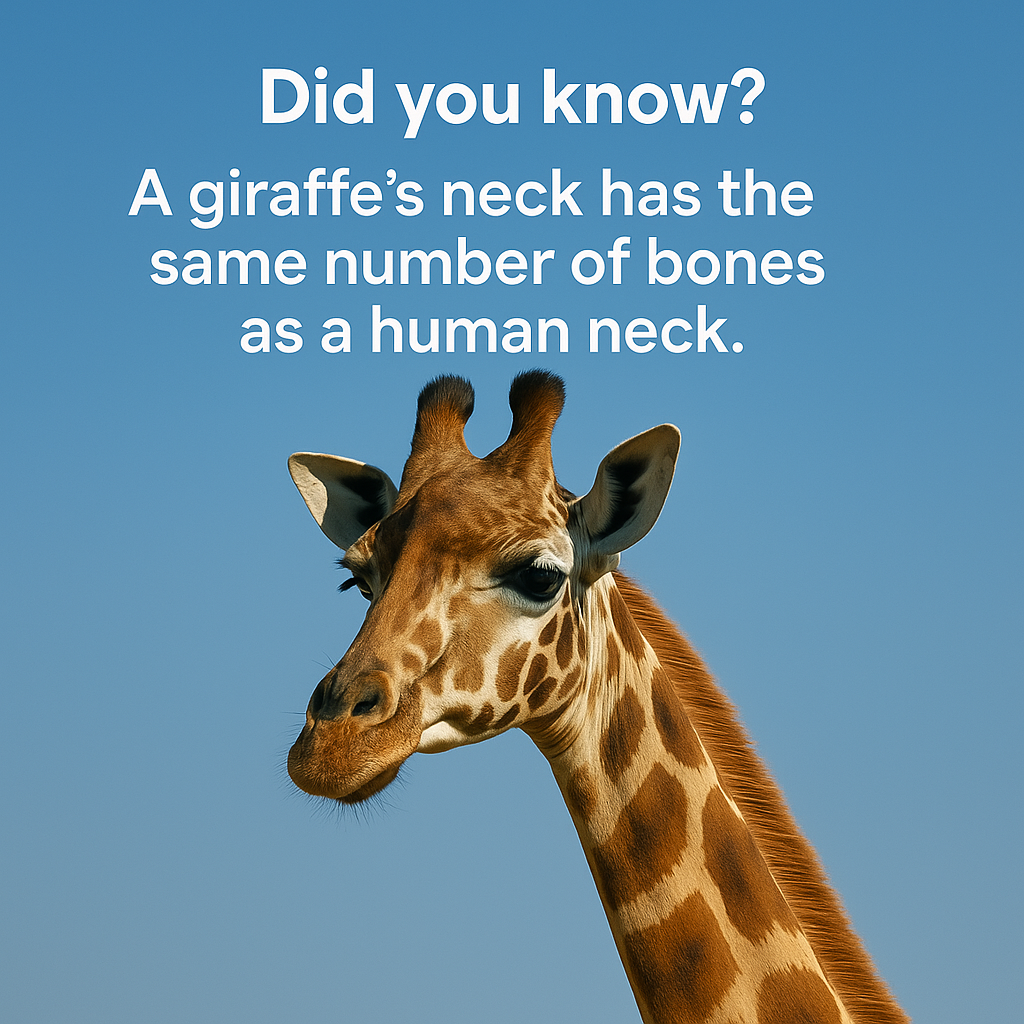
Despite having a 2-meter neck, giraffes have only 7 cervical vertebrae - the same number as humans, mice, and almost all other mammals. Each giraffe cervical vertebra is simply extremely long - up to 28 cm each.
The reason mammals generally have exactly 7 cervical vertebrae is a developmental constraint from deep evolutionary history. Evolution has not easily produced exceptions. Rather than evolving more neck vertebrae, giraffes elongated the existing seven.
Only two known mammals deviate from 7 cervical vertebrae: manatees and sloths, which have 6 or 9 depending on species. These exceptions are rare and associated with other unusual developmental patterns.
The horn-like ossicones:
Giraffes have two to five bony protrusions on their heads called ossicones. These are not true horns (not made of keratin) but bony outgrowths covered in skin and hair.
Ossicones are permanent - they do not shed like deer antlers. They develop during the giraffe's growth and remain throughout life. In adult males, ossicones become larger and often bald on top from fighting.
Ossicones serve dual purposes:
- Weaponry during male-male combat
- Display features that may influence female mate choice
The Heart That Defies Physics
Pumping blood up a 2-meter vertical neck is a significant engineering challenge. Giraffe hearts are specialized to accomplish this.
Giraffe heart specifications:
- Weight: 11 kg (one of the largest hearts among land mammals relative to body size)
- Length: 60 cm
- Blood pressure generated: up to 280 mmHg
For comparison, a healthy human adult has blood pressure of 120 mmHg. The giraffe's 280 mmHg is over twice human systolic pressure - required to push blood up against gravity through the vertical neck.
Why this matters:
At 280 mmHg, blood pressure problems that would be catastrophic in humans are normal for giraffes. Their cardiovascular system is specifically designed to handle this pressure and the pressure variations that occur with head position changes.
The lowering-the-head problem:
When a giraffe bends down to drink water, all the blood pressure that was pushing blood up to the brain suddenly has gravity helping it. Unchecked, this would cause:
- Dangerous pressure spikes in the brain
- Possible brain hemorrhage
- Fainting or death
Giraffes have evolved several solutions:
Elastic-walled arteries. Neck arteries expand when head position lowers, effectively storing excess pressure as potential energy in the expanded artery walls.
Valves in jugular veins. Prevent blood backflow to the head when the giraffe raises up from drinking.
Brain protection structures. The skull contains a network of small blood vessels (called a "rete mirabile") that buffers pressure changes, protecting the brain.
Behavioral adaptation. Giraffes drink only briefly and awkwardly. They spread their front legs wide and lower their head quickly, drink for 30-60 seconds, then raise up. This minimizes the time the cardiovascular system must manage position-related pressure changes.
The combined adaptations allow giraffes to live with blood pressure that would kill other mammals and position changes that would incapacitate them.
The Walking Gait
Giraffes walk with a distinctive "pacing" gait that differs from most other ungulates.
What pacing means:
Most four-legged mammals walk by moving diagonal pairs of legs - front-right and back-left move together, then front-left and back-right. This is called a trot.
Giraffes walk by moving the legs on one side of the body first (both right legs move forward together), then the legs on the other side (both left legs). This is pacing.
Why:
Giraffe pacing likely evolved because their long legs and tall necks would cause balance problems in a standard trot. The specific leg geometry and head position of giraffes is more stable when moved one side at a time rather than in diagonal pairs.
Speed:
Giraffes at full gallop can reach 55 km/h (35 mph) for short distances. They can sustain running at 30-35 km/h for moderate distances. Their long legs provide impressive stride length despite the unusual walking gait.
Interestingly, when galloping, giraffes switch from pacing to a more conventional gallop pattern. Pacing is their walking gait specifically; running uses different mechanics.
The Sleep Question
Giraffes sleep extraordinarily little - about 30 minutes to 4 hours per day total.
Sleep patterns:
- Total sleep per day: 30 minutes to 4 hours
- Typical nap duration: 1-35 minutes
- REM (deep) sleep per day: 3-8 minutes
- Sleep position: legs folded, head resting on back
Why so little:
Lying down makes giraffes vulnerable to predators. A giraffe on the ground takes several seconds to stand up - during which time a lion pride could attack. Short naps minimize this vulnerability.
Evolution has selected for minimized sleep in adult giraffes. Only very young giraffes or ill giraffes sleep for extended periods.
The REM mystery:
Adult mammals typically require significant REM sleep for brain function. Giraffes sleep in REM for only 3-8 minutes per day on average. How they function with so little REM sleep is a biological puzzle.
Possible explanations include:
- Different brain architecture requiring less REM than humans
- Daytime wakeful rest may serve some of the same functions as REM
- The species has not fully optimized sleep - it may just function suboptimally with this little rest
The topic is an active research area with no consensus.
Social Structure
Giraffes live in loose social groups called towers (a collective noun as tall as the animals).
Group sizes and stability:
- Typical group size: 10-20 individuals
- Extended social networks can include 40-100 individuals
- Groups are fluid - individuals come and go daily
- Females maintain more stable social bonds than males
Communication:
Giraffes are traditionally considered nearly silent, but recent research has revealed they hum at very low frequencies (below 20 Hz) that humans cannot normally hear. These infrasonic calls travel long distances and likely serve group coordination functions.
They also communicate through:
- Body posture
- Tail movements
- Ear positions
- Visual signals (approach behavior, avoidance)
Calf protection:
Young giraffes are vulnerable to lions, hyenas, and other predators during their first year. Mother giraffes are highly protective, kicking lions with their hooves (which can kill a lion with a single strike) and staying close to calves.
Despite this protection, calf mortality is high - approximately 50 percent of calves die before their first birthday.
Conservation
Giraffe populations have declined approximately 40 percent since the 1980s, from 155,000 individuals to approximately 97,000. The species is now classified as Vulnerable by the IUCN.
Subspecies-specific threats:
- Rothschild's giraffe: 2,000-2,500 individuals remaining, critically threatened
- West African giraffe: 600+ after intensive conservation (was 50 in the 1990s)
- Reticulated giraffe: Sharp decline in Somalia and Kenya
- Southern giraffe: More stable populations in southern Africa
- Masai giraffe: Declining populations in Tanzania and Kenya
Primary threats:
Habitat loss. Expanding agriculture, infrastructure, and human settlement fragment giraffe habitat. Giraffes need large territories, and their ranges are shrinking.
Poaching. Illegal hunting for bushmeat and ceremonial uses continues in multiple countries. Giraffe parts have limited trade value internationally compared to elephant ivory or rhino horn, but local poaching remains significant.
Civil conflict. Wars and political instability in several African countries disrupt conservation efforts and expose wildlife to poaching.
Climate change. Changing rainfall patterns alter vegetation availability. Droughts become more frequent and severe.
Disease. Livestock diseases can spread to giraffes in areas where their ranges overlap with cattle and other domestic animals.
Slow reproduction. Giraffes reproduce slowly - one calf every 2-3 years with 15-month gestation. Population recovery from declines is inherently slow.
Conservation efforts:
- Giraffe Conservation Foundation (international organization)
- National park protection in key range countries
- Community-based conservation in Niger (successful West African giraffe recovery)
- Genetic research to guide breeding programs
- Anti-poaching patrols in major habitats
What Giraffes Teach Us
Giraffes are more than tall herbivores. Their evolution demonstrates several important principles:
Classical explanations can be wrong. The feeding hypothesis for giraffe neck evolution was accepted for over a century before being seriously challenged. Science corrects itself when new evidence arrives, even against long-standing textbook explanations.
Multiple selection pressures shape evolution. Modern understanding recognizes that sexual selection and natural selection both contributed to giraffe necks. Single-factor explanations often miss the real complexity of evolution.
Bodies are complex engineering solutions. Giraffe cardiovascular adaptations for handling enormous blood pressure differences across their tall body represent remarkable biological engineering. Each component - heart, arteries, brain protection, behavior - works in concert.
Time matters. Giraffe necks reached their current length over approximately 16 million years. Evolution at this scale is unimaginable in human time but well within biological time.
Iconic species have surprising stories. The giraffe is one of the most recognizable animals on Earth. We all learned the simple version of its story as children. The real story is more complex and more interesting.
When you watch a giraffe browsing in an African savanna, you are watching an animal whose anatomy was shaped more by male combat than by reaching for leaves. The neck that seems designed for treetop feeding is also, maybe primarily, a weapon that evolved to help males win fights for mates.
This correction does not diminish giraffes. It makes them more interesting. Evolution rarely produces the tidy narratives of biology textbooks. Real evolutionary history is messier, more multi-causal, and more surprising than simplified stories can convey.
The giraffe's neck teaches us to hold our scientific certainties more lightly. Even the most iconic examples of adaptation may have stories we have not yet fully understood.
Subspecies Diversity and Recent Taxonomic Revision
Our research team has tracked the ongoing revision of giraffe taxonomy, which has moved from a single-species classification to a proposed four-species classification based on genetic evidence published by Fennessy and colleagues in 2016 [1]. The four proposed species show less interbreeding than traditional subspecies assumptions predicted, which has significant implications for conservation.
Giraffe Populations Under Proposed Four-Species Classification
| Proposed species | Includes subspecies | Population | Status |
|---|---|---|---|
| Northern giraffe (G. camelopardalis) | Kordofan, Nubian, West African | ~5,900 | Critically Endangered |
| Reticulated giraffe (G. reticulata) | - | ~15,000 | Endangered |
| Masai giraffe (G. tippelskirchi) | Masai, Luangwa | ~45,000 | Endangered |
| Southern giraffe (G. giraffa) | Angolan, South African | ~48,000 | Least Concern |
"When you recognize that these populations have not been interbreeding substantially for over one million years, the conservation picture changes dramatically. A species of fewer than 6,000 northern giraffes is in a much more dire situation than a subspecies of the same number within a global species of 97,000." - Dr. Julian Fennessy, Giraffe Conservation Foundation [1]
Notable Research Findings
- Giraffe hearts weigh approximately 11 kg and generate blood pressure of 280/180 mmHg at rest, roughly double that of any other mammal. Despite this extreme pressure, giraffes show no evidence of cardiovascular pathology, making them a unique model for hypertension research.
- Giraffes sleep only 30 minutes to 2 hours per night in total, the shortest sleep requirement of any mammal. Most sleep occurs in multiple brief episodes while standing. Only deep sleep (about 20 minutes per day) occurs with the animal lying down with its head curled back.
- Giraffes have seven cervical vertebrae - the same number as nearly every other mammal, including mice and whales. The vertebrae are simply extremely elongated, each one reaching approximately 28 cm in adults.
- Our research team notes that necking fights between males can last 30 minutes or more and occasionally result in death. A 2019 study of Masai giraffe combat documented one fatality during a fight observed in Tarangire National Park, Tanzania - the first such mortality to be filmed in its entirety.
- Giraffe tongues are prehensile, up to 50 cm long, and colored dark purplish-blue. The dark pigmentation is believed to provide UV protection during long periods of tongue-out feeding.
References
[1] Fennessy, J., Bidon, T., Reuss, F., et al. (2016). Multi-locus analyses reveal four giraffe species instead of one. Current Biology, 26(18), 2543-2549. DOI: 10.1016/j.cub.2016.07.036
[2] Simmons, R. E., & Scheepers, L. (1996). Winning by a neck: Sexual selection in the evolution of giraffe. The American Naturalist, 148(5), 771-786. DOI: 10.1086/285955
[3] Cameron, E. Z., & du Toit, J. T. (2007). Winning by a neck: Tall giraffes avoid competing with shorter browsers. The American Naturalist, 169(1), 130-135.
[4] IUCN Red List. (2018). Giraffa camelopardalis assessment. International Union for Conservation of Nature.
[5] Muller, D. W. H., Codron, D., Meloro, C., et al. (2013). Assessing the Jarman-Bell principle: Scaling of intake, digestibility, retention time and gut fill with body mass in mammalian herbivores. Comparative Biochemistry and Physiology Part A, 164(1), 129-140.
[6] Mitchell, G., van Sittert, S. J., & Skinner, J. D. (2009). Sexual selection is not the origin of long necks in giraffes. Journal of Zoology, 278(4), 281-286.
Related Articles
- Ungulates: The Hoofed Animals That Shaped the World
- African Elephants: Memory, Intelligence, and the Fight for Survival
- How Do Kangaroos Jump So High?
Frequently Asked Questions
Why do giraffes have long necks?
The traditional explanation - that giraffes evolved long necks to reach tall tree leaves - is increasingly questioned by biologists. A competing hypothesis, the ‘necks for sex’ theory, proposes that giraffe necks evolved primarily through sexual selection. Male giraffes fight for mating access by swinging their necks and striking each other with their heads (a behavior called ‘necking’).
Males with longer, stronger necks win these contests and produce more offspring. Supporting evidence includes: female giraffes have shorter necks than males despite eating the same diet, giraffes often browse on lower vegetation rather than the highest leaves, and the neck structure shows adaptations for combat rather than pure feeding.
The scientific consensus now favors the sexual selection hypothesis as a major driver, though feeding benefits likely contributed additionally. Classical Darwinian explanations often simplified the story; modern research reveals more complex evolutionary pressures.
How tall are giraffes?
Adult male giraffes reach 5.5 meters (18 feet) tall, with record individuals reaching 6 meters (20 feet). Adult females typically stand 4.3-5 meters (14-16 feet) tall. The neck alone measures 2 meters (6.5 feet) in adults, making up approximately one-third of total height. Despite the enormous neck length, giraffes have only seven vertebrae in their neck - the same number as humans and almost all other mammals.
Each giraffe cervical vertebra is simply much longer (up to 28 cm) than human equivalents. Giraffes weigh 800-1,500 kg, with males larger than females. Their legs are also very long - 1.8 meters just for the legs - giving them their distinctive silhouette. The tallest giraffe ever measured was named George, a male Rothschild giraffe at Chester Zoo who reached 5.88 meters (19 feet 4 inches) before his death in 1969.
How do giraffes sleep with such long necks?
Giraffes sleep in a distinctive posture: they fold their legs under their body, curl their neck around, and rest their head on their own hindquarters or alongside their body. A sleeping giraffe looks something like a rock formation with a tucked head. Total sleep per day averages only 30 minutes to 4 hours, making giraffes one of the shortest-sleeping mammals.
They typically take multiple short naps of 1-35 minutes each rather than one extended sleep period. This brief sleep likely evolved because lying down makes giraffes vulnerable to predators - a giraffe on the ground takes several seconds to stand up, during which a lion could attack. Short naps minimize vulnerability time. Surprisingly, giraffes enter REM (deep) sleep only rarely, typically for just 3-8 minutes total per day.
How they function with so little restorative sleep remains a biological mystery.
How does a giraffe's heart pump blood up such a long neck?
Giraffe hearts are enormously powerful to deliver blood up their 2-meter necks to the brain. A giraffe heart weighs approximately 11 kg and is 60 cm long - the largest of any land mammal relative to body size. It can generate blood pressure up to 280 mmHg (a healthy human is 120 mmHg) to push blood against the gravity of the vertical neck. This extreme pressure requires specialized adaptations elsewhere.
When a giraffe bends down to drink water, all this pressure would rush to the brain causing brain damage. Giraffes have elastic-walled arteries that expand to reduce pressure when the head lowers, then contract again when raising. Their jugular veins have valves preventing backflow. Their brains sit inside skulls designed to buffer pressure changes.
Even so, giraffes drink awkwardly and briefly, spreading their front legs widely and bending down only for short periods - both to minimize vulnerability to predators AND to limit blood pressure changes.
Are giraffes endangered?
Giraffes are classified as Vulnerable by the IUCN, though specific subspecies range from Critically Endangered to Least Concern. Total wild giraffe populations have declined approximately 40 percent since the 1980s, from about 155,000 to 97,000 individuals. Major threats include habitat loss from expanding agriculture, illegal hunting for meat and bushmeat, civil unrest disrupting traditional habitat, and climate change reducing food availability.
The Rothschild’s giraffe subspecies numbers only 2,000-2,500 animals. The West African giraffe, once reduced to fewer than 50 individuals, has recovered to 600+ through intensive conservation in Niger. Reticulated giraffes have declined sharply in Somalia and Kenya. Conservation efforts include protecting habitat in national parks, anti-poaching programs, genetic rescue breeding programs, and research monitoring.
The slow reproductive rate of giraffes (one calf every 2-3 years, 15-month gestation) makes population recovery slow when declines occur.