
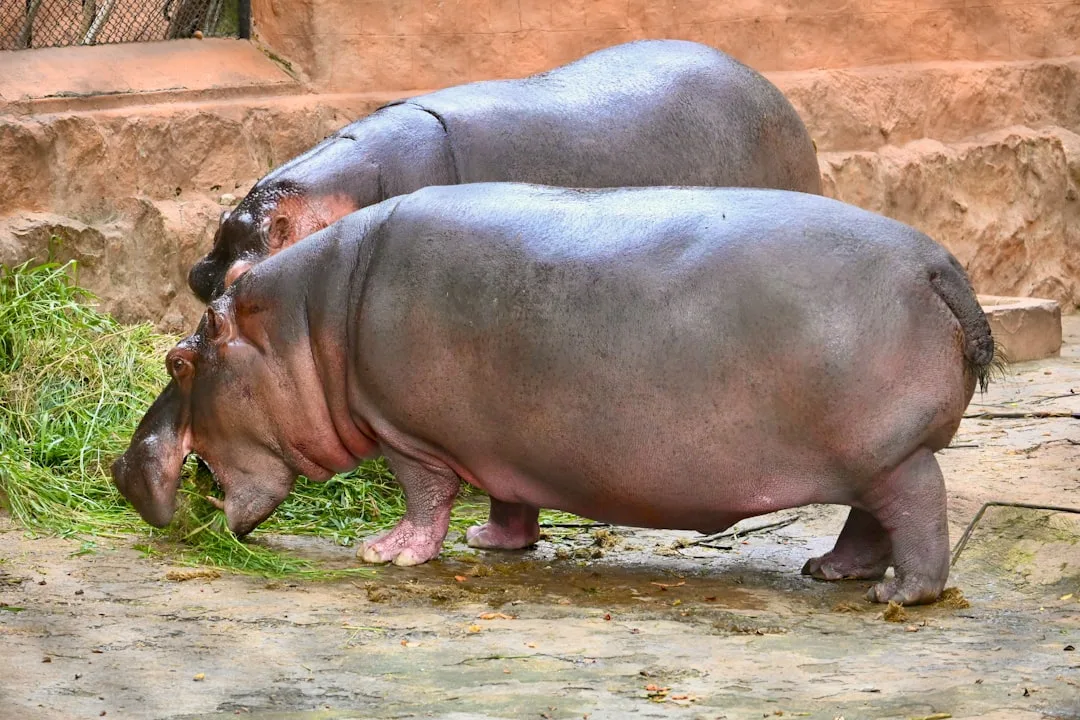
The hippopotamus is the third-heaviest land mammal alive today, the most dangerous large animal in Africa to humans, and one of the strangest results of mammal evolution.
A creature that looks, at first glance, like an overweight pig with short legs turns out to be the closest living land relative of whales and dolphins, a territorial grazer that travels kilometres overland at night, and an ambulatory pharmacy that manufactures its own sunscreen, antibiotic, and insect repellent in a single reddish secretion. The hippo is a reminder that "looks like an animal we already know" is rarely a safe assumption in biology.
This guide covers every aspect of hippopotamus biology and ecology: size and body plan, semi-aquatic adaptations, territorial behaviour, diet and digestion, reproduction and calf development, the species' lethal reputation, conservation status, and the curious case of Pablo Escobar's feral Colombian hippos. It is a reference entry, not a summary - so expect specifics: kilograms, litres, bite forces, canine lengths, population counts, and verified records.
Etymology and Classification
The name Hippopotamus comes from the Greek hippos (horse) and potamos (river), literally "river horse". Ancient Greek observers of Nile hippos apparently saw a resemblance to horses that modern viewers mostly do not. The scientific binomial Hippopotamus amphibius was formalised by Linnaeus in 1758.
Taxonomically the hippo sits inside order Artiodactyla (even-toed ungulates) and family Hippopotamidae. Only two species of hippopotamid survive: the common hippo (H. amphibius) and the much smaller pygmy hippo (Choeropsis liberiensis) of the West African rainforest. The pygmy hippo occupies a sister genus, weighs roughly one-tenth as much as the common hippo, and has a very different solitary forest lifestyle. Everything below concerns H. amphibius unless explicitly noted.
The most important point in hippo taxonomy is not the internal family structure but the external relationship. Genetic, morphological, and fossil evidence all place hippos as the closest living relatives of whales and dolphins (order Cetacea). The two lineages split from a common semi-aquatic ancestor, likely an anthracothere, roughly 55 million years ago.
That shared heritage is still visible in unusual traits including the absence of sebaceous glands, subcutaneous fat layers, underwater birth and nursing, and acoustic signalling through water.
For decades cetaceans were treated as a separate order entirely. Molecular evidence in the 1990s and 2000s forced a taxonomic revision. Many modern references now combine the two lineages into a single group called Cetartiodactyla, reflecting that whales are essentially highly derived, fully aquatic artiodactyls, and hippos are their closest surviving terrestrial cousins. Pigs, cattle, deer, antelopes, and giraffes are more distant relatives within that same group.
Size and Physical Description
Hippos are built like biological tanks. The combination of low slung, barrel-shaped body, short stout legs, and immense head gives them the third-heaviest body mass on land, behind only elephants and white rhinoceros.
Males:
- Length: 3.0-5.0 metres from nose to tail
- Shoulder height: 1.3-1.6 metres
- Weight: typically 1,300-1,800 kg, occasionally over 2,000 kg in prime bulls
- Canines: lower pair can exceed 50 cm, largest teeth of any land mammal
Females:
- Length: 2.8-4.2 metres
- Shoulder height: 1.2-1.5 metres
- Weight: typically 1,000-1,500 kg
- Canines: present but shorter and blunter than males
Calves at birth:
- Length: roughly 100 cm
- Weight: 25-50 kg
- Capable of swimming and walking within minutes
The skin is grey to reddish-brown, hairless except for a few stiff bristles around the mouth and tail, and up to 6 centimetres thick on the flanks and back. That armour of skin protects against bites during territorial fights that would kill thinner-skinned mammals outright. Underneath lies a subcutaneous fat layer similar in structure, though not thickness, to cetacean blubber.
The head is massive in proportion to body size. Eye sockets, ear canals, and nostrils all sit on the uppermost part of the skull. This "high triangle" arrangement lets a hippo breathe, see, and hear while the entire remainder of the body is submerged, a layout functionally identical to that of crocodiles sharing the same waters.
The jaws open to an extraordinary 150 degrees - almost straight up. Combined with the elongated canines, the gape is both a weapon and a threat display used in territorial disputes.
Hippo feet have four toes each, webbed to help spread the enormous body weight across soft riverbed mud. Despite the short legs, hippos can reach sprinting speeds of 30 kilometres per hour on land over short distances - faster than any human, and faster than most people assume is possible from an animal shaped this way.
Semi-aquatic Life and the Swimming Myth
Hippos spend 16-18 hours of each day in water, emerging mostly at night to graze. The water is not incidental - it is essential. Hippo skin is poorly protected against direct sun and dries out dangerously in open air. Submersion keeps body temperature manageable through the heat of the day and prevents dehydration.
Despite this aquatic lifestyle, hippos cannot actually swim in any conventional sense. They are too dense to float and their legs are too short and inflexible to paddle effectively. What observers see as graceful underwater swimming is the hippo walking or bounding across the riverbed, pushing off the bottom with the hind legs, gliding briefly through deeper water, and landing back on the bottom to push off again.
The motion resembles a slow-motion moonwalk more than the stroke of a marine mammal. Between pushes the animal sinks smoothly to the substrate.
Adults hold their breath for about three to five minutes, with occasional dives documented up to seven minutes. A specialised reflex allows sleeping hippos to surface automatically without waking. The animal sleeps at the bottom of a pool, rises to breathe, and sinks back - all without regaining consciousness. Calves even learn to nurse underwater, pressing their noses shut and drinking from the mother's submerged teats.
Hippos do not live in deep open water the way their cetacean relatives do. They require shallow enough pools or river sections to keep their feet on the bottom and grazing pasture within walking distance overnight. This is a significant constraint on their distribution.
Territoriality and Social Structure
Hippos are highly social but intensely territorial. A typical pod contains 10-30 individuals, with some groups in rich habitat approaching 100 animals. Pods consist of related females, their calves, and a single dominant bull. Subordinate and younger males hold marginal positions on the edges of the pod or outside it entirely.
Dominant bulls defend a linear river territory averaging 250 metres in length, though some stretches can be longer depending on terrain and population density. Inside this stretch the bull has exclusive mating rights with resident females.
The territory is advertised acoustically through low-frequency "wheeze-honks" that travel long distances both above and below the water surface, and visually through a behaviour called dung-showering - the bull spins its tail rapidly while defecating, spraying faeces across vegetation and water as a boundary marker.
Territorial disputes between bulls can be brutal. Opposing males face each other with jaws open at full 150-degree gape, display canines, and if neither retreats, slash sideways with the teeth. Thick hide absorbs most blows but deep wounds are common and fatalities occur. Old bulls often have canines broken near the root and their bodies mapped with scars from decades of fighting.
Despite territorial aggression on the water, grazing behaviour on land is more or less solitary. Hippos leaving the river at dusk scatter into the pastures, feed individually, and return to the water before dawn. They follow well-worn paths back and forth. These paths, carved deep into riverbank vegetation by repeated use, are ecologically important features that create secondary habitat for other species.
Diet and Nightly Grazing
Hippos are obligate herbivores despite a set of teeth that look built for combat. An adult eats 35-40 kilograms of vegetation per night, overwhelmingly short grasses. They use the broad, flattened front of the upper lip to crop grass close to the ground, the canines and incisors held well clear of the food. The molars do the grinding further back in the mouth.
Typical grazing session:
- Emerges from water between 18:00 and 20:00 local time
- Walks along established trail 2-8 km inland
- Feeds continuously for 5-6 hours
- Returns to water before dawn
- Rests and digests through daylight hours
Grazing at such distances from water sets limits on habitat viability. A pasture more than about 10 kilometres from a suitable pool cannot support hippos because the animal cannot complete the round trip, feed enough, and return before sunrise heat. During droughts when water recedes and grass belts move, hippo populations crash rapidly.
Digestive anatomy is unusual. Hippos have a three-chambered foregut fermentation system similar in principle to that of ruminants such as cattle and deer, but they do not chew cud. Microbial fermentation in the stomach extracts energy efficiently from low-quality grass, letting the species survive on smaller food volumes per unit body mass than most large herbivores. Per kilogram of body weight, a hippo eats less than a horse or a cow.
Scavenging on carrion and even opportunistic predation have been documented but are rare. A handful of observed cases involve hippos killing and consuming impala or attacking fellow hippos, most likely in response to mineral deficiency or extreme stress. These incidents are aberrant, not dietary norms.
Reproduction and Calves
Hippos breed year-round in most of their range, with local peaks timed to dry seasons when animals concentrate in shrinking water bodies. Mating occurs in water. A dominant bull mates with multiple females inside his territory while excluding rival males.
Reproductive timeline:
- Gestation: approximately 240 days (about 8 months)
- Usual litter size: 1 calf
- Twins: extremely rare
- Birth: in shallow water or on riverbank
- Nursing: up to 8 months, partly underwater
- Sexual maturity: 5-6 years (females), 7-8 years (males)
- Inter-birth interval: typically 2 years
Females give birth either on land at the water's edge or directly in shallow water. The calf surfaces to breathe within seconds. Newborns weigh 25-50 kg and can walk and "swim" immediately, though they are vulnerable to crocodiles, lions, and adult male hippos that will sometimes kill unrelated calves.
Maternal behaviour is unusually protective. Mothers position calves between their own body and the pod, intervene aggressively against threats, and extend the period of close association for 6-8 months. Calf mortality in the first year is high, estimated between 25 and 50 percent depending on local conditions, with predation by Nile crocodiles responsible for a substantial share in some populations.
The Ivory of the Mouth: Teeth and Bite
Hippo dentition is unlike that of any other living mammal. The lower canines - called tusks in common usage - grow continuously throughout life. Self-sharpening occurs because the upper and lower canines rub against each other during jaw movement, maintaining an edge that can slice through bone and small boats.
Key dental data:
| Metric | Value |
|---|---|
| Lower canine length (record) | 51 cm |
| Typical adult canine length | 30-40 cm |
| Jaw gape | 150 degrees |
| Bite force | ~1,800 psi (8,100 newtons) at the canines |
| Number of teeth | 36 total |
| Tooth replacement | None - adult dentition is permanent |
The canines are classified as ivory under international trade conventions. This matters because as elephant ivory trade has tightened since the 1989 CITES ban, hippo ivory has become an increasingly common substitute, particularly in the Asian carving market. Volumes remain below elephant levels but the trend is upward and is a significant pressure on unprotected hippo populations.
Hipposudoric Acid and the Sunscreen Myth
Hippos secrete a striking reddish-pink fluid from glands scattered across the skin. Early European naturalists described it as "sweating blood" and the phrase has stuck in popular culture. The fluid is not blood and not ordinary sweat.
The compound is called hipposudoric acid, with a related orange pigment norhipposudoric acid. Both emerge from subcutaneous glands as a colourless viscous liquid and oxidise within minutes on exposure to air, first to red and then to brown. Laboratory work has confirmed at least three biological functions:
- Ultraviolet filter. The molecules absorb across UV-B and most of UV-A, protecting the hairless, thin-membraned areas of skin during the long daytime hours spent partly exposed above water.
- Antibiotic. The compound inhibits growth of several pathogenic bacteria including strains of Pseudomonas and Klebsiella that might otherwise infect wounds from territorial fights.
- Insect repellent. Biting flies land less frequently on the secreted areas compared with control skin.
No other mammal produces anything chemically similar. Dermatological research has investigated the compounds as potential models for synthetic sunscreens and topical antibiotics.
The Deadliest African Large Mammal
Hippos kill an estimated 500 people per year across Africa. This figure, which is widely cited by the World Health Organization and regional wildlife authorities, makes the hippopotamus the deadliest large mammal on the continent to humans. Lions, leopards, buffalo, and elephants combined do not approach this fatality rate.
The fatality pattern is specific. Most deaths involve territorial bulls attacking boats that enter river stretches they control, mothers protecting calves against people walking the riverbank, and animals surprised on their nightly grazing paths. Dawn and dusk carry the highest risk. Fishing communities and communities that rely on river access for water and laundry are disproportionately affected.
A hippo attack is extremely hard to survive. A bull can overturn a canoe with a single upward thrust of the head, bite through fibreglass or wooden hulls, and sever limbs or torsos with its canines. Thick hide makes the animal almost bulletproof to small-calibre weapons. Victims in the water typically drown, are crushed, or are bitten severely. On land, charges are direct and short-ranged; the animal is faster than the victim over the first 30 metres.
Local management strategies include seasonal avoidance of known territorial stretches, ranger escorts at fishing points, low-fence barriers around village water-collection areas, and community education. Fatal removals of problem individuals occur under national wildlife management regulations but remain controversial where the species is also locally valued.
Pablo Escobar's Colombian Hippos
One of the strangest stories in modern invasive ecology begins in 1981 when Colombian drug lord Pablo Escobar smuggled four hippos - one bull and three cows - onto his Hacienda Napoles estate in Antioquia, Colombia. After Escobar's 1993 death the hippos were left unmanaged. In the absence of seasonal droughts, territorial competition, or natural predators, the population thrived and expanded.
By 2023 surveys estimated between 130 and 200 hippos in the Magdalena River basin. This is the largest free-ranging hippo population outside Africa and the largest invasive megafauna population anywhere on Earth. Population models suggest that without intervention the number could exceed 1,000 within two decades.
Ecological effects are measurable. Hippo dung is transforming nutrient flows in Colombian rivers in ways that favour algal blooms and disadvantage native fish. Displacement of manatees and caimans has been documented. Attacks on people have begun to appear in local records.
The Colombian government has declared the animals an invasive species but legal and political barriers have complicated culling or sterilisation programmes, and public affection for the "cocaine hippos" has further slowed a clear management response.
Conservation Status and Threats
The IUCN Red List classifies hippos as Vulnerable with a decreasing population trend. The most recent consolidated assessment estimates 115,000-130,000 individuals remaining across Africa.
Geographic distribution by region:
| Region | Approximate share | Key strongholds |
|---|---|---|
| East Africa | ~40% | Luangwa, Mara, Rufiji, Lake Edward |
| Southern Africa | ~30% | Okavango, Zambezi, St Lucia |
| Central Africa | ~20% | Virunga, Garamba, Salonga basins |
| West Africa | ~10% | Niger river system, Gambia river, Volta |
Primary threats include:
- Habitat loss. Water extraction, dam construction, and agricultural encroachment reduce the availability of deep-enough pools and adjacent grazing belts. Because hippos need both within walking distance, losing either eliminates a site.
- Illegal hunting for ivory. Canines are targeted as an elephant ivory substitute. Enforcement is weaker for hippo ivory in most jurisdictions.
- Hunting for bushmeat. A single hippo yields several hundred kilograms of meat, an enormous incentive in food-insecure rural areas.
- Human-wildlife conflict. Hippos raid crops and damage fishing gear. Retaliatory killings are common and rarely prosecuted.
- Climate change. Drought reduces water availability and shrinks habitat to the point where pods concentrate, diseases spread, and local die-offs accelerate.
Conservation success stories exist. Populations are stable or increasing in well-managed protected areas such as South Luangwa (Zambia), Okavango Delta (Botswana), and iSimangaliso Wetland Park (South Africa). International trade in hippo ivory is regulated under CITES Appendix II, though enforcement is uneven.
Hippos and Humans
Hippos have been part of African cultural and spiritual life for millennia. Ancient Egyptian religion included both a hippo goddess (Taweret, a protective figure associated with childbirth) and a hippo-demon (Ammit, which devoured the unjust in the afterlife), reflecting the animal's dual reputation as life-giving river inhabitant and lethal threat. Hippo hunts were recorded in pharaonic iconography as acts of state power.
Modern relationships are mixed. Ecotourism has made hippos economic assets in countries like Zambia, Botswana, Uganda, and Kenya, where river cruise operators and wildlife lodges structure itineraries around hippo-watching. On the other hand, communities that live alongside hippos on a daily basis bear the costs of crop raids, livestock loss, and fatal attacks.
Successful conservation in these landscapes depends on sharing tourism revenue with local people and investing in practical mitigation such as chilli-pepper fences, bright lighting at water-collection points, and early-warning networks.
Related Reading
- The Hippopotamus: Africa's Most Dangerous Large Mammal
- Ungulates: The Hoofed Animals That Shaped the World
- Giraffe
- Why Giraffes Have Long Necks
References
Relevant peer-reviewed and governmental sources consulted for this entry include IUCN Hippopotamus Specialist Group status reports (2022, 2023), the African Wildlife Foundation's Common Hippopotamus fact sheets, the CITES Appendix II reviews of hippo ivory trade, and published research in Mammalian Biology, Journal of Zoology, Biological Conservation, and Molecular Phylogenetics and Evolution.
Population figures reflect the most recent consolidated estimates as of the 2023 IUCN assessment. Data on Colombian feral populations come from the 2023 survey coordinated by the Universidad Nacional de Colombia and the Corporacion Autonoma Regional del Centro de Antioquia.
Frequently Asked Questions
How big is a hippopotamus?
Adult male hippopotamuses (Hippopotamus amphibius) weigh 1,300-1,800 kg and measure 3-5 metres from nose to tail. Shoulder height is typically 1.3-1.6 metres. Females are smaller, generally 1,000-1,500 kg. Old dominant bulls can exceed 2,000 kg in regions with good forage. Calves weigh 25-50 kg at birth and can already swim and walk within minutes.
Despite short legs and a barrel-shaped body, hippos are the third-heaviest land mammal alive, behind only elephants and white rhinoceros.
Why are hippos so dangerous to humans?
Hippos kill an estimated 500 people per year across Africa, more than any other large African mammal. The risk is highest at dawn, dusk, and night when hippos move between water and grazing pastures, and around fishing boats and laundry points where people share riverbanks with them. Bulls aggressively defend river territories and mothers defend calves with lethal force.
A charging hippo outruns a human on land, its canines can slice a small boat in half, and its bite force - around 1,800 pounds per square inch - can crush a crocodile. Hippos are herbivores, so attacks are not predatory but territorial and defensive.
Can hippos actually swim?
No. Despite spending most of their lives in water, hippos cannot swim in the biomechanical sense. They are too dense to float and their legs are too short for proper paddling. What appears to be graceful swimming is the hippo walking or pushing off the riverbed, using bouncing leaps to move through deeper water. Between leaps they sink back to the bottom. They can hold their breath for about five minutes, and young calves even learn to suckle underwater.
This is one reason hippos stick to shallow rivers and lakes rather than the deep open water their cetacean cousins inhabit.
What are hippos' closest living relatives?
Genetic and fossil evidence places hippos inside the larger cetartiodactyl group, with whales and dolphins (order Cetacea) as their closest living relatives. The split between the hippo lineage and the cetacean lineage occurred roughly 55 million years ago from a shared semi-aquatic ancestor.
Shared traits that point to this common origin include the absence of sebaceous glands, underwater birth and nursing, subcutaneous fat layers, acoustic signalling through water, and similar placental biochemistry. Pigs, cattle, deer, and antelopes are more distant relatives within the even-toed ungulates.
Where do hippos live?
Hippopotamus amphibius inhabits freshwater rivers, lakes, and swamps across sub-Saharan Africa. Major strongholds include the Nile river system, the Luangwa and Zambezi basins, the Okavango Delta, the Mara river, and the wetlands of Virunga National Park. The species needs deep enough water to submerge the body for thermoregulation plus accessible grazing pasture within a few kilometres.
Historical range covered most of the continent including North Africa, but populations north of the Sahara were extirpated in Roman times. The IUCN recognises the species as locally extinct in Algeria, Egypt, Liberia, and Mauritania.
What do hippos eat?
Hippos are grazing herbivores. Adults consume 35-40 kg of vegetation per night, overwhelmingly short grasses cropped by their wide lips. Grazing happens almost entirely after dusk on pastures up to 8 km from water, with daytime hours spent cooling in rivers or lakes.
Their digestive system is unusual among large herbivores: they have a three-chambered foregut fermentation system despite not being ruminants, which allows them to survive on surprisingly low food intake relative to body mass. Opportunistic scavenging on carrion has been documented but is rare and not a regular part of the diet.
Do hippos really sweat blood?
No, but they do sweat a red fluid that early naturalists mistook for blood. The secretion, hipposudoric acid, is produced by subcutaneous glands and emerges colourless before oxidising to a vivid orange-red. It behaves as a natural sunscreen across ultraviolet wavelengths, an antibiotic that protects the frequent skin wounds hippos sustain during fights, and an insect deterrent.
Pigment chemistry changes through the day from red to brown as the compound further oxidises. No other mammal produces anything chemically similar, and the compound is an active research subject in dermatology.
Are hippos endangered?
The IUCN lists Hippopotamus amphibius as Vulnerable with a decreasing population trend. The latest assessment estimates 115,000-130,000 individuals remaining across Africa, with populations stable or recovering in well-managed national parks but declining sharply in unprotected areas.
Primary threats are habitat loss through water extraction and agricultural encroachment, illegal hunting for bushmeat and ivory (hippo canines are classified as ivory and are increasingly targeted as elephant ivory trade tightens), and human-wildlife conflict in fishing and farming communities. Regional conservation success stories include Zambia’s South Luangwa, Botswana’s Okavango, and South Africa’s iSimangaliso Wetland Park.