
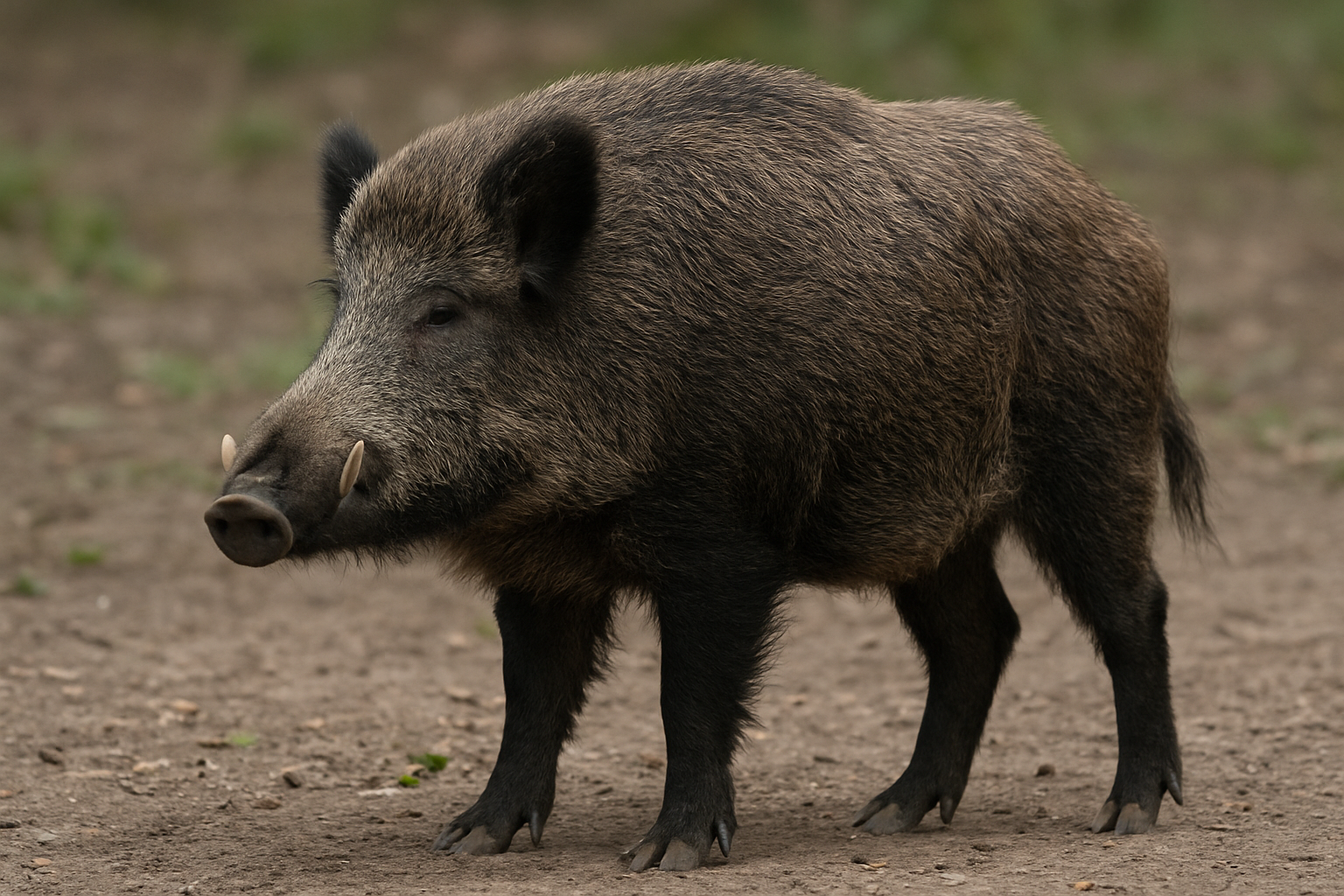
The wild boar is one of the most successful large mammals alive today. No other terrestrial mammal of its size occupies so broad a natural range, tolerates so wide a variety of habitats, or carries such profound cultural and agricultural weight for human societies.
Sus scrofa is the direct ancestor of every domestic pig on Earth, the dominant large omnivore of the Eurasian forest, and - in its feral form - one of the costliest invasive species in modern North America. A species that most Europeans picture as a shy forest dweller is, across its global footprint, an ecological force capable of reshaping entire landscapes.
This guide covers every aspect of wild boar biology and ecology: size, tusks, diet, social structure, intelligence, reproduction, sixteen subspecies, the relationship between wild boar and domestic pig, the spiralling feral hog crisis in the United States, and the strange facts that have accumulated around a species humans have hunted, farmed, feared, and admired for millennia. It is a reference entry, not a summary - so expect specifics: kilograms, kilometres, dollars, and verified records.
Etymology and Classification
The scientific name Sus scrofa was applied by Carl Linnaeus in 1758 in the tenth edition of Systema Naturae. Sus is the Latin word for pig; scrofa is a Latin term for a breeding sow. The combined name is essentially "pig of pigs" and reflects Linnaeus's view of the species as the archetypal member of the family Suidae.
The wild boar sits inside the order Artiodactyla, the even-toed ungulates, which also contains deer, cattle, sheep, giraffes, hippos, and - in the modern phylogenetic view - cetaceans. Within Artiodactyla, pigs occupy the family Suidae together with warthogs, bushpigs, forest hogs, and babirusas.
All modern Suidae retain features that are primitive for the order: four functional toes on each foot, simple stomachs, and an omnivorous rather than strictly herbivorous diet. Among them Sus scrofa is by far the most widespread and the only species with a truly global distribution.
Sixteen subspecies of wild boar are currently recognised by most taxonomic authorities, ranging from the large-bodied European wild boar (S. s. scrofa) of the western Palearctic to the small Ryukyu wild boar (S. s. riukiuanus) of southern Japan, the Central Asian S. s. nigripes, and the Sumatran S. s. vittatus.
The domestic pig is treated by most modern taxonomists as a domesticated form of Sus scrofa, often written Sus scrofa domesticus. Molecular work confirms multiple independent domestication events in Anatolia and East Asia at least 9,000 years ago.
Size and Physical Description
Wild boar are compact, heavily built ungulates with a barrel-shaped torso, short thick legs, a long mobile snout, and a coat of coarse bristles overlying a softer underfur. Adults are among the largest non-ruminant ungulates in their native range.
Males (boars):
- Body length: 1.4-1.8 metres
- Shoulder height: 70-110 cm
- Weight: typically 80-130 kg, occasionally more than 200 kg
- Continuously growing canine tusks
Females (sows):
- Body length: 1.2-1.6 metres
- Shoulder height: 55-90 cm
- Weight: typically 50-90 kg
- Smaller, less prominent canines
Piglets at birth:
- Weight: 750-1,000 grams
- Pale longitudinal stripes on a reddish-brown background
- Stripes fade by around four months of age
The largest verified wild boar on record weighed 320 kg - roughly three times the mass of a typical adult - and was shot in eastern Europe. Feral hogs in the southern United States, supplied with agricultural food and hybridised with domestic stock, have produced individuals claimed to exceed 400 kg, though many such reports are poorly documented.
Body shape is optimised for pushing through dense cover. The head is triangular in profile, with small eyes set high and a flexible, cartilage-reinforced snout disc that is used to root through soil and turn over logs. The shoulders carry a mane of longer bristles that stand erect in threat displays. The coat colour varies by subspecies and season, ranging from almost black through dark brown, grey, rust-red, and even silvery in old animals.
The most visually distinctive feature of the adult male is the pair of continuously growing canine tusks. The upper and lower canines grow in opposing curves; as the jaws move they grind against each other, sharpening both sets to chisel edges. A mature boar carries lower tusks 10-25 cm long measured along the curve, of which perhaps a third is visible outside the lip.
The upper tusks are shorter but broader and help direct the sharpening action. Sows have tusks too, but they remain small and do not protrude.
Adaptations for a Generalist Life
Where polar bears are adapted for one extreme environment and one prey type, wild boar are adapted for flexibility. Almost every part of the species' biology is built around being able to live somewhere else, eat something else, and reproduce anyway.
Sensory system:
- Sense of smell: among the keenest of any land mammal; truffle-hunters historically used sows precisely because they can smell buried fungi through tens of centimetres of soil
- Hearing: excellent, particularly for low-frequency sound; wild boar detect approaching humans long before they are seen
- Vision: relatively weak compared to ungulate prey species; good for motion, poor for detail
Physical adaptations:
- Powerful forelimbs and snout for rooting in hard ground
- Thick skin on the shoulders and neck, forming a "shield" that deflects tusk strikes during fights
- Strong cardiovascular system that supports sustained running at 30-40 km/h
- Swimming ability - wild boar routinely cross rivers and have colonised offshore islands across open saltwater
Behavioural adaptations:
- Nocturnal shift under hunting pressure; populations hunted during the day become largely nocturnal within a few generations
- Rapid learning of novel food sources, including crops, garbage, and road kills
- Strong social memory of trap locations, human patrol patterns, and dangerous individuals
The combination is what makes the species so difficult to manage. A population hunted hard does not collapse; it goes nocturnal, more cautious, and more fertile.
Tusks, Fights, and the "Shield"
Wild boar social life is structured by tusks and the shields built to resist them. Adult males live largely solitary lives outside the autumn breeding season, known as the rut. During the rut, boars travel long distances searching for receptive sows and confront rival males repeatedly.
A full boar-on-boar fight begins with parallel walking and lateral display. If neither male retreats, they rotate head-to-head and slash upward with the lower tusks, aiming for the opponent's shoulder shield. The shield is a zone of dense connective tissue up to five centimetres thick on the shoulders and neck of rutting males. It absorbs most tusk strikes; decisive injuries are rare in evenly matched adults.
Fatalities do occur, particularly when one animal loses footing. Broken tusks and facial scars are near-universal in older males.
The same tusks are the reason a cornered wild boar is genuinely dangerous to humans. A charging boar lowers the head, drives forward with the powerful shoulders, and hooks upward at the end of each stride. The resulting wound pattern - deep parallel lacerations starting low and travelling up the thigh or abdomen - is distinctive enough that European emergency-room staff recognise it on sight in rural districts.
Diet and Foraging
Wild boar are true omnivores. Stomach-content studies across the native range consistently show plant material making up roughly 85-90% of the diet by volume, with animal matter and fungi making up the rest. But the composition of each category varies enormously with habitat and season.
| Food category | Examples | Typical share |
|---|---|---|
| Roots, tubers, rhizomes | Bracken, wild garlic, bulbs | 20-40% |
| Mast (nuts, acorns) | Acorns, beech mast, chestnuts | 20-40% |
| Fruit and seeds | Apples, pears, berries, grains | 10-30% |
| Green vegetation | Grasses, forbs, shoots | 5-15% |
| Animal matter | Earthworms, insects, small vertebrates, carrion | 5-15% |
| Fungi | Truffles, mushrooms | 1-5% |
In heavily agricultural landscapes the composition shifts sharply toward crops - maize, wheat, sunflowers, potatoes - with individual boar sometimes eating more than 80% cultivated material during peak crop seasons. In urban environments, wild boar scavenge garbage, compost, and deliberate feeding by residents.
Foraging technique is as flexible as the menu. Wild boar "root" by driving the nose disc into soil and levering soil and plant material upward with the neck muscles. A single sounder - the social group of sows and young - can turn over a hectare of forest floor in a single night. This rooting activity is both an ecological service (seed dispersal, soil mixing) and, in the wrong context, serious damage to gardens, sports fields, and archaeological sites.
Piglets, Sounders, and Reproduction
Wild boar reproduction is built around quantity and social support. Females reach sexual maturity around 8-18 months depending on body condition and food supply. In food-rich environments, including most feral hog ranges in the United States, sows can produce two litters per year from their first birthday onward.
Gestation lasts approximately 115 days. A few days before giving birth, the sow separates from her sounder and builds a "farrowing nest" - a mounded structure of grass, branches, and leaves up to a metre high - in a sheltered location. Litters typically contain four to eight piglets, occasionally up to twelve.
Piglets are born with closed eyes, functioning legs, and the famous pale longitudinal stripes that give them a watermelon-like appearance. The stripes provide camouflage in leaf-dappled forest light and fade to uniform brown by about four months of age.
For the first few weeks, piglets remain in or very near the nest. The sow nurses them on high-fat milk, and mortality is high: predation, cold, and disease together often kill a third or more of a litter before weaning. Once mobile, piglets rejoin the sow's sounder, which is typically a matrilineal group of 6-30 related females and young. Sounders move together, feed together, rest together, and defend piglets collectively. Adult males are peripheral, attaching only during rut.
Males disperse from their natal sounder around 12-18 months and take up the wandering, largely solitary life that characterises adult boars outside the breeding season.
The Domestic Pig Connection
No other wild mammal has given rise to a domestic animal as globally important as the domestic pig. Every pork chop, bacon rasher, and prosciutto ham on Earth traces back to Sus scrofa. Domestication began at least 9,000 years ago and happened independently at least twice - once in Anatolia and once in East Asia - producing lineages whose descendants were later crossbred to create the hundreds of modern breeds.
The genetic continuity remains so strong that domestic and wild Sus scrofa interbreed freely wherever they meet. This is the root of the feral hog problem: a domestic pig that escapes into a suitable environment reverts toward the wild phenotype within a few generations. Longer legs, coarser bristles, darker pigmentation, and larger tusks appear in feral-born offspring.
In most of the Americas, Australia, and the Pacific, the "wild" pig populations are genetically a mix of imported European wild boar and escaped domestic stock.
This hybridisation is why American feral hogs often grow larger than their European wild ancestors and why their behaviour combines wild-boar wariness with domestic-pig fertility and generalism.
The US Feral Hog Crisis
Few invasive species illustrate the adaptability of Sus scrofa as starkly as the feral hog crisis in the United States. Feral pigs have been present in North America since Spanish colonists released domestic stock in the 1500s, but modern populations trace mostly to deliberate introductions of European wild boar for hunting in the twentieth century and to agricultural escapes.
Key figures:
- Estimated US population: roughly 6 million
- States with established populations: at least 35
- Texas population: 1.5-2.6 million (single-state total)
- Annual agricultural damage: approximately 1.5 billion US dollars
- Annual control spending: hundreds of millions across federal, state, and private programmes
Feral hogs damage agriculture through direct crop destruction (rooting through planted fields), livestock predation (mostly young lambs, goat kids, and newborn calves), and the transmission of diseases including pseudorabies, brucellosis, and classical swine fever. They damage natural ecosystems by tearing up ground cover, outcompeting native deer and turkey, destroying wetland vegetation, and predating on ground-nesting birds and amphibians.
Control is notoriously difficult. Traditional hunting pressure removes maybe 20-25% of a feral hog population annually, while sow fertility can replace 70% or more in a year. Large-scale corral trapping of entire sounders, coupled with aerial shooting from helicopters, has emerged as the most effective control method.
Toxic bait research has progressed but faces regulatory and non-target-species hurdles. No state with established feral hog populations has ever successfully eradicated them at landscape scale.
Intelligence and Behaviour
Pigs - wild and domestic - are regularly placed among the top ten most intelligent non-human animals on Earth. Laboratory cognitive work has shown domestic pigs can use mirrors to find hidden food, learn arbitrary symbolic associations, manipulate joysticks in video-game tasks, and outperform three-year-old children on certain problem-solving benchmarks.
Wild boar add a layer of applied intelligence to this baseline. Field studies have documented:
- Episodic memory of food patches, with individuals returning to specific oak trees in good mast years and bypassing them in poor ones
- Social learning of novel behaviours within sounders, including crop raiding tactics and road-crossing strategies
- Deliberate avoidance of traps after a single sounder loses a member, with wariness persisting for months
- Tool use: individuals have been filmed using sticks to dig and scoop soil, a behaviour once thought restricted to primates and corvids
The practical consequence is that wild boar populations adapt faster to human control than humans adapt their control methods. A hunting season, a new trap design, or a culling programme shifts behaviour within a single generation.
Mud Wallows, Truffles, and Other Strange Behaviours
Wild boar have a series of well-studied behaviours that look peculiar to outside observers but serve precise ecological functions.
Mud wallows are not about cooling or play. The boar rolls in soft mud until a thick coating adheres to the skin and bristles. Over the next few hours the mud dries, cracks, and flakes off - carrying with it lice, ticks, mites, and embedded parasite larvae. The behaviour is an evolved ectoparasite control mechanism, performed more frequently during warm seasons when parasite loads peak. Wallowing sites become traditional features of a home range, used by multiple generations.
Truffle hunting was until the early twentieth century a near-universal role for European wild boar sows and lightly trained pigs. The reason is olfactory: truffles produce androstenol, a steroid similar to a boar pheromone. Sows in oestrus are strongly attracted to it and dig truffles from as deep as thirty centimetres. Dogs eventually replaced pigs because dogs do not try to eat the truffle the moment they find it.
Rub trees are another traditional feature. Boar rub their flanks and shoulders against specific trees, leaving hair, pheromones, and mud. Such trees become social bulletin boards for multiple animals passing through.
Swimming and island colonisation are often overlooked. Wild boar have colonised numerous Mediterranean and Pacific islands under their own power, crossing kilometres of saltwater. They swim with a strong dog-paddle stroke and can sustain it for hours.
Conservation Status and Threats
The IUCN Red List assesses Sus scrofa as Least Concern with an increasing population trend. Globally, the species is one of the most demographically successful large mammals of the twenty-first century. In Europe, wild boar populations have risen roughly fourfold since 1980 because of forest regrowth, reduced winter severity, and heavy maize cultivation.
In North America, Australia, Japan, and South America, feral populations are expanding rapidly. Only a handful of island subspecies and isolated Southeast Asian populations face real decline.
The policy consequence is paradoxical. In parts of the native range the conservation concern is the ecological damage caused by superabundant wild boar - agricultural loss, road accidents, disease reservoirs for African swine fever - rather than their survival.
In much of the introduced range the species is classified as invasive, subject to year-round culling, and the target of active control programmes. Few other large mammals have both protected and invasive status at different points on the map.
Threats where they are real:
- Disease: African swine fever outbreaks have devastated wild boar populations in parts of eastern Europe and China
- Habitat loss for some tropical island subspecies
- Hybridisation with domestic pigs eroding native subspecies genetic integrity, particularly in Southeast Asia
- Targeted persecution in agricultural landscapes, rarely sufficient to threaten populations but locally significant
Wild Boar and Humans
The relationship between wild boar and humans is among the oldest and most complex of any large mammal. Sus scrofa was one of the earliest mammals domesticated. It features prominently in European, Celtic, Hindu, and Japanese mythology. Roman legions carried the boar as a standard. Medieval European nobility hunted it on foot with dedicated long-bladed spears. Modern European game management treats it as the most economically and ecologically significant large mammal on the continent.
Human-wild boar conflict is also ancient. Crop damage, livestock predation, road collisions, and occasional human injury have shaped control strategies for centuries. Modern management tools include legal hunting quotas, bounty programmes, trap-and-cull operations, urban control contracts, and experimental contraceptive research. None has reduced overall wild boar populations at the continental scale; most are simply keeping local damage below politically tolerable levels.
Urban wild boar have become a twenty-first-century phenomenon in their own right. Populations living inside or adjacent to major European cities - Berlin, Rome, Barcelona, Madrid, Krakow - now include thousands of animals. They raid garbage, occupy parks, and occasionally block traffic. Cities have responded with a mix of sterilisation trials, selective culls, and public education campaigns about leaving wild boar alone.
Related Reading
- Ungulates: The Hoofed Animals That Shaped the World
- Hippopotamus
- Giraffe
- Biggest Predators in the World Ranked by Size
References
Relevant peer-reviewed and governmental sources consulted for this entry include the IUCN SSC Wild Pig Specialist Group status reports, the USDA APHIS National Feral Swine Damage Management Program annual reports, European Food Safety Authority reports on African swine fever and wild boar, and published research in Mammal Review, Journal of Wildlife Management, Wildlife Biology, and Biological Invasions. Population and damage figures reflect the most recent consolidated estimates as of 2024.
Frequently Asked Questions
How big are wild boar?
Adult wild boar (Sus scrofa) typically weigh 50-130 kg and measure 1.2-1.8 m from snout to rump, with an additional 15-40 cm of tail. Shoulder height ranges from 55-110 cm. Males are consistently larger than females. Size varies enormously by subspecies and habitat: European wild boar from the Carpathians routinely reach 150-200 kg, while the smaller tropical subspecies of Southeast Asia rarely exceed 60 kg.
The heaviest verified wild boar weighed 320 kg, though unverified hunter reports claim larger animals. Feral hogs in the American South can grow even larger than their wild European ancestors because of abundant crop food.
What do wild boar eat?
Wild boar are omnivores and one of the most flexible feeders among large mammals. Roots, tubers, bulbs, fallen fruit, acorns, beechnuts, and other plant material make up roughly 90% of a typical diet. The remaining 10% is animal matter: earthworms, insects, grubs, small mammals, bird eggs, reptiles, amphibians, fish trapped in shallow pools, and carrion.
Wild boar will scavenge large carcasses including deer and livestock, and they readily eat human refuse, crops, and even road-killed animals. This dietary flexibility is the single biggest reason the species thrives in everything from alpine forest to suburban parkland.
Where do wild boar live?
Wild boar are native to a vast swath of Eurasia and North Africa, stretching from Portugal and Morocco through central Europe, Russia, the Middle East, India, Southeast Asia, and into southern China, Japan, and Indonesia. They have been deliberately or accidentally introduced to most continents outside their native range, including North America, South America, Australia, and many oceanic islands.
Preferred habitats include deciduous and mixed forests, reed beds, wetlands, and grasslands - anywhere with dense cover, water, and rootable soil. They avoid extreme deserts and high alpine zones but tolerate almost everything else, including city parks in Berlin, Rome, and Barcelona.
Are wild boar dangerous to humans?
Yes, under the right circumstances. Wild boar attacks on humans are uncommon but not rare, and they are disproportionately severe when they occur. A charging boar lowers its head, drives with its shoulders, and slashes upward with its tusks - a single pass can open a deep thigh or abdominal wound. Attacks cluster in three situations: a sow defending piglets, a cornered animal with no escape, and a wounded boar during a hunt.
European hospitals report dozens of serious boar-related injuries every year. Fatalities are rarer but happen, particularly in India and parts of eastern Europe. Unprovoked predatory attacks on adults are extremely rare; most incidents are defensive.
Why are feral hogs such a big problem in the United States?
Feral hogs in the United States descend from European wild boar and escaped domestic pigs, and their populations have exploded since the 1990s. Current estimates put the US feral hog population at around six million animals across at least 35 states, with Texas alone holding an estimated 1.5-2.6 million.
They cause roughly 1.5 billion dollars in agricultural damage every year through rooting, crop destruction, livestock predation, and the spread of disease. They also damage native ecosystems by digging up ground-nesting bird habitat, outcompeting deer, and destroying wetlands.
Their combination of high fertility - sows can produce two litters a year from age one - with intelligence and adaptability makes them nearly impossible to eradicate by conventional hunting.
How intelligent are wild boar?
Wild boar and their domestic descendants regularly appear in the top ten of mammalian intelligence rankings, alongside great apes, dolphins, elephants, and corvids. Cognitive studies show pigs can use mirrors to locate food, learn symbolic associations, solve simple puzzles, and navigate video-game-style joystick tasks.
Wild boar-specific research has demonstrated episodic memory of food patches, social learning of novel behaviours within a sounder, and deliberate detours around human-set traps once a sounder has lost a member. This intelligence is the practical reason feral hog populations are so hard to manage: traditional hunting pressure selects for smarter, more nocturnal, more trap-averse individuals.
Are wild boar and domestic pigs the same species?
Yes. The domestic pig (often listed as Sus scrofa domesticus) is a subspecies of Sus scrofa, domesticated from Eurasian wild boar at least 9,000 years ago in Anatolia and independently in China. Domestic pigs and wild boar interbreed freely and produce fully fertile hybrids, which is why feral hog populations arise so quickly when domestic pigs escape.
Feral pigs often revert toward the wild phenotype within a few generations - longer legs, coarser hair, larger tusks, darker pigmentation - demonstrating how close the underlying biology remains. Sixteen wild subspecies of Sus scrofa are currently recognised, from the European wild boar to the tiny Ryukyu wild boar of Japan.
Are wild boar endangered?
No. The IUCN classifies Sus scrofa as Least Concern with an increasing population trend. Globally, wild boar are among the most successful large mammals of the twenty-first century: their range is expanding in Europe, their numbers are rising across North America and Australia as feral populations, and only a few local subspecies - including some island forms in Southeast Asia - face real decline.
In their introduced ranges they are classified as invasive and subject to year-round control. In parts of their native range, including Japan and several European countries, regional populations have actually become agricultural and road-safety problems, prompting expanded hunting seasons and organised culls.