
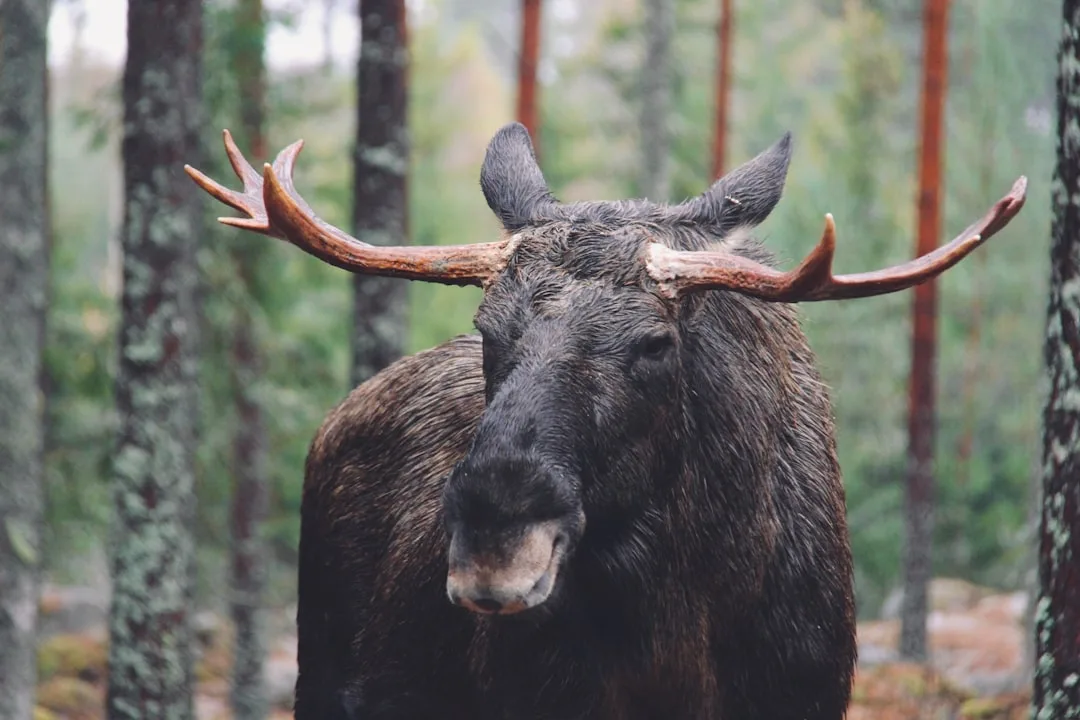
The moose is the largest living member of the deer family, an animal so disproportionate in its features that early European naturalists assumed specimens had been exaggerated.
A full-grown bull can stand taller at the shoulder than a draft horse, wear a crown of antlers wider than the span of an average person's arms, dive underwater to uproot aquatic plants, and run through dense forest at nearly 60 kilometres per hour. In North America it is called the moose. In Eurasia the same species is called the elk.
No other deer matches its size, and few other large mammals have adapted so completely to the cold, waterlogged, twig-eating existence of the circumpolar boreal forest.
This guide covers every aspect of moose biology and ecology: taxonomy, size, antlers, hunting and diet, swimming, reproduction, seasonal behaviour, conservation status, and the curious relationship between moose and humans - a relationship that involves more car crashes than almost any other large mammal in the Northern Hemisphere. It is a reference entry, not a summary, so expect specifics: kilograms, kilometres, gestation days, and verified records.
Etymology and Classification
The word moose entered English in the early seventeenth century from the Algonquian languages of northeastern North America, most likely from the Eastern Abenaki moz or the closely related Narragansett moos. The root carries the sense of 'he strips off' or 'twig eater', a direct description of how the animal peels bark and shears off woody shoots.
The Algonquian-speaking peoples had hunted the species for millennia before European contact, and the name moved into English, then French (orignal), then back into scientific usage.
In Eurasia the same animal is called elk in British English, algg or elg in Scandinavian languages, and los across most Slavic languages. This creates permanent confusion in international writing because the word 'elk' in American English refers to Cervus canadensis, a completely different deer species also known as the wapiti. Scientists reduce the ambiguity by sticking to the Linnaean binomial Alces alces, coined by Carl Linnaeus in 1758.
Taxonomists currently recognise a single species, Alces alces, divided into between four and eight subspecies depending on classification system. The four consensus subspecies are:
- Alces alces alces - European elk, across Scandinavia and European Russia
- Alces alces americana - Eastern moose, across eastern Canada and New England
- Alces alces gigas - Alaskan or giant moose, the largest subspecies
- Alces alces shirasi - Shiras or Wyoming moose, the smallest North American subspecies
Molecular evidence shows the genus Alces diverged from other deer roughly 2 million years ago and that the modern Eurasian and North American populations became isolated from one another during the Pleistocene. Despite the split, the two groups remain cross-fertile and genetically very close.
Size and Physical Description
Moose are the largest deer alive today. Sexual dimorphism is pronounced, and subspecies differences are large enough that an Alaskan bull and a Shiras bull look like different animals.
Males (bulls):
- Shoulder height: 1.5-2.1 metres
- Length from nose to tail: 2.4-3.1 metres
- Weight: typically 380-720 kg, record Alaskan individuals exceed 800 kg
- Antlers: up to 2 metres across, up to 36 kg
Females (cows):
- Shoulder height: 1.4-1.9 metres
- Weight: typically 200-490 kg
- No antlers at any life stage
Calves at birth:
- Length: roughly 75-85 cm
- Weight: 11-16 kg - comparable to a medium dog
The moose body is built around three unmistakable features. First, the long legs, which give moose their characteristic 'stilted' gait and allow them to step over deadfalls and wade through deep snow where other deer bog down. Second, the bulbous, overhanging upper lip, called a muffle or proboscis, which is prehensile and used to strip leaves and pull aquatic plants.
Third, the dewlap or bell, a loose flap of fur-covered skin dangling beneath the throat. The bell is present in both sexes but is more pronounced in bulls; its function is disputed, with hypotheses ranging from scent dispersal during rut to visual signalling of dominance.
The coat is dark brown to almost black on most of the body, fading to grey or lighter brown on the lower legs. Each guard hair is hollow, which provides thermal insulation on land and buoyancy in water. Moose moult twice a year. Their eyesight is poor, which biologists attribute to life in dense forest where sound and smell matter more than long-distance vision.
Hearing, by contrast, is excellent, and their sense of smell can detect a human or predator several hundred metres away through thick cover.
Antlers: Bone Grown in a Single Summer
Only male moose grow antlers, and they grow an entire fresh set every single year. This is one of the most extreme cycles of tissue regeneration in any mammal. Growth begins in late April or early May, triggered by rising testosterone and lengthening days. The antlers emerge from bony projections on the skull called pedicels, growing inside a furry living skin known as velvet that carries dense blood vessels and nerves.
At the peak of summer growth a bull moose can add up to 2 centimetres of new bone per day. By late August the antlers are fully formed - typically palmate, meaning they widen into broad flat blades dotted with tines along the outer edge. The largest racks measured span over 2 metres tip to tip and weigh up to 36 kilograms. Alaskan and eastern Siberian subspecies produce the biggest antlers; Shiras moose in the American Rockies produce smaller racks.
Annual antler cycle:
| Month | Stage |
|---|---|
| April-May | Growth begins from pedicels |
| June-August | Rapid growth under velvet |
| Late August | Hardening; velvet dries |
| Early September | Velvet shed; antlers polished by rubbing |
| September-October | Rut and sparring |
| November | Testosterone drops |
| December-February | Antlers shed |
During the rut bulls use their antlers primarily for display. Actual fighting occurs only when neither rival retreats, and combat typically involves pushing and twisting with locked antlers rather than violent stabbing. Occasionally two bulls lock antlers so tightly that neither can free himself and both die of exhaustion - wildlife officials across the moose range periodically recover paired skulls still locked together.
Shed antlers do not go to waste. Rodents, hares, and porcupines gnaw them for calcium and phosphorus, and within a year or two most shed antlers are reduced to fragments by the boreal forest's nutrient cycle.
Habitat and Range
Moose inhabit the circumpolar boreal forest, the vast band of cold conifer and mixed woodland that wraps the Northern Hemisphere. They prefer young successional forest - burn scars, logging regrowth, beaver wetlands, river valleys - where browse is abundant and dense cover provides refuge. Pure mature conifer forest is poor moose habitat; so is open tundra.
Geographic distribution:
| Region / Country | Approximate population |
|---|---|
| Canada | 800,000-1,000,000 |
| Russia | 600,000-700,000 |
| Sweden, Norway, Finland | 300,000-400,000 |
| Alaska (USA) | 175,000-200,000 |
| Lower 48 US states | 75,000-100,000 |
| Baltic states and Belarus | 30,000-50,000 |
| Poland, Czechia, Slovakia | 15,000-25,000 |
| Mongolia and NE China | Under 10,000 |
Moose once lived as far south as Pennsylvania and Ohio in North America and across most of temperate Europe. Habitat loss and heavy hunting pushed the range north by the nineteenth century. Twentieth-century recovery restored populations to New England, the Upper Midwest, the Scandinavian south, and the Baltic - but climate warming is now reversing that recovery along the southern range edge.
Diet and Feeding
Moose are obligate browsers. An adult consumes roughly 30 kilograms of vegetation every day in summer and about half that in winter. Despite their size they do not usually graze grass; their anatomy is built for shearing woody twigs, stripping bark, and hauling up aquatic plants.
Primary foods:
- Willow (Salix species) - year-round staple across the boreal zone
- Birch (Betula species) - bark and twigs, especially in winter
- Aspen and poplar - bark in winter, leaves in summer
- Balsam fir and other conifers - emergency winter food
- Aquatic plants - water lily, pondweed, horsetail, water arum
Summer foraging concentrates heavily on aquatic vegetation because submerged plants are rich in sodium. Moose need sodium for muscle and nerve function, and terrestrial plants in the boreal zone are dangerously low in it. A moose that can dive to 5.5 metres and stay submerged for up to 30 seconds opens up a food source no other large boreal herbivore can reach.
Moose digestion mirrors that of cattle and other ruminants. They chew cud, ferment food in a four-chambered stomach, and rely on microbial partners to break down cellulose. They lack upper incisors - like all deer - and use a hardened pad on the upper palate together with lower incisors and the mobile upper lip to shear vegetation.
In winter, when aquatic feeding is impossible and deep snow limits movement, moose switch almost entirely to woody browse and lose significant body mass. Starvation is a real risk late in winter and kills large numbers of individuals in harsh years.
Swimming and Aquatic Behaviour
Few large land mammals match the moose as a swimmer. Their long legs, hollow buoyant fur, and powerful shoulders make them unusually efficient in water.
Aquatic performance:
| Metric | Value |
|---|---|
| Sustained swim speed | 6-10 km/h |
| Longest recorded swim | Over 20 km continuous |
| Maximum dive depth | 5.5 m |
| Maximum dive duration | About 30 seconds |
| Age at first swim (calves) | 3-5 days |
Moose swim routinely - crossing lakes to reach better feeding sites, escaping biting insects, evading wolves, and simply moving between valleys. Historical accounts from Newfoundland and Scandinavia describe moose swimming between offshore islands over routes measured in tens of kilometres. Their ability to dive and feed underwater, rather than simply wade, separates them from almost every other deer.
Calves learn to swim within days of birth and often wade belly-deep beside feeding cows. The combination of buoyant coat and calm temperament means that a moose in water is far safer from wolves and bears than a moose in open ground, and some researchers believe the species' unusual swimming ability evolved partly as predator avoidance.
Life Cycle and Reproduction
Moose reproduction runs on a strict annual cycle keyed to the short subarctic summer.
Rut (September-October):
During the rut bulls abandon feeding to patrol for cows in oestrus. They dig shallow pits in the ground, urinate into them, and wallow in the mud. The resulting scent broadcasts their presence and reproductive status. Rival bulls assess each other through display - flaring the bell, swaying the antlers, and vocalising a hoarse low grunt. Fights occur only when display fails to resolve dominance, and are usually brief. Successful bulls mate with multiple cows across a three- to four-week window.
Gestation:
Cows carry their young for about 230 to 240 days. Implantation is not delayed as it is in some other large mammals. A healthy cow typically gives birth to a single calf, although twins occur in roughly 15 to 30 per cent of births in good years. Triplets are rare but documented.
Birth and early life:
Calves are born in late May or early June, deliberately in sheltered sites the cow has scouted. Birth weights range from 11 to 16 kilograms. Within 24 hours the calf can stand and follow its mother; within 5 days it can outrun a human; within 3 weeks it begins eating vegetation alongside milk.
Cow moose are ferociously protective. They will charge wolves, black bears, grizzly bears, and humans that approach too closely to calves. Most moose-related human injuries in North American national parks involve cows with calves rather than rutting bulls.
Weaning and independence:
Calves are weaned between 4 and 6 months. They stay with their mother through their first winter and are driven off in spring, usually when the cow is preparing to give birth to her next calf. Sexual maturity arrives at 16 to 18 months, though most bulls do not successfully breed until they are 4 or 5 years old and large enough to compete.
Predators and Threats
Healthy adult moose have few predators. Grey wolves are the main threat across most of the range and are capable of killing adult moose through cooperative hunting - though single wolves or small packs often fail against a defended cow or a bull in rut. Brown bears and black bears prey heavily on calves in spring. Siberian tigers take moose where their ranges overlap in the Russian Far East, and historically Amur leopards and cave lions may have done so too.
Major non-predator threats:
- Winter ticks (Dermacentor albipictus): A single moose can carry 30,000 to 90,000 engorged ticks. Infestations cause anaemia, hair loss, hypothermia, and death. Warmer autumns - late snow onset - allow more ticks to find hosts before dying, and tick-driven mortality is now the leading cause of calf death across New England and parts of the Upper Midwest.
- Brainworm (Parelaphostrongylus tenuis): A nematode parasite that white-tailed deer carry asymptomatically but that is frequently fatal to moose. As whitetail ranges expand northward with warming winters, brainworm cases in moose increase.
- Vehicle collisions: Adult moose are tall enough that a collision typically sweeps the legs out and brings the torso through the windshield. This design flaw of highway speeds meeting tall mammals makes moose strikes disproportionately deadly. Sweden, Finland, and Canada publish annual statistics; in Sweden, moose are responsible for more human traffic fatalities per year than all large carnivores combined.
- Habitat fragmentation: Roads, clear-cuts, and settlements can separate wintering areas from summer feeding habitat.
- Overhunting: In historical periods heavy commercial hunting extirpated moose across much of their southern range. Modern hunting is regulated by quotas.
Conservation Status
The IUCN Red List classifies Alces alces as Least Concern. Global population is estimated at roughly 1.5 million animals, which is high for any large mammal. Most of the Russian, Canadian, and Scandinavian populations are stable or increasing, and regulated hunting provides significant food, cultural value, and funding for wildlife management.
The concern is regional. Several North American moose populations are in measurable decline driven largely by climate-linked parasite expansion:
- Minnesota: Moose population fell from about 8,800 in 2006 to around 4,000 by 2020 before partially stabilising.
- New Hampshire and Vermont: Winter tick loads have driven calf survival below 30 per cent in some years.
- Nova Scotia: Mainland population has been listed as endangered provincially since 2003.
- Wyoming and Colorado (Shiras moose): Declining in parts of the southern range, with habitat degradation and parasites implicated.
No single policy measure addresses the underlying climate driver of winter ticks and brainworm expansion. Managers focus on tools that work regionally - modified hunting quotas, predator management, habitat restoration, and road mitigation (fences and wildlife overpasses). At the species level the moose remains secure; at the southern range edge it is retreating.
Moose and Humans
Moose have been central to northern human cultures for tens of thousands of years. Palaeolithic rock carvings in Scandinavia and Siberia depict moose hunts in detail. Indigenous peoples across Canada, Alaska, and the Russian North continue to rely on moose as a primary meat source. A single adult moose provides roughly 200 to 275 kilograms of boneless meat - several months of food for a family. Hide, bone, antler, and sinew all have traditional uses.
Recreational hunting generates significant wildlife management revenue in every range country. Annual legal harvests exceed 75,000 moose across North America and 150,000 across Eurasia. Sustainable harvests are calibrated to population surveys and regional productivity.
The darker side of the moose-human relationship is traffic. Swedish automotive engineering invented the 'moose test' in the 1990s, a standardised swerve manoeuvre that assesses whether a car can avoid a sudden obstacle at highway speed. The test became globally famous in 1997 when a specific compact car failed it dramatically.
Moose-specific fencing, wildlife overpasses, reduced night-time speed limits, and warning signs have all been deployed across Scandinavia, Canada, and the northern United States, with measurable reductions in collision rates.
Direct aggression is uncommon but real. Bulls during the rut and cows defending calves have killed and injured people who approached too closely in national parks. Wildlife agencies advise maintaining at least 15 to 25 metres of distance and retreating immediately if a moose flattens its ears, raises the mane along its neck, or licks its lips - all signs of imminent charge.
Related Reading
References
Relevant peer-reviewed and governmental sources consulted for this entry include IUCN Red List assessments for Alces alces, population surveys by the Alaska Department of Fish and Game, Parks Canada, and the Swedish Environmental Protection Agency, research papers in the Journal of Wildlife Management, Canadian Journal of Zoology, Alces, and Oecologia, and reviews of winter tick and brainworm ecology published in Wildlife Monographs and Global Change Biology.
Population figures reflect the most recent consolidated estimates available through the relevant national wildlife agencies.
Frequently Asked Questions
How big are moose?
Moose (Alces alces) are the largest deer species on Earth. Adult bulls stand 1.5 to 2.1 metres at the shoulder and weigh 380 to 720 kilograms, with the largest Alaskan subspecies occasionally exceeding 800 kilograms. Cows are smaller at 200 to 490 kilograms and stand 1.4 to 1.9 metres at the shoulder. A bull’s antlers add up to 2 metres of width and 36 kilograms of additional weight on his head during late summer.
From nose to tail a large bull measures about 2.4 to 3.1 metres. Calves weigh 11 to 16 kilograms at birth and gain weight rapidly on milk that is roughly 12 per cent fat.
What do moose eat?
Moose are strict herbivores that consume roughly 30 kilograms of vegetation per day to fuel their enormous bodies. Their diet shifts with the seasons. In summer they focus on nutrient-rich aquatic plants - water lilies, pondweed, horsetail - often wading chest-deep or diving to reach submerged vegetation. In winter they switch to terrestrial browse: willow, birch, aspen, and balsam fir twigs, plus bark stripped from young trees.
The name ‘moose’ itself derives from an Algonquian word meaning ‘twig eater’ or ‘bark stripper’. Moose lack upper incisors and use their tough upper lip and lower teeth to shear woody material. They do not normally graze on grass.
Where do moose live?
Moose inhabit the circumpolar boreal zone, a band of cold northern forest stretching across Canada, Alaska, Scandinavia, the Baltic states, Poland, Belarus, Russia, Mongolia, and northeastern China. They prefer young forests with abundant browse, mixed with lakes, bogs, and slow rivers where aquatic plants grow.
In North America the species is called moose; in Eurasia the same animal is called elk (which causes endless confusion because ‘elk’ in North America refers to a different deer species, Cervus canadensis). Core populations are concentrated in Canada (roughly one million animals), Russia (about 600,000), Scandinavia (roughly 300,000 in Sweden, Norway, and Finland combined), and Alaska (about 175,000).
Why do only male moose grow antlers?
Antlers in moose are a male-only feature driven by testosterone. Bulls grow a fresh set every spring, covered in living skin called velvet that supplies blood to the fast-growing bone. Antlers can add up to 2 centimetres per day during peak growth, making them among the fastest-growing tissues in any mammal.
By late summer the velvet dries, the bull rubs it off against trees, and the antlers are used for dominance displays and occasional sparring during the autumn rut. After the rut, declining testosterone causes the antler bases to weaken and the entire rack drops off - often within a few hours of each other - between December and February. Females (cows) never grow antlers.
Can moose really swim that well?
Yes. Moose are remarkable swimmers despite their bulk. They routinely cross lakes and rivers several kilometres wide, have been recorded swimming 20 kilometres without resting, and can dive to 5.5 metres and stay submerged for about 30 seconds to feed on aquatic plants. Their long legs act as powerful paddles, and hollow guard hairs provide buoyancy and insulation in cold water. Calves can swim within a few days of birth.
Aquatic feeding is a major part of summer diet because submerged plants are rich in sodium, which is otherwise scarce in boreal forests.
Are moose dangerous to humans?
Moose are not predators, but they are more dangerous to people than many large carnivores in the same regions. In Sweden, moose cause more human fatalities every year than bears, wolves, and wolverines combined - almost entirely through vehicle collisions on dark forest roads.
An adult moose standing 2 metres at the shoulder can come through a windshield in a collision, which is why many Nordic car manufacturers specifically test against a ‘moose test’ swerve manoeuvre. Direct aggression is also a real risk. Cows defending calves and bulls during the rut can charge without warning, kicking with all four hooves. Moose kicks are powerful enough to kill wolves.
People are advised to keep at least 15 to 25 metres of distance and retreat immediately behind a tree or vehicle if a moose flattens its ears or raises its mane.
How long do moose live?
Wild moose typically live 15 to 25 years, with most individuals dying between 10 and 15. Females generally live longer than males, because bulls invest enormous amounts of energy in antler growth and rutting and often enter winter in poor condition. The oldest documented wild moose was 22 years old; a few captive individuals have exceeded 25.
Calf mortality is extremely high - predation by wolves, bears, and winter tick infestations can kill 40 to 70 per cent of calves in their first year. In parts of the US Northeast where winter ticks are now endemic, calf survival has dropped below 30 per cent in some years.
Are moose endangered?
The IUCN Red List classifies moose as Least Concern globally, with a worldwide population estimated at about 1.5 million animals. At the species level the moose is not endangered. However, several regional populations are in measurable decline. Moose in New Hampshire, Maine, Vermont, and Minnesota have fallen sharply due to winter ticks - a parasite expanding north because warmer autumns delay the snow that would normally kill tick larvae.
Brainworm (Parelaphostrongylus tenuis) spreading from white-tailed deer is another climate-linked threat. Habitat loss, vehicle collisions, and predator-prey imbalances in specific regions also contribute. Hunting is tightly regulated across the entire range, and most governments publish annual quotas based on population surveys.