
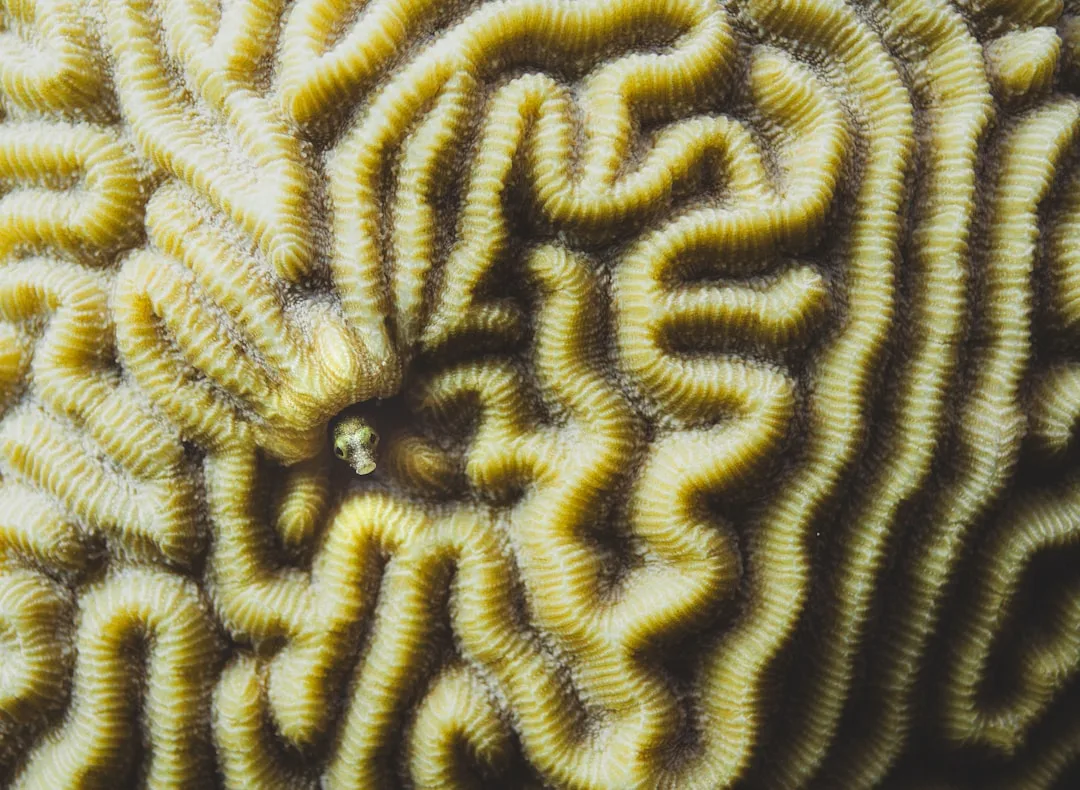
Brain coral is one of the most recognisable reef-builders on Earth. A single head of Diploria labyrinthiformis - the grooved brain coral - looks almost comically like a vertebrate brain, its surface covered with winding ridges and valleys that follow no obvious order. The resemblance is coincidental. Brain corals have no brain, no nervous system, and no central organs of any kind.
They are colonies of simple cnidarian polyps, each one a hollow sac of tissue with a mouth surrounded by tentacles, bound together into a shared skeleton of calcium carbonate. What they lack in anatomy they make up for in persistence. Individual colonies can live for several hundred years, some exceeding nine hundred, and the mineral skeletons they leave behind build reefs, islands, and entire coastlines.
This entry covers grooved brain coral biology and ecology with the depth of a reference article: taxonomy, anatomy, symbiosis, reproduction, growth, distribution, threats, and the wider "brain coral" group that shares the common name. Where numbers matter - depth ranges, growth rates, bleaching thresholds, population declines - they are given explicitly, with sources that can be cross-checked against peer-reviewed coral science and IUCN assessments.
Etymology and Classification
The genus name Diploria is derived from the Greek diplous meaning 'double', a reference to the two ridges that flank each valley on the colony surface. The species name labyrinthiformis means 'shaped like a labyrinth' in Latin. Together they describe the signature feature: a doubled ridge-and-valley pattern arranged in a maze across the top of each colony.
The common name 'brain coral' applies to at least four genera in tropical reefs worldwide - Diploria, Colpophyllia, Platygyra, and Favia - because all of them produce meandering surface grooves that look brain-like. Of these, Diploria labyrinthiformis is the most recognisable species in the Caribbean.
Classification of brain corals has been rearranged several times in the last two decades as molecular phylogenetics has replaced morphology. Traditionally the grooved brain coral sat in family Faviidae, but genetic analysis has placed Diploria in family Mussidae alongside the rose and ridge corals. Different authorities still disagree on the exact placement.
What is stable is the higher-level taxonomy: brain corals are Anthozoans in the order Scleractinia, the stony corals, distinguished from their soft coral relatives by the secretion of a calcium carbonate skeleton.
Brain corals are not the same organism as sea fans, sea whips, or sea pens. Those are octocorals, a completely separate branch of the Anthozoan tree. Brain corals are hexacorals, sharing their body plan with sea anemones and reef-building stony corals like staghorn, elkhorn, and boulder star corals.
Body Plan and Anatomy
A brain coral colony is a community of polyps, not a single animal. Each polyp is a tube of tissue two layers thick, with a central mouth, a ring of short tentacles, and a blind-ended gut called the gastrovascular cavity. Polyps in a brain coral are unusual in that they do not sit as isolated cups in the skeleton.
Instead, rows of polyps share their gastrovascular cavities along continuous grooves, so several polyp mouths may open into the same communal digestive valley. This is the anatomical basis for the characteristic brain-like surface pattern.
Key structural features:
- Polyp diameter: 1-2 mm
- Polyps per colony: typically hundreds of thousands to millions
- Valley width: 5-10 mm in D. labyrinthiformis
- Ridge height: 2-5 mm above the valley floor
- Secondary groove: a thin trench running along the top of each ridge, unique to the grooved brain coral
- Colour: yellow, tan, brown, green, or grey tissue over a white aragonite skeleton
Tissue layers:
- Epidermis (outer layer facing the water)
- Mesoglea (a jelly-like middle layer providing structure)
- Gastrodermis (inner layer lining the gut, hosting the zooxanthellae)
Beneath the living tissue lies the hard skeleton, which the polyps continuously secrete. The skeleton is made of aragonite, the orthorhombic form of calcium carbonate, deposited in concentric bands. Each band represents a period of growth, and the alternating dense and porous bands record seasonal variations in temperature, light, and water chemistry. These bands are readable under X-ray in the same way tree rings are visible in wood, which is why brain coral cores are a prized climate archive.
Polyps carry the full cnidarian toolkit. Their tentacles are lined with stinging cells called nematocysts, each a coiled dart waiting to fire at contact. Most brain coral nematocysts are tuned to small prey and rarely affect human skin noticeably, though they do catch and subdue zooplankton. Polyps also produce a surface mucus layer that captures organic particles and defends against pathogens.
Symbiosis with Zooxanthellae
The single most important feature of brain coral biology is the symbiotic relationship with photosynthetic algae called zooxanthellae - formally, dinoflagellates in the genus Symbiodinium and related genera. These single-celled algae live inside the coral's gastrodermal cells, often at densities above one million per square centimetre of tissue.
The algae photosynthesise during the day and pass a steady stream of sugars, glycerol, amino acids, and lipids to the coral host. Under normal conditions the algae supply around 90% of the colony's daily energy budget.
In return, the coral provides:
- A stable, well-lit environment inside its tissue
- Carbon dioxide from respiration to fuel photosynthesis
- Nitrogen and phosphorus waste compounds used as fertiliser
- Protection from grazers that would otherwise eat free-living algae
This mutualism is the reason stony corals are limited to clear, sunlit, warm tropical water. Without light there is no photosynthesis, and without photosynthesis the energy budget collapses. This is also why brain corals occur in the euphotic zone - from the intertidal down to roughly thirty metres in typical Caribbean clarity, with most colonies concentrated between two and twenty metres.
The coral-algae partnership is ancient. Stony corals have hosted photosynthetic symbionts for more than 200 million years, and the resulting productivity is what allowed corals to build massive reefs in nutrient-poor tropical seas. Tropical water looks blue because it is essentially a desert. Brain corals thrive in that desert only because each polyp farms its own garden of algae inside its cells.
Feeding Beyond Photosynthesis
Brain corals are not purely photosynthetic despite the heavy algal contribution. At night, polyps extend their tentacles, sometimes tripling or quadrupling the effective surface area of the colony. The extended tentacles form a dense forest of stinging cells that capture zooplankton, small invertebrates, and suspended organic particles drifting past on the reef current.
Captured prey is conveyed to the central mouth of each polyp, digested in the gastrovascular cavity, and shared through the communal grooves with neighbouring polyps.
Typical prey caught at night:
- Copepods and other small crustaceans
- Fish eggs and larvae
- Protists and ciliates
- Suspended marine snow (organic particle aggregates)
- Dissolved organic molecules absorbed directly through the tissue
Heterotrophic feeding is especially important during periods when photosynthesis is compromised. During bleaching episodes, cloudy water, storms, or seasonal plankton blooms the coral can compensate by up-regulating its active feeding. Field studies on Caribbean brain corals show heterotrophic feeding increasing by several-fold in bleached colonies. This flexibility is part of why brain corals often survive bleaching events that kill more specialised species.
Reproduction and Mass Spawning
Brain corals reproduce both asexually and sexually, and both strategies run simultaneously. Asexual budding is how a single settled larva grows into a colony of millions. New polyps bud from existing polyp walls, and the skeleton grows outward and upward at a few millimetres per year. Every polyp in the colony carries identical DNA. A one-metre brain coral head is a single genetic individual - technically called a genet - composed of millions of cloned polyp modules called ramets.
Sexual reproduction is the more dramatic event. Diploria labyrinthiformis is a simultaneous hermaphrodite, meaning each polyp produces both eggs and sperm. On a few specific nights each year, typically in late summer and synchronised to the lunar cycle and the annual water temperature peak, entire reefs release gametes at nearly the same moment. This is the famous Caribbean mass spawning event.
Colonies across tens of kilometres of reef release buoyant gamete bundles that float to the surface and break apart. Cross-fertilisation occurs in the surface layer where different colonies' gametes mix. The fertilised eggs develop into swimming planula larvae within a few days.
Spawning cue conditions for Caribbean brain corals:
- Sea surface temperature: typically above 27 degrees Celsius
- Moon phase: a few nights after the full or new moon, depending on species
- Day length: specific threshold reached in late summer
- Time of night: usually between two and five hours after sunset
Planula larvae drift in the plankton for several days to several weeks. Those that survive predation and currents settle on hard substrate, metamorphose into the first polyp, and begin secreting skeleton. The first polyp is the founder of a new genet, and every subsequent polyp budded from it will carry the founder's DNA.
Survivorship from egg to settled polyp is estimated below one in a million for most broadcast-spawning corals. The surplus is spectacular in the short term but most of it never lives long enough to join a reef.
Growth Rates and Lifespan
Brain corals grow slowly by reef standards. Diploria labyrinthiformis averages three to ten millimetres of linear growth per year, with four to six millimetres typical on healthy Caribbean reefs. Compare this to branching corals like staghorn Acropora cervicornis, which can grow more than ten centimetres per year. Slow growth is the trade-off for massive, dense skeletons that resist storm damage and predator bites over centuries.
| Metric | Typical range |
|---|---|
| Annual linear extension | 3-10 mm |
| Skeletal density | 1.4-1.8 g per cubic cm |
| Calcification rate | 1.0-2.5 kg per square m per year |
| Age at sexual maturity | 5-10 years |
| Typical colony age | 50-300 years |
| Verified maximum age | 500-900 years for large colonies |
Lifespan estimates are derived from skeletal core samples analysed via X-ray densitometry. The alternating dense and porous annual bands make it possible to count growth years directly. Large Caribbean brain coral heads one and a half to two metres across commonly yield ages of several hundred years. The biology does not impose an obvious senescence. A colony dies from outside causes - disease, bleaching, burial, mechanical damage, predation - not from internal aging.
Habitat and Distribution
Diploria labyrinthiformis is restricted to the tropical western Atlantic. The core range covers the Caribbean Sea, the Gulf of Mexico, the Bahamas, southern Florida, and Bermuda. Colonies extend as far south as Venezuela and as far north as the outermost warm-water reefs of Bermuda, which sit at the latitude of North Carolina but are kept warm by the Gulf Stream.
| Region | Key reef systems |
|---|---|
| Florida | Florida Keys, Dry Tortugas, Biscayne National Park |
| Bahamas | Great Bahama Bank, Abacos, Exuma Cays |
| Mexico and Central America | Cozumel, Belize Barrier Reef, Bay Islands |
| Caribbean Sea | Cuba, Jamaica, Hispaniola, Puerto Rico, Bonaire, Curacao |
| South America | Venezuelan coast, northern Colombia |
| Mid-Atlantic | Bermuda reefs |
Depth preference is two to twenty metres, with the upper limit set by wave energy and ultraviolet damage and the lower limit set by light availability for the symbiotic algae. Below about thirty metres the light is generally too dim for healthy calcification. Brain corals are most abundant on the reef crest and upper fore-reef zones, where wave action delivers plankton and nutrients but where ice and storm damage also take the heaviest toll.
The other "brain coral" genera extend the global distribution. Platygyra species inhabit the Indo-Pacific from East Africa to the central Pacific. Favia occurs in both oceans. Colpophyllia natans, the boulder brain coral, is a Caribbean neighbour of Diploria and is often mistaken for it. None of the brain corals occur in cold or temperate waters.
Reef Ecosystem Role
Brain corals are ecosystem engineers. Their calcified skeletons build the three-dimensional structure that defines a coral reef, providing habitat for fish, invertebrates, and algae. A single large brain coral head hosts dozens to hundreds of species living on, in, and around it: parrotfish grazing on turf algae between the ridges, blennies and gobies sheltering in crevices, shrimps and crabs hiding under overhangs, encrusting sponges and tunicates competing for substrate at the colony's edge.
Beyond habitat, brain corals are major contributors to the reef calcium carbonate budget. Over centuries their skeletons accumulate into solid reef limestone that accretes vertically faster than sea level can flood it. The Bahamas, the Florida Keys, Bermuda, and many Caribbean islands are effectively mountains of fossil coral skeleton built up over tens of thousands of years.
When sea level rises, these reef systems can grow upward to keep pace only if the living corals remain healthy. Dead reefs erode instead of growing, and the islands they built eventually follow.
Threats and Conservation
The Caribbean has lost roughly 80% of its reef coral cover since the 1970s, and brain corals have not been spared. Threats arrive from every direction and often compound each other.
Primary threats:
- Warming oceans. Sea surface temperatures in the Caribbean have risen roughly 1 degree Celsius over the past century, with summer peaks now routinely exceeding historical bleaching thresholds. Mass bleaching events occurred in 1998, 2005, 2010, 2015, 2017, 2019, 2023, and 2024. Prolonged bleaching depletes the coral's algal symbionts and leads to starvation.
- Ocean acidification. The ocean has absorbed roughly 30% of anthropogenic CO2, shifting seawater chemistry toward lower pH. Acidified water reduces the concentration of carbonate ions that corals use to build aragonite skeletons, measurably slowing growth rates.
- Stony coral tissue loss disease (SCTLD). First observed off Miami in 2014, this lethal pathogen has spread across most of the Caribbean by 2025. Brain corals including Diploria labyrinthiformis are among the most susceptible species. Infected colonies lose living tissue within weeks, leaving bare skeleton.
- Pollution and runoff. Agricultural and urban runoff delivers nutrients that feed macroalgae, which compete with corals for substrate. Sediment smothers polyps. Pesticides and sunscreen chemicals including oxybenzone are toxic to coral larvae.
- Overfishing. Removal of grazing fish - especially parrotfish - allows algae to overgrow corals. The 1983 Caribbean-wide die-off of long-spined sea urchins Diadema antillarum compounded this problem catastrophically.
- Hurricanes and storms. Climate change has intensified Caribbean hurricanes. Storm surges and wave action break brain coral heads off the reef, sometimes toppling centuries of growth in minutes.
- Physical damage. Dropped anchors, boat groundings, and careless divers damage individual colonies. A single anchor drag can kill a colony hundreds of years old.
Current conservation status:
The IUCN currently lists Diploria labyrinthiformis as Least Concern, but the assessment was completed before the worst of the stony coral tissue loss disease spread and is under review. Several related Caribbean brain coral species are already listed as Near Threatened or Vulnerable. NOAA and several Caribbean national agencies treat brain corals as priority species for restoration and disease intervention.
Antibiotic paste applied directly to disease lesions - amoxicillin in a thick delivery matrix - has proven effective at arresting SCTLD on individual colonies, and this treatment is being scaled up across the Florida Keys and elsewhere.
Reef restoration programmes now include brain coral propagation. Fragments collected during storms or from rescue operations are grown in ocean nurseries or land-based aquaria and replanted on degraded reefs. Brain corals are harder to propagate than branching species because they grow so slowly, but assisted gene flow and selective breeding for heat tolerance are active research areas.
Brain Corals as Climate Archives
Because brain coral skeletons grow continuously and record environmental conditions in their annual bands, they have become one of the most valuable natural archives of tropical ocean history. Scientists extract cylindrical cores from living or fossil colonies, section them, and measure:
- Annual growth rates (extension and density)
- Stable oxygen isotope ratios (reconstructing sea surface temperature)
- Strontium-to-calcium ratios (another temperature proxy)
- Carbon isotope ratios (productivity and circulation proxies)
- Trace elements such as barium, manganese, and uranium (river runoff, pollution, or redox history)
A single half-metre core can cover several centuries of continuous monthly-resolution climate data. Caribbean brain coral cores have been used to reconstruct pre-instrumental hurricane records, El Nino variability, and baseline reef temperatures against which modern bleaching thresholds can be compared. Fossil reef cores extend the archive much further, into the last interglacial period more than 120,000 years ago. Brain coral skeletons are, in a literal sense, stone books of ocean history.
Brain Corals and Humans
Humans have interacted with brain corals for as long as coastal communities have existed in the Caribbean and the wider tropics. Traditional use has included small-scale harvesting for building material - shaped coral blocks were widely used in historical construction across Caribbean islands - and for lime production.
Ornamental harvest of dried coral skeletons for the souvenir trade was widespread through the twentieth century and remains a pressure in some regions, although international trade in stony corals is now regulated under CITES Appendix II.
The modern relationship is largely one of stewardship under pressure. Coral reef tourism generates billions of dollars annually across the Caribbean, and brain corals are among the most photogenic and recognisable species for divers and snorkellers. Managed marine protected areas, reef fee systems, mooring buoys instead of anchors, and strict no-touch rules at dive sites have become standard best practice.
The damage from a single careless fin kick can undo decades of growth, and the calculation for reef managers is straightforward: a brain coral colony is worth far more alive as a tourism anchor than dead as a souvenir.
Related Reading
- Coral Reefs: Underwater Cities Built by Animals
- Coral Bleaching Explained
- Great Barrier Reef: World's Largest Living Structure
- Cnidarians: Jellyfish, Anemones, and Corals
References
Sources consulted for this entry include the IUCN Red List assessment of Diploria labyrinthiformis, NOAA Coral Reef Watch bleaching alert archives, the Atlantic and Gulf Rapid Reef Assessment (AGRRA) datasets, and published research in Coral Reefs, Marine Biology, Nature, Proceedings of the Royal Society B, and Global Change Biology.
Growth-rate and skeletal density figures reflect core-based studies compiled by the Smithsonian Tropical Research Institute and the University of Miami Rosenstiel School. Disease spread and treatment data reflect the most recent Florida Department of Environmental Protection and NOAA SCTLD response updates as of 2025.
Frequently Asked Questions
Is a brain coral a plant, animal, or rock?
Brain coral is an animal. Specifically it is a colonial cnidarian in the class Anthozoa, the same class that contains sea anemones and jellyfish relatives. Each visible head is a colony of thousands to millions of tiny polyps, each related to an anemone in basic body plan.
The polyps secrete a hard calcium carbonate skeleton that looks mineral, and they host single-celled algae called zooxanthellae that photosynthesise, which gives the colony a plant-like energy budget. So the common confusion is understandable - a brain coral is technically an animal, structurally part-mineral, and metabolically half-plant.
Why is it called brain coral?
The surface of the colony is covered in winding ridges and valleys that look strikingly like the convolutions of a vertebrate brain. The pattern arises because polyps bud next to each other and their mouths fuse into long grooves rather than remaining as isolated cups. In the grooved brain coral Diploria labyrinthiformis the valleys are deep and the ridges are topped with a distinctive secondary groove, giving it the ‘labyrinth’ name.
Several genera share the common name: Diploria, Colpophyllia, Platygyra, and Favia all produce brain-like surface patterns. The resemblance is purely coincidental - corals have no nervous system and the grooves are feeding and digestive structures, not neural tissue.
How long do brain corals live?
Individual polyps live only a few years, but the colony as a whole is effectively immortal as long as environmental conditions allow. Growth rates average three to ten millimetres per year, which is slow enough that a brain coral head one metre across represents roughly 100 to 300 years of continuous growth. Skeleton core samples from the largest Caribbean colonies have yielded ages of 500 to 900 years.
This makes brain corals among the longest-lived animals on the planet, comparable to black coral, ocean quahog clams, and Greenland sharks. The age record for related massive corals in the Pacific (Porites) exceeds 1,000 years.
What do brain corals eat?
Brain corals are mixotrophs - they get energy from two sources at once. Roughly 90% of their daily energy comes from photosynthetic dinoflagellates called Symbiodinium (zooxanthellae) that live inside the coral’s own cells. The algae capture sunlight and pass sugars, amino acids, and lipids directly to the coral, which gives them CO2, nitrogen waste, and a protected home in return. The remaining 10% comes from active predation.
At night polyps extend their tentacles and capture zooplankton, small invertebrates, and suspended organic particles with stinging cells called nematocysts. During the day most polyps retract into the skeleton, which is why a brain coral looks smooth in daylight and fuzzy after dark.
What is coral bleaching?
Bleaching is the stress response where a coral expels the symbiotic zooxanthellae from its tissues. Without the algae the coral tissue becomes transparent and the white aragonite skeleton shows through, which is why a bleached coral looks bone white. The expulsion is triggered by prolonged thermal stress, usually just one or two degrees Celsius above the local summer maximum for more than a few weeks.
Without its algae, the coral loses its main energy supply and must live on body reserves. If conditions return to normal within a few weeks the algae can recolonise and the coral recovers. If heat stress continues, the coral starves and dies. Mass bleaching events have become a near-annual feature of the Caribbean since the 1998 global event and have caused enormous mortality in brain coral populations.
How do brain corals reproduce?
Brain corals use two reproductive strategies. Asexually, polyps bud off new polyps continuously, which is how a single larva grows into a colony of millions of clones. Sexually, Diploria labyrinthiformis participates in the Caribbean annual mass spawning event.
Over a few specific nights each year, usually in late summer and synchronised to the lunar cycle and water temperature, every sexually mature colony across the reef releases gametes at nearly the same moment. The gametes are packaged in buoyant bundles that float to the surface, break apart, and cross-fertilise with gametes from unrelated colonies.
The resulting planula larvae drift for days to weeks before settling on hard substrate and founding new colonies. Mass spawning is one of the most spectacular reproductive events in the ocean.
Are brain corals endangered?
The IUCN Red List currently assesses Diploria labyrinthiformis as Least Concern, but the population trend is officially decreasing and the status predates the most recent stony coral tissue loss disease outbreak. Several closely related Caribbean brain corals are listed as Near Threatened or Vulnerable.
Caribbean reef coral cover has declined by roughly 80% since the 1970s due to overfishing of grazers, pollution, warming, acidification, hurricanes, and disease. Stony coral tissue loss disease, first observed off Florida in 2014, has since spread across most of the Caribbean and kills brain corals within weeks. Even species listed as Least Concern are widely considered at high long-term risk given the combination of stressors.
Do brain corals sting or hurt humans?
Brain coral polyps carry stinging cells called nematocysts, the same weapon used by jellyfish and anemones, but they are tuned to capture microscopic plankton and rarely affect human skin noticeably. Most people feel nothing when they accidentally brush a brain coral. However, any contact causes serious damage to the coral - broken polyps, stripped mucus, and opened wounds that invite disease.
Coral cuts on humans also heal poorly because fragments of aragonite skeleton and live cnidarian cells remain embedded in the wound. The practical rule for reef visitors is simple: do not touch any coral. Maintain buoyancy control, do not stand on the reef, and keep fins well clear of any colony.