
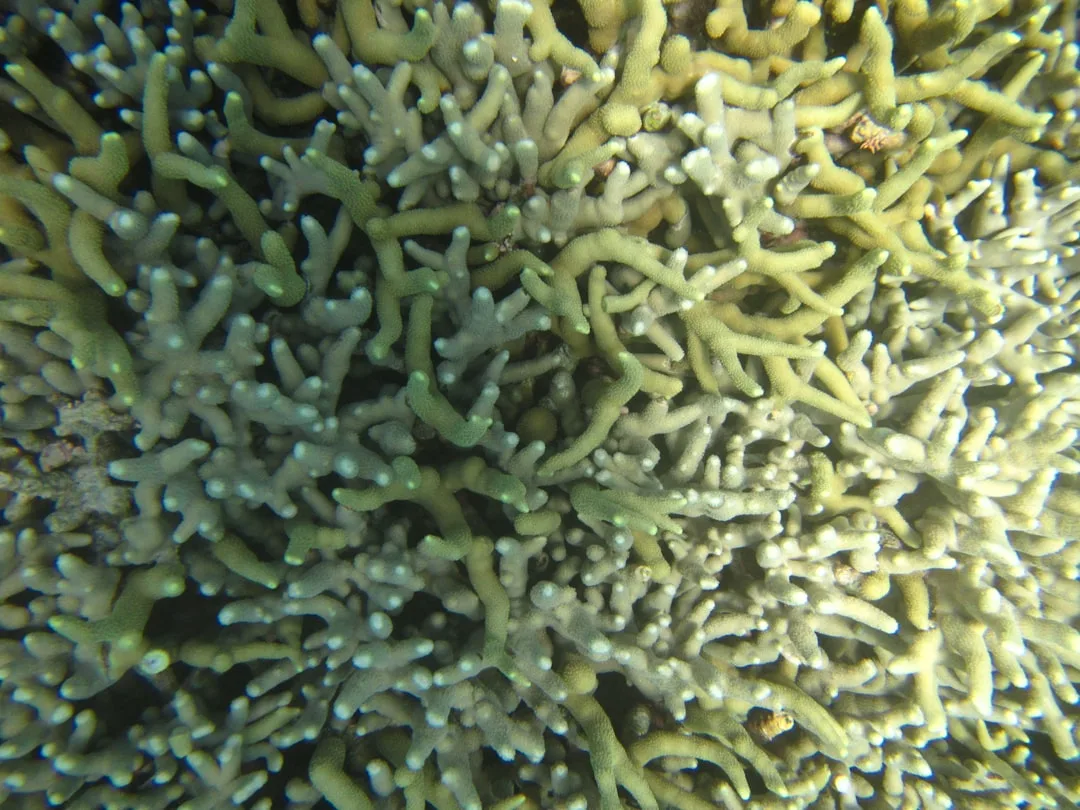
Staghorn coral is one of the most important reef-building animals in the Atlantic Ocean and also one of the most devastated. Fifty years ago, thickets of Acropora cervicornis blanketed the shallow reef crests of the Caribbean, the Bahamas, and the Florida Keys, building the three-dimensional habitat on which perhaps a quarter of the region's reef fish depend.
Today roughly four out of every five colonies that existed in 1980 are gone. The species sits on the IUCN Red List as Critically Endangered. A combination of disease, heat, pollution, and storm damage collapsed populations across an entire ocean basin inside a single human lifetime.
This guide is a full reference entry on staghorn coral: what it is, how it lives, how it grows so fast, how it reproduces, what is killing it, and what the coral restoration community is doing to pull the species back from the brink. Expect specifics - centimetres per year, depth ranges, spawning dates, mortality percentages, and the names of the organisations working underwater to rebuild Caribbean reefs one fragment at a time.
Etymology and Classification
The scientific name Acropora cervicornis was formally described by French zoologist Jean-Baptiste Lamarck in 1816. Acropora comes from the Greek akron (tip) and poros (pore), referring to the distinctive large polyp at the end of each branch - the axial corallite - which drives the colony's outward growth. Cervicornis is Latin for "deer-horned" and describes the antler-like branching pattern that also gave the species its English common name.
Staghorn coral sits firmly within the stony corals, order Scleractinia, a group that built the vast majority of the world's reefs over the past 240 million years. Its closest and equally famous relative in the Caribbean is elkhorn coral, Acropora palmata, which has broader, flattened branches resembling moose antlers. The two species can hybridise, producing a form known as Acropora prolifera that shows intermediate branch morphology and was once thought to be a separate species.
The genus Acropora as a whole contains roughly 150 species globally and is the dominant reef-building genus on Indo-Pacific reefs. In the Atlantic, however, only three species exist: staghorn, elkhorn, and their hybrid. The genetic isolation of Atlantic Acropora means Caribbean reefs have no backup: if these species are lost, no closely related coral can take over the reef-building role.
Physical Description and Anatomy
Staghorn coral colonies are instantly recognisable once you have seen one. Long, cylindrical branches typically 1-3 cm thick extend outward and upward from a basal attachment point, splitting repeatedly to form tangled thickets that resemble a field of submerged antlers.
Colony dimensions:
- Branch length: up to 2 metres in mature colonies
- Branch diameter: 1-3 cm
- Colony spread: up to 3 metres across
- Colony height: typically 1-2 metres off the seabed
- Branch tip colour: pale yellow, white, or light purple
- Branch base colour: tan, amber, or golden brown
Each branch is built from the deposited calcium carbonate skeletons of thousands of tiny polyps. A polyp is the individual coral animal: a sac-like body with a ring of stinging tentacles around a central mouth. In living colonies only a thin layer of tissue coats the outside of the skeleton - everything you can see as coral is in fact the collective output of a thin film of animal cells laid over ancient, self-built limestone.
At the end of each branch sits a single dominant polyp, the axial corallite, which drives linear extension. Smaller radial corallites stud the sides of the branch and produce the characteristic tubular texture. When branches are handled out of water they feel remarkably light and fragile, because the internal skeleton is perforated with microscopic channels that reduce weight without sacrificing structural support.
The Algal Partnership
Staghorn coral is technically a carnivorous animal, but it functions in daily life more like a plant. Inside the cells of every polyp live microscopic single-celled algae called zooxanthellae (family Symbiodiniaceae). A healthy branch of staghorn hosts roughly one to five million zooxanthellae per square centimetre of tissue.
The algae photosynthesise using sunlight, carbon dioxide, and waste nutrients from the coral. In return they hand over up to ninety per cent of the sugars they produce directly to the coral host. This is why staghorn grows so fast and why it thrives only in clear, shallow, well-lit water. Below roughly 30 metres there is not enough light to support the partnership, and the species becomes absent.
The colour of a living staghorn colony is effectively the colour of its algae. Different clades of Symbiodiniaceae produce different pigments, ranging from golden brown to greenish to purple. When water temperatures rise beyond the algae's tolerance the relationship breaks down.
The coral expels its zooxanthellae into the surrounding water, the colony loses its pigment, and the white skeleton becomes visible through the now-transparent tissue. This is coral bleaching. A bleached colony is not yet dead, but without its algal partners it is starving in real time. If temperatures drop again within a few weeks the algae can recolonise and the coral survives. If the heat stress persists, the coral tissue dies and algae grow over the bare skeleton.
Diet and Feeding
Staghorn coral has two feeding modes that together explain its ecological success.
Autotrophic feeding. Through photosynthesis performed by its zooxanthellae, the coral acquires most of its daily energy budget. Peak photosynthetic output occurs during late morning and early afternoon when light is brightest. This mode requires no active effort from the coral and costs nothing but the cellular space occupied by the algae.
Heterotrophic feeding. At night, and to a lesser extent during the day, polyps extend their tentacles to capture zooplankton drifting past in the current. Each tentacle is armed with nematocysts - microscopic stinging cells that fire venom-coated harpoons on contact. Captured prey is passed to the mouth and digested internally. Staghorn also absorbs dissolved organic nutrients directly from seawater across its tissue surface.
| Energy source | Approximate share of daily budget |
|---|---|
| Zooxanthellae photosynthesis | Up to 90% |
| Zooplankton capture | 5-15% |
| Dissolved organic uptake | 1-5% |
This dual strategy gives staghorn a strong competitive advantage in shallow clear water. It also makes the species vulnerable to any condition that disrupts photosynthesis - sedimentation, turbidity, bleaching, or prolonged cloud cover.
Growth Rate
Among the hundreds of reef-building corals worldwide, staghorn is near the top of the speed ranking. Documented extension rates range from 10 to 20 centimetres per branch per year under good conditions, and some fragments suspended on mid-water coral trees in restoration nurseries have exceeded 25 centimetres per year.
For comparison, massive boulder corals of the genera Orbicella and Montastraea typically add less than 1 cm per year. Even other branching corals like Porites grow several times more slowly than staghorn. Only elkhorn coral (Acropora palmata) and a handful of Indo-Pacific Acropora species rival this pace.
Rapid growth is why staghorn historically rebuilt reef structure quickly after hurricanes and why it is the restoration community's preferred species for reef reconstruction. A fragment the size of a coin can become a branching colony the size of a small shrub within three to five years. It is also why individual staghorn colonies rarely exceed a few decades in age even though genetic lineages (genotypes) can persist for centuries by continuously fragmenting and regrowing.
Reproduction
Staghorn coral reproduces by two remarkably different strategies, and both matter for the species' ecology and its restoration.
Annual Mass Spawning
Sexual reproduction occurs just once a year. On a handful of nights after the August or September full moon, colonies across the entire Caribbean simultaneously release bundles of eggs and sperm into the water column. The event is timed to within minutes of a particular moonrise interval and synchronised across thousands of square kilometres - one of the most spectacular reproductive events in the marine world.
Spawning sequence:
- Gamete bundles form inside polyps during the weeks before spawning
- Bundles release after sunset on target nights (typically 3-5 hours after sunset)
- Buoyant bundles rise to the surface and break apart
- Eggs and sperm from different colonies mix and fertilise
- Fertilised eggs develop into free-swimming planula larvae over 3-5 days
- Larvae drift with currents for 5-20 days before settling
Each staghorn colony is simultaneously male and female (hermaphroditic) but cannot self-fertilise. Only bundles from different colonies produce viable larvae. After settling onto a hard surface the larva metamorphoses into a single founding polyp and begins to deposit skeleton. If it survives its first year it will produce buds, fork, and eventually build a new branching colony.
Fragmentation
Asexual reproduction is mechanical and opportunistic. When a storm, a swell, a parrotfish bite, or a careless diver's fin snaps a branch, the broken piece can reattach to the seabed and grow into a genetically identical clone of the parent colony. Under natural conditions roughly 10-30% of fragments reattach and survive. Under nursery conditions, where fragments are deliberately secured to substrate with epoxy or zip ties, survival can exceed 80%.
Fragmentation is probably how most modern staghorn colonies actually originate. Historical surveys in Florida and Belize found that large thickets of staghorn frequently consist of dozens to hundreds of colonies that all share a single genotype - living evidence of decades of clonal reproduction following a single successful settlement event.
Habitat and Range
Staghorn coral is endemic to the wider Caribbean region and does not occur naturally anywhere else.
Geographic range:
| Region | Historical abundance | Current status |
|---|---|---|
| Florida Keys | Very high | Severely reduced |
| Bahamas | Very high | Reduced |
| Cuba | Very high | Reduced, some refuges |
| Jamaica | Very high | Near-collapse |
| Cayman Islands | High | Reduced |
| Belize (reef tract) | Very high | Reduced |
| Honduras (Bay Is.) | High | Reduced |
| Puerto Rico | High | Severely reduced |
| US Virgin Islands | High | Severely reduced |
| Bermuda | Low | Marginal, isolated |
The species occupies shallow tropical and subtropical reefs between 1 and 30 metres deep. It is most abundant between 5 and 15 metres where light is strong but wave energy is moderate. Unlike its cousin elkhorn, which dominates the very shallow reef crest exposed to breaking waves, staghorn prefers slightly deeper, more sheltered habitat on the fore-reef slope and in back-reef lagoons.
Water chemistry requirements are strict. Staghorn needs salinity between 32 and 40 parts per thousand, temperatures between 25 and 29 degrees Celsius for optimal growth, low turbidity, and low nutrient loading. Colonies do not tolerate freshwater runoff, sediment plumes, or sustained warm-water events above roughly 31 degrees Celsius.
The Collapse: White Band Disease and Its Aftermath
The modern story of staghorn coral is the story of one of the fastest and most complete marine ecological collapses ever recorded.
Before 1977 staghorn thickets covered large areas of the Caribbean reef tract. Divers in the Florida Keys, Jamaica, and Belize described swimming through forests of branching coral that stretched for hundreds of metres with only narrow sand channels cutting through. The species was so dominant that geologists named entire reef zones after it.
In 1977 divers in the Virgin Islands noticed something unusual. Healthy staghorn colonies were developing sharp white bands where living tissue met freshly exposed skeleton, and the bands were advancing along the branches at several millimetres per day. Within weeks, affected colonies died completely. The phenomenon was named White Band Disease.
Over the next decade the disease spread across the entire Caribbean basin. By the late 1980s most of the region's mature staghorn colonies were dead. Estimated mortality ranged from 80% to 98% depending on location. Researchers have struggled to identify the causative pathogen. Candidate organisms include Vibrio bacteria and one or more unnamed microbial consortia.
The outbreak almost certainly was accelerated by unusually warm water during El Nino events, nutrient pollution from coastal development, and the simultaneous near-extinction of the long-spined sea urchin Diadema antillarum, which had previously grazed algae off the reef.
With staghorn gone and grazers reduced, Caribbean reefs flipped from coral-dominated to algae-dominated. Fleshy macroalgae smothered the dead skeletons, preventing new coral larvae from settling. The shift has persisted for more than three decades and is remarkably difficult to reverse.
Current Threats
Even the survivors of the 1980s outbreak continue to face compounding pressures.
- Ocean warming. Marine heat waves in 1998, 2005, 2010, 2015, 2017, 2019, and 2023 triggered regional bleaching events. Each event kills a fraction of remaining colonies and selectively removes the most heat-sensitive genotypes. The 2023 summer in the Florida Keys recorded water temperatures above 38 degrees Celsius in shallow zones, killing most unprotected staghorn colonies.
- Ocean acidification. Rising atmospheric CO2 is absorbed by seawater and shifts the carbonate chemistry that corals depend on for skeleton-building. By 2050 many reef zones are expected to have aragonite saturation states low enough to slow or prevent staghorn growth.
- Nutrient pollution. Fertiliser runoff, sewage, and coastal development deliver nitrogen and phosphorus to nearshore reefs, favouring algae over coral and stressing symbiont partnerships.
- Storm damage. Hurricanes physically break staghorn colonies. Historically, fragmentation drove regrowth. With populations already depleted, storm damage now exceeds the regenerative capacity of remaining colonies.
- Overfishing. Removal of herbivorous parrotfish and surgeonfish allows algae to dominate reefs and prevents coral recovery.
- Coral diseases beyond White Band. Stony coral tissue loss disease, first observed near Miami in 2014, affects more than twenty Caribbean coral species and has spread throughout the region. Staghorn is less susceptible than many massive corals but is not immune.
- Physical damage from boats and divers. Anchors, snorkel fins, and dropped gear continue to break branches in tourism hotspots.
Conservation and Restoration
The IUCN first listed Acropora cervicornis as Critically Endangered in 2008 and maintains that status in current assessments. The species was listed as Threatened under the U.S. Endangered Species Act in 2006. Trade is regulated internationally under CITES Appendix II.
Coral Gardening
The most active conservation tool for staghorn is a restoration strategy called coral gardening. The approach treats staghorn like a crop species - because its capacity for fragmentation and its fast growth make it uniquely suited to propagation.
Typical workflow:
- Small fragments (2-5 cm) are collected from donor colonies, ideally representing multiple genotypes.
- Fragments are attached to mid-water nursery structures - fibreglass or PVC "coral trees" that suspend dozens of branches in moving water.
- Nursery colonies grow for 6-18 months, often doubling in size every six to nine months.
- Mature colonies are transported to degraded reef sites and attached to bare substrate with marine epoxy or cement.
- Out-planted colonies are monitored for survival, growth, and reproduction.
Key Organisations
- Coral Restoration Foundation (Florida, USA) - the largest restoration operation in the world, with multiple offshore nurseries and more than 220,000 corals out-planted into the Florida reef tract.
- SECORE International (Germany / Caribbean) - specialises in sexual reproduction techniques, collecting spawn during mass spawning events, raising larvae in labs, and settling new recruits on purpose-designed substrates.
- Mote Marine Laboratory (Florida) - pioneers micro-fragmentation techniques for massive corals and genetic rescue for Acropora species.
- Reef Renewal Bonaire / Curacao - Caribbean nurseries focusing on branching Acropora restoration.
- The Nature Conservancy - coordinates restoration projects across the Caribbean with national partners.
Genetic Rescue
Modern restoration increasingly focuses on identifying and propagating thermally tolerant genotypes - colonies that survive heat waves when their neighbours bleach and die. Genetic sequencing of these survivors reveals alleles associated with stronger heat-shock response, tighter symbiosis with heat-tolerant algae, and more efficient antioxidant systems. By restocking reefs with these genotypes, practitioners hope to give rebuilt thickets a fighting chance against the heat waves ahead.
Selective breeding programs are beginning to cross heat-tolerant parents from different populations in laboratory raceways, producing larvae with combinations of resilient traits that do not occur naturally. Whether these "designed" coral lineages will outperform wild stocks over decades remains an open research question.
Ecological Role
Staghorn coral is a keystone species - its presence or absence reshapes the entire reef ecosystem.
- Structural habitat. The dense branching creates three-dimensional cover used by juvenile fish, lobsters, crabs, and invertebrates.
- Nursery function. An estimated 25% of Caribbean reef fish species shelter in or near staghorn thickets at some life stage. Without the coral, juvenile fish face much higher predation and recruitment to adult populations drops.
- Wave protection. Staghorn thickets dampen wave energy before it reaches coastlines, reducing erosion and protecting seagrass beds and mangroves.
- Biogeochemical cycling. Staghorn is a major producer of calcium carbonate, the material from which Caribbean reef framework is built.
- Reef accretion. Historical rates of Caribbean reef growth depended heavily on staghorn's rapid calcification. With the species reduced, many reefs are now eroding faster than they accrete - net negative reef growth.
The cascading effects of staghorn loss have been measured repeatedly. Following the 1980s collapse, fish density, diversity, and biomass dropped in tandem across the Caribbean. Reefs that retained staghorn refuges retained more functional fish communities than those that lost the species entirely.
Staghorn and Humans
For coastal communities across the Caribbean, staghorn coral has been part of daily life for centuries - though mostly silently, as the ecosystem engineer behind productive fisheries, storm-protected coastlines, and the dive tourism industry. Staghorn-built reefs support commercial and artisanal fisheries that are estimated to generate more than 400 million US dollars in annual income across the region.
Dive tourism on Caribbean reefs generates several billion dollars a year, and surveys show that the quality of reef structure - most visibly, the presence or absence of branching corals - drives visitor satisfaction. Restoration programs have begun to integrate tourism operators as partners, training dive guides to transplant fragments and collecting visitor fees that fund nursery operations.
The long-term future of staghorn coral hinges on action well beyond the reef. Restoration programs can replant colonies at meaningful scales - hundreds of thousands of fragments per year across the Caribbean - but no amount of replanting can outpace ocean warming if atmospheric CO2 continues to rise. The species' survival depends on the same global decisions that determine the fate of Arctic sea ice, Amazonian rainforest, and coastal cities.
Related Reading
- Coral Reefs: The World's Most Biodiverse Marine Ecosystems
- Coral Bleaching Explained
- Elkhorn Coral: The Other Caribbean Reef-Builder
- Parrotfish: The Reef's Indispensable Grazers
References
Relevant peer-reviewed and governmental sources consulted for this entry include IUCN Red List assessments for Acropora cervicornis (2008, 2022), NOAA Fisheries Recovery Plan for Elkhorn and Staghorn Corals (2015, updated 2023), publications from the Coral Restoration Foundation and SECORE International, and peer-reviewed research in Coral Reefs, Marine Ecology Progress Series, Proceedings of the National Academy of Sciences, and Nature Communications.
Population and mortality figures reflect the most recent consolidated Caribbean-wide estimates.
Frequently Asked Questions
What is staghorn coral?
Staghorn coral (Acropora cervicornis) is a fast-growing, branching stony coral that historically dominated shallow Caribbean reefs. Each colony is built from thousands of tiny genetically identical polyps sharing a common calcium carbonate skeleton. The branches resemble deer or elk antlers, which is where both the scientific name cervicornis (‘deer-horned’) and the common name come from.
Individual branches can grow to 2 metres long and entire colonies can reach 3 metres across. Staghorn is a reef-building keystone species - without it, the three-dimensional habitat that shelters much of the Caribbean’s reef fish fauna does not form.
Where does staghorn coral live?
Staghorn coral is restricted to the wider Caribbean region, including the Caribbean Sea, the Bahamas, the Florida Keys and Florida reef tract, the Gulf of Mexico, and the waters around Bermuda. It prefers clear, warm, well-lit shallow water between 1 and 30 metres deep, though it is most abundant above 15 metres where light is strongest.
The species was once the dominant reef-crest coral across its range, forming vast monospecific thickets that provided habitat for juvenile fish, lobsters, and invertebrates. After the collapses of the 1980s, remaining populations are patchy, and many historical sites hold only isolated colonies instead of continuous thickets.
Why is staghorn coral critically endangered?
The IUCN lists Acropora cervicornis as Critically Endangered after Caribbean populations fell by roughly 80% since the 1980s, with some localities losing more than 95% of colonies. The primary cause was White Band Disease, a bacterial infection that swept through the region starting in 1977-1980 and killed mature colonies within weeks.
Compounding pressures include ocean warming and bleaching events, ocean acidification that weakens the skeleton, nutrient pollution from coastal development, physical damage from hurricanes and anchors, overfishing of herbivorous fish that keep algae in check, and sedimentation from land clearing. The species is listed as Threatened under the U.S. Endangered Species Act.
How fast does staghorn coral grow?
Staghorn coral is among the fastest-growing reef corals on Earth. Healthy colonies extend 10-20 cm per branch per year under good conditions, and some fragments in nursery programs have been measured growing even faster when suspended on floating trees with strong water flow. This is roughly ten times faster than massive boulder corals like Montastraea or Orbicella, which typically add less than 1 cm per year.
Rapid growth is why staghorn historically rebuilt reef structure quickly after hurricanes and why it is such an attractive species for restoration - a coin-sized fragment can become a branching colony the size of a shopping cart within five years.
How does staghorn coral reproduce?
Staghorn coral reproduces by two very different methods. Sexual reproduction takes place through annual mass spawning: on a handful of nights after the August or September full moon, colonies across the entire Caribbean simultaneously release bundles of eggs and sperm into the water column. Fertilised larvae drift with currents for days to weeks before settling on a hard surface and founding a new colony.
Asexual reproduction happens through fragmentation: when a storm, a swell, a parrotfish, or a diver’s fin snaps a branch, the broken piece can reattach to the seabed and grow into a genetically identical clone of the parent. This is why restoration programs deliberately propagate staghorn by cutting fragments and relocating them.
What is White Band Disease?
White Band Disease is a bacterial infection of Acropora corals first observed in the Caribbean around 1977-1980. Affected colonies develop a sharp white band of freshly exposed skeleton that advances along the branches, killing living tissue at rates of several millimetres per day. The specific pathogen or combination of pathogens responsible has been difficult to isolate, but bacterial candidates include members of the genus Vibrio.
The outbreak coincided with and was probably accelerated by warming water, nutrient pollution, and the near-simultaneous mass mortality of the long-spined sea urchin Diadema antillarum, which had previously grazed algae off the reef. Within a decade White Band Disease killed an estimated 80-95% of Caribbean staghorn colonies and transformed shallow reefs from coral-dominated to algae-dominated ecosystems.
How is staghorn coral being restored?
Staghorn is now one of the most actively restored marine species on Earth. Organisations like the Coral Restoration Foundation in Florida and SECORE International operate underwater nurseries that grow thousands of fragments on fibreglass or PVC ‘coral trees’ suspended in mid-water. Fragments typically double in size every six to nine months on these trees. Once large enough, colonies are out-planted onto degraded reefs.
Restoration practitioners increasingly focus on preserving and propagating rare genotypes that survived bleaching events, since genetic diversity and thermal tolerance are critical for long-term reef resilience. Programs have planted more than a million staghorn fragments across the Caribbean, though without global action on climate change the long-term outlook remains uncertain.
Is staghorn coral an animal or a plant?
Staghorn coral is an animal - specifically a colonial cnidarian related to jellyfish and sea anemones. Each branch is built from thousands of tiny polyps, each with a ring of stinging tentacles used to catch plankton. However, the reason staghorn grows so fast in shallow tropical water is that it is effectively part-plant. Inside the tissues of every polyp live microscopic symbiotic algae called zooxanthellae (Symbiodiniaceae).
These algae photosynthesise using sunlight and CO2 and transfer up to 90% of their sugars directly to the coral, which in return provides shelter, nutrients, and a stable chemical environment. When ocean temperatures climb too high, the partnership breaks down, the coral expels the algae, and the white skeleton becomes visible through transparent tissue - the phenomenon called coral bleaching.