
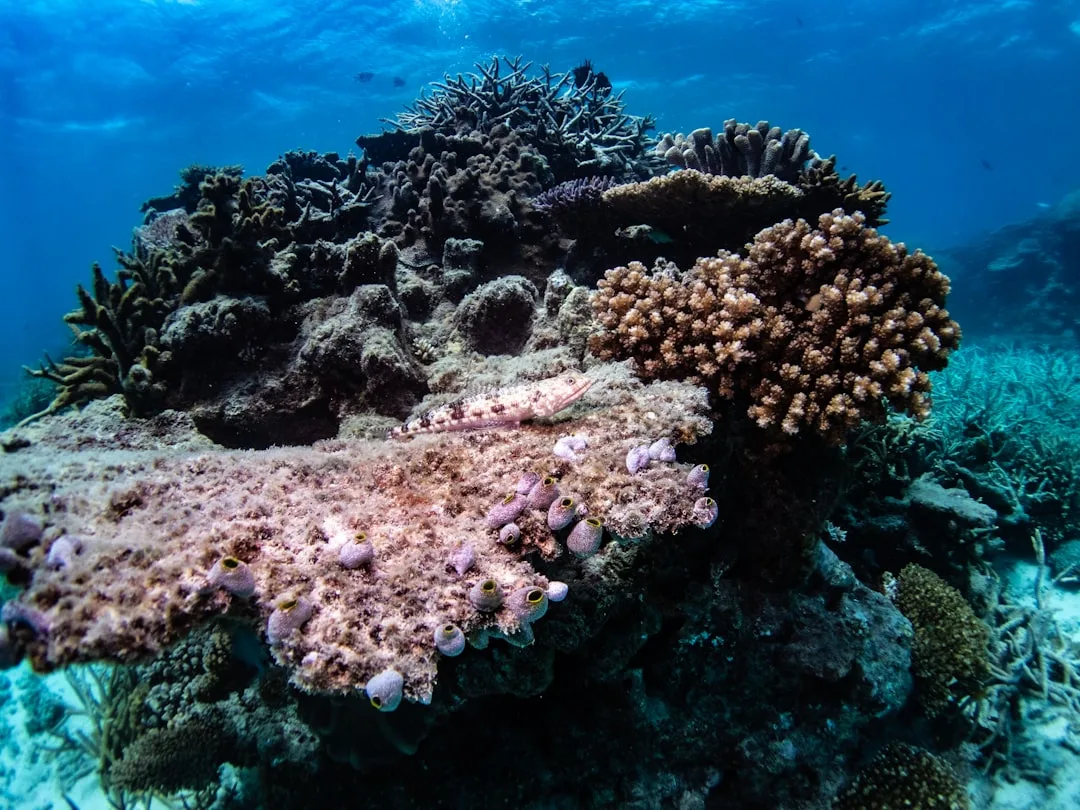
Pillar coral is one of the most visually distinctive stony corals in the Caribbean and, tragically, one of the most imperilled. Unlike the rounded boulders, delicate plates, and feathery branches that define most reef-building corals, Dendrogyra cylindrus grows as vertical spires - thick, cylindrical pillars rising as much as three metres above the reef floor.
Colonies look more like limestone columns than conventional corals, and when sunlight hits their sides, the surface shimmers with extended polyps that give the pillars a fuzzy, velvet-soft appearance seen in almost no other stony coral species in the region.
This guide covers every aspect of pillar coral biology, ecology, and conservation: its unique growth form, its unusual daytime activity, its once-a-year Caribbean spawning event, the devastating arrival of Stony Coral Tissue Loss Disease in 2014, the genetic bottleneck that now constrains recovery, and the rescue breeding programmes fighting to keep the species alive.
It is a reference entry written for readers who want specifics - depths, dates, percentages, and verified outcomes - rather than a general overview.
Etymology and Classification
The scientific name Dendrogyra cylindrus was coined by the French zoologist Jean-Baptiste Ehrenberg in 1834. Dendrogyra derives from the Greek roots dendron (tree) and gyros (circle), referring to the coral's tree-like upright growth and the circular pattern of its corallites. The species epithet cylindrus simply describes the cylindrical form of the colony's pillars. Together the name reads almost as an observation rather than a label: a cylindrical tree-coral with circular patterns.
Pillar coral sits within the order Scleractinia - the hard, reef-building stony corals that secrete calcium carbonate skeletons. The species belongs to the family Meandrinidae, a small grouping known for elongated, meandering corallites rather than the discrete polyp pits seen in most reef corals. Within Meandrinidae, Dendrogyra is a monotypic genus: pillar coral is the only species.
That distinction carries weight for conservation, because the loss of Dendrogyra cylindrus would erase an entire evolutionary branch, not merely a single species within a larger genus.
Common names in the Caribbean reflect the colony shape. English-speaking divers call it pillar coral, cathedral coral, or occasionally organ-pipe coral. Spanish-speaking communities use coral pilar or coral cilindro. In scientific literature the abbreviation D. cylindrus is standard.
Colony Form and Appearance
No other Caribbean stony coral grows like pillar coral.
Growth form:
- Vertical cylindrical pillars rising from a shared encrusting base
- Pillar diameter: 10-25 cm typical
- Colony height: 1-2 m most common, up to 3 m verified
- Sometimes branching, forming cathedral-like clusters of several pillars
- Pillars always grow roughly upright, independent of water flow direction
Surface appearance:
- Extended polyps during daylight produce a fuzzy, velvet-soft look
- Colour ranges from pale tan to chocolate brown, occasionally yellow-green
- Polyp tentacles are short and densely packed, about 2-4 mm long
- Corallites arranged in meandering valleys along the pillar surface
- No sharp ridges or large calyces - texture is uniform and hairy
A mature pillar coral is immediately identifiable from across a reef. Where other Caribbean stony corals present smooth, hard, stone-like surfaces with retracted polyps during the day, pillar coral looks alive. Its surface appears to breathe, and the tentacles respond to water movement.
Surveyors working from dive boats or drop cameras routinely use the daytime fuzzy appearance as a positive identification trait, because from a distance pillar coral looks less like a stone and more like a dense mat of short brown fur standing on end.
Daytime Polyps - A Rare Behaviour
Most stony corals keep their polyps retracted during daylight hours. Retraction protects soft tissue from predators such as parrotfish and butterflyfish, reduces ultraviolet exposure, and conserves energy. These corals then extend their tentacles at night to feed on drifting zooplankton, when visual predators are less active and plankton biomass in the water column often rises.
Pillar coral reverses this schedule. Colonies are visibly fuzzy throughout the day, with oral discs exposed and tentacles waving in reef currents. The behaviour is so consistent that researchers treat it as a diagnostic species trait rather than a response to local conditions. Night-time behaviour varies; polyps may partially retract or remain extended depending on turbulence and prey availability.
Several hypotheses explain the reversed schedule. Daytime extension maximises light exposure for the symbiotic zooxanthellae algae that live inside coral tissue. The tall pillar growth form also places polyps high above the reef substrate in clean, well-lit water, which supports photosynthesis. Finally, daytime feeding may exploit a plankton community that differs from night-time drift.
Whatever the ecological cause, the result is a coral that lives its life visibly active, a behavioural signature that no other Caribbean stony coral shares.
Habitat and Distribution
Pillar coral is a Caribbean endemic. Its historic range covered essentially the entire wider Caribbean basin:
| Region | Status |
|---|---|
| Florida Reef Tract | Functionally extinct in the wild by 2022 |
| Bahamas | Remaining strongholds, active surveys |
| Cuba | Reduced populations, some surviving colonies |
| Greater Antilles (Jamaica, Hispaniola, Puerto Rico) | Fragmented, declining |
| Lesser Antilles | Scattered colonies, limited monitoring |
| Mesoamerican Reef (Belize, Mexico, Honduras) | Stronghold populations remain |
| Cayman Islands | Persistent populations, protected |
| Netherlands Antilles, Venezuela coast | Reduced, patchy distribution |
Typical habitat is shallow, well-lit fore-reef and reef-slope terrain at depths of 1 to 25 metres, with the densest historical populations occurring between 5 and 15 metres. The species prefers clear water with moderate current, hard substrate for attachment, and sufficient light for zooxanthellae photosynthesis. Pillar coral avoids heavily sedimented back-reef lagoons and deeper mesophotic zones below roughly 25 metres.
Population density was never high. Even before the recent collapse, pillar coral colonies were typically scattered rather than forming dense thickets. Caribbean reef assessments from the early 2000s recorded pillar coral at a fraction of one per cent of total stony coral cover across most survey sites. Its conservation significance derives from unique form and function rather than reef-building dominance.
Feeding and Symbiosis
Pillar coral is a mixotroph - it obtains energy from two complementary sources.
Autotrophic pathway:
- Symbiotic zooxanthellae algae live inside coral tissue
- Algae perform photosynthesis, transferring sugars and other nutrients to the host
- Under healthy conditions zooxanthellae supply most of the colony's daily energy budget
- The host coral provides a stable, sunlit environment and access to metabolic waste products the algae can use
Heterotrophic pathway:
- Extended polyps capture passing zooplankton using stinging cells (nematocysts)
- Primary prey items include copepods, tiny shrimp larvae, fish eggs, and drifting protozoans
- Captured prey provides nitrogen, phosphorus, and other nutrients scarce in reef water
- Heterotrophic feeding becomes more important during bleaching events when zooxanthellae are expelled or non-functional
The combination is critical. Pillar coral colonies with healthy zooxanthellae populations grow faster and store more energy reserves, making them better able to survive periodic stressors such as storms, heat waves, and disease exposure. Colonies whose zooxanthellae have been damaged by warm water rely temporarily on plankton capture until the symbiosis can be rebuilt.
Growth and Longevity
Pillar coral grows slowly. Verified vertical growth rates average 1-2 centimetres per year under healthy conditions, with occasional pulses up to 3 centimetres in years of strong zooxanthellae productivity. A 3 metre colony therefore represents at least 100 to 200 years of continuous upward growth, assuming no major setbacks. Some large Caribbean colonies may have been standing since before the American Revolution.
Individual polyps are short-lived, but the colony as a superorganism can persist for centuries. Polyps divide by asexual budding, continuously replacing themselves along the pillar surface. A single 3 metre colony with a 20 cm diameter contains roughly 200,000 to 500,000 polyps at any one moment. All of them are genetically identical, because asexual division preserves the original genotype of the founding larva that settled on the reef substrate long ago.
The slow growth rate has severe implications for recovery. A reef stripped of mature pillar coral colonies cannot regenerate within human lifespans. Restoration outplants require decades before they begin to reproduce sexually and longer still before they reach the dimensions of the lost colonies.
Reproduction and Spawning
Pillar coral reproduces both sexually and asexually. The two strategies operate on different timescales and serve different ecological roles.
Sexual reproduction:
- Gonochoristic - each colony is either male or female for life
- Spawning occurs once per year, synchronised to the August full moon
- Spawning events last one to three nights per season
- Females release negatively buoyant egg bundles; males release sperm clouds
- Fertilisation is external, in the water column
- Planula larvae drift for 3 to 10 days before seeking hard substrate
- Successful settlement and juvenile survival are extremely rare under natural conditions
Asexual reproduction:
- Fragmentation after storms or physical breakage
- Fragments that land on suitable substrate can reattach and grow as new colonies
- Resulting colonies are genetically identical clones of the parent
- In declining populations fragmentation becomes the dominant reproductive mode
The gonochoristic mating system is unusual. Most stony corals are hermaphroditic, releasing both eggs and sperm in each colony, which increases the chance of finding a compatible partner during spawning.
Pillar coral's strict separation of sexes means that a population reduced below a critical density will fail to reproduce sexually, because male and female colonies must be close enough for their gamete clouds to mix in ocean currents. Once colonies are kilometres apart, synchrony of timing is not enough to rescue the species.
This exact failure has occurred in Florida. Surveys across the Florida Reef Tract have confirmed that surviving wild pillar corals are too widely scattered and too few in number to reproduce sexually during the August spawn. The population is therefore functionally extinct even though individual colonies remain alive.
Stony Coral Tissue Loss Disease
The recent collapse of pillar coral populations is dominated by a single cause: Stony Coral Tissue Loss Disease, almost always abbreviated SCTLD.
SCTLD timeline:
- 2014: First documented off Virginia Key, Florida during a bleaching event
- 2015-2018: Spread the length of the Florida Reef Tract
- 2019: Confirmed in Jamaica, Mexico, the Dominican Republic, and Sint Maarten
- 2020-2023: Continued spread across most of the wider Caribbean
- 2024 onward: Endemic in most Caribbean jurisdictions with active monitoring
SCTLD produces sharply defined lesions where coral tissue detaches from the underlying skeleton, leaving bare white limestone. Disease fronts typically advance several millimetres to several centimetres per day, and whole colonies can be lost within two to four weeks of first symptoms. Unlike bleaching, which sometimes allows recovery, SCTLD generally kills affected tissue outright.
The disease affects more than 20 Caribbean stony coral species, but pillar coral is among the most susceptible - infection almost always results in colony death.
The pathogen or pathogens responsible for SCTLD have not been fully characterised. Leading hypotheses point to a bacterial agent, possibly supplemented by viral or protozoan co-factors, though an environmental stressor trigger has also been proposed. What is clear is that the disease spreads along water currents, responds variably to antibiotic treatment (notably amoxicillin paste applied directly to lesion margins), and shows no sign of burning out naturally within affected reef systems.
The Florida Collapse
Florida offers the clearest case study in pillar coral decline.
Before 2014, Florida hosted roughly 1,600 known pillar coral colonies scattered across the Florida Reef Tract from Biscayne Bay to the Dry Tortugas. Annual surveys documented the species as uncommon but stable. Between 2014 and 2022, SCTLD swept the entire reef tract.
By the end of that period, fewer than a dozen living wild colonies remained in a state where any could be located by field teams. Spawning surveys in August of each year from 2019 onward recorded no successful in-water fertilisation events.
In response, a multi-institution rescue programme removed surviving colonies and colony fragments into land-based gene banks at the Florida Aquarium, Mote Marine Laboratory, the Coral Restoration Foundation, and partner institutions. The goal shifted from in-situ conservation to ex-situ preservation of the species' remaining genetic diversity.
Genetic analysis of the rescued material revealed only a small number of distinct genotypes, confirming that Florida's pillar coral population had already passed through a severe genetic bottleneck before rescue operations began.
Rescue Breeding and Restoration
A coordinated network now supports ex-situ pillar coral conservation.
Key institutions:
- Florida Aquarium (Apollo Beach, Florida) - first laboratory spawning 2019
- Mote Marine Laboratory (Sarasota, Florida) - nursery and land-based systems
- Coral Restoration Foundation (Key Largo, Florida) - outplant operations
- SECORE International - larval rearing and reef seeding techniques
- NOAA, university partners, and Caribbean-wide collaborators
Key achievements:
| Year | Milestone |
|---|---|
| 2019 | First successful laboratory spawning of pillar coral |
| 2020 | Production of viable juvenile colonies from lab larvae |
| 2021 | Cross-breeding between distinct rescued genotypes |
| 2022 | Initial outplant trials of laboratory-reared juveniles |
| 2023+ | Expanded multi-institution gene banking network |
Laboratory spawning requires simulating lunar cycles, water temperature, and photoperiod precisely enough that male and female colonies release gametes on the right night. Fertilised eggs are raised through settlement on prepared substrate plugs, then grown in nursery systems for months to years before outplant.
Because pillar coral grows slowly, a laboratory-reared juvenile may take five to ten years to reach reproductive maturity, and longer to approach the size of the wild colonies that were lost.
The work is important but not a substitute for healthy wild populations. Restoration succeeds only if underlying reef conditions - temperature, water quality, disease pressure - remain compatible with coral survival. Without that, laboratory-produced colonies face the same fate as their wild predecessors.
Conservation Status and Outlook
The IUCN Red List classifies pillar coral as Critically Endangered. The species is also protected under the US Endangered Species Act (listed as Threatened in 2014, with status review continuing), included under CITES Appendix II restrictions on international trade, and covered by regional coral protection measures across Caribbean jurisdictions.
Primary threats in order of current impact:
- SCTLD. The dominant proximate cause of population collapse since 2014. Ongoing, basin-wide, and not yet controllable at reef scale.
- Ocean warming and bleaching. Caribbean summer temperatures increasingly exceed thermal tolerance thresholds, weakening colonies before disease exposure.
- Genetic bottleneck. Low genotype diversity among survivors reduces evolutionary adaptability.
- Reproductive collapse. Functional extinction in key regions blocks natural recovery.
- Hurricanes and storm damage. Pillar form is physically vulnerable; storms break mature colonies.
- Water quality decline. Nutrient loading, sedimentation, and pollution reduce colony resilience.
- Direct physical damage. Anchoring, diver contact, and ship groundings affect surviving colonies.
Long-term outlook depends on whether Caribbean reefs can support wild pillar coral populations at all. Optimistic scenarios combine rescue breeding, disease management, water quality improvement, and climate stabilisation. Pessimistic scenarios preserve the species only as a managed population in aquaria and land-based facilities. Either way, pillar coral's future is now inseparable from active human intervention.
Pillar Coral and Caribbean Reefs
Pillar coral occupies a niche no other Caribbean coral fills. Its tall pillars provide vertical structure in otherwise mounded reef landscapes, creating shelter for fish, invertebrates, and algal communities along the pillar flanks. Dive operators across the Caribbean built tourism itineraries around recognisable pillar coral colonies for decades, with named colonies serving as dive site landmarks. The loss of those colonies has left reef geographies noticeably diminished.
Caribbean fishing communities also feel the change. Pillar coral hosts small reef fish and invertebrate grazers that support wider food webs. The species' collapse has accompanied measurable shifts in reef community composition, though disentangling pillar coral's specific contribution from the broader reef decline is difficult. What is not difficult is recognising the visual loss.
A Caribbean reef without pillar coral looks different - flatter, less varied, less structurally interesting - and divers returning to former pillar coral sites after many years away often describe the experience as a physical shock.
Related Reading
- Coral Reefs: Ecosystems Under Pressure
- Staghorn Coral: Caribbean Branching Coral Collapse
- Elkhorn Coral: Former Reef Builder on the Brink
- Coral Bleaching: Causes, Consequences, and Recovery
References
Relevant peer-reviewed and governmental sources consulted for this entry include the IUCN Red List assessment for Dendrogyra cylindrus, NOAA Fisheries Endangered Species Act status reviews, Florida Fish and Wildlife Conservation Commission SCTLD monitoring reports, and published research in Coral Reefs, Marine Ecology Progress Series, PLOS ONE, and Scientific Reports.
Florida collapse figures draw on the Florida Aquarium rescue programme records, Coral Restoration Foundation survey data, and the 2022 Florida Reef Tract pillar coral status synthesis. SCTLD timeline and epidemiological information reflect the most recent consolidated regional monitoring as of late 2024.
Frequently Asked Questions
What makes pillar coral unique among Caribbean corals?
Pillar coral (Dendrogyra cylindrus) is set apart by a combination of features that no other Caribbean stony coral shares. Its colonies grow as tall, unbranched vertical spires up to 3 m high, giving it a silhouette more like a stalagmite than a typical rounded or plate-like coral. Its polyps are extended during daylight hours, producing a distinctive fuzzy, velvet-like surface that most divers can identify from a distance.
It is also the only species in the genus Dendrogyra, making every colony part of a monotypic evolutionary lineage. Together these traits make the species ecologically and visually unmistakable.
Why are pillar coral polyps active during the day?
Most stony corals keep their polyps retracted during the day to protect against predators and ultraviolet damage, then extend them at night to feed on zooplankton. Pillar coral reverses this schedule. Colonies stay visibly fuzzy throughout daylight hours, with tentacles extended and oral discs exposed.
Researchers believe the behaviour supports a mixed feeding strategy - polyps capture passing plankton while also maximising light exposure for the symbiotic zooxanthellae algae inside the tissue. The fuzzy appearance is so reliable that surveyors use it as a diagnostic trait when working from dive boats or aerial imagery.
How did SCTLD devastate pillar coral populations?
Stony Coral Tissue Loss Disease was first documented off Virginia Key, Florida in 2014 and rapidly spread across the Florida Reef Tract and into the wider Caribbean. The disease produces sharply defined lesions where coral tissue detaches from the underlying skeleton, leaving bare white limestone exposed. Pillar coral proved to be one of the most susceptible species: colonies typically die within weeks of first lesions appearing.
Because pillar coral was already uncommon on Caribbean reefs, the outbreak pushed the species over an extinction threshold in many regions. By 2022 Florida wild populations were considered functionally extinct, with too few reproducing colonies left to sustain the species.
Where can pillar coral still be found?
Pillar coral historically occurred throughout the wider Caribbean, including Florida, the Bahamas, Cuba, Jamaica, Hispaniola, Puerto Rico, the Lesser Antilles, Belize, and the coasts of Central and South America. Today its distribution is patchy and shrinking. Strongholds persist in parts of the Bahamas, the Cayman Islands, Mesoamerican Reef sites in Belize and Mexico, and isolated locations in the Greater Antilles.
Florida retains only a handful of genotyped survivors, mostly held in land-based gene banks at the Florida Aquarium, Mote Marine Laboratory, and partner institutions. Reef surveys continue to search for undocumented wild colonies, but confirmed sightings now number in the dozens per year across the species’ entire historic range.
How does pillar coral reproduce?
Pillar coral is a gonochoristic broadcast spawner. Every colony is either male or female, a split that is unusual among stony corals, most of which are hermaphroditic. Spawning occurs once per year, synchronised to the August full moon across the Caribbean. On the evening of spawning, females release egg bundles and males release sperm clouds into the water column, where fertilisation takes place externally.
The resulting planula larvae drift for several days before settling on hard substrate. Because sexual reproduction requires both sexes within drifting distance, dwindling wild populations rarely reproduce successfully. Most remaining wild colonies persist only through fragmentation, where broken pieces reattach and clone themselves.
What are scientists doing to save pillar coral?
A coordinated rescue network now supports pillar coral survival. The Florida Aquarium achieved the first documented laboratory spawning of the species in 2019, producing viable larvae from rescued colonies. The Coral Restoration Foundation, Mote Marine Laboratory, SECORE International, and more than a dozen partner institutions maintain land-based gene banks, nursery systems, and assisted-breeding programmes.
Researchers are cross-breeding surviving genotypes to rebuild genetic diversity, testing disease-resistant strains, and outplanting juveniles back to protected reef sites. Meanwhile field teams map any remaining wild colonies, apply antibiotic paste to SCTLD lesions, and monitor spawning events. Long-term recovery depends on whether reef conditions - temperature, disease pressure, water quality - remain compatible with wild survival.
How tall and how old can pillar coral colonies get?
Healthy pillar coral colonies grow as vertical cylindrical pillars, sometimes branching from a shared base. Verified measurements record colonies up to 3 m tall, with individual pillars up to 25 cm in diameter. Growth is slow - roughly 1-2 cm per year in vertical extension - meaning a 3 m colony likely represents one to two centuries of continuous growth.
Like most reef-building corals, individual colonies can persist for extraordinarily long periods because the colony is a superorganism of many genetically identical polyps, each of which is continuously replaced. When undisturbed by storms, disease, or bleaching, pillar coral colonies can dominate a patch of reef for generations of human observers.
Why is pillar coral listed as Critically Endangered?
The IUCN Red List elevated pillar coral to Critically Endangered because of catastrophic population collapse driven primarily by SCTLD, compounded by ocean warming, bleaching events, hurricane damage, and declining water quality. Across its historic Caribbean range, pillar coral abundance has fallen by more than 80 per cent within a single coral generation.
In several key jurisdictions - Florida most notably - wild populations have collapsed to the point where sexual reproduction no longer occurs at meaningful scale, a condition biologists call functional extinction. The species meets multiple Critically Endangered criteria: extreme reduction in mature individuals, severe fragmentation of surviving populations, and a continuing decline projected into the coming decades without active human intervention.