
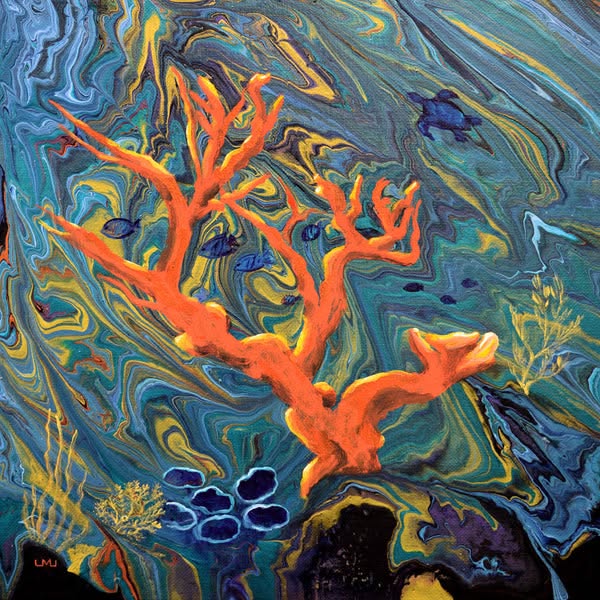
Elkhorn coral is the single most important shallow-reef builder in the Caribbean. For roughly five thousand years, Acropora palmata dominated the turbulent reef crest - the narrow zone where Atlantic swells break against coral - producing the broad, flattened, antler-like branches that defined the visual character of Caribbean reefs.
Fishers, divers, and coastal engineers treated elkhorn thickets as landscape features the way a mainland ecologist treats oak woodland: predictable, productive, and load-bearing for everything that lived around them.
That landscape is now gone. Across the Caribbean, elkhorn populations have declined by more than ninety-five per cent since the late 1970s, driven first by White Band Disease, then by repeated bleaching events, hurricanes, pollution, and most recently by Stony Coral Tissue Loss Disease and the 2023 Florida marine heatwave. Elkhorn was the first coral species ever listed under the U.S.
Endangered Species Act, added as Threatened in 2006, and is now classified as Critically Endangered by the IUCN. This entry covers every aspect of its biology and the accelerating effort to keep it alive.
Etymology and Classification
The scientific name Acropora palmata combines Acropora, from the Greek meaning 'pointed pore' and referring to the distinctive axial corallite at the tip of each branch, with palmata, the Latin for 'palm-like' or 'hand-shaped'. The species epithet captures the broad, flattened, blade-like geometry of the branches - fingers of calcium carbonate spreading outward from a massive base.
The English common name 'elkhorn' comes from the same visual impression: a mature colony looks like a thicket of bull elk antlers frozen in limestone.
Acropora palmata belongs to the family Acroporidae, the largest and most ecologically important family of reef-building corals. The genus Acropora contains more than 140 species distributed across tropical oceans worldwide, but only three are native to the Caribbean: elkhorn, staghorn (A. cervicornis), and their natural hybrid fused staghorn (A. prolifera).
Elkhorn's sister species staghorn is similar in growth rate and biology but differs in branch geometry: staghorn has cylindrical branches and occupies slightly deeper, calmer water, while elkhorn's flattened branches allow it to hold the exposed reef crest itself.
Within the class Anthozoa, elkhorn sits in the order Scleractinia - the stony corals, distinguished from soft corals and sea anemones by their ability to secrete a hard aragonite skeleton. Stony corals are the primary architects of every tropical reef on Earth.
Size, Structure, and Colony Form
A mature elkhorn colony is a single genetic individual composed of thousands to millions of cloned polyps, all sharing a continuous skeleton and interconnected tissues.
Colony dimensions:
- Diameter: up to 4 metres across in healthy conditions
- Height: typically 1-2 metres above the substrate
- Branch length: up to 60 centimetres
- Branch shape: flattened, palmate, blade-like
- Polyps per colony: thousands to millions of genetically identical individuals
The overall shape of a colony is dictated by its environment. Colonies on exposed reef crests grow outward and remain low, with thick, heavily flattened branches oriented roughly parallel to the dominant swell direction. Colonies in more sheltered water produce longer, thinner branches and can reach greater vertical height. In both cases the branches grow from a thick basal attachment that fuses to the limestone reef rock beneath.
Each polyp is only a few millimetres across and sits in a small cup-shaped skeletal depression called a corallite. The polyps at the tips of branches - the axial corallites - are slightly larger and define the direction of growth. Lateral polyps bud off the axial corallites as the branch extends. Every polyp carries a ring of stinging tentacles that extend at night to catch plankton.
The skeleton itself is calcium carbonate laid down in the form of aragonite. Under the microscope, elkhorn skeleton reveals a porous, lightweight architecture - dense enough to resist wave forces but light enough that the entire colony can grow several centimetres a year without collapsing under its own mass.
Why the Antler Shape Matters
The flattened palmate branches are the single most important feature of elkhorn's biology. They are a direct evolutionary response to the mechanical environment of the reef crest.
A cylindrical branch - the geometry used by elkhorn's sister species staghorn - offers the same drag profile to a wave no matter which direction the wave strikes from. That is acceptable in deeper, calmer water, but on the reef crest where every wave passes from roughly the same direction, a cylinder catches the full force of the break and snaps.
Elkhorn branches are flattened along the axis perpendicular to dominant wave direction. Water passes along the narrow edge, not the broad face, reducing drag by an order of magnitude.
The result is a colony that can hold its ground in water where almost nothing else builds reef. This is why elkhorn became the dominant reef-crest coral of the entire Caribbean over the past five thousand years. It is also why elkhorn's collapse has removed the natural breakwater that once protected hundreds of kilometres of coastline, and why coastal engineers now treat elkhorn restoration as shoreline infrastructure as well as marine conservation.
Growth Rate and Lifespan
Elkhorn colonies grow 5-10 centimetres per year under good conditions, measured as branch length extension. That sounds slow next to a terrestrial plant, but among reef corals it is fast: massive boulder corals like Orbicella and Montastraea add less than one centimetre of skeleton per year. Only staghorn, at 10-20 centimetres per year, grows faster in the Caribbean, and it trades mechanical strength for speed.
Growth is not constant. A fragment the size of a coin can become a shopping-cart-sized colony within five to seven years. Branch length doubles every one to two years during the fastest early growth phase. Growth slows as colonies mature, but old colonies continue expanding horizontally and thickening at the base for decades.
Individual branches can live decades. A single genotype - which may be represented by multiple physical colonies produced by fragmentation - can potentially live for centuries. Some elkhorn genotypes identified in the Florida Keys and the Bahamas appear to be hundreds of years old based on skeletal growth patterns. These ancient clones are now prioritised for restoration because they represent the accumulated adaptation of long survival in specific local environments.
Feeding, Photosynthesis, and the Zooxanthellae Partnership
Elkhorn is an animal that derives most of its energy from photosynthesis. It is not an exception to biology; it is a partnership.
Inside the tissues of every polyp live dense populations of microscopic dinoflagellate algae called zooxanthellae, belonging to the family Symbiodiniaceae. A single square centimetre of elkhorn tissue can hold millions of these algal cells. During the day the algae photosynthesise using sunlight and carbon dioxide, producing sugars and other organic compounds.
They release up to ninety per cent of that photosynthetic output directly into the host coral's tissues. In return, the coral provides shelter, a stable chemical environment, and a concentrated source of waste nitrogen and phosphorus that the algae would otherwise struggle to obtain in clear tropical water.
This partnership is why elkhorn grows fast enough to build reef structure in nutrient-poor tropical seas. It is also the partnership's biggest weakness. When water temperatures rise more than one or two degrees Celsius above the long-term summer maximum for more than a few weeks, the photosynthetic machinery of the zooxanthellae produces dangerous reactive oxygen species. The coral expels the algae to protect itself.
Without its photosynthetic partners, the colony turns stark white - the visible skeleton shows through transparent tissue - and begins to starve. This is coral bleaching. A bleached colony is not yet dead, but unless temperatures fall and the symbionts return within weeks, it will be.
At night, elkhorn supplements photosynthesis by capturing plankton directly. Each polyp extends its ring of stinging tentacles and catches small zooplankton, which are then digested inside the polyp's gastrovascular cavity. Plankton feeding contributes a minority of daily energy but provides essential nitrogen, phosphorus, and micronutrients that photosynthesis alone cannot supply.
Reproduction
Elkhorn reproduces sexually and asexually, and both modes matter for species survival.
Sexual reproduction occurs through annual mass spawning. On a handful of nights each year - typically the third to sixth night after the August full moon - elkhorn colonies across the entire Caribbean simultaneously release bundles of eggs and sperm into the water column. Each bundle is slightly buoyant and drifts to the surface, where the bundle breaks apart and fertilisation takes place.
Synchronisation is tight enough that divers timing the event correctly can swim through clouds of pink-and-white spawn bundles rising toward the moonlight.
Fertilised embryos develop into swimming planktonic larvae over the following days. Larvae drift with ocean currents for days to weeks before settling on a suitable hard surface, metamorphosing into a single founding polyp, and beginning to build a new colony. Successful sexual reproduction is rare: most larvae never find suitable substrate, and post-settlement mortality is extreme. But the process maintains genetic diversity.
Asexual reproduction occurs through fragmentation. When a storm, a hurricane, a passing swell, a parrotfish bite, or a diver's fin snaps a branch off a colony, the broken fragment can reattach to the seabed and regrow into a full colony. The new colony is genetically identical to the parent - a clone.
In elkhorn's case fragmentation is so effective that many apparently separate colonies on a single reef turn out to share an identical genotype. Restoration programs exploit this directly by cutting small fragments from donor colonies and out-planting them onto degraded reefs.
Range, Habitat, and Keystone Role
Elkhorn is endemic to the wider Caribbean region.
Geographic range:
| Region | Historic abundance | Current status |
|---|---|---|
| Florida Keys / Florida reef tract | Dominant reef-crest coral | Near-total wild mortality after 2023 heatwave |
| Bahamas | Continuous reef-crest thickets | Fragmented, patchy, reduced |
| Cuba | Major reef-builder | Declining but some populations persist |
| Yucatan / Mesoamerican reef | Dominant historically | Major losses, active restoration |
| Caribbean Lesser Antilles | Widespread on exposed crests | Sharply reduced |
| Caribbean Greater Antilles | Reef-crest keystone | Major disease losses, fragmented populations |
| Bermuda | Edge of range | Persistent but limited |
| Gulf of Mexico (southern) | Regional populations | Reduced |
Within these regions, elkhorn occupies extremely shallow, high-energy water - typically between 1 and 5 metres deep, right at the reef crest. A few colonies occur down to 20 metres in particularly clear water, but the species evolved specifically for the turbulent zone where breaking waves deliver high light, high oxygen, and strong water flow.
Elkhorn is a Caribbean keystone species. Roughly a quarter of all Caribbean reef fish use elkhorn thickets at some stage of life, either as juvenile shelter or adult foraging habitat. Commercially important species including grouper, snapper, grunts, and parrotfish spend early life stages hiding among elkhorn branches. Spiny lobster juveniles settle preferentially in reef-crest habitat that elkhorn creates.
And the coastal zones shoreward of historic elkhorn thickets are measurably more protected from wave energy than zones without them, making elkhorn a form of living infrastructure.
Conservation Status and the Collapse
The IUCN Red List classifies elkhorn coral as Critically Endangered. The species was listed as Threatened under the U.S. Endangered Species Act in 2006 - the first coral species ever given ESA protection - and remains under active federal management. CITES Appendix II regulates international trade, though wild-harvest pressure is no longer a major threat.
The collapse, in sequence:
- White Band Disease (1977-1990). A bacterial infection appeared on Caribbean reefs in the late 1970s, initially in the Virgin Islands and Florida. Colonies developed a sharp white band of freshly exposed skeleton that advanced along branches at several millimetres per day, killing tissue as it moved. The pathogen has been difficult to isolate definitively - candidates include members of the genus Vibrio - but within roughly a decade the disease killed more than ninety-five per cent of mature Caribbean elkhorn colonies. The outbreak coincided with the near-simultaneous mass mortality of the long-spined sea urchin Diadema antillarum, which had grazed algae off reefs, so dying elkhorn was overgrown by fleshy macroalgae rather than recolonised by new coral recruits.
- Bleaching events (1990s onward). Rising summer water temperatures produced repeated Caribbean-wide bleaching episodes in 1995, 1998, 2005, 2010, 2015, and 2023. Each event killed additional surviving colonies and prevented recovery from earlier losses.
- Hurricanes. Major hurricanes including Allen (1980), Gilbert (1988), Irma (2017), and Maria (2017) physically shattered surviving elkhorn colonies in their paths. Fragmentation normally supports elkhorn reproduction, but fragmentation onto algae-covered rubble fields rarely results in successful regrowth.
- Stony Coral Tissue Loss Disease (2014-present). First detected off Miami in 2014, this disease has spread through the Caribbean and attacks more than twenty coral species including elkhorn. Infected tissue sloughs off in patches, and colonies often die within weeks to months of first signs.
- 2023 Florida marine heatwave. In July and August 2023, water temperatures at shallow Florida Keys reef stations exceeded 38 degrees Celsius for weeks. Elkhorn, which occupies the shallowest and most exposed habitat, bleached and died almost immediately. Monitoring documented near-total mortality of wild Florida elkhorn within weeks. Some restoration nurseries reported more than ninety-nine per cent mortality of cultured colonies.
Supporting pressures:
- Ocean acidification: atmospheric CO2 dissolving into seawater lowers pH and weakens the calcium carbonate skeleton.
- Nutrient pollution from coastal development fuels algae that smother coral and compete for settlement space.
- Overfishing of herbivorous parrotfish removes grazers that keep reefs clean.
- Sedimentation from land clearing blocks the light photosynthesis requires.
- Physical damage from anchors, groundings, and careless diving.
The long-term outlook for wild elkhorn populations depends almost entirely on the trajectory of ocean warming. No local conservation measure can compensate for global greenhouse gas emissions.
Restoration: Coral Trees, Spawning, and Heat-Tolerant Genotypes
Elkhorn is one of the most actively restored marine species on Earth. Restoration combines three approaches.
Fragmentation and coral-tree nurseries. Organisations including the Coral Restoration Foundation in Florida and SECORE International operate underwater nurseries that suspend coral fragments on fibreglass or PVC 'coral trees'. Each tree resembles an upside-down Christmas tree anchored to the seabed, with hundreds of fragments hanging from fishing line along its branches.
Suspended in mid-water, fragments get strong water flow, abundant light, and no contact with seabed algae or predators. Growth rates are typically two to three times faster than on natural reef. Once fragments reach a target size - usually 20-30 centimetres across - they are out-planted onto degraded reef substrate, often attached with marine epoxy or masonry nails.
Sexual reproduction programs. SECORE International pioneered techniques for collecting spawn bundles during annual mass spawning events, fertilising the gametes in onshore labs, rearing larvae through settlement, and releasing juvenile colonies onto reefs. Sexual propagation is harder than fragmentation but produces genetically diverse offspring. Diversity is essential for long-term population resilience because fragmentation-only restoration simply multiplies existing genotypes.
Heat-tolerant genotype selection. The 2023 Florida heatwave inadvertently conducted the largest natural selection experiment in elkhorn history. A small number of colonies survived temperatures that killed almost everything around them.
Restoration practitioners have identified these survivors, propagated them in nurseries, and cross-bred them during spawning events to produce offspring with a higher chance of surviving future heatwaves. This is assisted evolution: humans actively selecting for traits that might otherwise require thousands of years of natural selection to spread through a population.
Scale of restoration so far:
| Metric | Approximate figure |
|---|---|
| Elkhorn fragments planted across the Caribbean | Several hundred thousand |
| Active restoration sites | Dozens across more than a dozen countries |
| Nursery-grown fragments lost in 2023 Florida heatwave | Over 99% at some sites |
| Restoration organisations with active elkhorn programs | 20+ |
Restoration cannot outpace climate change by itself. The field's consensus is that propagation and genetic-diversity work buys time - possibly decades - while the larger systemic problem of ocean warming is addressed or not.
Elkhorn, Coastlines, and Human Communities
Elkhorn's collapse has consequences that reach beyond reef ecology. The reef crest that elkhorn built across the Caribbean absorbed the majority of incoming Atlantic swell energy before it reached shallow flats, seagrass beds, and shorelines. Coastal engineers increasingly quantify this as ecosystem service value: studies estimate that intact Caribbean reef crests reduce nearshore wave energy by 70-97 per cent.
A reef crest without living elkhorn is a reef crest that erodes, loses height, and transmits more wave energy to the coast. Several Caribbean nations now include elkhorn restoration in coastal adaptation plans, treating coral thickets as living infrastructure equivalent to seawalls.
For diving, snorkelling, and reef tourism economies, elkhorn's collapse has changed the product. The shallow, gin-clear, antler-thicket scenes that defined Caribbean dive tourism in the 1960s and 1970s are mostly gone. Dive operators increasingly market 'restoration dives' where visitors can plant fragments or observe nursery sites, redirecting tourism value toward active recovery work.
Traditional fishing communities that depended on reef-crest fish nurseries have seen declines in juvenile recruitment of commercially important species. The ecological chain runs: fewer elkhorn thickets means less juvenile shelter means lower adult fish biomass means less catch.
Related Reading
- Staghorn Coral: Fastest-Growing Caribbean Reef Builder
- Brain Coral: Slow-Growing Reef Architect
- Coral Reefs: The Rainforests of the Ocean
- Great Barrier Reef: Is It Really Dying?
References
Relevant peer-reviewed and governmental sources consulted for this entry include IUCN Red List assessments for Acropora palmata, NOAA Fisheries Endangered Species Act status reviews, published research in Science, Nature Climate Change, Coral Reefs, and PLOS ONE, and technical reports from the Coral Restoration Foundation, SECORE International, the Florida Fish and Wildlife Conservation Commission, and the Atlantic and Gulf Rapid Reef Assessment program.
Mortality and bleaching figures for the 2023 Florida marine heatwave reflect preliminary post-event assessments from Florida state agencies and academic partners; final published estimates continue to be refined as of the most recent reef monitoring reports.
Frequently Asked Questions
What is elkhorn coral?
Elkhorn coral (Acropora palmata) is a large, branching stony coral that historically dominated the shallow reef crests of the Caribbean. Each colony is built from thousands of tiny genetically identical polyps sharing a common calcium carbonate skeleton. Its branches are flattened and broad, shaped like the antlers of a bull elk, which is where both the common name and the species epithet palmata (meaning ‘palm-like’ or ‘hand-shaped’ in Latin) originate.
A mature colony can measure up to 4 metres across with individual branches reaching 60 centimetres in length. Elkhorn is a keystone reef-builder - the three-dimensional structure it creates absorbs wave energy, shelters juvenile fish, and anchors the entire shallow-water ecosystem of the Caribbean.
Where does elkhorn coral live?
Elkhorn coral is restricted to the wider Caribbean region, including the Caribbean Sea, the Bahamas, the Florida Keys and Florida reef tract, the Gulf of Mexico, the Yucatan reefs, and the waters around Bermuda. It prefers extremely shallow, clear, high-energy water between 1 and 5 metres deep, right at the reef crest where Atlantic swells break.
A few colonies occur as deep as 20 metres, but the species evolved specifically for the shallowest, most turbulent part of the reef. Before the 1980s collapses, elkhorn formed continuous thickets along hundreds of kilometres of reef crest and acted as the principal natural breakwater protecting Caribbean coastlines from storm waves. Today remaining populations are fragmented and many historical sites hold no live colonies at all.
Why is elkhorn coral critically endangered?
The IUCN lists Acropora palmata as Critically Endangered after Caribbean populations collapsed by more than 95% since the late 1970s. The trigger was White Band Disease, a bacterial infection that swept through the region starting around 1977-1980 and killed mature colonies within weeks.
Compounding pressures have prevented recovery ever since: ocean warming drives repeated bleaching events, ocean acidification weakens the skeleton, nutrient pollution from coastal development fuels algae that smother coral, hurricanes physically shatter branches, sedimentation from land clearing blocks light, and overfishing of herbivorous parrotfish removes the grazers that keep reefs clean.
Stony Coral Tissue Loss Disease has since added another layer of mortality. Elkhorn was the first coral species listed under the U.S. Endangered Species Act, added as Threatened in 2006.
Why are elkhorn branches shaped like antlers?
The flattened, blade-like branches of elkhorn coral are a direct evolutionary response to high-energy wave environments. A cylindrical branch facing into a breaking wave would catch the full force of the water and snap. Elkhorn’s branches grow as flat palmate blades oriented roughly parallel to the direction of dominant swell, so waves slide along their narrow edges instead of slamming into their broad faces.
This geometry allows a colony to sit on the reef crest - the most turbulent zone of the entire reef - and still accumulate biomass faster than almost any other Caribbean coral. The shape is also what distinguishes elkhorn from its cylindrical-branched sister species staghorn (Acropora cervicornis), which lives slightly deeper and in calmer water where the antler flattening is not needed.
What is White Band Disease and how did it affect elkhorn?
White Band Disease is a bacterial infection of Acropora corals first observed in the Caribbean around 1977-1980. Affected colonies develop a sharp white band of freshly exposed skeleton that advances along the branches, killing living tissue at several millimetres per day. The specific pathogen has been difficult to isolate definitively, but bacterial candidates include members of the genus Vibrio.
The outbreak coincided with and was accelerated by warming water, nutrient pollution, and the near-simultaneous mass mortality of the long-spined sea urchin Diadema antillarum, which had grazed algae off the reef. Within roughly ten years the disease killed more than 95% of mature elkhorn colonies in many Caribbean localities and converted shallow reef crests from coral-built habitat to algae-dominated rubble fields.
Elkhorn has never recovered to its pre-disease abundance and is now considered a critically endangered reef-builder.
How is elkhorn coral being restored?
Elkhorn is one of the most actively restored marine species on Earth. Organisations including the Coral Restoration Foundation in Florida and SECORE International operate underwater nurseries that grow fragments on fibreglass ‘coral trees’ suspended in mid-water, where fast flow and strong light accelerate growth. Fragments roughly double in size every six to twelve months on these trees.
Once large enough, colonies are out-planted onto degraded reef crests, often attached with marine epoxy or nails. Practitioners increasingly prioritise rare heat-tolerant genotypes that survived the 2023 Florida heatwave, since genetic diversity and thermal resilience are essential for long-term survival.
Hundreds of thousands of elkhorn fragments have been planted across the Caribbean, and SECORE has pioneered sexual-reproduction techniques that rear larvae from mass spawning events to increase genetic diversity in restored populations.
What happened to elkhorn in the 2023 Florida heatwave?
In July and August 2023 the Florida Keys experienced the most extreme marine heatwave ever recorded in the region. Water temperatures at shallow reef stations exceeded 38 degrees Celsius - hotter than human body temperature - for weeks at a time. Elkhorn colonies, which live in the shallowest and most exposed part of the reef, bleached almost instantly and then died.
Monitoring by the Coral Restoration Foundation and Florida state agencies documented near-total mortality of wild elkhorn across the Florida reef tract. Restoration nurseries suffered catastrophic losses as well, with some sites reporting more than 99% mortality of nursery-grown colonies. Emergency responses included moving fragments to deeper water, onshore tanks, and cooler reef zones.
The 2023 event demonstrated that elkhorn’s long-term survival in Florida now depends on identifying and propagating the few heat-tolerant genotypes that survived, and ultimately on limiting further ocean warming.
Is elkhorn coral an animal or a plant?
Elkhorn coral is an animal - specifically a colonial cnidarian related to jellyfish and sea anemones. Each branch is built from thousands of tiny polyps, each with a ring of stinging tentacles that capture plankton at night. However, the reason elkhorn grows so fast in shallow tropical water is that it is effectively part-plant. Inside the tissues of every polyp live microscopic symbiotic algae called zooxanthellae (Symbiodiniaceae).
These algae photosynthesise using sunlight and CO2, then transfer up to 90% of their sugars directly to the coral host in exchange for shelter, nutrients, and stable chemistry. When ocean temperatures climb too high, this partnership breaks down: the coral expels the algae, the colony turns stark white, and without its photosynthetic partners it begins to starve.
A bleached elkhorn colony is not yet dead, but it is running out of time unless temperatures fall quickly.