
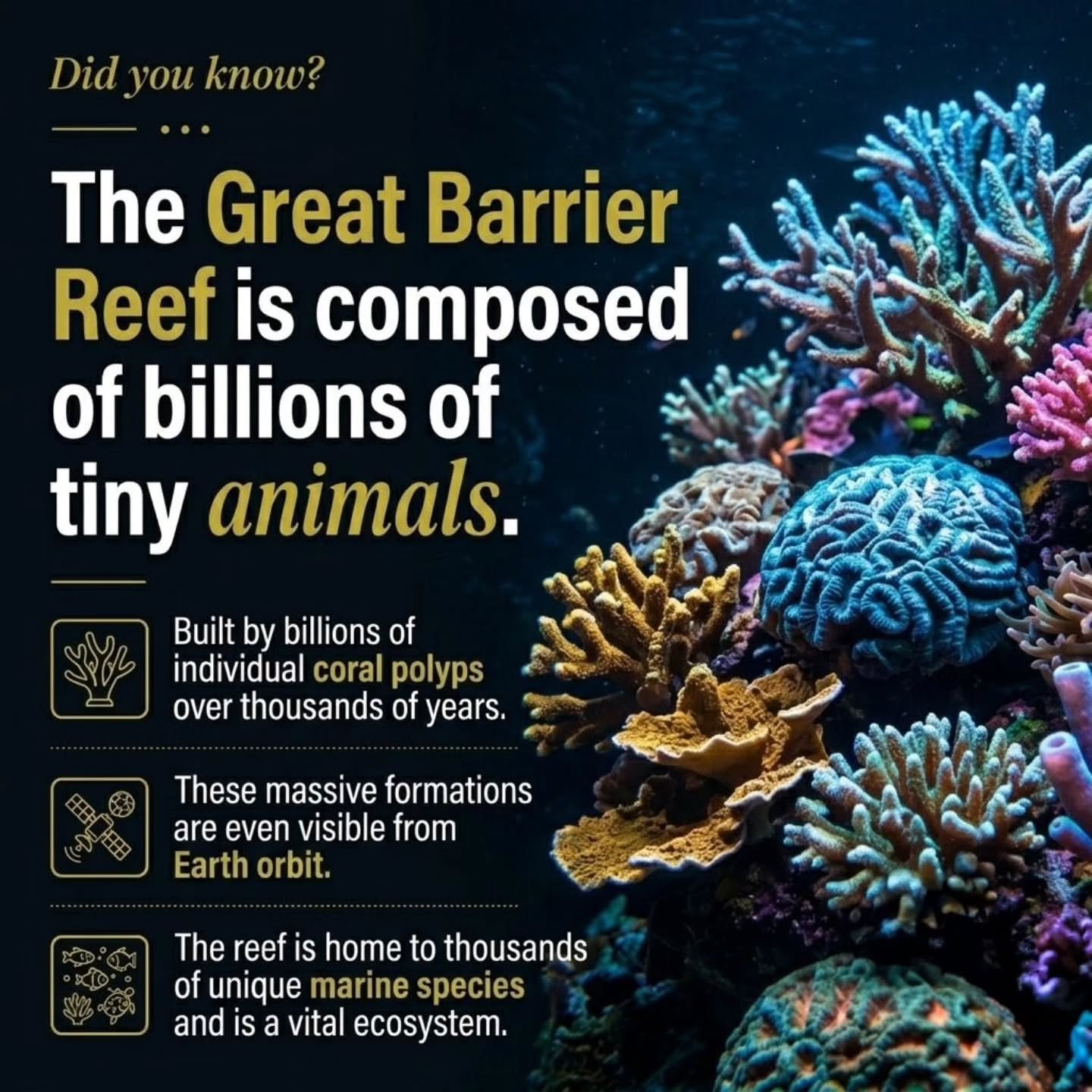
Is the Great Barrier Reef really dying?
The Great Barrier Reef has experienced severe damage but is not biologically dead. Approximately 50 percent of shallow-water corals died between 2016 and 2022 due to mass bleaching events caused by ocean warming. However, the reef system is extraordinarily large (344,400 square kilometers), and significant healthy portions remain.
The Complicated Truth
You have probably read that the Great Barrier Reef is dying. You may have also read that it is recovering. Both statements contain truth. Neither is complete.
The reality is that the world's largest coral reef system is severely damaged, actively declining in many regions, and partially recovering in others. Its long-term survival depends on decisions being made now about global emissions, decisions that extend far beyond the reef's shores.
This is a guide to what is actually happening, based on the best available science, without either minimization or exaggeration.
The Scale
The Great Barrier Reef covers approximately 344,400 square kilometers along the northeast coast of Australia. To put this in perspective:
- It is larger than the United Kingdom and Ireland combined
- It exceeds the area of the U.S. state of New Mexico
- It is the largest living structure on Earth
- It is visible from low Earth orbit and was confirmed by astronauts aboard Apollo missions
The reef extends 2,300 km along the Queensland coast, from Cape York Peninsula in the tropical north to Bundaberg in the subtropical south. Within this area are approximately 3,000 individual reefs, ranging from small coral outcrops to massive reef complexes, plus 900 islands.
Biological richness:
- 1,500+ fish species
- 600+ coral species
- 30 whale and dolphin species
- 4,000+ mollusc species
- 133+ shark and ray species
- 215 bird species
- 6 of the world's 7 marine turtle species
This is one of the most biodiverse ecosystems on Earth, supporting commercial fisheries, tourism generating $6+ billion annually, and scientific research across multiple disciplines.
What Coral Bleaching Is
To understand the Great Barrier Reef's condition, you need to understand coral bleaching.
The coral-algae partnership:
Corals are actually colonies of tiny animals called polyps. Within each polyp's tissues live microscopic single-celled algae called zooxanthellae. The algae perform photosynthesis, producing sugars that feed the coral. In return, corals provide the algae with shelter and carbon dioxide.
This partnership has existed for tens of millions of years. It is how corals grow despite living in nutrient-poor tropical waters - the algae provide most of their food. It is also why corals appear colored; the zooxanthellae give them their characteristic hues.
What bleaching does:
When water temperatures rise above the coral's tolerance range, the zooxanthellae become stressed and produce toxic byproducts. The coral responds by expelling the algae from its tissues.
Without the algae:
- The coral loses its color (becoming white or "bleached")
- The coral loses its primary food source
- The coral must survive on backup food from filter feeding
If temperatures return to normal within a few weeks, corals can reabsorb new algae and recover. But if elevated temperatures persist:
- The coral starves
- The coral becomes vulnerable to disease
- After 4-8 weeks of bleaching, many corals die
Bleaching is not dying itself. It is the first stage of dying. Whether it leads to death depends on how long the stressed conditions continue.
The Mass Bleaching Events
The Great Barrier Reef has experienced seven mass bleaching events since 1998:
1998. Approximately 50 percent of inshore reefs bleached. Recovery took 5-7 years.
2002. Similar impact to 1998. Recovery slowed because the two events were close together.
2016. Catastrophic bleaching across the northern third of the reef. Approximately 30 percent of corals died within 12 months.
2017. Back-to-back bleaching event. Central reef sections heavily damaged. No chance for recovery between 2016 and 2017 events.
2020. First major bleaching to affect southern reef sections. The most widespread bleaching ever recorded on the reef, affecting over 60 percent of surveyed coral.
2022. La Niña weather pattern would normally bring cool conditions, but heat anomalies caused bleaching anyway. First bleaching ever recorded during La Niña - a significant warning sign.
2024. The most recent mass bleaching event, affecting large sections of the reef. Impact still being assessed.
The pattern is clear: bleaching events have become more frequent and more severe. Intervals between events have shortened from decades to just a few years. Recovery periods are insufficient for full coral regrowth before the next event.
Coral Loss Statistics
Between 2016 and 2022:
- Approximately 50 percent of shallow-water corals on the Great Barrier Reef died
- Northern reefs lost approximately 67 percent of shallow corals
- Central reefs lost approximately 50 percent
- Southern reefs were less affected until the 2020 bleaching event
These figures come from the Australian Institute of Marine Science's long-term monitoring program, which surveys reef health continuously.
The 2022-2023 recovery:
In 2022 and 2023, coral cover in surveyed areas actually increased for the first time in decades. Fast-growing branching corals colonized areas where slower-growing massive corals had died.
This looked like good news - and it was, partially. But it came with caveats:
The increase reflects changed reef composition. Fast-growing branching corals (primarily the genus Acropora) grew to fill bleached areas, but these species are also more vulnerable to future bleaching. The "recovered" reef is structurally different from the pre-damage reef.
Slower-growing corals remain severely diminished. Brain corals, boulder corals, and other massive species that took centuries to grow remain heavily reduced. These species provide most of the structural complexity of reefs.
Some regions showed no recovery. Northern reef sections that experienced the worst bleaching continued declining even as southern sections partially recovered.
The 2024 bleaching event has raised concerns that the partial recovery will be reversed.
Why This Is Happening
Coral bleaching is driven primarily by ocean temperature increases.
The warming pattern:
Ocean temperatures have risen approximately 1.5°C globally since 1900 due to human-caused climate change. Tropical waters have warmed more slowly than polar regions in absolute terms, but tropical corals live very close to their upper temperature tolerance even in pre-warming conditions.
For most coral species, temperatures even 1-2°C above normal summer maximums cause bleaching. The ocean warming we have already caused is enough to push many reef systems past this threshold during heatwaves.
Additional stressors:
While warming is the primary cause of large-scale damage, other factors compound the problem:
Ocean acidification. Increased atmospheric CO2 is absorbed by oceans, lowering pH. Acidic water makes it harder for corals to form calcium carbonate skeletons.
Agricultural runoff. Fertilizers and pesticides from Queensland farms flow into reef waters. These pollutants harm corals directly and feed algal blooms that smother reefs.
Overfishing. Removing fish that eat algae allows algae to outcompete corals for space.
Crown-of-thorns starfish. These native starfish eat corals. Population explosions (caused partly by overfishing of their predators) cause massive coral destruction.
Coastal development. Sediment runoff from construction smothers corals. Reduced water quality near populated coastlines degrades reef health.
Tropical cyclones. Storms physically damage reefs. Climate change is increasing the intensity of tropical storms.
The Recovery Problem
Coral reefs can recover from damage, but recovery is slow.
Recovery timelines:
- Fast-growing branching corals (Acropora, Pocillopora): 10-15 years
- Massive boulder corals (Porites, Diploria): 50-100+ years
- Full ecosystem recovery (including fish populations): 20-30+ years
- Full species diversity recovery: unknown, possibly never in current conditions
The issue is not whether corals can recover - they can. The issue is whether recovery can outpace continued damage.
The math doesn't work currently:
Historical bleaching interval: 10-20 years Current bleaching interval: 4-6 years Minimum recovery time for basic reef structure: 10-15 years
When bleaching occurs more frequently than recovery completes, each event leaves the reef in worse condition than the last. This is the pattern observed in recent decades.
Projections:
Climate models incorporating continued emissions project:
- 1.5°C warming by 2030 (likely under current policies): 70-90 percent loss of tropical coral reefs by 2100
- 2.0°C warming by 2050: Near-complete loss of shallow tropical coral reefs
The Great Barrier Reef would not survive under these scenarios in any recognizable form. Some deep-water corals may persist, and isolated shallow populations in particularly favorable locations may survive, but the reef as a biological and ecological system would effectively end.
Ecological Consequences
Coral reefs support approximately 25 percent of all marine species despite covering less than 1 percent of the ocean floor. Losing them has cascading effects.
Direct effects:
- Fish species dependent on reef structure lose habitat
- Reef-dependent species include many commercially important food fish
- Coastal ecosystems protected by reefs become exposed to erosion
- Carbon cycling through reef systems is lost
Indirect effects:
- Fishing industries collapse when reef fish populations decline
- Tourism-dependent coastal economies lose primary attractions
- Sea-level rise impacts increase as reef-based protection fails
- Climate adaptation options for tropical coastlines are reduced
Economic impact:
The Great Barrier Reef alone supports:
- $6+ billion annually in tourism revenue
- 64,000+ jobs directly
- Commercial fishing operations worth hundreds of millions annually
Loss of the reef would cost Queensland and Australia tens of billions of dollars over the coming decades. Globally, coral reef loss represents trillions of dollars in lost ecosystem services and coastal protection.
What Can Actually Be Done
The Great Barrier Reef's future depends primarily on global climate policy, not local conservation. But local action is not irrelevant.
Global climate action (the critical factor):
Limiting warming to 1.5°C would preserve approximately 30 percent of tropical coral reefs. Limiting to 2.0°C would preserve less than 10 percent. Limiting to current trajectories (2.5-3.0°C+) would eliminate nearly all tropical reefs.
The Paris Agreement target of 1.5°C requires dramatic emissions reductions starting immediately. Current national commitments are insufficient, and actual emissions exceed committed reductions. This is the single most important factor for reef survival.
Local conservation measures:
Fisheries management. Reducing overfishing allows herbivorous fish populations to recover, which in turn controls algae growth that would otherwise smother corals.
Agricultural runoff reduction. Queensland has invested in programs to reduce fertilizer and sediment runoff into reef waters. These programs help but have not solved the problem.
Crown-of-thorns starfish control. Direct killing of starfish outbreaks saves some corals, though the approach is labor-intensive and treats symptoms rather than causes.
Coastal development restrictions. Managing development near reef waters reduces direct damage and pollution.
Research interventions:
Heat-tolerant coral strains. Scientists are identifying naturally heat-resistant corals and breeding them for restoration projects. Early trials show promise but cannot scale to protect entire reef systems.
Coral gardening. Nurseries grow corals from fragments, then transplant them to damaged reefs. Can restore small areas but cannot address reef-scale damage.
Cloud brightening. Experimental technology that sprays seawater into the air to increase cloud cover and reduce sunlight reaching reefs. Could temporarily reduce bleaching stress. Controversial.
Probiotic treatments. Research into beneficial bacteria that help corals resist heat stress. Still experimental.
None of these interventions can save the reef if ocean warming continues unchecked. They may preserve specific areas or provide time for broader action, but they are complements to - not substitutes for - emissions reduction.
The Australian Political Tension
Australia has a strange relationship with the Great Barrier Reef. The reef is one of the country's greatest natural assets, generating enormous economic value and attracting international attention. Australia has also approved some of the largest coal mining expansions of any developed nation, directly contributing to the emissions that drive reef decline.
Australian investment:
Australia has committed $2+ billion to reef conservation, including water quality programs, crown-of-thorns starfish control, coral research, and monitoring.
Australian emissions:
Simultaneously, Australia remains one of the largest per-capita coal producers and exporters in the world. Several new major coal mining projects have been approved in the past decade. Australian coal exports feed power plants across Asia whose emissions directly warm Pacific waters where the reef lives.
The contradiction:
This contradictory policy reflects broader global tensions. Protecting ecosystems requires reducing emissions, but short-term economic interests often favor continued emissions. The reef's fate depends partly on resolving this tension at national and international levels.
UNESCO has repeatedly considered adding the Great Barrier Reef to the "World Heritage in Danger" list due to climate impacts and Australian policy. Australia has lobbied aggressively against this designation, viewing it as politically damaging.
The Monitoring Programs
The Great Barrier Reef is one of the most extensively monitored ecosystems on Earth.
The Australian Institute of Marine Science has conducted long-term reef health surveys since the 1990s. Standardized methods allow year-over-year comparison of coral cover, species composition, and bleaching impacts.
The Great Barrier Reef Marine Park Authority (GBRMPA) manages the reef and produces regular assessments of its overall condition. The GBRMPA's five-yearly Outlook Report provides comprehensive official assessment.
Satellite monitoring tracks sea surface temperatures daily, predicting bleaching stress before it becomes severe. The NOAA Coral Reef Watch program provides global coral bleaching forecasts.
Citizen science programs engage tourists, divers, and recreational boaters in reef monitoring. Programs like Eye on the Reef produce valuable supplementary data.
Academic research. Multiple Australian universities and international partners conduct research on reef health, coral biology, and conservation.
The monitoring produces a clear picture: the reef is in serious decline, with significant regional variation, and continued damage outpacing recovery under current conditions.
What Living Coral Reefs Feel Like
Descriptions of reef decline can feel abstract. Actually experiencing a coral reef in person conveys what is at stake.
A healthy coral reef is a symphony of color and activity. Thousands of fish in every direction, in every conceivable color pattern. Massive brain corals rising meters above the reef surface. Fan corals waving in currents. Small reef sharks patrolling. Turtles gliding past. Cuttlefish changing colors to communicate. Parrotfish grinding coral with audible crunches. Octopuses tucked into crevices watching divers.
The complexity is staggering. A single square meter of healthy reef may contain hundreds of species interacting in real time.
A bleached reef is silent. White coral skeletons where vibrant living organisms once existed. Fewer fish, most of the smaller species gone entirely. Algae covering what should be coral. Damaged sections with no structure at all - just rubble and sediment.
The difference is not subtle. A diver moving from a healthy reef section to a dead one experiences a profound psychological shift. The dead sections feel empty, silent, wrong.
Experienced Australian divers who have worked the reef for decades describe the changes they have witnessed in emotional terms. They speak of reef sections that used to be spectacular and are now unrecognizable. They describe losing familiar landmarks - individual massive corals they knew personally - to bleaching events.
This emotional weight is part of why reef decline matters beyond economics or abstract ecology. We are losing something beautiful, and the loss is happening in real time to people who care deeply about what is being lost.
The Honest Answer
Is the Great Barrier Reef dying?
Yes, significantly. Half of shallow corals have died in the past decade. Mass bleaching events continue at intervals that exceed recovery capacity. Every climate projection shows continued decline under current warming trajectories.
Not completely. The reef is enormous. Substantial healthy sections remain. Partial recovery is occurring in some areas. The system has not collapsed entirely.
Depends on the next decade. Whether emissions can be reduced quickly enough to stabilize ocean temperatures will determine whether recovery becomes possible or whether continued decline leads to collapse.
The honest conclusion is that the Great Barrier Reef is in serious decline but not dead. Its future depends on choices being made right now about global emissions policy. Local conservation helps at the margins but cannot compensate for continued warming.
Whether the reef survives in any meaningful sense for future generations is up to us - meaning not "conservationists" but rather everyone who votes, consumes energy, chooses transportation options, and influences policy through collective action.
The reef will not survive without dramatic action. Whether it will receive that action is still an open question.
Related Articles
- Coral Reefs: The Rainforests of the Ocean
- Sea Turtles: Ancient Navigators of the Ocean
- Sharks: The Ocean's Most Misunderstood Predators
Frequently Asked Questions
Is the Great Barrier Reef really dying?
The Great Barrier Reef has experienced severe damage but is not biologically dead. Approximately 50 percent of shallow-water corals died between 2016 and 2022 due to mass bleaching events caused by ocean warming. However, the reef system is extraordinarily large (344,400 square kilometers), and significant healthy portions remain.
Between 2020 and 2022, coral cover in surveyed areas actually increased for the first time in decades - largely from fast-growing coral species recolonizing bleached areas. The reef is in serious decline but retains significant living structure. Characterizing it as ‘dead’ oversimplifies a complex situation. The accurate description is that the Great Barrier Reef is severely damaged, actively dying in many areas, but partially recovering in others.
Its long-term survival depends on whether ocean temperatures stabilize quickly enough for recovery to outpace continued damage.
What is coral bleaching?
Coral bleaching occurs when heat-stressed corals expel the microscopic algae (zooxanthellae) that live within their tissues and provide most of their food through photosynthesis. The algae give corals their color; without them, corals appear white or ‘bleached.’ Corals can survive brief bleaching if temperatures return to normal, allowing them to reabsorb algae.
Prolonged bleaching (several weeks or more) typically kills the coral because it starves without its symbiotic algae. The tropical oceans have warmed approximately 1.5°C since 1900, and marine heatwaves now occur regularly. The Great Barrier Reef experienced mass bleaching events in 1998, 2002, 2016, 2017, 2020, 2022, and 2024. Each event kills more corals, and recovery periods are becoming too short for full recovery between events.
How big is the Great Barrier Reef?
The Great Barrier Reef covers approximately 344,400 square kilometers - larger than the United Kingdom and Ireland combined, or larger than the state of New Mexico. It extends 2,300 km along the northeast coast of Australia, from Cape York Peninsula in the north to Bundaberg in the south. The reef system contains approximately 3,000 individual reefs ranging from small coral outcrops to massive reef complexes, plus 900 islands.
Approximately 1,500 fish species, 600 types of coral, 30 whale and dolphin species, 4,000 mollusc species, and 133 shark and ray species depend on the reef ecosystem. It is the only living structure on Earth visible from space. The sheer scale means that local damage in one region can coexist with healthy conditions in others, complicating any simple assessment of the reef’s status.
Can coral reefs recover from bleaching?
Yes, coral reefs can recover from bleaching if conditions improve, but recovery takes decades. Fast-growing branching corals can regrow in 10-15 years if water temperatures and conditions remain stable. Slower-growing massive corals (the ‘brain corals’ and similar) require 50-100+ years to fully regenerate. The Great Barrier Reef has shown partial recovery between bleaching events historically.
However, modern bleaching events are occurring at intervals of 4-6 years, which is much shorter than the 10-15 years minimum for adequate recovery. This creates a degrading pattern where reefs do not fully recover before being damaged again. The long-term outlook depends on whether ocean warming can be limited enough to give reefs adequate recovery time.
At current warming rates, most climate models predict 70-90 percent loss of all tropical coral reefs by 2100.
What can be done to save the Great Barrier Reef?
Saving the Great Barrier Reef requires both climate change mitigation and direct conservation measures. The most important action is reducing greenhouse gas emissions to limit further ocean warming - this is the single critical variable.
Local conservation includes managing fishing pressure (overfishing weakens reef ecosystems), reducing agricultural runoff (fertilizers from Queensland farms harm reef corals), controlling invasive species (particularly crown-of-thorns starfish that eat coral), and limiting coastal development.
Research is underway on heat-resistant coral strains that could be planted in damaged areas, and on ‘coral gardening’ projects that grow corals in nurseries for reef restoration. However, no local intervention can compensate for continued global warming. The reef cannot be saved without serious action on climate change, regardless of how well local management performs.
Australia has invested $2+ billion in reef conservation but continues approving new coal mining projects that drive the climate emissions damaging the reef.