
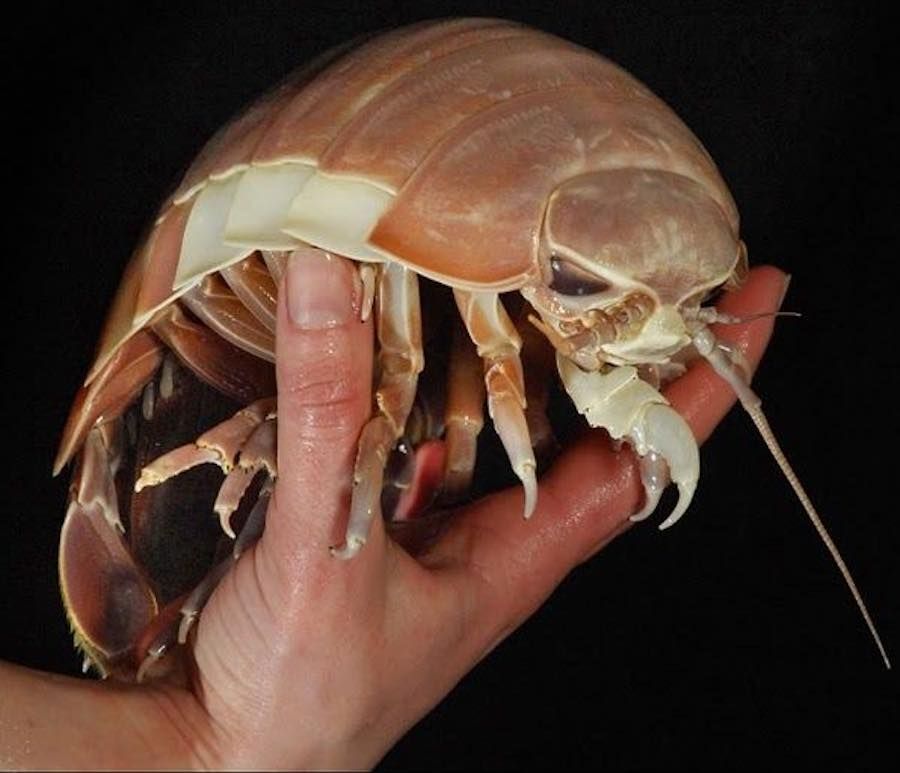
How big are giant isopods?
Giant isopods (Bathynomus giganteus) reach up to 50 cm (20 inches) in length, making them among the largest crustaceans on Earth and the largest isopods by far. Most common species are 20-40 cm. They weigh up to 1. 7 kg.
A Pill Bug the Size of a Dinner Plate
Imagine the common roly-poly pill bug in your garden, about a centimeter long. Now imagine it scaled up 40 times, to 50 centimeters in length, weighing nearly 2 kilograms. That's a giant isopod.
They look unmistakably like pill bugs because they essentially are, the same body plan, same seven pairs of legs, same ability to roll into a ball. Giant isopods simply scaled up dramatically through deep-sea gigantism and specialized for life on the abyssal ocean floor.
One famous specimen at Japan's Toba Aquarium refused food for over 5 years. It died in 2014, still refusing to eat. This is normal giant isopod behavior.
The Animals
Giant isopods (family Bathynomidae) are large crustaceans.
Physical features:
- Length: 20-50 cm (record specimens to 76 cm in one species)
- Weight: up to 1.7 kg
- Body plan: segmented like pill bug, 14 segments
- Legs: 7 pairs
- Eyes: compound, 4,000+ facets per eye
- Color: pale lilac/grayish
Species:
Multiple species in genus Bathynomus:
- B. giganteus: largest, up to 50 cm (Gulf of Mexico, Atlantic)
- B. doederleinii: Pacific species
- B. kensleyi: Gulf of California
- B. jamesi: recently described (Vietnam)
- Others
Pill Bug Relatives
Giant isopods are close relatives of garden pill bugs.
Both share:
- Isopod body plan (14 body segments)
- Seven pairs of legs
- Ability to roll into defensive ball
- Similar internal anatomy
- Same taxonomic order
Key differences:
- Size: giant isopods 40x larger than pill bugs
- Habitat: marine vs terrestrial
- Breathing: gills vs air exchange
- Diet: scavengers vs decomposers
- Life strategy: slow deep-sea vs fast reproductive
Deep-sea gigantism:
Giant isopods demonstrate deep-sea gigantism, a pattern where deep-sea species grow much larger than shallow-water relatives. Reasons include:
- Slow metabolism in cold water
- Large reserves help survive food scarcity
- No size competition with predators
- Stable environment allows long lifespans
- Larger size buffers against pressure changes
Extreme Fasting
Giant isopods can survive 5+ years without eating.
The Toba Aquarium story:
A specimen named "No. 1" was captured off Mexico and kept at Toba Aquarium in Japan:
- Arrived at aquarium 2007
- Last ate in January 2009
- Refused food for over 5 years
- Died in February 2014
- Stomach was empty at death
- Still healthy-looking throughout fasting period
This represents one of the longest documented fasts in any animal.
How they do it:
Giant isopods' fasting ability comes from:
Extremely slow metabolism:
- Among the slowest of any complex animal
- Enables long periods without energy input
- Cold-water temperatures slow processes further
Large fat reserves:
- Can gorge when food is available
- Store energy in tissues
- Draw down reserves slowly during fasting
Torpor-like state:
- Can essentially become dormant
- Reduced activity during fasting
- Minimized energy use
Efficient internal chemistry:
- Nothing wasted during fasting
- Extracts maximum value from stored reserves
- Survives extended periods without damage
Whale Falls: The Feast
Dead whales sinking to the deep ocean create extraordinary feeding opportunities.
What's a whale fall:
When a whale dies at sea, its body sinks to the deep ocean floor. The massive carcass provides food for deep-sea scavengers for months or years.
Giant isopod response:
Multiple giant isopods gather at whale falls:
- Dozens or hundreds at a single fall
- Swarm the carcass
- Eat until gorged
- Continue returning for additional meals
- Can sustain populations for months
Feast behavior:
During whale fall feeding:
- Individual isopods eat until nearly immobile
- Gut can expand dramatically
- Cannot walk after extreme feeding
- Rest digesting for days or weeks
The feast-famine cycle:
Giant isopod life alternates:
- Long periods: fasting (months to years)
- Short periods: gorging (days to weeks)
- Recovery: digesting and accumulating reserves
This cycle perfectly matches deep-sea food supply patterns.
Where They Live
Giant isopods inhabit deep ocean floors globally.
Distribution:
- Atlantic Ocean
- Pacific Ocean
- Indian Ocean
- Most deep-sea basins
- Gulf of Mexico
- Mediterranean (deeper areas)
Depth range:
- 170-2,140 meters
- Most common: 1,500-2,000 meters
- Bottom-dwelling exclusively
Habitat:
- Abyssal plains (flat deep-sea bottoms)
- Continental slopes
- Deep-sea mud and silt bottoms
- Cold waters (2-8°C)
Seafloor preference:
Giant isopods prefer:
- Soft sediment (for burrowing)
- Gentle currents (bring food)
- Near whale fall areas (higher food concentration)
- Away from deep-sea vents (too hot/toxic)
Hunting and Scavenging
Giant isopods are primarily scavengers.
Typical diet:
Large dead matter:
- Whale falls
- Dead fish
- Large cephalopods
- Sharks and other large fish
Small items:
- Dead smaller animals
- Sea cucumbers
- Some live animals (slow-moving)
- Marine snow
Hunting behavior:
Rarely hunts actively, but can:
- Kill small fish that come near
- Attack slow-moving invertebrates
- Sometimes take live prey when opportunities arise
Detection:
Giant isopods find food through:
- Chemical sensing: excellent sense of smell
- Vibration detection: feels movement
- Sight: limited in darkness but functional
- Current awareness: food travels with water flows
Opportunistic:
While normally slow, giant isopods can become quite active when food is detected. They will actively pursue obvious food sources.
Reproduction
Giant isopod reproduction is poorly understood but slow.
What is known:
- Females carry eggs in a ventral pouch called a marsupium
- Fertilization is internal (males use specialized organs)
- Eggs hatch as miniature juveniles
- No larval stage (unlike many crustaceans)
Development:
- Multiple molts required to reach adult size
- Growth is very slow
- Maturation may take decades
- Lifespan estimated 10-20+ years
Parental care:
- Females protect eggs in marsupium
- Young isopods emerge fully formed
- Parents release them as miniature adults
- Abandonment after emergence
The Aquarium Stars
Giant isopods have become popular aquarium specimens.
Famous aquariums:
Toba Aquarium, Japan:
- Most famous giant isopod displays
- "No. 1" who fasted 5+ years
- Multiple specimens rotating
Aquarium of the Pacific, California:
- US public display
- Educational focus
- Research collaboration
Sydney Aquarium:
- Australian specimens
- Part of deep-sea exhibit
- Public education
Why they work in captivity:
- Slow metabolism suits aquarium conditions
- Don't require active feeding
- Tolerate wide temperature range
- Cold temperatures key (4-10°C)
- Can live for years without incident
Care requirements:
- Cold, still water
- Gentle current
- Low-light environment
- Occasional feeding (weekly to monthly)
- Hands-off approach
The Famous No. 1
The Toba Aquarium specimen became internationally famous.
The story:
- Captured 2007 in Gulf of Mexico
- Brought to Toba Aquarium, Japan
- Last ate in January 2009
- Continued refusing food despite various offerings
- Finally died February 2014
- Refusing period: over 5 years
Why it mattered:
The story went viral because:
- 5+ years without eating seems impossible
- Aquarium posted regular updates
- Became a meme about persistence
- Demonstrated deep-sea biology to public
What killed him:
Not starvation, when death occurred:
- Body still had fat reserves
- Organs functioning
- Age or environmental factor more likely
- Exact cause unknown (no necropsy data published)
Cultural impact:
"No. 1" inspired:
- T-shirts and merchandise
- Memes about stubborn eating
- Educational content about deep-sea biology
- Tourism to Toba Aquarium
Scientific Importance
Giant isopods are research subjects for multiple areas.
Extreme biology:
- Fasting physiology
- Low-metabolism adaptations
- Deep-sea pressure tolerance
- Cold-water biochemistry
Ecosystem studies:
- Deep-sea carbon cycling
- Whale fall ecology
- Scavenger food webs
- Deep-sea community dynamics
Evolutionary biology:
- Deep-sea gigantism
- Isopod diversification
- Morphological evolution
- Genetic studies of deep-sea species
Potential applications:
Research on giant isopod biology may inform:
- Long-term food preservation (fasting biology)
- Cold storage of biological materials
- Medical fasting research
- Deep-sea mining impact assessment
Conservation
Giant isopods face some concerns.
Status:
- Not formally threatened globally
- Populations seem stable
- Deep habitat provides protection
- Abundance in most suitable habitat
Threats:
Deep-sea trawling:
- Damages habitat
- Occasional bycatch
- Limited commercial interest in them
Deep-sea mining:
- Proposed operations in Pacific
- Would destroy habitat
- No recovery expected
Climate change:
- Deep-sea temperature changes
- Food web disruptions
- Changes in whale fall availability
Commercial fishing impact:
- Not targeted directly
- Occasionally caught in deep trawl nets
- Survive capture if returned quickly (unusual for deep-sea species)
- Some local fisheries may take them
Hunting and Fishing
Giant isopods have commercial and cultural interest.
Eating them:
In some cultures:
- Coastal communities eat them when caught
- Served in some Asian cuisines
- Described as crab-like but less flavorful
- Not commercially farmed
Indonesian markets:
Some Indonesian markets sell giant isopods:
- Caught accidentally in deep nets
- Sold as curiosities
- Sometimes eaten fresh
- Also kept as unusual pets
Japanese interest:
Japan has cultural fascination with deep-sea creatures:
- Several aquariums display them
- Popular in documentaries
- Merchandise items available
- "No. 1" became genuine celebrity
The Deep-Sea Cleaners
Giant isopods serve crucial ecological roles.
Recycling services:
When large animals die in the deep ocean, giant isopods:
- Consume the carcass
- Prevent wasteful rot
- Return nutrients to ecosystem
- Enable other scavengers to find food
Food web position:
- Eat dead matter (primary role)
- Occasionally eat small live prey
- Are themselves prey for some larger predators
- Connect surface (dead matter source) to deep-sea life
Without them:
If giant isopods disappeared from deep oceans:
- Carcasses would accumulate
- Nutrient cycling would slow
- Food availability for other deep-sea species would change
- Deep-sea ecosystems would be significantly altered
Encounters with Humans
Giant isopods rarely interact with humans.
How people encounter them:
- Commercial deep-sea fishing (bycatch)
- Scientific research expeditions
- Aquarium visits
- Deep-sea submersible operations
- Occasional beach stranding
What happens in encounters:
- Usually fascination rather than fear
- Photographed extensively
- Sometimes collected for aquariums
- Often returned to water (if appropriate)
Human reactions:
- Initial surprise at size
- Disbelief they're real
- Comparison to pill bugs/wood lice
- Recognition of "that internet creature"
Why Giant Isopods Matter
Beyond their viral fame, giant isopods represent biology at ecological extremes.
They demonstrate:
- Basic body plans can succeed across vastly different environments
- Deep-sea gigantism produces extreme size variations
- Slow metabolism enables long fasting
- Simple creatures can perform critical ecological functions
Their famous 5-year fast is a biological marvel. Most animals would die from starvation within weeks or months. Giant isopods have evolved to thrive in an environment where food may arrive once a decade or less.
Each giant isopod on the deep ocean floor is essentially a patient, waiting animal. Most of its life is spent not moving, not eating, not doing anything visible. When food finally arrives, it gorges, then returns to waiting. This patient existence spans decades.
The deep sea is largely unexplored. Most of it has never been directly observed. Giant isopods and their deep-sea neighbors represent biology that continues undisturbed, largely invisible to surface humans, following patterns that have worked for millions of years.
When we do glimpse them - in aquariums, documentaries, or research footage - we're seeing the tip of an enormous iceberg of deep-sea life. Understanding them, respecting them, and protecting their habitat connects us to the two-thirds of Earth's surface that we rarely see but depend upon.
Deep-Sea Gigantism
Giant isopods are one of the clearest examples of deep-sea gigantism - the tendency for some animals to evolve dramatically larger body sizes in deep-water environments. The genus Bathynomus contains approximately 20 species, with the largest (Bathynomus giganteus) reaching 76 cm in length. Their shallow-water relatives, including the familiar pill bugs of gardens, rarely exceed 2 cm.
"Gigantism in deep-sea isopods is a textbook case. It combines low temperatures, reduced predation pressure, and abundant oxygen in a way that allows extreme body size evolution. The shallow-water relatives simply do not have this evolutionary latitude." - Dr. Magdalena Gluchowska, University of Lodz, crustacean researcher [1]
Isopod Size Comparison
| Species | Habitat | Typical length | Habitat depth |
|---|---|---|---|
| Giant isopod (Bathynomus giganteus) | Deep sea | 30-50 cm (76 cm max) | 170-2,140 m |
| Bathynomus jamesi | Deep sea (newly described 2022) | 30 cm | 800-1,200 m |
| Common pill bug (Armadillidium vulgare) | Terrestrial | 1-2 cm | Land (introduced globally) |
| Marine rock isopod (Ligia) | Shore | 3 cm | Rocky intertidal |
| Parasitic isopod (Cymothoa) | On fish | 2-5 cm | Host fish |
| Scuttling beach isopod | Beach | 2 cm | Sandy shores |
Slow Metabolism and Starvation Tolerance
Giant isopods have been observed living for extended periods without food, one of the most extreme fasting tolerances in any animal. A specimen kept at Toba Aquarium in Japan refused food for 5 years and 43 days before dying in 2014, during which time it lost substantial weight but survived - a record for extended starvation in any captive crustacean.
"Giant isopods have evolved for deep-sea conditions where food is extremely scarce. They can go years between meals when necessary, drawing on stored reserves and drastically reducing metabolic rate. This is not survival as we typically think of it - it is a fundamentally different relationship with time." - Dr. Takashi Sawada, Toba Aquarium [2]
Extreme Fasting Records in Animals
| Animal | Fasting duration | Context |
|---|---|---|
| Giant isopod (Toba Aquarium) | 5+ years | Captive, voluntary |
| Olm (Proteus anguinus) | 10 years | Cave salamander under stress |
| Emperor penguin (male) | 4 months | Egg incubation |
| Pacific salmon | 8 months | Spawning migration |
| Brown bear | 7 months | Hibernation |
| Camel | 2 weeks | Desert travel |
Notable Research Findings
- Giant isopods are primarily scavengers feeding on "whale falls" and other carcasses that reach the deep sea. They can consume such large meals that their bodies distend dramatically, and they then enter extended digestive quiescence.
- A new species, Bathynomus raksasa, was described in 2020 from specimens found in deep water off Indonesia. The name "raksasa" means "giant" in several southeast Asian languages. New giant isopod species continue to be discovered as deep-sea sampling expands.
- In 2022, Bathynomus jamesi was described from the South China Sea, named after James Lowry, an isopod taxonomist who has described many species in this group over his career.
- Our research team notes that giant isopods are becoming popular in public aquariums because of their striking appearance and general hardiness in captivity. Several Japanese and Taiwanese aquariums maintain live specimens, providing rare direct observation of these deep-sea animals.
References
[1] Rogers, A. D. (2015). Environmental change in the deep ocean. Annual Review of Environment and Resources, 40, 1-38.
[2] Briones-Fourzan, P., & Lozano-Alvarez, E. (1991). Aspects of the biology of the giant isopod Bathynomus giganteus off the Yucatan Peninsula. Journal of Crustacean Biology, 11(3), 375-385.
[3] Kou, Q., Chen, J., Li, X., et al. (2017). New species of the giant deep-sea isopod genus Bathynomus from Java and India. ZooKeys, 697, 1-12.
[4] Ng, P. K. L., Sidabalok, C. M., & Huang, C. (2022). A new species of giant deep-sea isopod of the genus Bathynomus Milne Edwards, 1879 from the South China Sea. ZooKeys, 1094, 1-22.
Related Articles
- Vampire Squid From Hell
- Anglerfish: The Deep Sea Predator With a Glowing Lure
- Dumbo Octopus: The Cutest Creature in the Deep Sea
Frequently Asked Questions
How big are giant isopods?
Giant isopods (Bathynomus giganteus) reach up to 50 cm (20 inches) in length, making them among the largest crustaceans on Earth and the largest isopods by far. Most common species are 20-40 cm. They weigh up to 1.7 kg. They look like enormous versions of the common woodlouse (pillbug) that lives in gardens - same general body plan scaled up 30-40x.
Their size is an example of deep-sea gigantism, where certain species grow much larger than shallow-water relatives due to cold temperatures, slow metabolism, and stable environments. Their carapace is segmented like a pill bug’s, with 14 body segments and 7 pairs of legs. Their compound eyes have been observed to contain over 4,000 individual facets.
Despite their imposing appearance, they are slow-moving and primarily scavengers rather than active predators.
How long can giant isopods go without eating?
Giant isopods can survive up to 5 years without eating - one of the longest fasting periods of any animal. This extreme ability allows them to cope with the sparse food supply of the deep ocean. A famous example at the Toba Aquarium in Japan was a specimen named ‘No. 1’ that refused food for over 5 years (2009-2014) before dying.
Their survival strategy relies on extremely slow metabolism, large fat reserves, and ability to essentially enter torpor between meals. When food is available, they can gorge dramatically - sometimes eating so much they cannot walk afterward. This feast-or-famine approach is adapted to the deep sea where food arrives unpredictably as ‘whale falls’ (dead whales sinking to the bottom), other large carcasses, or debris from surface waters.
When a whale fall occurs, hundreds of giant isopods may gather to feed on a single carcass, consuming thousands of kilograms of tissue over weeks or months.
Are giant isopods dangerous?
Giant isopods pose no danger to humans. They live at depths of 170-2,140 meters where humans never naturally venture. Even if you encountered one, they are slow-moving scavengers that don’t attack prey. Their sharp mouthparts could potentially bite if handled carelessly, but they rarely leave the seafloor and don’t defend themselves aggressively.
They might theoretically bite if caught by a fisherman and handled, but reports of such injuries are extremely rare. In aquarium settings, handlers treat them like any other large invertebrate - with respect but not fear. Their role in ocean ecosystems is primarily beneficial - they clean up carcasses that would otherwise decompose and pollute the water.
The deep-sea fishing industry sometimes catches them as bycatch, but their deep habitat makes commercial fishing of them uneconomical. They are a popular aquarium exhibit species and some specimens survive in captivity for decades with careful feeding.
What do giant isopods eat?
Giant isopods are primarily deep-sea scavengers, eating whatever dead matter reaches the ocean floor. Their primary food sources include whale falls (dead whales that sink to the abyss), dead fish, squid, sharks, and other large marine animals. They also eat smaller dead organisms, sea cucumbers, some slow-moving invertebrates, and occasionally hunt when opportunities arise.
They can kill small fish that come near, and have been observed attacking larger fish in rare cases. When a whale falls (dies and sinks to the abyss), giant isopods swarm in dozens or hundreds to feed on the enormous carcass - this single meal can sustain a population for months. Their gut can hold enormous amounts of food relative to their body size. After feeding, they may become immobile for days or weeks while digesting.
Research has documented individual giant isopods with stomachs so full they cannot move. They are therefore critical ecological recyclers, helping clean up the deep ocean after major deaths of large animals.
Are giant isopods related to pill bugs?
Yes, giant isopods are closely related to the common pill bug (roly-poly) found in gardens, sharing a basic body plan that has been scaled up dramatically. Both belong to the isopod order Isopoda and share key features: segmented bodies, 14 body segments, 7 pairs of legs, and similar appearance. The evolutionary divergence between common pill bugs and giant isopods occurred millions of years ago, with giant isopods specializing for deep-sea life.
Like their terrestrial cousins, giant isopods can roll into a ball when threatened - a classic isopod defensive posture. Unlike pill bugs, giant isopods breathe underwater through gills rather than air. Isopods as a group are extremely successful - over 10,000 species exist worldwide in nearly every environment.
The family Bathynomidae (giant isopods) evolved specifically for deep-sea niches where large body size offers advantages: stability during currents, reduced surface area relative to volume (less heat loss), and ability to consume large food items when available.