
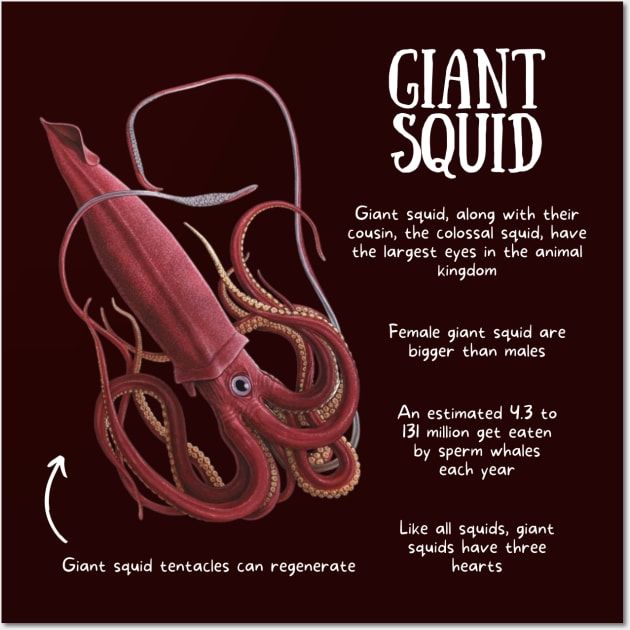
The giant squid is the largest invertebrate predator in the ocean and one of the strangest large animals on Earth. Architeuthis dux lives in the cold dark waters of the deep open ocean, grows to lengths of more than thirteen metres, and wields the biggest eyes of any animal ever measured. For centuries it was known only from rotting carcasses washed up on beaches and from beaks pulled out of sperm whale stomachs.
Not until 2004 did any human see a living giant squid, and the first footage of one swimming freely in its natural home was not recorded until 2012.
This guide is a reference entry for Architeuthis dux covering anatomy, physiology, habitat, feeding, predators, reproduction, conservation status, discovery history, and the Kraken folklore that grew up around the species long before science caught up. Expect specifics - metres, kilograms, depths, and verified records - rather than generalities.
Etymology and Classification
The genus name Architeuthis comes from Greek, combining archi meaning "chief" or "first" with teuthis meaning "squid". The species epithet dux is Latin for "leader" or "commander". The genus was described in 1857 by the Danish zoologist Japetus Steenstrup, who used beaks, stranded specimens, and historical accounts to confirm that a very large squid genuinely existed - something European naturalists had long dismissed as a sailor's fabrication.
Giant squid belong to:
- Kingdom: Animalia
- Phylum: Mollusca
- Class: Cephalopoda
- Order: Teuthida
- Family: Architeuthidae
- Genus: Architeuthis
- Species: Architeuthis dux
Older literature recognised as many as eight different species of giant squid distinguished by geography. Modern genetic work, most notably a 2013 study by Winkelmann and colleagues analysing mitochondrial DNA from 43 specimens worldwide, collapsed all of these into a single globally distributed species: Architeuthis dux.
Genetic diversity across the entire population is remarkably low, suggesting either a recent global expansion from a small ancestral population or widespread mixing of larvae via deep ocean currents.
Giant squid are sometimes confused with the colossal squid, Mesonychoteuthis hamiltoni. The two are not close relatives. The colossal squid is shorter but heavier and more muscular, has swivelling hooks on its tentacles, and lives mainly in Antarctic waters. The giant squid is longer, more slender, equipped with toothed suckers rather than hooks, and globally distributed.
Size and Physical Description
The giant squid's body is built on the standard cephalopod plan taken to extreme proportions. Total length is measured from the tip of the feeding tentacles to the end of the mantle, passing through the arm crown.
Females:
- Total length: up to roughly 13 m
- Mantle length: about 2 m
- Weight: approximately 275 kg at the upper end
- Generally larger than males, as in most squid species
Males:
- Total length: up to roughly 10 m
- Mantle length: about 1.5 to 1.8 m
- Possess a specialised hectocotylus arm used to transfer sperm packets
Anatomical structure:
- Mantle: the muscular cigar-shaped body containing the internal organs, gills, and siphon
- Fins: two triangular fins on the rear of the mantle, used for stability and slow cruising
- Head: contains the brain, two enormous eyes, and the beak
- Eight arms: each lined with double rows of suckers, radiating around the beak
- Two feeding tentacles: much longer than the arms, ending in club-shaped pads covered with toothed suckers
- Beak: a hard, sharp chitinous structure resembling a parrot's bill, used to bite prey apart
Claims of twenty-metre specimens appear regularly in popular literature and historical accounts, but no such animal has ever been rigorously measured. The standard measurement technique - straightening the feeding tentacles to their full extent along a flexible cephalopod body - is highly prone to exaggeration. When specimens are photographed fresh and measured against known references, the upper bound holds at about 13 m for females.
Built for Deep, Dark, Cold Water
Every feature of giant squid biology reflects the challenges of life in the deep mid-water. Temperatures at 300 to 1,000 metres are typically between 4 and 10 degrees Celsius, pressure is enormous, oxygen is limited, and sunlight is effectively absent below about 200 metres.
Blue blood. Giant squid, like octopuses and most cephalopods, circulate blood coloured blue rather than red. The oxygen-binding molecule is hemocyanin, which uses copper instead of the iron found in vertebrate hemoglobin. Copper-based hemocyanin performs better than hemoglobin in cold, low-oxygen water - exactly the conditions giant squid inhabit - even though it is less efficient in warmer surface seas.
Three hearts. Two branchial hearts pump blood through the pair of gills, and a systemic heart circulates newly oxygenated blood to the rest of the body. This triple-pump arrangement compensates for hemocyanin's lower oxygen-carrying capacity compared with hemoglobin and allows the squid to sustain the brief bursts of high effort required to capture prey.
Neutral buoyancy through ammonia. Giant squid tissues, especially the mantle, contain elevated concentrations of ammonium chloride. This compound is less dense than seawater, so the animal effectively fills itself with a fluid that keeps it neutrally buoyant at depth without the muscular effort of constant swimming. Freshly landed specimens famously smell of ammonia and are inedible to humans. Several groups of deep-sea squid and octopuses use the same strategy.
Eyes sized for the dark. The eyes of a giant squid are up to 27 centimetres across - the largest eyes of any animal ever measured. In a 2012 study, Dan-Eric Nilsson and colleagues calculated that giant squid eyes are far larger than would be optimal for ordinary prey detection in any light environment.
They are sized instead to detect the largest, dimmest moving object imaginable in the deep sea: the bioluminescent plankton trails left by a diving sperm whale. Eyes this large can pick out such a diffuse glow at roughly 120 metres, giving the squid enough warning to respond.
Skin and camouflage. Giant squid skin contains chromatophores - pigment cells that can expand or contract - but the range of colour change is more limited than in shallow-water cephalopods. Most of the deep sea is lit only by bioluminescence, so fine patterning is less useful than in coastal waters. The coloration appears to be a muted red or brown that effectively absorbs the blue bioluminescent wavelengths prevalent in the deep.
Hunting and Diet
Giant squid are active predators. The old image of a slow, drifting monster has given way, thanks to 2012 submersible footage, to a picture of a highly responsive animal capable of rapid pursuit when a prey target is identified.
Primary prey:
- Deep-sea fish including orange roughy, hoki, and lanternfish
- Other squid, including smaller giant squid (cannibalism is documented from stomach contents)
- Various mesopelagic crustaceans and gelatinous organisms
Hunting structure:
- The two long feeding tentacles are normally folded up. When a prey item is detected, they strike outward at speed, extending to more than twice the length of the arms, and clamp onto the prey with toothed suckers on the club-shaped tips.
- The prey is drawn inward to the crown of eight arms, which further immobilise it with more suckers.
- The beak bites the prey into manageable pieces, cutting through bones with ease.
- A radula - a rasping tongue-like structure lined with tiny chitinous teeth - shreds the pieces further before swallowing.
Giant squid do not appear to travel in schools. Most encounters with sperm whales, other squid, and research equipment show solitary individuals. Whether this reflects truly asocial ecology or simply very low population densities at depth is unresolved.
Predators and the Sperm Whale Relationship
The most famous biological relationship in the deep sea is the fight between giant squid and sperm whales. Sperm whales (Physeter macrocephalus) are the dominant predator of Architeuthis, diving to more than 2,000 metres and remaining below for over an hour on each hunting excursion. A single sperm whale's stomach may contain hundreds of giant squid beaks, and analyses of whale feeding ecology suggest an average adult consumes several large cephalopods per day.
Evidence of combat:
- Sucker scars. Adult sperm whales, particularly males, routinely carry circular scar patterns on their heads and flanks. Each ring marks where a giant squid sucker - lined with a chitinous toothed ring - locked onto the whale's skin. Some scars reach 10 centimetres in diameter, consistent with the suckers of full-grown Architeuthis.
- Beak accumulations. Accumulated beaks in sperm whale stomachs are the single largest source of giant squid specimens available to science. Beaks resist digestion almost indefinitely, and a single large whale may hold thousands of them from years of hunting.
- Ambergris. The waxy substance ambergris, still harvested for perfumery, is partly a product of sperm whale digestion of indigestible squid beaks.
Other predators include pilot whales, sleeper sharks, and several species of large deep-sea fish. Juvenile giant squid, which start life as a tiny planktonic form only a few millimetres long, are eaten by a wide range of mid-water animals. Survival from hatchling to adult is likely rare, and the giant squid compensates by producing very large numbers of eggs.
Reproduction and Life Cycle
Giant squid reproduction is poorly understood because no one has ever witnessed mating in the wild. Evidence comes from dissected specimens and a few indirect observations.
Reproductive anatomy:
- Males produce sperm packets (spermatophores) up to about 20 cm long.
- Males possess a specialised arm called the hectocotylus used to transfer spermatophores to the female. The hectocotylus itself can be surprisingly long and has been found embedded in the tissues of female specimens, suggesting the male actually injects sperm packets by striking at the female's body.
- Females produce huge numbers of small eggs, probably in the millions, which are released as gelatinous masses into the water column.
Life cycle:
- Hatchlings emerge as planktonic paralarvae only a few millimetres long.
- Growth is rapid; daily rings in the statoliths - small mineralised structures inside the head that act like otoliths in fish - indicate the animal reaches full adult size within about five years.
- Reproduction appears to be terminal, or semelparous. Individuals spawn once and die soon afterwards, as in most squid.
The implication is striking: Architeuthis dux packs the entire life history of a whale-scale animal into the lifespan of a housecat. The metabolic cost of building a 13-metre body in five years requires extraordinarily efficient feeding.
Movement, Range, and Depth
Giant squid inhabit the open water column rather than the sea floor. The majority of specimens, sightings, and encounters occur between 300 and 1,000 metres, with occasional records from shallower water (usually moribund individuals surfacing) and from far deeper water (as attested by sperm whale stomach contents).
| Metric | Value |
|---|---|
| Typical depth range | 300-1,000 m |
| Maximum estimated depth | ~2,000 m (from sperm whale stomachs) |
| Body length (female, max) | ~13 m |
| Mantle length | ~2 m |
| Eye diameter (max) | ~27 cm |
| Lifespan | ~5 years |
The giant squid propels itself by two mechanisms: slow cruising using the triangular fins on the rear of the mantle, and sudden jet propulsion driven by expelling water through the siphon. Jetting is effective for short distances and is probably how the animal escapes predators and strikes at prey. Cruising is slower but far more energy-efficient for long-distance travel.
Distribution is global, spanning the Atlantic, Pacific, and Indian Oceans. Strandings are concentrated around certain stretches of coastline, particularly Japan, New Zealand, Newfoundland, the Azores, Norway, and southern Africa. These hotspots appear to reflect a combination of ocean current patterns that carry weakened animals onto beaches, continental shelf geometry, and the presence of observers who report and preserve specimens.
Discovery and First Footage
The scientific history of the giant squid is short, and much of it runs in parallel with the maritime folklore of northern Europe.
Key milestones:
| Year | Event |
|---|---|
| 1857 | Japetus Steenstrup formally describes the genus Architeuthis based on stranded remains. |
| 1873 | A giant squid is tangled by fishermen in Newfoundland, producing the first good specimen. |
| 1874 | First preserved specimens reach museums in London and Yale. |
| 1887 | A record-length specimen (reported 18 m, disputed) strands in New Zealand. |
| 2004 | Tsunemi Kubodera and Kyoichi Mori photograph the first living giant squid near Japan. |
| 2006 | Japanese researchers capture a live giant squid at the surface on video for the first time. |
| 2012 | Kubodera and collaborators film a giant squid in its natural deep-sea habitat from a submersible. |
| 2019 | A juvenile giant squid is filmed in the Gulf of Mexico by the NOAA-funded Journey into Midnight expedition. |
The 2004 images were obtained by deploying a baited line fitted with a digital camera near a known sperm whale hunting ground off the Ogasawara Islands. The squid struck at the bait and was photographed over several hours, losing one tentacle to the hooks. The 2012 video was captured from a submersible using carefully engineered lighting designed to be invisible to the squid's eyes.
Both breakthroughs were led by Tsunemi Kubodera of the National Museum of Nature and Science in Tokyo, who is the single most important figure in modern giant squid research.
Conservation Status
The IUCN Red List classifies the giant squid as Least Concern. This rating is partly a reflection of genuine abundance - sperm whale feeding behaviour and the frequency of strandings suggest a globally distributed population of significant size - and partly a reflection of how little is known about actual population trends. The species is not targeted by commercial fisheries because it is so rarely caught, and the ammonia-laden flesh is unpalatable.
Potential pressures:
- Sperm whale population recovery. As sperm whale populations slowly recover from historical whaling, predation pressure on giant squid may return to pre-industrial levels.
- Deep-sea fisheries. Trawling for orange roughy, hoki, and similar mid-water fish occasionally catches giant squid as bycatch and may affect both prey availability and individual animals.
- Climate change. Warming and deoxygenation of the deep sea may affect the distribution and productivity of mesopelagic communities, with unpredictable consequences for top predators like Architeuthis.
- Pollution. Persistent organic pollutants accumulate in deep-sea food webs, and although giant squid are not directly studied for contaminants, the short lifespan and high growth rate may buffer them relative to long-lived species.
Because the species is so difficult to study, baseline population numbers are effectively unknown. Conservation attention therefore focuses on the broader mesopelagic ecosystem rather than on Architeuthis specifically.
Giant Squid in Myth and Culture
Long before the giant squid was recognised by science, something very much like it featured in the sea stories of northern Europe. Scandinavian sailors told of the Kraken, a monstrous ocean creature the size of a small island with tangled arms capable of dragging ships beneath the waves.
Bishop Erik Pontoppidan of Bergen, writing in 1752 in his Natural History of Norway, described the Kraken in terms that closely match a dying giant squid at the surface. Homer's Odyssey likely preserves an even older echo of the same animal in the figure of Scylla, the six-headed grasping monster that plucks sailors from passing ships.
Modern popular culture collapses the Kraken and the colossal squid and the giant squid into a single legendary image. Jules Verne's Twenty Thousand Leagues Under the Sea (1870) features a giant squid - or, in the original French, a poulpe - that attacks the Nautilus and kills a crew member. This literary episode drew on real 19th-century reports of giant squid strandings and became a template for every giant cephalopod in fiction since.
The giant squid has become one of the enduring symbols of the deep ocean, a shorthand for how little we know about the largest connected habitat on Earth. It is also an instructive case of how folklore, natural history, and eventual direct observation can converge on the same creature across centuries.
Related Reading
- Deep Sea Creatures: Life in the Eternal Darkness
- Bioluminescence: How Deep-Sea Creatures Create Their Own Light
- Vampire Squid: From the Deep
- Mariana Trench: Creatures That Defy Pressure
References
Sources consulted for this entry include the IUCN Red List assessment for Architeuthis dux, the global mitochondrial DNA study by Winkelmann and colleagues (2013, Proceedings of the Royal Society B), Nilsson and colleagues on giant squid eye optics (2012, Current Biology), the field reports and footage of Tsunemi Kubodera and collaborators at the National Museum of Nature and Science in Tokyo (2005, 2013), NOAA's Journey into Midnight expedition records (2019), and Clyde Roper's long-running giant squid research programme at the Smithsonian Institution.
Historical references include Japetus Steenstrup's 1857 genus description and Erik Pontoppidan's 1752 Natural History of Norway.
Frequently Asked Questions
How big is a giant squid?
Female giant squid (Architeuthis dux) reach up to about 13 metres from the tip of the beak to the end of the feeding tentacles, and males reach roughly 10 metres. The mantle, which is the muscular cigar-shaped body, is only about 2 metres long; almost all of the extreme length comes from the two elongated feeding tentacles.
Body mass is harder to measure because most specimens arrive at scientists in poor condition, but large females can weigh around 275 kg. Historical tall tales of 20-metre squid are unverified - no reliably measured specimen exceeds about 13 metres.
Where does the giant squid live?
Giant squid live in the open ocean at mesopelagic and bathypelagic depths in every major ocean basin except the Arctic and Antarctic. Most specimens and sightings come from depths between 300 and 1,000 metres, though carcasses and stomach remains from sperm whales suggest the species sometimes ventures deeper than 2,000 metres. Hotspots for strandings include Japan, New Zealand, Newfoundland, the Azores, Norway, and the waters off southern Africa.
The giant squid is a pelagic animal of the open water column rather than a bottom-dweller.
What does a giant squid eat?
Giant squid are active predators of the deep sea. Stomach analyses of stranded and trawled specimens show that their diet consists mainly of mid-water fish - such as orange roughy, hoki, and lanternfish - and other squid, including cannibalism of smaller giant squid. They hunt by ambush and by sudden strikes with the two long feeding tentacles, which are tipped with club-shaped pads covered in toothed suckers.
Prey is pulled to the eight shorter arms, bitten apart by the sharp chitinous beak, and shredded further by a tongue-like structure called the radula.
What eats the giant squid?
The dominant predator of the giant squid is the sperm whale (Physeter macrocephalus). Sperm whales dive to over 2,000 metres and carry giant squid remains in their stomachs in enormous quantities - some individuals show thousands of beaks accumulated over a lifetime. Many adult sperm whales also carry circular scars on their heads and flanks left by the toothed suckers of giant squid, hinting at struggles that happen deep beyond human observation.
Other predators include pilot whales, sleeper sharks, and in juvenile stages a variety of large deep-sea fish.
Why does the giant squid have such enormous eyes?
Giant squid eyes reach up to 27 cm across, making them the largest eyes of any known animal - larger even than those of blue whales. Research by Dan-Eric Nilsson and colleagues suggests the eyes are optimised for detecting very large, slow-moving objects at long range in the deep sea rather than small prey up close.
Specifically, the eyes are sized to detect the faint bioluminescent trails produced when a sperm whale disturbs plankton during a hunting dive. An earlier warning of an approaching whale is worth the metabolic cost of giant eyes, even in an environment where there is almost no other light to see by.
When was the first giant squid filmed alive?
Despite being known from stranded carcasses since the 1800s, no one recorded images of a living giant squid until 2004. In that year, Japanese researchers Tsunemi Kubodera and Kyoichi Mori set baited lines with cameras off the Ogasawara Islands and captured the first still photographs of a live Architeuthis dux in the wild.
Video of a live giant squid was not obtained until 2012, when a joint team from Japan’s NHK and the Discovery Channel filmed one from a submersible near the Ogasawara Islands. Before these milestones, almost everything known about the species came from dead specimens washed ashore or caught by trawlers.
How long do giant squid live?
Giant squid are short-lived for such enormous animals. Studies of the statoliths - small mineralised structures inside the head that grow in daily rings similar to tree rings - indicate a lifespan of roughly five years. This means giant squid hatch as tiny planktonic larvae and reach their full 10-13 metre adult size within about half a decade, making them among the fastest-growing large animals on Earth.
As in many squid, reproduction appears to be terminal: individuals spawn once and die soon after.
Is the giant squid the same as the Kraken?
The Kraken of Scandinavian folklore - a monstrous, ship-dragging sea creature reported by Norwegian sailors since at least the 13th century - almost certainly has its origins in real encounters with giant squid.
Historical drawings of the Kraken with tangled tentacles match the body plan of Architeuthis almost exactly, and dying or disoriented giant squid do occasionally surface, where their size and grasping tentacles could easily terrify small wooden boats. The Kraken itself is mythology, but the biological seed of the legend is real.
Modern usage sometimes also invokes the colossal squid (Mesonychoteuthis hamiltoni), a separate Antarctic species that is heavier but slightly shorter than the giant squid.