
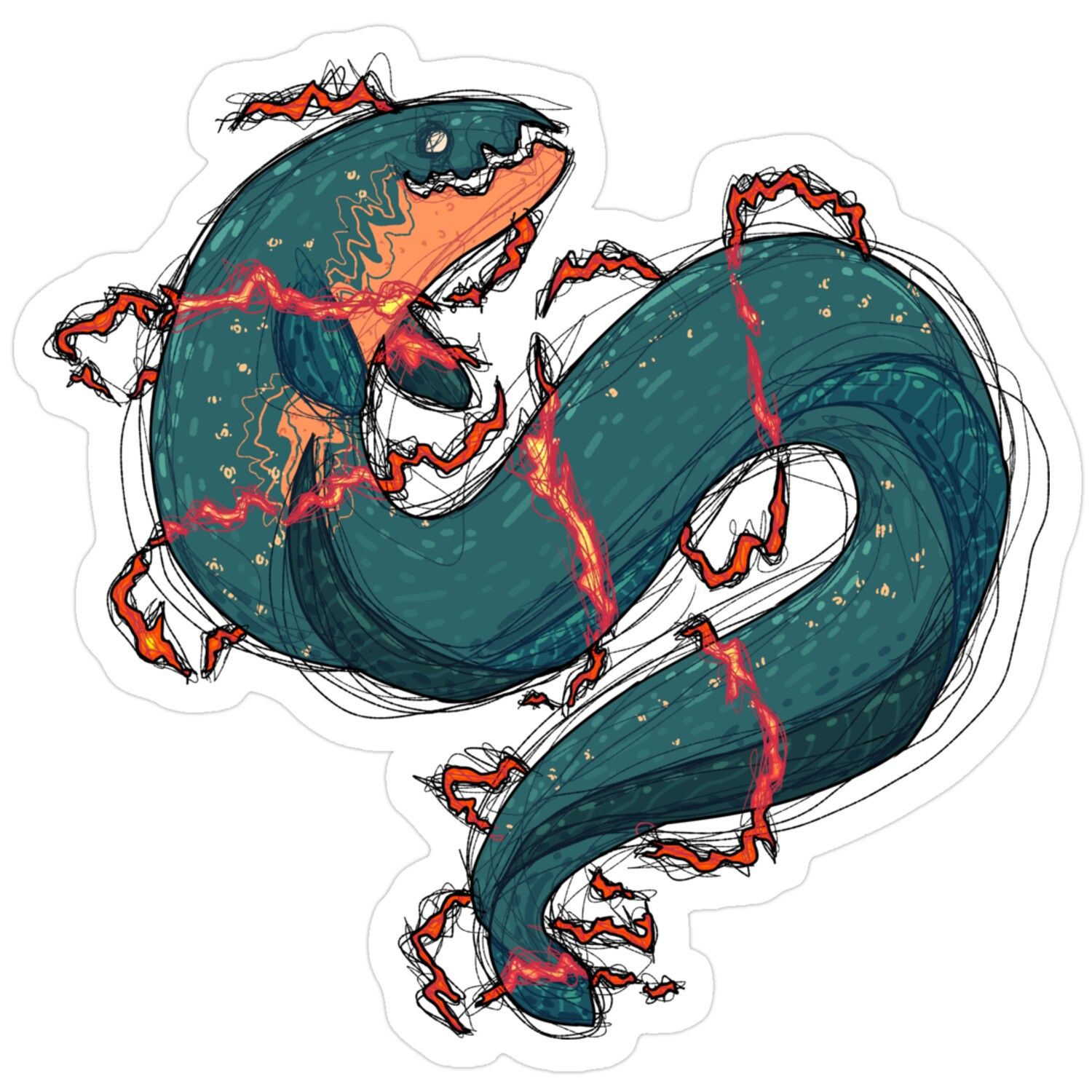
The electric eel is the most electric animal alive. A single adult can deliver a discharge powerful enough to stun a horse, light a bulb, or - in the case of the newly described species Electrophorus voltai - reach 860 volts, the strongest electric shock ever recorded from any known animal. Despite the name, it is not an eel. It is a South American knifefish, an obligate air-breather, a nocturnal predator of turbid Amazon waters, and the biological template for the first true battery.
This guide covers every major aspect of electric eel biology: taxonomy and the 2019 species split, anatomy of the electric organ, hunting and diet, reproduction, air-breathing, habitat, conservation, and the long scientific history that runs from Alexander von Humboldt's 1800 horse-eel fight to modern Nature papers. It is a reference entry, not a summary - expect voltages, hertz values, anatomical percentages, and verified records.
Etymology and Classification
The scientific name Electrophorus electricus was established by the Swedish naturalist Carl Linnaeus in 1766. The genus name combines the Greek elektron (amber, the historical source of static electricity) and -phorus (bearer), translating literally as 'electricity-bearer'. The species epithet simply reinforces the point.
Traditional taxonomy treated the electric eel as a single species worldwide across its range in northern South America. That picture changed in September 2019. A team led by C. David de Santana at the Smithsonian National Museum of Natural History published a study in Nature Communications splitting Electrophorus into three distinct species based on genetic, morphological, and ecological evidence:
- Electrophorus electricus - retained the original name; occupies the Guiana Shield and associated coastal drainages
- Electrophorus voltai - named in honour of Alessandro Volta; inhabits clear-water, highland rivers of the Brazilian Shield; capable of the record 860-volt discharge
- Electrophorus varii - honours the late ichthyologist Richard Vari; lives in lowland, sediment-rich Amazon basin waters
The split was backed by roughly 7% genetic divergence among the three species - more than twice the typical threshold for fish species separation - and clear morphometric differences in skull shape and electric organ structure. Despite the formal split, field biologists and aquarists still commonly use 'electric eel' as a collective name for the whole genus.
Electric eels are not eels. True eels belong to the order Anguilliformes (moray eels, freshwater eels, conger eels). Electric eels belong to the order Gymnotiformes - the Neotropical knifefishes - which contains more than two hundred species, all native to Central and South American fresh water, almost all producing weak electric fields for navigation. Electrophorus is the only genus in the group capable of generating potentially lethal voltages.
The elongated body shape is a case of convergent evolution. A long, flexible body is an effective chassis for manoeuvring through submerged vegetation and for sensing or generating electric fields, so multiple unrelated freshwater fish lineages - true eels, knifefishes, and others - have evolved similar silhouettes independently.
Size and Physical Description
Electric eels are long and cylindrical in cross-section. The body is built around the electric organ rather than around swimming muscles, and their appearance reflects that.
Dimensions:
- Length: typically 1.0-1.8 m, with large specimens reaching 2.0 m
- Weight: up to 20 kg in the largest individuals
- Body cross-section: roughly cylindrical, slightly flattened laterally toward the tail
- Skin: thick, leathery, nearly scaleless; grey-brown to olive dorsally, yellow or orange on the throat and belly
Only the front fifth of the body contains the organs most animals would consider vital. The brain, heart, liver, stomach, gills, and kidneys are all packed into the anterior portion. The remaining 80% is electric organ, tail musculature, and fin - effectively a living battery pack attached to a small conventional fish.
The eel propels itself through the water almost entirely by rippling its long anal fin, which runs from behind the head to the tip of the tail. The fin generates forward or backward thrust depending on the direction of the wave travelling along it, which makes the eel unusually manoeuvrable in tight underwater vegetation. The tail and trunk themselves stay relatively straight to keep the electric field stable and symmetric for sensing purposes. Dorsal and pelvic fins are reduced or absent.
Eyesight is poor. Adults have small eyes that respond mostly to light/dark contrast and offer little detail-resolution capacity. Vision is further degraded by the turbid, tannin-stained water where the species lives. The electric sense compensates completely.
The Electric Organ
The electric organ is the single most distinctive feature of the species and the reason for every other unusual trait in its biology. Three distinct organs operate as a coordinated system:
- Main organ - the largest; generates the high-voltage pulses used for hunting and defence
- Hunter's organ - anterior; contributes to high-voltage output and produces intermediate-voltage pulses
- Sach's organ - posterior; generates the constant low-voltage field used for electrolocation and communication
Each organ is built from stacks of disc-shaped cells called electrocytes. Electrocytes are modified muscle cells that have lost the ability to contract but retain and amplify the ability to polarise their membranes. Each individual electrocyte can generate only about 0.15 volts - a tiny pulse comparable to a single nerve impulse. The power of the system comes from stacking.
Electrical architecture:
| Metric | Value |
|---|---|
| Electrocytes per main organ | roughly 6,000 in series |
| Voltage per electrocyte | roughly 0.15 V |
| Peak voltage (E. electricus) | 600 V (traditional textbook value) |
| Peak voltage (E. voltai, 2019) | 860 V |
| Peak current | roughly 1 A for a brief pulse |
| Peak instantaneous power | approximately 800 W |
| High-voltage pulse duration | 2 milliseconds |
| High-voltage burst rate | up to ~500 Hz |
| Low-voltage electrolocation rate | roughly 10 Hz |
When the eel's nervous system fires simultaneously across the entire stack, sodium ions flood across thousands of electrocyte membranes at once, producing a combined pulse that propagates through the water. The mechanism is, in physical terms, identical to a nerve impulse - just scaled up and synchronised by orders of magnitude.
The eel controls discharge duration, intensity, and pulse rate independently, producing distinct signal patterns for navigation, prey detection, hunting, mating, and defence.
The electric organ is not only an offensive weapon but also a sensory system. The low-voltage field produced by Sach's organ creates a constant electrical bubble around the body. Any object with conductivity different from water - a fish, a rock, a predator, a root - distorts the field. Thousands of electroreceptors along the skin detect the distortion.
The eel essentially 'sees' its surroundings as a three-dimensional electrical landscape, which functions flawlessly in muddy water where vision fails.
Hunting and Diet
Electric eels are carnivores at every stage of life. Adults prey almost exclusively on fish but will opportunistically take amphibians, crustaceans, small reptiles, and any small mammals or birds that fall into the water. Juveniles begin on invertebrates - insect larvae, shrimp, small crustaceans - and switch to fish as they grow.
The eel's hunting sequence is a textbook example of combined offensive-sensory use of an unusual organ:
- Search phase. The eel cruises slowly through submerged vegetation, emitting low-voltage pulses at roughly 10 Hz to build a continuous electric picture of the environment. It is listening, in effect, for asymmetries in the field.
- Detection pulse. When the eel suspects prey is hiding nearby, it emits a brief doublet or triplet of high-voltage pulses. These pulses force involuntary muscle twitches in any fish or amphibian within range. The twitch itself produces detectable water movement and the eel's electroreceptors lock onto the location.
- Tetanic volley. The eel aligns itself with the prey and delivers a sustained high-voltage burst at up to 500 Hz. The rapid firing rate locks the prey's muscles into tetanic paralysis - every muscle contracted simultaneously and unable to release.
- Capture. With the prey immobilised, the eel moves in, swallows it whole, and resumes patrol.
Success rates in laboratory studies exceed 80% once the detection pulse has located prey, which is extraordinarily high among aquatic predators. The system works because it bypasses the normal problem of strike timing - the prey is paralysed at a distance before the eel commits to physical contact.
A 2021 paper in Ecology and Evolution documented coordinated group hunting in a small Brazilian lake in the Amazon basin. Over one hundred eels were observed forming rings around schools of tetras, herding them into shallow water, and then delivering synchronised discharges that left dozens of paralysed fish for easy pickup.
This was the first documented example of group hunting in any electric fish and one of the few documented in any fish species worldwide. Whether it occurs widely or only in unusual local conditions remains under study.
The eels also exhibit a defensive behaviour confirmed experimentally by biologist Kenneth Catania in 2016. When threatened by a large target partly out of water, an electric eel will leap up and press its chin against the target, effectively forming a closed electrical circuit through the target's body rather than dissipating current into the surrounding water.
Catania's experiments used a fake crocodile head fitted with LEDs to visualise the current path, and showed that the delivered voltage through the target could roughly double compared with submerged discharges.
Reproduction and Life Cycle
Electric eels reproduce during the dry season, when water levels drop and fish are concentrated in shrinking pools. Reproduction follows a foam-nest strategy unusual for a fish of this size.
Reproductive timeline:
- Pair formation. Males locate females by electric communication - specific low-voltage signal patterns appear to encode sex and reproductive status.
- Nest building. The male constructs a surface nest of saliva-bonded foam at the edge of a sheltered pool, often among submerged roots.
- Spawning. The female lays up to 17,000 eggs into the nest. Fertilisation occurs externally as the eggs drift into the foam.
- Guarding. The male remains at the nest, aggressively driving off predators for several weeks.
- Hatching. Juveniles emerge at roughly 1-2 cm in length, already equipped with functional (though very weak) electric organs.
- Early growth. First-wave hatchlings grow fastest and often cannibalise later hatchlings during food shortages - siblings are not protected once they begin active feeding.
Sexual maturity is reached at approximately 1-2 years of age and a length of roughly 80 cm. Growth continues throughout life, slowing but not stopping at maturity. The largest wild specimens are presumed to be decades old.
Air-Breathing and Physiology
Electric eels are obligate air-breathers. Unlike typical fish, they cannot extract enough oxygen from water through their gills to survive. The gills are reduced. The roof of the mouth is heavily vascularised and covered in papillae that function as an aerial respiratory surface, effectively a lung.
An adult eel rises to the surface every 5-10 minutes under normal conditions, gulps air, absorbs oxygen directly across the buccal membrane, and descends again. If trapped underwater and unable to reach the surface, an electric eel will drown. This trait is an adaptation to the oxygen-poor swamps and stagnant floodplain pools where the species thrives - dissolved oxygen is often near zero, but atmospheric oxygen is always available a few centimetres above.
Air-breathing also explains a peculiar aspect of the eel's vulnerability. The electrical discharge is costly in oxygen terms, and sustained hunting requires the eel to maintain a tight rhythm of surface breathing. Experimentally, eels forced to discharge repeatedly without access to the surface tire rapidly and reduce discharge voltage. In the wild, the breathing habit makes the species easy to locate and harvest by human fishers, who simply watch the surface of a pool.
Internally, the eel's heart, brain, and digestive tract are compressed into the first fifth of the body. The remainder is electric organ, swimming musculature, and fin. This unusual anatomy is why early dissectors found the species so startling - on first opening, the animal appears to be nearly all tail.
Habitat and Distribution
Electric eels inhabit turbid, slow-moving, warm freshwater environments across northern South America. The preferred habitat type is oxygen-poor swamp, floodplain pond, or slow river backwater, typically with dense submerged vegetation, overhanging roots, and thick silt or leaf-litter bottom.
Geographic distribution by species:
| Species | Region | Water type |
|---|---|---|
| E. electricus | Guiana Shield, coastal Guianas | Mixed, mostly clearer |
| E. voltai | Brazilian Shield uplands | Clear, higher-gradient streams |
| E. varii | Lowland Amazon basin | Turbid, sediment-rich |
The species tolerate wide ranges of temperature (22-28 degrees Celsius is typical), pH (5.5-7.5), and dissolved oxygen. They do not tolerate salinity and are absent from estuarine or coastal-marine habitats. Their distribution corresponds tightly to the Amazon and Orinoco basins, extending into smaller coastal drainages of the Guianas.
Density in optimal habitat is relatively low because each adult requires a substantial hunting range and because they are territorial to some extent. Mass aggregations occur only during the dry season when water contracts into shrinking pools.
Conservation Status
The IUCN Red List classifies Electrophorus electricus as Least Concern, with a stable population across a very large range. Electrophorus voltai and Electrophorus varii are too recently recognised for full separate assessments but are presumed also to be Least Concern at this time based on apparent abundance within their ranges.
Recognised threats:
- Habitat loss. Amazon deforestation, dam construction, and conversion of floodplain forest into agricultural land reduce the swamp and backwater habitat the species depends on.
- Pollution. Mercury from artisanal gold mining and pesticide runoff from agriculture bioaccumulate in predatory fish including electric eels.
- Capture for aquarium trade. Limited but ongoing; less significant than habitat loss.
- Fisheries bycatch. Electric eels are sometimes caught incidentally in subsistence fisheries and are generally killed rather than released, both because of the shock risk and because in some regions they are eaten.
None of these threats have produced measurable range-wide decline so far, which is why the conservation status remains favourable. The 2019 species split has drawn attention to the possibility that E. voltai in particular, with its more restricted range on the Brazilian Shield, could become vulnerable if upland deforestation continues.
Electric Eels and Humans
The electric eel's relationship with humans has been unusually important in the history of science. Indigenous Amazonian peoples have known the species and its shock for thousands of years, using various capture methods including driving the eels into shallows to exhaust their electrical reserves before harvest.
In 1775 Hugh Williamson published a detailed description of electric eel discharges in the Philosophical Transactions of the Royal Society, including the demonstration that the discharge could be transmitted through a wire and felt at a distance. This was pivotal: it suggested that the 'animal electricity' proposed by Luigi Galvani and the 'common electricity' of jars and friction machines were the same physical phenomenon.
Alessandro Volta explicitly cited the stacked structure of the electric eel's electric organ as the design inspiration for the voltaic pile, announced in 1800. The voltaic pile was the first device capable of producing a sustained electric current and is the direct ancestor of every battery in use today. The volt, the SI unit of electric potential, is named after Volta - so the unit name itself traces back, two steps, to the eel.
In 1800 the German naturalist Alexander von Humboldt travelled through Venezuela and witnessed - and participated in - a local eel-fishing method in which horses and mules were driven into the water to draw out the eels' discharges.
Humboldt described the scene with characteristic precision: eels leaping against the horses' bellies, two horses collapsing and drowning, the rest staggering out after several minutes of repeated shocks. The account was treated sceptically for nearly two centuries.
In 2016 Kenneth Catania's laboratory experiments demonstrating that electric eels will leap and press against large above-water threats fundamentally vindicated Humboldt's observation - the leaping behaviour is real and delivers increased shock voltage through the target's body.
Modern laboratories continue to use electric eel electrocytes as a model system for sodium-channel physiology. The mechanism that makes the electric organ work is the same one that makes nerves and muscles work, so studying an eel electrocyte is, in effect, studying a highly amplified version of a neuron.
Related Reading
- Electric Eel: 600-Volt Predator of the Amazon
- Remarkable Fish: The Most Extraordinary Species in the Sea
- Archerfish: The Spitting Hunter
- Pufferfish: The Deadliest Delicacy
References
Relevant peer-reviewed and historical sources consulted for this entry include de Santana et al. (2019) in Nature Communications for the three-species split and the 860-volt record, Catania (2016) in Proceedings of the National Academy of Sciences for the leaping-defence experiments, Bastos et al.
(2021) in Ecology and Evolution for the coordinated group hunting observation, Williamson (1775) in Philosophical Transactions of the Royal Society for early electrical measurements, and Humboldt's Personal Narrative of Travels to the Equinoctial Regions of the New Continent (1800) for the Venezuelan horse-and-eel account. Population and conservation figures reflect the most recent IUCN Red List assessments current as of the species split.
Frequently Asked Questions
How many volts can an electric eel produce?
Historic textbooks cite 600 volts as the standard peak for Electrophorus electricus. In 2019 a team led by C. David de Santana, publishing in Nature Communications, described a newly recognised species, Electrophorus voltai, that discharged up to 860 volts in field measurements from the Brazilian Shield uplands. That is the highest voltage ever recorded from a living animal, higher than a standard household outlet in most countries.
Current during a peak discharge is typically around 1 ampere for a brief pulse, meaning the instantaneous power output can exceed 800 watts. The shock is painful and potentially disabling for a healthy adult human but rarely directly lethal; drowning after involuntary muscle contraction in water is the real danger.
Are electric eels actually eels?
No. Despite the common name and the elongated body shape, electric eels are not eels. True eels belong to the order Anguilliformes. Electric eels belong to the order Gymnotiformes - the Neotropical knifefishes - and are more closely related to catfish and carp than to any true eel.
The resemblance is a case of convergent evolution: an elongated, flexible body is useful for manoeuvring through submerged vegetation and navigating via electric fields, so several unrelated freshwater fish lineages have evolved similar shapes. Electrophorus is the only genus in Gymnotiformes capable of generating lethal-level voltages; its knifefish cousins produce only weak fields for navigation and communication.
Where do electric eels live?
Electric eels inhabit slow-moving freshwater across northern South America, concentrated in the Amazon basin, the Orinoco basin, and the swampy coastal drainages of the Guianas. They prefer turbid floodplain lakes, muddy streams, and oxygen-poor swamps where visual hunting is impossible and electric sensing has a competitive advantage.
The three currently recognised species occupy different zones: E. varii dominates lowland Amazon waters, E. electricus is found through much of the shield edges and coastal drainages, and E. voltai - the high-voltage species - is restricted to clear, highland rivers of the Brazilian Shield. They are strictly freshwater animals and do not tolerate saline conditions.
How does an electric eel produce electricity?
Electric eels generate electricity using three specialised organs - the main organ, Hunter’s organ, and Sach’s organ - that together make up roughly 80% of the body by length. These organs are built from stacks of disc-shaped cells called electrocytes, derived evolutionarily from muscle cells but stripped of contractile function. Each electrocyte contributes about 0.15 volts.
Around 6,000 electrocytes are stacked in series and the stacks are arranged in parallel, combining to produce high voltage and meaningful current. When the nervous system fires simultaneously across the stack, sodium ions rush across the electrocyte membranes and release a pulse of electrical energy into the water. The mechanism is essentially the same as a nerve impulse, massively scaled up and synchronised.
What do electric eels eat?
Electric eels are obligate carnivores. Adults prey mainly on fish, but will also take amphibians, crustaceans, small reptiles, and the occasional small mammal or bird that falls into the water. Juveniles feed on invertebrates and switch to fish as they grow. Hunting typically uses a two-stage electric strategy.
First, the eel emits a brief high-voltage doublet that forces involuntary muscle twitches in any hidden prey nearby - the twitches reveal the prey’s location through the eel’s own electric sense. Second, the eel delivers a sustained high-voltage volley that causes tetanic paralysis, immobilising the prey long enough to swallow it whole.
A 2021 study in Ecology and Evolution documented coordinated group hunting in an Amazonian lake, with over a hundred eels herding tetras before simultaneous discharges - the first such behaviour recorded in any electric fish.
Can an electric eel kill a human?
Direct electrocution fatalities are rare but documented. A single adult discharge of 600-860 volts delivers enough current to stun a grown person, involuntarily contract muscles, and disable the respiratory and skeletal muscles briefly. The typical outcome in a healthy adult is pain, disorientation, and temporary paralysis. The common lethal pathway is not the shock itself but drowning: a person shocked in deep water may be unable to swim and go under.
Repeated discharges from multiple eels, or a discharge to a person with a heart condition or pacemaker, can be directly lethal. Alexander von Humboldt’s 1800 account of Venezuelan horses driven into eel pools describes at least two horses drowning from shock-induced paralysis in shallow water - an event frequently cited but long considered exaggerated until modern experiments confirmed that eels readily leap and press shocks onto above-water threats.
How long do electric eels live?
Documented lifespan in the wild is poorly studied, but captive records indicate 15-22 years as a normal range with some individuals exceeding 22 in aquaria. Sexual maturity is reached around 1-2 years of age at roughly 80 cm in length. Growth continues throughout life, with the largest wild specimens approaching or slightly exceeding 2 metres.
Reproduction takes place in the dry season: males build nests from saliva-bonded foam at the surface, females lay up to 17,000 eggs per spawn, and males guard the nest aggressively. Early juveniles can cannibalise siblings if food is scarce, which is why first-wave hatchlings grow fastest.
Why was the electric eel important to the history of science?
The electric eel played a central role in the early scientific understanding of electricity. In 1775 Hugh Williamson described eel discharges in the Philosophical Transactions of the Royal Society and showed they could travel through wire - proof that animal electricity and man-made electricity were the same phenomenon.
Alessandro Volta used the stacked structure of the eel’s electric organ as direct inspiration for the voltaic pile in 1800, the first device capable of producing a steady electric current and the ancestor of every battery in use today. The volt itself is named for Volta, so the eel sits two steps back in the etymology of electric units.
Later, Michael Faraday, Carl Sachs, and Alexander von Humboldt each conducted experiments on live eels that clarified the link between nerves, muscles, and electricity. Modern neurobiology still uses Electrophorus electrocytes as a model system for sodium-channel physiology.