
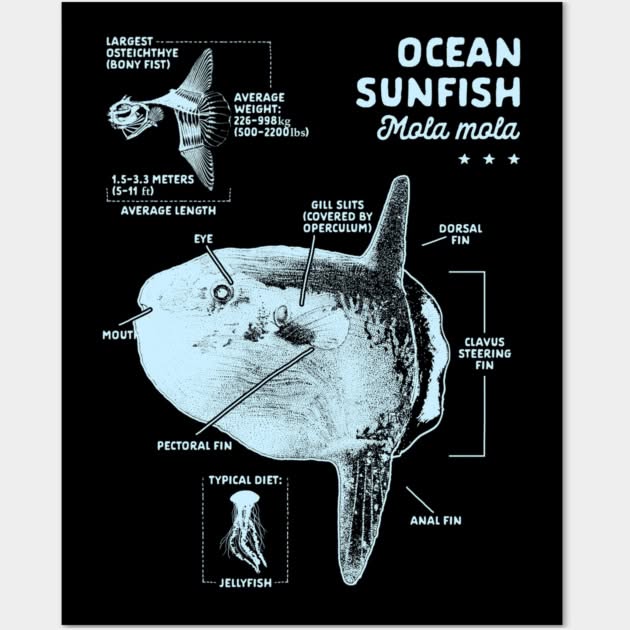
How big is an ocean sunfish?
Ocean sunfish (Mola mola) are the heaviest bony fish on Earth, with recorded specimens weighing over 2,300 kg (5,070 pounds) and reaching 3 meters in length. The largest verified specimen was 2,300 kg. They are considered the largest bony fish species - only sharks (which are cartilaginous fish, not bony fish) are larger.
2 Tons of Jellyfish Eater
A surfer in California paddles through calm morning water. Suddenly, a massive gray disc surfaces near her board, flat, almost circular, over 2 meters across. It doesn't move aggressively. It doesn't dive. It just floats there, apparently basking.
This is an ocean sunfish (Mola mola), the heaviest bony fish on Earth, reaching over 2 tons in weight. Despite their enormous size, they eat almost nothing but jellyfish. They bask at the surface to warm up after deep dives and let seabirds pick off parasites. They're among the strangest-looking and most recognizable ocean giants.
The Animal
Ocean sunfish are unique among fish.
Physical features:
- Length: up to 3 meters
- Weight: up to 2,300 kg (record)
- Body shape: disc-like, oval
- Height: nearly as tall as long
- Fins: enormous dorsal and anal
- Tail: no true tail (clavus instead)
- Color: silvery-gray
Distinctive features:
The clavus:
- Replaces typical fish tail
- Acts as rudder
- Small compared to body
- Unique among fish
Enormous fins:
- Dorsal fin extends high
- Anal fin matches
- Primary propulsion
- Characteristic appearance
Small mouth:
- Relative to body size
- Designed for soft prey
- Specialized feeding
Body structure:
- Dense, heavy tissue
- Thick skin
- Tough scales
- Unusual anatomy
The Heaviest Bony Fish
Ocean sunfish hold world records.
Records:
- Heaviest verified: 2,300 kg (2014, Kamogawa, Japan)
- Longest verified: 4.26 meters
- Height record: 4.9 meters vertical span
- Regular adults: 700-2,000 kg
Compared to other fish:
- Whale shark: 12+ meters but lighter
- Basking shark: similar size
- Marlin: faster but much lighter
- Most "big fish": dwarfed
Size implications:
- Takes years to reach full size
- 3-6 years to sexual maturity
- Continuous growth
- Record sizes indicate exceptional conditions
Growth rate:
- Juveniles grow rapidly
- Reach 2 meters in 10 years
- Maximum size at 15-20+ years
- Variable by diet/environment
Incredible Reproduction
Female ocean sunfish are record egg producers.
Egg production:
- Up to 300 million eggs per spawning
- Most of any vertebrate
- Tiny eggs individually
- Vast number compensates for mortality
Spawning:
- Broadcast spawning
- External fertilization
- Usually in warm surface waters
- Multiple times per lifetime
Success rate:
- Only 1 in millions reaches adulthood
- Extremely high juvenile mortality
- Predation pressure
- Environmental challenges
Scale comparison:
- Elephant: 1 calf every 4-6 years
- Salmon: thousands of eggs
- Ocean sunfish: 300 million
Development:
- Eggs hatch into tiny larvae
- Pass through multiple forms
- Spinose larvae stage (spiny appearance)
- Gradually develop adult form
Surface Basking
Their famous behavior serves multiple purposes.
Why bask:
Thermoregulation:
- Warm up after deep dives
- Cold water at feeding depths
- Need warm surface exposure
- Essential biological function
Parasite removal:
- Seabirds pick parasites
- Gulls and other birds
- Cleaner fish in warmer regions
- Multi-species cooperation
Oxygen exposure:
- Surface gas exchange
- Metabolic benefits
- Recovery from diving
- Body condition maintenance
Body positioning:
During basking:
- Lies on one side (sometimes)
- Keeps one eye visible
- Appears motionless
- Sometimes mistaken for dead
Timing:
- Often early morning
- Warm daylight hours
- After deep feeding dives
- Variable individual patterns
Challenges:
- Vulnerable to boats
- Collisions common
- Predator exposure
- Surface weather conditions
Diet: Mostly Jellyfish
Ocean sunfish specialize in gelatinous prey.
Primary diet:
Jellyfish:
- Moon jellyfish
- Box jellyfish
- Various species
- Multiple sizes
Gelatinous zooplankton:
- Salps
- Comb jellies
- Siphonophores
- Other soft-bodied prey
Occasional supplements:
- Small fish
- Larvae
- Some mollusks
- Various invertebrates
Daily consumption:
- 5-10% body weight daily
- Hundreds of kilograms of jellyfish
- Enormous volumes processed
- Continuous feeding
Digestive adaptations:
- Pharyngeal teeth grind soft prey
- Mucus-covered digestive system
- Handle gelatinous tissue
- Process enormous volumes
Ecological role:
- Jellyfish population control
- Food web connections
- Rarely competes with other predators
- Unique niche
Where They Live
Ocean sunfish occupy global oceans.
Geographic range:
- Atlantic: both hemispheres
- Pacific: both hemispheres
- Indian: widespread
- Mediterranean: common
- Arctic: occasional
Specific areas:
- California current
- Mediterranean waters
- Japanese coastal areas
- Indonesian seas
- Various tropical regions
Depth range:
- Surface to 600+ meters
- Daily vertical migration
- Deep diving for jellyfish
- Surface for warmth/cleaning
Migration:
Individual tracked sunfish:
- Travel thousands of kilometers
- Cross entire ocean basins
- Follow seasonal patterns
- Complex movement
Climate sensitivity:
- Shifting ranges with warming
- Some populations expanding
- Others declining
- Monitoring ongoing
Basking Behavior
Their surface behavior has unique characteristics.
Observation accounts:
- Fishermen encounter regularly
- Tourist sightings common
- Research documentation extensive
- Public fascination
Behavioral patterns:
- Lie on side
- Mostly motionless
- Sometimes swim horizontally at surface
- Exposed to sun and air
Purpose confirmed:
- Thermal recovery
- Parasite removal
- Metabolic benefits
- Social interactions (less clear)
Associated species:
- Gulls, albatrosses pick parasites
- Cleaner fish service them
- Various seabirds
- Mutually beneficial relationships
Timing:
- Often following deep dives
- After major feeding
- During warm calm conditions
- Variable by individual
Deep Diving
Sunfish regularly dive to great depths.
Dive patterns:
- Daily feeding dives
- Deep water feeding
- Cold water exposure
- Extended submergence
Depth records:
- 600+ meters documented
- Some possibly deeper
- Species-specific limits
- Individual variations
Cold adaptation:
Problems at depth:
- Very cold temperatures
- Blood cooling
- Metabolic slowdown
- Need to recover
Return to surface:
- Required for warming
- Thermoregulation
- Basking subsequently
- Biological necessity
Purpose:
- Access to prey
- Escape from predators
- Temperature preferences
- Behavioral choices
Predators and Threats
Ocean sunfish face various dangers.
Natural predators:
Adult sunfish:
- Orca (killer whales) - significant threat
- Great white sharks
- Sea lions
- Occasionally other sharks
Juvenile sunfish:
- Various larger fish
- Seabirds
- Predatory fish
- Extremely vulnerable
Human threats:
Commercial fishing:
- Bycatch in drift nets
- Gillnet entanglement
- Longline fishing
- Substantial mortality
Pollution:
- Plastic ingestion (confused for jellyfish)
- Chemical contamination
- Microplastics
- Ocean debris
Vessel strikes:
- Collisions with boats
- Surface basking vulnerability
- Ship traffic growth
- Direct mortality
Climate change:
- Habitat shifts
- Prey distribution changes
- Ocean condition changes
- Uncertain impacts
Conservation Status
Ocean sunfish conservation concerns.
IUCN status:
Vulnerable (since 2012).
Population trends:
- Declining globally
- Regional variations
- Some recovery attempts
- Continued pressure
Threats summary:
- Commercial fishing bycatch
- Ocean plastic pollution
- Climate change effects
- Vessel strikes
- Habitat degradation
Conservation efforts:
Regulations:
- Gillnet restrictions
- Protected areas
- Bycatch reduction
- Awareness campaigns
Research:
- Population monitoring
- Satellite tracking
- Genetic studies
- Threat assessment
Public awareness:
- Educational programs
- Tourism focus
- Citizen science
- Conservation advocacy
Scientific Research
Ocean sunfish are research subjects.
Research areas:
Evolution:
- How they lost their tails
- Relationship to other fish
- Body plan evolution
- Genetic analysis
Physiology:
- Deep diving adaptations
- Thermoregulation
- Basking behavior
- Digestive system
Behavior:
- Social interactions
- Migration patterns
- Feeding behaviors
- Cognitive capabilities
Conservation:
- Population assessment
- Threat mitigation
- Bycatch reduction
- Climate response
Cultural Significance
Ocean sunfish appear in various cultures.
Japanese culture:
- "Manbo" in Japanese
- Cultural curiosity
- Aquarium displays
- Traditional art
Pacific cultures:
- Native interpretations
- Folklore references
- Cultural significance
- Traditional knowledge
Modern culture:
- Nature documentaries
- Internet memes
- Educational importance
- Tourism appeal
Aquarium presence:
Several major aquariums:
- Monterey Bay: significant display
- Vancouver Aquarium: featured
- Various Japanese aquariums
- Major European aquariums
Encounters with Humans
Sunfish interactions are notable.
Surface encounters:
- Often mistaken for sharks (initial sighting)
- Slow, peaceful behavior
- No aggression toward humans
- Occasionally touched by curious swimmers
Divers:
- Memorable experience
- Safe to observe
- Allow close approach sometimes
- Photography opportunities
Boaters:
- Risk of collision
- Slow swim speed vulnerability
- Boating caution needed
- Regular encounters
Tourism:
- Seasonal sightings
- Organized viewing tours
- Educational opportunities
- Conservation awareness
Strange-Looking Fish
Why they look so unusual.
Evolutionary history:
- Descended from tail-fin fish
- Lost traditional tail
- Developed alternative propulsion
- Adapted to unique niche
Functional design:
- Disc shape for stability
- Large fins for power
- No tail for evolutionary reasons
- Body optimized for their lifestyle
Human perception:
- Unusual body shape surprises
- Different from typical fish
- Culturally memorable
- Inspires curiosity
Different views:
- From front: nearly circular
- From side: disc with fins
- Basking: floating disc
- Diving: unusual swimming
Relatives
Ocean sunfish are part of the Molidae family.
Other mola species:
- Southern sunfish: temperate Southern Hemisphere
- Hoodwinker sunfish: recently described (2017)
- Sharptail mola: Indo-Pacific
- Slender sunfish: smaller species
Each species:
- Unique distribution
- Some morphological differences
- Similar ecology
- Related evolution
Family features:
- All large
- All disc-shaped
- All slow swimmers
- All jellyfish eaters
Tourism Interest
Ocean sunfish support tourism.
Viewing opportunities:
California:
- Monterey Bay tours
- Pacific coast watching
- Summer season peak
Indonesia:
- Diving with sunfish
- Mola season (July-November)
- Bali and surrounding waters
Mediterranean:
- Limited sightings
- Occasional tours
- Italian and Greek waters
Commercial value:
- Tourism revenue
- Research opportunities
- Conservation awareness
- Economic incentive
Why They Matter
Ocean sunfish represent remarkable biology.
Biological significance:
- Heaviest bony fish
- Unique body plan
- Extreme specialization
- Evolutionary curiosity
Ecological role:
- Jellyfish population control
- Food web participant
- Ocean ecosystem indicator
- Nutrient cycling
Scientific value:
- Research subject
- Evolution example
- Behavioral interest
- Conservation focus
Cultural impact:
- Iconic species
- Tourism appeal
- Educational value
- Public fascination
The Gentle Giants
Every ocean sunfish basking at the surface or diving for jellyfish represents evolutionary extremes.
They've become the heaviest bony fish through specialization on jellyfish. They've lost their tails in favor of unique propulsion. They've developed surface basking behavior essential to their physiology. They've achieved global distribution through ocean drift.
They face declining populations. They encounter nets, boats, and plastic pollution. They're vulnerable to climate change. They reproduce with astronomical egg numbers but limited survival.
In oceans worldwide, these giant peaceful disc-shaped fish continue their unique existence, hunting jellyfish at depth, surfacing to warm and clean, producing hundreds of millions of tiny eggs, and being among the most distinctive fish species on Earth.
Their strange appearance, gentle nature, and extreme biology combine to create one of the ocean's most memorable species. They deserve protection, research, and continued wonder. The ocean's heaviest bony fish is also among its strangest and most fascinating.
The Molidae Family in Detail
The family Molidae comprises five recognized extant species distributed across temperate and tropical oceans worldwide. The recent discovery of the hoodwinker sunfish (Mola tecta) in 2017 by New Zealand researcher Marianne Nyegaard demonstrates how much remains to be learned about even the largest living bony fish.
| Species | Scientific Name | Maximum Mass | Maximum Length | Primary Range |
|---|---|---|---|---|
| Ocean sunfish | Mola mola | 2,300 kg | 3.3 m | Temperate and tropical seas worldwide |
| Southern sunfish | Mola alexandrini | 2,744 kg | 3.0 m | Southern temperate oceans |
| Hoodwinker sunfish | Mola tecta | 1,870 kg | 2.4 m | Southern Hemisphere temperate |
| Sharptail mola | Masturus lanceolatus | 2,000 kg | 3.4 m | Tropical Indo-Pacific, Atlantic |
| Slender sunfish | Ranzania laevis | 10 kg | 1.0 m | Global tropics, pelagic |
A 2022 specimen of Mola alexandrini caught off the Azores weighed 2,744 kilograms, making it the heaviest bony fish ever recorded and supplanting a 1996 Mola mola specimen as the record holder. The specimen was documented by researchers at the Atlantic Naturalist Association and published as a new maximum mass record for the Osteichthyes [1].
Genome and Growth Rates
A 2016 genome sequencing project led by the University of Copenhagen revealed that the ocean sunfish has undergone dramatic genome-wide acceleration in genes regulating growth, bone development, and immune function. The sunfish possesses mutations in the AKT1-IGF1 growth pathway that push cells toward continuous expansion, producing the fastest growth rates recorded in any vertebrate.
"Ocean sunfish can gain over 800 kilograms in a single year of favorable feeding. Their genome shows signatures of selection for unchecked growth that look more like a tumor gene expression profile than a normal teleost developmental program." - Dr. Byrappa Venkatesh, Institute of Molecular and Cell Biology, Singapore [2]
Despite this extraordinary growth potential, wild populations face severe mortality at juvenile stages. Only a tiny fraction of the 300 million eggs a single female produces will survive to adulthood - the survival rate to reproductive age is estimated at less than one in one million.
Parasites and Cleaning Behavior
Ocean sunfish host one of the most diverse parasite loads of any marine vertebrate, with over 40 species of parasitic copepods, nematodes, trematodes, and cestodes documented on a single individual. This parasite burden drives much of the sunfish's surface-basking behavior - at the surface, the fish is accessible to seabirds such as the black-footed albatross, which picks parasites from the skin.
In tropical waters, sunfish visit cleaning stations where wrasses and butterflyfish remove external parasites. Underwater photographers have documented mola clients actively queuing at cleaning stations off Bali's Nusa Penida island, where dozens of individuals may gather during the July to November mola season.
"Ocean sunfish at Nusa Penida demonstrate one of the most spectacular examples of fish cleaning mutualism in the world. Individual mola will remain motionless for five to ten minutes while small wrasses work methodically across their flanks, gills, and mouth." - Dr. Tierney Thys, marine biologist and National Geographic Explorer [3]
Thys has led satellite tagging studies tracking ocean sunfish across the Pacific, demonstrating that individuals undertake vertical migrations to depths exceeding 800 meters and may cover thousands of kilometers annually between feeding grounds.
References
- Sawai, E., Yamanoue, Y., Nyegaard, M., & Sakai, Y. (2018). Redescription of the bump-head sunfish Mola alexandrini (Ranzani 1839), senior synonym of Mola ramsayi (Giglioli 1883), with designation of a neotype. Ichthyological Research, 65(1), 142-160. DOI: 10.1007/s10228-017-0603-6
- Pan, H., Yu, H., Ravi, V., et al. (2016). The genome of the largest bony fish, ocean sunfish (Mola mola), provides insights into its fast growth rate. GigaScience, 5(1), s13742-016-0144-3. DOI: 10.1186/s13742-016-0144-3
- Thys, T. M., Ryan, J. P., Dewar, H., et al. (2015). Ecology of the ocean sunfish, Mola mola, in the southern California Current System. Journal of Experimental Marine Biology and Ecology, 471, 64-76. DOI: 10.1016/j.jembe.2015.05.005
- Nyegaard, M., Sawai, E., Gemmell, N., et al. (2018). Hiding in broad daylight: molecular and morphological data reveal a new ocean sunfish species (Tetraodontiformes: Molidae) that has eluded recognition. Zoological Journal of the Linnean Society, 182(3), 631-658. DOI: 10.1093/zoolinnean/zlx040
Related Articles
- Sailfish: The Ocean's Fastest Fish
- Whale Shark: The Largest Fish on Earth
- Basking Shark: The Second-Largest Fish
Frequently Asked Questions
How big is an ocean sunfish?
Ocean sunfish (Mola mola) are the heaviest bony fish on Earth, with recorded specimens weighing over 2,300 kg (5,070 pounds) and reaching 3 meters in length. The largest verified specimen was 2,300 kg. They are considered the largest bony fish species - only sharks (which are cartilaginous fish, not bony fish) are larger.
Ocean sunfish have: massive circular/oval bodies, enormous dorsal and anal fins (the ‘sail’ fins), tiny mouths relative to size, no true tail (clavus acts as rudder), and surprisingly dense tissue. They reach sexual maturity at 3-6 years and can live 15-20+ years. Female sunfish produce the largest number of eggs of any vertebrate - potentially 300 million eggs per spawning.
Individual size varies significantly - some populations produce much larger fish than others. Climate change and ocean conditions affect individual growth. Their enormous size makes them among the most impressive fish in the ocean, though their strange appearance often surprises people encountering them for the first time.
Why do ocean sunfish look so strange?
Ocean sunfish appear strange because they evolved from ancestors that essentially lost their tails, and their bodies represent millions of years of specialized adaptation for their unique lifestyle.
Their unusual features result from: evolutionary loss of tail fin (replaced by rudder-like clavus), enormous dorsal and anal fins serving as primary propulsion, disc-shaped body for gliding efficiency, tiny mouth for filter feeding on soft prey, and unusual body structure optimized for their niche.
They look most strange when: viewed from the front (nearly circular body), seen basking at surface (swimming upright), or in photographs showing scale (much larger than expected). Their body organization makes sense given their diet (mainly jellyfish), slow active lifestyle, low-energy hunting strategy, and surface-basking behavior. Each adaptation serves a purpose.
Their appearance has inspired: cultural references (their ‘looking like a giant fish head’), nicknames (‘the moonfish’), tourist fascination, and scientific interest. Despite being evolutionary adapted, their appearance truly is unusual among fish - they represent a distinctive evolutionary solution to the challenges of pelagic life.
What do ocean sunfish eat?
Ocean sunfish primarily eat jellyfish and other gelatinous zooplankton, consuming massive quantities to meet their energy needs. Their diet includes: jellyfish of all sizes (primary food), salps and other gelatinous animals, small fish occasionally, larval crustaceans, and various plankton. They specialize in prey that larger predators often ignore - jellyfish are low-nutrition, abundant, and widely available.
An adult sunfish consumes: approximately 5-10% of body weight daily, several hundred kilograms of jellyfish per week, and vast amounts over lifetime. Their feeding specialization includes: teeth-lined pharynx for grinding soft prey, small mouth appropriate for soft-bodied prey, mucus-covered digestive system handling gelatinous tissue, and ability to process enormous volumes of low-nutrition food.
This ecological role makes them: important for marine ecosystem balance, control of jellyfish populations, and impact on food web structure. Their specialization allows them to exploit a food source (jellyfish) that most large marine predators can’t effectively use. This niche has supported their evolution into the largest bony fish through a food source no other species dominates.
Where do ocean sunfish live?
Ocean sunfish inhabit all tropical and temperate oceans worldwide, with scattered populations in Arctic waters. Their global distribution includes: Atlantic Ocean (both hemispheres), Pacific Ocean (both hemispheres), Indian Ocean (widespread), Mediterranean Sea, and occasional Arctic appearances. They prefer: warm waters (though tolerate cold), open ocean environments, varying depths, and areas with abundant jellyfish.
They frequently bask at the surface - this is their most famous behavior. Surface basking: warms blood after deep dives, parasite removal by seabirds, oxygenation, and body temperature regulation. Some populations show: seasonal migrations, thermal regulation patterns, prey-following movements, and occasional coastal visits. Research has tracked individuals crossing oceans (15,000+ km annual travel).
They are more common in: California current, Mediterranean Sea, Japanese waters, Indonesian seas, and various tropical oceans. Climate change is affecting their distributions - populations shifting with warming ocean conditions. Their widespread presence makes them one of the most commonly encountered giant fish in the world’s oceans.
Why do ocean sunfish bask at the surface?
Ocean sunfish surface basking serves multiple critical functions in their life, making it one of their most distinctive behaviors. They bask for: body temperature regulation (thermoregulation) after deep dives in cold water, parasite removal by seabirds that pick external parasites, skin exposure to UV light (possibly beneficial), metabolic recovery from active hunting, and ocean current alignment for transport.
Their behavior includes: floating at surface with one side exposed, lying horizontally (appearing dead to uninformed observers), swimming through warm surface waters, and allowing seabirds to clean parasites. Parasite removal is particularly important - sunfish harbor numerous parasites (sometimes 40+ species) that seabirds help remove.
The basking appearance has led to: common misidentification as dead fish, fishing community confusion, cultural references to their behavior, and tourism opportunities. Deep diving is stressful for ocean sunfish - they dive to feed on jellyfish at depth, then must return to warmer surface waters to recover.
Their thermoregulation is crucial because they lack: true thermoregulation abilities of mammals, efficient heat generation, and ability to function in consistently cold water. Surface basking is essential life behavior, not laziness or distress.