
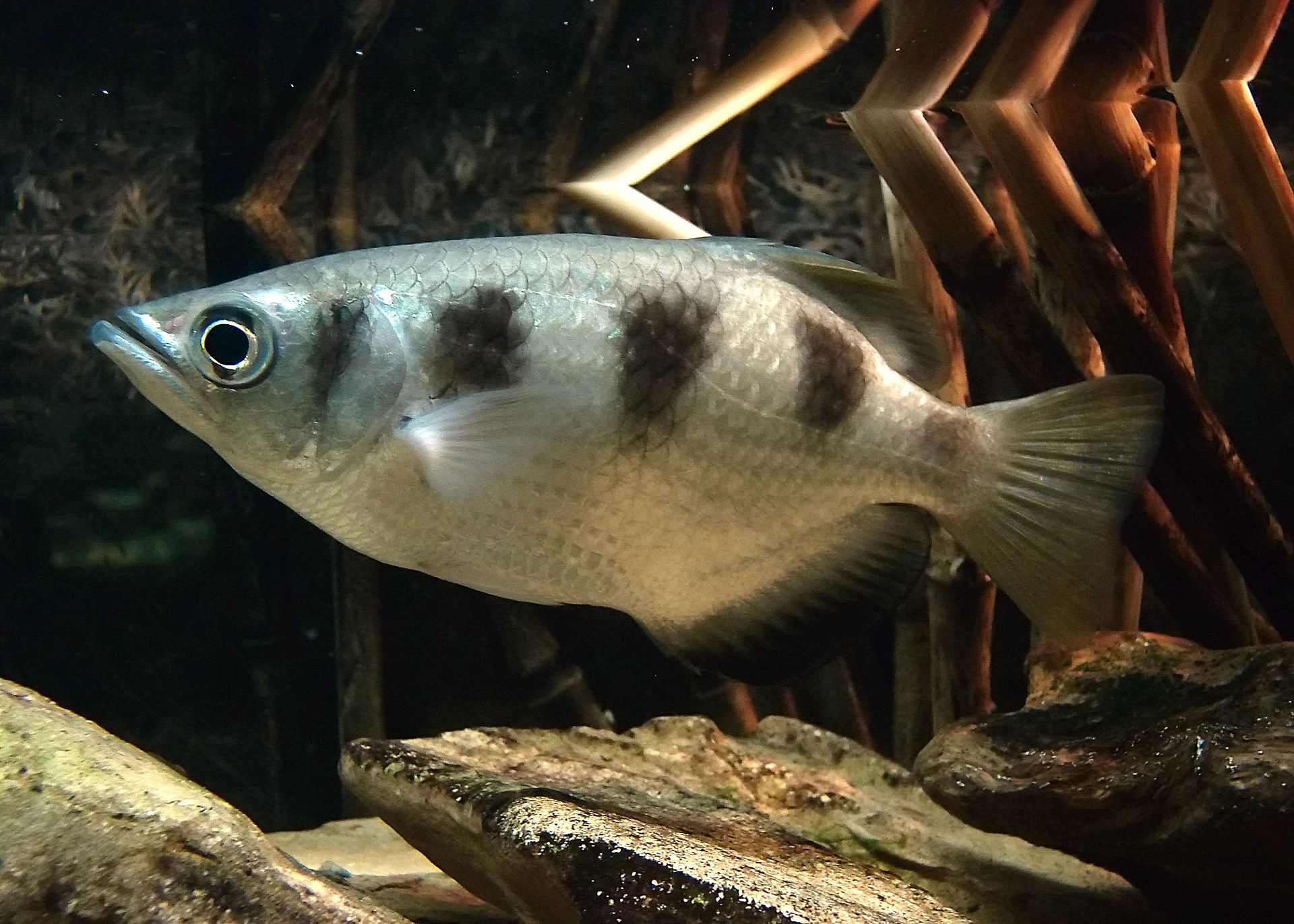
How do archerfish shoot water?
Archerfish (genus Toxotes) produce water jets by pressing their tongue against a specialized groove in the roof of their mouth, then rapidly expelling water by compressing their gills. The process creates a tightly focused stream that maintains coherence over distances of 1-2 meters. Their accuracy is remarkable - they hit targets consistently at these distances.
Shooting Water to Knock Down Prey
In a mangrove swamp in Southeast Asia, a fish eyes a beetle on a leaf hanging 1.5 meters above the water. The fish aligns itself carefully, adjusts for the angle of approach, calculates for light refraction between water and air, then expels a tight jet of water straight up at the beetle.
The water jet hits precisely. The beetle falls into the water. Before the insect can recover or escape, the fish grabs it.
This is an archerfish (genus Toxotes), and this is how they hunt, not by swimming to prey, but by shooting water jets to bring prey to them.
The Animal
Archerfish are distinctive tropical fish.
Physical features:
- Length: 10-40 cm (varies by species)
- Color: silvery with dark stripes
- Body shape: compressed, oval
- Eyes: large, binocular vision
- Mouth: positioned for shooting
- Specialized tongue: grooved
- Gills: powerful for water expulsion
Seven species:
- Banded archerfish: most common
- Largescale archerfish: Asian waters
- Western Australia archerfish: Australian
- Common archerfish: widespread
- Various Indonesian species: multiple
The Water Shooting
Their hunting method is unique.
Mechanism:
Water jet creation:
- Press tongue against mouth groove
- Rapidly expel water through gills
- Tight stream focuses
- Jet accelerates as it travels
Physics:
The jet:
- Maintains coherence over 1-2 meters
- Develops teardrop shape
- Pointed at front, thicker at back
- Hits harder than initial speed
Accuracy:
- Adults: 50-80% success rate
- Experienced fish: very accurate
- Distance variations
- Target size adjustments
Power:
Jets can:
- Reach 6+ body lengths
- Hit insects with force
- Knock prey off leaves
- Target moving insects
Solving Physics Problems
Each shot requires complex calculations.
Problems to solve:
Refraction:
- Light bends at water surface
- Visual perception distorted
- Fish must compensate
- Impressive brain processing
Distance:
- Estimate target range
- Calculate jet trajectory
- Account for energy loss
- Adjust for conditions
Target movement:
- Predict prey position
- Lead moving targets
- Compensate for changes
- Track quickly
Gravity:
- Water jet arcs
- Drop expected
- Aim compensates
- Physics-based targeting
Angle:
- Shoot at steep angle often
- Prey above water
- Must calculate vertically
- Different from horizontal
Hunting Prey
Archerfish target specific insects.
Primary prey:
- Insects on overhanging leaves
- Beetles
- Flies
- Mosquitoes
- Spiders
Secondary prey:
- Small lizards
- Tree frogs occasionally
- Fish eggs
- Various invertebrates
Hunting technique:
- Spot target on vegetation
- Position below
- Calculate aim
- Shoot water jet
- Knock prey into water
- Grab falling prey
- Consume quickly
Speed:
- Entire hunt: seconds
- Quick calculations
- Rapid response
- Efficient predation
Alternative hunts:
- Jump out of water
- Swim to surface insects
- Catch directly
- Multiple techniques
Where They Live
Archerfish inhabit brackish Indo-Pacific waters.
Range:
- India: western populations
- Southeast Asia: major diversity
- Indonesia: multiple species
- Philippines: various regions
- Northern Australia: indigenous species
- Various Pacific islands
Habitat:
- Mangrove forests: primary
- Brackish estuaries: common
- River mouths: abundant
- Coastal shallow water: present
- Some freshwater: certain species
Requirements:
- Overhanging vegetation
- Slow-moving water
- Warm temperatures (22-30°C)
- Brackish salinity
- Dense mangrove habitat
Habitat threats:
- Mangrove destruction
- Coastal development
- Climate change
- Pollution
- Habitat fragmentation
Intelligence
Archerfish demonstrate surprising cognition.
Cognitive abilities:
Learning:
- Practice improves accuracy
- Young learn by watching adults
- Cultural transmission observed
- Individual skill variation
Problem-solving:
- Adjust to new targets
- Handle different prey
- Novel situation responses
- Creative approaches
Memory:
- Remember productive areas
- Recall specific hunting spots
- Individual recognition
- Long-term memory
Recognition:
Research confirmed:
- Archerfish recognize individual human faces
- First fish confirmed for this ability
- Different fish, different patterns
- Extraordinarily sophisticated
Social behavior:
- Small groups typically
- Dominance hierarchies
- Group hunting sometimes
- Social learning
Compared to other fish:
- More intelligent than most
- Comparable to some mammals
- Complex brain processing
- Surprising capabilities
Anatomical Adaptations
Specialized for their lifestyle.
Mouth and tongue:
- Specialized groove
- Tongue channels water
- Creates tight jet
- Unique among fish
Gills:
- Powerful compression
- Water expulsion force
- Controlled by muscles
- Essential for shooting
Eyes:
- Large and forward-facing
- Binocular vision
- Depth perception
- Air-water boundary adaptation
Visual processing:
- Specialized brain regions
- Handle refraction
- Quick calculations
- Advanced for fish
Swimming:
- Can position precisely
- Hold stationary for shots
- Quick pivot capability
- Precise movements
Social Behavior
Archerfish have complex social lives.
Groups:
- Typically 2-10 individuals
- Loose social structures
- Dominance hierarchies
- Territorial behavior
Group hunting:
- Multiple fish near bait
- Take turns shooting
- Some cooperation
- Mostly competitive
Recognition:
- Recognize group members
- Remember specific individuals
- Social relationships
- Complex interactions
Learning:
Young fish:
- Watch adults hunt
- Practice on stationary targets
- Gradually improve
- Cultural behavior
Territorial:
- Defend feeding areas
- Prime hunting spots
- Aggressive against rivals
- Established territories
Famous Research
Archerfish have inspired significant research.
Vision studies:
- How they compensate for refraction
- Binocular vision in water
- Visual processing complexity
- Cognitive abilities
Hunting research:
- Accuracy improvements
- Strategy adaptation
- Individual differences
- Social learning
Face recognition:
- 2016 study confirmed
- Can identify human faces
- First fish verified
- Revolutionary findings
Intelligence comparisons:
- Versus other fish species
- Versus mammals and birds
- Cognitive capability tests
- Learning studies
Aquarium Keeping
Archerfish are popular aquarium fish.
Care requirements:
- Large tank (large species need space)
- Brackish water setup
- Dense vegetation
- Overhead food presentation opportunity
- Species-appropriate care
Feeding:
- Living insects possible
- Shooting water at food
- Manual feeding common
- Proper diet essential
Behavior:
- Active, interesting behavior
- Can be trained partially
- Recognize owners
- Responsive to care
Challenges:
- Salinity requirements
- Water quality sensitive
- Large size of some species
- Specialized diet
Popularity:
- Growing hobbyist interest
- Unique hunting behavior
- Intelligent pets
- Cultural fascination
Cultural Significance
Archerfish have cultural presence.
Southeast Asian cultures:
- Traditional knowledge
- Mangrove ecology connection
- Folklore references
- Cultural awareness
Modern popular culture:
- Documentary subjects
- Educational videos
- Scientific fascination
- Internet viral content
Economic importance:
- Aquarium trade
- Research subject
- Ecotourism (mangrove tours)
- Academic interest
Conservation Status
Archerfish face habitat pressures.
Status:
- Not formally threatened species-wide
- Specific species of concern
- Habitat declining
- Population pressure
Threats:
Habitat loss:
- Mangrove destruction (major)
- Coastal development
- River damming
- Land conversion
Pollution:
- Chemical contamination
- Agricultural runoff
- Plastic pollution
- Habitat degradation
Climate change:
- Sea level rise
- Salinity changes
- Temperature shifts
- Ecosystem changes
Aquarium trade:
- Some overcollection
- Sustainability concerns
- Wild populations affected
- Captive breeding growing
Protection:
- Various national protections
- Mangrove conservation
- Research and monitoring
- Awareness efforts
Why They Matter
Archerfish represent fascinating biology.
Biological uniqueness:
- Water jet hunting
- Physics-problem solving
- Aquatic to aerial prey targeting
- Remarkable precision
Scientific interest:
- Intelligence research
- Vision studies
- Behavior analysis
- Learning studies
Ecological role:
- Insect population control
- Mangrove ecosystem participant
- Biodiversity contribution
- Environmental indicator
Cultural importance:
- Educational value
- Aquarium appeal
- Nature documentary favorites
- Scientific celebrities
The Underwater Archers
Every archerfish in a mangrove system represents evolution solving a specific ecological problem - how to catch prey inaccessible to most fish.
They could have specialized like other fish - swim to prey, chase, catch. Instead, they developed water jet hunting that turns air-dwelling insects into aquatic prey. Their accuracy requires solving complex physics. Their cognition rivals mammals and birds.
In mangrove systems across Southeast Asia and northern Australia, they continue their ancient pattern. They see insects on leaves. They calculate the shot. They fire. They catch. They adjust based on success and failure.
They represent:
- Specialized evolution
- Advanced cognition
- Problem-solving intelligence
- Cultural transmission
- Environmental adaptation
Their mangrove habitats are under pressure. Coastal development continues. Climate change threatens their environment. Their specialized lifestyle depends on specific conditions that are increasingly threatened.
The archerfish hunting in mangroves today continue traditions their ancestors perfected over millions of years. They shoot water with deadly accuracy. They demonstrate intelligence that surprises researchers. They provide glimpses into the cognitive capabilities of fish that most people assume are simple.
They are the sharpshooters of the mangroves - fish that solve physics problems every day they hunt. Their future depends on habitat protection. Their lesson for us is about the hidden intelligence in supposedly simple creatures.
Species Comparison Across the Genus Toxotes
The genus Toxotes contains seven recognized species, each occupying distinct ranges and exhibiting subtle anatomical differences. The banded archerfish (Toxotes jaculatrix) remains the most studied, but the smallscale archerfish (Toxotes microlepis) and the largescale archerfish (Toxotes chatareus) diverge in scale counts, juvenile coloration, and preferred salinity regimes.
| Species | Maximum Length | Range | Preferred Salinity | Notable Trait |
|---|---|---|---|---|
| T. jaculatrix | 30 cm | Indo-Pacific mangroves | Brackish, 15-25 ppt | Type species, most studied |
| T. chatareus | 40 cm | India to northern Australia | Freshwater to brackish | Largest member of genus |
| T. microlepis | 15 cm | Mekong and Chao Phraya basins | Freshwater dominant | Smaller scales, river-dwelling |
| T. blythii | 25 cm | Myanmar and Thailand | Freshwater | Poorly studied, restricted range |
| T. lorentzi | 18 cm | New Guinea lowlands | Freshwater | Lacks vertical bars as adults |
| T. kimberleyensis | 28 cm | Kimberley region, Australia | Freshwater | Endemic, 2004 description |
| T. oligolepis | 20 cm | Molucca Islands | Brackish | Limited distribution |
The diversity of the genus reveals that archerfish have colonized a spectrum of habitats from pure freshwater to fully marine-influenced mangrove systems. Morphological comparisons suggest the ancestral Toxotes lineage evolved in Southeast Asian estuaries during the late Miocene, radiating outward as sea levels fluctuated during the Pliocene and Pleistocene.
The Physics of the Jet in Greater Depth
A 2012 study led by Alberto Vailati and colleagues at the University of Milan, published in PLOS ONE, documented that archerfish actively modulate the velocity of water within their jet so that the slower-leaving portion is caught by the faster trailing portion before the jet breaks apart. This creates a focused, droplet-tipped projectile that strikes with up to six times the muscular power the fish generates at the mouth [1].
"The archerfish is the first known vertebrate to use an external hydrodynamic amplification to multiply the force of its muscles. The physics here is genuinely sophisticated - it is the kind of momentum-concentration trick that engineers spend careers trying to replicate in inkjet and fuel-injection systems." - Alberto Vailati, Department of Physics, University of Milan [1]
Further work by Stefan Schuster at the University of Bayreuth showed that archerfish can hit rapidly falling insects before the prey reaches the water, executing predictive interception turns that compare in accuracy to the targeting behavior of birds of prey. Schuster's laboratory has published a multi-decade research program documenting that these fish perform real-time trajectory prediction rivaling that of primates [2].
Ecological Role in Mangrove Systems
Archerfish occupy a trophic niche few other fish can access - the air-water interface. By pulling insects out of the canopy, they transfer energy from terrestrial food webs into aquatic food webs, a process ecologists call cross-system subsidy. In healthy Indo-Pacific mangroves, archerfish have been documented consuming 6 to 14 insects per day per fish during dry-season peaks, representing a meaningful contribution to mangrove nutrient cycling.
Researchers at James Cook University in Queensland have estimated that a single hectare of intact mangrove forest supporting around 80 adult archerfish will remove roughly 30,000 terrestrial insects per year. This pest control function is significant in coastal agricultural regions, where mangrove systems border rice paddies and coconut plantations.
"Archerfish represent one of the clearest examples of an aquatic predator that exerts meaningful top-down pressure on terrestrial invertebrate communities. Removing their mangrove habitat does not just hurt the fish - it changes the insect communities of the forest above the waterline." - Dr. Ronald Baker, marine ecologist, James Cook University [3]
Captive Breeding and Aquaculture
Captive breeding of archerfish has proven challenging but is slowly advancing. The primary obstacles are reproductive cues - archerfish spawn in response to specific salinity and temperature transitions associated with wet-season flooding, conditions difficult to replicate consistently in aquaculture systems. Successful breeding programs at the Shedd Aquarium in Chicago and Ocean Park Hong Kong have produced F2 generation T. jaculatrix by simulating monsoonal salinity pulses.
Captive-bred individuals are now a small but growing share of the aquarium trade, reducing pressure on wild populations. Public aquariums increasingly feature archerfish feeding demonstrations, with training protocols allowing the fish to shoot at targets on demand during visitor exhibits.
Evolutionary History of Aerial Predation
Archerfish belong to the family Toxotidae, a monophyletic lineage within the order Perciformes. Molecular phylogenetic work has placed Toxotidae as a sister group to the monodactylids, or moony fishes, with which they share estuarine habitat preferences. The common ancestor likely lived 30 to 40 million years ago in the shallow Tethys Sea margins that later became the Indo-Pacific.
| Evolutionary Milestone | Estimated Age | Evidence |
|---|---|---|
| Divergence from monodactylids | 35 million years ago | Molecular clock, mitochondrial DNA |
| Jet-shooting behavior origin | Unknown, pre-radiation | Behavioral homology across genus |
| Genus radiation | 8-12 million years ago | Nuclear marker divergence |
| Arrival in Australia | 3-5 million years ago | Pliocene sea-level drops |
| Species isolation in Kimberley | <2 million years ago | Endemic T. kimberleyensis |
The jet-shooting behavior is shared by all members of the genus, suggesting the behavior predates the species-level radiation. No other fish family independently evolved this strategy, making the archerfish lineage a textbook example of evolutionary novelty leading to ecological specialization.
Sensory Biology and Neural Processing
The archerfish brain devotes a disproportionate share of its tectal volume to processing the visual information needed to shoot accurately through the air-water boundary. Neurophysiological recordings published by the Schuster lab have identified specific tectal neurons that fire in response to predicted trajectory intersections rather than observed target positions, a pattern previously documented only in primates and raptors.
The ability to correct for refraction requires a neural model of Snell's law - the mathematical relationship describing how light bends between media of different optical density. Archerfish appear to have encoded this relationship implicitly through visual experience. Juvenile fish raised without access to aerial targets still develop normal jet-shooting behavior but require considerably more practice to achieve accurate refraction compensation.
"What we see in the archerfish is an encoded understanding of optical physics that the fish never had to consciously derive. It is knowledge built into the wiring through evolutionary and developmental processes. The closest cognitive analogue in mammals is the way primates automatically track parabolic projectile motion." - Dr. Stefan Schuster, University of Bayreuth [2]
Follow-up research has shown archerfish can generalize shooting accuracy from one aerial distance to another without retraining, an ability researchers describe as abstract spatial mapping. This level of generalization was once considered a hallmark of mammalian and avian cognition and is now documented in a teleost fish.
References
- Vailati, A., Zinnato, L., & Cerbino, R. (2012). How archer fish achieve a powerful impact: hydrodynamic instability of a pulsed jet in Toxotes jaculatrix. PLOS ONE, 7(10), e47867. DOI: 10.1371/journal.pone.0047867
- Schuster, S., Wohl, S., Griebsch, M., & Klostermeier, I. (2006). Animal cognition: how archer fish learn to down rapidly moving targets. Current Biology, 16(4), 378-383. DOI: 10.1016/j.cub.2005.12.037
- Baker, R., Sheaves, M., & Johnston, R. (2015). Geographic variation in the trophic ecology of archerfish across the Indo-Pacific. Journal of Fish Biology, 87(2), 417-435. DOI: 10.1111/jfb.12724
- Newport, C., Wallis, G., Reshitnyk, Y., & Siebeck, U. E. (2016). Discrimination of human faces by archerfish (Toxotes chatareus). Scientific Reports, 6, 27523. DOI: 10.1038/srep27523
Related Articles
- Seahorse: The Fish Where Males Give Birth
- Pufferfish: The Deadly Delicacy
- Electric Eel: 600 Volts of Shock
Frequently Asked Questions
How do archerfish shoot water?
Archerfish (genus Toxotes) produce water jets by pressing their tongue against a specialized groove in the roof of their mouth, then rapidly expelling water by compressing their gills. The process creates a tightly focused stream that maintains coherence over distances of 1-2 meters. Their accuracy is remarkable - they hit targets consistently at these distances.
The jet accelerates as it travels, becoming thicker at the back and pointed at the front (teardrop shape), allowing it to hit targets harder than the initial propulsion speed. Their precision requires: compensating for refraction between air and water, judging insect movement, estimating distance accurately, and aiming from an angle. Research has shown they shoot water 6+ times body length, and their shot accuracy exceeds 50% even for novice fish.
Their anatomy has evolved specifically for this hunting technique - the groove in the mouth, specialized tongue, and powerful gill compression all work together to produce the focused water jets. They can adjust jet strength based on target size - stronger shots for bigger insects. This technique is so effective that archerfish can hunt prey that other fish cannot reach.
Where do archerfish live?
Archerfish inhabit brackish water environments in Southeast Asia, northern Australia, and parts of India. Their habitat includes: mangrove swamps (primary habitat), brackish estuaries, shallow coastal waters, mouth of rivers, and some freshwater adjacent areas. They prefer: slow-moving or still water, dense overhanging vegetation (source of insect prey), warm temperatures (22-30°C), and water quality that varies with tides.
Their range includes: southern Asia (India to Indonesia), Philippines, northern Australia, various Pacific islands, and some Indian Ocean locations. They are most abundant in: Asian mangrove forests, Australian tropical estuaries, and Southeast Asian coastal waters. Seven recognized species exist, distributed across this range.
They cannot survive in purely freshwater or fully marine environments - they require the specific brackish conditions where their food source (overhanging insects) is abundant. Climate change and coastal development threaten their habitat. They need overhanging vegetation as their hunting ground, so habitat loss directly impacts their survival. Their specific ecological requirements make them vulnerable to coastal ecosystem changes.
What do archerfish eat?
Archerfish primarily hunt insects and other small invertebrates found on overhanging vegetation above water. Their diet includes: insects (primary prey - beetles, flies, mosquitoes, others), spiders, lizards and small frogs occasionally, some vegetation, and fish eggs occasionally. Their signature hunting involves the water jet technique - shooting water at prey on leaves to knock them into water.
Once prey falls: archerfish can grab it before it sinks or other fish catch it. They also hunt conventionally - swimming to the surface and striking at insects directly. They can also jump out of water to catch higher prey. Their preferred prey size: matches their jet strength, larger prey for adults, smaller for juveniles, and adjusts to available species.
Feeding frequency: multiple times daily typically, opportunistic eaters, adjust to habitat conditions. They are predators of the air-to-water boundary, exploiting an ecological niche few fish target. Their ability to hit stationary targets consistently makes them among the most efficient insect hunters in their ecosystem. Research shows their hunting technique is adaptive - they modify shots based on target characteristics.
How accurate are archerfish shots?
Archerfish are remarkably accurate, with experienced adults hitting over 80% of targets at 1-2 meter distances. Their accuracy involves solving complex physics problems. When shooting, they must compensate for: light refraction (between air and water), distance estimation, target movement, angle of the shot (below prey), and gravity effect on water droplets.
Research on their accuracy has shown: young fish initially inaccurate, improvement with practice, experienced fish extraordinarily accurate, adjustment to different species, and rapid calculation abilities. Their shooting success relies on: specialized visual processing, learning and memory, cognitive flexibility, and rapid calculations.
They can hit targets moving on leaves, bugs in mid-flight (extremely impressive), targets at various distances, and prey of different sizes. Individual archerfish show different accuracies - older, experienced fish hit nearly perfect shots. Social learning occurs - young fish improve by observing adults. Their accuracy places them among the most cognitively sophisticated fish studied.
Research continues to reveal how their brains calculate these shots - involving multiple brain regions and rapid mental processing that surprises researchers familiar with fish cognition.
Are archerfish intelligent?
Yes, archerfish are considered highly intelligent fish, with cognitive abilities that surprise researchers. Their intelligence shows in: learning to aim through practice, adjusting shots for different targets, recognizing individual human handlers, passing cognitive tests, and cultural behaviors passed between fish.
Research has documented them: recognizing individual human faces (the first fish confirmed to do this), passing the mirror self-recognition test (debated), learning by observing other archerfish, remembering specific hunting successes, and adjusting strategies based on prey type.
Their problem-solving includes: figuring out how to hit moving targets, adjusting for different angles, remembering successful techniques, and sharing successful strategies with groups. Their social intelligence includes: dominance hierarchies in groups, cooperative hunting in some cases, recognition of conspecifics, and differential treatment of different individuals. Their brains are proportionally large for fish, with well-developed processing centers.
They demonstrate cognitive abilities that challenge traditional views of fish intelligence. As aquarium pets, they recognize owners, can be trained to perform tricks, and demonstrate personality differences. Their intelligence rivals some small mammals and most birds in specific tasks. Their accurate shooting alone requires cognitive processing far beyond what was thought possible for fish.