
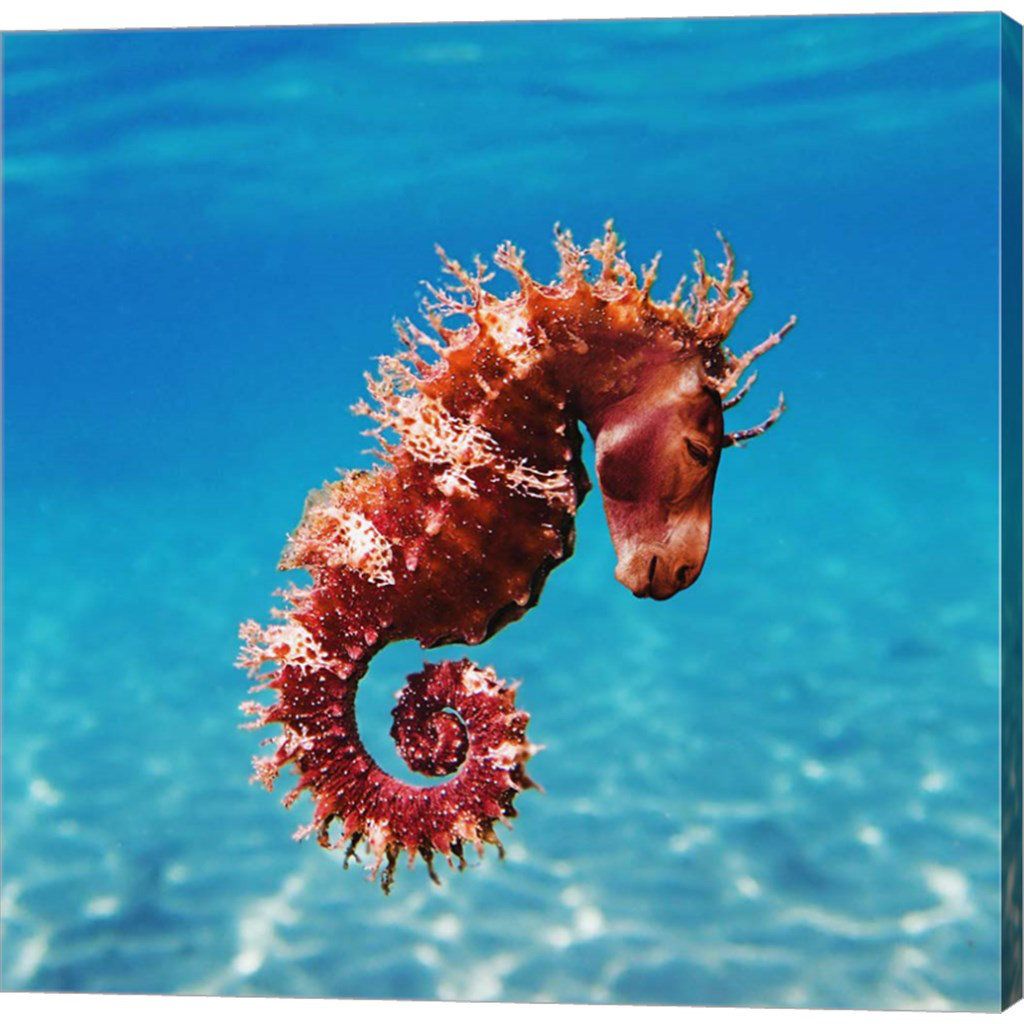
Do male seahorses really give birth?
Yes, male seahorses are the only male animals in the world that undergo true pregnancy and give birth. Female seahorses deposit eggs into a specialized brood pouch on the male's abdomen during mating. The male then fertilizes the eggs internally within the pouch, where they develop for 9-45 days depending on species.
Pregnant Fathers
Every morning at sunrise, a male and female seahorse approach each other. They spiral around together, intertwine their tails, and change colors in coordinated patterns. After several minutes of this dance, they separate and spend the day apart. Tomorrow morning, they will do it again.
Every 9 to 45 days, depending on species, this pair completes a cycle no other animals on Earth share: the female transfers her eggs to a pouch on the male's abdomen. The male internally fertilizes them and carries them through pregnancy. He provides oxygen, nutrients, and osmotic regulation through specialized tissue. Then he goes into labor and gives birth to hundreds or thousands of tiny seahorses.
This is the only true male pregnancy in the animal kingdom. Seahorses are fish that rewrote the biology of reproduction.
The Pouch Pregnancy
The mating sequence:
After extensive courtship, the female deposits 100-2,000 eggs through an ovipositor into a brood pouch on the male's abdomen. This transfer takes seconds.
Fertilization:
The male fertilizes the eggs internally, inside the pouch. Unlike external fertilization used by most fish, seahorse fertilization is internal - though it occurs in a male rather than a female.
Pregnancy:
For 9-45 days (varies by species), the eggs develop inside the male's pouch. During this time:
- Specialized tissue lines the pouch similarly to a mammalian placenta
- The male provides oxygen through tissue gas exchange
- Nutrients are supplied from the male's body
- Osmotic regulation maintains proper salinity for the eggs
- Immune protection shields eggs from pathogens
Birth:
When development is complete, the pouch begins contracting in what researchers call "seahorse labor." The male arches his back, clutches a nearby object, and expels hundreds to thousands of fully-formed baby seahorses over minutes to hours.
Fathers often appear exhausted after birth. They may also be immediately ready for another mating cycle - sometimes mating with the same partner within hours.
Why Male Pregnancy?
Seahorse reproduction evolved under specific selective pressures.
Egg protection:
External egg deposition (typical for most fish) results in high egg mortality. Predators, currents, and environmental stresses kill most eggs before hatching.
Internal pouch protection dramatically increases egg survival. The pouch environment is stable, defended, and nutritionally supported.
Why males and not females:
In most animals, females bear the cost of pregnancy because males invest less. For seahorses, evolutionary pressures shifted this balance. Possible explanations:
- Males may have had ancestral structures (like skin pouches) that were pre-adapted for egg-carrying
- Female body space may be needed for egg production while male bodies were available for pregnancy
- Selection pressures favored splitting reproductive investment between both sexes
Consequences:
Male pregnancy has distinctive consequences for seahorse behavior:
- Males are reproductive limiting factor (eggs must find available pouches)
- Females compete more aggressively for mates
- Courtship is elaborate because both parties invest heavily
- Monogamy is favored because males cannot quickly re-mate
Swimming Upright
Seahorses stand out among fish for swimming in upright posture.
Why vertical:
Seahorse anatomy evolved from horizontal fish ancestors. Over evolutionary time, their body orientation rotated 90 degrees. The reasons probably include:
- Tail-gripping on coral and seagrass works better with vertical orientation
- Upright body looks like seagrass, providing camouflage
- Eye placement for forward-facing vision works better upright
- Ambush hunting is easier from vertical position
Swimming mechanism:
Seahorses swim using:
- Dorsal fin: beats 35 times per second, provides forward propulsion
- Pectoral fins: small fins behind head for steering
- Tail: for gripping and balance, not swimming
Speed:
Seahorses are among the slowest fish in the ocean. The dwarf seahorse moves at just 0.015 km/h - essentially the slowest fish measured.
Maneuverability:
Despite slow speed, seahorses are remarkably maneuverable. They can move in any direction, hover in place, and precisely position themselves for hunting.
Hunting
Seahorses are surprisingly effective predators.
Diet:
- Copepods (small crustaceans)
- Mysid shrimp
- Fish larvae
- Other small crustaceans
Hunting technique:
Seahorses hunt by ambush:
- Anchor tail to stable object
- Match color and shape to surroundings (camouflage)
- Wait motionless for prey to approach
- Strike with explosive suction
The strike:
The suction strike is among the fastest predatory movements in any vertebrate. Key measurements:
- Duration: 6 milliseconds
- Distance: up to 1 cm
- Success rate: up to 90 percent
The snout expands rapidly, creating negative pressure that sucks prey into the mouth. Prey is often captured before it can react.
Feeding requirements:
Seahorses must eat 30-50 prey items daily because they have:
- No stomach (food passes directly through intestines)
- Inefficient digestion
- Small individual prey (must catch many)
- High energy cost from constant hovering
Continuous feeding is essential. Seahorses that stop eating for even a day begin losing significant body condition.
Pair Bonds
Many seahorse species maintain long-term pair bonds.
Morning greetings:
Bonded pairs perform elaborate greeting rituals each morning:
- Approach each other slowly
- Change colors to match each other
- Spiral around one another
- Intertwine tails
- Continue for 5-30 minutes
- Separate for the day's activities
These rituals are thought to strengthen pair bonds and maintain reproductive synchrony.
Monogamy:
Different seahorse species show different levels of monogamy:
Strong monogamy:
- Potbelly seahorse
- Big-belly seahorse
- Lined seahorse
Weaker monogamy:
- Dwarf seahorse
- Some small tropical species
Research has shown that social monogamy (staying together) is more common than genetic monogamy (all offspring from one partner). Some "monogamous" seahorse pairs produce offspring from multiple matings outside the pair bond.
When partners die:
Surviving partners often do not re-pair quickly. Some remain solitary for months or even years before finding new mates. This loyalty is unusual for fish.
Species Diversity
Approximately 46 species of seahorse are known, all belonging to the genus Hippocampus.
Size range:
- Smallest: Satomi's pygmy seahorse at 1.4 cm
- Largest: Pacific seahorse at 35 cm
- Typical: 5-15 cm
Habitats:
- Coral reefs: many tropical species
- Seagrass beds: temperate species
- Mangrove forests: estuarine species
- Open ocean: some pelagic species
Geographic distribution:
Seahorses live in coastal waters worldwide:
- Tropical and subtropical regions (most diversity)
- Temperate coasts
- All oceans except polar waters
Camouflage:
Different species have evolved remarkable camouflage:
- Leafy sea dragon: looks exactly like seaweed
- Weedy sea dragon: similar camouflage
- Pygmy seahorses: look like coral bumps
- Spotted seahorses: match reef textures
Threats and Conservation
Many seahorse species face serious threats.
Traditional medicine:
The largest threat is the traditional medicine trade. Over 20 million seahorses are killed annually for markets in:
- China
- Hong Kong
- Taiwan
- Southeast Asia
- Increasingly in international Chinese diaspora communities
Ground seahorse is used in treatments for various conditions. Modern medicine has not validated any medical benefits.
Aquarium trade:
Millions of live seahorses are captured annually for the aquarium trade. Many species do not survive long in captivity, leading to constant new captures.
Bycatch:
Shrimp trawling operations catch enormous numbers of seahorses as bycatch. Most die from the capture itself or from discarded nets.
Habitat loss:
Coastal development destroys seagrass beds, mangrove forests, and coral reefs - critical seahorse habitats. Climate change adds stress through ocean acidification and coral bleaching.
Protection:
- CITES Appendix II: restricts international trade (since 2004)
- Various national protections
- Marine protected areas in some regions
- Aquaculture development reduces wild capture pressure
Captive breeding:
Several species are now bred in captivity:
- Commercial aquaculture produces seahorses for pet trade
- Reduces pressure on wild populations
- Some programs aim at eventual reintroduction
Evolutionary Position
Seahorses belong to the family Syngnathidae, along with pipefishes and seadragons. The family has been evolutionarily experimenting with alternative reproduction for millions of years.
Within the family:
- Pipefishes: males carry eggs on their bodies or in pouches
- Seadragons: males carry eggs on tails
- Seahorses: most advanced male pregnancy with true pouch
The evolution of male pregnancy within this family shows gradual refinement over evolutionary time:
- External eggs → ancestral fish pattern
- Eggs attached to male body → pipefish pattern
- Partial pouch → advanced pipefish
- Complete brood pouch → seadragons
- Placenta-like pouch with full pregnancy → seahorses
This evolutionary sequence represents one of the more complete transitions documented in any animal lineage.
The Meaning of Male Pregnancy
Seahorses force reconsideration of what "male" and "female" mean biologically.
In most definitions, males produce sperm and females produce eggs and carry pregnancies. Seahorses fit the first part (males produce sperm) but not the second (males also carry pregnancies). Which category "pregnancy" belongs to biologically is revealed to be more flexible than typical examples suggest.
This matters beyond academic curiosity. It illustrates that evolution can rearrange reproductive roles in ways that seem impossible until actual examples are discovered. Sea-level biology does not have to match patterns that seem universal from mammalian perspectives.
Seahorses are also reminders that the ocean still contains creatures whose biology fundamentally differs from land-based expectations. A fish that swims upright, has male pregnancy, forms long-term pair bonds, performs morning dance rituals with its partner, and feeds on 30+ meals per day of plankton - this is not what biology textbooks would predict as "typical" fish behavior. But it is typical seahorse behavior, and it has been going on for millions of years.
Diversity Across the Genus Hippocampus
The genus Hippocampus contains approximately 46 recognized species, though ongoing molecular phylogenetics continues to split and merge taxa as new genetic data emerges. Species range from the pygmy seahorses, some smaller than a human fingernail, to the big-belly seahorse of southern Australia, which can reach 35 centimeters in length. Our research team has compiled a reference table of the most biologically notable species.
| Species | Common Name | Maximum Size | IUCN Status | Range |
|---|---|---|---|---|
| Hippocampus abdominalis | Big-belly seahorse | 35 cm | Least Concern | Australia, New Zealand |
| Hippocampus kuda | Common seahorse | 30 cm | Vulnerable | Indo-Pacific |
| Hippocampus erectus | Lined seahorse | 19 cm | Vulnerable | Western Atlantic |
| Hippocampus hippocampus | Short-snouted | 15 cm | Data Deficient | Mediterranean, E. Atlantic |
| Hippocampus zosterae | Dwarf seahorse | 2.5 cm | Least Concern | Gulf of Mexico, Caribbean |
| Hippocampus bargibanti | Bargibant's pygmy | 2.4 cm | Data Deficient | Indo-Pacific coral reefs |
| Hippocampus denise | Denise's pygmy | 2.4 cm | Data Deficient | Indonesia, Philippines |
| Hippocampus satomiae | Satomi's pygmy | 1.4 cm | Data Deficient | Derawan, Indonesia |
Pygmy seahorses were not recognized as a distinct group until the 1970s, when diver Georges Bargibant discovered H. bargibanti while collecting Muricella gorgonians for a museum exhibit. These fish are so small and perfectly camouflaged against their host corals that they were overlooked for decades of reef research.
The Biology of Male Pregnancy
Seahorse brood pouch physiology has been studied as one of the closest functional parallels to mammalian placental pregnancy found outside the mammalian lineage. A 2015 study by Camilla Whittington and colleagues at the University of Sydney identified more than 3,000 genes upregulated in the male pouch during pregnancy, with significant overlap to mammalian placental gene expression profiles [1].
"The seahorse brood pouch shows that the machinery for providing oxygen, nutrients, and osmoregulatory balance to developing embryos has been independently assembled in fish using many of the same gene networks we see in mammalian pregnancy. This is convergent evolution at the molecular level." - Dr. Camilla Whittington, School of Life and Environmental Sciences, University of Sydney [1]
The pouch tissue thickens during pregnancy, develops increased vascularization, and secretes specialized fluids that regulate embryo salinity and provide nutrients beyond the yolk supply. Hormonal profiles of pregnant males show elevated prolactin and estrogen - hormones typically associated with mammalian pregnancy - indicating that the endocrine machinery of pregnancy has been co-opted from the ancestral vertebrate toolkit.
Trade, Traditional Medicine, and Conservation
The dried seahorse trade for traditional Chinese medicine is estimated by Project Seahorse, based at the University of British Columbia, to consume approximately 20 million individuals annually. Bycatch in shrimp trawling contributes additional mortality, with some studies estimating that bycatch alone kills 37 million seahorses per year globally.
"Seahorses are a genuinely global conservation concern because they are targeted, incidentally captured, and habitat-dependent all at once. The listing of the genus Hippocampus on CITES Appendix II in 2004 was a landmark, but enforcement remains inconsistent across the major trading nations." - Dr. Amanda Vincent, founder of Project Seahorse [2]
Captive-breeding programs now produce several species commercially, reducing wild capture pressure for the aquarium trade but not for the much larger traditional medicine market. The iSeahorse citizen science program coordinates global sighting data that has contributed to IUCN Red List assessments for dozens of species.
Feeding Biology and Prey Capture
Despite their slow-moving, delicate appearance, seahorses are among the most successful ambush predators in the reef environment by capture success rate. A 2013 study by Brad Gemmell and colleagues at the University of Texas used high-speed imaging to document that seahorses capture small crustacean prey with success rates exceeding 90 percent, a figure higher than the success rates of most active-pursuit predatory fish.
The mechanism is their unique head shape. The curved snout allows a seahorse to approach prey from below and slightly behind while producing minimal hydrodynamic disturbance in the water ahead of the strike. At the instant of strike, rapid elevation of the head creates a brief suction-vacuum that draws the prey into the mouth in less than one millisecond. The prey - typically a copepod capable of detecting approaching disturbances in 2 to 3 milliseconds - has insufficient time to escape.
"The seahorse head has been independently evolved into a precision strike weapon. The combination of the curved snout and the rotational strike produces what we call a hydrodynamic silent approach, allowing the predator to essentially materialize within striking range of its prey without triggering the normal copepod escape response." - Dr. Brad Gemmell, University of Texas Marine Science Institute [5]
Seahorses consume between 30 and 50 individual prey items per day as adults, with pregnant males and brooding females showing elevated feeding rates. Because they lack stomachs, food passes rapidly through a simple digestive tract, requiring continuous feeding throughout daylight hours.
References
- Whittington, C. M., Griffith, O. W., Qi, W., et al. (2015). Seahorse brood pouch transcriptome reveals common genes associated with vertebrate pregnancy. Molecular Biology and Evolution, 32(12), 3114-3131. DOI: 10.1093/molbev/msv177
- Vincent, A. C. J., Foster, S. J., & Koldewey, H. J. (2011). Conservation and management of seahorses and other Syngnathidae. Journal of Fish Biology, 78(6), 1681-1724. DOI: 10.1111/j.1095-8649.2011.03003.x
- Lourie, S. A., Pollom, R. A., & Foster, S. J. (2016). A global revision of the seahorses Hippocampus Rafinesque 1810 (Actinopterygii: Syngnathiformes): taxonomy and biogeography with recommendations for further research. Zootaxa, 4146(1), 1-66. DOI: 10.11646/zootaxa.4146.1.1
- Stolting, K. N., & Wilson, A. B. (2007). Male pregnancy in seahorses and pipefish: beyond the mammalian model. BioEssays, 29(9), 884-896. DOI: 10.1002/bies.20626
- Gemmell, B. J., Sheng, J., & Buskey, E. J. (2013). Morphology of seahorse head hydrodynamically aids in capture of evasive prey. Nature Communications, 4, 2840. DOI: 10.1038/ncomms3840
Related Articles
- Weedy Seadragons: The Seahorse's Stranger Cousins
- Coral Reefs: The Rainforests of the Ocean
- Remarkable Fish: The Most Extraordinary Species in the Sea
Frequently Asked Questions
Do male seahorses really give birth?
Yes, male seahorses are the only male animals in the world that undergo true pregnancy and give birth. Female seahorses deposit eggs into a specialized brood pouch on the male’s abdomen during mating. The male then fertilizes the eggs internally within the pouch, where they develop for 9-45 days depending on species.
During this pregnancy, the male provides oxygen, nutrients, and osmotic regulation through specialized tissue lining the pouch - functioning similarly to a mammalian placenta. When the pouch contractions begin (resembling labor in mammals), the male releases 50-2,000+ fully-formed baby seahorses in a dramatic birthing sequence. Despite appearing male, these animals have essentially redefined what pregnancy means in the animal kingdom.
This reproductive strategy evolved to maximize egg survival - the pouch provides much better protection than external egg deposition. After giving birth, the male is often immediately ready for another mating cycle, sometimes within hours.
Why do seahorses swim upright?
Seahorses swim upright because their body plan evolved from ancestral horizontal fish but rotated 90 degrees over evolutionary time. Their upright posture provides several advantages: they can use their coiled tails to anchor to coral, seagrass, and other structures; their forward-facing eyes can independently focus on different objects; and their shape mimics seagrass blades, providing excellent camouflage.
Their swimming is surprisingly slow - the dwarf seahorse is actually the slowest fish in the world, moving at just 0.015 km/h (0.009 mph). They swim using small dorsal fins that beat rapidly (35 times per second) and pectoral fins for steering. Because they swim poorly against currents, they rely on ambush hunting rather than pursuit.
They wait motionless, using their horse-like head to strike at passing prey (copepods and other small crustaceans) with extraordinary speed - their suction-feeding strikes take just 6 milliseconds, among the fastest predatory movements in any vertebrate.
Are seahorses really monogamous?
Many seahorse species are long-term monogamous, with mated pairs staying together for entire breeding seasons or multiple years. Every morning, seahorse pairs perform elaborate greeting dances lasting several minutes - they spiral around each other, change colors, and reinforce their pair bond before separating for the day. This behavior is unusual in fish.
However, not all species are strictly monogamous - some engage in brief or multiple partnerships, and research has shown that genetic monogamy (all offspring from one partner) is less common than social monogamy (staying together while reproducing). Dwarf seahorses tend to be more promiscuous, while larger species like lined seahorses show stronger pair bonds.
The extended parental investment (male pregnancy) favors monogamy because males cannot quickly re-mate with many females like in most animal reproduction. When one partner in a bonded pair dies, survivors often do not re-pair quickly, sometimes waiting months or years to find new mates.
How do seahorses eat?
Seahorses are ambush predators that eat primarily copepods, mysid shrimp, small crustaceans, and fish larvae. They have no teeth and cannot chew - instead, they use explosive suction-feeding. Their elongated snouts act as pipettes that rapidly expand, sucking in water and prey simultaneously. The suction strike takes just 6 milliseconds - among the fastest movements in any vertebrate.
A seahorse must eat 30-50 small prey items per day to maintain its energy balance, consuming approximately one prey item every 10-15 minutes during active daylight hours. They have poor digestion, requiring near-constant feeding. Despite their static appearance, they are remarkably effective hunters - their 90 percent success rate on strikes is among the highest in fish.
They use their camouflage (often matching surrounding seaweed or coral colors exactly) and slow, careful stalking to get within striking range. Their lack of a stomach means food passes through their digestive system quickly, requiring continuous feeding.
Are seahorses endangered?
Many seahorse species are threatened or endangered, with approximately 30 percent of the 46 known species listed as vulnerable or worse. Major threats include the pet trade (millions of seahorses captured annually), use in traditional medicine (over 20 million seahorses killed yearly for Asian markets), accidental catch in shrimp trawling (bycatch), and habitat loss from coastal development and coral reef destruction.
The seahorse trade for traditional medicine is the largest threat - ground seahorse is used in traditional Chinese medicine to treat various conditions despite lacking scientific evidence of medical value. Populations of common species like the spotted seahorse have declined 50 percent since 1990 in some regions. CITES has restricted international trade in seahorses since 2004, but enforcement is difficult.
Captive breeding programs produce some species for the aquarium trade, reducing pressure on wild populations. Conservation efforts focus on protecting seagrass beds and coral reefs where seahorses live, reducing bycatch through fishing gear modifications, and addressing medicinal demand through education and alternative products.